Introduction
Deep learning frameworks are software platforms that help teams build, train, test, and deploy neural network models. In simple words, they provide ready building blocks for tensors, automatic differentiation, GPU acceleration, distributed training, and model optimization so you do not have to write everything from scratch. They matter because modern applications depend on computer vision, speech, recommendation, forecasting, and generative AI, and these models must be trained faster, scaled safely, and shipped reliably. Common use cases include image classification and detection, natural language understanding and text generation, speech recognition, fraud detection, and predictive maintenance. When selecting a framework, evaluate ease of prototyping, performance on GPUs and accelerators, distributed training maturity, model deployment options, debugging experience, ecosystem libraries, community support, stability of releases, interoperability with model formats, and long-term maintainability.
Best for: ML engineers, data scientists, research teams, platform teams, and product teams shipping AI features at scale.
Not ideal for: teams that only need simple statistical models, spreadsheet forecasting, or no-code automation where deep learning is unnecessary.
Key Trends in Deep Learning Frameworks
- Training and serving are converging, with frameworks improving end-to-end deployment readiness.
- Larger models push more focus on memory efficiency, sharding, and mixed-precision training.
- Distributed training is becoming a default requirement, not an advanced feature.
- Hardware diversity is increasing, so portability across GPUs and accelerators matters more.
- Compilation and graph optimization are expanding to improve speed and reduce cost.
- Debugging and observability are improving through better tracing, profiling, and performance tooling.
- Model interchange and portability are getting stronger through standardized formats and runtimes.
- Enterprise expectations are rising for governance, reproducibility, and secure pipelines.
How We Selected These Tools (Methodology)
- Chosen based on adoption across research and production environments.
- Included both training-first frameworks and deployment optimization runtimes.
- Considered maturity of GPU acceleration, distributed training, and performance profiling.
- Evaluated ecosystem depth for vision, NLP, and common model architectures.
- Prioritized tools that scale from laptop prototyping to cluster training.
- Included options that improve inference performance and model portability.
- Balanced general-purpose frameworks with specialist tools for large-model training.
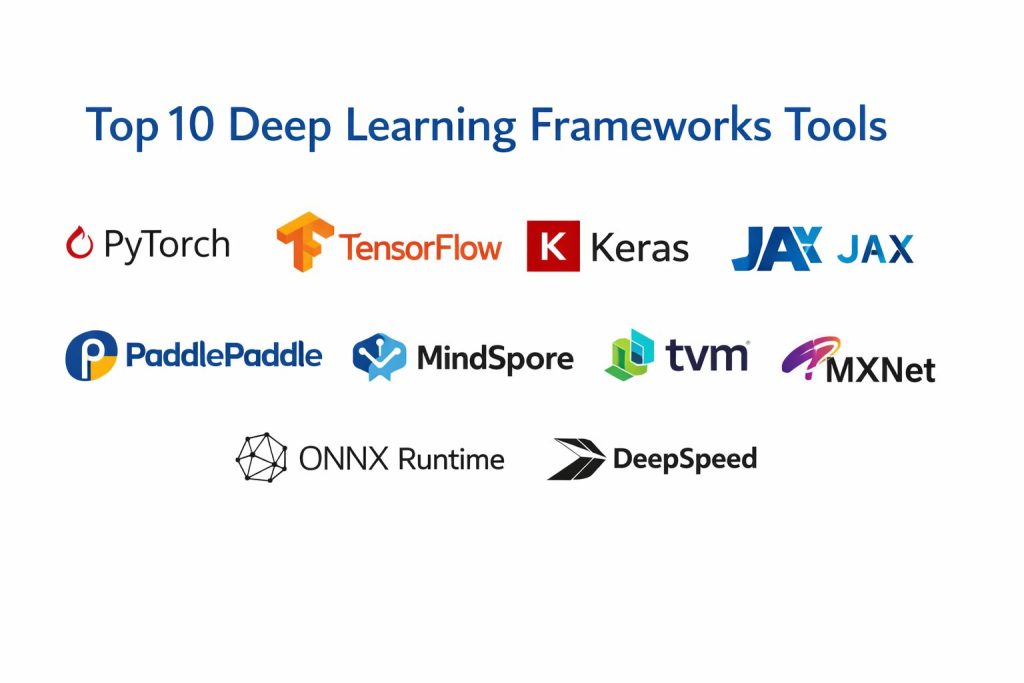
Top 10 Deep Learning Framework Tools
1 — PyTorch
A widely used deep learning framework favored for research flexibility and increasingly strong production tooling. It is popular for building custom model architectures, experimenting quickly, and scaling training when needed.
Key Features
- Dynamic computation for flexible model building
- Automatic differentiation for training neural networks
- Strong GPU acceleration and mixed precision support
- Distributed training tools and ecosystem integrations
- Large ecosystem for vision, NLP, and generative models
Pros
- Developer-friendly for experimentation and iteration
- Huge community and strong library ecosystem
Cons
- Performance tuning can require experience
- Production deployment often benefits from additional tooling
Platforms / Deployment
Windows / macOS / Linux, Self-hosted
Security and Compliance
Not publicly stated
Integrations and Ecosystem
PyTorch is often used with common data pipelines, experiment tracking tools, and deployment layers for serving models in production.
- Strong ecosystem packages for vision and NLP
- Works well with common model export patterns
- Broad tooling support across training workflows
Support and Community
Very strong community, extensive tutorials, and wide industry adoption.
2 — TensorFlow
A mature framework designed for scalable training and production deployment, with broad tooling for model building, optimization, and serving in structured pipelines.
Key Features
- High-performance training and inference capabilities
- Strong support for deployment and serving workflows
- Tools for model optimization and graph execution
- Distributed training support for large workloads
- Broad ecosystem and long-term stability focus
Pros
- Strong production readiness and deployment pathways
- Mature tooling for scaling across infrastructure
Cons
- Some users find prototyping less intuitive than alternatives
- Debugging complex graphs may take extra effort
Platforms / Deployment
Windows / macOS / Linux, Self-hosted
Security and Compliance
Not publicly stated
Integrations and Ecosystem
TensorFlow typically connects well with structured ML pipelines and production workflows that emphasize repeatability.
- Broad ecosystem of related tooling
- Strong deployment and optimization pathways
- Common usage across enterprise ML teams
Support and Community
Large community, extensive documentation, and mature training resources.
3 — Keras
A high-level deep learning API designed to make model development simpler and faster. It is often used when teams want readable code and quick iteration, while still benefiting from underlying performance engines.
Key Features
- High-level model building with clean abstractions
- Rapid prototyping for common neural architectures
- Easy training loops for standard workflows
- Strong support for typical vision and NLP tasks
- Good learning curve for new practitioners
Pros
- Very approachable and fast to develop with
- Helps standardize model code across teams
Cons
- Less flexible for unusual research architectures without customization
- Advanced performance tuning may require deeper framework knowledge
Platforms / Deployment
Windows / macOS / Linux, Self-hosted
Security and Compliance
Not publicly stated
Integrations and Ecosystem
Keras is often used in teams that want a simpler interface while connecting to broader training and deployment workflows.
- Integrates with common training ecosystems
- Works well for standardized model development
- Useful for education and production prototypes
Support and Community
Strong documentation and community usage, especially for learning and rapid development.
4 — JAX
A framework built for high-performance numerical computing with automatic differentiation, often used for research and advanced training techniques. It is valued for speed and composability with modern accelerator support.
Key Features
- Automatic differentiation with functional programming style
- Strong performance through compilation-based execution
- Efficient use of accelerators for large computations
- Suitable for advanced research and custom training methods
- Strong support for parallelism patterns
Pros
- Excellent performance potential for advanced workloads
- Great for research requiring composable transformations
Cons
- Learning curve can be steep for new users
- Production deployment may require extra engineering work
Platforms / Deployment
Windows / macOS / Linux, Self-hosted
Security and Compliance
Not publicly stated
Integrations and Ecosystem
JAX often pairs with specialized libraries for model building and training, and is common in research-driven teams.
- Strong interoperability with research tooling
- Good fit for performance-focused experimentation
- Ecosystem depends on selected libraries
Support and Community
Strong research community and growing production usage.
5 — MXNet
A framework designed for efficiency and scalability, historically used in production environments and supporting multiple language bindings. It can suit teams that need flexibility in integration across systems.
Key Features
- Efficient computation and memory management
- Support for multiple programming language bindings
- Scalable training patterns for large workloads
- Useful for certain legacy or specialized pipelines
- Flexible deployment patterns depending on setup
Pros
- Supports scalable training for many workloads
- Useful when multi-language support is important
Cons
- Mindshare is lower compared to leading frameworks
- Ecosystem momentum may feel slower in some areas
Platforms / Deployment
Windows / macOS / Linux, Self-hosted
Security and Compliance
Not publicly stated
Integrations and Ecosystem
MXNet can integrate into varied production stacks, especially where multi-language needs exist.
- Multi-language integration options
- Supports standard deployment patterns
- Ecosystem depends on organization usage
Support and Community
Community strength varies; enterprise usage often depends on internal expertise.
6 — PaddlePaddle
A framework designed for practical industrial deep learning with strong tooling around training, inference, and model deployment for common use cases.
Key Features
- Practical training workflows for real-world tasks
- Support for scalable training and inference pipelines
- Tools for common domains like vision and language
- Optimization features to improve performance
- Deployment-oriented features depending on setup
Pros
- Useful for teams wanting an end-to-end workflow focus
- Strong for common applied AI workloads
Cons
- Adoption varies significantly by region and ecosystem
- Some integrations may require extra validation
Platforms / Deployment
Windows / macOS / Linux, Self-hosted
Security and Compliance
Not publicly stated
Integrations and Ecosystem
PaddlePaddle often comes with ecosystem components that help move models from training to deployment.
- Domain libraries for applied AI tasks
- Practical deployment and optimization tooling
- Ecosystem maturity varies by use case
Support and Community
Community and documentation strength varies by language and region.
7 — MindSpore
A deep learning framework focusing on performance and deployment across different environments. It can be relevant for teams working with specific hardware ecosystems and optimization needs.
Key Features
- Training and inference workflow support
- Performance optimization patterns for certain deployments
- Tools for common deep learning architectures
- Support for scalable execution patterns
- Focus on deployment readiness in some setups
Pros
- Strong optimization focus for certain environments
- Useful when aligned with supported hardware ecosystems
Cons
- Ecosystem adoption may be uneven across regions
- Some community resources may be less extensive
Platforms / Deployment
Windows / macOS / Linux, Self-hosted
Security and Compliance
Not publicly stated
Integrations and Ecosystem
MindSpore is often used with its ecosystem tools for building, training, and deploying models with performance attention.
- Focus on end-to-end tooling
- Integration patterns depend on deployment environment
- Best fit when hardware alignment exists
Support and Community
Support and community strength varies; documentation coverage depends on region and use case.
8 — Apache TVM
A deep learning compiler stack focused on optimizing models for fast inference across hardware targets. It is often used by platform teams aiming to reduce latency and cost.
Key Features
- Compilation and optimization for inference performance
- Hardware-aware code generation for multiple targets
- Graph-level optimizations and operator tuning
- Useful for deploying models to diverse devices
- Supports performance profiling and tuning workflows
Pros
- Can significantly improve inference performance
- Helpful when deploying across varied hardware
Cons
- Requires engineering expertise to integrate well
- Not a full model training framework by itself
Platforms / Deployment
Windows / macOS / Linux, Self-hosted
Security and Compliance
Not publicly stated
Integrations and Ecosystem
TVM is often integrated into pipelines where models are trained elsewhere and then optimized for serving.
- Works as an optimization layer
- Useful for edge and performance-sensitive serving
- Integration depends on model formats and pipelines
Support and Community
Strong open-source community; best fit for technical platform teams.
9 — ONNX Runtime
A high-performance inference runtime designed to run trained models efficiently across different environments. It is often used to standardize deployment across teams and platforms.
Key Features
- Fast inference execution for exported models
- Support for multiple hardware acceleration backends
- Optimization passes to reduce latency and improve throughput
- Useful for cross-framework deployment portability
- Practical for production inference pipelines
Pros
- Strong for standardizing inference across environments
- Helps improve performance without changing training code
Cons
- Not a training framework
- Model compatibility depends on export quality and operators used
Platforms / Deployment
Windows / macOS / Linux, Self-hosted
Security and Compliance
Not publicly stated
Integrations and Ecosystem
ONNX Runtime is commonly used as a deployment layer after training, improving portability and speed.
- Good fit for production serving systems
- Helps reduce framework lock-in for inference
- Integrates into many deployment stacks
Support and Community
Strong documentation and wide production adoption; community support is solid.
10 — DeepSpeed
A deep learning optimization library focused on enabling efficient training of very large models through memory and parallelism techniques. It is often used when large-scale training becomes a key challenge.
Key Features
- Memory optimization for large model training
- Parallelism strategies for scalable training
- Training efficiency improvements through optimization techniques
- Helps reduce cost and speed up large workloads
- Designed for large language model training patterns
Pros
- Strong for scaling training when models become very large
- Can improve training efficiency and reduce resource needs
Cons
- Not a standalone full framework
- Best results require careful configuration and expertise
Platforms / Deployment
Windows / macOS / Linux, Self-hosted
Security and Compliance
Not publicly stated
Integrations and Ecosystem
DeepSpeed is usually used alongside a main framework to improve training scale and efficiency.
- Often paired with common training frameworks
- Useful for distributed and large-model workloads
- Integration depends on training stack design
Support and Community
Strong community among large-model practitioners; documentation is practical but assumes experience.
Comparison Table
| Tool Name | Best For | Platform(s) Supported | Deployment | Standout Feature | Public Rating |
|---|---|---|---|---|---|
| PyTorch | Research and flexible production training | Windows, macOS, Linux | Self-hosted | Developer-friendly dynamic modeling | N/A |
| TensorFlow | Structured production pipelines | Windows, macOS, Linux | Self-hosted | Production tooling and scalability | N/A |
| Keras | Rapid prototyping and readability | Windows, macOS, Linux | Self-hosted | High-level API simplicity | N/A |
| JAX | High-performance research workflows | Windows, macOS, Linux | Self-hosted | Compilation-based performance | N/A |
| MXNet | Scalable training with multi-language needs | Windows, macOS, Linux | Self-hosted | Multi-language flexibility | N/A |
| PaddlePaddle | Applied industrial deep learning | Windows, macOS, Linux | Self-hosted | End-to-end applied tooling | N/A |
| MindSpore | Performance-focused workflows in aligned environments | Windows, macOS, Linux | Self-hosted | Optimization focus | N/A |
| Apache TVM | Inference optimization and compilation | Windows, macOS, Linux | Self-hosted | Hardware-aware acceleration | N/A |
| ONNX Runtime | Portable high-performance inference | Windows, macOS, Linux | Self-hosted | Standardized inference runtime | N/A |
| DeepSpeed | Large model training efficiency | Windows, macOS, Linux | Self-hosted | Memory and parallelism optimization | N/A |
Evaluation and Scoring of Deep Learning Frameworks
Weights
Core features 25 percent
Ease of use 15 percent
Integrations and ecosystem 15 percent
Security and compliance 10 percent
Performance and reliability 10 percent
Support and community 10 percent
Price and value 15 percent
| Tool Name | Core | Ease | Integrations | Security | Performance | Support | Value | Weighted Total |
|---|---|---|---|---|---|---|---|---|
| PyTorch | 9.5 | 8.5 | 9.0 | 6.0 | 9.0 | 9.0 | 9.0 | 8.93 |
| TensorFlow | 9.0 | 7.5 | 9.0 | 6.0 | 9.0 | 8.5 | 8.0 | 8.35 |
| Keras | 7.5 | 9.0 | 8.0 | 5.5 | 7.5 | 8.0 | 9.0 | 7.95 |
| JAX | 8.5 | 6.5 | 7.5 | 5.5 | 9.0 | 7.5 | 8.5 | 7.85 |
| MXNet | 7.0 | 6.5 | 6.5 | 5.5 | 7.5 | 6.5 | 7.0 | 6.73 |
| PaddlePaddle | 7.5 | 7.0 | 7.0 | 5.5 | 7.5 | 7.0 | 7.5 | 7.15 |
| MindSpore | 7.5 | 6.5 | 6.5 | 5.5 | 7.5 | 6.5 | 7.5 | 6.95 |
| Apache TVM | 7.5 | 5.5 | 7.5 | 5.5 | 9.0 | 7.0 | 8.0 | 7.33 |
| ONNX Runtime | 7.0 | 7.0 | 8.5 | 5.5 | 9.0 | 7.5 | 9.0 | 7.78 |
| DeepSpeed | 7.5 | 5.5 | 7.0 | 5.5 | 9.0 | 7.0 | 8.5 | 7.38 |
How to interpret the scores
These scores are comparative and help you shortlist, not declare a universal winner. Some tools are full frameworks, while others are optimization layers, so compare them based on your actual goal. If you need research flexibility, prioritize core and ease. If you need enterprise deployment, prioritize integrations, performance, and reliability. Use the table to shortlist options, then validate by running a pilot on your own datasets and infrastructure.
Which Deep Learning Framework Tool Is Right for You
Solo or Freelancer
PyTorch is often the easiest to learn while still being powerful for real projects, especially for modern model work. Keras is also a strong option when you want a simpler interface and faster prototypes. If you mainly do inference work, ONNX Runtime can help you ship lightweight solutions.
SMB
Small teams often want fast iteration and stable delivery. PyTorch fits well when you iterate quickly and adopt modern libraries. TensorFlow can be strong when you need a structured production pipeline. ONNX Runtime is useful when deployment portability matters across different environments.
Mid-Market
At this stage, scaling, repeatability, and integration matter more. TensorFlow and PyTorch can both work, but the decision often depends on team familiarity and existing pipelines. If you want performance and compilation benefits, JAX can be valuable for research-driven teams. Apache TVM and ONNX Runtime become more relevant when serving cost and latency become critical.
Enterprise
Enterprises typically need consistency, governance practices, and scalability. TensorFlow is often chosen for production stability, while PyTorch remains strong due to broad adoption and talent availability. For large model training, DeepSpeed can reduce training cost and improve efficiency. For inference standardization, ONNX Runtime can reduce framework lock-in and improve portability.
Budget vs Premium
If budget is tight, focus on open frameworks and minimize infrastructure waste through profiling and efficiency. If premium performance is required, invest in optimization layers like Apache TVM and runtime standardization like ONNX Runtime. For large training workloads, DeepSpeed helps control cost by improving memory use.
Feature Depth vs Ease of Use
Keras tends to feel simpler for many users, while PyTorch offers a friendly balance of usability and power. TensorFlow can be very strong but may feel more structured. JAX provides strong performance but can be harder for beginners. Pick based on your team’s comfort level and the complexity of your models.
Integrations and Scalability
TensorFlow and PyTorch offer broad ecosystem coverage. ONNX Runtime helps portability for inference across environments. Apache TVM helps when you need maximum inference performance on varied hardware. DeepSpeed is a strong add-on when distributed training is a core requirement.
Security and Compliance Needs
Many security controls live in your ML platform rather than the framework itself. Focus on controlled access to datasets, secure secrets management for training jobs, reproducible builds, and audit-friendly deployment pipelines. If public compliance details are unclear, treat them as not publicly stated and validate through internal security reviews.
Frequently Asked Questions
1. Which framework is easiest for beginners
Keras is often considered easier for fast learning and readable model code. PyTorch is also beginner-friendly while still being used in advanced work.
2. Which framework is best for production deployment
TensorFlow is widely used in structured production setups, and PyTorch is also common in production with the right deployment stack. ONNX Runtime can improve inference portability and speed.
3. What is the difference between a framework and a runtime
A framework is mainly used to build and train models. A runtime focuses on running trained models efficiently in production environments.
4. When should I use JAX
Use JAX when you need performance-focused research workflows, advanced transformations, or compilation-based speed improvements. It is best when your team is comfortable with functional style patterns.
5. Do I need DeepSpeed for normal projects
Not usually. DeepSpeed becomes valuable when training large models and you need memory optimization and parallelism strategies to make training feasible.
6. How do I reduce inference cost and latency
Start with profiling and batching strategies, then consider exporting models to ONNX Runtime. For deeper performance tuning across hardware, Apache TVM can help.
7. Can I switch frameworks later
Yes, but it depends on your model architecture, custom operators, and deployment approach. Using portable model formats and clean training code makes switching easier.
8. What are common mistakes teams make
Common mistakes include ignoring data pipelines, skipping profiling, and over-optimizing too early. Another mistake is choosing tools without piloting on real datasets and hardware.
9. How important is ecosystem and community
Very important, because you will rely on libraries, examples, bug fixes, and best practices. A strong community also improves hiring and onboarding speed.
10. What is a practical pilot plan to choose a framework
Pick two frameworks, train the same model on the same dataset, measure training speed, stability, and ease of debugging. Then test inference speed in a realistic deployment setting.
Conclusion
Deep learning frameworks and runtimes are not one-size-fits-all choices. If you want the most flexible and developer-friendly training experience with broad community support, PyTorch is a strong default. If you prioritize structured production workflows and mature scaling patterns, TensorFlow remains a practical choice. If you want simpler model building and fast prototypes, Keras can reduce friction, especially for standard architectures. For performance-focused research, JAX can be compelling, but it often needs a more experienced team. When deployment speed and portability matter, ONNX Runtime helps standardize inference, and Apache TVM can improve performance on diverse hardware. For large model training, DeepSpeed can reduce cost and expand what is feasible. The best next step is to shortlist two or three options, run a pilot on real data, validate your deployment path, and confirm performance under expected workloads.