Introduction
Deception technology tools help security teams detect attackers by placing realistic decoys, lures, and traps inside the network. The idea is simple: real users should never touch these assets, so any interaction becomes a high-signal alert. This reduces noise compared to many traditional detections and helps you spot stealthy intrusions earlier, especially when attackers use valid credentials or move slowly.
Common use cases include detecting lateral movement, catching credential theft attempts, identifying ransomware staging, monitoring privileged account abuse, and validating whether suspicious activity is a true attack. When choosing a tool, evaluate decoy realism, coverage across endpoints and networks, ease of deployment, alert fidelity, integration with SIEM and SOAR, support for identity lures, scalability for large environments, ability to run quietly without disruption, reporting and investigation workflow, and total cost and operational effort.
Best for: SOC teams, blue teams, incident responders, and IT security leaders who want high-confidence detection and faster investigation.
Not ideal for: very small environments with limited monitoring maturity, or teams that cannot maintain asset hygiene and integration workflows.
Key Trends in Deception Technology
- Higher focus on identity-based lures to catch credential misuse and privilege escalation early
- Better decoy realism that mimics production services, shares, and workflows
- Tighter integration with SOAR for automated containment and faster triage
- More endpoint and cloud-adjacent deception patterns to extend coverage beyond the data center
- Emphasis on low-noise detection signals that help reduce alert fatigue
- Improved investigation context, such as attacker path reconstruction and intent mapping
- More flexible deployment options, including segmented environments and distributed sites
- Stronger expectations around access controls, auditability, and safe operations in enterprise environments
How We Selected These Tools (Methodology)
- Included widely recognized deception platforms plus credible open-source options
- Looked for practical coverage across network deception, identity lures, and endpoint-adjacent scenarios
- Considered alert signal quality and how easy it is to confirm true attacker interaction
- Evaluated how well tools fit into SOC workflows through SIEM and SOAR integrations
- Balanced enterprise-grade platforms with lighter tools suited for rapid rollout
- Considered operational effort, deployment complexity, and maintainability over time
- Favored tools with strong ecosystem support, extensibility, and production usage patterns
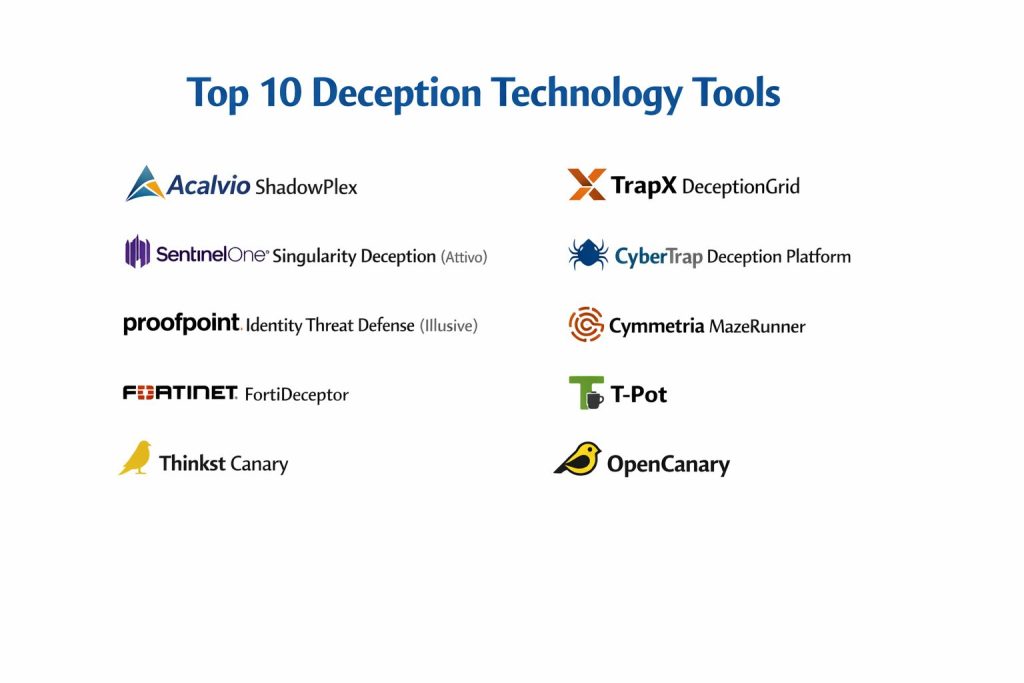
Top 10 Deception Technology Tools
1 — Acalvio ShadowPlex
A deception platform designed to deploy realistic decoys and lures at scale, producing high-confidence detections with investigation context.
Key Features
- Decoys and lures across common enterprise assets and services
- Centralized orchestration for large environments
- High-signal alerting based on decoy interaction
- Flexible deployment patterns for segmented networks
- Investigation context to support faster triage
Pros
- Strong signal quality when deception assets are touched
- Scales well when deployed with clear standards
Cons
- Requires thoughtful placement strategy for best coverage
- Operational success depends on integration and tuning
Platforms / Deployment
Varies / N/A
Security and Compliance
Not publicly stated
Integrations and Ecosystem
Works best when connected to SOC workflows so deception alerts become actionable incidents.
- SIEM integration patterns
- SOAR playbook triggers
- Ticketing and incident workflow alignment
Support and Community
Vendor support model varies; community footprint is smaller than open-source tools.
2 — SentinelOne Singularity Deception (Attivo)
A deception-focused capability positioned around identity and lateral movement detection, designed to surface stealthy intrusion behavior with high confidence.
Key Features
- Identity lures and decoy-based detection for credential misuse
- Detection patterns aimed at lateral movement activity
- Coverage for common attacker discovery and enumeration behavior
- Central management for deception assets and alerts
- Investigation-friendly alert context
Pros
- Helpful for catching credential-driven intrusions early
- Fits well when identity threat scenarios are a priority
Cons
- Effectiveness depends on correct lure placement and policy hygiene
- Some capabilities may vary by edition and deployment design
Platforms / Deployment
Varies / N/A
Security and Compliance
Not publicly stated
Integrations and Ecosystem
Designed to feed high-confidence alerts into existing monitoring and response workflows.
- SIEM ingestion patterns
- SOAR automation triggers
- Integration depends on environment and tooling standards
Support and Community
Vendor support tiers vary; adoption is strongest in environments focused on identity threat detection.
3 — Proofpoint Identity Threat Defense (Illusive)
A deception-oriented approach focused on identity and attacker movement, aiming to detect and disrupt credential-based intrusion paths.
Key Features
- Identity-focused lures to detect credential misuse
- Deception signals aligned to attacker movement patterns
- Alert context for investigation and response decisions
- Coverage for common privilege escalation paths
- Central control for lure deployment strategy
Pros
- Strong fit for identity-centric threat models
- Useful for improving confidence in suspicious identity activity
Cons
- Requires identity and access hygiene to minimize blind spots
- Some details vary by deployment model and environment
Platforms / Deployment
Varies / N/A
Security and Compliance
Not publicly stated
Integrations and Ecosystem
Most valuable when paired with monitoring, incident workflows, and response automation.
- SIEM integration patterns
- SOAR playbooks for containment actions
- Works best with clear identity governance standards
Support and Community
Support approach varies; community discussions are more limited than mainstream EDR tools.
4 — Fortinet FortiDeceptor
A deception tool designed to deploy decoys and traps within enterprise networks, often considered in environments already aligned to a broader security stack.
Key Features
- Decoy services and assets to lure attackers
- High-confidence alerts based on trap interaction
- Centralized deployment and management
- Supports common enterprise network deception scenarios
- Investigation context to reduce time-to-triage
Pros
- Useful for high-signal detection in internal networks
- Can fit well in environments standardizing on a single security ecosystem
Cons
- Coverage depth can vary depending on deployment design
- Best outcomes require clear placement and monitoring strategy
Platforms / Deployment
Varies / N/A
Security and Compliance
Not publicly stated
Integrations and Ecosystem
Deception alerts gain value when connected to response workflows and incident tooling.
- SIEM ingestion approaches
- SOAR integration possibilities
- Broader ecosystem fit depends on existing tools
Support and Community
Vendor support tiers vary; community presence depends on customer base and region.
5 — Thinkst Canary
A lightweight deception approach centered on deploying “canaries” that trigger high-signal alerts when touched, often favored for fast rollout and clarity.
Key Features
- Deployable decoy assets designed to attract attacker interaction
- Clear, high-signal alerting model
- Simple setup and operational workflow
- Flexible placement across common attack paths
- Practical reporting for investigation context
Pros
- Fast to deploy and easy to operate
- Alerts are typically low-noise and actionable
Cons
- Not a full deception fabric for every enterprise scenario
- Advanced customization depth may be limited versus heavier platforms
Platforms / Deployment
Varies / N/A
Security and Compliance
Not publicly stated
Integrations and Ecosystem
Best used when alerts route directly to SOC tooling for rapid containment decisions.
- SIEM alert routing
- Incident workflow alignment
- Automation potential via SOAR depends on setup
Support and Community
Good documentation and approachable operations; community and vendor support vary by plan.
6 — TrapX DeceptionGrid
A deception platform aimed at deploying realistic decoys and traps across enterprise environments to detect attacker behavior early.
Key Features
- Realistic decoys and lures for multiple network segments
- High-confidence detection when decoys are accessed
- Centralized orchestration and policy management
- Supports segmentation-aware deployment patterns
- Investigation context to support SOC workflows
Pros
- Strong fit for environments needing broad internal deception coverage
- Helpful for detecting lateral movement behavior
Cons
- Requires planning for decoy realism and placement
- Integration effort can be meaningful in complex environments
Platforms / Deployment
Varies / N/A
Security and Compliance
Not publicly stated
Integrations and Ecosystem
Most useful when integrated into monitoring and incident response processes.
- SIEM event forwarding
- SOAR automation triggers
- Ticketing integration patterns
Support and Community
Support model varies; community footprint is moderate.
7 — CyberTrap Deception Platform
A deception platform focused on detecting lateral movement and internal attacker activity using traps designed to generate high-confidence alerts.
Key Features
- Traps and decoys designed for internal detection scenarios
- Alerting based on interaction with deceptive assets
- Support for deployment across segmented environments
- Investigation context to shorten triage time
- Centralized management and reporting
Pros
- Strong for internal attacker detection and movement visibility
- High-confidence alerts when deception is triggered
Cons
- Requires careful operational rollout to maximize realism
- Feature depth can vary depending on environment and edition
Platforms / Deployment
Varies / N/A
Security and Compliance
Not publicly stated
Integrations and Ecosystem
Deception results become more valuable when connected to response workflows.
- SIEM integration patterns
- SOAR playbook triggers
- Incident workflow mapping for consistent response
Support and Community
Support tiers vary; community is more specialized than general security platforms.
8 — Cymmetria MazeRunner
A deception platform designed to deploy decoys and lures that detect attacker activity with high confidence and support investigations.
Key Features
- Deception assets tailored to common enterprise attack paths
- Alerting designed to reduce false positives
- Central management for deployment at scale
- Supports placement strategies across zones and segments
- Investigation context for SOC teams
Pros
- Useful for improving signal-to-noise in intrusion detection
- Works well when placed near high-value paths and identity targets
Cons
- Requires planning to avoid predictable patterns
- Some operational details vary by environment
Platforms / Deployment
Varies / N/A
Security and Compliance
Not publicly stated
Integrations and Ecosystem
Works best when integrated into alerting pipelines and response tooling.
- SIEM forwarding
- SOAR automation
- Ticketing and case management alignment
Support and Community
Support varies; community is niche.
9 — T-Pot
A multi-honeypot platform that helps teams deploy multiple deception services for visibility into attacker scanning and interaction patterns, often used for research and monitoring.
Key Features
- Multi-honeypot approach to simulate different services
- Consolidated setup pattern for deception services
- Practical for learning attacker behavior and techniques
- Useful for lab environments and controlled deployments
- Supports monitoring and analysis workflows
Pros
- Strong value for teams wanting multiple honeypots in one approach
- Useful for training, research, and controlled security monitoring
Cons
- Requires security discipline to avoid exposure risks
- Enterprise-grade workflow features may be limited
Platforms / Deployment
Linux, Self-hosted
Security and Compliance
Varies / N/A
Integrations and Ecosystem
Often used with monitoring stacks and logging pipelines chosen by the team.
- Log forwarding to SIEM depends on setup
- Integration is typically DIY
- Best in controlled and well-segmented environments
Support and Community
Community-driven support; response times and depth vary.
10 — OpenCanary
A lightweight honeypot-style deception tool designed to raise alerts when suspicious interactions occur, often used for quick detection signals in simple setups.
Key Features
- Quick deployment for basic deception signals
- Configurable services to attract attacker interaction
- Simple alerting model for rapid notification
- Useful for learning and small-scale deployments
- Low overhead when used with care
Pros
- Easy to start with and low cost to operate
- Can produce clear alerts with proper placement
Cons
- Not a complete enterprise deception fabric
- Requires careful configuration and monitoring discipline
Platforms / Deployment
Linux, Self-hosted
Security and Compliance
Varies / N/A
Integrations and Ecosystem
Often integrated through logging and alert routing chosen by the operator.
- SIEM integration depends on how logs are shipped
- Automation depends on your SOAR and alerting flow
- Works best with clear incident routing rules
Support and Community
Community support varies; documentation quality depends on project updates.
Comparison Table
| Tool Name | Best For | Platform(s) Supported | Deployment | Standout Feature | Public Rating |
|---|---|---|---|---|---|
| Acalvio ShadowPlex | Scalable enterprise deception coverage | Varies / N/A | Varies / N/A | Broad decoys and orchestration | N/A |
| SentinelOne Singularity Deception (Attivo) | Identity-focused deception and movement detection | Varies / N/A | Varies / N/A | Identity lures for credential misuse | N/A |
| Proofpoint Identity Threat Defense (Illusive) | Identity threat deception and intrusion path disruption | Varies / N/A | Varies / N/A | Identity-centric lure strategy | N/A |
| Fortinet FortiDeceptor | Network deception for internal detection | Varies / N/A | Varies / N/A | Decoy-based internal intrusion signals | N/A |
| Thinkst Canary | Fast, low-noise deception rollout | Varies / N/A | Varies / N/A | Clear, high-signal alerts | N/A |
| TrapX DeceptionGrid | Broad internal deception deployments | Varies / N/A | Varies / N/A | Realistic decoy environments | N/A |
| CyberTrap Deception Platform | Lateral movement detection with traps | Varies / N/A | Varies / N/A | High-confidence trap alerts | N/A |
| Cymmetria MazeRunner | Deception for signal-rich detection | Varies / N/A | Varies / N/A | Low-noise deception alerts | N/A |
| T-Pot | Multi-honeypot monitoring and research | Linux | Self-hosted | Multi-honeypot setup approach | N/A |
| OpenCanary | Lightweight honeypot-style alerts | Linux | Self-hosted | Simple deception signals | N/A |
Evaluation and Scoring
Weights
Core features 25 percent
Ease of use 15 percent
Integrations and ecosystem 15 percent
Security and compliance 10 percent
Performance and reliability 10 percent
Support and community 10 percent
Price and value 15 percent
| Tool Name | Core | Ease | Integrations | Security | Performance | Support | Value | Weighted Total |
|---|---|---|---|---|---|---|---|---|
| Acalvio ShadowPlex | 9.0 | 7.5 | 8.5 | 7.0 | 8.0 | 7.5 | 7.0 | 7.95 |
| SentinelOne Singularity Deception (Attivo) | 9.0 | 7.0 | 8.0 | 7.5 | 8.0 | 7.0 | 7.0 | 7.80 |
| Proofpoint Identity Threat Defense (Illusive) | 8.5 | 7.0 | 8.0 | 7.0 | 7.5 | 7.0 | 6.5 | 7.50 |
| Fortinet FortiDeceptor | 8.0 | 7.0 | 7.5 | 7.0 | 7.5 | 7.0 | 7.5 | 7.45 |
| Thinkst Canary | 7.5 | 9.0 | 7.5 | 6.5 | 7.5 | 8.0 | 8.0 | 7.75 |
| TrapX DeceptionGrid | 8.0 | 7.0 | 7.5 | 7.0 | 7.5 | 7.0 | 6.5 | 7.30 |
| CyberTrap Deception Platform | 8.0 | 7.0 | 7.5 | 7.0 | 7.5 | 7.0 | 6.5 | 7.30 |
| Cymmetria MazeRunner | 7.5 | 7.5 | 7.0 | 6.5 | 7.0 | 6.5 | 7.0 | 7.10 |
| T-Pot | 7.0 | 6.5 | 6.5 | 5.5 | 7.0 | 6.5 | 9.0 | 6.95 |
| OpenCanary | 6.5 | 7.5 | 6.0 | 5.5 | 6.5 | 6.5 | 9.5 | 6.93 |
How to interpret the scores
These scores are comparative and help you shortlist. A slightly lower total can still be the right pick if it matches your threat model and operating style. Core features and integrations tend to drive long-term fit, while ease impacts deployment speed and adoption. Security scores reflect what is typically expected in enterprise operations, but details may be not publicly stated and should be validated directly. Use the table to narrow options, then validate with a controlled pilot.
Which Tool Is Right for You
Solo or Freelancer
OpenCanary is a simple way to get deception signals in a lab or small environment. T-Pot can be useful if you want multiple honeypots for learning and visibility, but it requires careful isolation and discipline.
SMB
Thinkst Canary is often a strong fit when you need fast rollout and low-noise alerts. If you want a more platform-style approach, consider options like Cymmetria MazeRunner, but validate integration effort first.
Mid-Market
Teams that need broader coverage and structured rollout often look at Acalvio ShadowPlex, TrapX DeceptionGrid, or CyberTrap Deception Platform. Focus on how easily you can deploy across sites and how cleanly alerts flow into your SOC tools.
Enterprise
Enterprises typically prioritize scalability, orchestration, and SOC integration. Acalvio ShadowPlex is a strong candidate for broad deception coverage, while identity-centric approaches like SentinelOne Singularity Deception (Attivo) and Proofpoint Identity Threat Defense (Illusive) can be valuable when credential abuse is a major risk. Fortinet FortiDeceptor can also fit well when network-based deception aligns to existing operational standards.
Budget vs Premium
Budget-friendly options like OpenCanary and T-Pot can help you learn and add deception signals, but they require more hands-on maintenance. Premium platforms can reduce operational burden and provide stronger orchestration, but you must confirm deployment complexity and integration fit.
Feature Depth vs Ease of Use
If you want speed and clarity, Thinkst Canary is often easier to operate. If you want deeper platform coverage, Acalvio ShadowPlex or TrapX DeceptionGrid may offer more breadth, but they demand better planning and process maturity.
Integrations and Scalability
If your SOC relies heavily on SIEM and SOAR, prioritize tools that can reliably feed alerts with context and support consistent routing. Large environments should also validate how tools handle segmentation, distributed sites, and administrative boundaries.
Security and Compliance Needs
Deception works best when access control, logging, and change management are disciplined. If compliance requirements are strict, validate identity controls, auditability, and safe deployment practices. Where details are not publicly stated, treat that as a requirement to confirm with the vendor during evaluation.
Frequently Asked Questions
1. What problem does deception technology solve better than many other tools
It creates high-confidence alerts because legitimate users should not touch decoys. This reduces noise and helps analysts focus on real attacker activity.
2. Where should I place decoys for maximum impact
Place them on likely attacker paths: near privileged systems, shared file locations, admin tooling, and high-value segments. Avoid random placement with no threat model logic.
3. Can deception detect credential misuse and lateral movement
Yes, especially when identity lures and decoys are designed to attract credential-driven access attempts. It is most effective when paired with strong monitoring and incident routing.
4. How do I avoid false positives
Use believable decoys that are not used by normal workflows, and ensure asset naming and placement do not confuse internal teams. Clear documentation and change control also help.
5. Do I need SIEM and SOAR integration
You can start without them, but integration improves operational value. SIEM centralizes visibility, while SOAR can automate containment and accelerate response.
6. What are common mistakes during rollout
Common mistakes include poor placement strategy, inconsistent configuration, lack of alert ownership, and no incident playbooks. Another mistake is deploying deception in unsafe network zones.
7. Is deception useful against ransomware
It can be useful for detecting early stages like scanning, credential abuse, and lateral movement. It should complement, not replace, backup hygiene and endpoint protections.
8. How do I measure success
Measure reduction in noisy alerts, time saved in triage, number of high-confidence detections, and how quickly response actions occur after a deception trigger.
9. Are open-source honeypots enough for enterprise needs
They can add value, but they often require more hands-on work and careful isolation. Enterprise teams may prefer platforms with orchestration, reporting, and stronger workflow integration.
10. What is a practical pilot approach
Pick a small segment, deploy a limited set of decoys and lures, connect alerts to your incident workflow, and run controlled tests. Validate signal quality, operational overhead, and investigation context before scaling.
Conclusion
Deception technology can be one of the cleanest ways to detect real attacker behavior because it produces high-confidence signals when decoys are touched. The right choice depends on your environment size, identity risk, SOC maturity, and how much orchestration you need. Platforms like Acalvio ShadowPlex, TrapX DeceptionGrid, and CyberTrap Deception Platform can support broader coverage, while identity-focused options such as SentinelOne Singularity Deception (Attivo) and Proofpoint Identity Threat Defense (Illusive) can be powerful when credential misuse is a primary threat. Tools like Thinkst Canary can help teams move fast with low-noise alerts, while OpenCanary and T-Pot can support learning and targeted deployments. Shortlist two or three options, run a controlled pilot, confirm alert routing and response playbooks, and then scale with consistent standards.