Introduction
Debt collection software has evolved into a sophisticated ecosystem of automated workflows and digital communication tools designed to streamline the recovery of outstanding receivables. For modern businesses, these platforms act as the primary defense against cash flow disruptions, replacing manual spreadsheets with intelligent tracking systems that monitor every stage of the delinquency lifecycle. By centralizing debtor data and automating repetitive follow-ups, organizations can significantly reduce their Days Sales Outstanding (DSO) while maintaining professional relationships with their clients.
The current landscape of debt recovery emphasizes a “digital-first” approach, where automated reminders and self-service payment portals are the standard. Shippers, lenders, and service providers now rely on these tools to handle high volumes of accounts without increasing their administrative headcount. In an era where regulatory compliance and data privacy are paramount, specialized software ensures that every interaction is logged and remains within legal boundaries, providing an audit trail that protects the business from potential litigation.
Real-World Use Cases
- Automated Dunning Sequences: Finance teams set up multi-stage email and SMS triggers that automatically escalate in tone as an invoice ages, ensuring consistent outreach without manual effort.
- Patient-Friendly Healthcare Billing: Medical offices use specialized portals to offer flexible payment plans and automated statements, helping patients manage large bills through a self-service interface.
- Legal Recovery Tracking: Law firms and collection agencies use these tools to manage court filings, track judgment dates, and calculate accrued interest automatically for accounts in litigation.
- Tenant Rent Collection: Property managers automate rent reminders and late fee applications, providing tenants with “one-click” mobile payment options to improve monthly collection rates.
- B2B Dispute Resolution: Companies use centralized communication logs to track customer disputes over invoices, allowing sales and finance teams to collaborate on resolving issues before they lead to non-payment.
Buyer Evaluation Criteria
- Omnichannel Communication Capability: Ensure the platform supports a mix of email, SMS, automated voice (IVR), and traditional mail to reach debtors on their preferred channels.
- Self-Service Payment Portals: Look for tools that allow debtors to view their balances, negotiate settlements, and set up installment plans 24/7 without needing to speak to an agent.
- Compliance Management Tools: The software must include built-in safeguards for regulations like the FDCPA and GDPR, including automated disclosures and contact frequency limits.
- Integration with ERP and Accounting Systems: The tool must sync seamlessly with your existing tech stack (e.g., NetSuite, QuickBooks, SAP) to ensure that payment data is always accurate and up-to-date.
- Predictive Analytics and Scoring: Evaluate the platform’s ability to rank debtors based on their propensity to pay, allowing your team to focus their manual efforts on high-priority accounts.
- Automated Document Generation: Check if the system can automatically generate and send legal notices, statements, and “Promise to Pay” agreements based on account triggers.
- Multi-Currency and Global Support: For international businesses, the software should handle different currencies and adapt to the specific debt collection laws of various countries.
- Role-Based Security and Permissions: Ensure the platform offers granular access controls so that sensitive financial data is only visible to authorized personnel.
- Customizable Workflow Engine: The ability to build unique collection “playbooks” for different customer segments (e.g., high-value clients vs. small retail accounts) is essential for efficiency.
- Scalability and API Access: A strong platform provides a robust API for custom integrations and has the infrastructure to handle a growing volume of accounts as your business expands.
Best for: Finance departments, professional collection agencies, and healthcare providers who need to automate the recovery of overdue payments while staying compliant with strict regulations.
Not ideal for: Very small businesses with fewer than 10 invoices per month, where the cost of a dedicated subscription may outweigh the benefits of manual follow-ups.
Key Trends in Debt Collection Software
- Behavioral Science Integration: Platforms are increasingly using behavioral archetypes to tailor the tone and timing of messages, improving engagement by appealing to a debtor’s psychological readiness to pay.
- AI-Powered Voice Agents: Autonomous voice assistants can now handle routine inbound and outbound calls, answering basic questions and processing payments while sounding more human than traditional IVR.
- Embedded Payment Links: Moving away from “log-in” portals, software now generates secure, one-time payment links that allow debtors to pay instantly from an SMS or email notification.
- Regulatory Automation (RegTech): Software is shifting from being a simple tool to a “compliance engine” that automatically updates its workflows based on the latest changes in local and international debt laws.
- Hyper-Personalized Content: Dynamic templates now pull in specific invoice details, disputed items, and historical interaction data to create reminders that feel tailored rather than generic.
- Machine Learning for Self-Cure Identification: Advanced algorithms identify which debtors are likely to pay on their own without any intervention, saving companies from wasting resources on “low-touch” accounts.
- Mobile-First Settlement Negotiation: Debtors can now use “sliding-scale” tools on their smartphones to propose settlement amounts or payment plans that are automatically approved based on pre-set business rules.
- Unified Communication Streams: Platforms are merging disparate data sources into a single “timeline” of interactions, ensuring that an agent knows exactly what was said in a previous chat or email.
How We Selected These Tools (Methodology)
Our selection of the top 10 debt collection platforms is based on a rigorous analysis of market leadership, technological innovation, and user feedback. We focused on tools that provide a clear return on investment through automation and enhanced recovery rates.
- Automation Maturity: We prioritized platforms that offer high-level workflow automation, reducing the need for manual data entry and human-initiated follow-ups.
- Compliance and Security: Each tool was vetted for its commitment to data protection and its ability to help users navigate complex regulatory environments like FDCPA and HIPAA.
- Market Versatility: We looked for a mix of tools that serve different sectors, including specialized software for healthcare, legal, and large-scale enterprise collections.
- User Experience (UX): Our team evaluated the intuitiveness of the agent dashboards and the simplicity of the debtor-facing payment portals to ensure high adoption rates.
- Integration Ecosystem: Only tools with a proven track record of connecting to major financial and CRM systems were included in the final ranking.
- Innovation Roadmap: We favored vendors that are actively investing in AI and machine learning to drive predictive insights and autonomous communication.
- Global Presence: The list includes platforms that can support businesses operating across different borders, offering multi-language and multi-currency capabilities.
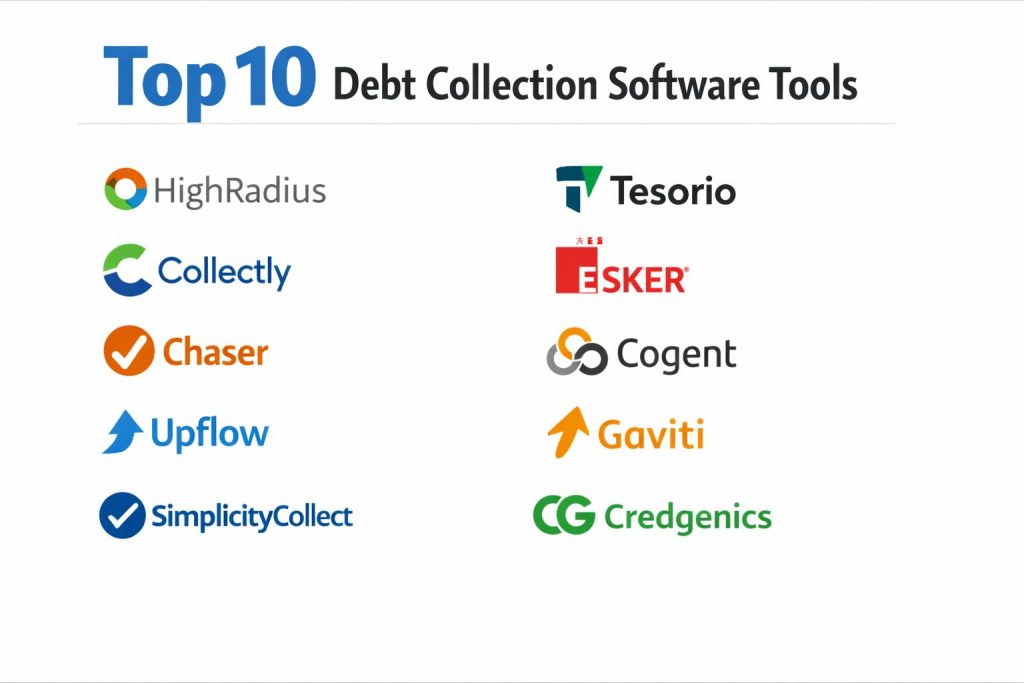
Top 10 Debt Collection Software
1 HighRadius
HighRadius is an enterprise-grade platform that uses artificial intelligence to transform the entire order-to-cash cycle. It is the leading choice for large corporations with complex accounts receivable needs that require deep predictive insights into customer payment behavior.
Key Features
- AI-Powered Collection Scoring: Ranks every customer based on their likelihood to pay, allowing collectors to prioritize their daily worklist automatically.
- Automated Dunning: Sends personalized reminders via email, fax, or mail based on pre-defined strategies that adapt to customer segments.
- Integrated Payment Processing: Allows customers to pay directly from invoices via ACH, credit card, or digital wallets with real-time reconciliation.
- Dispute Management Workflow: Provides a centralized space for identifying, tracking, and resolving invoice disputes to accelerate payment.
- Cash Forecasting: Uses historical data to predict future cash flows, helping finance leaders make more informed liquidity decisions.
- Collaboration Portal: A digital workspace where sales and finance teams can coordinate on at-risk accounts to prevent bad debt.
- Sustainability Reporting: Tracks the environmental impact of digital vs. paper invoicing to help companies meet their ESG goals.
Pros
- Exceptional predictive accuracy that significantly reduces the manual effort of identifying high-risk accounts.
- Built for massive scale, handling millions of invoices and thousands of global users seamlessly.
- Deep integration with major ERP systems like SAP and Oracle, ensuring data consistency across the enterprise.
Cons
- The implementation process is intensive and typically requires a significant time commitment from the IT department.
- The feature-rich nature of the platform can lead to a steep learning curve for new users.
- Pricing is positioned at the enterprise level, making it less accessible for smaller businesses.
Platforms / Deployment
- Web / iOS / Android
- Cloud-based SaaS
Security & Compliance
- SOC 1 & SOC 2 Type II, ISO 27001, and GDPR compliant.
- PCI-DSS Level 1 certified for secure payment processing.
Integrations & Ecosystem
HighRadius is designed to be the “intelligent layer” on top of existing enterprise software.
- Native connectors for SAP S/4HANA and Oracle ERP Cloud.
- Deep integration with Microsoft Dynamics 365.
- API support for custom connections to legacy WMS and CRM systems.
- Direct bridges to major global banks for automated cash application.
Support & Community
The company offers 24/7 global support and a dedicated success team for enterprise clients. They host “Radiance,” one of the largest annual conferences focused on AI in the office of the CFO.
2 Collectly
Collectly is a modern, patient-centric billing and debt collection platform specifically designed for the healthcare industry. It focuses on improving the patient experience through transparent communication and easy-to-use digital payment options.
Key Features
- Patient Engagement Portal: A mobile-friendly interface where patients can view their bills, chat with billing staff, and set up payment plans.
- Automated Patient Outreach: Uses SMS and email sequences to send friendly reminders and digital statements as soon as a balance is due.
- Real-Time EHR Integration: Syncs directly with Electronic Health Records to ensure that billing data is always accurate and up-to-date.
- Intelligent Payment Plans: Allows patients to self-select installment options that fit their budget based on pre-approved provider rules.
- Live Chat Integration: Provides an immediate channel for patients to ask questions about their bills, reducing the volume of inbound phone calls.
- Insurance Verification: Automatically checks a patient’s insurance status to ensure that only the correct “patient responsibility” amount is billed.
- Detailed Analytics Dashboard: Offers insights into collection rates, patient engagement levels, and the overall health of the revenue cycle.
Pros
- Dramatically improves the “patient-to-provider” relationship by making the billing process less intimidating.
- Highly effective at capturing small-balance payments that are often lost in traditional paper-based systems.
- Fast implementation times, with most medical practices going live in just a few weeks.
Cons
- Highly specialized for healthcare; not suitable for B2B or general commercial debt collection.
- Some older patient demographics may still prefer traditional paper statements over digital-only outreach.
- Customization of the automated messaging can be limited compared to broader enterprise platforms.
Platforms / Deployment
- Web / iOS / Android
- Cloud-based SaaS
Security & Compliance
- Fully HIPAA compliant for handling sensitive patient data.
- SOC 2 Type II certified and PCI-DSS compliant.
Integrations & Ecosystem
Collectly is built to sit inside the existing healthcare technology environment.
- Deep integrations with major EHRs like Athenahealth, Epic, and Cerner.
- Connects with specialized medical billing software and clearinghouses.
- API-first design for custom integration with proprietary hospital systems.
- Native support for popular healthcare payment gateways.
Support & Community
Collectly provides dedicated onboarding specialists and 24/7 technical support. They are an active participant in healthcare revenue cycle management forums and industry events.
3 Chaser
Chaser is a leading accounts receivable and debt collection platform designed for SMEs that want to automate their “chasing” process while keeping it personalized. It is known for its human-like automated emails that improve recovery rates without damaging client relationships.
Key Features
- Automated Personalized Emailing: Sends reminders that look like they were typed by a human, including “thank you” notes when a payment is received.
- Customer Payment Portals: Provides a secure link in every email where customers can view their invoices and pay immediately via various methods.
- Collection Strategy Templates: Offers pre-built dunning workflows that can be customized based on a customer’s payment history.
- Chaser Collections Service: Provides an option to escalate difficult accounts to their professional, in-house debt collection team with one click.
- CRM and Note Tracking: Centralizes all customer communication and internal notes so the entire finance team is on the same page.
- Credit Checking: Includes built-in credit monitoring to alert you when a customer’s financial health changes, helping you prevent future debt.
- DSO Reporting: Provides clear visual dashboards showing Days Sales Outstanding trends and the effectiveness of your chasing strategies.
Pros
- Extremely user-friendly; many businesses can set up their first automated chasing sequence in under an hour.
- Excellent balance between automation and personalization, ensuring that the “human touch” is never lost.
- Very affordable for small and mid-sized businesses, offering a high return on investment.
Cons
- Lacks the deep AI predictive scoring found in enterprise tools like HighRadius.
- Not designed for high-volume consumer debt; it is primarily focused on B2B relationships.
- Advanced customization of the customer portal may require higher-tier subscription plans.
Platforms / Deployment
- Web
- Cloud-based SaaS
Security & Compliance
- GDPR and CCPA compliant.
- ISO 27001 certified with standard data encryption.
Integrations & Ecosystem
Chaser is built to be the perfect companion for modern accounting software.
- Native, one-click integrations with Xero, QuickBooks Online, and Sage.
- Support for Microsoft Dynamics 365 Business Central.
- Integration with payment providers like Stripe to enable “Pay Now” buttons.
- Zapier support for connecting to hundreds of other business apps.
Support & Community
Chaser provides 24/7 email support and a comprehensive “Help Center” with video tutorials. They maintain a strong presence in the Xero and QuickBooks communities.
4 Upflow
Upflow is a modern accounts receivable platform that focuses on collaboration and transparency between finance teams and their customers. It is designed for B2B companies that want to move away from aggressive “collection” and toward a more cooperative “payment” culture.
Key Features
- Collaborative Workflows: Allows different departments (Sales, Finance, CS) to leave comments and take ownership of specific overdue accounts.
- Real-Time Cash Forecasting: Provides a live view of expected cash inflows based on current invoice statuses and payment trends.
- Smart Reminders: Automates the outreach process with highly customizable templates that can be triggered based on the “risk” of the account.
- Customer Payment Portals: Offers a centralized hub for customers to manage all their past and present invoices in one place.
- Executive Dashboards: High-level reporting that tracks key metrics like DSO and collection effectiveness for management review.
- Dispute Tracking: Enables customers to flag issues directly on an invoice, which then triggers an internal notification for the relevant team.
- Multi-Entity Support: Allows larger businesses to manage multiple subsidiaries or regions from a single, unified Upflow dashboard.
Pros
- One of the most modern and aesthetically pleasing user interfaces in the financial software market.
- Focuses on the “Customer Experience” (CX) of paying, which often leads to faster resolution than traditional dunning.
- Very strong reporting capabilities that provide actionable insights into why payments are being delayed.
Cons
- As a relatively newer player, it may lack some of the deeper “legal” collection features found in legacy systems.
- The focus is strictly B2B; it is not a good fit for high-volume B2C or retail debt collection.
- Integration with legacy, on-premise ERP systems can be more complex than with cloud-based tools.
Platforms / Deployment
- Web
- Cloud-based SaaS
Security & Compliance
- SOC 2 Type II certified.
- GDPR compliant with enterprise-grade data encryption at rest and in transit.
Integrations & Ecosystem
Upflow is designed to integrate deeply with the modern SaaS and finance stack.
- Native integrations with NetSuite, QuickBooks, and Xero.
- Deep ties to billing systems like Chargebee, Stripe, and Zuora.
- Slack integration for real-time notifications on payment activity or disputes.
- Open API for custom data syncing with internal business intelligence tools.
Support & Community
Upflow offers 24/7 technical support and a dedicated “Success Manager” for their higher-tier clients. They are well-regarded for their educational content on modern B2B finance operations.
5 SimplicityCollect
SimplicityCollect is a comprehensive, cloud-based collection management system built for professional collection agencies and legal firms. It is known for its “all-in-one” approach, providing everything from debt tracking to integrated dialers in a single platform.
Key Features
- Unlimited User Licensing: Unlike many competitors, it offers plans with unlimited users, making it highly cost-effective for growing agencies.
- Integrated Credit Reporting: Allows agencies to report delinquent accounts directly to TransUnion, Experian, and Equifax with one click.
- Virtual Agent Portal: A 24/7 self-service portal where debtors can negotiate settlements and make payments without agent interaction.
- Automated Document Generation: Creates and sends mass letters, legal forms, and court documents based on customizable templates.
- Built-in Dialer and SMS: Enables agents to make calls and send texts directly from the software, with automatic call logging and recording.
- Client Portals: Provides a secure space for your clients to log in and see real-time updates on the progress of their collections.
- Custom Workflow Engine: Allows for the creation of complex “if-then” logic to automate the movement of accounts through the collection process.
Pros
- Exceptional value for money, particularly for larger teams that would be penalized by per-user pricing elsewhere.
- Extremely feature-rich, covering the entire lifecycle from early-stage delinquency to final judgment and garnishment.
- High degree of customization, allowing users to tailor the interface and data fields to their specific industry.
Cons
- The user interface is functional but can feel dated compared to newer “SaaS-style” platforms like Upflow or Chaser.
- Because it is so feature-dense, initial setup and configuration can be complex for smaller organizations.
- The integrated dialer and SMS features often come with additional per-minute or per-message costs.
Platforms / Deployment
- Web
- Cloud-based SaaS
Security & Compliance
- PCI-DSS compliant and HIPAA ready.
- Includes features for managing FDCPA and TCPA compliance, such as contact hour restrictions.
Integrations & Ecosystem
SimplicityCollect is built to be a standalone powerhouse but offers essential bridges to other tools.
- Integration with major payment gateways like PDCflow and Repay.
- Support for credit bureau reporting across all three major agencies.
- API access for connecting to external CRM or accounting systems.
- File import/export tools for batch processing large portfolios from clients.
Support & Community
The company provides 24/7 support and an extensive online training academy for new users. They are a staple at professional debt collection and legal industry trade shows.
6 Tesorio
Tesorio is a “Cash Flow Performance” platform that places debt collection within the broader context of a company’s liquidity. It is designed for mid-market and enterprise companies that want to use their accounts receivable data to drive strategic financial planning.
Key Features
- Connected Workspace: Unifies the collection process with cash forecasting and credit risk management in a single view.
- Automated Workflows: Uses intelligent triggers to send personalized reminders and escalate accounts based on real-time behavior.
- Behavioral Forecasting: Predicts when specific customers will pay based on their historical trends, providing a more accurate cash forecast.
- CRM-Style Note Taking: Allows team members to tag each other, leave notes, and attach files to specific accounts for better internal coordination.
- Credit Risk Monitoring: Automatically flags customers whose payment behavior is deteriorating, allowing for proactive intervention.
- Executive Insights: Provides high-level dashboards that show the direct impact of collection efforts on the company’s overall cash position.
- Dispute Management Hub: Centralizes the communication around disputed invoices to ensure they are resolved quickly and don’t stall payments.
Pros
- Unique focus on the “strategic” value of collections, rather than just the tactical recovery of money.
- Excellent for companies that have high-growth targets and need to manage their working capital very closely.
- Very strong integration with “modern” ERPs like NetSuite, offering a “real-time” look into financial health.
Cons
- Not a dedicated “collection agency” tool; it lacks features for things like credit bureau reporting or legal garnishment.
- The focus on cash forecasting might be unnecessary for smaller companies that only need basic dunning.
- Pricing is based on the scale of the organization, which can be expensive for mid-sized firms.
Platforms / Deployment
- Web
- Cloud-based SaaS
Security & Compliance
- SOC 2 Type II certified.
- Standard enterprise encryption and data privacy protocols.
Integrations & Ecosystem
Tesorio acts as a strategic layer that pulls data from several different financial sources.
- Premier integration with NetSuite (one of their most common use cases).
- Support for Sage Intacct, Microsoft Dynamics 365, and Oracle.
- Connects with Slack and email providers for unified communication.
- Direct data feeds from major banking institutions for real-time cash visibility.
Support & Community
Tesorio offers 24/7 technical support and strategic “Cash Flow Advisory” services for enterprise clients. They have a growing community of CFOs and finance leaders.
7 Esker
Esker is a global leader in AI-driven process automation for the entire “Order-to-Cash” and “Source-to-Pay” cycles. Their debt collection module is part of a massive ecosystem that uses machine learning to eliminate paper and manual errors across the office of the CFO.
Key Features
- AI Recognition for Invoices: Automatically reads and processes incoming payment data to match it with outstanding debts.
- Predictive Collection Scoring: Uses AI to identify which customers are likely to pay and which require immediate attention from a human agent.
- Omnichannel Dunning: Supports automated outreach via email, SMS, and even physical mail (handled by Esker’s own mail centers).
- Multi-Lingual and Multi-Currency: Built for global operations, with support for dozens of languages and complex international tax rules.
- Customer Self-Service Portal: A global portal where customers can view invoices, manage disputes, and pay in their local currency.
- Collaborative Case Management: Allows different regions and departments to work together on complex, international debt cases.
- Carbon Footprint Tracking: Monitors the environmental impact of moving from paper-based to digital-first collection processes.
Pros
- Unmatched global reach; one of the few platforms that can truly handle the complexity of a Fortune 500 company.
- The ability to automate physical mail alongside digital channels is a major advantage for traditional industries.
- Offers an end-to-end suite that goes beyond collections to automate the entire accounts receivable department.
Cons
- The platform’s immense scale and complexity make it “overkill” for most small to mid-sized businesses.
- Implementation is a major enterprise project that can take several months to fully optimize.
- The user interface, while powerful, follows a traditional “enterprise” design that can feel data-heavy.
Platforms / Deployment
- Web / iOS / Android
- Cloud-based SaaS
Security & Compliance
- ISO 27001, SOC 1, and SOC 2 Type II certified.
- Fully compliant with global e-invoicing and debt collection regulations across Europe, Asia, and the Americas.
Integrations & Ecosystem
Esker is designed to be deeply embedded within the largest enterprise technology stacks.
- Certified integrations with SAP (including S/4HANA) and Oracle.
- Native connectors for Microsoft Dynamics and other major ERPs.
- Support for a wide range of global payment gateways and banking networks.
- Open API for specialized industry-specific integrations.
Support & Community
Esker provides 24/7 global support with local teams in over 15 countries. They are widely recognized as industry leaders in “Digital Transformation” and sustainable business practices.
8 Cogent
Cogent is a specialized platform designed for high-volume debt collection and legal recovery. It is widely used by law firms, credit unions, and collection agencies that need to manage complex litigation workflows alongside traditional collection efforts.
Key Features
- Legal Workflow Automation: Manages the entire legal process, including court dates, filings, service of process, and judgment tracking.
- Sophisticated Document Management: Stores and organizes thousands of legal and financial documents with robust version control and search.
- Automated Interest and Fee Calculation: Calculates complex, state-specific interest rates and legal fees automatically to ensure accuracy.
- Comprehensive Audit Trail: Logs every single action taken on an account, essential for maintaining compliance in a legal environment.
- Interactive Agent Workspace: Provides collectors with all the data they need, including scripts and historical interaction logs, in a single view.
- Client Reporting Portal: Allows your clients to log in and see exactly where their accounts stand in the legal or collection process.
- Security and Permissions: Highly granular control over who can see and edit sensitive legal and financial information.
Pros
- The clear choice for organizations where the collection process frequently leads to legal action.
- Extremely stable and reliable, built to handle massive volumes of data for decades-long recovery cycles.
- Very strong “litigation-specific” features that general AR platforms simply do not offer.
Cons
- The user interface is traditional and “industrial,” lacking the modern flair of newer SaaS platforms.
- It is not a “quick start” tool; it requires a disciplined setup to align with your specific legal and business workflows.
- The software is primarily designed for the North American legal and financial market.
Platforms / Deployment
- Web / On-Premise / Private Cloud
- Hybrid SaaS options available
Security & Compliance
- Built to meet the stringent security requirements of the banking and legal sectors.
- Supports compliance with FDCPA, TCPA, and various state-specific legal recovery laws.
Integrations & Ecosystem
Cogent is built to be a core “System of Record” for legal and collection operations.
- Integration with major credit bureaus and skip-tracing providers.
- Support for legal filing systems and court data feeds.
- API access for connecting to external CRM or financial systems.
- Direct bridges to payment processing and check verification services.
Support & Community
The company provides professional, US-based technical support and on-site training for large implementations. They have a long-standing reputation in the collection industry as a “power user” tool.
9 Gaviti
Gaviti is a specialized accounts receivable automation platform that focuses on optimizing the “Receivables Management” process for B2B companies. It is designed to act as a collaborative bridge between the sales and finance departments to improve cash flow.
Key Features
- Smart Workflow Automation: Uses pre-defined “playbooks” to automate the dunning process while allowing for manual overrides.
- Collaborative Collection Map: Provides a visual view of where every customer stands in the collection cycle, making it easy to identify bottlenecks.
- DSO Performance Analytics: Tracks your Days Sales Outstanding in real-time and benchmarks your performance against industry standards.
- Automated Escalation Logic: Automatically moves an account to a more senior collector or a different channel if initial reminders are ignored.
- Dispute and Query Management: Centralizes all customer questions and disputes to ensure they are handled by the right person quickly.
- Credit Risk Assessment: Uses real-time payment behavior to score customer risk and alert you to potential bad debt before it happens.
- Custom Reporting Engine: Allows for the creation of tailored reports for different stakeholders, from team leads to the CFO.
Pros
- Very strong focus on “Collaboration”; it helps break down the silos between sales and finance teams.
- Exceptionally easy to navigate, with a clean and modern dashboard that focuses on “actionable” tasks.
- Proven to significantly reduce the time spent on manual administrative tasks for the AR team.
Cons
- Primarily B2B-focused; it lacks the high-volume dialer and consumer-facing features of agency-grade software.
- While it offers strong integrations, the “ecosystem” is not as vast as older players like HighRadius.
- Advanced predictive features are still evolving compared to the market leaders.
Platforms / Deployment
- Web
- Cloud-based SaaS
Security & Compliance
- SOC 2 Type II certified.
- Fully GDPR and CCPA compliant with standard data protection protocols.
Integrations & Ecosystem
Gaviti is designed to “plug and play” with the world’s most popular business software.
- Native integrations with NetSuite, SAP, Oracle, and Microsoft Dynamics.
- Connects with popular accounting tools like QuickBooks and Xero.
- API for custom data feeds and internal BI system connections.
- Support for major B2B payment gateways for integrated collections.
Support & Community
Gaviti offers 24/7 support and a dedicated success team to help companies optimize their “collection playbooks.” They are active in the global AR and credit management community.
10 Credgenics
Credgenics is a leading AI-powered debt recovery platform that specializes in the banking, financial services, and insurance (BFSI) sectors. It is famous for its “Legal-to-Collection” unified platform and its use of advanced technology like Skit.ai for voice automation.
Key Features
- AI-Driven Prioritization: Uses machine learning to segment debtors and recommend the most effective communication channel and time for each.
- Digital Self-Service Portals: Offers a highly intuitive mobile interface for borrowers to resolve their debts and manage their loans.
- Legal Workflow Management: Automates the creation and tracking of legal notices, court filings, and recovery cases in a unified dashboard.
- Integrated Field Operations: Includes a mobile app for field collection agents to track their visits, capture data, and update statuses in real-time.
- Conversational AI (Voice & Chat): Integrates with autonomous agents to handle routine recovery conversations across multiple languages.
- Omnichannel Communication Hub: Manages SMS, WhatsApp, Email, and Voice outreach in a single coordinated stream.
- Comprehensive Analytics: Provides deep insights into recovery performance across different regions, teams, and asset classes.
Pros
- Unmatched in its ability to coordinate “digital” and “physical” (field agent) collection efforts in a single system.
- Exceptional for high-volume lenders and banks that need to manage millions of retail loan accounts.
- Very modern, AI-first approach that delivers a significant lift in recovery rates compared to legacy systems.
Cons
- The platform is highly specialized for the lending and banking industries; it may not be suitable for general B2B manufacturing.
- Implementation in large, regulated banks can be complex due to data privacy and residency requirements.
- Some of the most advanced AI features are optional add-ons that can increase the total cost.
Platforms / Deployment
- Web / iOS / Android
- Cloud-based SaaS
Security & Compliance
- ISO 27001 and SOC 2 Type II certified.
- Designed to meet strict global banking regulations and data protection laws.
Integrations & Ecosystem
Credgenics is designed to be the “Recovery Engine” for modern financial institutions.
- Deep integration with core banking systems and loan management platforms.
- Native connections to WhatsApp and other regional messaging apps for higher engagement.
- API for custom integration with internal risk and compliance databases.
- Support for a wide range of regional payment gateways and bank transfer systems.
Support & Community
Credgenics provides 24/7 global support and has a massive presence in the fintech and banking technology space. They are a frequent winner of global “Innovation in Collections” awards.
Comparison Table (Top 10)
| Tool Name | Best For | Platform(s) Supported | Deployment | Standout Feature |
| HighRadius | Enterprise AR Automation | Web, iOS, Android | Cloud (SaaS) | AI-Driven Priority Scoring |
| Collectly | Healthcare Patient Billing | Web, iOS, Android | Cloud (SaaS) | Patient-Friendly Digital Portal |
| Chaser | SME B2B Collections | Web | Cloud (SaaS) | Human-like Email Automation |
| Upflow | B2B Collaboration & CX | Web | Cloud (SaaS) | Shared Finance/Sales Workspace |
| SimplicityCollect | Agencies & Legal Teams | Web | Cloud (SaaS) | Unlimited User Licensing |
| Tesorio | Cash Flow Performance | Web | Cloud (SaaS) | Behavioral Cash Forecasting |
| Esker | Global Process Automation | Web, iOS, Android | Cloud (SaaS) | Integrated Physical Mail Center |
| Cogent | Legal Recovery & Litigation | Web, On-Premise | Hybrid Cloud | Specialized Legal Workflows |
| Gaviti | B2B Receivables Optimization | Web | Cloud (SaaS) | Collection “Playbook” Engine |
| Credgenics | Banking & Financial Services | Web, iOS, Android | Cloud (SaaS) | Integrated Field Agent App |
Evaluation & Scoring of Debt Collection Software
The scoring below is a comparative model intended to help shortlisting. Each criterion is scored from 1–10, then a weighted total from 0–10 is calculated using the weights listed. These are analyst estimates based on typical fit and common workflow requirements, not public ratings.
Weights:
- Price / value – 15%
- Core features – 25%
- Ease of use – 15%
- Integrations & ecosystem – 15%
- Security & compliance – 10%
- Performance & reliability – 10%
- Support & community – 10%
| Tool Name | Automation (25%) | Compliance (20%) | Integrations (15%) | AI/Predictive (15%) | Ease of Use (10%) | Security (15%) | Weighted Total |
| HighRadius | 10 | 9 | 10 | 10 | 6 | 9 | 9.2 |
| Collectly | 9 | 10 | 9 | 7 | 10 | 9 | 8.9 |
| Chaser | 8 | 8 | 9 | 6 | 10 | 8 | 8.1 |
| Upflow | 8 | 9 | 9 | 7 | 10 | 9 | 8.5 |
| SimplicityCollect | 9 | 9 | 8 | 7 | 8 | 8 | 8.3 |
| Tesorio | 8 | 8 | 9 | 9 | 9 | 9 | 8.5 |
| Esker | 10 | 10 | 10 | 9 | 6 | 10 | 9.3 |
| Cogent | 7 | 10 | 8 | 6 | 7 | 10 | 7.9 |
| Gaviti | 9 | 8 | 9 | 7 | 9 | 8 | 8.3 |
| Credgenics | 10 | 9 | 9 | 10 | 8 | 9 | 9.2 |
How to interpret the scores:
- Use the weighted total to shortlist candidates, then validate with a pilot.
- Security and compliance scores reflect controllability and governance fit, because certifications are often not publicly stated.
- A lower score can mean specialization, not weakness.
- Actual outcomes vary with assembly size, team skills, templates, and process maturity.
Which Debt Collection Software Tool Is Right for You?
Small Businesses (SMEs)
For a small team that needs to automate B2B reminders without a complex setup, Chaser is the clear winner due to its affordability and human-centric approach. If you prefer a more collaborative, modern feel for your B2B relationships, Upflow offers a superior user experience.
Large Global Enterprises
If you are managing high-volume, international receivables within a complex ERP like SAP, Esker and HighRadius are the industry standards. They provide the depth of AI and the global infrastructure required for multi-national operations.
Professional Collection Agencies
Agencies that prioritize cost-efficiency and volume should look at SimplicityCollect, especially for its unlimited user model. For agencies that focus heavily on the legal aspect of recovery, Cogent remains the most robust system for managing litigation.
Healthcare Providers
There is no better option for medical practices than Collectly. Its deep integration with EHRs and its focus on the “patient experience” address the unique challenges of healthcare billing better than any general-purpose tool.
Banks and Financial Lenders
Credgenics is the most advanced choice for the financial sector, offering a unique blend of digital automation and field agent management that is essential for retail loan recovery.
Finance Teams focused on Cash Flow
If your primary goal is not just “collecting money” but managing overall liquidity and predicting future cash position, Tesorio provides the most strategic value by linking AR data directly to financial forecasting.
Frequently Asked Questions (FAQs)
What is the average recovery rate improvement when using these tools?
Most companies see a 15–25% increase in recovery rates within the first year by eliminating manual gaps in communication and using AI to prioritize high-probability accounts.
Can these platforms handle international debt collection?
Yes, tools like Esker and HighRadius are built for global use, supporting multiple languages, currencies, and localized tax/debt regulations across different countries.
Is it legal to send automated debt collection messages via WhatsApp?
In many regions, yes, provided you have the debtor’s consent. Platforms like Credgenics include compliance tools to ensure messaging follows regional privacy and debt collection laws.
How does “AI Scoring” actually work in debt collection?
The AI analyzes thousands of historical data points—such as past payment dates, response times, and industry trends—to assign a score to each debtor that predicts their likelihood of paying.
Do I need to replace my existing accounting software?
No, these platforms are designed to “sit on top” of your current system (like QuickBooks, Xero, or SAP), pulling in invoice data and pushing back payment updates automatically.
Can I set up different “collection playbooks” for different customers?
Yes, most modern tools allow you to create custom workflows. For example, you can send gentle reminders to long-term “VIP” clients while using a more aggressive escalation for new, one-off customers.
How do self-service portals help improve collection rates?
By providing a 24/7 way for debtors to pay or negotiate without the social friction of a phone call, portals significantly increase the likelihood of receiving payments from “reluctant” debtors.
What is the typical implementation time for this software?
For SME-focused tools like Chaser or Upflow, you can be live in hours. For enterprise systems like Esker, the process typically takes 3–6 months for full data mapping and testing.
Does the software handle the legal process if I need to sue a debtor?
Specialized tools like Cogent and Credgenics include legal modules to track court dates and filings. General tools like Chaser often offer a one-click “handover” to a partner collection agency.
How secure is my customer’s financial data on these platforms?
All tools on this list use enterprise-grade encryption and are compliant with standards like SOC 2 and PCI-DSS, ensuring that sensitive data is protected to the highest degree.
Conclusion
The shift toward digital and automated debt recovery is no longer a luxury but a necessity for maintaining a healthy balance sheet. Whether you are a small business looking to save time on manual follow-ups with Chaser or a global enterprise requiring the AI sophistication of HighRadius, there is a platform tailored to your specific recovery needs. By implementing one of these top 10 solutions, you can transform debt collection from a reactive burden into a proactive, data-driven strategy that fuels business growth.