Introduction
A data warehouse platform is a central system that stores structured and semi-structured data for analytics, reporting, and decision-making. It collects data from many sources, cleans it, organizes it, and makes it fast to query. It matters because teams need reliable insights for revenue, cost, customer experience, and operations, and they need those insights without breaking production systems. Common use cases include executive dashboards, finance and revenue reporting, customer analytics, marketing attribution, supply chain planning, risk analysis, and machine learning feature generation. When choosing a platform, evaluate scalability, query performance, data ingestion options, workload isolation, governance, security controls, interoperability with BI and ETL tools, operational effort, reliability, and total cost over time.
Best for: data engineers, analytics engineers, BI teams, data scientists, and platform teams in startups, mid-market, and enterprises that need trustworthy analytics at scale.
Not ideal for: small teams with minimal analytics needs, organizations that only need simple spreadsheets, or workloads that are purely transactional and do not benefit from analytical storage patterns.
Key Trends in Data Warehouse Platforms
- More separation of storage and compute to control cost and improve elasticity
- Stronger built-in support for semi-structured data like JSON and nested formats
- AI-assisted performance tuning and workload recommendations in some platforms
- Increased focus on governance: lineage, cataloging, and policy-based access controls
- Zero-copy sharing and cross-organization collaboration patterns becoming common
- Multi-cloud and hybrid strategies to reduce lock-in and meet data residency needs
- Better streaming and near-real-time ingestion to reduce latency to insights
- Lakehouse-style interoperability between warehouses and open table formats
- More secure-by-default controls: encryption, key management, and tighter auditing
- Cost management features becoming a buyer priority, not an afterthought
How We Selected These Tools (Methodology)
- Picked platforms with strong adoption and credibility across industries
- Prioritized query performance, concurrency handling, and scalability patterns
- Considered ecosystem strength: BI tools, ETL tools, and partner integrations
- Included both cloud-first and hybrid options to fit different constraints
- Looked at operational simplicity and how much expertise is required to run well
- Evaluated security features that typically matter to regulated organizations
- Considered workload flexibility for SQL analytics, ELT, and mixed data types
- Chose tools that fit different buyer segments instead of one-size-fits-all
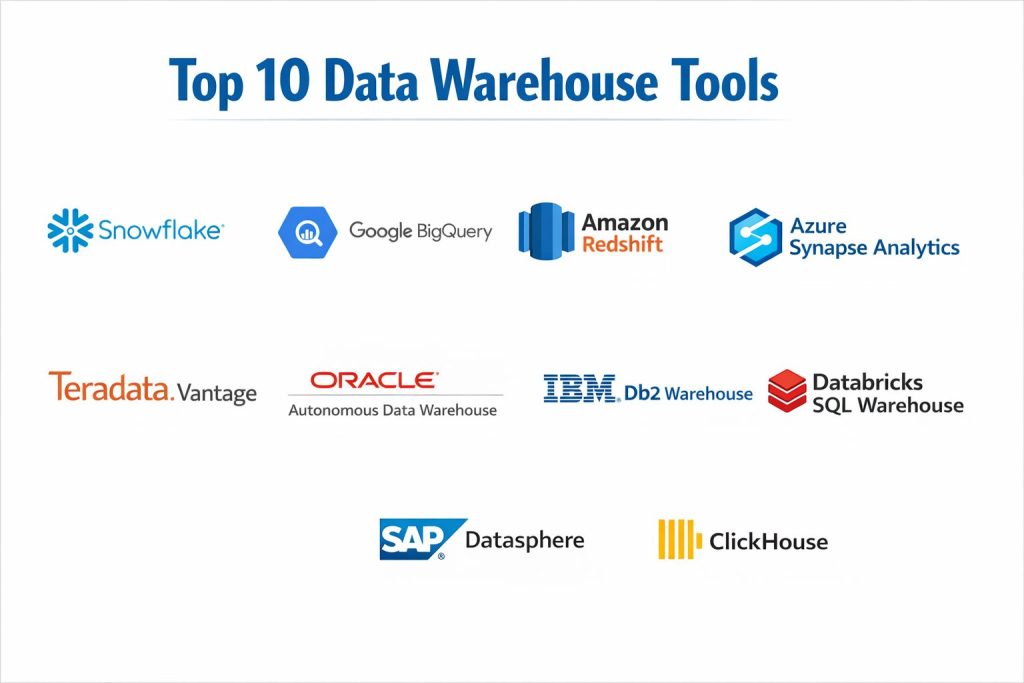
Top 10 Data Warehouse Platforms Tools
1) Snowflake
A cloud-native data warehouse platform designed for scalable analytics, strong concurrency, and flexible data sharing. It fits teams that want high performance with lower day-to-day infrastructure overhead.
Key Features
- Elastic compute scaling with workload isolation options
- Strong support for concurrent analytics users and mixed workloads
- Data sharing patterns that reduce duplication in many scenarios
- SQL-first analytics with broad ecosystem tooling compatibility
- Storage and compute separation for flexible cost management
- Time travel and recovery-style capabilities (feature availability varies by plan)
Pros
- Strong performance for many analytics workloads with simpler operations
- Large ecosystem and strong adoption across many industries
Cons
- Costs can rise if workloads are not governed and monitored
- Some advanced governance and optimization practices still require expertise
Platforms / Deployment
- Cloud
- Cloud
Security & Compliance
- Not publicly stated
Integrations & Ecosystem
Snowflake commonly connects to ETL/ELT, BI platforms, and data governance tools. It is often used as a central analytics store with many upstream sources.
- BI and reporting integrations: Varies / N/A
- ETL/ELT tools: Varies / N/A
- APIs and connectors: Varies / N/A
- Data catalog and governance tools: Varies / N/A
Support & Community
Strong documentation and a large user community. Support tiers vary by plan and contract.
2) Google BigQuery
A fully managed cloud data warehouse designed for fast SQL analytics at scale. It is a good fit for teams that want minimal infrastructure management and strong integration with a broader cloud ecosystem.
Key Features
- Serverless-style analytics with simplified operations
- Strong performance for large-scale analytical queries
- Built-in support for semi-structured data patterns
- Easy scaling for spiky workloads and variable demand
- Strong integration patterns with cloud data ingestion and processing services
- Fine-grained access control and auditing capabilities (feature set varies)
Pros
- Very low operational burden for many teams
- Scales well for large datasets and variable query demand
Cons
- Cost control requires discipline around query patterns and governance
- Some portability concerns for teams with strict multi-cloud goals
Platforms / Deployment
- Cloud
- Cloud
Security & Compliance
- Not publicly stated
Integrations & Ecosystem
BigQuery commonly integrates with cloud-native ingestion, transformation, and BI layers.
- BI and reporting integrations: Varies / N/A
- ETL/ELT tools: Varies / N/A
- Streaming ingestion and connectors: Varies / N/A
- APIs and automation: Varies / N/A
Support & Community
Strong documentation, many learning resources, and broad community usage. Support varies by plan.
3) Amazon Redshift
A cloud data warehouse platform designed for scalable analytics, commonly used by organizations that already rely heavily on a specific cloud ecosystem. It fits teams that want tight integration with cloud storage and data services.
Key Features
- Scalable analytics with managed warehouse options
- Integration patterns with cloud storage and data ingestion services
- Workload management controls for concurrency and priorities
- Support for structured analytics and common SQL workloads
- Performance tuning options and optimization features (varies by configuration)
- Ecosystem compatibility with many data tooling stacks
Pros
- Strong fit for cloud-first organizations with existing data services
- Mature platform with many integration patterns and operational tooling
Cons
- Performance and cost outcomes depend heavily on configuration discipline
- More operational decisions than fully serverless alternatives
Platforms / Deployment
- Cloud
- Cloud
Security & Compliance
- Not publicly stated
Integrations & Ecosystem
Redshift is often used with cloud storage, ingestion, and transformation services.
- Data lake integrations: Varies / N/A
- BI and reporting integrations: Varies / N/A
- ETL/ELT tooling: Varies / N/A
- APIs and connectors: Varies / N/A
Support & Community
Large user base and extensive documentation. Support depends on plan and enterprise agreements.
4) Microsoft Azure Synapse Analytics
A data warehouse and analytics platform designed for organizations using a Microsoft ecosystem. It fits teams that want unified patterns for data integration, warehousing, and analytics workflows.
Key Features
- Analytics workspace patterns that combine multiple data workflows
- SQL analytics support for warehouse-style reporting
- Integration with common enterprise identity and governance patterns
- Compatibility with many BI tools and data integration services
- Scalable compute options depending on configuration
- Enterprise-friendly management and access patterns (varies by setup)
Pros
- Strong fit for Microsoft-oriented enterprises and BI teams
- Good integration with enterprise identity and governance ecosystems
Cons
- Architecture choices can be complex without strong platform ownership
- Performance depends on correct design and operational discipline
Platforms / Deployment
- Cloud
- Cloud
Security & Compliance
- Not publicly stated
Integrations & Ecosystem
Synapse often integrates with Microsoft BI layers and data integration tooling, plus broader ecosystem connectors.
- BI and reporting integrations: Varies / N/A
- Data integration tools: Varies / N/A
- Identity and access management: Varies / N/A
- APIs and automation: Varies / N/A
Support & Community
Strong enterprise documentation and partner ecosystem. Community resources are broad, support varies by plan.
5) Databricks SQL Warehouse
A data warehouse-style SQL layer designed for analytics workloads, often used in environments that also run data engineering and machine learning. It fits teams that want SQL analytics plus broader data and AI workflows.
Key Features
- SQL analytics layer designed for performance and concurrency
- Strong support for mixed workloads in data and AI environments
- Interoperability patterns with open data lake storage approaches
- Workload controls and query acceleration features (vary by plan)
- Integrated collaboration patterns for data engineering and analytics teams
- Strong ecosystem for notebooks and data workflows (varies)
Pros
- Strong fit for organizations blending BI analytics with data engineering and ML
- Often aligns well with open storage strategies and flexible architectures
Cons
- Governance and cost controls require discipline as usage scales
- Architecture decisions may be heavier than pure warehouse-only platforms
Platforms / Deployment
- Cloud
- Cloud
Security & Compliance
- Not publicly stated
Integrations & Ecosystem
Databricks SQL Warehouse commonly integrates with BI tools, transformation tooling, and broader data platforms.
- BI integrations: Varies / N/A
- Data governance and catalogs: Varies / N/A
- Data ingestion and pipelines: Varies / N/A
- APIs and automation: Varies / N/A
Support & Community
Strong community and learning ecosystem. Support tiers vary by plan and enterprise agreements.
6) Teradata Vantage
An enterprise-grade data warehouse platform known for high-performance analytics and long-standing usage in large organizations. It fits enterprises needing strong scale, governance patterns, and mature operational tooling.
Key Features
- High-performance analytics for large enterprise workloads
- Strong concurrency and workload management patterns
- Mature optimization and administration capabilities
- Enterprise governance and access control features (vary by edition)
- Hybrid and cloud options depending on deployment choices
- Supports large-scale reporting and operational analytics patterns
Pros
- Proven for large enterprise workloads with heavy concurrency needs
- Mature platform with many operational patterns and controls
Cons
- Can be complex and costly compared to cloud-native-first platforms
- Best results often require experienced administration and tuning
Platforms / Deployment
- Cloud / Self-hosted / Hybrid
- Hybrid
Security & Compliance
- Not publicly stated
Integrations & Ecosystem
Teradata Vantage integrates with enterprise BI and data integration ecosystems, typically in mature data environments.
- BI integrations: Varies / N/A
- Data integration tools: Varies / N/A
- APIs and connectors: Varies / N/A
- Governance tooling: Varies / N/A
Support & Community
Enterprise-grade support options and extensive documentation. Community is strong in enterprise environments.
7) Oracle Autonomous Data Warehouse
A managed data warehouse designed for organizations already invested in Oracle ecosystems. It emphasizes automated operations for tuning and scaling in many standard warehouse scenarios.
Key Features
- Managed warehouse operations with automation for common tasks
- SQL analytics support for enterprise reporting and dashboards
- Integration with enterprise identity patterns (varies by setup)
- Performance features aimed at reducing manual tuning needs
- Backup and recovery patterns managed by the platform (varies)
- Strong fit for Oracle-based enterprise data landscapes
Pros
- Reduced operational overhead for many traditional warehouse workloads
- Strong fit for Oracle-centric organizations and legacy environments
Cons
- Can increase ecosystem lock-in for teams seeking portability
- Pricing and operational outcomes depend on usage patterns and plan choices
Platforms / Deployment
- Cloud
- Cloud
Security & Compliance
- Not publicly stated
Integrations & Ecosystem
Often integrates into Oracle enterprise toolchains and broader ETL/BI ecosystems.
- BI and reporting tools: Varies / N/A
- Data integration tools: Varies / N/A
- APIs and connectors: Varies / N/A
- Governance tooling: Varies / N/A
Support & Community
Strong enterprise support options and extensive documentation; community varies by region and industry.
8) IBM Db2 Warehouse
A data warehouse platform designed for enterprise analytics, commonly used in organizations with IBM ecosystems. It supports warehouse-style reporting and governance patterns for regulated environments.
Key Features
- SQL analytics optimized for warehouse-style workloads
- Enterprise governance and access patterns (vary by edition)
- Hybrid deployment options for different infrastructure constraints
- Integration with enterprise reporting tools and data services
- Administration and performance controls (varies by setup)
- Suitable for regulated environments with strong control needs (details vary)
Pros
- Strong enterprise fit for organizations with existing IBM platforms
- Hybrid options can help with data residency and infrastructure constraints
Cons
- Operational complexity can be higher than cloud-native serverless options
- Ecosystem adoption may be narrower outside IBM-centric environments
Platforms / Deployment
- Cloud / Self-hosted / Hybrid
- Hybrid
Security & Compliance
- Not publicly stated
Integrations & Ecosystem
Db2 Warehouse often integrates with enterprise ETL, BI, and governance tooling.
- BI integrations: Varies / N/A
- ETL/ELT tools: Varies / N/A
- APIs and connectors: Varies / N/A
- Governance tools: Varies / N/A
Support & Community
Enterprise-grade support and documentation; community is strongest in enterprise and IBM-aligned organizations.
9) SAP Datasphere
A data warehousing and data management platform designed for organizations running SAP landscapes. It focuses on enabling analytics and governance across SAP and non-SAP data sources.
Key Features
- Strong fit for SAP-centric data and analytics architectures
- Data integration patterns across enterprise systems (setup dependent)
- Governance-friendly modeling and access control concepts (vary by plan)
- Supports analytics layers that feed reporting and BI usage
- Designed to reduce friction for SAP-to-analytics workflows
- Enterprise tooling compatibility depending on architecture decisions
Pros
- Strong alignment for enterprises with SAP-first data landscapes
- Useful for connecting business data domains into analytics workflows
Cons
- Best value is often limited to SAP-heavy environments
- Broader ecosystem flexibility depends on how integrations are set up
Platforms / Deployment
- Cloud
- Cloud
Security & Compliance
- Not publicly stated
Integrations & Ecosystem
Commonly integrates with SAP reporting layers, enterprise ETL, and business systems.
- SAP ecosystem integrations: Varies / N/A
- BI tooling: Varies / N/A
- Data integration tooling: Varies / N/A
- APIs and connectors: Varies / N/A
Support & Community
Enterprise support options and documentation are strong; community strength varies by region and SAP adoption.
10) ClickHouse
A high-performance analytical database often used for large-scale analytics, real-time reporting, and event data workloads. It is a strong option when query speed on large volumes is a primary requirement.
Key Features
- High-performance analytical query execution for large datasets
- Strong fit for event analytics and high-ingestion reporting patterns
- Efficient storage and compression for analytical workloads (varies)
- Useful for near-real-time dashboards depending on pipeline setup
- Supports large-scale aggregation workloads efficiently
- Can be used in different deployment styles depending on environment
Pros
- Very strong performance for certain analytics patterns
- Good fit for event and telemetry analytics at scale
Cons
- Not a traditional enterprise warehouse experience out of the box
- Requires careful modeling and operational discipline for best results
Platforms / Deployment
- Cloud / Self-hosted
- Hybrid
Security & Compliance
- Not publicly stated
Integrations & Ecosystem
ClickHouse commonly integrates with event pipelines, ingestion tooling, and BI layers depending on architecture.
- BI integrations: Varies / N/A
- Data ingestion pipelines: Varies / N/A
- APIs and connectors: Varies / N/A
- Governance tooling: Varies / N/A
Support & Community
Growing community and strong performance-focused documentation; support depends on distribution and plan.
Comparison Table (Top 10)
| Tool Name | Best For | Platform(s) Supported | Deployment (Cloud/Self-hosted/Hybrid) | Standout Feature | Public Rating |
|---|---|---|---|---|---|
| Snowflake | Elastic analytics with strong concurrency | Cloud | Cloud | Workload isolation and sharing patterns | N/A |
| Google BigQuery | Managed SQL analytics at scale | Cloud | Cloud | Serverless-style scaling | N/A |
| Amazon Redshift | Cloud-first analytics in cloud ecosystems | Cloud | Cloud | Mature integrations with data services | N/A |
| Microsoft Azure Synapse Analytics | Microsoft-centric enterprise analytics | Cloud | Cloud | Unified analytics workspace patterns | N/A |
| Databricks SQL Warehouse | SQL analytics plus data and AI workflows | Cloud | Cloud | Lakehouse-style interoperability | N/A |
| Teradata Vantage | Large enterprise analytics and governance | Cloud / Self-hosted | Hybrid | Enterprise concurrency and workload control | N/A |
| Oracle Autonomous Data Warehouse | Oracle-centric managed warehousing | Cloud | Cloud | Automation for common operations | N/A |
| IBM Db2 Warehouse | Enterprise warehouse with hybrid options | Cloud / Self-hosted | Hybrid | Enterprise control patterns | N/A |
| SAP Datasphere | SAP-first enterprise analytics workflows | Cloud | Cloud | SAP domain-aligned data access | N/A |
| ClickHouse | High-performance analytics and event data | Cloud / Self-hosted | Hybrid | Fast aggregation on large datasets | N/A |
Evaluation & Scoring of Data Warehouse Platforms
| Tool Name | Core (25%) | Ease (15%) | Integrations (15%) | Security (10%) | Performance (10%) | Support (10%) | Value (15%) | Weighted Total (0–10) |
|---|---|---|---|---|---|---|---|---|
| Snowflake | 9.0 | 8.0 | 9.0 | 7.0 | 8.5 | 8.0 | 7.0 | 8.23 |
| Google BigQuery | 9.0 | 8.5 | 8.5 | 7.0 | 8.5 | 8.0 | 7.5 | 8.38 |
| Amazon Redshift | 8.5 | 7.5 | 8.5 | 7.0 | 8.0 | 8.0 | 7.0 | 7.95 |
| Microsoft Azure Synapse Analytics | 8.0 | 7.0 | 8.0 | 7.0 | 7.5 | 7.5 | 7.0 | 7.58 |
| Databricks SQL Warehouse | 8.5 | 7.5 | 8.0 | 7.0 | 8.0 | 7.5 | 7.0 | 7.88 |
| Teradata Vantage | 8.5 | 6.5 | 7.5 | 7.5 | 8.5 | 7.5 | 6.0 | 7.55 |
| Oracle Autonomous Data Warehouse | 8.0 | 7.5 | 7.5 | 7.0 | 7.5 | 7.5 | 6.5 | 7.43 |
| IBM Db2 Warehouse | 7.5 | 6.5 | 7.0 | 7.0 | 7.5 | 7.0 | 6.5 | 7.00 |
| SAP Datasphere | 7.5 | 6.5 | 7.0 | 7.0 | 7.0 | 7.0 | 6.5 | 6.93 |
| ClickHouse | 7.5 | 6.5 | 6.5 | 6.5 | 9.0 | 7.0 | 7.5 | 7.23 |
How to interpret the scores:
- These scores compare tools within this list, not the entire market.
- A higher total suggests stronger overall balance across common buyer needs.
- Performance scores reflect typical analytical workload strengths, but your results depend on data model and workload patterns.
- Security scoring is limited because public disclosures vary and many capabilities depend on surrounding platform controls.
- Always run a pilot with real data volume, concurrency, and cost constraints to validate fit.
Which Data Warehouse Platform Tool Is Right for You?
Solo / Freelancer
If you are a solo analyst or small consulting team, prioritize simplicity and pay-as-you-go patterns. Google BigQuery can work well when you want minimal infrastructure management and quick time-to-insight. Snowflake can be a good option when you expect many users or teams sharing data and you want strong workload isolation. If you handle event analytics and need extreme query speed, ClickHouse can be strong, but it often requires more setup discipline.
SMB
SMBs should focus on time-to-value, predictable cost controls, and integration with BI and transformation tooling. Snowflake and Google BigQuery are common picks when you want strong managed experience. Amazon Redshift is a fit when your operational stack already lives inside a cloud ecosystem and you want tight integration with surrounding services. Databricks SQL Warehouse can be a strong choice if you also plan to run data engineering and AI workloads in the same environment.
Mid-Market
Mid-market teams often need governance, workload separation, and reliable performance as users grow. Snowflake is often strong for many concurrent teams, while Google BigQuery works well for large-scale analytics with low ops. Databricks SQL Warehouse is a fit when the organization blends BI analytics with data engineering and machine learning workflows. Microsoft Azure Synapse Analytics is typically strongest when the organization is already Microsoft-first across identity and BI.
Enterprise
Enterprises should prioritize governance, security controls, workload management, and operational maturity. Teradata Vantage remains common in large enterprises that need heavy concurrency and mature administrative controls. Microsoft Azure Synapse Analytics can align well with Microsoft identity and enterprise BI patterns. Oracle Autonomous Data Warehouse and SAP Datasphere can be strong choices in organizations deeply invested in Oracle or SAP ecosystems. IBM Db2 Warehouse is often relevant when IBM stacks and hybrid deployment needs are central.
Budget vs Premium
Budget-driven teams should select a platform that minimizes operational effort and supports cost governance features. Premium buyers may pay more for mature workload management, enterprise governance patterns, and platform consistency at scale. The right choice depends on whether staff time or platform cost is the bigger constraint.
Feature Depth vs Ease of Use
If you want ease and speed, managed options that reduce tuning and infrastructure work are often better. If you need deep administrative control, certain enterprise platforms can offer more tuning and governance patterns, but they require experienced ownership. Choose based on your team maturity and how much operational complexity you can afford.
Integrations & Scalability
Integrations matter as much as the warehouse itself. Validate your BI tools, ELT tools, identity setup, and governance tooling early. Scalability is not only about data volume, it is also about concurrency, workload separation, and predictable cost controls under growth.
Security & Compliance Needs
For regulated teams, focus on fine-grained access control, auditing, encryption, and strong governance workflows. If compliance details are not clearly known, treat them as not publicly stated and validate through procurement, security review, and controlled pilot testing with real policies and role models.
Frequently Asked Questions (FAQs)
1. What is the main difference between a data warehouse and a database?
A data warehouse is optimized for analytics and reporting, while many databases are optimized for transactions. Warehouses usually handle large scans, aggregations, and many reporting users more efficiently.
2. How do pricing models usually work for data warehouses?
Many platforms charge based on compute usage and stored data. Costs can vary widely depending on query patterns, concurrency, and how well you govern workloads.
3. How long does onboarding typically take?
A basic setup can be quick, but a real production rollout takes longer because you must define data models, access controls, pipelines, and governance rules. The timeline depends on data complexity and team maturity.
4. What is the biggest cost mistake teams make?
Running uncontrolled queries, leaving compute running, and failing to isolate workloads. Cost control improves when you set standards for transformations, scheduling, and access patterns.
5. Do I need a separate data lake if I have a warehouse?
Not always. Some teams run everything in a warehouse, while others keep raw data in a lake for cheaper storage and flexibility. The right approach depends on your volume and compliance needs.
6. Which platform is best for real-time analytics?
Many warehouses support near-real-time patterns with streaming ingestion, but performance depends on your pipeline design. ClickHouse is often chosen for very fast event analytics, while other platforms may be simpler to operate.
7. How do I choose between Snowflake and BigQuery?
Compare your cloud strategy, cost governance approach, sharing needs, and workload patterns. A pilot with real data and concurrency is the safest way to decide.
8. What security features should I prioritize first?
Start with role-based access control, encryption, auditing, and strong identity integration. Then add governance controls like lineage and policy-based access patterns.
9. Can I migrate from one warehouse to another easily?
Migration is possible but not trivial. SQL compatibility, data types, performance tuning, and orchestration patterns differ. Plan for parallel runs and validation.
10. What should I test in a pilot before finalizing a platform?
Test real query workloads, concurrency, ingestion pipelines, BI dashboards, security roles, auditing needs, and cost under realistic usage. A pilot should uncover both performance and governance gaps.
Conclusion
A data warehouse platform becomes the foundation for analytics trust, faster decisions, and consistent reporting across the business. However, the best choice depends on your data volume, concurrency, governance maturity, and cloud strategy. Snowflake and Google BigQuery often fit teams that want managed scale with strong performance, while Amazon Redshift can be effective in cloud-first environments that value tight ecosystem integration. Databricks SQL Warehouse is attractive when BI analytics and data engineering need to live together, and enterprise options like Teradata Vantage, Oracle Autonomous Data Warehouse, SAP Datasphere, and IBM Db2 Warehouse can align better with deep enterprise ecosystems and controls. Next, shortlist two or three platforms, run a pilot using real workloads, validate integrations and access controls, measure cost under realistic usage, and then standardize.