Introduction
Data pipeline orchestration has evolved from simple cron-based scheduling into a sophisticated management layer that coordinates complex dependencies across distributed computing environments. In the modern data stack, an orchestrator acts as the “central nervous system,” ensuring that data flows from ingestion sources to warehouses and AI models in the correct sequence, at the right time, and with full observability. These tools utilize Directed Acyclic Graphs (DAGs) or asset-based models to define the relationships between tasks, managing everything from simple SQL transformations to complex machine learning retraining loops. By abstracting the infrastructure and scheduling logic, orchestration platforms allow data engineers to build resilient systems that automatically handle retries, manage state, and provide a unified audit trail for compliance.
The strategic importance of orchestration is amplified in the era of real-time decision intelligence and autonomous data operations. As organizations shift toward data mesh and distributed ownership architectures, the orchestrator provides the necessary governance and visibility to prevent “data silos” and “pipeline debt.” A robust orchestration strategy enables rapid experimentation by allowing teams to swap components—such as a data loader or a transformation tool—without rebuilding the entire workflow. Ultimately, these tools are not just about scheduling; they are about providing the reliability and transparency required to turn raw data into a strategic asset that powers enterprise-wide digital transformation.
Best for: Data engineering teams, MLOps professionals, and large-scale enterprises that require complex dependency management, real-time observability, and automated error recovery across hybrid cloud environments.
Not ideal for: Small teams with static, low-frequency data transfers where basic built-in triggers from a single SaaS tool (like a CRM or a simple ETL vendor) would suffice without the overhead of a dedicated platform.
Key Trends in Data Pipeline Orchestration Tools
The industry is currently witnessing a massive shift toward AI-augmented orchestration, where platforms use machine learning to predict pipeline failures, optimize resource allocation, and even suggest fixes for broken code. We are seeing a move away from “black box” scheduling toward Data Observability-first designs, where lineage tracking and data quality checks are embedded directly into the execution engine. This ensures that a pipeline doesn’t just run on time, but also produces accurate and reliable results before they reach downstream consumers.
Another defining trend is the rise of declarative and asset-centric orchestration. Instead of defining “how” a task should run, engineers are increasingly defining “what” data assets should exist and their expected state. This approach simplifies maintenance and aligns perfectly with modern software engineering practices like version control and unit testing. Furthermore, serverless and container-native execution has become the standard, allowing orchestrators to scale compute resources dynamically for each task, significantly reducing infrastructure costs and operational burden for DevOps teams.
How We Selected These Tools
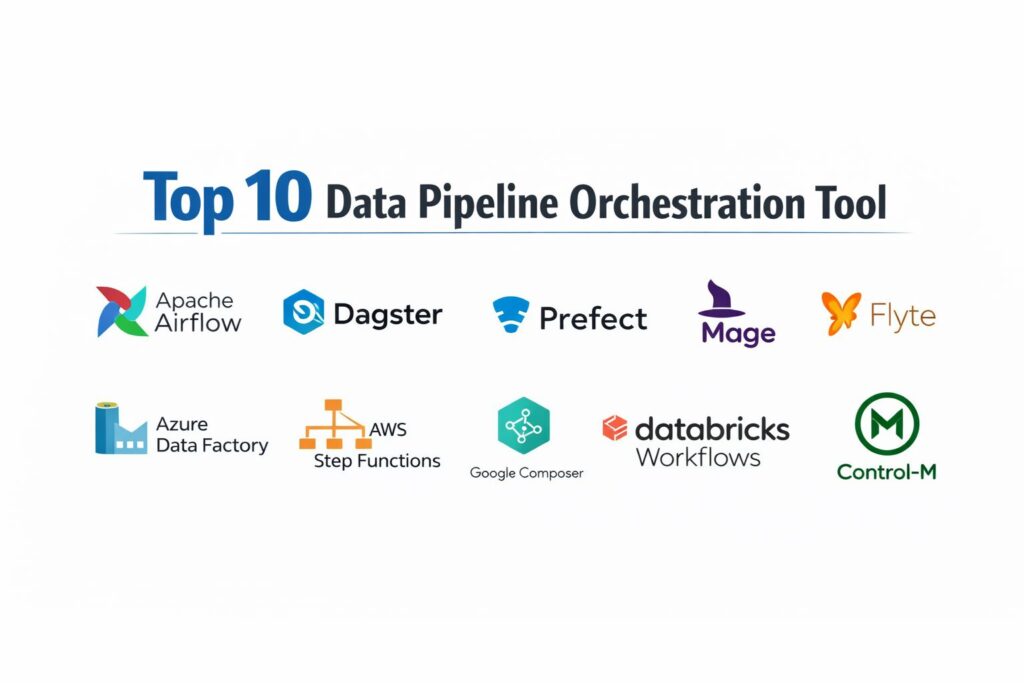
The selection of these top 10 tools was guided by a rigorous evaluation of their technical maturity, community support, and alignment with modern data engineering standards. We prioritized tools that offer high flexibility through Python-based or code-first configurations, as these are essential for building complex, custom logic. Market adoption was a key factor; we focused on platforms that have a proven track record in production environments at scale, ranging from open-source legends to cloud-native powerhouses.
Technical criteria included the robustness of the API, the quality of the monitoring UI, and the depth of the integration ecosystem. We looked for tools that could bridge the gap between legacy on-premises systems and modern cloud warehouses. Reliability features—such as native support for retries, backfilling, and state management—were considered non-negotiable. Finally, we assessed each tool’s ability to support emerging paradigms like MLOps, real-time streaming, and data mesh architectures to ensure they remain relevant in a rapidly changing landscape.
1. Apache Airflow
Apache Airflow remains the gold standard for programmatic workflow orchestration. Originally developed at Airbnb, it uses Python-based Directed Acyclic Graphs (DAGs) to define tasks and their dependencies. Its massive “Providers” ecosystem allows it to connect to virtually any database, cloud service, or API in existence, making it the most extensible tool in the market.
Key Features
The platform features a rich, web-based UI for visualizing DAGs and monitoring execution progress in real-time. It supports dynamic pipeline generation, allowing DAGs to be created on-the-fly based on external configurations or database entries. It offers powerful scaling options through executors like Kubernetes and Celery. The system includes built-in retry logic, alerting, and complex scheduling capabilities. With the latest versions, it has introduced enhanced support for event-driven triggers and improved performance for large-scale deployments.
Pros
An unmatched ecosystem of integrations and a massive global community provide extensive documentation and pre-built operators. It is highly customizable, allowing for the most complex logic imaginable.
Cons
It has a steep learning curve and requires significant infrastructure management and DevOps support if self-hosted. It can feel clunky for very simple or lightweight projects.
Platforms and Deployment
Self-hosted on Kubernetes/Docker or managed via cloud providers (Amazon MWAA, Google Cloud Composer).
Security and Compliance
Supports RBAC (Role-Based Access Control), secret management integrations, and enterprise-grade authentication protocols.
Integrations and Ecosystem
Thousands of community-built providers for AWS, GCP, Azure, Snowflake, dbt, Spark, and more.
Support and Community
Extensive open-source community support via Slack, Stack Overflow, and the Apache Software Foundation.
2. Dagster
Dagster is a modern, “orchestrator for the whole lifecycle,” focusing on developer experience and data quality. It introduced the concept of “Software-Defined Assets,” where the focus is on the data products produced rather than just the tasks performed. This makes it a favorite for teams prioritizing observability and testability.
Key Features
The platform emphasizes local development and testing, allowing engineers to run and verify pipelines on their laptops before deployment. It features a built-in asset catalog that tracks the versioning and lineage of every piece of data produced. It uses a type-safe approach to pipeline building, catching errors early in the development process. The UI (Dagster+ or Dagit) is highly interactive and provides deep insights into metadata. It also supports “sensors” for event-driven orchestration and “schedules” for time-based execution.
Pros
Superior observability and built-in lineage tracking make it easier to debug complex data issues. The asset-based approach aligns perfectly with modern data mesh and data quality standards.
Cons
The ecosystem of pre-built integrations is smaller than Airflow’s. The shift from task-centric to asset-centric thinking may require a mindset change for experienced engineers.
Platforms and Deployment
Cloud-native (Dagster+), self-hosted on Kubernetes, or local execution.
Security and Compliance
Provides robust security features including SSO, fine-grained access controls, and secure metadata handling.
Integrations and Ecosystem
Excellent native integrations with dbt, Snowflake, BigQuery, and DuckDB.
Support and Community
A rapidly growing community and highly responsive commercial support via Dagster Labs.
3. Prefect
Prefect is designed as a “Python-first” orchestrator that aims to stay out of the developer’s way. It allows you to turn any standard Python function into a resilient, observable task with a simple decorator. It is widely praised for its ease of use and its hybrid execution model.
Key Features
The platform features a unique “Hybrid” model where the orchestration engine lives in the cloud, but the actual data processing stays within your own secure infrastructure. It supports dynamic mapping, which allows tasks to be spawned based on the output of previous steps. It provides real-time alerting and monitoring through a polished web dashboard. It eliminates the need for rigid DAG definitions, allowing for more flexible, imperative code. The system also includes “Blocks” for managing configurations and secrets across different environments.
Pros
Extremely low barrier to entry for Python developers; if you can write Python, you can use Prefect. It offers high flexibility for running workflows anywhere—from a local machine to a global Kubernetes cluster.
Cons
While it is open-source, some of the most powerful features are optimized for the Prefect Cloud platform. It may lack some of the enterprise-level “legacy” connectors found in Airflow.
Platforms and Deployment
Managed SaaS (Prefect Cloud) or self-hosted server on Kubernetes or virtual machines.
Security and Compliance
SOC 2 Type II compliant with advanced security features like API keys and workspace isolation.
Integrations and Ecosystem
Strong support for the modern data stack, including AWS, Azure, GCP, dbt, and Databricks.
Support and Community
Active community on Slack and professional support tiers for enterprise customers.
4. Mage
Mage is an open-source data orchestration tool that combines the interactive experience of a notebook with production-grade engineering. It is designed to make building pipelines as fast and collaborative as possible, catering to both data engineers and analysts.
Key Features
The platform features a hybrid development interface that allows users to write code in a notebook-style UI while automatically generating modular, file-based code in the background. It supports Python, SQL, and R within a single pipeline, allowing team members with different skill sets to collaborate. It includes built-in data visualization tools to inspect data at every step of the pipeline. The system provides real-time feedback on errors and supports automated data validation. It also features a lightweight, containerized architecture for easy deployment.
Pros
The “notebook-to-production” workflow significantly accelerates development speed and prototyping. It is very user-friendly for teams that prefer a visual and interactive environment.
Cons
As a newer tool, it has a smaller community and fewer third-party plugins compared to established giants. It might not be as battle-tested for extreme, petabyte-scale enterprise workloads yet.
Platforms and Deployment
Web-based UI, easily deployable via Docker, Kubernetes, or various cloud-managed services.
Security and Compliance
Standard encryption and access control protocols; focuses on secure local or private cloud deployments.
Integrations and Ecosystem
Growing list of integrations with major data warehouses and streaming platforms.
Support and Community
Strong initial community adoption and a focus on open-source developer engagement.
5. Flyte
Flyte is a Kubernetes-native orchestration platform originally created at Lyft. It is specifically designed to handle massive, complex workflows for data and machine learning at scale, focusing on reproducibility and strong typing.
Key Features
The platform uses a container-first approach, where every task runs in its own isolated environment with its own dependencies. It provides a strongly typed interface for task inputs and outputs, ensuring data integrity across large teams. It features native support for versioning, allowing every execution to be reproduced exactly. The system supports multi-language workflows, including Python, Java, and Scala. It also includes an advanced resource management system that can dynamically allocate GPUs or high-memory instances for specific tasks.
Pros
Unparalleled scalability and reliability for AI and ML workloads. The strong typing and versioning make it the best choice for highly regulated industries like healthcare or finance.
Cons
It has a very steep learning curve and requires deep expertise in Kubernetes to manage effectively. It is likely overkill for simple ETL pipelines.
Platforms and Deployment
Kubernetes-native; can be deployed on EKS, GKE, AKS, or on-premises K8s clusters.
Security and Compliance
Enterprise-grade security with native Kubernetes RBAC and secure data isolation between tasks.
Integrations and Ecosystem
Deep integrations with ML frameworks like PyTorch, TensorFlow, and various cloud-native data tools.
Support and Community
Backed by the Union.ai team and a dedicated community of high-scale data practitioners.
6. Azure Data Factory (ADF)
Azure Data Factory is Microsoft’s premier cloud-based data integration service. It is designed for hybrid environments, making it the ideal choice for enterprises moving data from on-premises servers to the Azure cloud.
Key Features
The platform features a visual, “no-code” pipeline designer that allows users to build complex ETL workflows with drag-and-drop ease. It includes over 90 built-in connectors for a wide range of data sources, from SAP and Oracle to SaaS apps like Salesforce. It supports the rehosting of SQL Server Integration Services (SSIS) packages in the cloud. The system provides integrated monitoring and alerting through Azure Monitor. It also allows for the execution of custom code via Azure Functions or Spark notebooks within the visual pipeline.
Pros
The visual interface is highly accessible for non-developers and data analysts. It integrates perfectly with the entire Microsoft ecosystem, including Power BI, Synapse, and Azure DevOps.
Cons
It can be restrictive for engineers who prefer “code-first” development. Complex conditional logic can sometimes feel “clunky” within a visual canvas compared to raw Python code.
Platforms and Deployment
Fully managed SaaS within the Microsoft Azure portal.
Security and Compliance
Complies with global standards (HIPAA, GDPR) and uses Azure’s high-level security infrastructure.
Integrations and Ecosystem
Deeply integrated with Azure services and dozens of external databases and SaaS applications.
Support and Community
Standard Microsoft enterprise support and an extensive library of documentation and tutorials.
7. AWS Step Functions
AWS Step Functions is a serverless orchestration service that coordinates multiple AWS services into business-critical workflows. It is built on the concept of state machines, making it exceptionally reliable for long-running processes.
Key Features
The platform features a visual workflow designer that helps visualize the state transitions of a process. It is completely serverless, meaning you don’t have to manage any infrastructure, and it scales automatically with your workload. It provides built-in error handling, retries, and “wait” states to handle asynchronous tasks. It integrates natively with over 200 AWS services, including Lambda, Glue, and Redshift. The system supports both “Standard” workflows for long-running tasks and “Express” workflows for high-volume, short-duration tasks.
Pros
Extremely high reliability with automatic state management and “exactly-once” execution. The pay-per-execution pricing model is very cost-effective for irregular workloads.
Cons
Vendor lock-in is high, as it is strictly designed for the AWS ecosystem. The JSON-based Amazon States Language (ASL) used to define workflows can be verbose and difficult to write manually.
Platforms and Deployment
Serverless SaaS within the Amazon Web Services environment.
Security and Compliance
Fully integrated with AWS IAM (Identity and Access Management) and supports HIPAA and PCI compliance.
Integrations and Ecosystem
Native integration with the entire AWS service catalog.
Support and Community
Enterprise-grade support from AWS and a massive library of blueprints and examples.
8. Google Cloud Composer
Google Cloud Composer is a fully managed workflow orchestration service built on Apache Airflow. It offers the full power and flexibility of Airflow without the operational headache of managing the underlying Kubernetes clusters and databases.
Key Features
The platform automatically provisions and scales the Airflow environment within the Google Cloud ecosystem. It integrates natively with BigQuery, Cloud Dataflow, and Vertex AI, making it a powerful choice for Google-centric data stacks. It features a simplified UI for managing Airflow environments and updating Python packages. The system includes integrated logging and monitoring through Google Cloud’s operations suite. It also provides high availability by distributing the Airflow components across multiple zones.
Pros
Provides all the benefits of Airflow (customization, community) with the ease of a managed service. It significantly reduces the DevOps time needed to maintain a production Airflow instance.
Cons
It can be more expensive than self-hosting Airflow for very large fleets. Users are tied to specific Airflow versions supported by Google at any given time.
Platforms and Deployment
Fully managed service on Google Cloud Platform.
Security and Compliance
Integrates with Google Cloud IAM and VPC Service Controls for high-level security.
Integrations and Ecosystem
Full access to the Airflow provider ecosystem, with optimized performance for Google Cloud services.
Support and Community
Standard GCP support and the broader Apache Airflow open-source community.
9. Databricks Workflows
Databricks Workflows is a unified orchestration service built into the Databricks Lakehouse Platform. It is designed to orchestrate data, analytics, and machine learning workloads seamlessly within the Databricks environment.
Key Features
The platform allows for the orchestration of Databricks notebooks, Spark jobs, SQL queries, and dbt projects. It features “Task Repair,” which allows users to restart only the failed parts of a complex multi-task job. It integrates deeply with Unity Catalog for end-to-end data lineage and governance. The system provides a unified monitoring dashboard for all jobs across the workspace. It supports both scheduled and file-arrival triggers, as well as an API for event-driven execution. It also offers git-integration for version control of workflow definitions.
Pros
The tight integration with Spark and the Lakehouse architecture provides superior performance for big data processing. It eliminates the need for an external orchestrator for teams already using Databricks.
Cons
It is primarily optimized for the Databricks ecosystem, making it less ideal for orchestrating tasks in other cloud environments or legacy systems.
Platforms and Deployment
Managed SaaS on AWS, Azure, and GCP as part of the Databricks platform.
Security and Compliance
Inherits enterprise security and governance from the Databricks Unity Catalog and platform.
Integrations and Ecosystem
Excellent integration with dbt and major cloud storage providers.
Support and Community
Professional support from Databricks and an active user community focused on the Lakehouse architecture.
10. Control-M
Control-M by BMC is the leading enterprise-grade orchestration tool for hybrid IT environments. It is designed for large-scale organizations that need to coordinate complex workflows across mainframes, on-premises servers, and multiple cloud platforms.
Key Features
The platform provides a single “pane of glass” for viewing and managing workflows across the entire enterprise tech stack. It features predictive analytics that can forecast when a pipeline might miss its SLA (Service Level Agreement). It includes “Control-M Automation API,” which allows developers to treat “Jobs as Code” using JSON and Git. The system supports massive scale, managing millions of jobs per day with high reliability. It also offers advanced auditing and governance features required by highly regulated industries like banking and insurance.
Pros
The absolute gold standard for hybrid visibility and legacy-to-cloud bridging. The predictive SLA monitoring is a critical feature for mission-critical business processes.
Cons
The enterprise licensing cost is high, making it inaccessible for startups or small teams. The interface and configuration model are more IT-admin focused than developer-focused.
Platforms and Deployment
On-premises, cloud-based, or hybrid deployment models.
Security and Compliance
Deep security features designed for global banking and government standards.
Integrations and Ecosystem
Vast list of connectors for everything from Hadoop and SAP to modern cloud-native tools.
Support and Community
High-level enterprise support from BMC and a long-standing community of IT operations professionals.
Comparison Table
| Tool Name | Best For | Platform(s) Supported | Deployment | Standout Feature | Public Rating |
| 1. Apache Airflow | Engineering Power-users | K8s, Cloud, Docker | Hybrid | Infinite Extensibility | 4.8/5 |
| 2. Dagster | Data Quality/Lineage | Web, K8s, Cloud | Hybrid | Software-Defined Assets | 4.7/5 |
| 3. Prefect | Developer Speed | Web, K8s, Cloud | Hybrid | Hybrid Execution Model | 4.6/5 |
| 4. Mage | Collaborative Teams | Web, Docker | Cloud | Notebook-style UI | 4.4/5 |
| 5. Flyte | High-Scale AI/ML | Kubernetes-native | Cloud/On-prem | Strongly Typed Tasks | 4.5/5 |
| 6. Azure Data Factory | Visual/Hybrid ETL | Azure | Managed SaaS | 90+ Native Connectors | 4.5/5 |
| 7. AWS Step Functions | Serverless Workflows | AWS | Serverless | Exactly-once Execution | 4.6/5 |
| 8. Google Composer | Managed Airflow | GCP | Managed SaaS | GCP Ecosystem Sync | 4.4/5 |
| 9. Databricks Workflows | Lakehouse Teams | Multi-cloud (DBX) | Managed SaaS | Task Repair Logic | 4.6/5 |
| 10. Control-M | Global Enterprise | Hybrid/Mainframe | Hybrid | Predictive SLA Alerts | 4.3/5 |
Evaluation & Scoring of Data Pipeline Orchestration Tools
The scoring below is a comparative model intended to help shortlisting. Each criterion is scored from 1–10, then a weighted total from 0–10 is calculated using the weights listed. These are analyst estimates based on typical fit and common workflow requirements, not public ratings.
Weights:
- Core features – 25%
- Ease of use – 15%
- Integrations & ecosystem – 15%
- Security & compliance – 10%
- Performance & reliability – 10%
- Support & community – 10%
- Price / value – 15%
| Tool Name | Core (25%) | Ease (15%) | Integrations (15%) | Security (10%) | Performance (10%) | Support (10%) | Value (15%) | Weighted Total |
| 1. Apache Airflow | 10 | 6 | 10 | 9 | 8 | 10 | 8 | 8.85 |
| 2. Dagster | 9 | 7 | 8 | 9 | 9 | 9 | 8 | 8.55 |
| 3. Prefect | 8 | 10 | 8 | 9 | 9 | 8 | 9 | 8.65 |
| 4. Mage | 7 | 10 | 6 | 8 | 8 | 7 | 9 | 7.70 |
| 5. Flyte | 10 | 5 | 7 | 10 | 10 | 8 | 7 | 8.10 |
| 6. Azure Data Factory | 8 | 9 | 9 | 10 | 8 | 9 | 8 | 8.60 |
| 7. AWS Step Functions | 9 | 8 | 8 | 10 | 10 | 9 | 9 | 9.00 |
| 8. Google Composer | 9 | 8 | 9 | 9 | 8 | 9 | 7 | 8.45 |
| 9. Databricks Workflows | 8 | 8 | 7 | 10 | 10 | 9 | 8 | 8.45 |
| 10. Control-M | 9 | 5 | 10 | 10 | 10 | 10 | 6 | 8.35 |
How to interpret the scores:
- Use the weighted total to shortlist candidates, then validate with a pilot.
- A lower score can mean specialization, not weakness.
- Security and compliance scores reflect controllability and governance fit, because certifications are often not publicly stated.
- Actual outcomes vary with assembly size, team skills, templates, and process maturity.
Which Data Pipeline Orchestration Tool Is Right for You?
Solo / Freelancer
For individuals or small projects, Prefect is the clear winner due to its “Python-first” ease of use. You can get up and running in minutes by adding a simple decorator to your existing scripts, and the managed cloud tier is very generous for solo work.
SMB
Small and medium businesses often benefit most from Mage or Dagster. Mage offers a fast, interactive way to build and visualize pipelines, while Dagster provides the testing and observability features that help a growing team maintain high data quality standards without a large DevOps presence.
Mid-Market
Organizations with established data teams should look toward managed Airflow options like Google Cloud Composer or Amazon MWAA. These provide the industry-standard power of Airflow with significantly reduced operational overhead, allowing the team to focus on building logic rather than maintaining servers.
Enterprise
Large-scale enterprises with hybrid infrastructure (on-prem + cloud) will find the most value in Control-M or Azure Data Factory. Control-M provides the necessary visibility across legacy systems, while ADF offers the enterprise-grade connectors and visual interface needed for large, cross-functional teams.
Budget vs Premium
If the goal is to keep costs low, open-source Airflow or Prefect are the strongest choices, provided you have the engineering talent to manage them. For those willing to pay a premium for a “zero-management” experience, AWS Step Functions or Databricks Workflows offer exceptional value.
Feature Depth vs Ease of Use
Airflow and Flyte offer the greatest feature depth but come with a steep learning curve. Conversely, Mage and Azure Data Factory prioritize ease of use and accessibility, making them better for teams that need to deliver pipelines quickly without deep specialized knowledge.
Integrations & Scalability
Airflow remains the undisputed king of integrations. However, if your scale is driven specifically by AI and machine learning, Flyte’s Kubernetes-native architecture offers specialized scalability that even Airflow struggles to match.
Security & Compliance Needs
All listed tools meet high security standards, but AWS Step Functions and Azure Data Factory offer the most seamless integration with existing enterprise-grade identity and access management (IAM) systems, which is often a critical requirement for corporate compliance teams.
Frequently Asked Questions (FAQs)
1. What is the difference between a scheduler and an orchestrator?
A scheduler (like Cron) simply runs a task at a specific time. An orchestrator manages the entire lifecycle, including dependencies (Task B only runs if Task A succeeds), retries, error handling, state management, and real-time observability across the whole system.
2. Do I need an orchestrator if I use dbt?
While dbt has some basic internal scheduling (especially in dbt Cloud), most production environments use a dedicated orchestrator like Airflow or Dagster to trigger dbt as part of a larger workflow that includes data ingestion and BI dashboard refreshing.
3. Is Airflow still the best choice in 2026?
It is still the most widely used due to its maturity and ecosystem. However, newer tools like Dagster and Prefect are gaining significant ground by offering better developer experiences and more modern paradigms like asset-centric orchestration.
4. Can I use these tools for real-time streaming data?
Some tools like Mage and Prefect have better support for event-driven triggers. However, for true high-volume, millisecond-latency streaming, you would typically use a dedicated system like Apache Flink or Kafka Streams, managed by an orchestrator for the broader business logic.
5. How much does a managed orchestration service cost?
Costs vary wildly. Serverless options like AWS Step Functions charge per execution, while managed Airflow services like MWAA charge per hour for the environment. Startups might spend $100/month, while enterprises can easily spend thousands.
6. What is “Jobs as Code”?
This is the practice of defining your data pipelines using standard programming languages (like Python or JSON) and storing them in Git. This allows for version control, code reviews, and automated testing, similar to how modern software is built.
7. Can an orchestrator handle data quality checks?
Many modern orchestrators like Dagster have built-in data quality tracking. For others like Airflow, you typically integrate a third-party tool like Great Expectations or Monte Carlo into the pipeline to perform the checks.
8. Which tool is best for MLOps?
Flyte and ZenML (often used with Prefect) are highly specialized for the ML lifecycle, offering native support for things like model versioning, GPU resource allocation, and experiment tracking that general-purpose tools may lack.
9. Is vendor lock-in a major concern?
It is a concern with cloud-native tools like AWS Step Functions or Azure Data Factory. Open-source tools like Airflow or Prefect are more portable, allowing you to move your pipelines between different cloud providers or on-premises servers more easily.
10. How do I choose between Dagster and Prefect?
Choose Dagster if you are focused on data lineage, testing, and modeling your data as “assets.” Choose Prefect if you want the most “Pythonic” experience that lets you turn existing scripts into pipelines with minimal effort.
Conclusion
The selection of a data pipeline orchestration tool is a foundational decision that impacts the agility, reliability, and scalability of your entire data strategy. The marketplace offers a spectrum ranging from the “infinite flexibility” of open-source Apache Airflow to the “serverless simplicity” of AWS Step Functions. The right choice depends on your team’s technical maturity and your specific architectural needs—whether that is bridging legacy on-premises systems or powering a modern, AI-first Lakehouse. As the data ecosystem continues to shift toward autonomous operations and deep observability, the orchestrator you choose today must not only schedule tasks but also serve as a source of truth for your data lineage and quality. By investing in a robust orchestration layer, you ensure that your data infrastructure remains a resilient, well-governed engine of growth rather than a source of operational complexity and technical debt.