Introduction
Data Integration and ETL tools help teams collect data from many sources, clean it, transform it into a usable format, and deliver it to a target system like a data warehouse, lake, or analytics platform. They matter because businesses now depend on timely, trusted data for reporting, machine learning, customer insights, finance controls, and operational decisions. Real-world use cases include building a unified customer view, syncing product and order data across systems, feeding dashboards with fresh metrics, supporting regulatory reporting, and moving application data into a warehouse for analytics. When choosing a tool, evaluate connector coverage, transformation depth, reliability, monitoring, scaling, orchestration, governance, security controls, ease of use, and total cost.
Best for: data engineers, analytics engineers, BI teams, platform teams, and IT teams who need repeatable, reliable pipelines across databases, SaaS apps, files, and streaming sources.
Not ideal for: teams doing one-off manual exports, very small datasets, or simple spreadsheet-based reporting where a full pipeline adds unnecessary complexity.
Key Trends in Data Integration & ETL Tools
- More ELT-style workflows where transformations run inside the warehouse
- Wider use of change data capture for near-real-time replication
- Stronger focus on data observability, lineage, and end-to-end monitoring
- More low-code pipeline building for faster delivery across teams
- Increased demand for governance controls and standardized data contracts
- Greater attention to cost control with usage-based pricing and workload tuning
- More hybrid patterns to support cloud and on-prem sources together
- Better schema drift handling and automated pipeline recovery features
- Growing expectation for role-based access, audit logs, and encryption controls
- Bigger ecosystem focus: connectors, APIs, and integrations with orchestration tools
How We Selected These Tools (Methodology)
- Chose widely adopted tools with strong credibility in data integration and ETL
- Prioritized reliable pipeline execution and clear operational monitoring
- Looked for broad connector availability across SaaS, databases, and warehouses
- Considered transformation flexibility for both simple and complex pipelines
- Evaluated scalability for higher volumes and more frequent refresh needs
- Included a mix of modern cloud-first tools and established enterprise options
- Considered ecosystem strength: integrations, community, and talent availability
- Weighted practical fit across teams: solo engineers to large enterprises
- Scored comparatively using a consistent rubric rather than marketing claims
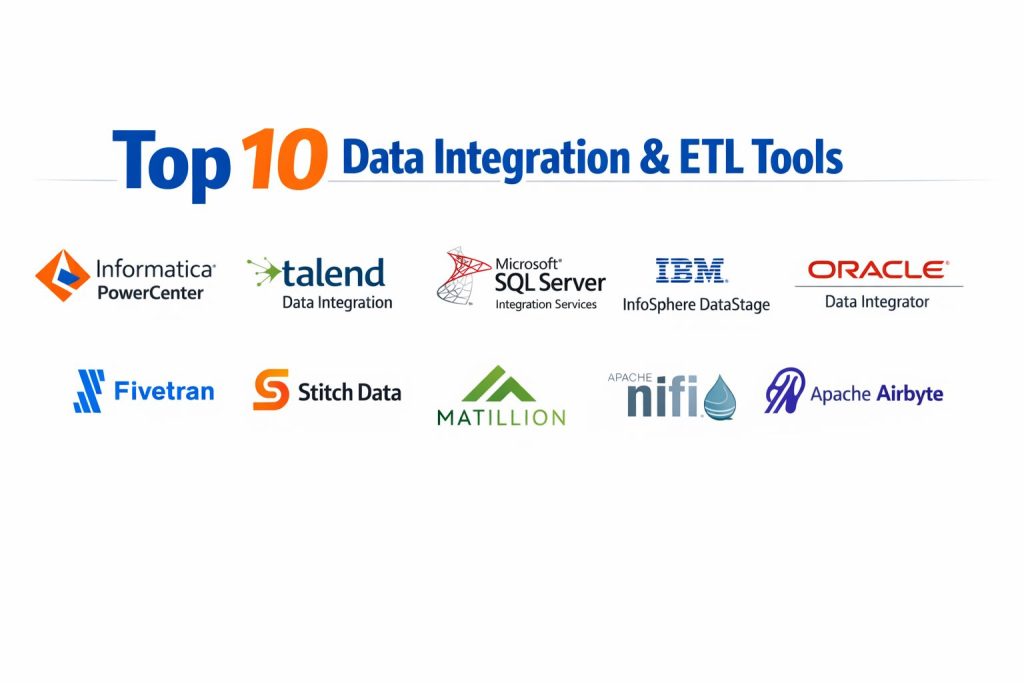
Top 10 Data Integration & ETL Tools
1) Informatica PowerCenter
A long-standing enterprise ETL platform used for complex data integration at scale. Best for large organizations that need mature governance, strong control, and proven operational patterns.
Key Features
- Enterprise-grade ETL design and execution
- Broad connectivity across databases and enterprise systems
- Advanced transformation capabilities for complex pipelines
- Centralized management for scheduling and workload control
- Strong metadata-driven development patterns
- Robust monitoring and operational controls
- Common fit for regulated and large-scale environments
Pros
- Proven at scale for complex enterprise requirements
- Strong support for governance-oriented processes
Cons
- Can be heavy to implement and maintain for smaller teams
- Licensing and administration overhead can be significant
Platforms / Deployment
- Windows / Linux
- Self-hosted (hybrid patterns vary / N/A)
Security & Compliance
- SSO/SAML, MFA, encryption, audit logs, RBAC: Not publicly stated
- SOC 2, ISO 27001, GDPR, HIPAA: Not publicly stated
Integrations & Ecosystem
Often integrated with enterprise data management stacks, governance tools, and large system landscapes.
- Database and enterprise connectors: Varies / N/A
- Scheduling and workload integration: Varies / N/A
- Metadata and governance integrations: Varies / N/A
- Custom extensions and APIs: Varies / Not publicly stated
Support & Community
Strong enterprise support options; community is smaller than open tools but enterprise adoption is broad.
2) Talend Data Integration
A widely used data integration tool with strong transformation capabilities and a large connector ecosystem. Fits teams that need both development flexibility and enterprise patterns.
Key Features
- Visual pipeline design for ETL and data integration
- Strong connector library across many common sources
- Flexible transformation logic for complex workflows
- Data quality and enrichment patterns (varies by edition)
- Scheduling and job management features
- Supports batch and some near-real-time patterns (setup dependent)
- Common use for both analytics and operational integration
Pros
- Good balance of flexibility and structured development
- Strong connectivity across common enterprise and analytics systems
Cons
- Operational overhead can grow as pipelines and jobs increase
- Advanced features may depend on edition and licensing
Platforms / Deployment
- Windows / macOS / Linux (varies by distribution)
- Self-hosted (cloud options vary / N/A)
Security & Compliance
- SSO/SAML, MFA, encryption, audit logs, RBAC: Not publicly stated
- SOC 2, ISO 27001, GDPR, HIPAA: Not publicly stated
Integrations & Ecosystem
Often used in pipelines that combine databases, SaaS applications, and warehouses, with extensions for enterprise governance.
- Connector ecosystem: Varies / N/A
- APIs and extensibility: Varies / Not publicly stated
- Orchestration integration: Varies / N/A
- Data quality ecosystem: Varies / N/A
Support & Community
Good documentation and community footprint; enterprise support varies by plan.
3) Microsoft SQL Server Integration Services
A classic ETL tool frequently used in Microsoft-centered environments. Best for teams that live in SQL Server ecosystems and want tight integration with related tooling.
Key Features
- Strong ETL workflow design around SQL Server environments
- Built-in transformations for common ETL tasks
- Scheduling and execution patterns through Microsoft toolchains
- Good fit for data movement between Microsoft data systems
- Supports complex workflows with careful design
- Mature operational patterns for job execution and logging
- Works well for structured batch processing needs
Pros
- Excellent fit for Microsoft-centric stacks
- Mature, well-known ETL patterns for batch pipelines
Cons
- Less ideal for cloud-native SaaS-heavy connector needs
- Can become complex to maintain with large numbers of packages
Platforms / Deployment
- Windows
- Self-hosted
Security & Compliance
- SSO/SAML, MFA, encryption, audit logs, RBAC: Varies / N/A
- SOC 2, ISO 27001, GDPR, HIPAA: Not publicly stated
Integrations & Ecosystem
Commonly used with Microsoft data platforms and enterprise scheduling practices.
- SQL Server ecosystem integrations: Varies / N/A
- Orchestration through related Microsoft tools: Varies / N/A
- Custom scripts and extensions: Varies / N/A
- Connectors: Varies / N/A
Support & Community
Large community and abundant learning resources; support depends on Microsoft licensing and enterprise agreements.
4) IBM InfoSphere DataStage
An enterprise ETL platform designed for large-scale data integration and performance. Best for organizations needing strong parallel processing patterns and structured governance.
Key Features
- Parallel processing support for higher-scale workloads
- Visual job design for ETL pipelines
- Strong enterprise connectivity patterns
- Centralized management and operational oversight
- Handling of complex transformations and enterprise workflows
- Common use in large and regulated environments
- Strong fit for standardized data integration programs
Pros
- Built for enterprise workloads and structured operations
- Strong performance patterns for large-scale processing
Cons
- Implementation and administration can be complex
- Cost may be high for smaller teams and simple needs
Platforms / Deployment
- Linux (Windows support varies / N/A)
- Self-hosted (hybrid patterns vary / N/A)
Security & Compliance
- SSO/SAML, MFA, encryption, audit logs, RBAC: Not publicly stated
- SOC 2, ISO 27001, GDPR, HIPAA: Not publicly stated
Integrations & Ecosystem
Often used within IBM and enterprise governance ecosystems, with integrations depending on the broader stack.
- Enterprise connectors: Varies / N/A
- Governance and metadata systems: Varies / N/A
- Automation and APIs: Varies / Not publicly stated
Support & Community
Strong enterprise support; community is more specialized than modern cloud-first tools.
5) Oracle Data Integrator
An ETL and data integration tool designed for Oracle-heavy environments, often used when teams want strong integration with Oracle data platforms and enterprise patterns.
Key Features
- Strong integration patterns for Oracle ecosystems
- Supports ELT-style transformations in target systems (workflow dependent)
- Visual design and management for integration workflows
- Broad enterprise connectivity (varies by configuration)
- Scheduling and operational controls
- Suitable for large-scale structured integration programs
- Often used in centralized data teams with governance processes
Pros
- Strong fit where Oracle platforms are core
- Works well for enterprise-grade integration patterns
Cons
- Less appealing if your stack is mostly non-Oracle and SaaS-heavy
- Can be complex to manage at scale without standard practices
Platforms / Deployment
- Windows / Linux (varies by environment)
- Self-hosted
Security & Compliance
- SSO/SAML, MFA, encryption, audit logs, RBAC: Not publicly stated
- SOC 2, ISO 27001, GDPR, HIPAA: Not publicly stated
Integrations & Ecosystem
Typically strongest in Oracle-first environments, with broader connector coverage depending on setup and licensing.
- Oracle ecosystem integrations: Varies / N/A
- APIs and extensions: Varies / Not publicly stated
- Orchestration integration: Varies / N/A
Support & Community
Enterprise-oriented support and documentation; community is stronger in Oracle-centric organizations.
6) Fivetran
A managed data integration platform known for automated connectors and low-maintenance pipeline operation. Best for teams that want to replicate data from many sources into warehouses with minimal engineering effort.
Key Features
- Managed connectors for many SaaS apps and databases
- Automated schema handling patterns (behavior varies by connector)
- Change data capture options for supported sources (varies)
- Operational monitoring and alerting patterns
- Incremental sync workflows to reduce full reloads
- Fast setup for common analytics warehouse destinations
- Good fit for teams prioritizing speed and reliability over custom logic
Pros
- Low operational burden for common connector-based ingestion
- Fast time-to-value for analytics replication pipelines
Cons
- Complex transformations often need separate transformation tooling
- Costs can rise with volume and connector usage patterns
Platforms / Deployment
- Web
- Cloud
Security & Compliance
- SSO/SAML, MFA, encryption, audit logs, RBAC: Not publicly stated
- SOC 2, ISO 27001, GDPR, HIPAA: Not publicly stated
Integrations & Ecosystem
Strong ecosystem for warehouse ingestion and analytics workflows, commonly paired with transformation tools.
- Warehouse destinations: Varies / N/A
- Connector ecosystem: Varies / N/A
- Orchestration and transformation integrations: Varies / N/A
- APIs and extensibility: Varies / Not publicly stated
Support & Community
Generally strong documentation and product support; community content exists but is smaller than open-source tools.
7) Stitch Data
A data ingestion and integration tool designed to move data into analytics systems with simple setup. Often used by smaller teams that want straightforward ingestion with limited operational overhead.
Key Features
- Connectors for common SaaS apps and databases
- Incremental loading patterns for many sources (varies)
- Simple management for ingestion pipelines
- Basic monitoring and pipeline visibility
- Works well for analytics replication needs
- Good fit for lean teams building reporting pipelines
- Easier onboarding than heavy enterprise ETL suites
Pros
- Simple and relatively fast setup for common ingestion pipelines
- Useful for small analytics teams and early-stage data stacks
Cons
- Transformation depth may be limited compared to full ETL suites
- Connector breadth and advanced features can vary by plan
Platforms / Deployment
- Web
- Cloud
Security & Compliance
- SSO/SAML, MFA, encryption, audit logs, RBAC: Not publicly stated
- SOC 2, ISO 27001, GDPR, HIPAA: Not publicly stated
Integrations & Ecosystem
Often used in lightweight analytics stacks and paired with external transformation layers when needed.
- Warehouse destinations: Varies / N/A
- Connector ecosystem: Varies / N/A
- APIs: Varies / Not publicly stated
Support & Community
Documentation is typically sufficient for setup; support and community depth varies by plan and user base.
8) Matillion
A cloud-focused ETL and data integration tool often used for warehouse-centric ELT patterns. Best for teams that want strong transformation inside modern cloud warehouses with a practical UI.
Key Features
- Visual pipeline building for ELT and transformation workflows
- Strong support for warehouse-centric transformations
- Orchestration-style job scheduling patterns (depends on setup)
- Good fit for analytics engineering workflows
- Connector support for common sources (varies)
- Monitoring and operational job controls
- Designed for cloud-oriented data platforms
Pros
- Strong fit for ELT workflows inside modern warehouses
- Helps teams move quickly with visual job development
Cons
- Best value depends on the specific warehouse and connector needs
- Costs can scale with usage and job complexity
Platforms / Deployment
- Web
- Cloud
Security & Compliance
- SSO/SAML, MFA, encryption, audit logs, RBAC: Not publicly stated
- SOC 2, ISO 27001, GDPR, HIPAA: Not publicly stated
Integrations & Ecosystem
Typically integrated with cloud warehouses and analytics tools, often acting as the main transformation layer.
- Warehouse integration patterns: Varies / N/A
- Connector ecosystem: Varies / N/A
- Orchestration integration: Varies / N/A
- APIs and extensibility: Varies / Not publicly stated
Support & Community
Generally strong documentation and support materials; community presence varies by region and user base.
9) Apache NiFi
An open-source data flow automation tool for moving and transforming data across systems. Best for teams that need flexible routing, flow control, and on-prem or hybrid data movement.
Key Features
- Visual flow-based programming for data routing and transformation
- Strong support for streaming-style flows and controlled backpressure
- Many processors for common systems and protocols (varies)
- Versioned flow management patterns (setup dependent)
- Good fit for hybrid and on-prem integration needs
- Fine-grained control over data movement and prioritization
- Often used as a backbone for data ingestion and system-to-system flows
Pros
- Flexible for complex routing and hybrid integration patterns
- Strong control over flow reliability and throughput management
Cons
- Requires operational skills to run reliably at scale
- Complex transformations may be better handled in dedicated processing layers
Platforms / Deployment
- Windows / macOS / Linux
- Self-hosted
Security & Compliance
- SSO/SAML, MFA, encryption, audit logs, RBAC: Varies / N/A
- SOC 2, ISO 27001, GDPR, HIPAA: Not publicly stated
Integrations & Ecosystem
NiFi is often used in system integration architectures where protocol support and routing flexibility are critical.
- Processor ecosystem: Varies / N/A
- Integration via common protocols and connectors: Varies / N/A
- APIs and extensions: Varies / Not publicly stated
- Orchestration integration: Varies / N/A
Support & Community
Strong open-source community and documentation, with support options available through vendors and service providers.
10) Apache Airbyte
An open-source data integration platform focused on connectors and replication into analytics destinations. Best for teams that want connector flexibility and the ability to self-host or customize.
Key Features
- Connector-based ingestion for many sources (connector maturity varies)
- Supports self-hosted and managed patterns (depending on chosen approach)
- Custom connector development patterns for unique sources
- Incremental sync workflows for supported connectors (varies)
- Useful for analytics ingestion and replication
- Community-driven ecosystem for connectors and improvements
- Works well when teams want more control than fully managed ingestion
Pros
- Flexible connector approach with customization potential
- Good fit for teams wanting open tooling and self-host control
Cons
- Operational overhead exists if self-hosting at scale
- Connector quality and maintenance can vary across sources
Platforms / Deployment
- Web (management UI varies) / Windows / macOS / Linux (self-hosted environments vary)
- Cloud / Self-hosted (varies)
Security & Compliance
- SSO/SAML, MFA, encryption, audit logs, RBAC: Varies / Not publicly stated
- SOC 2, ISO 27001, GDPR, HIPAA: Not publicly stated
Integrations & Ecosystem
Airbyte is commonly used for ingestion into modern analytics platforms and extended through custom connectors.
- Connector ecosystem: Varies / N/A
- Warehouse destinations: Varies / N/A
- APIs and extensibility: Varies / Not publicly stated
- Orchestration and transformation integrations: Varies / N/A
Support & Community
Active community and growing documentation; support depends on how it is deployed and whether a managed plan is used.
Comparison Table (Top 10)
| Tool Name | Best For | Platform(s) Supported | Deployment (Cloud/Self-hosted/Hybrid) | Standout Feature | Public Rating |
|---|---|---|---|---|---|
| Informatica PowerCenter | Enterprise ETL at scale | Windows, Linux | Self-hosted | Mature enterprise ETL governance patterns | N/A |
| Talend Data Integration | Flexible ETL and integration across systems | Windows, macOS, Linux (varies) | Self-hosted | Broad connectors with strong transformations | N/A |
| Microsoft SQL Server Integration Services | Microsoft-centered ETL workflows | Windows | Self-hosted | Tight fit for SQL Server ecosystems | N/A |
| IBM InfoSphere DataStage | Large-scale enterprise ETL | Linux (Windows varies / N/A) | Self-hosted | Parallel processing patterns | N/A |
| Oracle Data Integrator | Oracle-heavy enterprise integration | Windows, Linux (varies) | Self-hosted | Strong Oracle ecosystem alignment | N/A |
| Fivetran | Managed ingestion into warehouses | Web | Cloud | Low-maintenance connectors | N/A |
| Stitch Data | Simple ingestion for lean teams | Web | Cloud | Fast setup for common sources | N/A |
| Matillion | Warehouse-centric ELT transformations | Web | Cloud | Visual ELT for cloud warehouses | N/A |
| Apache NiFi | Hybrid flows and controlled data routing | Windows, macOS, Linux | Self-hosted | Flow control with backpressure | N/A |
| Apache Airbyte | Open connector-based ingestion | Windows, macOS, Linux (varies) | Cloud / Self-hosted | Customizable connector framework | N/A |
Evaluation & Scoring of Data Integration & ETL Tools
Weights: Core features 25%, Ease 15%, Integrations 15%, Security 10%, Performance 10%, Support 10%, Value 15%.
| Tool Name | Core (25%) | Ease (15%) | Integrations (15%) | Security (10%) | Performance (10%) | Support (10%) | Value (15%) | Weighted Total (0–10) |
|---|---|---|---|---|---|---|---|---|
| Informatica PowerCenter | 9.0 | 6.5 | 8.5 | 7.0 | 8.5 | 8.0 | 5.5 | 7.63 |
| Talend Data Integration | 8.5 | 7.0 | 8.5 | 6.5 | 8.0 | 7.5 | 7.0 | 7.78 |
| Microsoft SQL Server Integration Services | 7.5 | 7.5 | 7.0 | 6.0 | 7.5 | 7.5 | 7.5 | 7.33 |
| IBM InfoSphere DataStage | 8.5 | 6.5 | 8.0 | 6.5 | 8.5 | 7.5 | 5.5 | 7.38 |
| Oracle Data Integrator | 8.0 | 6.5 | 7.5 | 6.5 | 8.0 | 7.0 | 6.0 | 7.08 |
| Fivetran | 7.5 | 8.5 | 8.5 | 6.5 | 8.0 | 7.5 | 6.5 | 7.70 |
| Stitch Data | 6.5 | 8.0 | 7.5 | 6.0 | 7.0 | 6.5 | 7.5 | 7.03 |
| Matillion | 7.5 | 8.0 | 8.0 | 6.5 | 7.5 | 7.0 | 6.5 | 7.43 |
| Apache NiFi | 7.5 | 6.5 | 7.5 | 6.5 | 8.0 | 7.0 | 8.0 | 7.38 |
| Apache Airbyte | 7.0 | 7.5 | 8.0 | 6.0 | 7.0 | 7.0 | 8.5 | 7.45 |
How to interpret the scores:
- The scores compare these tools against each other, not the entire market.
- Higher totals suggest broader strength across many common evaluation areas.
- A tool with a lower total may still be the best choice for your exact stack and team.
- Security scores are limited when disclosures are not publicly stated.
- Always validate with a pilot using your real sources, data volumes, and operational needs.
Which Data Integration & ETL Tool Is Right for You?
Solo / Freelancer
If you are building a small analytics stack and want faster setup, Stitch Data can be simpler for ingestion, while Apache Airbyte can be better if you want customization and control. If you also need flexible routing, Apache NiFi can help, but it requires more operational ownership.
SMB
SMBs often want speed, stable connectors, and predictable operations. Fivetran is a common fit for low-maintenance ingestion into warehouses. Matillion can be a strong choice when you need warehouse-centric transformations with a practical UI. Talend Data Integration works well if you need deeper transformations and more control than pure ingestion tools.
Mid-Market
Mid-market teams typically blend tools: managed ingestion for common sources, plus flexible transformation and orchestration patterns. Talend Data Integration is often a strong middle-ground for connector breadth and transformation depth. Matillion works well for ELT-heavy warehouse workflows. Apache NiFi can be useful for hybrid integration and routing needs, especially when on-prem sources remain important.
Enterprise
Enterprises often need governance, standardization, and stable operations across many domains. Informatica PowerCenter and IBM InfoSphere DataStage are common fits for structured enterprise ETL programs. Oracle Data Integrator is compelling in Oracle-heavy environments. Enterprises should prioritize operational visibility, standard patterns, role controls, and repeatable change management.
Budget vs Premium
Open-source options like Apache NiFi and Apache Airbyte can reduce licensing costs but shift more work to your team for operations. Managed tools like Fivetran reduce operational load but can become expensive at high volume. The best value depends on data volume, connector count, refresh frequency, and your ability to operate the platform.
Feature Depth vs Ease of Use
If you need complex transformations and structured enterprise control, tools like Informatica PowerCenter and IBM InfoSphere DataStage offer depth but require more setup and expertise. If you want faster delivery and easier onboarding, Fivetran and Matillion may fit better. Talend Data Integration often sits in between with flexible capabilities.
Integrations & Scalability
If your stack is SaaS-heavy, prioritize connector reliability and schema drift handling. If your stack is hybrid with on-prem systems, Apache NiFi or enterprise suites may fit better. For scaling, test incremental loads, CDC patterns, retry behavior, and monitoring features using real volumes.
Security & Compliance Needs
Many requirements depend on deployment model. Self-hosted tools can meet strict requirements if your environment is governed well. Cloud tools can also work, but confirm access controls, auditability, and encryption practices through official procurement channels when details are not publicly stated.
Frequently Asked Questions (FAQs)
1. What is the difference between ETL and ELT?
ETL transforms data before loading it into the target, while ELT loads first and transforms inside the target system. Many modern stacks prefer ELT because warehouses handle transformation at scale.
2. How do I choose between a managed ingestion tool and a full ETL suite?
If you mainly need reliable ingestion into a warehouse, managed ingestion can be enough. If you need complex transformations, data quality rules, or heavy governance, a full ETL suite may be better.
3. What are the most common mistakes in building ETL pipelines?
Skipping monitoring, ignoring schema drift, not planning for retries, and failing to document ownership. Many teams also underestimate cost growth as data volume rises.
4. Do I need change data capture for all pipelines?
Not always. CDC helps when you need near-real-time updates or large tables where full reloads are expensive. For small tables or low-frequency updates, batch loads may be simpler.
5. How important is data quality in ETL tools?
Very important. Bad data leads to wrong decisions. If data quality features are limited, teams often implement validation checks in the transformation layer or downstream models.
6. What should I test before committing to a tool?
Test connectors, incremental loads, schema change handling, failure recovery, and monitoring alerts. Also test performance using your real data size and refresh frequency.
7. How do these tools handle security and access control?
It varies by tool and deployment model. Many details are not publicly stated, so you should validate role controls, audit needs, and encryption through vendor documentation and procurement review.
8. Can open-source tools replace enterprise ETL suites?
Sometimes. Open-source can work well when you have strong engineering and operations capability. For strict governance and standardized enterprise processes, enterprise suites may still be preferred.
9. How do I control costs in data integration platforms?
Limit refresh frequency where possible, use incremental loads, avoid unnecessary connectors, and monitor usage. Also standardize transformations to reduce repeated compute and rework.
10. What is the best approach for long-term maintainability?
Define pipeline standards, naming conventions, ownership, monitoring rules, and change management. Keep transformations modular and document assumptions so teams can maintain pipelines over time.
Conclusion
Data integration and ETL tools are the backbone of a trusted analytics and operational data platform. The best choice depends on your sources, data volumes, delivery frequency, and how much operational ownership your team can handle. Enterprise suites like Informatica PowerCenter and IBM InfoSphere DataStage are strong when governance, scale, and standardization are central. Cloud-first tools like Fivetran and Matillion can deliver faster setup and lower daily operational effort for common warehouse-focused pipelines. Open approaches like Apache NiFi and Apache Airbyte can provide flexibility and cost advantages, but they require strong internal skills to operate reliably. A practical next step is to shortlist two or three tools, run a pilot on real sources, validate monitoring and recovery, and confirm costs under expected usage.