Introduction
Data governance platforms help organizations define, discover, control, and trust their data across systems. They bring structure to messy reality: scattered data sources, inconsistent definitions, unclear ownership, and growing risk from poor quality or unmanaged access. A strong governance platform typically combines a business glossary, data catalog and metadata, stewardship workflows, policy controls, lineage visibility, and reporting so teams can answer simple but critical questions like “What does this metric mean?”, “Where did this dataset come from?”, and “Who is allowed to use it?”
Common use cases include standardizing KPI definitions across teams, improving data quality for analytics, governing sensitive fields for privacy programs, accelerating audits, reducing duplication of datasets, and enabling safe self-service for data consumers. When evaluating a platform, focus on coverage across catalog, glossary, lineage, stewardship, access policy alignment, automation, scalability, integration breadth, usability for non-technical users, and operational ownership models.
Best for: data leaders, governance teams, security and risk stakeholders, data engineering, analytics teams, and business owners who need shared definitions and controlled access at scale.
Not ideal for: very small teams with a handful of sources and limited compliance needs, or teams that only need a lightweight catalog without workflows, policy alignment, or stewardship processes.
Key Trends in Data Governance Platforms
- More automation for metadata collection, classification, and policy suggestions to reduce manual stewardship load
- Deeper alignment between governance and access control so policies translate into actual enforcement patterns
- Stronger lineage expectations to support auditability, impact analysis, and incident response
- Governance moving closer to data products and domain ownership patterns in federated organizations
- Greater emphasis on user experience for non-technical stakeholders to increase adoption
- Integration of data quality signals into governance views to improve trust and prioritization
- Privacy programs demanding finer classification, retention alignment, and sensitive-data handling workflows
- More connectors and API-first strategies to support modern warehouses, lakehouses, and streaming ecosystems
- Shift from static documentation to operational governance with measurable stewardship outcomes
- Increased need for scalable reporting that demonstrates governance impact to leadership
How We Selected These Tools (Methodology)
- Focused on widely adopted governance-capable platforms with proven use in mid-market and enterprise settings
- Required strong coverage of governance fundamentals such as glossary, stewardship workflows, policies, and metadata management
- Considered ecosystem and connector breadth to match common enterprise data stacks
- Weighed usability for business users alongside depth for technical stakeholders
- Looked at scalability signals for large catalogs, many domains, and complex organizations
- Included a mix of commercial and open-source options where governance patterns are credible
- Scored tools comparatively based on practical fit, not marketing positioning
- Prioritized platforms that support governance as an ongoing operating model, not a one-time documentation project
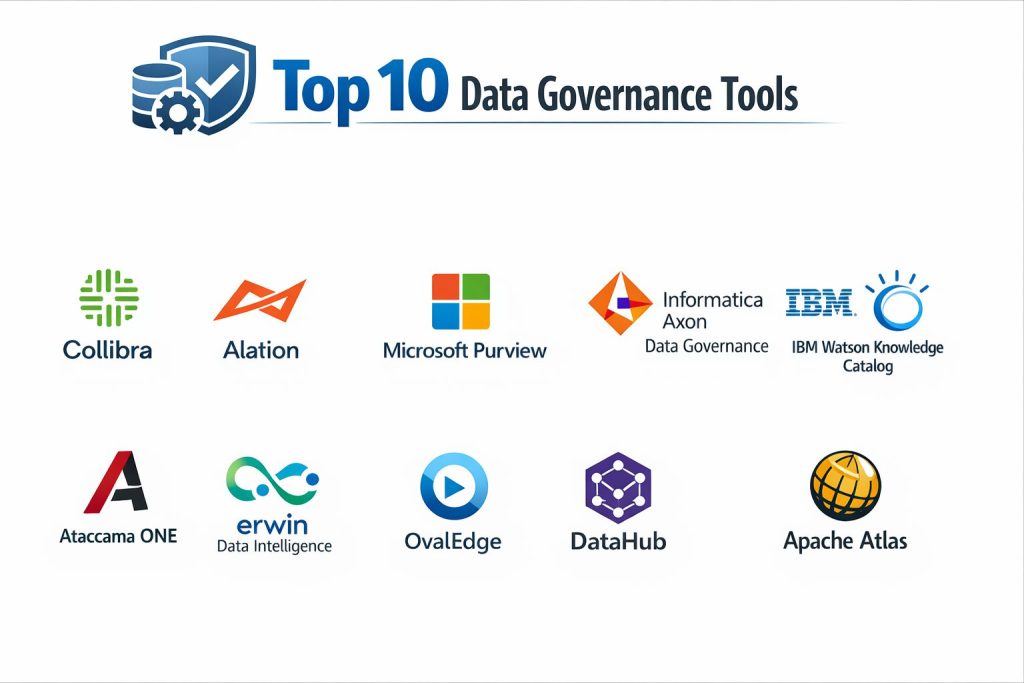
Top 10 Data Governance Platforms
1) Collibra
A governance-first platform used to standardize definitions, ownership, and stewardship workflows across large organizations. Strong fit for enterprises that need mature processes, operating models, and cross-team coordination.
Key Features
- Business glossary with stewardship workflows and approvals
- Catalog and metadata management for discovery and consistency
- Policy and control alignment through governance processes
- Lineage visibility patterns depending on connected systems
- Role-based stewardship with domain ownership models
- Reporting for governance adoption and accountability
- Integration support for common data stacks via connectors and APIs
Pros
- Strong governance workflows and organizational operating model fit
- Effective for standardizing definitions and ownership at scale
Cons
- Setup and rollout require planning, change management, and clear roles
- Cost and administration effort can be high for smaller teams
Platforms / Deployment
- Cloud / Hybrid (Varies / N/A)
Security & Compliance
- SSO/SAML, MFA, encryption, audit logs, RBAC: Not publicly stated
- SOC 2, ISO 27001, GDPR, HIPAA: Not publicly stated
Integrations & Ecosystem
Collibra commonly integrates with warehouses, lakehouses, BI tools, ETL/ELT systems, and identity providers to connect governance definitions to real usage.
- Metadata ingestion connectors: Varies / N/A
- APIs for automation and workflow integration
- BI and analytics integrations: Varies / N/A
- Data engineering tooling integrations: Varies / N/A
Support & Community
Enterprise-grade support and onboarding are typically available by plan; partner ecosystem is common in larger deployments.
2) Alation
A platform known for data discovery, cataloging, and collaboration, often used as a foundation for governance adoption. Strong for improving findability, shared context, and adoption across analytics communities.
Key Features
- Catalog and search experience oriented around discovery
- Business glossary capabilities and curated definitions
- Stewardship and curation workflows depending on configuration
- Usage signals to help identify trusted datasets and adoption
- Collaboration features that capture tribal knowledge
- Metadata ingestion and connector ecosystem
- Governance patterns built around standardizing meaning and access context
Pros
- Strong adoption drivers through discovery and collaboration
- Helpful for improving consistency and trust across data consumers
Cons
- Governance depth depends heavily on operating model and configuration
- Some policy enforcement needs may require adjacent tooling
Platforms / Deployment
- Cloud / Self-hosted (Varies / N/A)
Security & Compliance
- SSO/SAML, MFA, encryption, audit logs, RBAC: Not publicly stated
- SOC 2, ISO 27001, GDPR, HIPAA: Not publicly stated
Integrations & Ecosystem
Alation commonly connects to warehouses, BI tools, and engineering systems to surface context where users work.
- Warehouse and lake integrations: Varies / N/A
- BI integrations: Varies / N/A
- APIs and extensibility for workflow automation
- Identity and access context integrations: Varies / N/A
Support & Community
Strong documentation and enterprise onboarding options vary by plan; broad user community and partner ecosystem.
3) Microsoft Purview
A governance-oriented service in the Microsoft ecosystem that supports discovery, classification, and cataloging across data estates. Strong fit for organizations standardized on Microsoft platforms.
Key Features
- Central catalog and metadata management patterns
- Classification and labeling workflows depending on connected sources
- Lineage visibility patterns across integrated services
- Discovery and search across common data sources
- Integration with Microsoft data services and identity patterns
- Policy alignment through ecosystem tooling (Varies / N/A)
- Enterprise-scale management patterns for large estates
Pros
- Strong ecosystem fit for Microsoft-centric organizations
- Good foundation for cataloging and classification at scale
Cons
- Best results often depend on Microsoft stack alignment
- Mixed environments may require careful connector planning
Platforms / Deployment
- Cloud
Security & Compliance
- SSO/SAML, MFA, encryption, audit logs, RBAC: Not publicly stated
- SOC 2, ISO 27001, GDPR, HIPAA: Not publicly stated
Integrations & Ecosystem
Purview is commonly used with Microsoft data services and integrates through connectors to scan metadata and apply classifications.
- Microsoft data platform integrations: Varies / N/A
- Connectors for external sources: Varies / N/A
- Identity alignment through Microsoft ecosystem patterns
- APIs for automation: Varies / N/A
Support & Community
Large ecosystem documentation and community. Enterprise support is typically available through Microsoft support structures and varies by agreement.
4) Informatica Axon Data Governance
A governance solution often paired with broader Informatica capabilities for metadata, quality, and integration programs. Strong for organizations that want governance tied to data management execution.
Key Features
- Business glossary and governance workflows for stewardship
- Ownership, accountability, and approval processes
- Alignment with broader metadata and data management tooling (Varies / N/A)
- Governance reporting and responsibility mapping
- Data quality and policy alignment patterns depending on connected tools
- Enterprise governance model support
- Integration options via ecosystem components and APIs
Pros
- Strong governance workflows aligned to enterprise data programs
- Works well when paired with broader metadata and quality initiatives
Cons
- Best value often comes with larger ecosystem adoption
- Complexity can increase with multi-product implementations
Platforms / Deployment
- Cloud / Hybrid (Varies / N/A)
Security & Compliance
- SSO/SAML, MFA, encryption, audit logs, RBAC: Not publicly stated
- SOC 2, ISO 27001, GDPR, HIPAA: Not publicly stated
Integrations & Ecosystem
Axon is frequently used as the governance layer in programs that connect metadata, integration, and quality tooling.
- Metadata integration patterns: Varies / N/A
- Workflow automation via APIs
- Data management ecosystem alignment: Varies / N/A
- BI and analytics context integrations: Varies / N/A
Support & Community
Enterprise implementation support is commonly available through vendors and partners; documentation strength varies by component.
5) IBM Watson Knowledge Catalog
A governance and catalog offering designed to help organizations manage metadata, discovery, and policy-aligned access patterns. Often used in IBM-centered data and AI environments.
Key Features
- Cataloging and metadata organization for discoverability
- Classification and policy alignment patterns depending on setup
- Governance workflows around ownership and access context
- Integration into broader IBM data ecosystem (Varies / N/A)
- Collaboration and curation patterns for trusted datasets
- Support for enterprise scale and role-based access models
- Automation and APIs depending on implementation
Pros
- Strong fit in IBM ecosystem and enterprise governance initiatives
- Useful for combining catalog with governance-oriented controls
Cons
- Best outcomes often require IBM ecosystem alignment and careful setup
- Connector coverage varies and may need validation for your stack
Platforms / Deployment
- Cloud / Self-hosted (Varies / N/A)
Security & Compliance
- SSO/SAML, MFA, encryption, audit logs, RBAC: Not publicly stated
- SOC 2, ISO 27001, GDPR, HIPAA: Not publicly stated
Integrations & Ecosystem
Commonly integrated with IBM data services and enterprise identity patterns, with connectors for external sources depending on configuration.
- Ecosystem integrations: Varies / N/A
- Metadata ingestion connectors: Varies / N/A
- APIs for automation and workflow integration
- Policy alignment patterns: Varies / N/A
Support & Community
Enterprise support options vary by plan and partner involvement; community resources exist but depth varies by product footprint.
6) Ataccama ONE
A platform that blends governance needs with strong emphasis on data quality, profiling, and management workflows. Good fit for organizations that want governance tied to measurable quality improvement.
Key Features
- Catalog and glossary patterns for shared definitions
- Data profiling and quality workflows tied to governance programs
- Classification and matching patterns depending on setup
- Stewardship processes for remediation and issue handling
- Integration into data pipelines for continuous improvement
- Monitoring and reporting for quality and trust signals
- Workflow and automation support depending on configuration
Pros
- Strong quality-driven governance approach that improves trust
- Useful for stewardship teams managing issues and remediation
Cons
- Requires process maturity to sustain quality workflows long term
- Stack integrations should be validated early for coverage and depth
Platforms / Deployment
- Cloud / Hybrid (Varies / N/A)
Security & Compliance
- SSO/SAML, MFA, encryption, audit logs, RBAC: Not publicly stated
- SOC 2, ISO 27001, GDPR, HIPAA: Not publicly stated
Integrations & Ecosystem
Often integrates with warehouse/lake environments and data integration tools to turn governance into operational quality outcomes.
- Connectors and ingestion: Varies / N/A
- APIs for automation and remediation workflows
- Integration into pipeline steps: Varies / N/A
- Stewardship tooling alignment: Varies / N/A
Support & Community
Professional services and partner-led deployments are common; support depth varies by agreement.
7) erwin Data Intelligence
A platform focused on metadata-driven governance and understanding data across systems. Often used where data modeling, lineage, and metadata management are central.
Key Features
- Metadata-driven cataloging and discovery
- Glossary and definition management for shared meaning
- Lineage and impact analysis patterns (depends on sources)
- Governance workflows around stewardship and ownership
- Integration with modeling and metadata practices
- Reporting for governance programs and adoption
- Extensibility options through connectors and APIs
Pros
- Strong fit for metadata-centric governance and impact analysis
- Useful where modeling and structured metadata are priorities
Cons
- Adoption can be slower without strong stakeholder engagement
- Connector depth and lineage fidelity should be validated per source
Platforms / Deployment
- Cloud / Self-hosted (Varies / N/A)
Security & Compliance
- SSO/SAML, MFA, encryption, audit logs, RBAC: Not publicly stated
- SOC 2, ISO 27001, GDPR, HIPAA: Not publicly stated
Integrations & Ecosystem
erwin is typically integrated through metadata ingestion and lineage mapping across core systems.
- Source connectors: Varies / N/A
- Lineage extraction patterns: Varies / N/A
- APIs for automation and updates
- BI and analytics integration: Varies / N/A
Support & Community
Support varies by plan; professional services can accelerate rollout; community depth varies by region and customer base.
8) OvalEdge
A governance and catalog platform often chosen for balancing usability with governance workflows. Useful for organizations that need cataloging, lineage patterns, and stewardship without extreme complexity.
Key Features
- Catalog and discovery with curated governance views
- Business glossary and ownership assignment patterns
- Lineage visualization depending on connected sources
- Stewardship workflows for definitions and approvals
- Role-based access patterns and governance reporting
- Connectors for common data systems (coverage varies)
- APIs and extensibility for workflow alignment
Pros
- Balanced approach between governance depth and usability
- Can fit mid-market and enterprise with disciplined rollout
Cons
- Feature depth and connector coverage need validation per stack
- Strong governance outcomes still require clear operating model
Platforms / Deployment
- Cloud / Self-hosted (Varies / N/A)
Security & Compliance
- SSO/SAML, MFA, encryption, audit logs, RBAC: Not publicly stated
- SOC 2, ISO 27001, GDPR, HIPAA: Not publicly stated
Integrations & Ecosystem
OvalEdge typically integrates by scanning metadata and mapping lineage across systems where possible.
- Metadata ingestion connectors: Varies / N/A
- Lineage and impact analysis integrations: Varies / N/A
- APIs for automation
- BI and analytics context integrations: Varies / N/A
Support & Community
Documentation and enterprise support vary by plan; customer success engagement can be important for adoption.
9) DataHub
An open-source metadata platform frequently used as a flexible foundation for discovery and governance patterns. Strong for teams that want customization and engineering ownership of governance workflows.
Key Features
- Metadata platform with extensible schema and ingestion patterns
- Search and discovery for datasets, dashboards, and pipelines
- Ownership, domains, and tagging concepts for governance structure
- Lineage modeling patterns depending on ingestion sources
- API-first approach for customization and workflow integration
- Great fit for modern data stacks with strong engineering support
- Community-driven innovation and extensibility
Pros
- High flexibility and customization for governance programs
- Strong fit for engineering-led organizations that want control
Cons
- Requires internal engineering effort to operate and scale
- Enterprise governance workflows may require custom development
Platforms / Deployment
- Self-hosted
Security & Compliance
- SSO/SAML, MFA, encryption, audit logs, RBAC: Varies / N/A
- SOC 2, ISO 27001, GDPR, HIPAA: Not publicly stated
Integrations & Ecosystem
DataHub commonly integrates through ingestion frameworks and APIs that connect to warehouses, pipelines, and BI tools.
- Ingestion connectors: Varies / N/A
- APIs for automation and policy workflows
- Integration into CI/CD patterns for metadata changes: Varies / N/A
- Ecosystem extensions driven by community
Support & Community
Strong open-source community momentum; professional support availability varies by vendor and distribution options.
10) Apache Atlas
An open-source governance and metadata framework often used in big-data ecosystems. Best for organizations that need lineage, classification, and governance concepts in Hadoop-adjacent environments or custom platforms.
Key Features
- Metadata and classification framework for governance concepts
- Lineage modeling patterns for supported ecosystems (varies)
- Tagging and taxonomy structures for sensitive data handling
- Integration patterns within certain big-data stacks
- Extensible approach for custom governance needs
- Suitable for organizations with strong platform engineering teams
- Can serve as a governance component in larger architectures
Pros
- Flexible open-source foundation for governance frameworks
- Useful for lineage and classification patterns in compatible stacks
Cons
- Requires engineering ownership and operational maturity
- User experience and workflow depth may be less polished than commercial platforms
Platforms / Deployment
- Self-hosted
Security & Compliance
- SSO/SAML, MFA, encryption, audit logs, RBAC: Varies / N/A
- SOC 2, ISO 27001, GDPR, HIPAA: Not publicly stated
Integrations & Ecosystem
Apache Atlas is typically integrated in environments where metadata services are part of a broader platform.
- Ecosystem integrations: Varies / N/A
- APIs for custom extensions
- Lineage integration depends on stack compatibility
- Policy alignment requires external enforcement layers: Varies / N/A
Support & Community
Open-source community support is available; enterprise-grade support depends on third-party vendors and internal expertise.
Comparison Table
| Tool Name | Best For | Platform(s) Supported | Deployment | Standout Feature | Public Rating |
|---|---|---|---|---|---|
| Collibra | Enterprise governance operating model and stewardship | Varies / N/A | Cloud / Hybrid | Mature workflows and ownership model | N/A |
| Alation | Data discovery with governance adoption and collaboration | Varies / N/A | Cloud / Self-hosted | Strong discovery and usage-driven trust | N/A |
| Microsoft Purview | Microsoft-centric governance and classification programs | Varies / N/A | Cloud | Ecosystem alignment for large estates | N/A |
| Informatica Axon Data Governance | Governance tied to broader data management initiatives | Varies / N/A | Cloud / Hybrid | Stewardship and accountability workflows | N/A |
| IBM Watson Knowledge Catalog | Catalog plus governance patterns in IBM ecosystems | Varies / N/A | Cloud / Self-hosted | Governance-aligned catalog approach | N/A |
| Ataccama ONE | Quality-driven governance and stewardship remediation | Varies / N/A | Cloud / Hybrid | Strong quality and profiling alignment | N/A |
| erwin Data Intelligence | Metadata-centric governance with lineage patterns | Varies / N/A | Cloud / Self-hosted | Impact analysis and metadata approach | N/A |
| OvalEdge | Balanced catalog plus stewardship for mixed stacks | Varies / N/A | Cloud / Self-hosted | Practical governance depth with usability | N/A |
| DataHub | Engineering-led, customizable governance foundation | Varies / N/A | Self-hosted | API-first extensible metadata platform | N/A |
| Apache Atlas | Open-source governance framework for compatible stacks | Varies / N/A | Self-hosted | Classification and lineage framework | N/A |
Evaluation & Scoring Table
Weights used: Core 25%, Ease 15%, Integrations 15%, Security 10%, Performance 10%, Support 10%, Value 15%.
| Tool Name | Core (25%) | Ease (15%) | Integrations (15%) | Security (10%) | Performance (10%) | Support (10%) | Value (15%) | Weighted Total (0–10) |
|---|---|---|---|---|---|---|---|---|
| Collibra | 9.5 | 7.5 | 8.5 | 6.5 | 8.5 | 8.5 | 6.0 | 8.06 |
| Alation | 8.5 | 8.5 | 8.0 | 6.0 | 8.0 | 8.0 | 6.5 | 7.80 |
| Microsoft Purview | 8.0 | 8.0 | 8.5 | 7.0 | 8.0 | 7.5 | 8.0 | 8.03 |
| Informatica Axon Data Governance | 8.5 | 7.5 | 8.0 | 6.5 | 8.0 | 7.5 | 6.5 | 7.69 |
| IBM Watson Knowledge Catalog | 8.0 | 7.0 | 7.5 | 6.5 | 7.5 | 7.5 | 6.5 | 7.36 |
| Ataccama ONE | 8.0 | 7.5 | 7.5 | 6.5 | 8.0 | 7.0 | 7.0 | 7.48 |
| erwin Data Intelligence | 8.0 | 6.5 | 7.5 | 6.0 | 7.5 | 7.0 | 6.5 | 7.12 |
| OvalEdge | 7.5 | 7.5 | 7.5 | 6.0 | 7.5 | 7.0 | 7.0 | 7.28 |
| DataHub | 7.5 | 6.5 | 8.0 | 5.5 | 7.5 | 7.0 | 8.5 | 7.38 |
| Apache Atlas | 7.0 | 5.5 | 6.5 | 5.5 | 7.0 | 6.5 | 9.0 | 6.75 |
How to interpret the scores:
- The totals are comparative within this list, not universal rankings.
- A higher score usually means broader capability across more governance scenarios.
- Ease and value often win for teams that need fast adoption without heavy change management.
- Security scoring is limited because governance outcomes often depend on surrounding systems and disclosures vary.
- Always validate through a pilot that tests your connectors, workflows, and adoption patterns.
Which Data Governance Platform Is Right for You?
Solo / Freelancer
Most solo users do not need a heavy governance platform. If you are building governance practices for a small stack, DataHub can work if you are comfortable operating self-hosted tools and want full control. If you want something easier without engineering overhead, consider starting with a lighter catalog approach in your stack and adopt formal governance later as complexity grows.
SMB
SMBs benefit most from tools that drive adoption quickly and reduce confusion around definitions and ownership. Alation and OvalEdge are often attractive when you want discovery plus stewardship patterns without overbuilding process. If you are Microsoft-centered, Microsoft Purview can become a practical hub for catalog and classification programs.
Mid-Market
Mid-market organizations usually need stronger workflows, ownership models, and reporting. Collibra is strong when you need an operating model with clear stewardship and governance leadership. Informatica Axon Data Governance can be compelling when governance is tied tightly to data management execution across integration and quality programs. Ataccama ONE is attractive if data quality improvement is a top driver of governance success.
Enterprise
Enterprises typically prioritize organizational consistency, auditable processes, and scale. Collibra is commonly selected where governance is a formal program with many domains and stewards. Microsoft Purview is strong for Microsoft standardized estates. IBM Watson Knowledge Catalog fits well when IBM ecosystem alignment is important. Enterprises should invest in governance operating design, stewardship capacity, and measurable adoption goals.
Budget vs Premium
If budget is the primary constraint, DataHub and Apache Atlas can provide a foundation, but you must budget engineering time for operations and customization. Premium platforms typically reduce time-to-adoption with stronger packaged workflows, governance reporting, and managed options, but require careful rollout planning and change management.
Feature Depth vs Ease of Use
Feature depth matters when you need stewardship approvals, complex ownership mapping, and large-scale domain governance. Ease of use matters when adoption is low and business users avoid governance tools. A practical approach is to prioritize a tool that business users will actually use, then add depth through process and integration as maturity grows.
Integrations & Scalability
Integration is often the deciding factor. Before choosing, test your top systems: warehouse/lakehouse, BI, ETL/ELT, identity, and key operational sources. Validate metadata freshness, lineage quality, glossary linking, and ownership workflows. For scalability, verify performance with large catalogs and confirm governance reporting that can demonstrate real impact.
Security & Compliance Needs
Governance is strongest when policies connect to real access controls, retention rules, and sensitive-data handling. If formal certifications and controls are not publicly stated, treat them as unknown and validate through procurement and internal review. Also validate how the platform supports least privilege, auditability, role separation, and integration with identity providers.
Frequently Asked Questions
1. What problem does a data governance platform solve first?
It creates shared meaning and ownership so teams stop arguing about definitions and start trusting data. Most programs begin by standardizing critical terms, KPIs, and key datasets.
2. Do I need a governance platform if I already have a data catalog?
A catalog improves discovery, but governance adds stewardship workflows, accountability, and policy alignment. If you need approvals, ownership, and measurable controls, governance features matter.
3. How long does it take to see value from governance?
Value can appear quickly if you start with a narrow scope like key metrics and priority datasets. Broad enterprise rollouts usually take longer because adoption depends on people and process.
4. What is the most common mistake in governance rollouts?
Trying to govern everything at once. Start with critical domains, create clear roles, and prove outcomes, then expand.
5. How should we measure governance success?
Track adoption, glossary usage, stewardship cycle time, reduced duplicate datasets, improved quality signals, fewer access incidents, and faster audit readiness.
6. Does governance automatically enforce access controls?
Not always. Many platforms document and align policies, but enforcement often requires integration with access management and data platform controls.
7. How important is lineage for governance?
Lineage helps with impact analysis, trust, and auditability. It becomes essential when you manage many pipelines and need to understand how changes affect downstream reports.
8. What teams must be involved for governance to work?
Data owners, stewards, data engineering, analytics, security, and business stakeholders. Without business ownership, the glossary becomes unused documentation.
9. Can open-source options work for serious governance?
Yes, especially in engineering-led organizations that can operate and extend them. The trade-off is more internal work for workflows, UX, and long-term operations.
10. How do we choose between two strong platforms?
Run a short pilot on your real stack. Test connectors, glossary workflows, lineage fidelity, adoption experience for business users, and reporting that demonstrates governance impact.
Conclusion
A data governance platform is most valuable when it becomes a living operating system for trust, not a static documentation project. The best choice depends on your organization’s size, stack, and governance maturity. Some teams need deep stewardship workflows and enterprise operating models, while others need quick adoption through strong discovery and collaboration. Your next step should be practical: shortlist two or three tools, run a focused pilot on your most important domain, validate metadata connectors and lineage quality, test glossary ownership workflows, and confirm how governance policies align with real access controls. Then scale gradually, with clear roles, measurable outcomes, and steady stakeholder engagement.