Introduction
In the modern data stack, a “Data Contract” is a formal agreement between a data producer and a data consumer that defines the schema, quality standards, and service-level agreements (SLAs) for a specific data product. As organizations shift toward decentralized architectures like Data Mesh, these contracts serve as the “API for data,” ensuring that upstream changes do not cause catastrophic downstream failures. Data contract management tools provide the infrastructure to define these agreements in code, enforce them during pipeline execution, and alert stakeholders when a breach occurs. Without these tools, data teams often find themselves in a reactive cycle of fixing “silent failures” and broken dashboards caused by unexpected schema drift or missing values.
The rise of DataOps has accelerated the need for tools that treat data as a high-quality product rather than a byproduct of application logic. Modern data contract management involves a complex orchestration of version control, CI/CD integration, and real-time observability. These platforms bridge the gap between software engineering practices and data management, allowing engineers to catch breaking changes before they reach the data warehouse. For enterprise-level organizations, implementing a data contract strategy is no longer optional; it is a fundamental requirement for maintaining the reliability of AI models, financial reporting, and operational analytics.
Best for: Data engineers, analytics engineers, and data architects who need to ensure the reliability of data pipelines and prevent breaking changes in complex, multi-team environments.
Not ideal for: Small teams with simple, centralized data architectures where the producer and consumer are the same person, or organizations that do not yet have a formal data governance or quality strategy.
Key Trends in Data Contract Management
The most significant trend is the shift from “descriptive” to “executable” contracts. Historically, data contracts were static documents or wiki pages that quickly became outdated. Today, tools are moving toward “Contract-as-Code,” using YAML or JSON definitions that are stored in Git and automatically validated against live data streams. We are also seeing the emergence of “Shift-Left” data quality, where contracts are enforced at the source (the application database or message bus) rather than at the destination (the data warehouse). This prevents “garbage data” from ever entering the analytical ecosystem.
Another major trend is the integration of Generative AI to automate contract creation. AI agents can now analyze existing data patterns and suggest scientifically sound schema constraints and quality thresholds, reducing the manual effort required to “bootstrap” a contract library. Furthermore, the integration between data catalogs and contract management is tightening; modern catalogs now display “Contract Status” as a primary metadata field, allowing consumers to see at a glance if a dataset is governed by an active, passing agreement. Finally, the “Open Data Contract Standard” (ODCS) is gaining traction, providing a vendor-neutral way for different tools to exchange contract definitions.
How We Selected These Tools
Our selection process focused on tools that provide “enforcement” rather than just “documentation.” We prioritized platforms that integrate directly into the data engineering workflow—specifically those with strong CLI tools, CI/CD plugins, and support for major orchestration engines like Airflow or Dagster. A key criterion was the ability to handle both schema validation and semantic quality checks, such as checking for null ratios or specific value ranges. We also looked for tools that support a “human-in-the-loop” workflow, where proposed changes to a contract can be reviewed and approved by both producers and consumers.
Scalability across different data technologies was another critical factor. We selected tools that can operate across diverse environments, including SQL warehouses (Snowflake, BigQuery), streaming platforms (Kafka), and transformation layers (dbt). We also assessed the maturity of the reporting and alerting features, favoring platforms that provide clear, actionable notifications to the right team when a contract is violated. Security and governance were also paramount; we prioritized tools that maintain a clear audit trail of contract versions and approvals, which is essential for compliance in regulated industries.
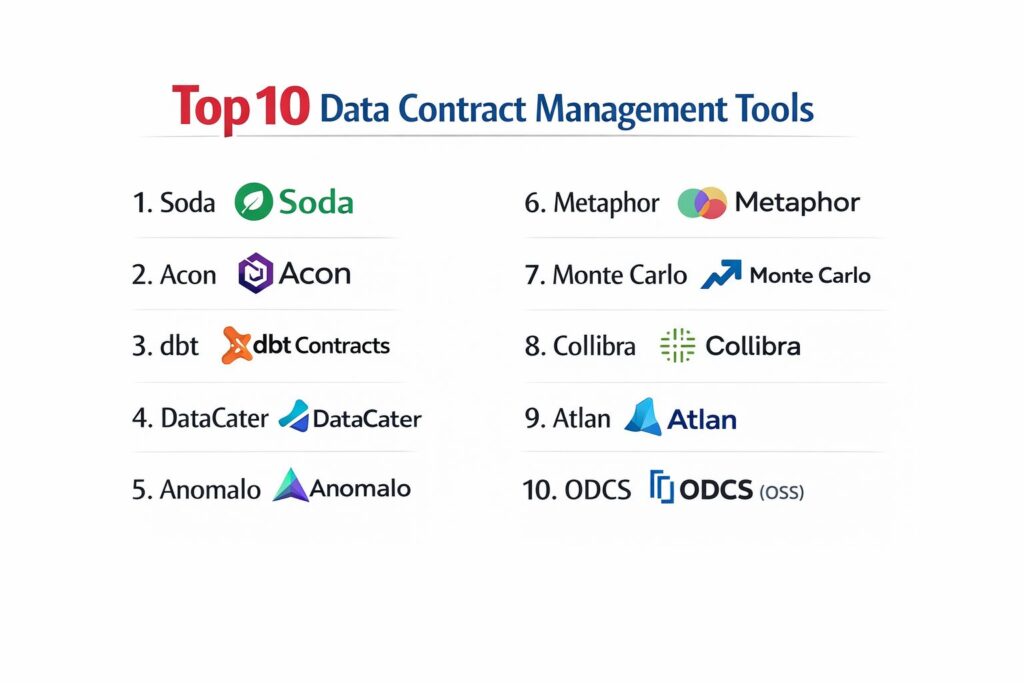
1. Soda Data Contracts
Soda is a pioneer in the “executable” data contract space, providing a platform that allows teams to define expectations in a declarative language (SodaCL) and enforce them directly within data pipelines. It is designed for high-velocity data teams that need to catch issues at the “point of entry.”
Key Features
The platform features an “Executable Contract” engine that can block a pipeline run if data does not meet defined standards. It includes “SodaCL,” a human-readable language for defining complex checks across schema, freshness, and quality. The system offers a “Contract UI” where both producers and consumers can collaborate on and approve contract versions. It features native integration with GitHub/GitLab for version-controlled contract management. It also provides “Automatic Anomaly Detection” that suggests contract updates based on historical data trends.
Pros
It provides one of the most robust “blocking” capabilities in the industry, preventing bad data from moving downstream. The SodaCL language is exceptionally easy for non-engineers to read and understand.
Cons
The full “enforcement” features require deep integration into your orchestration layer, which can take time to set up. Some advanced reporting features are locked behind the higher-tier Enterprise plans.
Platforms and Deployment
Cloud SaaS with a powerful open-source CLI and Python library for local or containerized execution.
Security and Compliance
SOC 2 Type II compliant with advanced data anonymization features for contract previews.
Integrations and Ecosystem
Deeply integrated with dbt, Airflow, Snowflake, BigQuery, and Slack for alerting.
Support and Community
Maintains a very active Slack community and provides “Soda University” for practitioner training.
2. Acon (formerly Gable)
Acon provides a sophisticated data contract platform that focuses on the collaboration between software engineers (producers) and data teams (consumers). It is built to resolve the “broken dashboard” problem by managing the impact of application changes on data pipelines.
Key Features
The platform features a “Change Impact Analysis” tool that predicts which downstream assets will break if a producer modifies a source schema. It includes “Code-Native Contracts” that live in the application repository alongside the producer’s code. The system offers a “Collaboration Workflow” that requires data consumer approval for any change that violates a contract. It features an “Asset Discovery” engine that automatically maps the lineage between application code and data warehouse tables. It also provides a “Policy Engine” to enforce global data standards across all contracts.
Pros
It is uniquely focused on the producer-consumer relationship, making it the best choice for organizations with a large gap between software and data teams. The impact analysis feature is a significant time-saver for risk assessment.
Cons
It is a newer player in the market, so its ecosystem of third-party integrations is still growing. It requires buy-in from software engineering teams, which can be a cultural hurdle.
Platforms and Deployment
Web-based SaaS platform with GitHub/GitLab integration.
Security and Compliance
Complies with GDPR and CCPA standards, focusing on secure metadata management without storing raw data.
Integrations and Ecosystem
Strong support for GitHub, dbt, and modern data warehouses like Snowflake.
Support and Community
Offers direct expert support and a growing library of documentation for “Contract-First” development.
3. dbt (Data Build Tool) Contracts
dbt has introduced native “Model Contracts” into its core transformation framework, allowing analytics engineers to define and enforce schemas for their models. It is the natural choice for organizations already running their entire transformation layer on dbt.
Key Features
The platform features “Model-Level Constraints” defined directly in YAML, which dbt enforces during the materialization process. It includes “Breaking Change Prevention” by comparing proposed code changes against the existing contract in the production environment. The system offers “Semantic Layer” integration, ensuring that metric definitions remain consistent with the underlying contract. It features “Auto-Documentation” where the contract serves as the primary source of truth for the dbt docs site. It also provides “Multi-Project Support” for managing contracts across different business units.
Pros
There is no additional cost or tool to manage if you are already using dbt. It integrates perfectly with the existing “dbt run” and “dbt test” workflows that teams already use.
Cons
It is primarily focused on the transformation layer and does not natively enforce contracts at the “source” (e.g., in the operational database). Enforcement is limited to what the underlying database (Snowflake, etc.) can support.
Platforms and Deployment
Available in both dbt Core (open-source) and dbt Cloud.
Security and Compliance
Inherits the security posture of the dbt environment, including SOC 2 and ISO 27001 for dbt Cloud users.
Integrations and Ecosystem
Natively part of the dbt ecosystem; integrates with all major cloud data warehouses.
Support and Community
Backed by the massive dbt Slack community and “dbt Learn” professional training courses.
4. DataCater
DataCater is a streaming-first data management platform that focuses on “Real-Time Data Contracts.” It is designed for organizations that rely on Kafka or other event-driven architectures where data quality must be checked in milliseconds.
Key Features
The platform features “Streaming Validation,” which checks every event against a contract as it flows through the pipeline. It includes a “Visual Contract Designer” for teams that prefer a GUI over writing YAML. The system offers “Automated Dead-Letter Queues” for events that violate the contract, ensuring they are quarantined for review. It features “Schema Evolution Tracking” for managing versioning in streaming environments. It also provides “Real-Time Quality Metrics” that show the health of a stream at a glance.
Pros
It is one of the few tools specifically optimized for high-volume, real-time data streams. The visual designer makes it accessible to business analysts and data stewards.
Cons
It is less effective for traditional “Batch” data processing compared to tools like Soda or dbt. The pricing can scale quickly based on event volume.
Platforms and Deployment
Cloud-native SaaS or self-hosted deployment for on-premise streaming clusters.
Security and Compliance
Supports end-to-end encryption for streaming data and is GDPR compliant.
Integrations and Ecosystem
Primary focus on Kafka, Redpanda, and other event-streaming platforms.
Support and Community
Provides dedicated engineering support for complex streaming architecture implementations.
5. Anomalo
Anomalo is an enterprise-grade data quality platform that uses deep machine learning to automate the creation and enforcement of data contracts. It is best for teams that want “contract-like” protection without manual configuration of every single rule.
Key Features
The platform features “AI-Generated Contracts” that automatically learn the normal behavior of a dataset and set thresholds. It includes “Root Cause Analysis,” which doesn’t just flag a contract violation but points to the specific column or source change that caused it. The system offers “Unstructured Data Support,” allowing for contracts on text and image metadata. It features “Virtual Data Contracts” that can be applied retroactively to existing tables. It also provides “Executive Health Dashboards” for high-level governance reporting.
Pros
It requires the least amount of manual effort to set up, as the AI does most of the “heavy lifting” for defining thresholds. The root cause analysis is exceptionally deep and actionable.
Cons
It is a premium enterprise tool with pricing that may be out of reach for smaller startups. The “AI-first” approach can sometimes feel like a “black box” compared to explicit YAML contracts.
Platforms and Deployment
Cloud SaaS with high-performance connectors for all major cloud warehouses.
Security and Compliance
Enterprise-ready with SOC 2 Type II, HIPAA, and advanced RBAC (Role-Based Access Control).
Integrations and Ecosystem
Deeply integrated with Slack, Microsoft Teams, and PagerDuty for operational alerting.
Support and Community
Provides high-touch customer success and a dedicated “Data Quality Academy” for users.
6. Metaphor (formerly LinkedIn Data Hub)
Metaphor is a modern “Metadata Platform” that treats data contracts as a core part of the data catalog. It is designed for large enterprises where the discovery of governed data is just as important as the enforcement of the contract itself.
Key Features
The platform features a “Contract-Integrated Catalog,” where the passing status of a contract is displayed next to the table in search results. It includes “Social Governance,” allowing users to “follow” a contract and receive updates on changes. The system offers “Lineage-Aware Contracts,” showing how a contract violation at the source impacts specific business metrics. It features “No-Code Contract Workflows” for business users to request data and define requirements. It also provides “Compliance Mapping” to tie contracts to specific regulatory requirements like GDPR.
Pros
It provides the best “business context” for data contracts, making them visible and useful to the entire company. The lineage visualization is among the best in the industry.
Cons
It is primarily a metadata and catalog tool, meaning it often relies on integrations with other tools (like Soda) for the actual “hard enforcement” in the pipeline.
Platforms and Deployment
Cloud-based SaaS.
Security and Compliance
Strong focus on governance and auditability, fully compliant with global data privacy standards.
Integrations and Ecosystem
Integrates with the entire “Modern Data Stack,” including Snowflake, Looker, and dbt.
Support and Community
Born out of the LinkedIn DataHub project, it has a strong foundation in enterprise metadata standards.
7. Monte Carlo
Monte Carlo is the leader in “Data Observability,” and it has recently expanded its platform to include a dedicated “Data Contracts” module. It is best for organizations that want a single platform for both automated monitoring and explicit contract enforcement.
Key Features
The platform features “Bi-Directional Data Contracts” that facilitate a formal handshake between engineers and analysts. It includes “Schema Change Alerts” that trigger immediately when a contract-bound table is modified. The system offers “Data Health Insights,” providing a comprehensive view of all contracts across the entire stack. It features “Automated Circuit Breakers” that can stop a pipeline if a critical contract is violated. It also provides “Contract Performance History” to track how often specific producers meet their SLAs.
Pros
It offers the most comprehensive view of data health, combining contracts with broader observability metrics like volume and freshness. The “Circuit Breaker” feature is highly effective at preventing data corruption.
Cons
The platform can be overwhelming due to its sheer number of features. It is generally more expensive than “contract-only” tools.
Platforms and Deployment
Cloud SaaS.
Security and Compliance
Industry-leading security with SOC 2, HIPAA, and advanced encryption for metadata.
Integrations and Ecosystem
Integrates with almost every major tool in the data ecosystem, from Fivetran to Power BI.
Support and Community
Known for world-class technical support and a highly influential “Data Reliability” blog and community.
8. Collibra
Collibra is the traditional “Gold Standard” for enterprise data governance, and its modern platform now includes robust support for data contracts. It is the go-to for Fortune 500 companies with complex regulatory and compliance needs.
Key Features
The platform features an “Enterprise Data Office” where data contracts are managed as formal legal-style agreements. It includes “Workflow Orchestration” for the complex approval process required in large organizations. The system offers “Policy Enforcement” that ties data contracts to global corporate data standards. It features “Privacy Risk Assessment” as a built-in part of the contract creation process. It also provides “Financial Impact Analysis” to show the cost of poor data quality associated with contract breaches.
Pros
It provides the most advanced governance and compliance features in the market. It is highly effective at managing data across massive, fragmented global organizations.
Cons
The interface is corporate and can feel slow compared to modern, engineering-focused tools. The implementation process is long and requires significant professional services.
Platforms and Deployment
Cloud SaaS with support for hybrid and on-premise data sources.
Security and Compliance
Unmatched security credentials, including FedRAMP, HIPAA, and ISO standards.
Integrations and Ecosystem
Integrates with legacy enterprise systems (SAP, Oracle) as well as modern cloud platforms.
Support and Community
Offers extensive enterprise-grade support, professional services, and a global user community.
9. Atlan
Atlan is a “Collaborative Data Workspace” that has built data contracts into its active metadata platform. It is designed to be the “Home Page” for data teams, making contract management a natural part of the daily workflow.
Key Features
The platform features “Active Metadata Enforcement,” where contracts are used to trigger actions in other tools (e.g., stopping an Airflow task). It includes a “Collaboration Feed” for discussing contract changes in a Slack-like interface. The system offers “Personalized Contract Views” for different roles (Engineer vs. Business User). It features “Auto-Lineage” that populates contract metadata throughout the downstream stack. It also provides “Contract Health Scores” that are visible to any data consumer.
Pros
It has one of the most modern and user-friendly interfaces in the category. The “active” nature of its metadata means contracts can drive automation across the entire stack.
Cons
The enforcement layer often requires external “execution” tools, as Atlan is primarily a coordination and metadata layer. It can be expensive for very large teams.
Platforms and Deployment
Cloud-based SaaS.
Security and Compliance
SOC 2 Type II compliant with a strong focus on granular access control and data residency.
Integrations and Ecosystem
Deeply integrated with Snowflake, dbt, Slack, and various BI tools.
Support and Community
Offers excellent customer success and a “community-first” approach to product development.
10. Open Data Contract Standard (ODCS) – CLI Tools
While not a standalone SaaS “platform,” the ODCS ecosystem (spearheaded by companies like PayPal and GoCardless) provides a set of open-source tools for managing data contracts. It is the best choice for teams that want to build their own custom infrastructure using a standardized framework.
Key Features
The ecosystem features a “Standardized YAML Schema” for defining contracts that is tool-agnostic. It includes “Linter and Validator” CLI tools that can be run in any CI/CD environment. The system offers “Code Generators” that create dbt models or SQL schemas from a contract definition. It features “Template Libraries” for common contract types (e.g., Financial, E-commerce). It also provides “Reference Implementations” for integrating contracts into popular data engines.
Pros
It is completely free and open-source, providing ultimate flexibility for engineering teams. It ensures that you are not “locked in” to any single vendor’s proprietary format.
Cons
It requires significant engineering effort to build the “enforcement” and “reporting” layers yourself. There is no central UI or dashboard without building one.
Platforms and Deployment
Open-source libraries and CLI tools (Python, Go, etc.).
Security and Compliance
Dependent on the organization’s own implementation and infrastructure.
Integrations and Ecosystem
Designed to be compatible with any tool that can read YAML or run a CLI command.
Support and Community
Supported by a growing community of data engineering leaders and major enterprise contributors.
Comparison Table
| Tool Name | Best For | Platform(s) | Deployment | Standout Feature | Public Rating |
| 1. Soda | Pipeline Enforcement | Web / CLI | Cloud SaaS | SodaCL Language | 4.8/5 |
| 2. Acon | Producer/Consumer Sync | Web / Git | Cloud SaaS | Change Impact Analysis | 4.6/5 |
| 3. dbt Contracts | Transformation Layer | Web / CLI | Cloud / OSS | Native dbt Integration | 4.9/5 |
| 4. DataCater | Real-Time Streaming | Web-Based | Cloud / On-Prem | Streaming Validation | 4.5/5 |
| 5. Anomalo | AI-Driven Quality | Web-Based | Cloud SaaS | Root Cause Analysis | 4.7/5 |
| 6. Metaphor | Business Context | Web-Based | Cloud SaaS | Lineage-Aware Catalog | 4.6/5 |
| 7. Monte Carlo | Full Observability | Web-Based | Cloud SaaS | Circuit Breakers | 4.8/5 |
| 8. Collibra | Enterprise Governance | Web-Based | Cloud SaaS | Workflow Orchestration | 4.4/5 |
| 9. Atlan | Collaborative Teams | Web-Based | Cloud SaaS | Active Metadata | 4.7/5 |
| 10. ODCS (OSS) | Custom Architecture | CLI / Git | Self-Hosted | Vendor-Neutral Std. | 4.3/5 |
Evaluation & Scoring of Data Contract Management Tools
The scoring below is a comparative model intended to help shortlisting. Each criterion is scored from 1–10, then a weighted total from 0–10 is calculated using the weights listed. These are analyst estimates based on typical fit and common workflow requirements, not public ratings.
Weights:
- Core features – 25%
- Ease of use – 15%
- Integrations & ecosystem – 15%
- Security & compliance – 10%
- Performance & reliability – 10%
- Support & community – 10%
- Price / value – 15%
| Tool Name | Core (25%) | Ease (15%) | Integrations (15%) | Security (10%) | Performance (10%) | Support (10%) | Value (15%) | Weighted Total |
| 1. Soda | 10 | 9 | 9 | 9 | 9 | 9 | 9 | 9.35 |
| 2. Acon | 9 | 8 | 8 | 9 | 9 | 8 | 8 | 8.55 |
| 3. dbt Contracts | 8 | 10 | 10 | 9 | 9 | 10 | 10 | 9.20 |
| 4. DataCater | 9 | 7 | 7 | 8 | 10 | 8 | 7 | 8.05 |
| 5. Anomalo | 10 | 8 | 9 | 9 | 9 | 9 | 6 | 8.60 |
| 6. Metaphor | 7 | 8 | 8 | 9 | 8 | 8 | 8 | 7.85 |
| 7. Monte Carlo | 10 | 7 | 10 | 10 | 9 | 9 | 6 | 8.60 |
| 8. Collibra | 9 | 5 | 8 | 10 | 8 | 9 | 5 | 7.70 |
| 9. Atlan | 8 | 9 | 9 | 9 | 8 | 9 | 7 | 8.40 |
| 10. ODCS (OSS) | 7 | 6 | 7 | 7 | 10 | 6 | 10 | 7.30 |
How to interpret the scores:
- Use the weighted total to shortlist candidates, then validate with a pilot.
- A lower score can mean specialization, not weakness.
- Security and compliance scores reflect controllability and governance fit, because certifications are often not publicly stated.
- Actual outcomes vary with assembly size, team skills, templates, and process maturity.
Which Data Contract Management Tool Is Right for You?
Solo / Freelancer
For a small, fast-moving startup, complexity is the enemy. You likely don’t need a separate “platform” yet. Your best bet is to leverage the native contract features within dbt or use open-source CLI tools to enforce basic schema checks. This keeps your costs at zero while establishing the discipline of “Contract-First” development from day one, which will pay massive dividends as your team grows.
SMB
Nonprofits often handle sensitive data with limited technical staff. Focus on tools that provide high “Ease of Use” and clear reporting. Soda or Atlan are excellent choices because they offer intuitive interfaces that allow even non-technical stakeholders to understand the health of their data assets. Prioritize tools that offer a generous free tier or a discount for social impact organizations.
Mid-Market
As a mid-market company, you are likely experiencing the “growing pains” of multiple teams producing and consuming data. Acon is specifically designed for this stage, focusing on the collaboration between software and data teams. Alternatively, if your stack is heavily invested in observability, the Monte Carlo contract module provides a unified way to manage health without adding another tool to your procurement list.
Enterprise
For the large enterprise, “Data Contracts” are a matter of compliance and risk management. Collibra or Icertis (if integrated with your broader CLM) provide the necessary governance framework and multi-department workflows. However, for your high-performance data engineering teams, a tool like Soda or Anomalo is essential to provide the “hard enforcement” in the pipeline that purely governance-focused tools often lack.
Budget vs Premium
If budget is the primary constraint, the dbt contract feature and the ODCS open-source ecosystem provide world-class technical capabilities for free. You only pay with your time for implementation. On the premium side, tools like Monte Carlo and Anomalo offer “AI-First” experiences that dramatically reduce the manual labor of maintaining contracts, which is often worth the high price tag in terms of engineering hours saved.
Feature Depth vs Ease of Use
If you need deep statistical checks (e.g., “is this distribution normal?”) and complex blocking logic, Soda and Anomalo are the leaders. However, if your goal is simply to document what data exists and ensure basic schema stability, the metadata-focused tools like Atlan and Metaphor offer a much smoother experience for the average business user.
Integrations & Scalability
A data contract tool must live in your Git repository and your CI/CD pipeline. Ensure the tool you choose has a first-class CLI or API. For scalability, look for tools that can manage thousands of contracts across different cloud regions and technologies (e.g., managing a contract that spans from a Kafka stream to a Snowflake table).
Security & Compliance Needs
In regulated sectors like fintech or healthcare, the ability to redact PII from contract samples and maintain a 7-year audit trail of every change is non-negotiable. Enterprise platforms like Collibra and Soda offer the specific security certifications (HIPAA, SOC 2) and role-based access controls required to pass a security audit while maintaining a robust data contract strategy.
Frequently Asked Questions (FAQs)
1. What is the difference between a data contract and data quality?
Data quality is the outcome of measuring data against certain rules. A data contract is the agreement that defines those rules and the consequences for violating them. A contract is proactive and preventative, while quality monitoring is often reactive and descriptive.
2. Where should a data contract live?
In a modern setup, the “Source of Truth” for a data contract should be a YAML or JSON file stored in a Git repository (like GitHub). This allows the contract to be version-controlled, reviewed via Pull Requests, and automatically integrated into CI/CD pipelines.
3. Does a data contract slow down development?
Initially, yes—defining a contract takes more time than just shipping a table. However, it significantly speeds up development over the long term by preventing “breaking changes” that would otherwise take days of manual debugging and dashboard fixing to resolve.
4. Who is responsible for writing the data contract?
It is a shared responsibility. The data producer (usually a software or data engineer) defines what they can provide, while the data consumer (analyst or scientist) defines what they need. The contract tool facilitates the “negotiation” between these two parties.
5. Can data contracts be used for real-time streaming data?
Yes, specialized tools like DataCater and certain open-source Kafka plugins are designed specifically to validate events in real-time. This is often called “Schema Enforcement” and is critical for ensuring that downstream consumers can always parse the incoming events.
6. What happens if a data contract is broken?
Depending on the tool, several things can happen: an alert can be sent to Slack/PagerDuty, the data can be moved to a “quarantine” area, or the entire data pipeline can be “blocked” (circuit breaker) to prevent bad data from reaching production.
7. Can AI write my data contracts for me?
AI can “bootstrap” your contracts by analyzing your existing data and suggesting reasonable constraints (e.g., “this column is never null” or “this value is always between 0 and 100”). However, a human should always review and “sign” the contract to ensure it meets business requirements.
8. What is “Schema Drift” and how do contracts help?
Schema drift occurs when the structure of a source database changes unexpectedly (e.g., a column is renamed or its type is changed). A data contract catches this in the CI/CD phase before the code is deployed, preventing the change from breaking downstream systems.
9. Are data contracts the same as SLAs?
A data contract often includes an SLA. While the contract defines the structure and quality, the SLA defines the “service” aspects, such as how quickly the data must be delivered (freshness) and what the “uptime” of the data pipeline should be.
10. Do I need a data catalog if I have data contracts?
They are complementary. A data contract ensures that a specific data asset is reliable, while a data catalog helps people find those reliable assets. Modern catalogs (like Atlan or Metaphor) now display “Contract Status” as a key feature to build trust with users.
Conclusion
The implementation of data contract management tools represents the “professionalization” of the data engineering field. By moving away from informal agreements and reactive monitoring toward explicit, code-governed contracts, organizations can finally achieve the level of reliability required for mission-critical AI and analytics. Whether you are a small team utilizing the native features of dbt or a global enterprise deploying a comprehensive platform like Soda or Monte Carlo, the goal is the same: to create a “trust layer” that allows data to flow safely across the organization. In an increasingly data-driven world, your ability to manage contracts is your ability to manage the very foundation of your business intelligence.