Introduction
Customer loyalty platforms help brands design, run, and optimize programs that keep customers coming back. They manage points, tiers, rewards, referrals, personalized offers, and member experiences across channels like web, mobile, email, and in-store. Loyalty matters because acquisition costs are often high, competition is intense, and customers expect recognition and relevant rewards, not generic discounts. These platforms also bring structure to retention strategy by tracking member activity, reward costs, and incremental revenue.
Common use cases include ecommerce points-and-rewards programs, subscription retention and win-back offers, tiered VIP programs for high spenders, referrals for growth, omnichannel loyalty for retail, and partner rewards for marketplace models. When evaluating a platform, focus on program flexibility, segmentation and personalization, omnichannel support, integrations, fraud controls, analytics, operational workflows, scalability, support quality, and total cost of ownership.
Best for: ecommerce brands, retail chains, D2C companies, marketplaces, and enterprises that want measurable retention lift through structured rewards and personalization.
Not ideal for: very early businesses without consistent repeat purchases, teams that only need basic discount codes, or organizations that cannot operationally support rewards fulfillment and member support.
Key Trends in Customer Loyalty Platforms
- More focus on profitability-based loyalty, not just points issued and redeemed
- Increased personalization using customer behavior, lifecycle stage, and purchase patterns
- Expansion beyond transactions into engagement loyalty, including reviews, UGC, and community actions
- More omnichannel programs that unify online, mobile, and store experiences
- Stronger fraud detection for referrals, coupon abuse, and points exploitation
- Wider use of tier logic that rewards margin-friendly behaviors and long-term value
- Loyalty and CRM becoming more tightly connected for segmentation and orchestration
- Better experimentation support to test reward economics and program structures
- Greater demand for flexible rule engines and API-first loyalty design
- Increasing focus on operational workflows such as approvals, liabilities, and customer care tools
How We Selected These Tools (Methodology)
- Prioritized platforms with strong adoption across ecommerce, retail, and enterprise loyalty use cases
- Evaluated program flexibility across points, tiers, referrals, and rewards catalogs
- Considered integration breadth with ecommerce, POS, CRM, and marketing systems
- Looked at scalability signals for large member bases and high transaction volumes
- Assessed analytics maturity for measuring lift, liability, and program ROI
- Considered admin usability and operational workflows for daily program management
- Reviewed ecosystem strength including APIs, partners, and available implementation talent
- Weighted support reputation and onboarding depth for different customer segments
- Scored tools comparatively using a consistent rubric rather than vendor claims
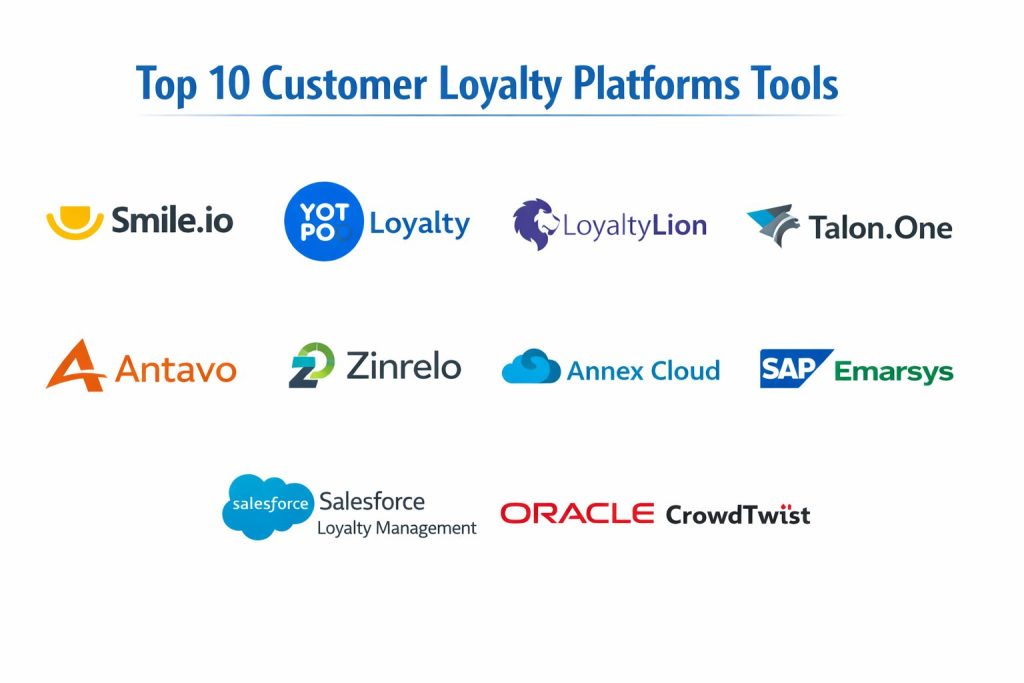
Top 10 Customer Loyalty Platforms
1) Smile.io
A widely used loyalty solution for ecommerce brands that want quick setup for points, referrals, and VIP tiers. Strong fit for small to mid-sized stores that need speed, simplicity, and proven loyalty mechanics.
Key Features
- Points programs for purchases and customer actions
- Referral program workflows with sharing and tracking
- VIP tiers with benefits and milestone logic
- Rewards catalog controls and redemption management
- On-site loyalty widgets and customer-facing experiences
- Basic reporting for program performance tracking
- Admin tools designed for fast launch and iteration
Pros
- Fast to implement and easy for small teams to operate
- Strong fit for standard ecommerce loyalty patterns
Cons
- Advanced enterprise rule complexity may be limited for some models
- Deep customization often depends on integrations and surrounding stack
Platforms / Deployment
- Web
- Cloud
Security & Compliance
- SSO/SAML, MFA, encryption, audit logs, RBAC: Not publicly stated
- SOC 2, ISO 27001, GDPR, HIPAA: Not publicly stated
Integrations & Ecosystem
Often used with ecommerce stacks and marketing tools to drive retention loops and repeat purchase.
- Ecommerce platform integrations: Varies / N/A
- Email and marketing integrations: Varies / N/A
- APIs and extensibility: Varies / Not publicly stated
- Rewards and coupon flows: Varies / N/A
Support & Community
Strong documentation for common setups and a broad user community; support tiers vary by plan.
2) Yotpo Loyalty
A loyalty platform often adopted by ecommerce brands that want loyalty tightly connected to customer engagement programs. Fits teams that want loyalty plus broader retention-related capabilities in one ecosystem.
Key Features
- Points and rewards programs for transactions and actions
- Referral program setup with tracking and incentives
- Tiered loyalty with VIP benefits and member perks
- Customer experience widgets and redemption flows
- Segmentation-friendly loyalty data for personalization
- Program reporting and performance visibility
- Operational tools for managing campaigns and rewards
Pros
- Works well for ecommerce retention strategies with engagement focus
- Flexible program building for many standard loyalty models
Cons
- Advanced customization may require deeper configuration and planning
- Cost can increase as features and usage scale
Platforms / Deployment
- Web
- Cloud
Security & Compliance
- SSO/SAML, MFA, encryption, audit logs, RBAC: Not publicly stated
- SOC 2, ISO 27001, GDPR, HIPAA: Not publicly stated
Integrations & Ecosystem
Typically aligns with ecommerce and marketing ecosystems to activate loyalty across touchpoints.
- Ecommerce integrations: Varies / N/A
- Marketing and messaging integrations: Varies / N/A
- Data connections to CRM and analytics: Varies / N/A
- APIs and extensibility: Varies / Not publicly stated
Support & Community
Structured onboarding for many customers and strong documentation; support strength depends on plan and contract.
3) LoyaltyLion
A loyalty platform built for ecommerce brands that want strong program customization without feeling overly enterprise-heavy. Good for teams that want points, tiers, and rewards with meaningful customer experience controls.
Key Features
- Points and rewards for purchases and engagement actions
- VIP tiers with configurable benefits and thresholds
- On-site loyalty experiences and member dashboards
- Rule configuration for earning and redemption logic
- Campaign tools for seasonal boosts and targeted rewards
- Reporting for loyalty performance and member behavior
- Tools to encourage repeat purchase and higher basket size
Pros
- Strong balance of configurability and usability for ecommerce teams
- Good member experience tooling without heavy custom development
Cons
- Enterprise-scale customization may require more engineering support
- Some advanced models can be harder to implement without a clear strategy
Platforms / Deployment
- Web
- Cloud
Security & Compliance
- SSO/SAML, MFA, encryption, audit logs, RBAC: Not publicly stated
- SOC 2, ISO 27001, GDPR, HIPAA: Not publicly stated
Integrations & Ecosystem
Often used with ecommerce, email, and customer engagement stacks to activate loyalty data.
- Ecommerce integrations: Varies / N/A
- Email and lifecycle integrations: Varies / N/A
- Customer data and analytics connections: Varies / N/A
- API access and customization: Varies / Not publicly stated
Support & Community
Known for practical documentation and onboarding guidance; support levels vary by plan.
4) Talon.One
A rule-engine-driven platform for promotions and loyalty that suits teams needing advanced logic, experimentation, and scalable personalization. Strong fit for larger organizations that want precise control over incentives.
Key Features
- Advanced rules engine for loyalty and promotions logic
- Support for points, tiers, vouchers, and custom incentives
- API-first approach for flexible integration patterns
- Segmentation and targeting capabilities for offer control
- Testing and experimentation workflows for incentive strategies
- Real-time decisioning patterns for eligibility and rewards
- Tools to manage fraud patterns and abuse prevention logic
Pros
- Excellent for complex incentive logic and scalability needs
- Strong fit for teams with technical resources and mature growth strategy
Cons
- Requires planning and engineering involvement to get full value
- Can be heavy for small teams needing basic loyalty quickly
Platforms / Deployment
- Web
- Cloud
Security & Compliance
- SSO/SAML, MFA, encryption, audit logs, RBAC: Not publicly stated
- SOC 2, ISO 27001, GDPR, HIPAA: Not publicly stated
Integrations & Ecosystem
Designed for integration into custom stacks with strong API-based connectivity.
- APIs and webhooks for custom builds: Varies / N/A
- Ecommerce and POS connections: Varies / N/A
- CDP and CRM integrations: Varies / N/A
- Partner ecosystem for implementation: Varies / N/A
Support & Community
Strong technical documentation and structured enterprise onboarding; support depth varies by contract.
5) Antavo
An enterprise loyalty platform built for complex programs, multi-brand setups, and omnichannel experiences. Suitable for organizations that need governance, scalability, and advanced loyalty design.
Key Features
- Enterprise-grade loyalty program management for large member bases
- Multi-brand and multi-region program design patterns
- Advanced tiering, rewards, and partner benefit structures
- Omnichannel member experience support (setup dependent)
- Workflow tools for operations, approvals, and program governance
- Analytics support for performance and program health
- Integration patterns for CRM, POS, and ecommerce stacks
Pros
- Strong enterprise fit for complex loyalty and partner ecosystems
- Good for organizations needing operational controls and scale
Cons
- Implementation effort can be significant
- Best results require clear loyalty economics and program ownership
Platforms / Deployment
- Web
- Cloud
Security & Compliance
- SSO/SAML, MFA, encryption, audit logs, RBAC: Not publicly stated
- SOC 2, ISO 27001, GDPR, HIPAA: Not publicly stated
Integrations & Ecosystem
Built to integrate with enterprise systems and support complex customer journeys.
- CRM and marketing integrations: Varies / N/A
- POS and commerce integrations: Varies / N/A
- Partner benefit and reward integrations: Varies / N/A
- APIs for custom member experiences: Varies / N/A
Support & Community
Enterprise onboarding and support approach with varying tiers; community visibility is smaller than SMB-first tools.
6) Zinrelo
A loyalty platform designed to drive repeat revenue with configurable rewards and customer segmentation support. Often used by brands that want a structured, data-driven loyalty approach.
Key Features
- Points and rewards programs with configurable earn and burn rules
- Tiered loyalty and milestone-based benefits
- Referral program support (setup dependent)
- Customer segmentation for targeted loyalty offers
- Program analytics and ROI-oriented tracking patterns
- Reward catalog and redemption management
- Tools to reduce churn through structured incentives
Pros
- Good balance of configurability and operational usability
- Focus on measurable retention outcomes and program clarity
Cons
- Some advanced custom experiences may need additional development
- Integrations vary based on your commerce and CRM stack
Platforms / Deployment
- Web
- Cloud
Security & Compliance
- SSO/SAML, MFA, encryption, audit logs, RBAC: Not publicly stated
- SOC 2, ISO 27001, GDPR, HIPAA: Not publicly stated
Integrations & Ecosystem
Often integrated with ecommerce, marketing automation, and data platforms for activation.
- Ecommerce integrations: Varies / N/A
- CRM and CDP connections: Varies / N/A
- Marketing integrations: Varies / N/A
- APIs and data export patterns: Varies / Not publicly stated
Support & Community
Support approach is structured and implementation-oriented; documentation quality varies by plan.
7) Annex Cloud
An enterprise customer loyalty and engagement platform aimed at brands running broader retention programs across multiple channels. Often used where loyalty connects with community and advocacy strategies.
Key Features
- Loyalty programs with points, tiers, and reward management
- Customer engagement and advocacy patterns (setup dependent)
- Omnichannel program support for large brands (setup dependent)
- Segmentation and targeting features for personalized loyalty experiences
- Analytics for performance and member lifecycle visibility
- Operational tools for moderation and program management (varies)
- Integration patterns for enterprise ecosystems
Pros
- Strong fit for enterprise programs that combine loyalty with engagement
- Designed for larger operational teams and governance needs
Cons
- Can be complex for small teams with simple requirements
- Implementation scope can expand if goals are not tightly defined
Platforms / Deployment
- Web
- Cloud
Security & Compliance
- SSO/SAML, MFA, encryption, audit logs, RBAC: Not publicly stated
- SOC 2, ISO 27001, GDPR, HIPAA: Not publicly stated
Integrations & Ecosystem
Typically connects to enterprise commerce, CRM, and messaging stacks for activation.
- Commerce and POS integrations: Varies / N/A
- CRM and marketing integrations: Varies / N/A
- Data platform integrations: Varies / N/A
- APIs for custom workflows: Varies / Not publicly stated
Support & Community
Enterprise-style onboarding and support tiers; community resources are smaller than SMB-first tools.
8) SAP Emarsys
A customer engagement platform with loyalty-related capabilities for brands that want strong lifecycle orchestration. Best for organizations that already rely on enterprise marketing orchestration and want loyalty tied into it.
Key Features
- Customer lifecycle orchestration and segmentation tools
- Loyalty-related campaign patterns (setup dependent)
- Personalization to target offers and retention workflows
- Cross-channel messaging orchestration (setup dependent)
- Data activation support for customer profiles and behavior
- Reporting for lifecycle performance and retention impact
- Enterprise integration patterns for broader stacks
Pros
- Strong fit when loyalty is driven through lifecycle orchestration
- Works well for multi-channel retention programs with mature teams
Cons
- Loyalty depth may depend on configuration and add-on components
- Can be heavy if you only need simple points and rewards
Platforms / Deployment
- Web
- Cloud
Security & Compliance
- SSO/SAML, MFA, encryption, audit logs, RBAC: Not publicly stated
- SOC 2, ISO 27001, GDPR, HIPAA: Not publicly stated
Integrations & Ecosystem
Typically integrates with commerce, CRM, and data platforms to orchestrate retention journeys.
- CRM and commerce integrations: Varies / N/A
- Data connections and exports: Varies / N/A
- Marketing channel integrations: Varies / N/A
- APIs and extensibility: Varies / Not publicly stated
Support & Community
Enterprise documentation and support; onboarding and service depend on contract scope.
9) Salesforce Loyalty Management
A loyalty offering designed for organizations already using Salesforce and wanting loyalty data tightly connected to CRM and service workflows. Suitable for enterprise programs that need customer data unification and governance.
Key Features
- Loyalty program modeling with points, tiers, and benefits (setup dependent)
- Strong CRM alignment for unified customer views
- Workflow support for service and member support processes
- Personalization possibilities through CRM-driven segmentation
- Partner and ecosystem alignment patterns (setup dependent)
- Reporting across customer lifecycle and loyalty activity
- Strong enterprise governance patterns when used with a broader stack
Pros
- Strong fit for organizations standardized on Salesforce ecosystem
- Helpful for connecting loyalty to service and CRM processes
Cons
- Implementation often requires experienced Salesforce resources
- Total cost can be high for smaller programs
Platforms / Deployment
- Web
- Cloud
Security & Compliance
- SSO/SAML, MFA, encryption, audit logs, RBAC: Not publicly stated
- SOC 2, ISO 27001, GDPR, HIPAA: Not publicly stated
Integrations & Ecosystem
Best used when loyalty is integrated with CRM, service, and data workflows.
- CRM-native workflows and data model alignment: Varies / N/A
- Partner ecosystem and integrations: Varies / N/A
- Automation and orchestration patterns: Varies / N/A
- APIs for integration: Varies / Not publicly stated
Support & Community
Large enterprise community, structured support options, and strong partner ecosystem; support depends on plan.
10) Oracle CrowdTwist
An enterprise loyalty platform aimed at brands managing sophisticated rewards and engagement strategies. Useful for programs needing scale, governance, and multi-channel experiences.
Key Features
- Enterprise loyalty program design for points, tiers, and rewards
- Engagement loyalty models beyond purchases (setup dependent)
- Segmentation and targeted offers for member groups
- Analytics for program performance and member activity tracking
- Omnichannel support patterns (setup dependent)
- Operational workflows for program administration
- Integration patterns for enterprise stacks and data flows
Pros
- Strong fit for large loyalty programs with governance needs
- Suitable for multi-channel programs with complex engagement logic
Cons
- Implementation effort can be significant
- Best outcomes require clear economics and program operations maturity
Platforms / Deployment
- Web
- Cloud
Security & Compliance
- SSO/SAML, MFA, encryption, audit logs, RBAC: Not publicly stated
- SOC 2, ISO 27001, GDPR, HIPAA: Not publicly stated
Integrations & Ecosystem
Designed to integrate into enterprise ecosystems with structured data and customer workflows.
- CRM and marketing integrations: Varies / N/A
- Commerce and POS integrations: Varies / N/A
- Data platform connections: Varies / N/A
- APIs for custom experiences: Varies / Not publicly stated
Support & Community
Enterprise onboarding and support approach; community visibility is smaller than SMB-focused platforms.
Comparison Table
| Tool Name | Best For | Platform(s) Supported | Deployment | Standout Feature | Public Rating |
|---|---|---|---|---|---|
| Smile.io | Quick ecommerce loyalty launch | Web | Cloud | Fast setup for points and referrals | N/A |
| Yotpo Loyalty | Ecommerce loyalty tied to engagement | Web | Cloud | Loyalty plus broader retention ecosystem | N/A |
| LoyaltyLion | Flexible ecommerce loyalty programs | Web | Cloud | Strong member experience tooling | N/A |
| Talon.One | Complex incentive logic at scale | Web | Cloud | Advanced rules engine and experimentation | N/A |
| Antavo | Enterprise omnichannel loyalty | Web | Cloud | Multi-brand enterprise program design | N/A |
| Zinrelo | Configurable loyalty with analytics focus | Web | Cloud | Structured loyalty ROI approach | N/A |
| Annex Cloud | Enterprise loyalty and engagement | Web | Cloud | Loyalty combined with broader engagement | N/A |
| SAP Emarsys | Lifecycle-driven retention programs | Web | Cloud | Orchestration-led retention strategy | N/A |
| Salesforce Loyalty Management | CRM-native loyalty programs | Web | Cloud | Tight CRM and service alignment | N/A |
| Oracle CrowdTwist | Enterprise loyalty at scale | Web | Cloud | Engagement and rewards governance | N/A |
Evaluation & Scoring
Weights: Core features 25%, Ease 15%, Integrations 15%, Security 10%, Performance 10%, Support 10%, Value 15%.
| Tool Name | Core (25%) | Ease (15%) | Integrations (15%) | Security (10%) | Performance (10%) | Support (10%) | Value (15%) | Weighted Total |
|---|---|---|---|---|---|---|---|---|
| Smile.io | 7.5 | 9.0 | 7.5 | 6.0 | 7.5 | 7.5 | 9.0 | 7.83 |
| Yotpo Loyalty | 8.0 | 8.0 | 8.0 | 6.0 | 7.5 | 7.5 | 7.5 | 7.60 |
| LoyaltyLion | 8.0 | 8.5 | 7.5 | 6.0 | 7.5 | 7.5 | 8.0 | 7.73 |
| Talon.One | 9.0 | 7.0 | 9.0 | 6.5 | 8.5 | 8.0 | 7.0 | 8.10 |
| Antavo | 8.5 | 7.0 | 8.5 | 6.5 | 8.0 | 7.5 | 6.5 | 7.68 |
| Zinrelo | 8.0 | 7.5 | 7.5 | 6.0 | 7.5 | 7.0 | 7.5 | 7.43 |
| Annex Cloud | 8.0 | 7.0 | 8.0 | 6.5 | 7.5 | 7.5 | 6.5 | 7.40 |
| SAP Emarsys | 7.5 | 7.0 | 8.5 | 7.0 | 7.5 | 7.5 | 6.5 | 7.40 |
| Salesforce Loyalty Management | 8.0 | 6.5 | 8.5 | 7.0 | 7.5 | 8.0 | 6.0 | 7.45 |
| Oracle CrowdTwist | 8.0 | 6.5 | 8.0 | 6.5 | 7.5 | 7.5 | 6.5 | 7.28 |
How to interpret the scores:
- These scores compare tools within this list, not the whole market.
- Higher totals usually indicate broader fit across many scenarios.
- Ease and value can matter more than depth for small teams shipping fast.
- Security scoring is limited when public disclosures are not clear.
- Always validate with a pilot using your real ecommerce, CRM, and data workflows.
Which Customer Loyalty Platform Is Right for You?
Solo / Freelancer
If you run a small store or manage loyalty for a few clients, prioritize quick launch and easy daily management. Smile.io, LoyaltyLion, and Yotpo Loyalty are often easier to implement and operate for standard loyalty patterns. Focus on member experience, redemption simplicity, and basic reporting rather than complex rule engines.
SMB
For SMBs, the best choice depends on how customized you want your program to be. If you want rapid launch with proven mechanics, Smile.io is a practical option. If you need a more flexible loyalty experience and want deeper control over earning and redemption rules, LoyaltyLion can be a better fit. If you are connecting loyalty with reviews and engagement workflows, Yotpo Loyalty can align well.
Mid-Market
Mid-market teams typically care about segmentation, operational workflows, and integration patterns with CRM and marketing automation. Talon.One becomes attractive when your incentive logic is complex and you want precise eligibility rules. Zinrelo can fit well for brands wanting a structured loyalty program with clear analytics direction. Annex Cloud can fit when you want loyalty plus broader engagement strategies.
Enterprise
Enterprises usually need governance, scalability, and strong integration architecture. Antavo and Oracle CrowdTwist suit complex programs, multi-brand setups, and omnichannel ambitions when you can support the operational load. Salesforce Loyalty Management is a strong option if your organization is already heavily invested in Salesforce and wants loyalty unified with CRM and service workflows. SAP Emarsys can be a fit when retention is driven through lifecycle orchestration and multi-channel messaging.
Budget vs Premium
Budget-friendly approaches typically emphasize fast deployment and standard mechanics, which makes Smile.io, LoyaltyLion, and some configurations of Yotpo Loyalty more appealing. Premium, enterprise-grade programs often require deeper implementation and governance, pointing toward Antavo, Talon.One, Oracle CrowdTwist, or Salesforce Loyalty Management depending on your stack.
Feature Depth vs Ease of Use
If your team has limited time and wants simplicity, prioritize platforms that are easier to configure and run daily. If you have a dedicated retention team and want deeper rules, partner logic, and experimentation, Talon.One and enterprise platforms can provide more control, but they require stronger ownership and operational maturity.
Integrations & Scalability
If your loyalty program must connect to ecommerce, POS, CRM, and marketing automation, integration quality becomes a deciding factor. Validate real event tracking, member identity resolution, coupon and reward handling, and data export patterns. For large scale, confirm performance on peak traffic days and verify how rewards liabilities are tracked operationally.
Security & Compliance Needs
Many loyalty platforms expose customer and purchase data, so governance matters. If compliance details are not publicly stated, treat them as unknown and validate through vendor security reviews. Focus on access controls, auditability, secure data handling practices, and role-based permissions for admin users.
Frequently Asked Questions (FAQs)
1) What does a customer loyalty platform actually do?
It manages rewards rules, member accounts, tiers, referrals, and redemption flows. It also helps track member activity and measure how loyalty impacts repeat purchases and retention.
2) Should I use points, tiers, or referrals first?
Start with the simplest model that matches your business. Points and basic tiers work well for repeat purchases, while referrals help when you need cost-effective acquisition tied to retention.
3) How long does it take to launch a loyalty program?
Basic programs can launch quickly if your ecommerce stack is straightforward. More complex omnichannel programs take longer because identity, POS, and operations must be aligned.
4) What are common mistakes in loyalty programs?
Giving rewards that hurt margins, making redemption confusing, ignoring fraud, and not measuring incremental lift. Another mistake is running too many overlapping discounts and incentives.
5) How do I measure loyalty program success?
Track repeat purchase rate, member vs non-member revenue, redemption rate, program cost, and incremental margin. Also watch customer support tickets related to rewards confusion.
6) Do loyalty platforms help with personalization?
Many do through segmentation and targeting, especially when connected to CRM and marketing tools. The strongest outcomes come when loyalty data feeds lifecycle messaging and offers.
7) How do I prevent referral and points fraud?
Use clear rules, monitor unusual patterns, and limit abuse through verification steps and fraud controls. Also keep reward issuance tied to real purchases and validated identities.
8) Can I run loyalty across online and in-store purchases?
Yes, but it depends on how well the platform integrates with your POS and identity resolution. Omnichannel loyalty requires clean customer matching and consistent transaction capture.
9) What should I test before choosing a platform?
Test earning rules, redemption flow, coupon behavior, returns handling, tier upgrades, data exports, and integrations with your email or CRM system. Also validate admin workflows for day-to-day operations.
10) How hard is it to switch loyalty platforms later?
Switching can be painful because points balances, tiers, and customer expectations must be migrated carefully. Plan a controlled transition with clear communication and strong data validation.
Conclusion
Customer loyalty platforms work best when the program is designed for your business model and operated with discipline. Some brands need a fast, standard program that is easy to run every day, which makes tools like Smile.io, Yotpo Loyalty, and LoyaltyLion practical options. Others need advanced control over incentives and eligibility, which is where Talon.One becomes attractive. Enterprises often prioritize governance, scalability, and deep ecosystem alignment, making Antavo, Oracle CrowdTwist, Salesforce Loyalty Management, and SAP Emarsys more relevant depending on the stack. The simplest next step is to shortlist two or three tools, run a small pilot using real customer scenarios, validate integrations and redemption behavior, and confirm that program economics remain profitable before scaling.