Introduction
Customer IAM (CIAM) is the system that manages how customers sign up, sign in, and safely use your digital products. It sits behind your websites, apps, portals, and APIs to handle authentication, customer profiles, and consent. Unlike workforce identity, CIAM is built for high-volume traffic, fast onboarding, and smooth user experience while still enforcing strong security.
CIAM matters because customers expect simple login, social sign-in, passkeys, and consistent access across devices, while businesses must reduce account takeovers, protect data, and meet privacy expectations. Common use cases include ecommerce logins, consumer banking and fintech onboarding, telecom self-service portals, citizen services, healthcare patient portals, and B2B customer portals.
What to evaluate: signup and login UX, passwordless and MFA options, session security, bot and fraud defenses, profile and consent management, developer APIs and SDKs, integrations with apps and data stores, scalability and uptime patterns, customization and branding controls, and admin governance.
Best for: product teams, security teams, and engineering teams building customer-facing apps with large user bases, frequent logins, and privacy requirements.
Not ideal for: small internal apps with a few employees where a workforce IAM is enough, or very simple sites where a basic authentication library is sufficient.
Key Trends in Customer IAM (CIAM)
- Passwordless adoption is rising, including passkeys and device-based authentication, to reduce phishing risk and login friction
- Risk-based authentication is becoming standard, using context like device, location, and behavior to step up security only when needed
- Higher expectations for privacy, consent, and data minimization, with stronger controls for profile attributes and data retention
- More focus on bot and fraud protection at login and signup, especially for credential stuffing and fake account creation
- Identity-first customer experience, where login is treated as part of product conversion, not just security
- API-first CIAM architectures for mobile apps, partner portals, and microservices
- Better support for customer-to-customer and customer-to-business models, including multi-tenant and organization membership
- More demand for flexible identity journeys, such as progressive profiling and step-up verification at key moments
- Integration patterns shifting toward event-driven sync with CRM, CDP, and marketing tools to keep profiles consistent
- Admin governance and auditability are increasingly important as identity becomes a shared service across many product teams
How We Selected These Tools (Methodology)
- Included widely recognized CIAM platforms used in real customer-facing environments
- Prioritized strong authentication options, customer lifecycle support, and flexible developer tooling
- Considered scalability fit for consumer traffic spikes and high-volume user stores
- Evaluated how well platforms support customization, branding, and flexible login journeys
- Looked at integration breadth with apps, APIs, directories, and common business systems
- Considered security posture features such as MFA, adaptive policies, and admin controls
- Balanced enterprise-grade suites with developer-friendly options and platform-native offerings
- Selected tools that cover different buyer profiles: startups, mid-market, and large enterprises
- Scored tools comparatively using a consistent rubric focused on CIAM outcomes
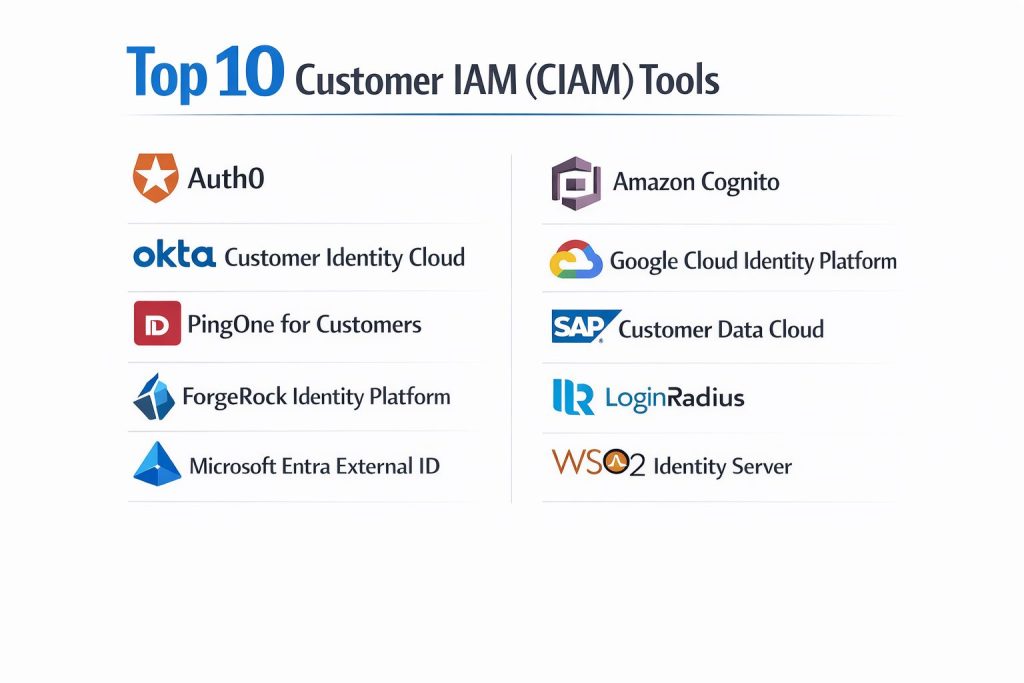
Top 10 Customer IAM (CIAM) Platforms
1) Auth0
Auth0 is a developer-friendly identity platform often chosen for fast implementation, flexible authentication, and modern application patterns. It fits teams building consumer apps that need quick time-to-market with scalable authentication.
Key Features
- Flexible authentication and authorization for web and mobile apps
- Passwordless and MFA options (varies by configuration)
- Customizable login experiences and identity flows
- API-first approach with SDKs for common platforms
- Social login options and enterprise federation patterns (varies)
- Token-based access patterns for modern app architectures
- Extensibility through rules, actions, or similar mechanisms (naming varies)
Pros
- Strong developer experience and fast implementation for many teams
- Good fit for modern app stacks and API-centric architectures
Cons
- Advanced customization and governance may require careful design
- Total cost can grow with scale and feature requirements
Platforms / Deployment
- Cloud
- Hybrid: Varies / N/A
Security & Compliance
- SSO/SAML, MFA, encryption, audit logs, RBAC: Varies / Not publicly stated
- SOC 2, ISO 27001, GDPR, HIPAA: Not publicly stated
Integrations & Ecosystem
Auth0 typically integrates through SDKs, APIs, webhooks, and marketplace-style connectors.
- Web and mobile SDK support (varies by stack)
- Integration with social identity providers
- Enterprise federation patterns (varies)
- APIs for user management and tokens
- Extensibility for custom policies and flows
Support & Community
Strong documentation and developer community; support tiers vary by plan.
2) Okta Customer Identity Cloud
Okta Customer Identity Cloud is a CIAM offering aimed at secure, scalable customer login and profile management with enterprise-grade governance. It’s often chosen by organizations that want strong security controls and operational maturity.
Key Features
- Customer authentication and lifecycle management
- MFA and adaptive policy patterns (varies by setup)
- User profile management and progressive profiling options (varies)
- Social login support and identity federation options
- Admin controls for governance and access management
- APIs and SDKs for integration with customer apps
- Scalable architecture for large user populations (implementation dependent)
Pros
- Strong enterprise fit with governance and administrative tooling
- Good alignment for organizations standardizing identity across products
Cons
- Implementation depth can increase for highly custom journeys
- Licensing and feature packaging can be complex
Platforms / Deployment
- Cloud
- Hybrid: Varies / N/A
Security & Compliance
- SSO/SAML, MFA, encryption, audit logs, RBAC: Varies / Not publicly stated
- SOC 2, ISO 27001, GDPR, HIPAA: Not publicly stated
Integrations & Ecosystem
Commonly used with app gateways, API services, and enterprise identity stacks.
- APIs and SDKs for authentication flows
- Connectors and identity provider integrations (varies)
- Integration with customer apps and portals
- Extensibility for custom flows (varies)
- Admin reporting and audit patterns (varies)
Support & Community
Strong enterprise support options and documentation; community strength varies by region and product adoption.
3) PingOne for Customers
PingOne for Customers is a CIAM platform focused on secure customer authentication, adaptive access, and enterprise-grade governance. It fits organizations that need strong policy control and complex customer identity requirements.
Key Features
- Customer authentication with policy-based controls
- MFA and adaptive access capabilities (varies by configuration)
- Single sign-on patterns for customer portals (varies)
- Identity federation and integration with external providers
- User lifecycle and profile capabilities (varies by modules)
- APIs for modern app integration and token services
- Administrative controls for identity governance and audit trails (varies)
Pros
- Strong policy and access control approach for complex environments
- Good fit for regulated industries with strong governance needs
Cons
- Can require experienced identity engineering for best outcomes
- Cost and packaging may be challenging for small teams
Platforms / Deployment
- Cloud
- Hybrid: Varies / N/A
Security & Compliance
- SSO/SAML, MFA, encryption, audit logs, RBAC: Varies / Not publicly stated
- SOC 2, ISO 27001, GDPR, HIPAA: Not publicly stated
Integrations & Ecosystem
Often integrates into enterprise application environments with federation and API security patterns.
- Integration with external identity providers
- APIs for tokens, sessions, and user management
- Connectors and ecosystem add-ons (varies)
- Logging and monitoring integrations: Varies / N/A
- Extensible policy frameworks (varies)
Support & Community
Strong enterprise support; community is smaller than developer-first tools but generally mature.
4) ForgeRock Identity Platform
ForgeRock Identity Platform is known for flexible identity journeys, strong customization, and enterprise-grade customer identity use cases. It’s commonly considered when complex workflows, fine-grained control, and large-scale deployments are required.
Key Features
- Journey-based or flow-based authentication patterns (product-specific naming varies)
- Customer identity, profile, and lifecycle management
- Adaptive access and risk-based controls (varies by configuration)
- Fine-grained authorization patterns (varies)
- Integration support for directories and identity stores
- APIs and extensibility for custom CIAM requirements
- Strong support for complex customer portal models (implementation dependent)
Pros
- Very flexible for complex customer journeys and large programs
- Strong customization options when identity is a core platform capability
Cons
- Higher implementation and operational complexity than simpler CIAM tools
- Often best with experienced identity architects and engineers
Platforms / Deployment
- Cloud: Varies / N/A
- Self-hosted / Hybrid: Varies / N/A
Security & Compliance
- SSO/SAML, MFA, encryption, audit logs, RBAC: Varies / Not publicly stated
- SOC 2, ISO 27001, GDPR, HIPAA: Not publicly stated
Integrations & Ecosystem
Typically used as a central identity layer integrated with directories, APIs, and enterprise systems.
- Identity store and directory integration patterns
- APIs for auth, identity, and profile operations
- Integration with customer apps and portals
- Extensibility for custom authentication and verification steps
- Support for complex organizational models (varies)
Support & Community
Enterprise-focused support and professional services are common; community is more specialized than mass-market tools.
5) Microsoft Entra External ID
Microsoft Entra External ID supports customer and external user access scenarios, often considered by organizations already using Microsoft identity services. It’s useful when CIAM must align with Microsoft-based security, administration, and enterprise governance.
Key Features
- Customer authentication patterns for external users (capabilities vary by configuration)
- Integration with Microsoft identity services and admin controls
- Policies for access, conditional steps, and MFA (varies)
- Customizable user journeys and UI branding options (varies)
- Support for social and local accounts (varies)
- APIs and integration patterns for app authentication
- Administrative reporting and governance patterns (varies)
Pros
- Strong fit for organizations standardizing on Microsoft identity administration
- Useful governance and enterprise controls for external identities
Cons
- Custom journey design can be complex depending on requirements
- Some advanced CIAM features may require additional configuration or services
Platforms / Deployment
- Cloud
- Hybrid: Varies / N/A
Security & Compliance
- SSO/SAML, MFA, encryption, audit logs, RBAC: Varies / Not publicly stated
- SOC 2, ISO 27001, GDPR, HIPAA: Not publicly stated
Integrations & Ecosystem
Often connects naturally with Microsoft-centric stacks and common enterprise integrations.
- Integration with Microsoft admin and security tooling (varies)
- APIs for application authentication and identity management
- Federation with external identity providers (varies)
- Integration with monitoring and logging tools: Varies / N/A
- SDK support for application platforms: Varies / N/A
Support & Community
Large enterprise footprint and documentation availability; support options vary by plan.
6) Amazon Cognito
Amazon Cognito is a cloud-native CIAM option for teams building on AWS. It’s commonly chosen for app authentication, user pools, and integration with AWS services, especially for developers who want a managed identity layer.
Key Features
- Managed user directories and authentication flows
- Integration with AWS application services (varies by architecture)
- MFA and configurable security policies (varies)
- Social login and federation options (varies)
- Token-based access for APIs and mobile apps
- Scales with cloud infrastructure patterns (implementation dependent)
- Administrative controls for user management and access configuration
Pros
- Strong fit for AWS-native architectures and developer workflows
- Managed service reduces operational overhead for many teams
Cons
- Deep customization may be limited compared to enterprise CIAM suites
- Some customer journey patterns can require extra application logic
Platforms / Deployment
- Cloud
- Hybrid: Varies / N/A
Security & Compliance
- SSO/SAML, MFA, encryption, audit logs, RBAC: Varies / Not publicly stated
- SOC 2, ISO 27001, GDPR, HIPAA: Not publicly stated
Integrations & Ecosystem
Works best when combined with AWS services, API gateways, and serverless patterns.
- Integration with AWS application services
- Federation with external identity providers (varies)
- APIs for user and token operations
- Event and trigger patterns for custom logic (varies)
- Logging and monitoring integrations: Varies / N/A
Support & Community
Large developer community and documentation; support depends on cloud support plan.
7) Google Cloud Identity Platform
Google Cloud Identity Platform provides customer authentication services for apps built on Google Cloud or multi-cloud environments. It’s commonly used when teams want managed authentication with integration to cloud-native services.
Key Features
- Customer authentication flows for web and mobile apps
- Integration with cloud services and app platforms (varies)
- Support for social login and federation patterns (varies)
- Token-based authentication and API access patterns
- Administrative controls for identity configuration (varies)
- Developer-friendly integration via APIs and SDKs (varies)
- Scalable managed service patterns (implementation dependent)
Pros
- Useful for cloud-native application stacks and fast implementation
- Managed approach reduces operational burden for many teams
Cons
- Advanced CIAM journey customization may be limited versus enterprise suites
- Some enterprise governance features may require additional tooling
Platforms / Deployment
- Cloud
- Hybrid: Varies / N/A
Security & Compliance
- SSO/SAML, MFA, encryption, audit logs, RBAC: Varies / Not publicly stated
- SOC 2, ISO 27001, GDPR, HIPAA: Not publicly stated
Integrations & Ecosystem
Commonly integrates via APIs and identity federation with application stacks.
- Social identity provider integration (varies)
- API integration for auth and user management
- Integration with cloud logging and monitoring: Varies / N/A
- Federation options: Varies / N/A
- SDK patterns for app platforms: Varies / N/A
Support & Community
Good documentation and cloud community support; support tiers vary by cloud plan.
8) SAP Customer Data Cloud
SAP Customer Data Cloud focuses on customer identity, consent, and profile management, often used by organizations already invested in SAP ecosystems. It can be attractive when identity needs to align closely with customer data and marketing workflows.
Key Features
- Customer registration and login flows (varies by configuration)
- Consent and preference management (varies)
- Profile management and progressive profiling patterns
- Integration with customer data and marketing processes (varies)
- Security controls for authentication and access (varies)
- Administrative dashboards for customer identity management (varies)
- Support for large customer bases (implementation dependent)
Pros
- Strong fit when consent and profile management are central priorities
- Useful alignment for SAP-centric customer platforms
Cons
- Best value often depends on existing SAP stack and integration needs
- Some developer-first workflows may be less flexible than pure CIAM tools
Platforms / Deployment
- Cloud
- Hybrid: Varies / N/A
Security & Compliance
- SSO/SAML, MFA, encryption, audit logs, RBAC: Varies / Not publicly stated
- SOC 2, ISO 27001, GDPR, HIPAA: Not publicly stated
Integrations & Ecosystem
Often chosen for integration with customer data flows and enterprise systems.
- Integration with SAP ecosystem services (varies)
- APIs for identity and profile operations
- Consent and preference export patterns (varies)
- Integration with analytics and marketing systems: Varies / N/A
- Federation and identity provider integrations (varies)
Support & Community
Enterprise support structure is common; community is strongest among SAP-focused teams.
9) LoginRadius
LoginRadius is a CIAM platform designed for customer login, social identity, and profile management, often used by mid-market teams that want strong functionality without building everything from scratch.
Key Features
- Customer login and registration workflows
- Social login and identity federation patterns
- Profile and identity data management (varies)
- MFA and security features (varies by plan)
- Customizable UI and hosted login options (varies)
- APIs for integration and user management
- Administrative reporting and operational controls (varies)
Pros
- Solid balance of features and implementation speed for many teams
- Useful for customer-facing apps needing social login and profile management
Cons
- Advanced enterprise governance needs may require careful evaluation
- Feature depth can vary by plan and packaging
Platforms / Deployment
- Cloud
- Hybrid: Varies / N/A
Security & Compliance
- SSO/SAML, MFA, encryption, audit logs, RBAC: Varies / Not publicly stated
- SOC 2, ISO 27001, GDPR, HIPAA: Not publicly stated
Integrations & Ecosystem
Typically integrates through APIs, SDKs, and prebuilt connectors where available.
- Social identity provider integrations
- APIs for identity and profile management
- Integration with customer apps and portals
- Webhook and event patterns: Varies / N/A
- Integration with CRM and marketing tools: Varies / N/A
Support & Community
Documentation is generally accessible; support options vary by plan; community is moderate.
10) WSO2 Identity Server
WSO2 Identity Server is an identity platform that can support CIAM use cases for organizations that want more control and self-managed deployment options. It fits teams comfortable running identity infrastructure and building custom flows.
Key Features
- Configurable authentication and authorization for customer apps
- Support for standards-based federation patterns (implementation dependent)
- Extensibility for custom login flows and policies
- APIs for identity operations and token services
- Self-managed deployment options for governance control
- Integration patterns for enterprise systems (varies)
- Flexible approach for building tailored CIAM solutions
Pros
- Greater control for organizations wanting self-managed identity infrastructure
- Flexible for teams that need custom flows and deeper configuration control
Cons
- Requires more operational effort than managed cloud CIAM services
- Best results typically need experienced identity engineering
Platforms / Deployment
- Cloud: Varies / N/A
- Self-hosted / Hybrid: Varies / N/A
Security & Compliance
- SSO/SAML, MFA, encryption, audit logs, RBAC: Varies / Not publicly stated
- SOC 2, ISO 27001, GDPR, HIPAA: Not publicly stated
Integrations & Ecosystem
Often used where standards-based integration and custom extension are priorities.
- Federation and protocol standards support (varies)
- APIs for integration and automation
- Integration with enterprise identity and directories: Varies / N/A
- Logging, monitoring, and SIEM integration: Varies / N/A
- Custom policy and flow extensions (varies)
Support & Community
Has a technical community and documentation; enterprise support options vary by commercial agreements.
Comparison Table
| Tool Name | Best For | Platform(s) Supported | Deployment | Standout Feature | Public Rating |
|---|---|---|---|---|---|
| Auth0 | Developer-first CIAM for fast app delivery | Web / Mobile / APIs | Cloud | Strong developer experience and extensibility | N/A |
| Okta Customer Identity Cloud | Enterprise customer identity governance | Web / Mobile / APIs | Cloud | Scalable customer identity with admin controls | N/A |
| PingOne for Customers | Policy-driven customer access at scale | Web / Mobile / APIs | Cloud | Adaptive access and enterprise policy control | N/A |
| ForgeRock Identity Platform | Complex customer journeys and customization | Web / Mobile / APIs | Varies / N/A | Flexible journey-based identity patterns | N/A |
| Microsoft Entra External ID | Microsoft-aligned external identity scenarios | Web / Mobile / APIs | Cloud | Integration with Microsoft identity administration | N/A |
| Amazon Cognito | AWS-native customer authentication | Web / Mobile / APIs | Cloud | Managed identity for AWS application stacks | N/A |
| Google Cloud Identity Platform | Cloud-native customer authentication | Web / Mobile / APIs | Cloud | Managed authentication for app platforms | N/A |
| SAP Customer Data Cloud | Consent and customer profile-centric CIAM | Web / Mobile / APIs | Cloud | Consent and preference management focus | N/A |
| LoginRadius | Balanced CIAM for customer login and profiles | Web / Mobile / APIs | Cloud | Social login and customer profile management | N/A |
| WSO2 Identity Server | Self-managed CIAM with customization control | Web / Mobile / APIs | Varies / N/A | Standards-based integration with extensibility | N/A |
Evaluation & Scoring
Scoring model
Each tool is scored from 1–10 per criterion. Weighted Total is calculated using these weights. Scores are comparative within this list and should be validated through a pilot.
Weights:
- Core features – 25%
- Ease of use – 15%
- Integrations & ecosystem – 15%
- Security & compliance – 10%
- Performance & reliability – 10%
- Support & community – 10%
- Price / value – 15%
| Tool Name | Core (25%) | Ease (15%) | Integrations (15%) | Security (10%) | Performance (10%) | Support (10%) | Value (15%) | Weighted Total (0–10) |
|---|---|---|---|---|---|---|---|---|
| Auth0 | 8.8 | 8.6 | 8.7 | 7.6 | 8.6 | 8.4 | 7.6 | 8.33 |
| Okta Customer Identity Cloud | 8.9 | 8.0 | 8.7 | 8.0 | 8.6 | 8.3 | 7.2 | 8.25 |
| PingOne for Customers | 8.7 | 7.6 | 8.4 | 8.1 | 8.5 | 8.0 | 7.1 | 8.03 |
| ForgeRock Identity Platform | 9.0 | 6.8 | 8.3 | 8.2 | 8.4 | 7.6 | 6.9 | 7.83 |
| Microsoft Entra External ID | 8.2 | 7.8 | 8.6 | 8.0 | 8.4 | 8.2 | 7.8 | 8.12 |
| Amazon Cognito | 7.9 | 7.8 | 8.1 | 7.7 | 8.5 | 7.9 | 8.6 | 8.08 |
| Google Cloud Identity Platform | 7.8 | 7.8 | 8.0 | 7.6 | 8.3 | 7.8 | 8.1 | 7.93 |
| SAP Customer Data Cloud | 8.1 | 7.4 | 7.9 | 7.7 | 8.1 | 7.7 | 7.0 | 7.72 |
| LoginRadius | 7.8 | 8.1 | 7.7 | 7.3 | 8.0 | 7.6 | 7.9 | 7.83 |
| WSO2 Identity Server | 8.0 | 6.8 | 7.9 | 7.6 | 8.0 | 7.2 | 8.0 | 7.62 |
How to interpret the scores:
- Weighted Total highlights broad balance across criteria, not a universal winner.
- If you prioritize conversion and fast onboarding, ease of use may matter more than maximum feature depth.
- If you operate in regulated environments, security posture and governance features should dominate selection.
- Value scores reflect typical cost-to-capability expectations, but actual pricing varies widely by contracts and scale.
- Always validate scoring with a real pilot using your apps, traffic assumptions, and integration requirements.
Which CIAM Tool Is Right for You?
Solo / Small Product Team
If you need to ship quickly with minimal identity engineering, favor platforms that provide clean SDKs, hosted login options, and sensible defaults. Auth0 and Amazon Cognito are commonly chosen in this scenario depending on whether you want a vendor-managed CIAM experience or a cloud-native identity service aligned with your stack. For small teams, the main risk is building too much custom logic early. Start with a simple login journey, add MFA later, and rely on proven integration patterns.
SMB
SMBs typically need strong login UX, social sign-in, manageable admin tooling, and integrations with customer systems. Okta Customer Identity Cloud and LoginRadius often fit when you want a full CIAM feature set without building everything. Microsoft Entra External ID can be a strong option if your environment already uses Microsoft identity services and you want consistent administration and governance across teams.
Mid-Market
Mid-market teams usually have multiple customer apps, mobile plus web experiences, and higher traffic variability. PingOne for Customers is attractive when policy-based control, adaptive access, and enterprise governance matter. Auth0 can also fit well when developer velocity and extensibility are priorities. If your product requires complex journeys, such as multi-step verification or organization membership, ForgeRock Identity Platform may be considered, but you should plan for more architecture and operational work.
Enterprise
Enterprises often need consistency across many apps, strong auditability, flexible identity journeys, and a clear operating model for identity as a shared service. Okta Customer Identity Cloud, PingOne for Customers, Microsoft Entra External ID, and ForgeRock Identity Platform are commonly evaluated in enterprise programs. The key success factor is governance: standard flows, shared policy templates, centralized logging, and a reliable customer profile strategy that avoids duplication.
Budget vs Premium
For budget-focused teams, cloud-native options like Amazon Cognito or Google Cloud Identity Platform can be practical when the requirements are straightforward and your architecture is already aligned to that cloud. Premium suites often justify cost when you need deep journey customization, broad integration, and strong governance across multiple product lines.
Feature Depth vs Ease of Use
If your team needs highly tailored customer flows, complex policies, or unusual identity models, platforms like ForgeRock Identity Platform and PingOne for Customers can offer more depth, but they demand stronger identity engineering. If your priority is speed and developer experience, Auth0 and cloud-native services can reduce time-to-market. Many successful programs start with ease-of-use and evolve toward depth only when the business requires it.
Integrations & Scalability
Choose based on your integration map, not only feature checklists. Map your apps, APIs, customer data stores, CRM needs, analytics, and fraud signals. Validate token flows, session behavior, and identity events. For scalability, test rate limits, login spikes, and operational observability. A small proof of concept that covers sign-up, sign-in, passwordless or MFA, and one real integration is often more valuable than weeks of vendor comparisons.
Security & Compliance Needs
If compliance is strict, focus on governance controls, auditability, policy enforcement, and how you handle consent and customer data. Also confirm administrative separation of duties and how quickly you can respond to incidents such as credential stuffing. When a certification or compliance claim is not clearly known, treat it as Not publicly stated and verify directly through procurement and security review.
Frequently Asked Questions (FAQs)
1. What is the main difference between CIAM and workforce IAM?
CIAM is designed for customers and external users, so it prioritizes smooth onboarding, high scalability, and flexible login journeys. Workforce IAM is optimized for employees, with tighter admin controls and internal app access patterns.
2. Should I choose passwordless login for my customer app?
Passwordless can reduce phishing risk and improve login success rates, but it depends on your audience and device mix. Many teams start with optional passwordless and expand after measuring conversion and support impact.
3. What are the most common CIAM implementation mistakes?
Over-customizing early, skipping a pilot, not planning for account recovery, and ignoring fraud and bot defenses. Another mistake is storing too much customer data in identity profiles without clear governance.
4. How do I evaluate CIAM security beyond MFA?
Look for adaptive access policies, session controls, audit logs, admin permissions, and support for monitoring integrations. Also assess account recovery, credential stuffing mitigation, and suspicious signup detection options.
5. How hard is it to migrate from one CIAM tool to another?
Migration can be complex because passwords, sessions, and profile schemas do not always transfer cleanly. Plan for phased migration, parallel login, careful data mapping, and strong customer communication.
6. What integrations should I validate first in a CIAM pilot?
Start with your core application, one API gateway or backend service, and one customer data destination such as CRM or analytics. Validate token formats, session expiry, logout behavior, and identity events.
7. Do I need consent and preference management inside CIAM?
If you operate in privacy-sensitive markets or rely on marketing personalization, consent and preference features can be critical. Even if handled elsewhere, CIAM should support attributes and policies that respect consent signals.
8. Can cloud-native CIAM services scale for consumer traffic spikes?
They often can, but you must test your specific traffic patterns, rate limits, and integration architecture. The weakest link is usually the surrounding application stack, not the identity service alone.
9. How should I design customer account recovery safely?
Use step-up verification, avoid weak knowledge-based questions, and track risky recovery behavior. Make recovery easy for legitimate users but hard for attackers, especially for high-value accounts.
10. What is a practical way to pick the right CIAM tool?
Shortlist two or three tools, run a pilot for signup, sign-in, MFA, and one real integration, then measure conversion, security signals, and operational effort. The best choice is the one that meets your requirements with the least ongoing complexity.
Conclusion
Customer IAM is one of the few platforms that directly impacts both revenue and security because it shapes how customers enter your product and how safely they stay there. The best CIAM choice depends on your user volume, your need for customization, your integration map, and the security posture required for your industry. Developer-first options can speed delivery, cloud-native services can align well with platform stacks, and enterprise suites can shine when governance and complex journeys are non-negotiable. A smart next step is to shortlist two or three tools from this list, run a pilot with real signup and login flows, validate integrations and session behavior, and only then standardize your identity patterns across teams.