Introduction
CRM platforms help businesses manage customer relationships across the full journey, including lead capture, sales pipeline, marketing touchpoints, customer support, renewals, and account growth. In simple terms, a CRM becomes the single place where teams track who the customer is, what they need, what has been promised, and what should happen next. This matters because teams are working faster, customers expect quicker responses, and revenue teams need better forecasting and clean data. A solid CRM also reduces missed follow-ups, improves handoffs between teams, and creates a more predictable process.
Real-world use cases include managing B2B sales pipelines, running outbound and inbound lead follow-ups, tracking customer onboarding tasks, handling renewals and upsells, and measuring sales performance and forecasts. When choosing a CRM platform, evaluate sales pipeline flexibility, reporting and forecasting, automation and workflows, integration options, data quality tools, mobile usability, permission controls, scalability, customization depth, support quality, and total cost.
Best for: sales teams, account managers, founders, customer success teams, and service teams in SMB to enterprise organizations.
Not ideal for: teams with very simple needs like a small contact list and basic reminders, where a spreadsheet or lightweight contact app may be enough.
Key Trends in CRM Platforms
- Built-in AI for lead scoring, email drafting, call summaries, and forecasting assistance
- Stronger automation for routing leads, task creation, follow-ups, and pipeline stage governance
- Revenue teams pushing for a single customer view across sales, marketing, and support
- More focus on clean data, duplicate control, enrichment, and governance rules
- Deeper integration expectations with email, calendars, chat, BI tools, and data warehouses
- Growing demand for industry-specific CRM templates and faster deployment patterns
- More enterprises standardizing role-based access, auditability, and security controls
- Usage-based add-ons and tiered packaging impacting true total cost over time
How We Selected These Tools (Methodology)
- Chosen based on broad adoption and credibility across SMB, mid-market, and enterprise
- Evaluated pipeline management depth, automation, and reporting strength
- Considered scalability patterns for larger teams, multiple regions, and complex permissions
- Looked at ecosystem maturity including integrations, marketplace options, and extensibility
- Considered typical implementation success patterns and admin friendliness
- Balanced premium enterprise suites with strong SMB-first CRMs
- Included tools that support both sales productivity and governance needs
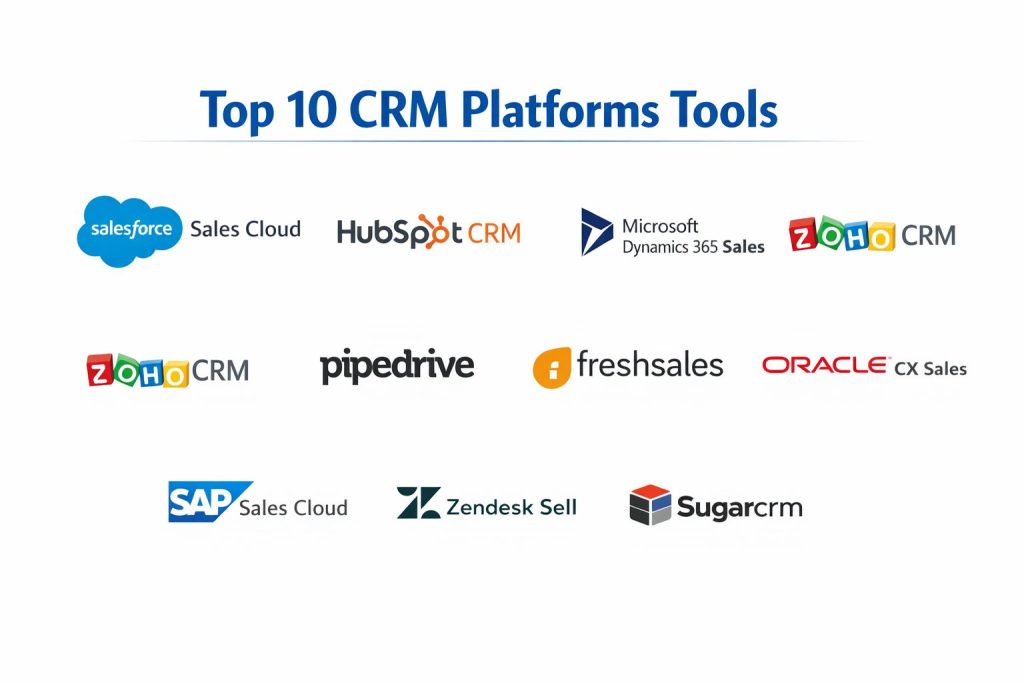
Top 10 CRM Platforms Tools
1 — Salesforce Sales Cloud
A widely adopted enterprise-grade CRM known for deep customization, strong ecosystem, and powerful automation for complex sales organizations.
Key Features
- Highly flexible pipeline and account management
- Advanced workflow automation and approvals
- Strong reporting, dashboards, and forecasting tools
- Large marketplace for extensions and add-ons
- Custom objects and admin-level configuration depth
Pros
- Strong fit for complex enterprise sales processes
- Very large ecosystem and partner availability
Cons
- Implementation can be complex without strong admin support
- Total cost can rise quickly with add-ons and higher tiers
Platforms / Deployment
Web, iOS, Android, Cloud
Security and Compliance
Varies / Not publicly stated
Integrations and Ecosystem
Salesforce works best when it becomes the central system of record and connects to marketing, support, finance, and analytics tools.
- Large integration marketplace
- Strong API and automation options
- Extensive partner and implementation ecosystem
Support and Community
Large global community, strong documentation, and multiple support tiers.
2 — HubSpot CRM
A user-friendly CRM often chosen for fast onboarding, strong inbound workflows, and close alignment with marketing and customer engagement.
Key Features
- Easy-to-use pipeline management and deal tracking
- Email tracking, meeting scheduling, and templates
- Strong marketing alignment for lead capture and nurturing
- Reporting dashboards for sales activity and performance
- Automation workflows depending on tier
Pros
- Fast setup and strong user adoption
- Good fit for inbound-driven teams and SMB growth
Cons
- Advanced customization can be limited compared to enterprise suites
- Cost may increase as teams scale into higher tiers
Platforms / Deployment
Web, iOS, Android, Cloud
Security and Compliance
Varies / Not publicly stated
Integrations and Ecosystem
HubSpot commonly integrates with email, website forms, chat, and sales tools to keep customer context in one place.
- Large app ecosystem for common business tools
- Automation and workflow connections
- APIs for custom integrations
Support and Community
Strong knowledge base, active community, and support tiers depending on plan.
3 — Microsoft Dynamics 365 Sales
A CRM designed for organizations that want tight alignment with Microsoft productivity tools and structured sales process management.
Key Features
- Opportunity and account management with structured processes
- Strong reporting and forecasting capabilities
- Workflow automation and approval patterns
- Integration-friendly for Microsoft-based environments
- Role-based permissions suitable for larger orgs
Pros
- Strong fit for Microsoft-first companies
- Enterprise-ready governance and scalability
Cons
- Implementation often needs skilled admin and setup effort
- Customization and UX may require careful configuration
Platforms / Deployment
Web, iOS, Android, Cloud
Security and Compliance
Varies / Not publicly stated
Integrations and Ecosystem
Dynamics 365 Sales fits well in environments using Microsoft productivity and analytics workflows.
- Strong integration patterns across Microsoft tools
- APIs and connectors for business systems
- Extensible through configuration and partner solutions
Support and Community
Strong enterprise support options and a broad Microsoft partner ecosystem.
4 — Zoho CRM
A cost-effective CRM with wide functionality, often selected by SMB and mid-market teams needing flexibility and good value.
Key Features
- Deal and lead management with customizable stages
- Workflow automation and assignment rules
- Reporting dashboards and activity tracking
- Multi-channel communication support options
- Broad suite alignment for teams using related Zoho products
Pros
- Strong value for growing teams
- Good customization for the price tier
Cons
- Enterprise-grade complexity may require additional setup
- Some advanced analytics may depend on add-ons
Platforms / Deployment
Web, iOS, Android, Cloud
Security and Compliance
Varies / Not publicly stated
Integrations and Ecosystem
Zoho CRM can become a hub for SMB operations when connected to email, finance, and support systems.
- Integrations across a broad business suite
- Marketplace connectors for common tools
- APIs for custom workflows
Support and Community
Large user base with documentation and support tiers depending on plan.
5 — Pipedrive
A sales-focused CRM built around pipeline visibility and activity-based selling, popular with SMB teams that want clarity and speed.
Key Features
- Simple pipeline visualization and deal tracking
- Activity reminders and sales task management
- Email sync and communication tracking
- Custom fields and lightweight automation
- Reporting dashboards for sales performance
Pros
- Easy adoption and strong daily usability
- Great for pipeline discipline and follow-up execution
Cons
- Less ideal for complex enterprise governance
- Some advanced features may require higher tiers
Platforms / Deployment
Web, iOS, Android, Cloud
Security and Compliance
Varies / Not publicly stated
Integrations and Ecosystem
Pipedrive integrates well with common sales tools to support a practical sales workflow without heavy complexity.
- Email, calendar, and calling tool integrations
- App marketplace for sales productivity tools
- APIs and automation support depending on plan
Support and Community
Good documentation and support; community is strong among SMB sales teams.
6 — Freshsales
A CRM designed for sales teams that want fast setup, built-in automation, and practical productivity features in a modern UI.
Key Features
- Lead and deal management with scoring options
- Automation for routing and task creation
- Built-in communication tools depending on setup
- Reporting and pipeline analytics
- Customization options for stages and fields
Pros
- Good balance of usability and capability
- Strong value for small and mid-size teams
Cons
- Very large enterprises may need deeper governance options
- Some advanced integrations may require additional planning
Platforms / Deployment
Web, iOS, Android, Cloud
Security and Compliance
Varies / Not publicly stated
Integrations and Ecosystem
Freshsales typically fits teams that want straightforward CRM adoption and workflow automation with common business tools.
- Integrations with email and support tools
- Marketplace connectors and APIs
- Automation patterns for standard sales flows
Support and Community
Solid onboarding resources and support tiers; community varies by region.
7 — Oracle CX Sales
An enterprise CRM suited for large organizations that need structured sales operations, governance, and integration into broader enterprise systems.
Key Features
- Enterprise account and opportunity management
- Structured workflows for approvals and governance
- Reporting and forecasting designed for complex orgs
- Configurable processes for large sales teams
- Scalable architecture for multi-region operations
Pros
- Strong fit for enterprise governance and scale
- Works well in enterprise system landscapes
Cons
- Setup can be heavier and slower than SMB CRMs
- Licensing and implementation costs can be significant
Platforms / Deployment
Web, iOS, Android, Cloud
Security and Compliance
Varies / Not publicly stated
Integrations and Ecosystem
Oracle CX Sales often fits organizations connecting CRM with finance, operations, and enterprise analytics workflows.
- Enterprise integration patterns and connectors
- APIs for custom workflows
- Strong fit for large system environments
Support and Community
Enterprise support options available; community is more enterprise-focused than SMB.
8 — SAP Sales Cloud
A CRM used by organizations that want sales execution aligned with SAP-driven operations and structured customer processes.
Key Features
- Sales pipeline and account management for structured workflows
- Activity tracking and guided selling patterns
- Reporting and forecasting for pipeline visibility
- Permission controls for role-based teams
- Integration-ready for SAP-oriented environments
Pros
- Strong fit for SAP-aligned organizations
- Designed for structured processes and governance
Cons
- Adoption may require training and change management
- Some teams may find it heavier than lightweight CRMs
Platforms / Deployment
Web, iOS, Android, Cloud
Security and Compliance
Varies / Not publicly stated
Integrations and Ecosystem
SAP Sales Cloud is typically selected where CRM needs to connect with broader operational and enterprise systems.
- Enterprise integration patterns
- Standard connectors depending on environment
- Extensibility options vary by implementation approach
Support and Community
Enterprise support options and partner ecosystem; community strength varies by industry.
9 — Zendesk Sell
A CRM designed to work well for teams that blend sales and customer conversations, especially when support and communication workflows matter.
Key Features
- Pipeline management focused on sales execution
- Email and activity tracking for follow-ups
- Calling and communication workflows depending on plan
- Reporting dashboards for sales activity
- Strong fit for teams that also live in customer support tools
Pros
- Practical for teams mixing sales and customer support context
- Clear and usable UI for day-to-day selling
Cons
- Enterprise customization depth may be limited
- Some advanced forecasting needs may require alternatives
Platforms / Deployment
Web, iOS, Android, Cloud
Security and Compliance
Varies / Not publicly stated
Integrations and Ecosystem
Zendesk Sell often fits workflows where sales and support systems must connect cleanly for a unified customer view.
- Integrations with customer support workflows
- Common productivity tool connections
- APIs and connectors depending on plan
Support and Community
Good vendor support and documentation; community is strong among Zendesk users.
10 — SugarCRM
A flexible CRM platform often used by organizations needing customization, deployment flexibility, and strong control over CRM workflows.
Key Features
- Configurable pipeline, lead, and account workflows
- Customization options for fields, objects, and processes
- Reporting and forecasting tools for pipeline visibility
- Automation capabilities for routing and follow-ups
- Deployment flexibility depending on plan and edition
Pros
- Strong customization and flexibility for many industries
- Good fit for teams wanting control over CRM design
Cons
- Setup requires thoughtful configuration for best results
- Ecosystem may be smaller than the largest CRM platforms
Platforms / Deployment
Web, iOS, Android, Cloud
Security and Compliance
Varies / Not publicly stated
Integrations and Ecosystem
SugarCRM is often chosen when teams want CRM flexibility and integration options that can adapt to specific business workflows.
- APIs and integration connectors
- Extensibility options for custom workflows
- Common business tool integrations depending on plan
Support and Community
Vendor support tiers available; community is active but smaller than top mega-platforms.
Comparison Table
| Tool Name | Best For | Platform(s) Supported | Deployment | Standout Feature | Public Rating |
|---|---|---|---|---|---|
| Salesforce Sales Cloud | Enterprise sales organizations | Web, iOS, Android | Cloud | Deep customization and ecosystem | N/A |
| HubSpot CRM | Fast onboarding and inbound sales | Web, iOS, Android | Cloud | Strong marketing and sales alignment | N/A |
| Microsoft Dynamics 365 Sales | Microsoft-first organizations | Web, iOS, Android | Cloud | Enterprise governance and integration | N/A |
| Zoho CRM | SMB to mid-market value | Web, iOS, Android | Cloud | Strong features for cost | N/A |
| Pipedrive | SMB pipeline discipline | Web, iOS, Android | Cloud | Simple pipeline visibility | N/A |
| Freshsales | Modern SMB sales teams | Web, iOS, Android | Cloud | Practical automation and usability | N/A |
| Oracle CX Sales | Large enterprise governance | Web, iOS, Android | Cloud | Structured enterprise workflows | N/A |
| SAP Sales Cloud | SAP-aligned enterprises | Web, iOS, Android | Cloud | Process-driven sales execution | N/A |
| Zendesk Sell | Sales plus support context | Web, iOS, Android | Cloud | Customer conversation alignment | N/A |
| SugarCRM | Customizable CRM needs | Web, iOS, Android | Cloud | Flexible configuration control | N/A |
Evaluation and Scoring of CRM Platforms
Weights
Core features 25 percent
Ease of use 15 percent
Integrations and ecosystem 15 percent
Security and compliance 10 percent
Performance and reliability 10 percent
Support and community 10 percent
Price and value 15 percent
| Tool Name | Core | Ease | Integrations | Security | Performance | Support | Value | Weighted Total |
|---|---|---|---|---|---|---|---|---|
| Salesforce Sales Cloud | 9.5 | 7.5 | 9.5 | 8.0 | 8.5 | 8.5 | 6.5 | 8.44 |
| HubSpot CRM | 8.5 | 9.0 | 8.5 | 7.0 | 8.0 | 8.0 | 7.5 | 8.26 |
| Microsoft Dynamics 365 Sales | 9.0 | 7.5 | 9.0 | 8.0 | 8.5 | 8.0 | 6.5 | 8.13 |
| Zoho CRM | 8.0 | 8.0 | 8.0 | 7.0 | 7.5 | 7.5 | 8.5 | 7.96 |
| Pipedrive | 7.5 | 9.0 | 7.5 | 6.5 | 7.5 | 7.5 | 8.0 | 7.78 |
| Freshsales | 7.5 | 8.5 | 7.5 | 6.5 | 7.5 | 7.5 | 8.0 | 7.70 |
| Oracle CX Sales | 8.5 | 7.0 | 8.5 | 8.0 | 8.0 | 7.5 | 6.0 | 7.71 |
| SAP Sales Cloud | 8.0 | 7.0 | 8.0 | 8.0 | 8.0 | 7.5 | 6.0 | 7.55 |
| Zendesk Sell | 7.5 | 8.0 | 7.5 | 7.0 | 7.5 | 7.5 | 7.5 | 7.56 |
| SugarCRM | 7.5 | 7.5 | 7.5 | 7.0 | 7.5 | 7.0 | 7.5 | 7.46 |
How to interpret the scores
These scores are comparative and meant to help you shortlist tools based on typical buyer priorities. A lower total can still be the best choice if the tool matches your exact workflow and team structure. Core and integrations drive long-term fit, while ease drives user adoption and speed. Security scores are conservative when details are not publicly stated. Use this table to pick two or three tools, then validate through a pilot using real data, real users, and your required integrations.
Which CRM Platform Tool Is Right for You
Solo or Freelancer
HubSpot CRM and Pipedrive are often easier to adopt quickly and keep disciplined follow-ups. Zoho CRM can be a strong value if you need more customization without enterprise complexity.
SMB
Pipedrive, Zoho CRM, and Freshsales are strong picks for SMB teams that want a balance of ease and automation. HubSpot CRM is excellent if inbound leads and marketing alignment are central to your growth.
Mid-Market
Microsoft Dynamics 365 Sales and Salesforce Sales Cloud become more attractive when reporting, governance, and integrations are more complex. Zoho CRM can still work well if your processes are structured and you want better value.
Enterprise
Salesforce Sales Cloud, Oracle CX Sales, and SAP Sales Cloud are common enterprise picks where multi-region governance and structured processes matter. Microsoft Dynamics 365 Sales is strong in Microsoft-first organizations that want tight alignment with productivity and analytics workflows.
Budget vs Premium
Zoho CRM and Freshsales often offer strong value for growing teams. Salesforce Sales Cloud and Oracle CX Sales are premium options that may deliver ROI when complexity and scale justify the investment.
Feature Depth vs Ease of Use
If adoption speed is your top priority, HubSpot CRM and Pipedrive usually perform well. If you need deep customization and governance, Salesforce Sales Cloud and Microsoft Dynamics 365 Sales are better suited.
Integrations and Scalability
Salesforce Sales Cloud and Microsoft Dynamics 365 Sales typically scale well with large ecosystems and integration patterns. HubSpot CRM integrates strongly for marketing and inbound pipelines. Oracle CX Sales and SAP Sales Cloud fit enterprises aligning CRM to broader operational systems.
Security and Compliance Needs
If you have strict requirements, prioritize tools that support role-based access control, audit trails, and strong identity management patterns. When public compliance details are unclear, treat them as not publicly stated and validate directly during vendor review and procurement.
Frequently Asked Questions
1. What is the most important feature to evaluate in a CRM platform
Pipeline flexibility and reporting are usually the foundation. If you cannot track stages, activities, and outcomes clearly, forecasting and performance management become unreliable.
2. How long does CRM implementation usually take
It depends on complexity. Small teams can go live quickly, while larger teams need time for data migration, permissions, integrations, and sales process alignment.
3. What are common mistakes during CRM rollout
Poor data cleanup, unclear pipeline definitions, and lack of training are the biggest issues. Another mistake is turning on too many features before the team is ready.
4. How do CRMs improve forecasting accuracy
They improve forecasting when teams follow consistent stage rules and log activities. Clean data plus clear pipeline governance typically drives better predictability.
5. Can CRM platforms support both sales and customer success
Yes, many do, especially when you design lifecycle stages and handoffs. The key is defining ownership of accounts, renewals, onboarding tasks, and escalation paths.
6. How important are integrations for CRM success
Very important. If email, calendar, calling, marketing tools, and finance systems do not connect, data becomes fragmented and teams lose trust in the CRM.
7. Is it hard to switch from one CRM to another
Switching is doable but requires careful planning. The most time-consuming parts are data mapping, pipeline redesign, workflow migration, and team retraining.
8. What should I do before importing data into a CRM
Clean duplicates, standardize fields, and define what “good data” means. Importing messy data can reduce adoption because users lose trust quickly.
9. How do I ensure my sales team actually uses the CRM daily
Keep it simple, automate repetitive tasks, and make dashboards helpful for reps, not only managers. Tie the CRM to daily routines like follow-ups, meetings, and next steps.
10. Which CRM is best for a small sales team starting from scratch
HubSpot CRM and Pipedrive are often the easiest starts. Zoho CRM and Freshsales can be strong choices if you want more automation and customization early.
Conclusion
CRM platforms succeed when they become a trusted system of record for customer data, sales activity, and revenue forecasting. The right choice depends on your team size, sales complexity, and how tightly you need the CRM to connect with marketing, support, and finance. Salesforce Sales Cloud and Microsoft Dynamics 365 Sales often fit complex organizations needing deep customization and governance. HubSpot CRM, Pipedrive, Zoho CRM, and Freshsales are strong for teams that want quick adoption, practical automation, and clean pipeline visibility. Oracle CX Sales and SAP Sales Cloud can be right for enterprises aligning CRM to broader systems. The best next step is to shortlist two or three tools, run a pilot with real workflows, validate key integrations, confirm permission needs, and measure adoption before committing.