Introduction
Consumer Loan Origination Systems (LOS) are the primary engines powering the modern credit economy. These platforms manage the end-to-end lifecycle of a loan—from the moment a customer submits an application on their smartphone to the final disbursement of funds. In a world where consumers expect “instant everything,” a high-performing LOS is the difference between a completed loan and an abandoned application. These systems integrate complex credit scoring models, identity verification tools, and automated legal disclosures into a single, seamless digital workflow.
As the financial landscape becomes more competitive, the role of the LOS has shifted from a back-office administrative tool to a front-line revenue driver. Financial institutions now use these systems to compete with agile fintech startups by offering rapid “time-to-cash” and personalized interest rates based on real-time data. By automating up to 90% of the manual labor involved in underwriting and document collection, these platforms allow banks and credit unions to scale their lending operations without a proportional increase in headcount.
Real-World Use Cases
- Instant Auto Financing: Dealerships and lenders use mobile-first LOS platforms to provide on-the-spot credit approvals, allowing customers to drive off the lot with completed financing in minutes.
- Point-of-Sale (POS) Lending: Retailers integrate “Buy Now, Pay Later” (BNPL) functionality directly into their checkout pages, powered by an LOS that performs micro-credit assessments in seconds.
- Automated Personal Loans: Banks offer “pre-approved” personal loans to existing customers through their mobile apps, where the LOS uses historical account data to bypass traditional application forms.
- Cross-Selling Financial Products: When a customer applies for a car loan, the LOS can automatically analyze their profile and offer a pre-approved credit card or a home equity line of credit (HELOC).
- Emergency Relief Funding: During economic disruptions, government agencies and banks use scalable LOS platforms to rapidly process thousands of small business or personal relief loans simultaneously.
Buyer Evaluation Criteria
- Auto-Decisioning Rate: The percentage of applications the system can approve or deny without human intervention is the most critical metric for operational efficiency.
- Omni-Channel Consistency: The platform must provide a perfectly consistent experience whether the customer starts their application on a laptop and finishes it in a physical branch.
- KYC and Fraud Integration: Look for systems with “built-in” identity verification, including biometric checks and real-time fraud scoring, to minimize manual document reviews.
- No-Code Configuration: Modern lenders require the ability to change interest rates, credit rules, and application fields instantly without waiting for a software developer.
- Direct Core Integration: The LOS must have a “deep” connection to your core banking system to ensure that funded loans post accurately to the general ledger without manual entry.
- Compliance Automation: Ensure the system automatically generates and updates legal disclosures (like Truth in Lending) based on the latest regional and federal regulations.
- Mobile-First Borrower Portal: A user-friendly interface that allows borrowers to snap photos of their ID and pay stubs directly from their phone is essential for high conversion rates.
- Multi-Product Versatility: Evaluate if the tool can handle a diverse range of loans (Auto, Personal, Credit Card, HELOC) on a single platform to avoid “software sprawl.”
- API Extensibility: The system should offer an open API to connect with emerging fintech data sources, such as alternative credit scoring or utility bill history.
- Scalability and Uptime: For high-volume lenders, the platform must demonstrate the ability to handle peak application loads (e.g., during a holiday sale) without performance lag.
Best for: Commercial banks, credit unions, and fintech lenders seeking to automate their retail credit products and provide a modern, digital-first experience to their customers.
Not ideal for: Ultra-small lenders with low volume who can manage loans via simple spreadsheets, or specialized commercial lenders focusing solely on complex corporate syndications.
Key Trends in Consumer Loan Origination
- Hyper-Personalized Pricing: AI now allows lenders to offer “bespoke” interest rates based on a consumer’s specific financial behavior rather than just a static credit score.
- Biometric Identity Verification: Systems are moving away from passwords and “security questions” toward facial recognition and liveness detection to verify applicants instantly.
- Alternative Data Scoring: Modern LOS platforms are incorporating “soft” data points—such as rent payment history and social media footprints—to expand credit access to underserved populations.
- Embedded Finance: Lending is moving out of the bank app and into the “shopping journey,” with LOS platforms being integrated directly into e-commerce and real estate websites.
- Real-Time Disbursement: The delay between “Approval” and “Funding” is disappearing, with platforms using instant payment networks to send money to a customer’s account in seconds.
How We Selected These Tools (Methodology)
To select the top 10 consumer LOS platforms, we analyzed the market for tools that offer the highest levels of automation and the best borrower experiences. Our methodology focused on platforms that have successfully bridged the gap between legacy banking stability and modern fintech agility.
- Market Adoption and Trust: We prioritized platforms used by a significant number of tier-1 and tier-2 financial institutions.
- User Experience (UX) Design: We evaluated both the borrower-facing portal and the employee-facing dashboard for modern, intuitive design and ease of use.
- Integration Ecosystem: Tools were selected based on their ability to connect with major core banking providers and third-party data services (credit bureaus, income verification).
- AI and Machine Learning Depth: We looked for platforms where AI is a core part of the decisioning engine, not just a marketing add-on.
- Regulatory Compliance Record: Only vendors with a proven track record of maintaining high compliance standards in strictly regulated markets were included.
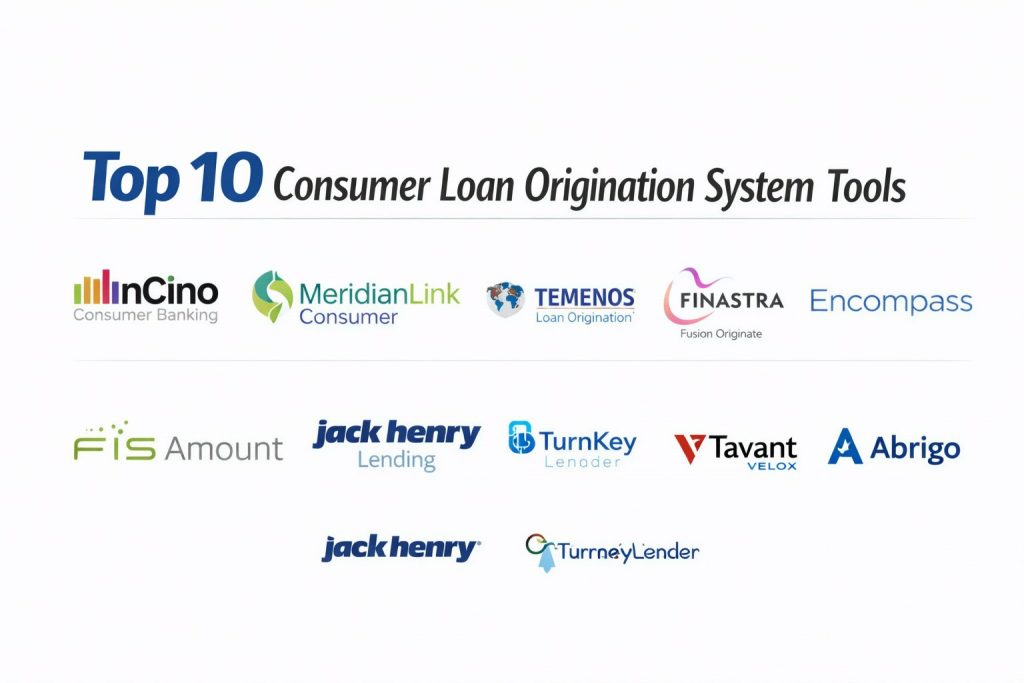
Top 10 Consumer Loan Origination Systems
1 nCino Consumer Banking
nCino is a global leader in cloud-based banking, built on the Salesforce platform. Its consumer solution is famous for creating a unified “single pane of glass” that connects every department of a bank—from the teller line to the back-office underwriters.
Key Features
- Omnichannel Journey: Allows customers to switch seamlessly between mobile, desktop, and in-branch applications without losing progress.
- Automated Decisioning Engine: A highly configurable rules engine that can approve or decline loans instantly based on the lender’s specific credit policy.
- 360-Degree Customer View: Leverages Salesforce data to give employees a complete history of the customer’s relationship with the bank.
- Document Management: Securely collects, categorizes, and stores borrower documents with automated reminders for missing items.
- Low-Code Configuration: Enables business users to adjust loan products and workflows without writing a single line of code.
- Compliance Workflows: Built-in guardrails ensure every loan follows local and federal regulations from application to funding.
- Partner Ecosystem: Easy integration with hundreds of third-party fintech services available through the Salesforce AppExchange.
Pros
- Built on Salesforce, offering world-class security, scalability, and familiar navigation for many bank employees.
- Dramatically reduces loan cycle times, with some institutions reporting a 90% reduction in approval times.
- Highly flexible for institutions that want to customize every step of their lending process.
Cons
- Requires a Salesforce license, which can make the total cost of ownership quite high for some banks.
- The system is so feature-rich that it can require a significant investment in staff training and implementation.
- Might be “over-engineered” for small community banks with very simple lending needs.
Platforms / Deployment
- Web / iOS / Android
- Cloud-based SaaS (Salesforce-native)
Security & Compliance
- SOC 2 Type II and ISO 27001 certified.
- Full compliance with global privacy standards, including GDPR and CCPA.
Integrations & Ecosystem
nCino thrives on its ability to connect the entire bank ecosystem.
- Native integration with the Salesforce CRM suite.
- Pre-built connectors for major cores like FIS, Fiserv, and Jack Henry.
- Integration with top credit bureaus and identity verification services.
Support & Community
nCino offers 24/7 global support and an extensive “nCino Community” portal for sharing best practices. They host “nSight,” a massive annual user conference for financial leaders.
2 MeridianLink Consumer
MeridianLink is a powerhouse in the community bank and credit union space. Its consumer LOS is known for its incredible “configuration density,” allowing lenders to fine-tune every aspect of the lending process for maximum automation.
Key Features
- Cross-Channel Integration: Centralizes applications from online, branch, mobile, and indirect (dealership) channels into one dashboard.
- Instant Decisioning: A robust underwriting engine that can process complex rules to provide “time-to-yes” in under a minute.
- MeridianLink One Platform: Allows lenders to manage consumer loans, mortgages, and account openings on a single unified platform.
- Advanced Cross-Selling: Automatically identifies and presents other relevant loan offers to the borrower during the application process.
- 1,000+ Configuration Points: Offers an unmatched level of granular control over workflows, rates, and decisioning logic.
- Built-in Analytics: Provides “MeridianLink Insight” reporting to track loan pull-through rates and portfolio performance.
- Indirect Lending Support: Specialized tools for managing high-volume automotive lending through third-party dealerships.
Pros
- Exceptional for high-volume automated lending; many users report significant increases in loan volume without adding staff.
- Very cost-effective for mid-sized institutions compared to enterprise-heavy platforms.
- Highly regarded for its data consolidation and reporting capabilities.
Cons
- The back-office user interface can feel a bit dated and “clunky” compared to more modern fintech-style platforms.
- Extensive configuration options mean that the initial setup phase can be complex and time-consuming.
- Some users have reported that certain updates require manual intervention from support.
Platforms / Deployment
- Web / iOS / Android
- Cloud-based SaaS
Security & Compliance
- SOC 2 Type II compliant.
- Regularly audited for compliance with FFIEC and other major financial regulations.
Integrations & Ecosystem
MeridianLink features one of the largest marketplaces in the lending industry.
- Over 200 pre-integrated third-party partners for credit, fraud, and valuation.
- Deep integrations with popular credit union and bank core systems.
- Direct connections to major automotive and retail dealership networks.
Support & Community
MeridianLink provides 24/7 technical support and a comprehensive learning academy. They are known for a very active user community among North American credit unions.
3 Temenos Loan Origination
Temenos is a global banking software giant. Its origination platform is designed for speed and agility, helping traditional banks launch modern digital lending products in days rather than months.
Key Features
- 5-Minute Applications: Optimized for “frictionless” digital journeys that allow consumers to go from application to funding in minutes.
- Intelligent Decisioning: Uses multi-factor AI models to drive auto-decisioning rates for consumer loans as high as 70%.
- Journey Manager: A powerful tool for designing and testing new borrower experiences without needing software developers.
- Omnichannel Parity: Ensures that a loan started on a mobile phone looks and acts exactly the same if finished in a branch.
- Smart Cross-Sell: Analyzes borrower data in real-time to offer additional products (like credit cards) that they are likely to qualify for.
- Interactive Dashboards: Provides executives with live views of application volumes, approval rates, and bottleneck areas.
- Global Core Agnosticism: While it pairs best with Temenos Transact, it is designed to integrate with any existing core banking system.
Pros
- Extremely fast “speed-to-market” for new loan products, often achievable in just a few days.
- Modern, clean, and intuitive user interface that is highly rated by both staff and consumers.
- Very strong global presence with support for multi-currency and multi-language operations.
Cons
- Integration with old, legacy “green-screen” core systems can be technically challenging.
- The reporting module, while functional, is sometimes cited as having a basic graphical interface.
- Support response times can vary depending on the region and the complexity of the issue.
Platforms / Deployment
- Web / iOS / Android
- Cloud-native or On-premise options
Security & Compliance
- ISO 27001 and SOC 2 Type II certified.
- Strong focus on regional compliance, with specific “model bank” setups for different countries.
Integrations & Ecosystem
Temenos utilizes a robust API-first strategy to connect with the broader financial world.
- Native integration with the Temenos Transact core banking system.
- Open API for connecting to local credit bureaus, e-signature, and fraud tools.
- Integrated connectors for services like IDology and Experian Precise ID.
Support & Community
Temenos offers 24/7 global support and maintains a “Developer Community” for technical users. They host “Temenos Community Forum (TCF),” one of the largest annual banking tech events globally.
4 Finastra Fusion Originate
Finastra provides a “harmonized” origination experience. Fusion Originate is unique because it combines consumer loans, mortgages, and deposit account openings into one single solution with a common look and feel.
Key Features
- Unified UX: A single modern interface for all consumer product types, reducing the learning curve for bank staff.
- Direct Core Sync: Real-time integration with Finastra and third-party cores for “one-touch” loan onboarding.
- Automated Document Capture: Allows borrowers to use their mobile camera to scan IDs and income documents for instant processing.
- Fraud Mitigation: Built-in tools for identity verification and anti-money laundering (AML) checks at the point of sale.
- Configurable Branding: Allows banks to easily tailor the platform’s look and feel to match their corporate identity.
- Self-Service Portals: Empowers borrowers to track their application status and sign documents 24/7 without calling the bank.
- Scalable SaaS Architecture: Hosted on Microsoft Azure, providing high availability and enterprise-grade performance.
Pros
- One of the best options for institutions that want to consolidate their entire retail front-end onto one platform.
- Strong compliance and document automation features backed by Finastra’s decades of industry experience.
- Excellent “mobile-first” design that helps reduce application abandonment rates.
Cons
- For very specialized lending products, the “all-in-one” approach may lack some niche-specific depth.
- Implementation can be complex if a bank is moving multiple disparate systems onto the Fusion platform at once.
- Licensing and per-application costs may be higher for small institutions.
Platforms / Deployment
- Web / iOS / Android
- Cloud-based SaaS (Microsoft Azure)
Security & Compliance
- SOC 1, SOC 2, and ISO 27001 certified.
- Adheres to stringent global security standards for data encryption and residency.
Integrations & Ecosystem
Finastra uses its “FusionFabric.cloud” platform to offer an open, collaborative ecosystem.
- Pre-built integrations with major Finastra cores like PhoenixE3 and Fusion Digital Banking.
- Extensive API library for connecting to third-party fintech apps and data providers.
- Native support for electronic signatures (DocuSign/IMM) and credit reporting agencies.
Support & Community
Finastra provides 24/7 support and has a global footprint of consultants and partners. They manage an active developer portal for institutions looking to build custom extensions.
5 Encompass (by ICE Mortgage Technology)
While famous for mortgage lending, Encompass is a comprehensive system used by many lenders for all types of consumer real-estate and high-value consumer loans. It is widely considered the industry standard for compliance and scalability.
Key Features
- End-to-End Automation: Manages everything from initial borrower engagement to closing and secondary market delivery.
- Encompass Consumer Connect: A high-quality digital front-end that allows borrowers to complete applications on any device.
- Compliance Management: Features a built-in compliance engine that automatically alerts users to any potential regulatory issues.
- Electronic Document Management (EDM): A secure environment for sharing, e-signing, and archiving all loan-related documents.
- Predictive Pricing Engine: Uses real-time market data to provide accurate pricing and product options to the borrower.
- Automated Underwriting: Direct integration with major AUS systems like Fannie Mae’s Desktop Underwriter.
- Customizable Workflows: Allows enterprise lenders to build highly complex, multi-stage approval processes.
Pros
- Unmatched in the industry for compliance rigor and audit-readiness.
- Highly scalable, making it the preferred choice for the world’s largest mortgage and consumer lenders.
- Massive network of pre-integrated partners (thousands of lenders, service providers, and investors).
Cons
- Significantly more expensive than many consumer-only LOS platforms.
- Known for having a steep learning curve for both administrators and end-users.
- System updates and customization can be resource-intensive for the IT team.
Platforms / Deployment
- Web / Windows Desktop / iOS / Android
- Cloud-based SaaS
Security & Compliance
- Top-tier security certifications including SOC 2 Type II and ISO 27001.
- The “Gold Standard” for compliance with U.S. federal lending regulations.
Integrations & Ecosystem
Encompass sits at the center of the largest lending network in North America.
- Direct integration with all major credit bureaus and asset verification services.
- Open API (Encompass Developer Connect) for custom enterprise integrations.
- Native connections to the secondary market for selling and servicing loans.
Support & Community
ICE Mortgage Technology provides extensive training, 24/7 support, and holds the annual “Experience” conference, the largest event in the mortgage and lending space.
6 FIS Amount
FIS Amount is a high-speed, AI-driven lending platform born from a partnership between banking giant FIS and the fintech pioneer Amount. It is specifically designed to help traditional banks compete with “challenger” neobanks.
Key Features
- Conversion-Focused Workflows: Every step of the application is A/B tested to minimize friction and prevent borrower drop-offs.
- AI Risk Orchestration: Uses advanced machine learning to detect fraud and assess risk more accurately than traditional models.
- Mobile-First Biometrics: Includes “ID + Selfie” verification and biometric checks built directly into the digital application.
- Real-Time Booking: Automatically posts approved loans to the bank’s core system for instant funding.
- Product Configuration Module: A low-code tool that allows lenders to launch new loan programs with 200+ configuration options.
- Omnichannel Parity: Ensures that a customer getting a loan through a call center has the same experience as someone on the mobile app.
- Data Prefill: Uses existing customer records and external data sources to fill in application fields automatically.
Pros
- Delivers a true “fintech-level” user experience that significantly lowers application abandonment.
- Proven ability to reduce loan onboarding time from several days down to just a few minutes.
- Backed by the immense infrastructure and security of FIS Global.
Cons
- As a premium partnership product, it may have a higher entry price point than basic LOS tools.
- The platform is highly optimized for “standard” consumer loans; very niche products might require customization.
- Best suited for institutions already using or planning to use FIS core banking products.
Platforms / Deployment
- Web / iOS / Android
- Cloud-based SaaS
Security & Compliance
- SOC 2 Type II and ISO 27001 compliant.
- Leverages FIS’s global security operations for 24/7 threat monitoring.
Integrations & Ecosystem
FIS Amount is designed to be a “plug-and-play” digital front-end for traditional banks.
- Seamless integration with FIS Modern Banking Platform and other FIS cores.
- Native connectors for e-signatures, ACH disbursements, and KYC providers.
- API-first design allows for easy integration with third-party marketing and CRM tools.
Support & Community
FIS provides enterprise-grade global support and dedicated account management. They offer extensive resources for digital transformation through the “FIS Impact” conference.
7 Jack Henry Lending
Jack Henry is a cornerstone of the community banking and credit union industry. Their lending platform focuses on “breaking down silos,” providing a fresh, digital-first experience for both consumer and commercial loans.
Key Features
- Modern Borrower UX: A clean, conversational application style that works perfectly on any mobile device.
- Auto-Decisioning Tools: Allows lenders to automate approvals for standard consumer products like personal loans and auto financing.
- Secure Document Exchange: A built-in portal for borrowers to securely upload documents and communicate with their loan officer.
- Product-Specific Workflows: Tailored processes for different loan types (e.g., HELOC vs. Auto) to ensure efficiency and compliance.
- Unified Account Opening: Often bundled with digital account opening to provide a “one-stop” onboarding experience.
- Relationship Focus: Designed to help small-to-mid-sized institutions maintain their “local feel” while offering big-bank technology.
- Real-Time Reporting: Provides immediate insights into loan queues, approval times, and regional lending trends.
Pros
- Highly trusted by community banks and credit unions for its reliability and excellent customer service.
- Very straightforward to implement for institutions already using Jack Henry core systems.
- Strong focus on “user-friendly” design for bank employees, reducing the need for heavy training.
Cons
- While modern, it may lack some of the extreme “AI-first” features found in fintech-specific startups.
- Integration with non-Jack Henry cores, while possible, is not as seamless as their native connections.
- Customization depth for very large enterprises is sometimes seen as secondary to its community-focus.
Platforms / Deployment
- Web / iOS / Android
- Cloud-based SaaS
Security & Compliance
- SOC 2 Type II compliant.
- Strictly adheres to U.S. banking regulations and FFIEC guidelines.
Integrations & Ecosystem
Jack Henry Lending is designed as a core-connected ecosystem.
- Native integration with Jack Henry’s SilverLake, CIF 20/20, and Core Director systems.
- Integrated with major credit bureaus, flood certification, and appraisal services.
- Support for industry-leading e-signature providers.
Support & Community
Jack Henry is famous for its high-touch support and “Jack Henry University” for user training. They host the “Jack Henry Annual Conference (JAC),” a major networking hub for community bankers.
8 TurnKey Lender
TurnKey Lender is an AI-powered, modular platform that automates the entire lending process. It is used by banks, fintechs, and even non-financial businesses in over 50 countries to launch highly automated lending operations.
Key Features
- AI-Driven Decisioning: Uses proprietary machine learning models to analyze thousands of data points for more accurate risk assessment.
- Modular Architecture: Lenders can choose to use only specific modules (e.g., just Origination or just Servicing) or the full end-to-end suite.
- Global Compliance Engine: Automatically adapts workflows and disclosures to the regulations of different countries.
- Embedded Lending: Specialized tools for non-banks (like retailers) to offer loans directly within their own platforms.
- Psychometric Scoring: Offers alternative scoring methods for borrowers with thin credit files, improving financial inclusion.
- Automated Collections: Includes an AI module that identifies high-risk loans and automates early-stage collection efforts.
- Multi-Language Support: Fully localized for global operations with support for various currencies and time zones.
Pros
- One of the most technologically advanced platforms for “Alternative Data” and AI-driven underwriting.
- Very fast setup for “greenfield” fintech projects or non-financial companies entering the lending space.
- Exceptional for global organizations that need a single platform for multiple different international markets.
Cons
- The user interface for borrowers can sometimes feel more “utilitarian” compared to high-end retail bank apps.
- Advanced AI and modular features often require separate subscriptions, increasing the total cost.
- Integration with very old, “on-premise” legacy bank cores can be more difficult than with modern APIs.
Platforms / Deployment
- Web / iOS / Android
- Cloud-based SaaS
Security & Compliance
- ISO 27001, SOC 2 Type II, and PCI DSS certified.
- Strong focus on data privacy and regional compliance across 50+ countries.
Integrations & Ecosystem
TurnKey Lender is built on an API-first philosophy for maximum flexibility.
- 100+ pre-built integrations with global credit bureaus, payment gateways, and KYC tools.
- Open REST API for connecting to any modern web or mobile application.
- Integrations with major accounting software (QuickBooks, Xero) for business lending.
Support & Community
TurnKey Lender provides 24/7 global support and extensive online documentation. They are recognized leaders in the “Lending-as-a-Service” (LaaS) community.
9 Tavant Velox
Tavant Velox is an AI-powered suite designed for “Touchless Lending.” It focuses on using automation to eliminate as many manual steps as possible for both the borrower and the lender’s staff.
Key Features
- Touchless Lending: Uses AI and straight-through processing to move a loan from application to funding with zero manual touches.
- FinXperience Portal: An intuitive, high-performance point-of-sale experience designed to “surprise and delight” borrowers.
- FinDecision Engine: Provides real-time underwriting and product comparison, enabling “best execution” for every loan.
- 150+ Bi-directional Integrations: Seamlessly pulls and pushes data to hundreds of third-party service providers and government agencies.
- Advanced Data Analytics: Provides deep insights into the lending funnel to identify where customers are dropping off.
- Collaborative Workspaces: Allows borrowers, loan officers, and third-party agents to work on the same file in real-time.
- Dynamic AUS Integration: Real-time connection to Automated Underwriting Systems with side-by-side guideline comparisons.
Pros
- Leading the industry in “Touchless” automation, significantly lowering the cost per loan for high-volume lenders.
- Exceptional user experience design that feels like a modern consumer app, not “banking software.”
- Highly effective at improving application conversion rates through data-driven insights.
Cons
- As a high-end AI platform, the implementation process requires a significant commitment from the institution’s technical team.
- The focus on “automation” may be less beneficial for institutions that handle a high volume of complex, non-standard loans.
- Pricing is aimed at enterprise-level lenders and may be out of reach for smaller community institutions.
Platforms / Deployment
- Web / iOS / Android
- Cloud-based SaaS
Security & Compliance
- SOC 2 Type II compliant.
- Built with a “security-first” architecture to protect sensitive financial and personal data.
Integrations & Ecosystem
Tavant Velox is designed to be the “intelligent layer” on top of the lending ecosystem.
- Robust API for integrating with any core banking system or CRM (like Salesforce).
- Native integrations with major mortgage and consumer credit service providers.
- Support for a wide range of AI and machine learning tools for custom data analysis.
Support & Community
Tavant provides 24/7 technical support and has a strong presence in the digital transformation consulting space. They are major contributors to industry discussions on AI in lending.
10 Abrigo
Abrigo is a specialized platform for community financial institutions. It is unique because it integrates loan origination with broader risk management, portfolio analytics, and regulatory reporting tools.
Key Features
- End-to-End Lending Suite: Manages the full journey from initial prospect tracking to loan servicing and final payoff.
- AI-Driven Underwriting: Includes a robust decision engine with built-in templates for various consumer and business loan types.
- Integrated CRM: Allows lenders to track their sales pipeline and customer interactions directly within the LOS.
- Portfolio Analytics: Provides deep insights into loan concentrations and credit risk across the entire institution.
- Built-in Compliance: Features tools for CECL (Current Expected Credit Losses) reporting and other complex regulatory requirements.
- Mobile Borrower Portal: A simple, secure digital application that allows for easy document submission and e-signing.
- Workflow Automation: Uses a rules-based engine to assign tasks, send reminders, and move loans through the approval stages.
Pros
- The only platform on this list that seamlessly blends “Origination” with “Institutional Risk Management.”
- Specifically designed for the needs of community banks and credit unions, with a focus on simplicity and compliance.
- Excellent customer success and implementation teams that understand the local banking landscape.
Cons
- The borrower-facing portal is functional but may not be as “flashy” as fintech-first platforms like FIS Amount.
- While it handles consumer loans well, it is often primarily known for its strengths in small business and commercial lending.
- Integration with very large, “Tier 1” enterprise banking stacks is not its primary focus.
Platforms / Deployment
- Web / iOS / Android
- Cloud-based SaaS
Security & Compliance
- SOC 2 Type II and FFIEC compliant.
- Strong reputation for helping banks ace their regulatory exams with audit-ready reporting.
Integrations & Ecosystem
Abrigo focuses on creating a “closed-loop” for community bank operations.
- Native integration with dozens of community bank and credit union core systems.
- Integrated with major credit bureaus and flood/tax service providers.
- Support for common document management and e-signature tools.
Support & Community
Abrigo provides 24/7 support and is highly active in the community banking education space. They host the “ThinkBIG” conference, focused on lending, risk, and compliance.
Comparison Table (Top 10)
| Tool Name | Best For | Platform(s) Supported | Deployment | Standout Feature |
| nCino Consumer Banking | Salesforce-Centric Banks | Web, iOS, Android | Cloud (SaaS) | Unified Salesforce Core |
| MeridianLink Consumer | High-Volume Credit Unions | Web, iOS, Android | Cloud (SaaS) | 1,000+ Configuration Points |
| Temenos Loan Origination | Rapid Product Launch | Web, iOS, Android | Cloud/On-prem | 5-Minute Cash-in-Hand |
| Finastra Fusion Originate | Unified Retail Onboarding | Web, iOS, Android | Cloud (SaaS) | Mortgage/Loan Harmony |
| Encompass | Enterprise Real Estate/HELOC | Web, Desktop, Mobile | Cloud (SaaS) | Industry Standard Compliance |
| FIS Amount | Bank-to-Fintech Performance | Web, iOS, Android | Cloud (SaaS) | Biometric Fraud Mitigation |
| Jack Henry Lending | Community-Focused Banks | Web, iOS, Android | Cloud (SaaS) | High-Touch Service Focus |
| TurnKey Lender | Global AI/Alternative Data | Web, iOS, Android | Cloud (SaaS) | Psychometric Scoring Module |
| Tavant Velox | Touchless Automation | Web, iOS, Android | Cloud (SaaS) | Zero-Manual-Touch AI |
| Abrigo | Risk-Integrated Lending | Web, iOS, Android | Cloud (SaaS) | Built-in CECL Reporting |
Evaluation & Scoring of Consumer Loan Origination Systems
The scoring below is a comparative model intended to help shortlisting. Each criterion is scored from 1–10, then a weighted total from 0–10 is calculated using the weights listed. These are analyst estimates based on typical fit and common workflow requirements, not public ratings.
Weights:
Price / value – 15%
Core features – 25%
Ease of use – 15%
Integrations & ecosystem – 15%
Security & compliance – 10%
Performance & reliability – 10%
Support & community – 10%
| Tool Name | Automation (25%) | UX / UI (20%) | Integrations (15%) | Compliance (15%) | Scalability (10%) | Support (15%) | Weighted Total |
| nCino Consumer Banking | 9 | 9 | 10 | 9 | 10 | 9 | 9.2 |
| MeridianLink Consumer | 10 | 7 | 9 | 9 | 9 | 9 | 8.9 |
| Temenos Loan Origination | 9 | 10 | 8 | 9 | 9 | 8 | 8.9 |
| Finastra Fusion Originate | 8 | 9 | 9 | 10 | 8 | 9 | 8.8 |
| Encompass | 8 | 7 | 10 | 10 | 10 | 8 | 8.7 |
| FIS Amount | 10 | 10 | 8 | 9 | 9 | 8 | 9.1 |
| Jack Henry Lending | 8 | 9 | 8 | 9 | 8 | 10 | 8.6 |
| TurnKey Lender | 10 | 8 | 9 | 8 | 9 | 8 | 8.8 |
| Tavant Velox | 10 | 10 | 8 | 8 | 9 | 8 | 9.0 |
| Abrigo | 8 | 8 | 8 | 10 | 7 | 10 | 8.4 |
How to interpret the scores:
- Use the weighted total to shortlist candidates, then validate with a pilot.
- A lower score can mean specialization, not weakness.
- Security and compliance scores reflect controllability and governance fit, because certifications are often not publicly stated.
- Actual outcomes vary with assembly size, team skills, templates, and process maturity.
Which Consumer Loan Origination System Is Right for You?
Community Banks & Credit Unions
For institutions that value localized service and deep core integration, Jack Henry Lending and Abrigo are the top choices. These platforms are built specifically for the community banking model and excel at managing the regulatory burdens unique to smaller institutions.
Large Enterprise Banks
Global or nationwide banks with massive loan volumes should prioritize nCino Consumer Banking or Encompass. These platforms offer the “enterprise-grade” scalability and Salesforce-native workflows required to manage thousands of users and millions of applications across different time zones.
Fintechs & Alternative Lenders
For new lending startups that need to launch fast and use advanced AI for underwriting, TurnKey Lender and Tavant Velox offer the most modern, API-first architectures. Their ability to ingest alternative data and provide “touchless” decisions is a major competitive advantage in the fintech space.
Institutions Needing a Unified Front-End
If your goal is to consolidate multiple retail products—loans, deposits, and mortgages—onto one single digital interface, Finastra Fusion Originate is the strongest contender. It eliminates the friction of having borrowers jump between different platforms for different needs.
High-Speed “Challenger” Competitors
Traditional banks looking to launch a digital brand that can compete with neobanks on speed and experience should look at FIS Amount or Temenos Loan Origination. These tools are optimized for the highest possible “time-to-cash” and the most modern borrower UX.
Heavy Real Estate/HELOC Focus
If consumer real-estate products (like Home Equity Loans or HELOCs) represent a major portion of your portfolio, Encompass provides the most rigorous compliance and secondary-market tools in the industry, though at a higher price point.
Frequently Asked Questions (FAQs)
What is the average time to implement a new LOS?
A standard implementation typically takes 4 to 9 months, depending on the complexity of your core banking integration and the number of custom workflows being built. SaaS-native tools like TurnKey Lender can sometimes go live in as little as 12 weeks.
Can an LOS replace our core banking system?
No. An LOS handles the “origination” (the process of getting the loan), while a core banking system handles the “servicing” (managing the ledger, interest, and payments) once the loan is funded. The two systems must work in tandem.
What is “straight-through processing” (STP) in lending?
STP refers to a loan that is applied for, underwritten, and funded entirely by the system without a single human being needing to touch the file. This is the “holy grail” of lending efficiency.
How do these systems handle data security?
All top-tier LOS platforms use bank-grade encryption (AES-256), multi-factor authentication (MFA), and are hosted in secure cloud environments like AWS or Azure that meet SOC 2 Type II and ISO 27001 standards.
Does an LOS help with Fair Lending audits?
Yes. By using a standardized, rule-based decision engine, an LOS ensures that every applicant is treated exactly the same based on data, which provides an unalterable audit trail to prove compliance with Fair Lending laws.
Can I change my lending rules instantly?
Most modern “low-code” platforms like nCino and MeridianLink allow authorized managers to change credit policies or interest rates in a few minutes through a visual dashboard, rather than waiting for IT.
What happens if a borrower abandons an application midway?
Platforms like FIS Amount and Temenos include “retention tools” that automatically send a reminder email or SMS with a link to pick up right where the borrower left off, significantly increasing final conversion rates.
Do I need to be a Salesforce user to use nCino?
Yes. nCino is built natively on the Salesforce platform, so you will need Salesforce licenses. For many banks, this is a benefit as it unifies their lending and CRM data in one place.
Can an LOS track where my applications are coming from?
Yes. Advanced reporting modules track the “source” of every application (e.g., Google ads, social media, or branch visits) so marketing teams can see which channels are providing the most profitable loans.
Is “Psychometric Scoring” legal?
While controversial in some regions, alternative scoring methods are increasingly used in emerging markets or as “secondary” indicators to help lend to people who have high income but no traditional credit history.
Conclusion
The selection of a Consumer Loan Origination System is one of the most significant technology decisions a modern financial institution will make. Whether you prioritize the enterprise scalability of nCino, the specialized risk tools of Abrigo, or the high-speed AI of FIS Amount, the goal is universal: to make borrowing as simple and fast as any other digital transaction. In 2026, the lenders who win are those who can provide a “yes” in minutes while maintaining the highest standards of security and compliance behind the scenes.