Introduction
A Clinical Trial Management System (CTMS) is a specialized software ecosystem designed to manage the operational, financial, and administrative complexities of clinical research. In the current landscape, these systems have moved beyond simple tracking tools to become intelligent command centers that synchronize global data across sponsors, Contract Research Organizations (CROs), and research sites. By centralizing essential functions like investigator management, patient enrollment, and financial auditing, a CTMS ensures that life sciences organizations can maintain absolute regulatory compliance while accelerating the delivery of life-saving therapies to market.
The evolution of clinical research now demands high levels of interoperability and real-time data transparency to handle decentralized and hybrid trial models. Modern CTMS platforms utilize cloud-native architectures and machine learning to predict enrollment bottlenecks and automate the massive volume of documentation required by global health authorities. Choosing the right system is no longer just an IT decision; it is a strategic imperative that directly impacts a trial’s timeline, budget, and ultimate success.
Best for: Pharmaceutical companies, biotechnology firms, CROs, and academic medical centers needing a centralized “source of truth” for clinical operations.
Not ideal for: Basic lab-only research without human subjects, small-scale non-clinical data collection, or projects requiring only simple spreadsheet-style tracking.
Key Trends in Clinical Trial Management Systems
- AI-Native Protocol Automation: Advanced systems now use AI to ingest protocol PDFs and automatically configure study databases, saving weeks of manual setup time.
- Real-Time Financial Oversight: Automated site payment triggers and budget forecasting tools ensure that financial transparency is maintained throughout the trial lifecycle.
- Unified Clinical Clouds: There is a massive shift toward platforms that consolidate CTMS, EDC (Electronic Data Capture), and eTMF (Electronic Trial Master File) into a single sign-on environment.
- Decentralized Trial Support: Modern tools include specialized modules for managing remote monitoring, home health visits, and direct-to-patient logistics.
- Predictive Enrollment Analytics: Machine learning models now analyze historical site performance to predict which investigators will meet enrollment targets and which may lag.
- Automated Regulatory Compliance: Systems are increasingly featuring “compliance-by-design,” with built-in audit trails that satisfy FDA 21 CFR Part 11 and GDPR requirements automatically.
- Risk-Based Monitoring (RBM): A move from 100% source data verification to targeted, risk-based oversight, allowing monitors to focus on high-priority data points and sites.
How We Selected These Tools (Methodology)
The methodology for selecting the top CTMS platforms focused on a rigorous assessment of operational scalability, data security, and cross-platform integration capabilities. We analyzed the market presence of each tool, specifically looking at their adoption rates among the top 50 global pharmaceutical companies and leading CROs. Our evaluation prioritized systems that demonstrate a commitment to “interoperability,” meaning their ability to ingest data from external EMR/EHR systems and various eClinical point solutions via standardized APIs.
Furthermore, we examined the user experience (UX) from both the sponsor and site perspectives, as high adoption rates at the investigative site level are critical for data quality. Security compliance was a non-negotiable factor, with all selected tools meeting stringent SOC 2, HIPAA, and global privacy standards. Finally, we weighted the quality of vendor support and the depth of the available training ecosystem, ensuring that these tools provide the necessary infrastructure for long-term clinical success.
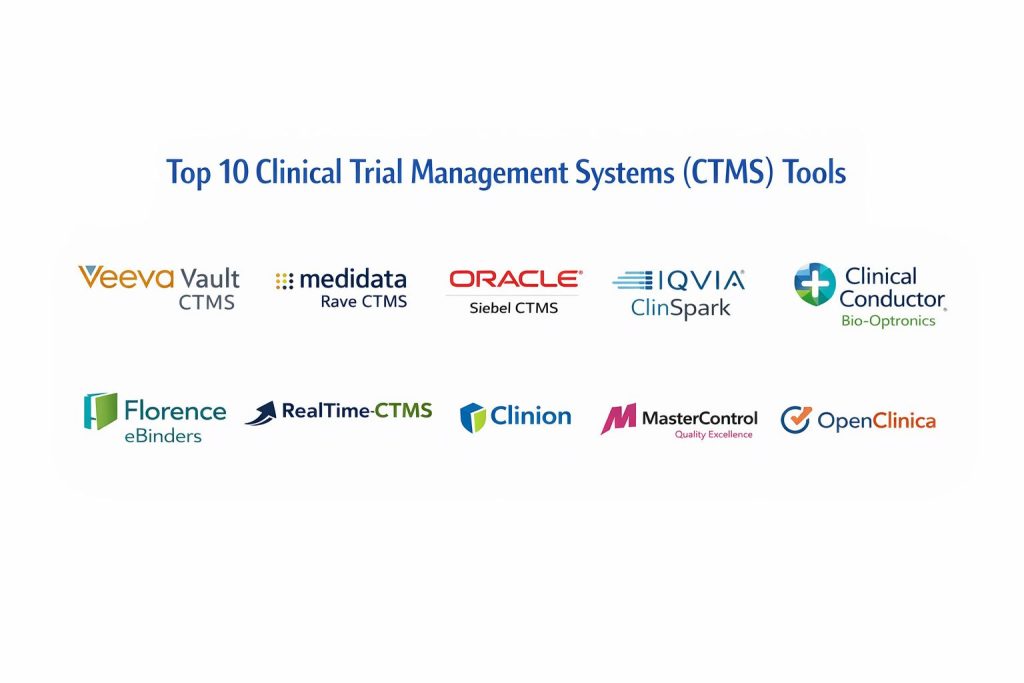
Top 10 Clinical Trial Management Systems (CTMS)
1. Veeva Vault CTMS
Veeva Vault CTMS is widely recognized as the market leader for organizations seeking a unified clinical cloud experience. It integrates seamlessly with the broader Veeva ecosystem, allowing clinical operations teams to share data instantly with regulatory and quality departments.
Key Features
- Unified Clinical Operations: Shares a single data model with Veeva eTMF and Vault EDC for total visibility.
- Automated Trip Reports: Streamlines the monitoring process by auto-populating site visit reports with existing study data.
- Site Management & Monitoring: Provides a comprehensive view of site health, including recruitment progress and protocol deviations.
- Seamless Payments: Integrated site payment features that trigger automatically based on completed study milestones.
- Interactive Dashboards: Real-time reporting on study status, enrollment trends, and monitoring backlogs.
- Global Regulatory Support: Built-in workflows to manage multi-country submissions and local compliance requirements.
Pros
- Unmatched integration within the Veeva ecosystem, significantly reducing manual data entry.
- Modern, intuitive interface that is easy for clinical monitors and project managers to navigate.
Cons
- Premium pricing model makes it one of the most expensive options on the market.
- Requires a significant initial investment in configuration and user training.
Platforms / Deployment
- Web-based (SaaS)
- iOS / Android (Mobile apps for monitors)
Security & Compliance
- Features: 21 CFR Part 11, Annex 11, HIPAA, and GDPR compliant.
- Compliance: SOC 2 Type II, ISO 27001.
Integrations & Ecosystem
Deeply integrated with Veeva Vault eTMF, Vault EDC, and Vault RIM. It also features a robust API for connecting with third-party IVRS/IWRS systems.
Support & Community
Offers 24/7 global support and access to “Veeva Connect,” a vast community of users and experts sharing best practices.
2. Medidata Rave CTMS
Medidata Rave CTMS, part of Dassault Systèmes, is a cornerstone of the global clinical research industry. It is renowned for its powerful data analytics and its ability to handle the scale and complexity of Phase III and IV global trials.
Key Features
- Rave EDC Integration: Direct, real-time data flow from the Electronic Data Capture system into the CTMS.
- Medidata Detect: Uses AI to identify data anomalies and site performance risks before they impact the study.
- Centralized Monitoring: Supports remote and risk-based monitoring strategies with targeted data visualizations.
- Intelligent Enrollment: Predictive modeling to help sponsors select the most effective sites for a given therapeutic area.
- Grant Manager Integration: Sophisticated financial tools for fair market value assessment and site contract management.
- Unified Workflow: A single portal for sponsors and CROs to manage all operational tasks.
Pros
- The most established platform in the industry with a proven track record in massive global trials.
- Exceptional predictive analytics and risk-based monitoring capabilities.
Cons
- The user interface can feel complex and “heavy” compared to newer cloud-native competitors.
- Long implementation cycles are common for highly customized enterprise setups.
Platforms / Deployment
- Web-based (SaaS)
- Desktop (Legacy support available)
Security & Compliance
- Features: End-to-end data encryption and robust audit trails.
- Compliance: SOC 2 Type II, HIPAA, FISMA.
Integrations & Ecosystem
Part of the Medidata Clinical Cloud, it integrates with Medidata eCOA, RTSM, and Imaging Bank.
Support & Community
Provides professional services for implementation and a comprehensive training platform via Medidata Academy.
3. Oracle Siebel CTMS
Oracle Siebel CTMS is the preferred choice for large-scale enterprises that require deep customization and the ability to manage thousands of studies simultaneously. It is known for its extreme flexibility and “industrial-strength” database architecture.
Key Features
- Massive Scalability: Designed to support the world’s largest pharmaceutical portfolios without performance loss.
- Advanced Customization: Highly configurable workflows that can be tailored to any unique organizational process.
- Integrated Oracle Health Sciences: Connects natively with Oracle’s safety and data management suites.
- Complex Financial Management: Robust tools for managing multi-currency site budgets and global investigator payments.
- Offline Monitoring: Allows monitors to work in the field without an active internet connection and sync later.
- Protocol Management: Detailed versioning and tracking for complex, multi-arm clinical protocols.
Pros
- Unrivaled for handling the data volume of “Big Pharma” and large CROs.
- High degree of configurability allows it to match established internal workflows perfectly.
Cons
- Known for a high “Total Cost of Ownership” due to maintenance and IT requirements.
- The interface is often described as dated and less user-friendly than modern rivals.
Platforms / Deployment
- On-premise / Hosted Cloud
- Windows / Web
Security & Compliance
- Features: Enterprise-grade security with role-based access control (RBAC).
- Compliance: 21 CFR Part 11, GDPR, GxP.
Integrations & Ecosystem
Integrates with Oracle Argus (Safety) and Oracle Clinical One. Supported by a global network of Oracle consultants.
Support & Community
Oracle provides enterprise-level technical support and a massive global user base for knowledge sharing.
4. IQVIA ClinSpark
ClinSpark by IQVIA is a modern, high-speed CTMS designed specifically for early-phase clinical research. It is built on the Salesforce platform, offering a familiar interface and rapid deployment for biotechs and CROs.
Key Features
- Salesforce Core: Leverages the world’s leading CRM infrastructure for site and contact management.
- Phase I Specialization: Tools specifically designed for the high-intensity needs of early-phase clinics.
- Automated Data Capture: Direct integration with bedside devices for real-time subject monitoring.
- Rapid Study Build: A library of templates that allow for incredibly fast study startup.
- Participant Portal: Integrated tools for recruiting and managing early-phase study participants.
- Financial Dashboards: Real-time visibility into project profitability and burn rates.
Pros
- Exceptionally fast to implement compared to traditional enterprise systems.
- Modern, responsive interface that works well on both desktop and mobile devices.
Cons
- Primarily focused on Phase I/II research; may lack some features needed for large Phase III trials.
- Customization beyond the Salesforce framework can sometimes be limited.
Platforms / Deployment
- Web-based (SaaS)
- Mobile (Responsive Web)
Security & Compliance
- Features: Built on Salesforce’s highly secure infrastructure.
- Compliance: HIPAA, 21 CFR Part 11, SOC 2.
Integrations & Ecosystem
Works seamlessly with IQVIA’s broader eClinical suite and any app available on the Salesforce AppExchange.
Support & Community
Backed by IQVIA’s global expertise in clinical research and Salesforce’s massive developer ecosystem.
5. Bio-Optronics Clinical Conductor
Clinical Conductor is a unique CTMS that provides powerful tools for both sponsors and investigative sites. It is highly regarded for its financial management features and its ability to coordinate large site networks.
Key Features
- Dual-Market Design: Specific versions for both research sites and sponsors/CROs.
- Financial Command Center: One of the industry’s best tools for clinical trial billing and invoicing.
- Site Recruitment Tools: Advanced database features for finding and screening potential participants.
- Protocol Adherence Tracking: Real-time alerts to ensure sites are following the study protocol accurately.
- Business Intelligence: In-depth reporting on site performance and ROI for research organizations.
- Regulatory Binder Management: Integrated tools for maintaining essential study documents digitally.
Pros
- Exceptional for research sites that need to manage the “business” side of clinical trials.
- Strong focus on financial compliance and reducing billing errors.
Cons
- The user interface is functional but lacks the sleekness of modern “SaaS-first” platforms.
- Integration with third-party EDCs can require more configuration than unified platforms.
Platforms / Deployment
- Web-based (SaaS)
- Windows (Legacy components)
Security & Compliance
- Features: Comprehensive audit trails and encrypted data storage.
- Compliance: HIPAA, 21 CFR Part 11.
Integrations & Ecosystem
Integrates with major EMR systems and financial software like QuickBooks or Great Plains.
Support & Community
Known for personalized customer service and a dedicated user group that helps drive product development.
6. Florence eBinders
Florence is a disruptor in the CTMS space, focusing heavily on the “eRegulatory” and document management aspects of clinical trials. It is the platform of choice for sites and sponsors who want to eliminate paper-based workflows.
Key Features
- eRegulatory/eISF Management: The industry standard for digital Investigator Site Files.
- Sponsor-Site Collaboration: Direct, secure portal for monitors to review documents remotely.
- Electronic Signatures: Native eSignature capability that is fully compliant with global regulations.
- Remote Monitoring Hub: A dedicated space for CRA (Clinical Research Associate) oversight.
- Automated Tracking: Automatically logs document status and expiration dates for regulatory items.
- Site-First Design: Built specifically to reduce the burden on investigative site staff.
Pros
- The easiest platform to adopt for sites transitioning from paper to digital.
- Dramatically reduces the time and cost of remote monitoring visits.
Cons
- Lacks the deep financial and logistics modules found in “full” enterprise CTMS tools.
- Best used as a component of a larger system rather than a standalone operational suite.
Platforms / Deployment
- Web-based (SaaS)
Security & Compliance
- Features: Advanced document encryption and 21 CFR Part 11 compliance.
- Compliance: SOC 2 Type II, HIPAA, GDPR.
Integrations & Ecosystem
Extensive API that connects with major CTMS platforms like Veeva and Medidata.
Support & Community
Florence offers “Florence University” for user training and has a very strong reputation for site-level support.
7. RealTime-CTMS
RealTime-CTMS is a versatile, cloud-based system that excels in site-level operations and site management organization (SMO) workflows. It focuses on making daily research tasks as efficient as possible.
Key Features
- Integrated eSource: Allows for the direct capture of data on tablets, eliminating the need for paper source documents.
- Participant Engagement: Built-in SMS and email tools for appointment reminders and recruitment.
- Calendar Management: A sophisticated scheduling system designed specifically for clinical visits.
- Recruitment Tracking: Real-time visibility into the recruitment funnel, from lead to enrollment.
- Financial Tracking: Simplified invoicing and payment tracking for site-level finances.
- Document Portal: Secure storage for site-specific regulatory and administrative documents.
Pros
- High user satisfaction among research coordinators due to its “real-world” design.
- Includes specialized features for managing large site networks and SMOs.
Cons
- May not scale as effectively for massive global pharmaceutical sponsors as Oracle or Medidata.
- reporting features are less customizable than enterprise-level tools.
Platforms / Deployment
- Web-based (SaaS)
- Tablet-optimized (For eSource)
Security & Compliance
- Features: Multi-factor authentication and role-based access.
- Compliance: HIPAA, 21 CFR Part 11.
Integrations & Ecosystem
Offers integrations with various EMR systems and some industry-standard EDC tools.
Support & Community
Responsive customer support team and regular webinars for feature training.
8. Clinion
Clinion offers an integrated eClinical platform that combines CTMS, EDC, and eCOA into a single, cohesive environment. It is particularly popular among mid-market CROs and biotechnology firms.
Key Features
- AI-Native Coding: Uses machine learning to assist in medical coding (MedDRA/WHODrug).
- Unified Data Model: Eliminates data silos between operational tracking and patient data.
- eCOA/ePRO Integrated: Native support for capturing patient-reported outcomes within the system.
- Flexible Monitoring: Supports both onsite and remote monitoring with automated workflows.
- Study Startup Tools: Includes a “Global Study Builder” for quick configuration of complex trials.
- Compliance Dashboards: Real-time visibility into the audit-readiness of any given study.
Pros
- Excellent value proposition for companies wanting a “all-in-one” clinical suite.
- The AI features significantly reduce the manual effort required for data cleaning and coding.
Cons
- The brand has less “name recognition” in the industry compared to Veeva or Medidata.
- Smaller third-party consultant ecosystem for specialized custom development.
Platforms / Deployment
- Web-based (SaaS)
Security & Compliance
- Features: End-to-end encryption and robust system validation.
- Compliance: 21 CFR Part 11, Annex 11, HIPAA, GDPR.
Integrations & Ecosystem
A fully integrated suite that also supports external integrations via a standard REST API.
Support & Community
Clinion provides hands-on implementation support and a growing library of digital learning materials.
9. MasterControl Quality Excellence
MasterControl is a unique player in the CTMS space, as it approaches clinical trials from a quality management (QMS) and regulatory compliance perspective. It is ideal for companies that prioritize audit-readiness above all else.
Key Features
- Quality-First Architecture: Built on a foundation of quality and document control.
- Integrated Training: Automatically tracks and manages required training for all study personnel.
- CAPA & Deviation Management: Advanced tools for managing protocol deviations and corrective actions.
- Document Control: Industry-leading version control for protocols, SOPs, and regulatory filings.
- Audit Management: Specialized tools for preparing for and managing regulatory inspections.
- Supplier Management: Tracks and manages the quality and compliance of third-party vendors and CROs.
Pros
- Unrivaled for ensuring that every aspect of a trial is fully documented and audit-ready.
- Strong integration between clinical operations and the broader corporate quality system.
Cons
- Not a “pure” CTMS; may lack some of the deeper patient-level tracking features of specialized tools.
- The focus on quality can sometimes make the system feel more rigid than operations-focused tools.
Platforms / Deployment
- Web-based (SaaS)
- On-premise
Security & Compliance
- Features: Rigorous security protocols and automated validation.
- Compliance: ISO 9001, ISO 13488, 21 CFR Part 11.
Integrations & Ecosystem
Integrates with SAP, Oracle, and other enterprise-level ERP and LIMS systems.
Support & Community
Offers a massive training portal and a very active user community focused on quality and compliance.
10. OpenClinica
OpenClinica is a modern, modular eClinical platform that prides itself on being “open” and highly interoperable. It is a favorite among academic researchers and tech-forward biotechs who want control over their data.
Key Features
- Open Interoperability: Built on open standards (CDISC, FHIR) for easy data exchange.
- Participant-Centric Design: Native ePRO and eConsent modules that are easy for patients to use.
- No-Code Study Build: Allows clinical teams to build and modify studies without IT assistance.
- Automated Data Review: Real-time checks for data errors and inconsistencies as they are entered.
- Cloud-Native Performance: A lightweight, fast system that works well on any device.
- Collaborative Monitoring: Tools that allow sites and monitors to resolve queries in a shared space.
Pros
- Avoids “vendor lock-in” by using open data standards and providing a highly transparent platform.
- Exceptionally user-friendly for both site staff and study participants.
Cons
- May require more internal technical expertise to manage the open-source or highly customized versions.
- Fewer pre-built “enterprise” integrations than the major legacy suites.
Platforms / Deployment
- Web-based (SaaS)
- On-premise (Open source version available)
Security & Compliance
- Features: Transparent security model with frequent audits.
- Compliance: 21 CFR Part 11, HIPAA, GDPR.
Integrations & Ecosystem
Strong support for Web Services/API integrations and a community that shares open-source plugins.
Support & Community
Active open-source community as well as professional enterprise support for the commercial version.
Comparison Table (Top 10)
| Tool Name | Best For | Platform(s) Supported | Deployment | Standout Feature | Public Rating |
| Veeva Vault CTMS | Unified Operations | Web, iOS, Android | SaaS | Single Clinical Cloud | 4.8/5 |
| Medidata Rave CTMS | Global Mega-Trials | Web, Desktop | SaaS | Predictive Analytics | 4.7/5 |
| Oracle Siebel CTMS | Enterprise Pharma | Web, Windows | Cloud/On-prem | Industrial Scalability | 4.2/5 |
| IQVIA ClinSpark | Phase I / Early Phase | Web, Mobile | SaaS | Salesforce Ecosystem | 4.6/5 |
| Clinical Conductor | Site Networks/Finances | Web, Windows | SaaS | Billing & Invoicing | 4.5/5 |
| Florence eBinders | eReg / Sites | Web | SaaS | eRegulatory Dominance | 4.8/5 |
| RealTime-CTMS | Site Operations | Web, Tablet | SaaS | Integrated eSource | 4.4/5 |
| Clinion | Integrated AI-Native | Web | SaaS | AI Medical Coding | 4.3/5 |
| MasterControl | Quality & Compliance | Web | SaaS/On-prem | Training & Audit MGMT | 4.1/5 |
| OpenClinica | Academic / Open-Data | Web | SaaS/Open-src | Interoperability Focus | 4.5/5 |
Evaluation & Scoring of CTMS Software
The scoring below is a comparative model intended to help shortlisting. Each criterion is scored from 1–10, then a weighted total from 0–10 is calculated using the weights listed. These are analyst estimates based on typical fit and common workflow requirements, not public ratings.
Weights:
Price / value – 15%
Core features – 25%
Ease of use – 15%
Integrations & ecosystem – 15%
Security & compliance – 10%
Performance & reliability – 10%
Support & community – 10%
| Tool Name | Core (25%) | Ease (15%) | Integrations (15%) | Security (10%) | Performance (10%) | Support (10%) | Value (15%) | Weighted Total |
| Veeva Vault CTMS | 10 | 8 | 10 | 10 | 9 | 9 | 6 | 8.85 |
| Medidata Rave CTMS | 10 | 6 | 9 | 10 | 8 | 9 | 5 | 8.15 |
| Oracle Siebel CTMS | 10 | 4 | 8 | 10 | 10 | 8 | 5 | 7.60 |
| IQVIA ClinSpark | 8 | 9 | 9 | 9 | 9 | 8 | 7 | 8.35 |
| Clinical Conductor | 8 | 7 | 7 | 9 | 8 | 8 | 8 | 7.75 |
| Florence eBinders | 7 | 10 | 8 | 10 | 9 | 9 | 9 | 8.55 |
| RealTime-CTMS | 7 | 9 | 7 | 9 | 8 | 8 | 9 | 7.95 |
| Clinion | 8 | 7 | 8 | 9 | 8 | 7 | 8 | 7.75 |
| MasterControl | 8 | 6 | 7 | 10 | 8 | 8 | 6 | 7.30 |
| OpenClinica | 7 | 8 | 10 | 9 | 8 | 8 | 10 | 8.20 |
How to interpret the scores:
- Use the weighted total to shortlist candidates, then validate with a pilot.
- A lower score can mean specialization, not weakness.
- Security and compliance scores reflect controllability and governance fit, because certifications are often not publicly stated.
- Actual outcomes vary with assembly size, team skills, templates, and process maturity.
Which Clinical Trial Management System (CTMS) Is Right for You?
Global Pharmaceutical Company (Enterprise)
For massive organizations with global portfolios, Veeva Vault CTMS or Medidata Rave CTMS are the gold standards. They provide the necessary visibility and advanced analytics to manage hundreds of concurrent studies while maintaining global regulatory compliance.
Mid-Market Biotech / CRO
The Clinion or OpenClinica platforms are often the best fit for mid-sized organizations. They offer high-end features like AI-assisted coding and unified data models without the astronomical costs associated with the largest enterprise legacy suites.
Clinical Research Site / SMO
Sites and Site Management Organizations (SMOs) should prioritize RealTime-CTMS or Clinical Conductor. These tools are built “site-first,” focusing on the daily operational realities of patient scheduling, eSource capture, and financial invoicing.
Specialized Regulatory Needs
If your primary goal is to achieve digital transformation of your investigator site files and streamline monitoring visits, Florence eBinders is the premier choice. It is often used as a specialized satellite system alongside a larger corporate CTMS.
Academic / Non-Profit Research
OpenClinica is highly recommended for academic settings. Its modular design and support for open data standards allow researchers to maintain control over their data and collaborate easily with other institutions.
Frequently Asked Questions (FAQs)
What is the primary difference between an EDC and a CTMS?
An EDC (Electronic Data Capture) system is used to collect and manage actual clinical data from patients. A CTMS focuses on the “operational” data—such as which sites are active, who the investigators are, and what the study budget looks like.
Is it better to have a unified system or best-of-breed tools?
A unified system (like Veeva) reduces data silos and training time, but “best-of-breed” tools (like Florence for eReg) often provide deeper, more specialized functionality. The industry is currently trending toward unified platforms to improve real-time visibility.
How do these systems ensure data security?
Professional CTMS platforms use multiple layers of security, including end-to-end encryption, multi-factor authentication, and strict role-based access controls to ensure that only authorized personnel can view sensitive patient or operational data.
Can a CTMS help with patient recruitment?
Yes, many modern systems include recruitment tracking modules that help sponsors find high-performing sites and provide sites with tools to manage their database of potential participants and track them through the enrollment funnel.
Are these systems compliant with FDA regulations?
All the top-tier systems listed are designed to be compliant with FDA 21 CFR Part 11, which governs electronic records and electronic signatures in clinical trials. They maintain complete, unalterable audit trails of every action taken in the system.
How long does it take to implement a new CTMS?
Implementation can range from a few weeks for a site-based system like RealTime-CTMS to 6–12 months for a complex, global enterprise deployment of Oracle Siebel or Medidata.
Do these tools support decentralized clinical trials (DCTs)?
Most modern CTMS platforms now include features for DCTs, such as remote monitoring portals, eConsent, and integrations with wearable devices and telehealth platforms to support subjects who are not visiting a physical clinic.
What is “Fair Market Value” (FMV) in a CTMS?
FMV refers to the standard rates paid to investigators for their work. Sophisticated systems like Medidata include FMV databases to ensure that site budgets are compliant with anti-kickback laws and industry standards.
Can a CTMS handle multiple currencies?
Yes, enterprise-level systems are built to handle the financial complexities of global trials, including multi-currency budgeting, currency conversion tracking, and international tax considerations for site payments.
Is there a free or open-source CTMS?
OpenClinica offers a community edition that is open-source. However, for most regulated clinical trials, the commercial, validated versions are required to meet health authority expectations for data integrity and system maintenance.
Conclusion
The selection of a Clinical Trial Management System (CTMS) is a foundational decision that dictates the efficiency and compliance of your entire clinical research program. The demand for unified, real-time data visibility has made legacy, siloed systems a significant liability. Whether you choose a “Big Pharma” powerhouse like Veeva or a site-centric tool like RealTime-CTMS, the priority must be on system interoperability and ease of use for the people on the front lines of research.
Successful implementation requires more than just software; it requires a commitment to standardized workflows and continuous training. By selecting a system that aligns with your specific organizational goals—be it global scalability, site-level efficiency, or absolute quality compliance—you can significantly reduce trial timelines and bring new treatments to patients faster.