Introduction
Clinical Terminology Management (CTM) tools are the foundational pillars of modern healthcare interoperability, designed to govern the complex web of medical vocabularies and code systems. As patient data moves across disparate Electronic Health Records (EHRs), pharmacies, and laboratories, these tools ensure that a diagnosis or procedure remains semantically consistent, regardless of the platform. CTM software handles the lifecycle of global standards such as SNOMED CT, ICD-10/11, LOINC, and RxNorm, while also managing localized proprietary codes. By providing a centralized “source of truth,” these platforms enable healthcare organizations to normalize unstructured data into actionable insights, facilitating precise clinical decision support and accurate population health analytics.
The technical imperative for CTM tools lies in their ability to resolve semantic fragmentation—the phenomenon where the same clinical concept is described differently across systems. For senior health informatics leaders and DevOps engineers in the medical space, these tools are essential for maintaining data integrity during massive EHR migrations and ensuring regulatory compliance with mandates like the ONC’s Cures Act. A robust terminology server does more than just store codes; it provides sophisticated mapping algorithms, version control, and real-time API access to validate clinical data at the point of care. Choosing the right tool requires a deep understanding of how a platform handles cross-walks, handles massive multi-tenant data sets, and supports the evolving FHIR (Fast Healthcare Interoperability Resources) standards.
Best for: Health information exchange (HIE) architects, clinical informaticians, EHR vendors, and hospital IT departments requiring high-fidelity data normalization and regulatory reporting accuracy.
Not ideal for: Small independent clinics with basic documentation needs or organizations that do not participate in broader health data sharing and advanced clinical analytics.
Key Trends in Clinical Terminology Management Tools
The most significant shift in the CTM landscape is the transition from static, manual mapping to AI-driven “semantic normalization.” Modern platforms now utilize Natural Language Processing (NLP) and machine learning to automatically suggest maps between local interface terms and international standards, significantly reducing the burden on human coders. There is also a strong movement toward cloud-native, “API-first” terminology services. Instead of bulky on-premise installations, organizations are moving toward lightweight FHIR terminology servers that provide sub-second latency for code validation and expansion, supporting the rapid growth of mobile health applications and real-time clinical dashboards.
Another critical trend is the rise of terminology governance as a collaborative enterprise function. Tools are increasingly incorporating workflow management features that allow clinical experts and IT teams to collaboratively draft, review, and approve custom value sets. This ensures that the terminologies used in clinical research or quality reporting are vetted and transparent. Furthermore, as global healthcare moves toward ICD-11, these platforms are being updated with advanced “transition managers” to help organizations map their legacy ICD-10 data to the new hierarchical structure without losing historical context or revenue integrity.
How We Selected These Tools
Our selection process focused on enterprise-grade reliability and the depth of “clinical intelligence” embedded within the software. We prioritized platforms that demonstrate a long-standing commitment to international standards and show proactive adoption of the latest FHIR specifications. Market mindshare was a primary factor, as tools with larger user bases often have more refined “clinician-friendly” synonym libraries—essential for ensuring that doctors can find the right terms quickly without needing to know formal medical coding.
We also evaluated tools based on their “automation maturity.” We sought out platforms that offer more than just a repository, specifically looking for features like automated change-impact analysis and intelligent mapping assistants. Security and compliance were non-negotiable, with a focus on tools that provide high-availability architectures and meet global data protection standards. Finally, we considered the ease of integration; the top-ranked tools are those that can act as a seamless backend service to existing EHRs and analytics engines, providing a unified terminology layer across the entire enterprise.
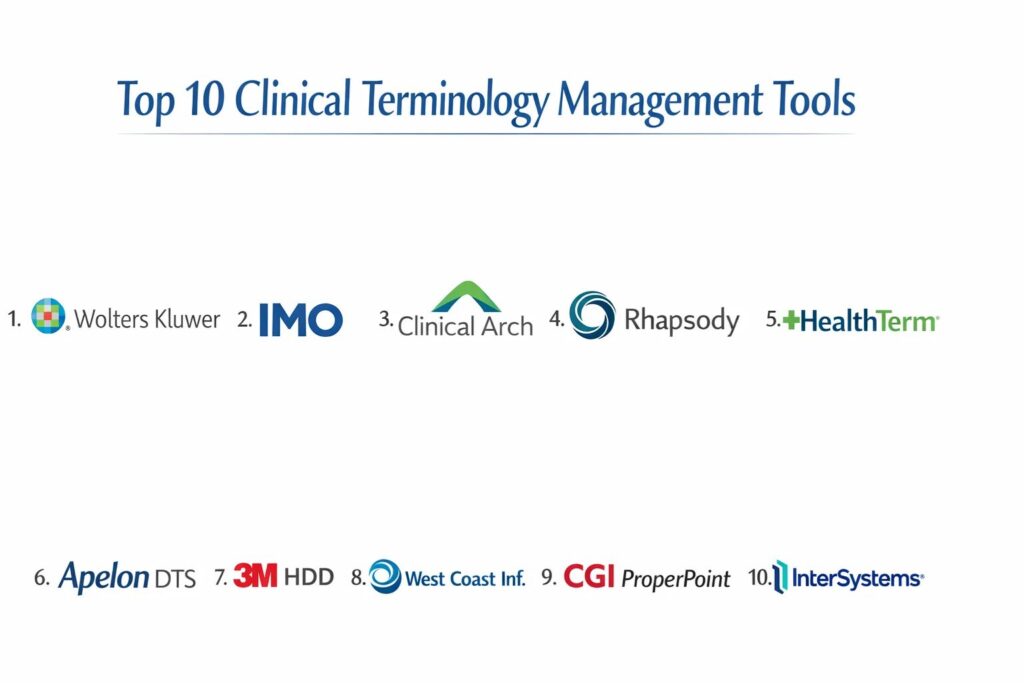
1. Wolters Kluwer (Health Language)
Health Language is an industry-standard platform known for its massive library of over one million clinically curated synonyms and its robust mapping engine. It is designed to help large health systems and payers maximize their data assets by standardizing disparate data streams from multiple EHRs and claims systems into a unified clinical record.
Key Features
The platform features the LEAP Map Manager, which utilizes advanced algorithms to automate the mapping of local codes to standard terminologies. It provides a centralized web-based portal for managing value sets and terminology updates, ensuring all systems stay synchronized with the latest regulatory changes. Its “Language Engine” offers a high-performance REST API for real-time terminology lookups and data validation. The tool also includes a dedicated module for managing pharmacy and laboratory codes, ensuring high specificity in medication and test data. Additionally, it provides built-in tools for monitoring data quality and identifying coding gaps that could impact reimbursement.
Pros
Extensive clinical content library reduces the manual work required for data normalization. The platform is highly scalable and supports the complex needs of multi-facility health systems.
Cons
The enterprise-level complexity can lead to a longer implementation period. The cost structure may be prohibitive for smaller, non-enterprise organizations.
Platforms and Deployment
Cloud-based SaaS with flexible API integration options for existing infrastructure.
Security and Compliance
Fully HIPAA compliant with SOC 2 certification and robust data encryption at rest and in transit.
Integrations and Ecosystem
Native integrations with major EHR vendors and powerful hooks for data warehouses and population health platforms.
Support and Community
Offers 24/7 technical support and professional onboarding services with a large network of clinical informatics experts.
2. Intelligent Medical Objects (IMO)
IMO is widely recognized for bridging the gap between clinical intent and standardized coding. Its “Terminology 1.0” approach focuses on providing the terms that clinicians actually use in practice, which are then mapped in the background to the required billing and regulatory codes like ICD-10-CM or SNOMED CT.
Key Features
The tool offers a comprehensive “interface terminology” that allows doctors to search for concepts using familiar clinical shorthand. It features a smart search engine that accounts for common misspellings and abbreviations while maintaining clinical accuracy. IMO Precision provides automated maintenance of value sets, ensuring they are always up to date with the latest code releases from standard bodies. The platform also includes tools for data normalization that help clean up messy “legacy” data for more accurate analytics. Its cloud-based “Knowledge Builder” allows for collaborative management of enterprise-wide terminologies and mappings.
Pros
Significantly improves clinician satisfaction by allowing for natural language entry. Highly accurate mapping reduces the risk of coding errors and denied claims.
Cons
Primarily focused on the North American market and its specific regulatory requirements. Requires constant connectivity to their cloud service for the most up-to-date term lookups.
Platforms and Deployment
Cloud-native platform with deep embedding capabilities for third-party EHR systems.
Security and Compliance
Adheres to strict HIPAA and HITRUST standards to ensure patient data privacy and security.
Integrations and Ecosystem
Deeply integrated into Epic, Oracle Health (Cerner), and Meditech, making it almost a default choice for hospitals using these EHRs.
Support and Community
Extensive documentation and a dedicated client success team that works closely with hospital informatics departments.
3. Clinical Architecture (Symedical)
Symedical is a highly automated terminology management suite that focuses on “data liquidity.” It is designed to handle the heavy lifting of mapping, organizing, and improving the quality of healthcare data at scale, particularly for organizations moving toward advanced analytics and AI.
Key Features
The platform includes a powerful mapping engine that uses sophisticated logic and critical reasoning to automate the mapping of entire clinical domains. Its “SIFT” tool can extract and normalize clinical concepts from unstructured text in patient records. Symedical provides a “Waypoint” module, which is a web-based toolset for distributing the tasks of reviewing and updating mappings across an organization. It supports comprehensive versioning and change-impact analysis, showing exactly how a new code release will affect existing value sets. The system also includes “Inferencing” logic that can identify gaps in clinical documentation based on existing data patterns.
Pros
Automation features significantly reduce the time needed for informatics teams to manage code sets. Strongest performance in “unstructured-to-structured” data conversion.
Cons
The interface is highly technical and aimed at professional informaticians rather than general IT staff. Setup and configuration of custom mapping rules require specialized knowledge.
Platforms and Deployment
Available as both a cloud-based service and an on-premise installation for maximum data control.
Security and Compliance
Maintains high security standards suitable for large government and military health contracts.
Integrations and Ecosystem
Works well with a variety of data platforms through a robust set of enterprise APIs.
Support and Community
Features the “Symmunity” center, a dedicated resource for users to share maps and best practices.
4. Rhapsody (Semantic Manager)
Rhapsody Semantic Manager (formerly part of Orion Health) is built for high-volume interoperability environments. It provides a centralized terminology server that acts as a translation layer, enabling different healthcare systems to “speak” the same language during data exchange.
Key Features
The tool excels in real-time “runtime translation,” where it intercepts data in motion and converts codes on the fly to meet the requirements of the receiving system. It supports a multi-tenant architecture, allowing HIEs to manage separate terminology sets for different member organizations within a single platform. The system features a robust “Concept Map” designer for building and testing complex cross-walks between different code systems. It provides full support for FHIR terminology services, including code system lookups and value set expansions. The dashboard offers detailed audit trails and governance logs for every terminology change.
Pros
Extremely fast processing speeds make it ideal for real-time integration engines. Excellent for regional health exchanges that must manage thousands of disparate local code sets.
Cons
Best utilized as an add-on to the Rhapsody Integration Engine, which might limit its appeal as a standalone tool. Smaller organizations may find the feature set overly complex.
Platforms and Deployment
Cloud-ready architecture that can also be deployed in private data centers.
Security and Compliance
Provides enterprise-grade security features including role-based access control and detailed transaction logging.
Integrations and Ecosystem
Part of the broader Rhapsody interoperability suite, providing seamless data flow from integration to terminology management.
Support and Community
Global support network with 24/7 coverage and a mature user base in the interoperability space.
5. HealthTerm (CareCom)
HealthTerm is a flexible, web-based terminology management system used extensively by national health ministries and large enterprise organizations. It is designed to be a “single source of truth” for all standardized and local terminologies across an entire country or large network.
Key Features
The platform offers a highly intuitive user interface that allows both clinicians and technical staff to participate in terminology governance. It features a sophisticated “Auto-Map” function that uses semantic matching to suggest connections between local terms and standards like SNOMED CT. HealthTerm supports a comprehensive workflow engine for the authoring and approval of value sets, including multi-stage review cycles. It provides a high-availability FHIR terminology server for distributing codes to downstream systems. The system also includes tools for “extension management,” allowing organizations to create and maintain their own localized additions to international standards.
Pros
User-friendly interface lowers the barrier for clinical participation in terminology management. Strongest option for national or large-scale multi-country deployments.
Cons
The platform’s massive flexibility can sometimes lead to “configuration fatigue” during initial setup. Support is highly centralized, which may impact response times for small local issues.
Platforms and Deployment
Web-based platform available as SaaS or on-site deployment.
Security and Compliance
Fully compliant with GDPR and HIPAA, providing advanced encryption and identity management.
Integrations and Ecosystem
Integrates with any system that supports FHIR or RESTful APIs, making it highly vendor-neutral.
Support and Community
CareCom provides deep expert-led onboarding and has a strong presence in the international standards community.
6. Apelon (Distributed Terminology System – DTS)
Apelon’s DTS is one of the oldest and most trusted names in terminology management. It is an open-source-based platform that provides professional-grade tools for modeling, mapping, and managing clinical vocabularies in a collaborative environment.
Key Features
DTS features a rich “Term Editor” for creating and modifying complex clinical concepts and their relationships. It provides a centralized repository for all major international standards, which are updated regularly by the Apelon team. The platform includes advanced search and browsing capabilities that allow users to navigate the hierarchical structures of SNOMED and ICD with ease. It supports collaborative mapping workflows with built-in conflict resolution and audit trails. DTS also provides a suite of APIs (Java, REST) for integrating terminology services directly into custom clinical applications or research platforms.
Pros
The “DTS” core has a long history of stability and reliability in high-stakes clinical environments. Highly customizable for research organizations that need to build their own unique ontologies.
Cons
The user interface feels dated compared to modern cloud-native competitors. Requires a higher level of technical expertise to install and maintain the server-side components.
Platforms and Deployment
Server-based installation with web-based client access and a robust API layer.
Security and Compliance
Supports secure enterprise authentication and provides detailed logs for regulatory audits.
Integrations and Ecosystem
Strong ties to the academic and research communities, with numerous plugins and extensions available.
Support and Community
Active community of long-time users and professional support packages provided by Apelon.
7. 3M Health Information Systems (HDD)
3M’s Healthcare Data Dictionary (HDD) is a massive, managed terminology service that focuses heavily on the intersection of clinical care and revenue integrity. It is used by some of the largest health systems in the world to ensure that clinical data is ready for both advanced analytics and accurate billing.
Key Features
The HDD provides access to a huge database of standardized concepts that have been refined over decades of use in 3M’s coding products. It features automated content updates that “push” the latest code sets to client systems without manual intervention. The platform includes sophisticated “cross-walk” tools that link clinical findings to the specific codes required for regulatory quality reporting (eCQMs). It provides a robust API for integrating terminology lookups into EHR workflows. The tool also features a “semantic network” that helps users find related concepts across different code systems, such as linking a laboratory test (LOINC) to a corresponding diagnosis (ICD-10).
Pros
Unrivaled expertise in the connection between clinical documentation and financial reimbursement. The “managed service” model removes the burden of terminology maintenance from the hospital IT team.
Cons
The platform is often part of a larger 3M software suite, which can make it less flexible as a standalone tool. High entry cost makes it suitable only for large enterprises.
Platforms and Deployment
Cloud-managed service with enterprise API connectivity.
Security and Compliance
Enterprise-grade security that meets the rigorous requirements of global health systems.
Integrations and Ecosystem
Seamlessly connects with 3M’s other coding and clinical documentation improvement (CDI) tools.
Support and Community
Provides extensive professional services and a dedicated clinical informatics consulting arm.
8. West Coast Informatics (TermServer)
TermServer is a modern, high-performance terminology management platform built using the latest cloud technologies. It is specifically designed to be fast, scalable, and easy to integrate into modern web and mobile healthcare applications.
Key Features
The platform features a native FHIR terminology server that supports the full lifecycle of CodeSystems and ValueSets. It provides a sleek, modern web interface for searching and browsing large terminologies like SNOMED CT. TermServer includes advanced “version comparison” tools that highlight exactly what has changed between different releases of a code set. It supports collaborative terminology authoring with a Git-like branching and merging workflow. The system also features high-performance APIs that are optimized for high-concurrency environments, such as large-scale data ingestion or real-time clinical alerts.
Pros
The most modern architecture in the list, providing exceptional performance and developer experience. The “branching” workflow is perfect for organizations that need to manage complex, overlapping terminology projects.
Cons
Smaller market footprint compared to giants like Wolters Kluwer or 3M. Less “out-of-the-box” clinical content than some of the more established vendors.
Platforms and Deployment
Cloud-native (SaaS) or containerized deployment for private clouds.
Security and Compliance
Built with modern security principles, including SSO integration and SOC 2 compliance.
Integrations and Ecosystem
API-first design makes it the preferred choice for startups and health-tech developers.
Support and Community
Provides highly responsive technical support and active engagement with the FHIR development community.
9. CGI (ProperPoint)
CGI’s ProperPoint is an enterprise terminology management solution that focuses on governance and data quality for large-scale government and private health networks. It is particularly strong in environments that require strict auditability and high-level data oversight.
Key Features
The platform provides a centralized governance dashboard that tracks the “owner” and the “status” of every terminology set in the enterprise. It features advanced mapping tools that support the ingestion of custom legacy codes and their alignment with national standards. ProperPoint includes a robust “validation engine” that checks clinical data against defined value sets to ensure data integrity before it reaches the analytics layer. The system provides extensive reporting on terminology usage and mapping accuracy. It also supports localized language translations for international deployments, allowing the same clinical concept to be managed in multiple languages.
Pros
Strong focus on governance and auditability, making it ideal for highly regulated environments. The platform is backed by CGI’s massive global consulting and support infrastructure.
Cons
The user interface can feel more like a corporate business tool than a clinical one. Implementation usually requires a significant consulting engagement to align with organizational workflows.
Platforms and Deployment
Enterprise-grade cloud or on-premise deployment.
Security and Compliance
Meets the highest global standards for data security, including ISO 27001 and SOC 2.
Integrations and Ecosystem
Well-suited for large-scale government health initiatives and enterprise-wide data platform integrations.
Support and Community
Offers global 24/7 support and the ability to provide on-site implementation teams.
10. InterSystems (HealthShare Terminology)
InterSystems HealthShare Terminology is a core component of the InterSystems TrakCare and HealthShare suites. It is a high-performance terminology server that provides the “semantic glue” for one of the world’s most widely used health data platforms.
Key Features
The tool provides a unified terminology repository that is natively integrated into the InterSystems IRIS for Health database. It features “on-the-fly” normalization, where data is standardized as it enters the HealthShare platform from disparate sources. The system supports full FHIR terminology services and provides a comprehensive set of management APIs. It includes built-in search tools that allow users to navigate complex hierarchies and find the correct codes for any clinical concept. HealthShare Terminology also provides specific tools for managing “cross-maps” between different versions of the same code system, such as ICD-9 to ICD-10.
Pros
Unbeatable performance for organizations already using the InterSystems ecosystem. Natively handles massive data volumes with very low latency.
Cons
Best utilized within the InterSystems HealthShare environment; its value as a standalone terminology server is less clear. The learning curve for the InterSystems environment can be steep.
Platforms and Deployment
Integrated within the InterSystems HealthShare and IRIS for Health platforms.
Security and Compliance
Inherits the world-class security features of the InterSystems data platform, used by major defense and health organizations globally.
Integrations and Ecosystem
Natively integrated with hundreds of hospital systems worldwide that already run on InterSystems technology.
Support and Community
Provides 24/7 global support and a massive community of developers and clinical informatics specialists.
Comparison Table
| Tool Name | Best For | Platform(s) Supported | Deployment | Standout Feature | Public Rating |
| 1. Wolters Kluwer | Enterprise Systems | Web, Cloud | SaaS | 1M+ Clinical Synonyms | 4.8/5 |
| 2. IMO | Clinician Satisfaction | Cloud, Embedded | Hybrid | Clinical Intent Mapping | 4.7/5 |
| 3. Clinical Arch. | Automated Mapping | Web, Cloud, On-Prem | Hybrid | Semantic AI Extraction | 4.6/5 |
| 4. Rhapsody | High-Volume HIEs | Web, Cloud | Hybrid | Runtime Translation | 4.5/5 |
| 5. HealthTerm | National Programs | Web, Cloud | SaaS | Multi-country Scalability | 4.6/5 |
| 6. Apelon DTS | Research/Academic | Web, Server | On-Prem | Open-source Core | 4.1/5 |
| 7. 3M HDD | Revenue Integrity | Web, Cloud | Managed | Billing/Clinical Linkage | 4.4/5 |
| 8. West Coast Inf. | Tech-Forward Devs | Web, API | Cloud | Branching Workflow | 4.7/5 |
| 9. CGI ProperPoint | Governance/Audits | Web, Cloud | Enterprise | Governance Dashboard | 4.3/5 |
| 10. InterSystems | Data Normalization | Web, Cloud | Integrated | IRIS-Native Performance | 4.8/5 |
Evaluation & Scoring of Clinical Terminology Management Tools
The scoring below is a comparative model intended to help shortlisting. Each criterion is scored from 1–10, then a weighted total from 0–10 is calculated using the weights listed. These are analyst estimates based on typical fit and common workflow requirements, not public ratings.
Weights:
- Core features – 25%
- Ease of use – 15%
- Integrations & ecosystem – 15%
- Security & compliance – 10%
- Performance & reliability – 10%
- Support & community – 10%
- Price / value – 15%
| Tool Name | Core (25%) | Ease (15%) | Integrations (15%) | Security (10%) | Performance (10%) | Support (10%) | Value (15%) | Weighted Total |
| 1. Wolters Kluwer | 10 | 8 | 10 | 9 | 9 | 10 | 8 | 9.15 |
| 2. IMO | 10 | 10 | 10 | 9 | 9 | 9 | 7 | 9.10 |
| 3. Clinical Arch. | 9 | 7 | 9 | 9 | 10 | 8 | 8 | 8.65 |
| 4. Rhapsody | 9 | 8 | 10 | 9 | 10 | 8 | 8 | 8.85 |
| 5. HealthTerm | 9 | 9 | 8 | 9 | 8 | 9 | 8 | 8.60 |
| 6. Apelon DTS | 8 | 6 | 7 | 8 | 7 | 8 | 9 | 7.55 |
| 7. 3M HDD | 9 | 7 | 8 | 9 | 8 | 9 | 7 | 8.05 |
| 8. West Coast Inf. | 8 | 9 | 9 | 9 | 10 | 9 | 9 | 8.95 |
| 9. CGI ProperPoint | 8 | 7 | 8 | 10 | 8 | 9 | 7 | 7.95 |
| 10. InterSystems | 10 | 6 | 9 | 10 | 10 | 10 | 7 | 8.70 |
How to interpret the scores:
- Use the weighted total to shortlist candidates, then validate with a pilot.
- A lower score can mean specialization, not weakness.
- Security and compliance scores reflect controllability and governance fit, because certifications are often not publicly stated.
- Actual outcomes vary with assembly size, team skills, templates, and process maturity.
Which Clinical Terminology Management Tool Is Right for You?
Solo / Freelancer
For the independent clinical consultant or health-tech freelancer, West Coast Informatics (TermServer) is often the best fit. Its modern API-first approach and flexible pricing allow for rapid prototyping and integration into small-scale digital health applications without the overhead of enterprise contracts.
SMB
Small to medium-sized health tech companies or regional clinics should consider Intelligent Medical Objects (IMO). It provides high value by improving clinician documentation quality immediately, which is often the biggest pain point for smaller organizations looking to improve their data fidelity.
Mid-Market
Organizations with a strong focus on data quality and clinical research will benefit most from Clinical Architecture (Symedical). Its advanced automated mapping and extraction tools allow a small informatics team to perform the work of a much larger department.
Enterprise
For massive, multi-site health systems or national health networks, Wolters Kluwer (Health Language) or HealthTerm (CareCom) are the clear leaders. They provide the depth of content, governance workflows, and global scalability required to manage millions of patient records across diverse environments.
Budget vs Premium
If budget is the primary constraint and you have the technical expertise, Apelon DTS provides a professional-grade open-core platform. However, for those who value a fully managed, premium “white-glove” experience, 3M’s HDD offers a hands-off approach to terminology maintenance.
Feature Depth vs Ease of Use
HealthTerm strikes the best balance for organizations that need deep features but want a user-friendly interface for clinical staff. Conversely, InterSystems offers unparalleled depth and performance but requires a significant investment in platform-specific technical skills.
Integrations & Scalability
Rhapsody is the winner for organizations that prioritize real-time data exchange and integration. Its ability to scale across massive health exchanges makes it a critical piece of infrastructure for regional or state-level interoperability projects.
Security & Compliance Needs
CGI (ProperPoint) is the top choice for government agencies and highly regulated entities that require rigorous audit trails and governance controls. Its architecture is built specifically to meet the high-security demands of public sector health initiatives.
Frequently Asked Questions (FAQs)
1. What is the difference between an EHR and a CTM tool?
An EHR stores patient records and uses basic code sets, whereas a Clinical Terminology Management (CTM) tool acts as the “brain” that manages, maps, and updates those code sets across multiple different systems to ensure they remain standardized.
2. Why can’t I just use a spreadsheet to manage my codes?
Spreadsheets lack version control, hierarchical relationships, and real-time API access. CTM tools automate updates and provide sophisticated mapping logic that prevents the “broken links” and data errors common in manual spreadsheet management.
3. Does every hospital need its own terminology server?
Not necessarily. While many large systems have their own, smaller hospitals often use the terminology services embedded within their EHR or use a cloud-based managed service like IMO to handle their coding needs.
4. How often are clinical terminologies like ICD-10 updated?
Standard code sets are typically updated annually or semi-annually. CTM tools like Health Language automatically ingest these updates and show you exactly how they will impact your current maps and clinical records.
5. What is “Semantic Normalization”?
It is the process of taking different terms that mean the same thing (e.g., “Heart Attack” and “Myocardial Infarction”) and mapping them to a single standardized code so that they can be analyzed as the same clinical concept.
6. Can these tools help with the transition to ICD-11?
Yes, most top-tier platforms have already built “transition managers” and cross-walks that help organizations map their current ICD-10 data to the new ICD-11 structure, ensuring historical data remains useful.
7. Do CTM tools handle laboratory data like LOINC?
Yes, specialized modules within tools like Symedical or 3M HDD are specifically designed to handle the complexities of lab terminology, including mapping local lab “test names” to the global LOINC standard.
8. How do CTM tools improve patient safety?
By ensuring that a patient’s allergy or medication list is correctly coded and standardized across all systems, CTM tools prevent critical information from being “lost in translation,” which reduces the risk of medical errors.
9. Are these tools compatible with FHIR?
Modern CTM tools like West Coast Informatics and HealthTerm are built as native FHIR terminology servers, meaning they can provide codes to any FHIR-compliant app or system using standardized APIs.
10. Do I need a clinical informatician to run these tools?
While the tools automate much of the work, a clinical informatician is usually required to oversee the governance, approve custom maps, and ensure the terminology strategy aligns with the organization’s clinical goals.
Conclusion
The successful implementation of a Clinical Terminology Management tool is no longer a luxury but a strategic necessity in the era of value-based care and advanced AI analytics. As healthcare data becomes increasingly interconnected, the ability to maintain a high-fidelity, standardized vocabulary is the difference between an organization that is data-rich but “insight-poor” and one that can leverage its information to improve patient outcomes. Informatics leaders must evaluate these tools not just as repositories, but as active intelligence engines that can automate the tedious tasks of mapping and governance. By selecting a platform that aligns with your organization’s technical maturity and scale—whether it’s a developer-centric FHIR server or an enterprise governance suite—you ensure that your data remains a reliable asset for years to come. Ultimately, the right CTM tool provides the semantic foundation upon which the future of digital medicine is built.