Introduction
Clinical Data Management Systems (CDMS) serve as the technological foundation for modern drug development and medical device testing. These platforms are designed to collect, clean, and manage clinical trial data while ensuring strict adherence to global regulatory standards. By providing a centralized digital environment for Case Report Forms (CRFs) and electronic data capture, a CDMS enables research teams to transition from manual paper processes to automated, high-fidelity data workflows. In the current landscape of decentralized trials and complex biologics, these systems are essential for maintaining the “integrity of truth” from the first patient enrollment to the final regulatory submission.
The evolution of clinical research has moved CDMS from simple database repositories to intelligent orchestration hubs. With the integration of wearable device data, electronic health records (EHR), and real-time lab results, modern systems must handle a massive volume of diverse data points without compromising security or speed. This digital transformation allows for “risk-based monitoring,” where researchers can identify data anomalies instantly, rather than waiting months for a manual site audit. For any life sciences organization, selecting the right CDMS is a strategic imperative that directly impacts the time-to-market and the overall safety profile of new medical interventions.
Real-World Use Cases
- Decentralized Clinical Trials (DCTs): CDMS platforms enable remote data entry through patient-facing apps, allowing participants to contribute data from home while ensuring researchers maintain a “real-time” view of the study’s progress.
- Automated Query Management: When a data point falls outside of pre-defined clinical parameters, the system automatically flags the entry and notifies the site coordinator for clarification, drastically reducing manual review time.
- Cross-Study Data Standardization: Organizations use CDMS to map raw trial data into industry-standard formats like CDISC SDTM, making it significantly easier to combine data from multiple trials for global regulatory submissions.
- Integrated Medical Coding: These systems provide automated links to medical dictionaries (such as MedDRA and WHODrug), ensuring that adverse events and medications are categorized consistently across different global research sites.
- Real-Time Safety Monitoring: Medical monitors use CDMS dashboards to track patient safety trends across a global cohort, enabling them to pause a trial or adjust dosages immediately if a systemic risk is identified.
Buyer Evaluation Criteria
- Regulatory Compliance and Validation: Does the system fully comply with 21 CFR Part 11 and Annex 11, providing a robust audit trail, electronic signatures, and the necessary validation documentation for health authorities?
- Electronic Data Capture (EDC) Flexibility: Evaluate how easily the platform allows for the design of complex, branching CRFs and whether it supports multi-lingual entry for global Phase III trials.
- Data Integration Capabilities: In a modern trial environment, the CDMS must be able to ingest data seamlessly from EPRO (Patient-Reported Outcomes), wearables, and central labs via standardized APIs.
- User Interface and Experience: If the platform is too cumbersome, site staff may commit data entry errors; prioritize systems with intuitive navigation and “clean” data entry screens to minimize friction.
- Scalability and Study Setup Speed: Determine the average “time-to-live” for a new study; look for systems that offer drag-and-drop design tools and reusable global libraries to accelerate trial launches.
- Reporting and Analytics Depth: Does the system provide real-time, high-level dashboards for study managers while also allowing for granular, ad-hoc data exports for biostatisticians?
- Vendor Support and Training: Clinical trials operate on tight timelines; ensure the vendor provides 24/7 technical support and comprehensive “on-demand” training modules for site investigators.
- Total Cost of Ownership: Beyond the initial license fee, consider the costs of study build services, database hosting, and the “hidden” costs of user seats or data storage limits.
- Security and Data Privacy: Ensure the platform meets global standards like GDPR and HIPAA, offering role-based access control and encrypted data transmission to protect sensitive patient information.
- Library Management: Evaluate the ability to create and manage a library of “Standardized Objects,” which allows for the rapid replication of validated CRFs across different studies within a program.
Best for: Pharmaceutical companies, Contract Research Organizations (CROs), and medical device manufacturers who require a validated, secure environment to manage large-scale human clinical trial data.
Not ideal for: Early-stage academic research projects with very limited budgets or small-scale laboratory experiments that do not require 21 CFR Part 11 compliance or formal regulatory oversight.
Key Trends in Clinical Data Management Systems
- AI-Driven Data Cleansing: Platforms are increasingly using machine learning to predict and auto-correct common data entry errors, allowing data managers to focus only on complex clinical discrepancies.
- Direct-to-EHR Integration: To reduce the “double entry” of data, modern CDMS tools are building direct bridges to hospital Electronic Health Record systems, allowing trial data to flow automatically from the clinic to the study database.
- Unified Clinical Platforms: The market is moving away from “standalone” CDMS toward unified platforms that integrate EDC, CTMS (Trial Management), and eTMF (Trial Master File) into a single user interface.
- Risk-Based Quality Management: Systems now include predictive analytics that flag “high-risk” research sites based on data entry patterns, enabling sponsors to allocate their monitoring resources more effectively.
- Patient-Centric Data Capture: There is a surge in eSource and ePRO integration, where the patient’s own mobile device becomes the primary source of data entry, increasing engagement and data frequency.
- Real-Time Medical Review: New visualization tools allow medical monitors to view patient “patient profiles” in real-time, combining lab results and adverse events into a single, chronological timeline.
- Cloud-Native Architecture: Legacy on-premise systems have been almost entirely replaced by multi-tenant cloud architectures that offer superior security, automatic updates, and global accessibility.
- Automated SDTM Mapping: Advanced systems are automating the transformation of raw clinical data into CDISC standards, significantly reducing the “last mile” effort before a regulatory filing.
How We Selected These Tools (Methodology)
To identify the top 10 systems for this list, we conducted a rigorous analysis of the global life sciences technology market. Our methodology prioritized systems that provide a balance of regulatory rigor and modern technological flexibility, ensuring they are suitable for the current era of decentralized and hybrid trials.
- Regulatory Track Record: We prioritized vendors with a long history of successful FDA and EMA audits, ensuring the software’s audit trails and validation protocols are industry-proven.
- Innovation and Feature Set: We looked for systems that have actively integrated AI, IoT, and mobile capabilities, moving beyond traditional “static” data entry.
- Market Adoption and Trust: Our list includes both the dominant “Gold Standard” platforms used by big pharma and the “Agile Challengers” that are gaining traction in the mid-market and CRO spaces.
- Interoperability and Openness: We evaluated the strength of the vendors’ API ecosystems, rewarding platforms that allow for easy data exchange with external lab and imaging systems.
- User Feedback and UI Design: We analyzed user reviews from clinical research associates (CRAs) and site coordinators to identify tools that actually reduce, rather than increase, the administrative burden of research.
- Global Scalability: We ensured that the selected tools can support multi-center, multi-language studies across different time zones and regulatory jurisdictions.
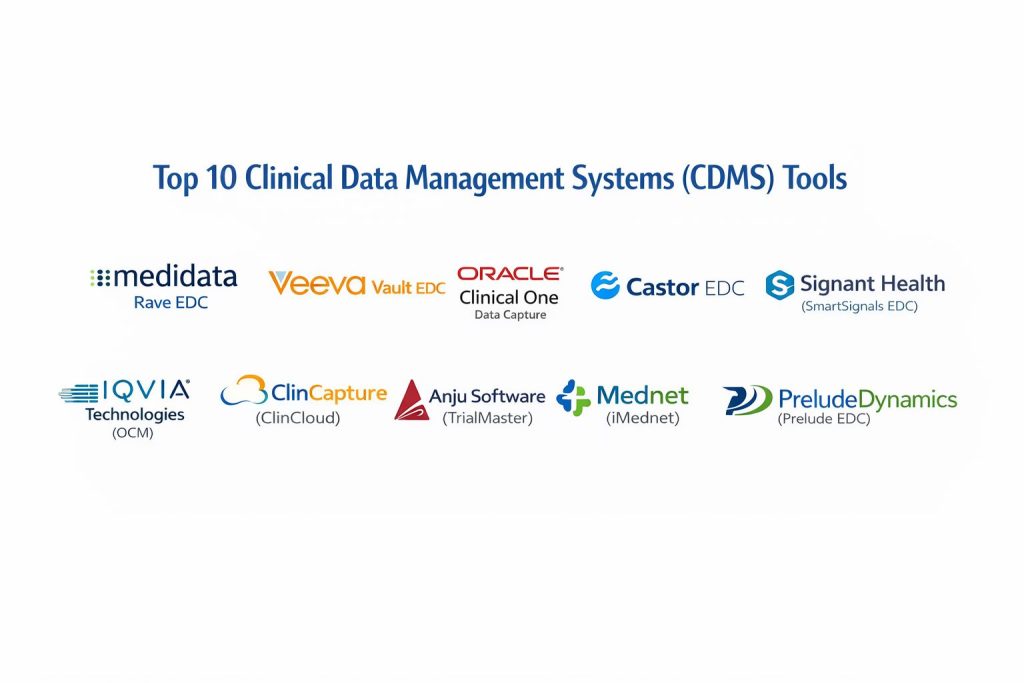
Top 10 Clinical Data Management Systems (CDMS)
1. Medidata Rave EDC
Medidata Rave EDC is widely regarded as the “Gold Standard” in the clinical trial industry. It provides a robust, highly scalable environment for capturing and managing clinical data, utilized by a vast majority of the world’s leading pharmaceutical companies and CROs for complex, global Phase III trials.
Key Features
- Integrated Clinical Cloud: Part of a unified platform that connects EDC with randomisation, supply management, and medical coding for a seamless end-to-end workflow.
- Advanced Query Management: Provides a sophisticated system for flagging, tracking, and resolving data discrepancies directly within the CRF interface.
- Medidata Coder: Automatically maps adverse events and medications to MedDRA and WHODrug dictionaries using intelligent suggestion logic to speed up coding tasks.
- Real-Time Data Visualizations: Offers study managers high-level dashboards to monitor site performance, enrollment trends, and data cleanliness in real-time.
- Flexible CRF Design: Includes a powerful “Architect” module for building complex, branching forms that can handle the most intricate protocol designs.
- High-Fidelity Audit Trails: Maintains a 21 CFR Part 11 compliant record of every single change made to the data, including who made the change and why.
- EHR to EDC Integration: Features the “Rave Companion” tool which allows for the rapid transfer of data from hospital EHRs into the Medidata environment to reduce manual entry.
Pros
- Unmatched industry recognition; most experienced clinical researchers are already trained on the Medidata interface.
- Incredible scalability, capable of handling tens of thousands of patients and millions of data points across a single global study.
- Extensive ecosystem of pre-built integrations with lab systems, imaging platforms, and mobile health devices.
Cons
- The platform can be significantly more expensive than newer, mid-market competitors, often pricing it out of reach for smaller biotechs.
- The “Study Build” process can be complex and time-consuming, frequently requiring specialized consultants to set up the database.
- Because it is a massive enterprise system, the user interface can sometimes feel data-dense and less “agile” than modern startups.
Platforms / Deployment
- Cloud (SaaS)
- Web-based access for all site users
Security & Compliance
- Full 21 CFR Part 11 and Annex 11 compliance.
- ISO 27001 and SOC 2 Type II certified.
- Comprehensive data encryption and global privacy standard adherence.
Integrations & Ecosystem
Medidata offers one of the most mature integration environments in the life sciences sector.
- Native integration with Medidata RTSM (Randomization) and eCOA (Clinical Outcome Assessment).
- Open APIs for connecting to external Electronic Health Records (EHR).
- Direct bridges to laboratory information management systems (LIMS).
- Partnership with major imaging vendors for centralized radiological review.
Support & Community
Medidata provides 24/7 global help desk support and a massive “Medidata Academy” for user certification. Their community is the largest in the industry, offering an endless supply of user groups and professional forums.
2. Veeva Vault EDC
Veeva Vault EDC is a modern, cloud-native application that is part of the larger Veeva Development Cloud. It is designed to modernize clinical trials by focusing on speed, an intuitive user interface, and the elimination of data silos between the CDMS and other clinical management tools.
Key Features
- Agile Design Tools: Allows study teams to build and deploy CRFs much faster than legacy systems through a drag-and-drop interface and reusable libraries.
- Modern UI/UX: Features a “clean” interface specifically designed to reduce the “click-count” for site staff, leading to faster data entry and fewer errors.
- Integrated Vault Platform: Shares a single data model with Veeva eTMF and Veeva CTMS, ensuring that data flows automatically between study documents and data management.
- Real-Time Data Cleaning: Provides a “Site-First” approach where queries are visible immediately, allowing site staff to resolve issues while the patient is still at the clinic.
- Automated Data Review: Uses intelligent rules to automatically flag data inconsistencies as they are entered, reducing the burden on manual data monitors.
- Comprehensive Reporting: Includes a built-in “Veeva View” that allows users to create ad-hoc reports and visualizations without needing a separate biostatistics tool.
- Mobile-Friendly Access: The platform is fully responsive, allowing investigators to review and sign off on data using tablets or mobile devices.
Pros
- Significantly faster study setup times compared to traditional “legacy” CDMS platforms.
- Eliminates the need for complex “integrations” because the data is already native to the Veeva Clinical suite.
- The most modern and aesthetically pleasing user interface in the industry, which improves site satisfaction and data quality.
Cons
- Newer compared to Medidata, meaning the pool of “Veeva-certified” study builders is smaller (though growing rapidly).
- Most effective when used as part of the full Veeva suite; standalone users may miss out on some of the “silo-breaking” benefits.
- Transitioning from legacy systems to the “Veeva way” requires a shift in internal study build processes.
Platforms / Deployment
- Cloud (SaaS)
- Fully responsive web application
Security & Compliance
- 21 CFR Part 11 and Annex 11 compliant.
- HIPAA and GDPR compliant data management.
- Extensive audit logging and electronic signature verification.
Integrations & Ecosystem
Veeva is known for its “open” philosophy, allowing for a highly connected digital trial environment.
- Seamless native integration with all other Veeva Vault applications.
- Robust REST APIs for connecting to external lab systems and EPRO.
- “Veeva Snap” for direct eSource data capture via mobile cameras.
- Direct connections to the Veeva Business Network of CROs and service providers.
Support & Community
Veeva offers 24/7 technical support and has a highly active “Veeva Community” portal where users can share best practices and influence the product roadmap.
3. Oracle Clinical One Data Capture
Oracle Clinical One is a transformative platform that goes beyond traditional EDC/CDMS. It aims to unify all clinical trial processes into a single environment, allowing researchers to “collect data once” and use it across randomization, supply, and analysis without moving it between systems.
Key Features
- Unified Environment: Randomization, Trial Supply, and Data Capture all live in one single application with a single login and a shared database.
- Rapid Study Build: Features a simplified design interface that allows non-technical users to build studies in weeks rather than months.
- Real-Time Data Engine: Data is available for analysis the moment it is entered, eliminating the need for traditional batch transfers or “data loads.”
- Mid-Study Changes: Allows for protocol amendments and CRF changes to be deployed instantly across all sites without needing to “take the system down.”
- IoT and Wearable Support: Designed to ingest massive streams of data from digital sensors alongside traditional clinical data.
- Oracle Analytics Integration: Provides deep, enterprise-grade data visualization and “big data” analysis tools out of the box.
Pros
- Eliminates “Integration Fatigue” by providing a truly unified platform where no data movement is required.
- Oracle’s global infrastructure provides unmatched uptime and reliability for large-scale international trials.
- Particularly strong for “Adaptive Trials” where protocol changes must be implemented quickly and safely mid-study.
Cons
- The user interface, while improved, can still feel “enterprise-heavy” compared to the sleekness of Veeva.
- Many organizations are still transitioning from legacy “Oracle Clinical” to “Clinical One,” which involves a significant data migration effort.
Platforms / Deployment
- Cloud (SaaS)
- Oracle Cloud Infrastructure
Security & Compliance
- Top-tier global compliance (21 CFR Part 11, Annex 11).
- Oracle Cloud security standards (SOC 1/2, ISO 27001).
- Advanced multi-factor authentication and role-based access.
Integrations & Ecosystem
- Native integration across the entire Oracle Health Sciences suite.
- Open API framework for connecting to third-party wearables and central labs.
- Direct connection to Oracle’s industry-leading database and analytics tools.
Support & Community
Oracle provides global, 24/7 enterprise support and a vast network of certified implementation partners. Their “Health Sciences” user group is one of the most established in the world.
4. Castor EDC
Castor EDC is a highly flexible and user-centric CDMS that has gained massive popularity among mid-market biotechs and academic research institutions. It focuses on extreme ease of use and “self-service” study builds, making professional clinical data management accessible to smaller teams.
Key Features
- User-Friendly Form Builder: A simple drag-and-drop interface that allows researchers to build a validated study database in a matter of days.
- Integrated ePRO/eCOA: Allows patients to enter data directly into the system via a mobile app, which is then automatically synced with the investigator’s database.
- Automated Data Validations: Features a “point-and-click” rule builder for setting up logic checks (e.g., ensuring a patient’s age matches the inclusion criteria).
- CDISC-Ready Exports: Supports one-click exports into SDTM and other industry-standard formats for easier analysis.
- Castor eConsent: Fully integrates digital consent forms into the data management workflow, ensuring patients are properly consented before data entry begins.
- Transparent Pricing: Offers a clear, predictable pricing model that is often more accessible for startups and non-profit research groups.
Pros
- The fastest “time-to-live” of any system on this list; ideal for teams that need to start a study immediately.
- Exceptional customer support and documentation, making it easy for researchers to build studies without a technical consultant.
- Highly rated by site staff for its simplicity and lack of unnecessary administrative clutter.
Cons
- While capable of Phase III trials, it is often perceived as a “mid-market” tool and lacks the brand recognition of Medidata in large pharma.
- Advanced custom programming for hyper-complex simulations or simulations is slightly more limited than in enterprise-grade platforms.
Platforms / Deployment
- Cloud (SaaS)
- Web and Mobile apps
Security & Compliance
- 21 CFR Part 11 and GDPR compliant.
- ISO 27001 and ISO 9001 certified.
- Data hosted in secure regional data centers (US, EU).
Integrations & Ecosystem
- Robust REST API for connecting to third-party devices and EHRs.
- Native integration with Castor’s own eConsent and eCOA tools.
- Direct export capabilities for R, SAS, and SPSS.
Support & Community
Castor provides excellent documentation and a “Community Forum” where researchers share templates and best practices. Their support team is highly regarded for their responsiveness.
5. Signant Health (SmartSignals EDC)
Signant Health specializes in “Evidence Generation” and their EDC platform is built with a deep focus on decentralized trials. It is specifically optimized for capturing high-quality data from patients in remote settings, making it a leader in digital health research.
Key Features
- Decentralized First: Built from the ground up to support trials where the patient never sets foot in a traditional clinic.
- Unified eCOA Integration: The industry’s deepest integration between clinical outcomes and the EDC, ensuring patient-reported data is the “source of truth.”
- Digital Health Integrations: Natively handles data from a wide variety of medical-grade wearables and home-monitoring devices.
- Intelligent Querying: Uses AI to identify and flag inconsistent data patterns across both site-entered and patient-entered fields.
- Global Medical Coding: Features a streamlined interface for MedDRA and WHODrug coding with automated suggestion logic.
Pros
- The best choice for trials that rely heavily on patient-reported outcomes (PRO) and digital sensors.
- Exceptional “Clinical Science” support; the company provides expert consulting on how to design digital endpoints.
- Very strong global footprint with support for complex multi-language studies.
Cons
- The platform is highly specialized; it may feel “over-engineered” for a traditional, site-based trial with no digital sensors.
- Integrating third-party “non-Signant” devices can sometimes require more custom configuration than the native ones.
Platforms / Deployment
- Cloud (SaaS)
- Specialized mobile apps for patient data capture.
Security & Compliance
- 21 CFR Part 11 and Annex 11 compliant.
- HIPAA, GDPR, and global data privacy standards.
- Rigorous validation for medical device data ingestion.
Integrations & Ecosystem
- Native integration across the Signant “SmartSignals” suite (eCOA, eConsent, IRT).
- Broad API support for connecting to a wide array of wearable device vendors.
Support & Community
Signant offers 24/7 global support and has a deep bench of “Clinical Scientists” who help sponsors design their digital data strategies.
6. IQVIA Technologies (OCM)
IQVIA Orchestrated Clinical Management (OCM) is a powerful, enterprise-grade CDMS backed by the world’s largest CRO. It is designed for massive efficiency, leveraging IQVIA’s vast clinical data experience to provide a highly optimized data management environment.
Key Features
- AI-Assisted Data Review: Uses proprietary algorithms to identify “high-risk” data points, allowing monitors to focus their time where it matters most.
- Integrated IRT: Seamlessly connects randomization and drug supply with the data capture process to prevent “out-of-stock” issues at research sites.
- Unified Site Portal: Provides site staff with a single dashboard to manage data entry, training, and documentation for multiple IQVIA-managed studies.
- Rapid Build Libraries: Includes a massive library of pre-validated CRF templates based on IQVIA’s experience across thousands of clinical trials.
- Configurable Workflows: Allows study managers to design custom data review paths based on the specific risk profile of the trial.
Pros
- Unmatched “Industry Experience” built directly into the templates and workflows.
- Ideal for sponsors who are already using IQVIA for their CRO services, as the technology and services are perfectly aligned.
- Very strong data analytics and “Trial Benchmarking” capabilities.
Cons
- The system is very enterprise-centric and can be difficult to manage without a dedicated technical team.
- Some users find the interface to be more “functional” than “intuitive” compared to newer cloud competitors.
Platforms / Deployment
- Cloud (SaaS)
- Enterprise web portal
Security & Compliance
- 21 CFR Part 11 and Annex 11 compliant.
- Top-tier global security and data privacy certifications.
Integrations & Ecosystem
- Native integration with the entire IQVIA “Orchestrated” suite.
- Direct bridges to the IQVIA “Core” data warehouse for advanced market and clinical insights.
Support & Community
IQVIA provides professional-grade support and a global network of study managers and data scientists to help sponsors optimize their trials.
7. ClinCapture (ClinCloud)
ClinCapture offers a high-performance, affordable CDMS platform (ClinCloud) that targets the mid-market and medical device sectors. It is known for its “Study Build in a Box” approach, allowing teams to get their studies up and running with minimal technical overhead.
Key Features
- ClinCapture Build: A powerful, browser-based tool for creating validated CRFs without any programming knowledge.
- Self-Service Randomization: Allows study teams to set up simple randomization schemes directly within the EDC interface.
- Integrated eSource: Enables site staff to enter data directly into the system during the patient visit, eliminating the need for paper source documents.
- Automated Medical Coding: Provides native support for MedDRA and WHODrug with a simplified, user-friendly coding interface.
- Risk-Based Monitoring Tools: Includes dashboards that highlight site-level performance issues and data anomalies in real-time.
Pros
- One of the most cost-effective “validated” systems on the market, offering great value for mid-sized sponsors.
- Very fast implementation timelines; ideal for medical device trials that move at a quicker pace than pharmaceutical ones.
- Excellent focus on “Ease of Use” for both study builders and site investigators.
Cons
- Lacks the deep “Global Infrastructure” and multi-vendor ecosystem of players like Medidata or Oracle.
- While it handles Phase I-III, it is not as commonly used for massive, 10,000+ patient cardiovascular trials.
Platforms / Deployment
- Cloud (SaaS)
- Web-based
Security & Compliance
- 21 CFR Part 11 compliant.
- HIPAA and GDPR compliant.
- Secure cloud hosting with daily backups and audit trails.
Integrations & Ecosystem
- Open API for connecting to third-party lab and imaging systems.
- Native integration with ClinCapture’s own IRT and ePRO modules.
Support & Community
ClinCapture provides high-touch customer support and a comprehensive online learning portal (ClinUniversity) for user training.
8. Anju Software (TrialMaster)
TrialMaster is a flexible, multi-modal EDC/CDMS platform that is highly regarded for its ability to support everything from early-phase trials to large, post-marketing registries. It is built for researchers who need a high degree of configuration and deep data export capabilities.
Key Features
- Omnichannel Data Intake: Supports data entry via web, mobile, and even legacy paper-based entry if required by specific global sites.
- Integrated Medical Coding: Features a robust “Coder” module that supports multi-version dictionary management.
- Advanced Cross-Form Logic: Allows for complex data checks that can look across multiple visits and CRFs to ensure longitudinal data integrity.
- Built-in Ad-Hoc Reporting: Provides an easy-to-use tool for creating custom reports and data extracts on the fly.
- Electronic Lab Ingestion: Includes a specialized module for mapping and importing large volumes of central lab data automatically.
Pros
- Highly configurable; it can be tailored to almost any unique protocol or therapeutic area requirement.
- Strong reputation for “Customer Partnership,” with a willingness to build custom features for large clients.
- Excellent data export tools that are highly valued by biostatisticians.
Cons
- The interface can feel more “traditional” and data-heavy than modern competitors like Veeva or Castor.
- Configuration of highly complex rules can require a deeper level of technical training than “no-code” builders.
Platforms / Deployment
- Cloud (SaaS)
- Web-based
Security & Compliance
- 21 CFR Part 11 and Annex 11 compliant.
- SOC 2 Type II and global privacy standard compliant.
Integrations & Ecosystem
- Open API for connecting to external data sources.
- Native integration within the Anju “eClinical” suite.
Support & Community
Anju provides 24/7 technical support and has a loyal user base that appreciates their high-touch, consultative approach to study builds.
9. Mednet (iMednet)
iMednet is a unified eClinical platform that combines EDC, CDMS, and various trial management modules into a single, cohesive interface. It is specifically designed to be “self-service,” allowing study teams to manage their own trials without being tethered to the vendor’s professional services.
Key Features
- Truly Unified Platform: One login provides access to EDC, IRT, Medical Coding, and basic CTMS features.
- Rapid Build Tool: Features a streamlined study designer that allows for the creation of sophisticated CRFs with no coding required.
- Integrated Payments: (Optional) Allows for the automation of site payments based on the completion of validated data milestones.
- Comprehensive Query Workflows: Provides a very clear, step-by-step interface for site staff to resolve queries and for monitors to close them.
- Global Dictionary Support: Supports multiple versions of MedDRA and WHODrug with automated dictionary updates.
Pros
- Exceptional value-to-feature ratio; you get a lot of clinical management functionality in a single package.
- Highly intuitive for site staff, leading to fast data entry and high data quality.
- The “Self-Service” philosophy gives sponsors total control over their study timelines.
Cons
- Not as widely used in the “Mega-Pharma” space, which may be a consideration for CROs looking for brand alignment with big sponsors.
- While the platform is unified, the individual “CTMS” features are lighter than standalone enterprise-grade CTMS tools.
Platforms / Deployment
- Cloud (SaaS)
- Web-based
Security & Compliance
- 21 CFR Part 11 compliant.
- HIPAA and global data privacy standards.
- Secure, redundant data hosting.
Integrations & Ecosystem
- Open API for connecting to third-party providers.
- Integrated suite of Mednet tools (EDC, IRT, Payments).
Support & Community
Mednet offers personalized support and a robust online training portal to help users master the study build process.
10. Prelude Dynamics (Prelude EDC)
Prelude Dynamics offers a highly specialized CDMS platform that is particularly strong in the Veterinary and Medical Device research spaces. It is known for its extreme flexibility and the ability to handle non-traditional trial designs that other systems might struggle with.
Key Features
- Flexible Data Modeling: Can be configured to handle data from animals, devices, or human patients with equal precision.
- Integrated eSource/ePRO: Supports real-time data capture at the point of care via tablets and mobile devices.
- Complex Logic Support: Allows for the creation of intricate, “calculated fields” and branching logic that goes beyond standard CRF designs.
- Automated Data Transfers: Features a robust “data pump” for moving information between the CDMS and external analytics or safety databases.
- Customizable Site Portals: Allows sponsors to design specific views for different types of site users (e.g., investigators vs. technicians).
Pros
- The clear choice for veterinary clinical trials and specialized medical device research.
- Highly consultative vendor that excels at building solutions for “odd” or non-traditional study designs.
- Extremely responsive to custom development requests.
Cons
- Lacks the “Big Pharma” brand recognition of the major enterprise players.
- The user interface is more “utilitarian” and may not feel as modern as Veeva or Castor.
Platforms / Deployment
- Cloud (SaaS)
- Web and Mobile
Security & Compliance
- 21 CFR Part 11 compliant.
- Veterinary-specific regulatory compliance support.
- Secure data hosting and audit trails.
Integrations & Ecosystem
- Open API architecture.
- Custom bridges to specialized veterinary and device data platforms.
Support & Community
Prelude Dynamics is known for its high-touch, concierge-level support, often working as a direct extension of the sponsor’s study team.
Comparison Table (Top 10)
| Tool Name | Best For | Platform(s) | Deployment | Standout Feature |
| Medidata Rave EDC | Global Phase III / Big Pharma | Web | Cloud (SaaS) | Medidata Clinical Cloud |
| Veeva Vault EDC | Unified Clinical Operations | Web / Mobile | Cloud (SaaS) | Agile Study Design |
| Oracle Clinical One | Unified Data/Supply/Analysis | Web | Cloud (SaaS) | Single Data Model |
| Castor EDC | Mid-Market / Rapid Setup | Web / Mobile | Cloud (SaaS) | Self-Service Builder |
| Signant Health | Decentralized / Patient-First | Web / Mobile | Cloud (SaaS) | Deep eCOA Integration |
| IQVIA OCM | Efficiency at Scale / CRO Led | Web | Cloud (SaaS) | AI-Assisted Data Review |
| ClinCapture | Mid-Market / Medical Device | Web | Cloud (SaaS) | Study Build in a Box |
| Anju TrialMaster | Configuration / Complex Data | Web | Cloud (SaaS) | Multi-modal Data Intake |
| Mednet iMednet | Unified Toolset / Self-Service | Web | Cloud (SaaS) | Integrated Site Payments |
| Prelude Dynamics | Vet Research / Device Trials | Web / Mobile | Cloud (SaaS) | Flexible Data Modeling |
Evaluation & Scoring of Clinical Data Management Systems
ScoringThe scoring below is a comparative model intended to help shortlisting. Each criterion is scored from 1–10, then a weighted total from 0–10 is calculated using the weights listed. These are analyst estimates based on typical fit and common workflow requirements, not public ratings.
Weights:
Price / value – 15%
Core features – 25%
Ease of use – 15%
Integrations & ecosystem – 15%
Security & compliance – 10%
Performance & reliability – 10%
Support & community – 10%
| Tool Name | Compliance (25%) | Setup Speed (15%) | Integration (15%) | AI/Analytics (15%) | UI/UX (15%) | Value (15%) | Weighted Total |
| Medidata Rave | 10 | 4 | 10 | 9 | 7 | 5 | 8.0 |
| Veeva Vault | 10 | 8 | 9 | 8 | 10 | 7 | 8.8 |
| Oracle Clinical One | 10 | 7 | 10 | 9 | 7 | 6 | 8.4 |
| Castor EDC | 9 | 10 | 8 | 6 | 10 | 9 | 8.6 |
| Signant Health | 9 | 6 | 9 | 9 | 8 | 7 | 8.0 |
| IQVIA OCM | 10 | 6 | 9 | 10 | 6 | 6 | 8.1 |
| ClinCapture | 9 | 9 | 7 | 6 | 9 | 9 | 8.2 |
| Anju TrialMaster | 10 | 5 | 8 | 7 | 6 | 8 | 7.6 |
| Mednet iMednet | 9 | 8 | 8 | 7 | 8 | 9 | 8.1 |
| Prelude Dynamics | 9 | 7 | 7 | 6 | 6 | 8 | 7.1 |
How to interpret the scores:
- Use the weighted total to shortlist candidates, then validate with a pilot.
- A lower score can mean specialization, not weakness.
- Security and compliance scores reflect controllability and governance fit, because certifications are often not publicly stated.
- Actual outcomes vary with assembly size, team skills, templates, and process maturity.
Which Clinical Data Management System Tool Is Right for You?
Global Pharmaceutical Companies
For “Big Pharma,” the choice almost always centers on Medidata Rave or Oracle Clinical One. These platforms provide the necessary global infrastructure, regulatory track record, and multi-vendor integration capabilities required to manage massive Phase III portfolios across hundreds of sites worldwide.
Mid-Sized Biotech and Emerging Pharma
Mid-sized companies that need high speed and a modern user experience should prioritize Veeva Vault EDC or Castor EDC. These tools offer significantly faster study setup times and an intuitive interface that reduces the training burden on site staff while maintaining total regulatory compliance.
Contract Research Organizations (CROs)
CROs that manage a diverse range of client studies often favor Anju TrialMaster or IQVIA OCM. These systems provide the high level of configuration and “reusable libraries” needed to efficiently manage trials for multiple different sponsors simultaneously.
Medical Device Manufacturers
The medical device sector, which often moves at a faster pace than traditional pharma, is perfectly served by ClinCapture or Castor EDC. These platforms provide a “lean” and affordable validated environment that can be set up in days rather than months.
Decentralized and Digital-First Trials
If your study relies heavily on patients entering data from home via wearables and mobile apps, Signant Health or Castor EDC are the clear leaders. They have the most mature integrations with digital health devices and patient-facing applications.
Academic and Non-Profit Research
For academic institutions and non-profits where budget is a primary driver, Castor EDC and Mednet iMednet provide professional-grade, validated data management at a more accessible price point than the major enterprise players.
Frequently Asked Questions (FAQs)
What is the difference between a CDMS and an EDC?
In the modern industry, the terms are often used interchangeably. Technically, the EDC (Electronic Data Capture) is the interface where data is entered, while the CDMS (Clinical Data Management System) includes the broader backend tools for cleaning, coding, and managing that data.
Is cloud-based CDMS secure enough for clinical data?
Yes, modern cloud platforms used in clinical research are often more secure than on-premise systems. They utilize advanced encryption, multi-tenant architectures, and undergo rigorous SOC 2 and ISO audits to ensure patient data remains private and protected.
How long does it take to set up a new study in a CDMS?
The timeline varies by platform and complexity. Modern systems like Veeva or Castor can set up a study in 4 to 8 weeks, while complex enterprise builds in Medidata or Oracle may take 3 to 6 months.
Does the system need to be “Validated” before use?
Yes, any system used to collect data for regulatory submission must undergo a formal “Software Validation” process to prove it functions exactly as intended and complies with 21 CFR Part 11.
Can a CDMS ingest data from wearable devices?
Yes, most modern platforms have open APIs that allow them to ingest data from medical-grade sensors and wearables, though the “validation” of that data stream is an additional step for the study team.
What is 21 CFR Part 11 compliance?
It is a set of FDA regulations that defines the criteria under which electronic records and electronic signatures are considered trustworthy, reliable, and equivalent to paper records.
Do these systems support medical coding?
Yes, all the systems on this list include or integrate with medical coding modules that map data to standard dictionaries like MedDRA and WHODrug.
Can I export data from a CDMS into my statistics software?
Yes, every professional CDMS provides data export tools, usually supporting formats like CSV, Excel, and specialized formats for SAS, R, or SPSS.
How does the system handle “Queries”?
When a data manager or an automated rule identifies a discrepancy, the system creates a “Query.” This flag remains visible to the site investigator until they either correct the data or provide a valid explanation.
Is the site staff’s training tracked within the system?
Most enterprise CDMS platforms include “Training Integration,” which prevents a site investigator from entering or signing off on data until they have completed their mandatory system training.
Conclusion
The selection of a Clinical Data Management System is one of the most consequential decisions a research organization can make. As clinical trials become more complex and data-heavy, the traditional “static” database is no longer sufficient. Whether you choose the industry dominance of Medidata Rave, the agile integration of Veeva Vault, or the self-service speed of Castor, your priority must be a balance of regulatory security and operational speed. By centralizing your clinical data in a validated, cloud-native environment, you are not just managing records—you are accelerating the path to medical breakthroughs while ensuring the absolute safety of the patients involved.