INTRODUCTION
Change Data Capture (CDC) is a critical software architecture pattern used to determine and track data that has changed within a database so that action can be taken using the changed data. It serves as the bridge between operational databases and analytical environments, ensuring that downstream systems like data warehouses, lakes, and search indexes remain synchronized in near real-time. By capturing row-level changes—specifically inserts, updates, and deletes—CDC eliminates the need for resource-intensive bulk data transfers. This technology is fundamental for modern enterprises that require up-to-the-second data accuracy for fraud detection, operational dashboards, and personalized customer experiences.
In the contemporary data landscape, the shift from batch processing to streaming ingestion has made CDC a non-negotiable component of the data stack. Professional data engineers prioritize CDC tools that offer log-based capture, which reads transaction logs directly to minimize the performance impact on the source production database. As organizations adopt hybrid and multi-cloud strategies, the ability of these tools to handle diverse data sources—from legacy mainframes to modern NoSQL clusters—determines their long-term viability. The ultimate goal of a robust CDC implementation is to provide a low-latency, reliable, and scalable pipeline that transforms raw database events into actionable business intelligence.
Best for: Real-time data synchronization, microservices synchronization, cloud migrations, and low-latency analytical reporting.
Not ideal for: Simple file-to-file transfers, basic 2D graphic reporting that does not require real-time updates, or small-scale applications where periodic batch exports are sufficient.
KEY TRENDS IN CHANGE DATA CAPTURE (CDC) TOOLS
The CDC market is rapidly evolving toward serverless and fully managed architectures, reducing the operational burden of managing complex Kafka clusters or replication agents. We are seeing a significant move toward “log-less” CDC for SaaS applications, which uses specialized APIs to mimic the behavior of traditional database logs. There is also a growing emphasis on “Shift-Left” data quality, where CDC tools perform validation and masking at the point of capture rather than after the data has reached the warehouse. Real-time schema evolution has become a standard requirement, allowing pipelines to automatically adjust when a source table’s structure changes without breaking downstream processes. Furthermore, integration with Generative AI is beginning to emerge, with tools using AI to assist in complex schema mapping and automated error resolution during high-volume replication tasks.
METHODOLOGY
The selection of these top ten CDC tools was based on a rigorous evaluation of their technical architecture, market adoption, and enterprise readiness. We focused on the efficiency of the capture mechanism, prioritizing log-based methods over trigger-based or polling-based approaches due to their lower overhead. Reliability was assessed through the software’s ability to handle network interruptions and provide “exactly-once” delivery semantics to prevent data duplication. We also evaluated the breadth of the connector ecosystem, ensuring that the selected tools support a wide variety of relational and non-relational databases. Security compliance was a critical factor, with a preference for tools that offer end-to-end encryption, SOC 2 compliance, and robust access controls. Finally, the scalability of each platform was tested against high-throughput environments to ensure they can maintain sub-second latency even under heavy transaction loads.
TOP 10 CHANGE DATA CAPTURE (CDC) TOOLS
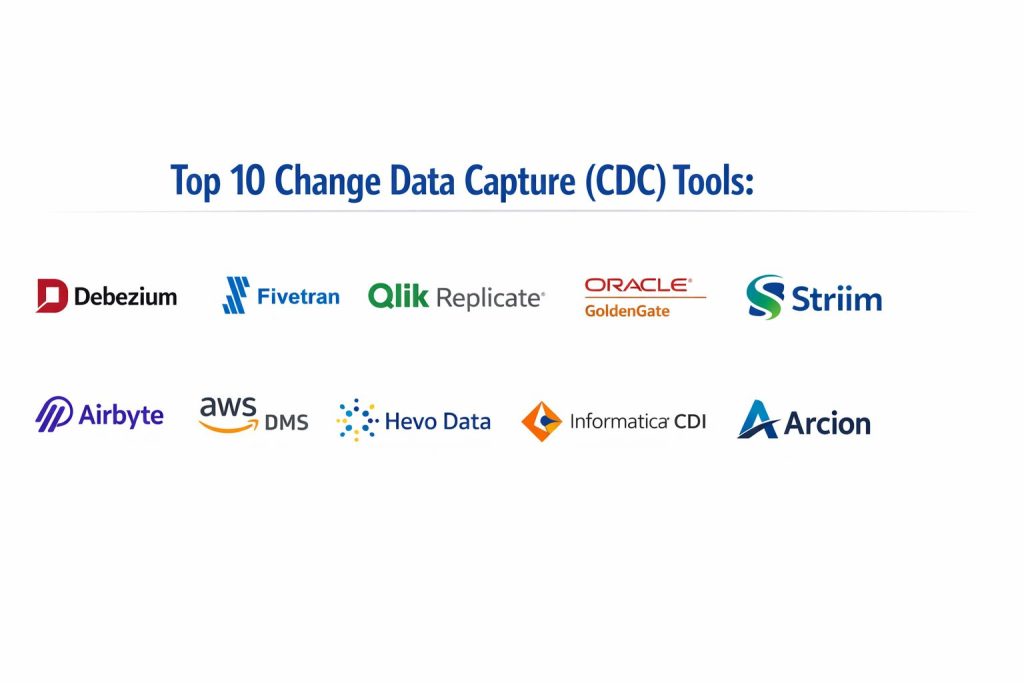
1. Debezium
Debezium is the leading open-source distributed platform for change data capture, built on top of Apache Kafka. It provides a set of Kafka Connect compatible connectors that monitor various database management systems in real-time. By converting database changes into a standardized event stream, it allows applications to respond to every row-level change immediately. It is highly favored by DevOps and data engineering teams who already utilize Kafka as their central data backbone.
The platform excels at capturing changes from PostgreSQL, MySQL, MongoDB, and SQL Server. Its architecture is designed to be fault-tolerant and scalable, handling massive volumes of events by leveraging the underlying power of Kafka. Debezium captures the “before” and “after” states of changed rows, providing a complete history of modifications for downstream consumers.
Pros:
As an open-source project, it has no licensing fees and a massive, active community contributing new connectors and bug fixes. It offers the highest level of flexibility for building custom, event-driven architectures.
Cons:
The operational complexity is significant, as it requires managing a full Apache Kafka and Kafka Connect infrastructure. There is no built-in graphical user interface, making it a “code-first” tool that demands specialized engineering expertise.
Platforms / Deployment:
Linux / Docker / Kubernetes
Self-hosted / Private Cloud
Security & Compliance:
SASL/SSL for Kafka, RBAC
Community-driven security patches
Integrations & Ecosystem:
Deeply integrated with the Apache Kafka ecosystem and works seamlessly with Confluent Platform. It supports standard formats like JSON and Avro for event serialization.
Support & Community:
Extensive community support through mailing lists, Slack channels, and a comprehensive documentation portal.
2. Fivetran (HVR)
Fivetran, particularly following its acquisition of HVR, offers an enterprise-grade, log-based CDC solution designed for high-volume data environments. It provides a fully managed SaaS experience that automates the entire ELT pipeline, from initial historical snapshots to continuous incremental updates. It is widely used by organizations that prioritize ease of use and automated maintenance over manual configuration.
The HVR technology within Fivetran allows for extremely efficient data capture from high-transaction databases like Oracle and SAP. It includes features for data validation and comparison to ensure that the target system remains perfectly in sync with the source. The platform also handles schema migrations automatically, ensuring that table changes in the source do not break analytical pipelines.
Pros:
The platform is almost entirely maintenance-free, with Fivetran handling all updates, scaling, and connector management. It offers sub-minute latency and high reliability for critical business data.
Cons:
The consumption-based pricing model can become very expensive as data volumes scale. Users have limited control over the underlying infrastructure, which may be a drawback for teams requiring highly custom networking configurations.
Platforms / Deployment:
Cloud-native (SaaS)
Managed Service
Security & Compliance:
SOC 2, ISO 27001, HIPAA, PCI DSS
End-to-end encryption (AES-256)
Integrations & Ecosystem:
Offers hundreds of native connectors for cloud warehouses like Snowflake, BigQuery, and Redshift. It integrates natively with dbt for post-load transformations.
Support & Community:
Provides 24/7 enterprise support with dedicated account managers for higher-tier plans.
3. Qlik Replicate
Qlik Replicate (formerly Attunity) is a high-performance data replication and CDC tool that focuses on speed and simplicity. It features a “click-to-replicate” interface that allows administrators to set up data pipelines without writing code. It is a preferred choice for large enterprises moving data from legacy on-premises systems to modern cloud platforms.
The software uses an agentless technology that captures changes from the transaction logs of major databases with minimal impact on performance. It is particularly strong in heterogeneous environments, where it can move data between different types of databases and data warehouses while automatically handling data type conversions.
Pros:
It is known for its extreme performance, capable of processing millions of changes per minute. The visual interface is highly intuitive, allowing non-developers to manage complex replication tasks.
Cons:
The licensing costs are among the highest in the industry, making it less suitable for small or mid-market companies. Troubleshooting can sometimes be difficult due to the “black-box” nature of the proprietary engine.
Platforms / Deployment:
Windows / Linux
On-premises / Cloud / Hybrid
Security & Compliance:
LDAP/AD Integration, TLS
SOC 2 compliant
Integrations & Ecosystem:
Strong integration with the broader Qlik data integration suite and supports a vast array of targets, including Hadoop, Kafka, and all major cloud warehouses.
Support & Community:
Offers professional global support and a well-structured training program through Qlik Academy.
4. Oracle GoldenGate
Oracle GoldenGate is the gold standard for real-time data integration and replication within the Oracle ecosystem and beyond. It is a comprehensive software package that enables high-availability replication, disaster recovery, and operational intelligence. It is designed for the most demanding mission-critical environments where data loss is not an option.
The tool supports a wide variety of topologies, including active-active and bi-directional replication. It provides powerful data filtering and transformation capabilities while data is in transit. Its “Microservices Architecture” allows for a modular deployment that can be easily managed and monitored through a web-based dashboard or REST APIs.
Pros:
Unmatched reliability and performance for Oracle databases, including support for Exadata. It provides advanced features for conflict detection and resolution in multi-master setups.
Cons:
The learning curve is very steep, often requiring certified specialists to manage. The pricing model is complex and typically very expensive for non-Oracle environments.
Platforms / Deployment:
On-premises / OCI (Oracle Cloud Infrastructure)
All major OS platforms
Security & Compliance:
FIPS 140-2, Advanced Security Options
ISO 27001, SOC 1/2/3
Integrations & Ecosystem:
Native integration with Oracle Cloud and deep support for Big Data targets like HDFS and HBase. It also offers connectors for non-Oracle databases like SQL Server and MySQL.
Support & Community:
World-class enterprise support from Oracle, though it comes at a premium cost.
5. Striim
Striim is a unified real-time data streaming and integration platform that combines CDC with in-flight stream processing. It allows users to not only move data but also to filter, aggregate, and mask it as it flows through the pipeline. This makes it an excellent choice for organizations that need to enrich their data before it reaches its destination.
The platform features a drag-and-drop UI and a SQL-like language for defining stream transformations. It is designed for sub-second latency and can ingest data from a wide range of sources, including databases, log files, and IoT sensors. Striim also provides real-time monitoring and alerting to help teams maintain the health of their data flows.
Pros:
It provides a single platform for both data movement and real-time processing, reducing the need for additional tools. The built-in data masking and encryption features are excellent for maintaining compliance.
Cons:
As a comprehensive platform, it may be overkill for simple point-to-point replication tasks. The cost can be significant for organizations only utilizing its basic CDC features.
Platforms / Deployment:
Linux / Cloud-native
PaaS / Managed Service
Security & Compliance:
SSO/SAML, Data Masking
GDPR, HIPAA compliant
Integrations & Ecosystem:
Broad support for cloud targets and messaging systems like Kafka and Azure Event Hubs. It has specialized connectors for SAP and mainframes.
Support & Community:
Provides professional technical support and a library of online training resources.
6. Airbyte
Airbyte is a modern, open-source data integration platform that has gained rapid popularity due to its extensive connector library and modular architecture. It supports log-based CDC for major databases like PostgreSQL, MySQL, and SQL Server using Debezium under the hood. It aims to make data integration more accessible and customizable through its “Connector Development Kit.”
The software offers a user-friendly UI for managing pipelines and provides detailed logs for troubleshooting. It can be deployed as a self-hosted open-source version or as a fully managed cloud service. Airbyte’s focus on community-driven connectors ensures that it can quickly adapt to new and niche data sources.
Pros:
The open-source version is free to use and highly customizable. It features a very large and rapidly growing number of connectors compared to many proprietary competitors.
Cons:
The quality of community-contributed connectors can vary. Some advanced features, like detailed performance monitoring, may require the paid cloud version or significant manual setup in the self-hosted version.
Platforms / Deployment:
Docker / Kubernetes
SaaS / Self-hosted
Security & Compliance:
MFA, RBAC (Cloud version)
SOC 2 Type II
Integrations & Ecosystem:
Integrates well with modern data stack tools like dbt and Dagster. It supports a wide range of destinations, from warehouses to vector databases for AI.
Support & Community:
A very active Slack community and comprehensive documentation; the cloud version includes dedicated support.
7. AWS Database Migration Service (AWS DMS)
AWS DMS is a managed service that makes it easy to migrate databases to AWS quickly and securely. While its name implies a one-time move, it is frequently used for ongoing replication with CDC. It supports both homogeneous and heterogeneous migrations, such as Oracle to Amazon Aurora.
The service is serverless in its latest iterations, automatically scaling the required resources based on the data volume. It provides an assessment tool to identify potential compatibility issues before the migration begins. Once started, it handles the complex tasks of data movement and continuous synchronization with minimal manual intervention.
Pros:
It is highly cost-effective, especially for one-time migrations or ongoing replication within the AWS ecosystem. The integration with other AWS services is seamless and requires no additional infrastructure management.
Cons:
It is primarily focused on moving data into AWS, making it less ideal for multi-cloud or egress-heavy strategies. Its transformation capabilities are limited compared to dedicated ETL/CDC platforms.
Platforms / Deployment:
AWS Cloud
Serverless / Managed Instance
Security & Compliance:
KMS Encryption, IAM Roles
PCI DSS, ISO, SOC, HIPAA
Integrations & Ecosystem:
Natively integrated with RDS, Redshift, S3, and Kinesis. It works closely with the AWS Schema Conversion Tool (SCT) for complex migrations.
Support & Community:
Standard AWS support tiers apply, with extensive documentation and a global partner network.
8. Hevo Data
Hevo Data is a no-code data pipeline platform designed for simplicity and speed. It provides a managed CDC solution that allows users to set up real-time data flows in minutes. It is particularly popular among mid-market companies and data-driven startups that need a reliable but affordable way to sync their databases.
The platform handles schema mapping and evolution automatically, ensuring that changes at the source do not disrupt the data warehouse. It also includes a “Workbench” feature that allows users to run Python-based transformations on the data as it is being ingested.
Pros:
Extremely easy to set up and requires zero maintenance. The pricing is transparent and more accessible for smaller teams than enterprise-heavy alternatives.
Cons:
It has a smaller library of connectors compared to Fivetran or Airbyte. Some users have noted that its latency can be slightly higher than dedicated, low-level CDC tools under very high loads.
Platforms / Deployment:
Cloud-native (SaaS)
Managed Service
Security & Compliance:
SOC 2 Type II, GDPR
Encryption at rest and in transit
Integrations & Ecosystem:
Supports all major cloud data warehouses and several popular SaaS sources. It integrates well with BI tools like Tableau and Looker.
Support & Community:
Offers 24/7 live chat support and a dedicated help center.
9. Informatica Cloud Data Integration
Informatica is a long-standing leader in the data management space, and its Cloud Data Integration (CDI) service brings its enterprise power to the cloud. It offers a robust CDC capability that is part of a larger, unified platform for data quality, governance, and master data management.
The tool uses an “intelligent” engine that can automatically optimize data flows and handle complex transformations at scale. It is designed for hybrid environments, allowing for secure data movement between on-premises databases and various cloud providers.
Pros:
It provides the most comprehensive suite of data management features in a single platform. The “Secure Agent” architecture allows for high security and performance in hybrid cloud deployments.
Cons:
The software is complex and has a steep learning curve. The pricing is enterprise-focused and can be difficult to predict due to its consumption-based “Informatica Processing Units” (IPU) model.
Platforms / Deployment:
Windows / Linux
SaaS / Hybrid
Security & Compliance:
SSO/SAML, MFA, RBAC
HITRUST, SOC 1/2, ISO 27001
Integrations & Ecosystem:
Deeply integrated with all major cloud providers (AWS, Azure, GCP) and has a massive library of enterprise-grade connectors.
Support & Community:
Offers tiered professional support and a vast global network of certified implementation partners.
10. Arcion (by Databricks)
Arcion, now part of Databricks, is a high-performance, distributed CDC platform designed for massive scale. It is built to move data with zero impact on the source systems while maintaining transactional integrity. It is particularly optimized for loading data into modern lakehouse architectures.
The software is agentless and uses a parallelized architecture to achieve high throughput and low latency. It supports a wide range of enterprise sources and provides a no-code interface for managing complex data movement tasks across hybrid environments.
Pros:
Exceptional performance for large-scale data volumes and complex schema environments. The native integration with Databricks makes it the premier choice for lakehouse users.
Cons:
As a high-end enterprise tool, it may be prohibitively expensive for smaller projects. Since the acquisition, its primary focus is increasingly centered on the Databricks ecosystem.
Platforms / Deployment:
Cloud-native / Linux
Managed / Self-hosted
Security & Compliance:
End-to-end encryption, SSO
SOC 2 compliant
Integrations & Ecosystem:
Unmatched integration with Databricks and strong support for major relational databases and cloud warehouses.
Support & Community:
Professional support through the Databricks ecosystem and a growing technical community.
COMPARISON TABLE
| Tool Name | Best For | Platform(s) Supported | Deployment | Standout Feature | Public Rating |
| 1. Debezium | Open-Source / Kafka | Linux, Docker | Self-hosted | Log-based Open Source | 4.8/5 |
| 2. Fivetran (HVR) | Managed Automation | Cloud-native | SaaS | Zero-Maintenance ELT | 4.7/5 |
| 3. Qlik Replicate | Enterprise Speed | Windows, Linux | Hybrid | Click-to-Replicate UI | 4.5/5 |
| 4. Oracle GoldenGate | Oracle Ecosystem | Multi-platform | On-prem/Cloud | Active-Active Sync | 4.6/5 |
| 5. Striim | Stream Processing | Linux, Cloud | Managed | In-flight SQL Processing | 4.4/5 |
| 6. Airbyte | Modular Customization | Docker, K8s | SaaS/Self-host | 600+ Connectors | 4.6/5 |
| 7. AWS DMS | AWS Migrations | AWS | Managed | Serverless Scaling | 4.3/5 |
| 8. Hevo Data | SMB Simplicity | Cloud-native | SaaS | Auto-Schema Mapping | 4.5/5 |
| 9. Informatica CDI | Data Governance | Windows, Linux | SaaS/Hybrid | Secure Agent Arch | 4.4/5 |
| 10. Arcion | Lakehouse Scaling | Linux, Cloud | Managed | Parallel CDC Engine | 4.7/5 |
EVALUATION & SCORING OF CDC TOOLS
The scoring below is a comparative model intended to help shortlisting. Each criterion is scored from 1–10, then a weighted total from 0–10 is calculated using the weights listed. These are analyst estimates based on typical fit and common workflow requirements, not public ratings.
Weights:
- Core features – 25%
- Ease of use – 15%
- Integrations & ecosystem – 15%
- Security & compliance – 10%
- Performance & reliability – 10%
- Support & community – 10%
- Price / value – 15%
| Tool Name | Core (25%) | Ease (15%) | Integrations (15%) | Security (10%) | Performance (10%) | Support (10%) | Value (15%) | Weighted Total |
| 1. Debezium | 10 | 3 | 9 | 7 | 10 | 6 | 10 | 8.05 |
| 2. Fivetran | 9 | 10 | 10 | 9 | 8 | 9 | 6 | 8.65 |
| 3. Qlik Replicate | 9 | 8 | 8 | 8 | 10 | 8 | 5 | 8.10 |
| 4. Oracle GoldenGate | 10 | 4 | 9 | 10 | 10 | 9 | 4 | 7.95 |
| 5. Striim | 9 | 7 | 8 | 9 | 9 | 8 | 7 | 8.20 |
| 6. Airbyte | 8 | 8 | 10 | 8 | 8 | 8 | 9 | 8.35 |
| 7. AWS DMS | 7 | 8 | 7 | 9 | 8 | 8 | 9 | 7.80 |
| 8. Hevo Data | 7 | 9 | 8 | 8 | 7 | 8 | 9 | 7.85 |
| 9. Informatica CDI | 9 | 5 | 10 | 10 | 8 | 9 | 5 | 7.95 |
| 10. Arcion | 10 | 6 | 9 | 9 | 10 | 9 | 6 | 8.45 |
How to interpret the scores:
- Use the weighted total to shortlist candidates, then validate with a pilot.
- A lower score can mean specialization, not weakness.
- Security and compliance scores reflect controllability and governance fit, because certifications are often not publicly stated.
- Actual outcomes vary with assembly size, team skills, templates, and process maturity.
WHICH CHANGE DATA CAPTURE (CDC) TOOL IS RIGHT FOR YOU?
Solo / Freelancer
For individual developers or those working on side projects, Airbyte (Open Source) or Debezium are the best choices. They provide professional-grade power without the barrier of high licensing fees, though they require more manual configuration.
SMB
Small to medium-sized businesses should prioritize Hevo Data or Airbyte Cloud. These platforms offer a balance of low maintenance and transparent pricing that scales reasonably with their data growth.
Mid-Market
Organizations with established data teams but limited time for infrastructure management will find Fivetran or Striim highly effective. These tools allow teams to focus on data analysis rather than pipeline maintenance.
Enterprise
For massive organizations with complex security and governance requirements, Qlik Replicate, Oracle GoldenGate, or Informatica are the standard choices. They provide the necessary support SLAs and administrative controls for high-stakes environments.
Budget vs Premium
Debezium and Airbyte (OSS) are the leaders in the budget category. At the premium end, Oracle GoldenGate and Qlik Replicate offer specialized performance and reliability that justify their higher price points for mission-critical use cases.
Feature Depth vs Ease of Use
Houdini and Oracle GoldenGate represent the peak of technical depth but are notoriously difficult to master. Fivetran and Hevo Data sit at the opposite end, offering extreme ease of use through automated, no-code interfaces.
Integrations & Scalability
Arcion and Airbyte lead in terms of the breadth and scale of their integration ecosystems, with Arcion particularly optimized for modern data lakehouses like Databricks.
Security & Compliance Needs
Informatica and Oracle GoldenGate offer the most robust security frameworks, including specialized features for data masking and governance that meet the strictest global regulatory standards.
FREQUENTLY ASKED QUESTIONS (FAQS)
What is the difference between CDC and standard ETL?
Standard ETL typically involves periodic, bulk data transfers, whereas CDC captures changes incrementally and in near real-time, significantly reducing the impact on source systems.
Is log-based CDC better than trigger-based CDC?
Yes, log-based CDC is generally preferred because it reads transaction logs directly, avoiding the performance overhead and database modifications required by triggers.
Can CDC tools handle NoSQL databases?
Yes, tools like Debezium and Arcion have specialized connectors for NoSQL sources like MongoDB, capturing changes from the oplog or similar internal change streams.
Does CDC guarantee data consistency?
High-quality CDC tools maintain transactional integrity by capturing changes in the exact order they were committed at the source, ensuring the target remains a faithful reflection of the source.
How does CDC affect production database performance?
Log-based CDC has a very minimal impact because it does not query the tables directly. However, misconfigured tools or high-volume polling can still put some pressure on CPU and I/O.
Can CDC be used for cloud migration?
Absolutely. CDC is often used for “zero-downtime” migrations, where the new database is kept in sync with the old one until the final cutover is performed.
What happens if the CDC pipeline breaks?
Professional CDC tools use “checkpoints” or “offsets” to keep track of where they left off, allowing them to resume from the exact point of failure without losing or duplicating data.
Are there free CDC tools available?
Debezium and the open-source version of Airbyte are free to use, though they still incur costs related to the infrastructure needed to run them.
How long is the typical latency for a CDC pipeline?
Most modern CDC tools achieve sub-second or low-second latency, though network conditions and target database performance can affect the total end-to-end time.
Do I need Kafka to use CDC?
While Debezium relies on Kafka, many other tools like Fivetran, Qlik, and Hevo use their own proprietary streaming engines and do not require a Kafka installation.
CONCLUSION
Implementing a Change Data Capture (CDC) solution is a fundamental step toward achieving a truly real-time, data-driven organization. The choice of tool depends heavily on your existing infrastructure, your team’s technical expertise, and the volume of data you need to process. While open-source solutions like Debezium offer the ultimate in flexibility and cost-efficiency for engineering-heavy teams, managed services like Fivetran and Hevo Data provide a path to rapid value with minimal operational overhead. For enterprises dealing with high-volume, mission-critical legacy data, the performance and reliability of Qlik Replicate or Oracle GoldenGate remain the benchmark. By selecting the tool that aligns with your specific architectural needs and security requirements, you can ensure a scalable and robust data pipeline that powers your business’s most critical analytical and operational initiatives.