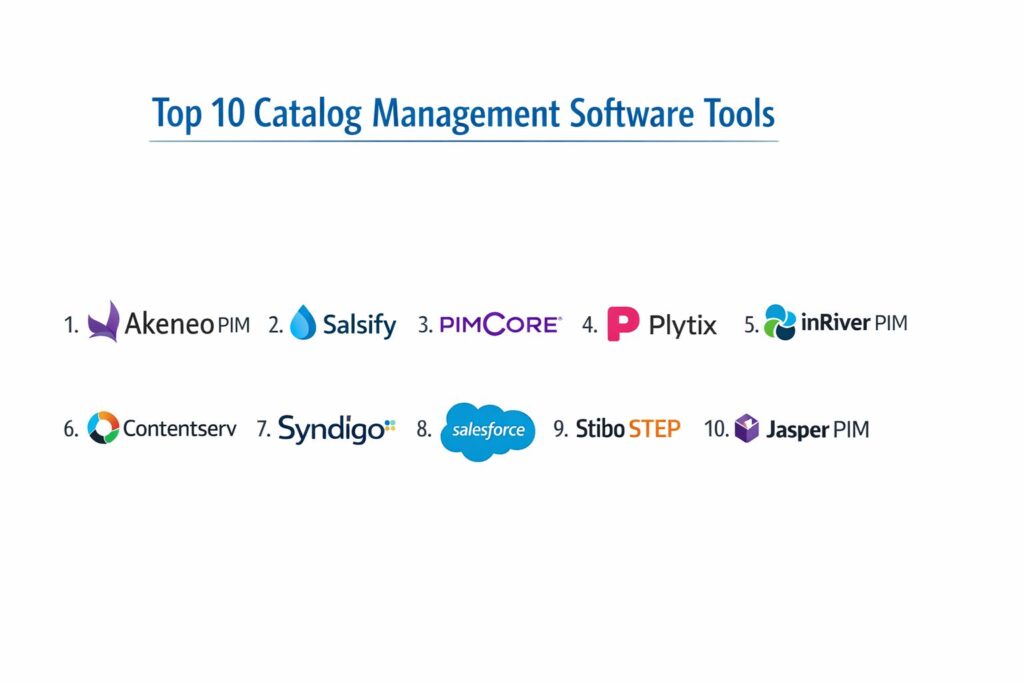
Introduction
Catalog management software is a foundational technology for modern commerce, providing a centralized repository to organize, standardize, and distribute product data across multiple sales channels. In an era where consumer expectations for accurate, rich product information are at an all-time high, these platforms act as the “single source of truth” for an organization’s entire inventory. By consolidating technical specifications, high-resolution media, and marketing descriptions into a unified environment, businesses can ensure that every digital shelf—from a proprietary webstore to global marketplaces—displays consistent and compelling product stories. This technology is critical for operational agility, as it eliminates the data silos and manual errors inherent in traditional spreadsheet-based management.
The strategic value of a robust catalog management system lies in its ability to accelerate time-to-market while enhancing the customer experience. Modern platforms facilitate complex product relationships, such as bundles, variants, and cross-sell suggestions, allowing for more sophisticated merchandising strategies. Furthermore, these systems are designed to handle the heavy lifting of data localization for international expansion and compliance with regional regulatory standards. For organizations scaling their operations, this software is not merely a database; it is a performance engine that transforms raw product data into a strategic asset, driving higher conversion rates and reducing the frequency of costly product returns.
Best for: E-commerce retailers, wholesalers, manufacturers, and distributors who manage extensive product assortments across multiple digital and physical touchpoints.
Not ideal for: Small service-based businesses with no physical inventory, organizations with static catalogs that rarely change, or businesses looking for a simple inventory tracker without enrichment or syndication needs.
Key Trends in Catalog Management Systems
Artificial Intelligence (AI) is currently reshaping the landscape, with systems now offering automated attribute extraction and AI-generated product descriptions. This allows teams to onboard thousands of new products in a fraction of the time previously required, as the software can “read” an image or technical sheet and populate the catalog automatically. Real-time data syndication is another dominant trend, ensuring that a price change or image update made in the central hub is reflected across every global marketplace within seconds. This “live” connection is essential for maintaining brand integrity in the fast-moving digital economy.
There is also a significant shift toward “Product Experience Management” (PXM), which moves beyond basic data storage to focus on how information is perceived by the end user. This involves using analytics to track how specific product descriptions or images perform on different channels and adjusting them to maximize engagement. Mobile-optimized management interfaces are becoming standard, allowing catalog managers to approve updates or check data completeness from anywhere. Finally, the rise of the “Composable Commerce” architecture means catalog tools are becoming more modular, allowing businesses to plug them into diverse ecosystems of specialized commerce and marketing technologies.
How We Selected These Tools
Our selection process was based on a comprehensive evaluation of technical maturity and market presence within the product information and catalog management space. We prioritized platforms that offer a balance of “Product Information Management” (PIM) and “Digital Asset Management” (DAM) capabilities, as the two are now inseparable for high-quality cataloging. A key criterion was the strength of the “Syndication Engine,” which measures how effectively the software can format and push data to major retailers like Amazon, Walmart, and Google Shopping.
Scalability and security were also non-negotiable factors in our assessment. We selected tools that have demonstrated the ability to handle millions of SKUs without performance degradation and those that adhere to enterprise security standards like ISO 27001 and GDPR. We also analyzed the “Onboarding Velocity”—how quickly a new user can learn the system and start enriching data—to ensure the list includes options for various organizational sizes. Finally, we looked for platforms with a strong track record of customer support and a vibrant partner ecosystem, which are essential for long-term implementation success.
1. Akeneo PIM
Akeneo is a premier enterprise-grade platform that pioneered the concept of Product Experience Management. It is designed to help marketing teams centralize and enrich product information, ensuring that every piece of data is optimized for the specific channel where it will be displayed. Its intuitive interface makes it a favorite for large retail teams.
Key Features
The platform features an “Activation” module that syndicates product data to over 500 different retailers and marketplaces. It includes a robust data quality assistant that scores the completeness of product descriptions and identifies missing images or attributes. The software supports advanced multi-language and multi-currency management for global operations. Users can create “Digital Showrooms” to share specific catalog subsets with wholesalers. It also features a powerful workflow engine for managing the internal approval process of new product launches.
Pros
The user interface is exceptionally clean and designed specifically for marketing users rather than IT staff. Its open-source heritage means it has a massive community and many third-party connectors.
Cons
The enterprise edition comes with a significant price tag, and the setup for complex product hierarchies can be time-consuming.
Platforms and Deployment
Cloud-based SaaS and on-premise options are available for specialized enterprise needs.
Security and Compliance
Features SOC 2 Type II compliance and robust role-based access controls to protect sensitive product data.
Integrations and Ecosystem
Offers a deep marketplace of connectors for Salesforce, Magento, Shopify, and various ERP systems.
Support and Community
Provides the “Akeneo Academy” for training and a global network of certified implementation partners.
2. Salsify
Salsify is a high-performance commerce experience platform that combines PIM, DAM, and digital shelf analytics. It is built for brand manufacturers who need to dominate the “digital shelf” by delivering high-fidelity product content to retail partners at scale.
Key Features
The software features “Digital Shelf Analytics” which provides real-time feedback on how products are performing on retailer sites. It includes an automated “GDSN” data pool integration for compliant data exchange in the grocery and healthcare sectors. The platform offers sophisticated workflow automation for collaborative content creation. Its “Enhanced Content” feature allows for the creation of rich A+ content for Amazon. It also provides a centralized DAM to manage all high-resolution product photography and videos.
Pros
The syndication capabilities are among the most advanced in the industry, with native links to almost every major retailer globally. It focuses heavily on driving actual sales performance rather than just data storage.
Cons
The pricing model is enterprise-focused and can be complex. Some users find the interface less intuitive than purely marketing-focused tools.
Platforms and Deployment
Cloud-native SaaS platform accessible via any modern web browser.
Security and Compliance
Adheres to rigorous enterprise security protocols and is fully GDPR compliant.
Integrations and Ecosystem
Maintains deep strategic partnerships with major e-commerce platforms and cloud service providers.
Support and Community
Offers dedicated account management and a comprehensive online resource center for best practices.
3. Pimcore
Pimcore is a unique open-source platform that integrates PIM, Master Data Management (MDM), and Content Management (CMS) into a single environment. It is the ultimate choice for organizations that require 100% control over their data architecture and extreme customization.
Key Features
The platform features a highly flexible data modeling engine that can handle any product relationship or attribute type. It includes a built-in DAM for managing all digital assets alongside product data. The “Headless CMS” capabilities allow for the delivery of product content to any device or application. It offers a powerful “Web2Print” module for generating physical catalogs directly from the database. The software also features automated data quality management with custom validation rules.
Pros
The software is free to use at its core level, providing unparalleled value for organizations with development resources. It can consolidate multiple disparate systems into one unified platform.
Cons
It requires significant technical expertise to install, configure, and maintain. The vast feature set can be overwhelming for small, non-technical teams.
Platforms and Deployment
Typically self-hosted or managed through specialized cloud providers on Linux servers.
Security and Compliance
Security is highly configurable, allowing for compliance with HIPAA, GDPR, and other strict data regulations.
Integrations and Ecosystem
Boasts a massive ecosystem of plugins and a robust API for custom enterprise integrations.
Support and Community
Backed by a global community of developers and a professional support division for enterprise clients.
4. Plytix
Plytix positions itself as the “PIM for everyone,” specifically targeting small to medium-sized businesses that need enterprise-power without the associated complexity or cost. It combines catalog management with powerful e-catalog generation tools.
Key Features
The system includes an intuitive bulk editor that allows users to update thousands of SKUs simultaneously. It features “Brand Portals” where external partners can download up-to-date product information and assets. The platform offers a unique “Product Feed” tool for simple syndication to social media and search engines. It includes built-in analytics to track which products are being viewed most in the brand portals. Users can also create professional PDF catalogs with a simple drag-and-drop interface.
Pros
It is one of the most user-friendly platforms on the market, with an onboarding process that is measured in days rather than months. The pricing is transparent and accessible for growing brands.
Cons
It may lack some of the advanced AI and deep Master Data Management features required by very large global conglomerates.
Platforms and Deployment
Web-based SaaS platform with a mobile-responsive interface.
Security and Compliance
Maintains high data security standards with encrypted storage and regular security audits.
Integrations and Ecosystem
Offers native, easy-to-set-up integrations with Shopify, BigCommerce, and various marketing tools.
Support and Community
Known for having an exceptionally responsive support team and a detailed help center.
5. inRiver PIM
inRiver is an enterprise-level catalog management solution that focuses on the “product journey,” helping brands build better stories across the entire product lifecycle. It is highly scalable and built to support complex B2B and B2C environments.
Key Features
The software features a “Model Builder” that allows for the creation of complex product structures and relationships. It includes an integrated “Print” module for high-quality publication management. The “Contribute” portal allows suppliers to upload their own data directly into the PIM for review. It offers advanced localization tools to manage regional variations of product descriptions. The system also features a “Marketing Insights” tool that helps teams understand which content drives the best engagement.
Pros
The platform is exceptionally good at handling complex product variations and bundles. Its multi-tenant SaaS architecture ensures that users always have access to the latest features.
Cons
The implementation phase can be complex and usually requires a certified partner. The interface has a professional feel that might require training for new users.
Platforms and Deployment
Cloud-native SaaS deployment.
Security and Compliance
Enterprise-grade security including SOC 2 and GDPR compliance with granular user permissions.
Integrations and Ecosystem
Part of a broad ecosystem with hundreds of connectors for e-commerce, ERP, and print platforms.
Support and Community
Provides the “inRiver Academy” and a dedicated customer success program.
6. Contentserv
Contentserv is an “all-in-one” Product Experience Cloud that merges PIM with DAM and marketing automation. It is designed for enterprises that want to create highly personalized product stories that adapt to different customer segments.
Key Features
The platform features an AI-powered “Contextualization” engine that automatically adapts product content based on the target audience. It includes a comprehensive DAM with advanced image editing and video management tools. The software offers a “Supplier Onboarding” portal to streamline data collection from external vendors. It features a “Business Rules” engine that automates data enrichment and validation. It also includes integrated campaign management to link product data directly to marketing activities.
Pros
The “all-in-one” nature reduces the need for multiple software subscriptions. It provides deep functionality for managing both the technical and emotional aspects of a product.
Cons
The sheer breadth of features can make the initial configuration feel overwhelming for smaller organizations. It is a premium-priced solution.
Platforms and Deployment
Web-based SaaS with high-availability infrastructure.
Security and Compliance
Adheres to ISO 27001 standards and provides full audit trails for data governance.
Integrations and Ecosystem
Offers a wide range of connectors for global e-commerce platforms and marketing technology stacks.
Support and Community
Provides professional implementation services and a global partner network.
7. Syndigo (Riversand)
Syndigo, which recently integrated the Riversand platform, is a leader in Master Data Management and global syndication. It is built for large enterprises that need to manage massive datasets across multiple domains like products, customers, and suppliers.
Key Features
The platform features a multi-domain MDM architecture that goes beyond simple product cataloging. It includes “Real-Time Content Validation” to ensure data meets the specific requirements of every global retailer. The system offers advanced AI for automated data cleansing and deduplication. It features a massive syndication network with thousands of pre-built connections to global endpoints. It also provides detailed “Health Reports” for your entire digital catalog.
Pros
It is one of the most powerful and scalable data management tools in the world. The combination of PIM and deep MDM makes it ideal for complex manufacturing environments.
Cons
The software has a very high technical overhead and is generally too complex for small retailers. The interface is professional and data-dense.
Platforms and Deployment
Cloud-native SaaS.
Security and Compliance
Offers the highest levels of enterprise security and is a certified GDSN data pool provider.
Integrations and Ecosystem
Maintains one of the largest syndication ecosystems in the industry.
Support and Community
Offers enterprise-level support tiers and dedicated account management for global clients.
8. Salesforce Commerce Cloud
Salesforce Commerce Cloud includes a robust built-in catalog management system that is part of its wider enterprise commerce engine. It is ideal for organizations already within the Salesforce ecosystem who want to manage their catalog alongside their customer data.
Key Features
The platform features “Einstein AI” which provides automated product sorting and personalized recommendations. It includes a “Multi-Site” management tool that allows for different catalogs across multiple regions from one instance. The system offers “Predictive Sort” to optimize the order of products in the catalog based on shopper behavior. It features automated merchandising tools to schedule promotions and seasonal updates. It also provides a seamless link between the catalog and the customer service cloud.
Pros
The integration with the world’s leading CRM is unmatched, providing a true 360-degree view of products and customers. It is built to handle extreme traffic spikes and massive scales.
Cons
It is highly expensive and often requires a team of certified Salesforce experts to manage. It is less of a “pure” PIM and more of a total commerce solution.
Platforms and Deployment
Cloud-native SaaS with automatic updates.
Security and Compliance
Industry-leading security including PCI-DSS for payments and full data privacy compliance.
Integrations and Ecosystem
Access to the massive Salesforce AppExchange for any conceivable third-party connection.
Support and Community
Backed by the massive Salesforce global community and “Trailhead” learning platform.
9. Stibo Systems STEP
Stibo Systems STEP is a highly sophisticated Master Data Management platform that treats product catalogs as part of a larger enterprise data strategy. It is favored by global retailers and manufacturers who need absolute data transparency and integrity.
Key Features
The software features a unique “Multi-Domain” approach that links product data with supplier and location data. It includes advanced “Data Governance” tools to enforce strict quality standards across the organization. The system offers a highly configurable workflow engine for complex business processes. It features a “Universal Business Language” support for international data exchange. The platform also provides deep integration for print and digital publishing.
Pros
It provides the most robust “single version of the truth” for complex global organizations. The ability to link different data domains provides insights that smaller tools cannot match.
Cons
The platform is exceptionally technical and has a very steep learning curve. It is a significant long-term investment that requires a dedicated management team.
Platforms and Deployment
Available as a managed cloud service or local installation.
Security and Compliance
Provides comprehensive audit trails and meets the most stringent global security certifications.
Integrations and Ecosystem
Designed to sit at the center of an enterprise architecture, connecting to all ERP and CRM systems.
Support and Community
Offers professional services and a dedicated global user group community.
10. Jasper PIM
Jasper PIM is a SaaS-based solution designed specifically for scaling merchants who use platforms like Shopify and BigCommerce. it offers a streamlined way to manage complex product variations across multiple storefronts.
Key Features
The platform features bi-directional data syncing, ensuring that updates in the PIM and the storefront are always aligned. It includes “Attribute Management” for handling complex product types like apparel or electronics. The software offers “Multi-Storefront” support, allowing one PIM to feed multiple different websites. It features a simple scheduling tool for price changes and seasonal catalog launches. It also provides bulk data import tools to simplify the migration from spreadsheets.
Pros
It is one of the fastest PIMs to set up, specifically optimized for modern e-commerce platforms. The pricing is very competitive for mid-market businesses.
Cons
It lacks the deep Master Data Management and offline print capabilities of larger enterprise suites. The dashboard is functional but lacks advanced customization.
Platforms and Deployment
Cloud-based SaaS.
Security and Compliance
Standard data encryption and secure login protocols to protect product information.
Integrations and Ecosystem
Exceptional native integrations with Shopify, BigCommerce, Magento, and NetSuite.
Support and Community
Offers a dedicated customer success team and a library of video tutorials.
Comparison Table
| Tool Name | Best For | Platform(s) Supported | Deployment | Standout Feature | Public Rating |
| 1. Akeneo PIM | Marketing Teams | Web-Based | Cloud SaaS | Activation Engine | 4.7/5 |
| 2. Salsify | Brand Performance | Web-Based | Cloud SaaS | Digital Shelf Analytics | 4.6/5 |
| 3. Pimcore | Total Customization | Linux / PHP | On-Prem/Cloud | Multi-Domain Open Source | 4.8/5 |
| 4. Plytix | SMB / Rapid Growth | Web-Based | Cloud SaaS | Brand Portals | 4.8/5 |
| 5. inRiver PIM | B2B & B2C Stories | Web-Based | Cloud SaaS | Model Builder | 4.5/5 |
| 6. Contentserv | All-in-One Experience | Web-Based | Cloud SaaS | AI Contextualization | 4.4/5 |
| 7. Syndigo | Global Syndication | Web-Based | Cloud SaaS | MDM Scalability | 4.3/5 |
| 8. Salesforce | Salesforce Ecosystem | Web-Based | Cloud SaaS | Einstein AI Integration | 4.2/5 |
| 9. Stibo STEP | Enterprise MDM | Web, On-Prem | Hybrid | Multi-Domain Linking | 4.1/5 |
| 10. Jasper PIM | Shopify / Scaling | Web-Based | Cloud SaaS | Bi-Directional Syncing | 4.6/5 |
Evaluation & Scoring of Catalog Management Software
The scoring below is a comparative model intended to help shortlisting. Each criterion is scored from 1–10, then a weighted total from 0–10 is calculated using the weights listed. These are analyst estimates based on typical fit and common workflow requirements, not public ratings.
Weights:
- Core features – 25%
- Ease of use – 15%
- Integrations & ecosystem – 15%
- Security & compliance – 10%
- Performance & reliability – 10%
- Support & community – 10%
- Price / value – 15%
| Tool Name | Core (25%) | Ease (15%) | Integrations (15%) | Security (10%) | Performance (10%) | Support (10%) | Value (15%) | Weighted Total |
| 1. Akeneo PIM | 9 | 9 | 9 | 9 | 8 | 8 | 7 | 8.55 |
| 2. Salsify | 9 | 7 | 10 | 9 | 9 | 8 | 6 | 8.30 |
| 3. Pimcore | 10 | 3 | 10 | 8 | 9 | 6 | 10 | 8.15 |
| 4. Plytix | 7 | 10 | 8 | 8 | 8 | 9 | 10 | 8.50 |
| 5. inRiver PIM | 8 | 7 | 8 | 8 | 8 | 8 | 7 | 7.75 |
| 6. Contentserv | 9 | 6 | 8 | 9 | 8 | 8 | 7 | 7.90 |
| 7. Syndigo | 10 | 4 | 9 | 10 | 9 | 8 | 6 | 8.00 |
| 8. Salesforce | 8 | 5 | 10 | 10 | 9 | 9 | 5 | 7.90 |
| 9. Stibo STEP | 10 | 2 | 8 | 10 | 9 | 8 | 5 | 7.40 |
| 10. Jasper PIM | 7 | 9 | 9 | 8 | 8 | 8 | 9 | 8.10 |
How to interpret the scores:
- Use the weighted total to shortlist candidates, then validate with a pilot.
- A lower score can mean specialization, not weakness.
- Security and compliance scores reflect controllability and governance fit, because certifications are often not publicly stated.
- Actual outcomes vary with assembly size, team skills, templates, and process maturity.
Which Catalog Management Software Tool Is Right for You?
Solo / Founder-Led
For entrepreneurs just starting out, the focus should be on a tool that provides immediate value without a complex setup. A platform with a free tier or a low-cost subscription that integrates natively with your existing webstore allows you to build a structured catalog from day one without needing a technical team.
Small Business
A growing business with a small marketing team should prioritize ease of use and automated data enrichment. You need a system that feels familiar and allows you to update your product feeds for social media and search engines quickly, ensuring your small team can punch above its weight class.
Mid-Market
Mid-sized organizations need to start thinking about “Product Experience.” You should look for a tool that offers Brand Portals and basic analytics to help you understand which product data is performing best. At this stage, the ability to manage your catalog alongside your digital assets like images and videos is critical.
Enterprise
Large, global organizations require a “Multi-Domain” Master Data Management approach. You need a system that can link product data with complex supplier contracts and regional compliance requirements. Security certifications and the ability to integrate with high-end ERP systems are the top priorities.
Budget vs Premium
If budget is the primary concern, open-source models provide professional power for zero licensing fees but require technical investment. Premium platforms offer specialized features like AI-driven recommendations and deep digital shelf analytics that can provide a much higher return on investment for established brands.
Feature Depth vs Ease of Use
The most powerful tools in the world are useless if your marketing team cannot navigate them. Often, a slightly more limited tool that is used daily by the whole staff is more valuable than an enterprise suite that requires a full-time administrator.
Integrations & Scalability
Your catalog system must be able to talk to your ERP, CRM, and storefront. As you expand, the ability to add new sales channels like TikTok Shop or global marketplaces without a total system migration is vital for your long-term technical health.
Security & Compliance Needs
If you operate in regulated industries like food, healthcare, or fashion (for sustainability reporting), your catalog choice is a legal decision. Ensure the provider has the specific certifications and GDSN capabilities required for your industry and operational region.
Frequently Asked Questions (FAQs)
1. What is the difference between a PIM and a catalog management tool?
A PIM (Product Information Management) is a specific type of catalog software that focuses on enriching data for marketing. Catalog management is a broader term that can include simple inventory databases or basic webstore management tools.
2. Can I use a spreadsheet instead of this software?
While possible for very small inventories, spreadsheets quickly become unmanageable as you add more channels, images, and localized descriptions. They lack the version control and data validation features necessary for professional e-commerce.
3. Does this software manage my physical inventory?
Most catalog management tools focus on the “information” and “media” of the product. They usually integrate with an “Inventory Management System” or ERP that handles the actual stock levels and warehouse data.
4. How does a PIM help with SEO?
By providing a structured environment for unique, keyword-rich descriptions and properly tagged images, a PIM ensures that your products are easily discoverable by search engines across every channel.
5. What are Digital Asset Management (DAM) capabilities?
DAM features within a catalog tool allow you to store and link high-resolution photos, 360-degree views, and videos directly to the product record, ensuring that the right image is always sent to the right sales channel.
6. Do these tools integrate with Amazon and eBay?
Yes, most of the professional tools on this list have “Syndication” features that automatically format and push your product data to major global marketplaces, adhering to their specific listing requirements.
7. Why is data completeness scoring important?
It provides a visual indicator of how ready a product is for launch. By ensuring every product has a description, price, and image before it goes live, you prevent poor customer experiences and lost sales.
8. Is data security different for catalog management?
While product descriptions are public, the underlying data structures, pricing strategies, and supplier information are proprietary. Therefore, role-based access and secure data protocols are essential for protecting your business intelligence.
9. Can I manage multiple languages in one system?
Yes, enterprise-level catalog tools are built specifically to handle localization, allowing you to have one core product record with multiple translated versions for different regional websites.
10. How long does a typical implementation take?
For small businesses using SaaS tools, it can be as little as a few days. For large enterprises implementing complex MDM systems, it can take several months of planning and data migration.
Conclusion
In the modern social impact sector and the wider commercial landscape, a robust catalog management system is the digital foundation upon which an organization’s future is built. Whether you are a small community initiative or a global NGO, the ability to transform raw data into meaningful supporter and customer relationships is the key to long-term sustainability. By choosing a system that balances technical depth with operational ease, you empower your team to move away from manual administration and back to the mission-driven work that matters most. The ideal platform is one that not only secures your current data but also provides the scalable infrastructure and intelligent insights needed to navigate the complexities of future fundraising and sales.