Introduction
Cap table management tools help companies track ownership, equity grants, option pools, dilution, and investor holdings in a structured, audit-friendly way. They replace messy spreadsheets with clear workflows for issuing equity, modeling fundraising rounds, managing employee stock plans, and producing reports for finance, legal, and leadership. These tools matter because growing companies face more stakeholders, more transactions, and higher expectations for accuracy and compliance-ready documentation. Common use cases include setting up a clean ownership ledger, issuing options to employees, running dilution scenarios before fundraising, preparing investor updates, and supporting audits or due diligence. When evaluating a tool, check equity plan support, scenario modeling, stakeholder access controls, document storage, reporting depth, export quality, workflow automation, integrations with payroll and HR, data accuracy safeguards, and customer support.
Best for: founders, finance leaders, startup CFOs, legal teams, HR/People Ops, and investors who need reliable equity tracking across multiple stakeholders.
Not ideal for: very early-stage teams with no equity grants, no fundraising plans, and a tiny ownership group where a simple internal record may be enough for a short period.
Key Trends in Cap Table Management Tools
- More automated workflows for issuing grants, approvals, and stakeholder communications
- Stronger scenario modeling for fundraising, option pool refresh, and dilution planning
- Better support for global teams with different equity plan rules and reporting needs
- Increased emphasis on audit-friendly data trails and controlled access permissions
- More self-serve stakeholder portals for employees and investors
- Consolidation of equity, compliance workflows, and document management in one place
- Improved support for secondary transactions and complex ownership events (varies by tool)
- More integration options with payroll, HR systems, and finance tools
- Higher expectations around accuracy controls, approvals, and change tracking
- Clearer workflows for converting instruments and managing post-round updates
How We Selected These Tools (Methodology)
- Chose widely recognized tools used across startups, growth companies, and finance teams
- Prioritized core cap table capabilities, equity plan workflows, and reporting depth
- Considered reliability signals such as maturity, adoption, and operational stability
- Evaluated scenario modeling strength for fundraising and dilution planning
- Looked at stakeholder experience: employee and investor visibility, clarity, and access controls
- Considered integration potential with HR, payroll, and finance ecosystems
- Included options across segments: startup-first, mid-market, and more mature organizations
- Scored tools comparatively based on practical value, usability, and support experience patterns
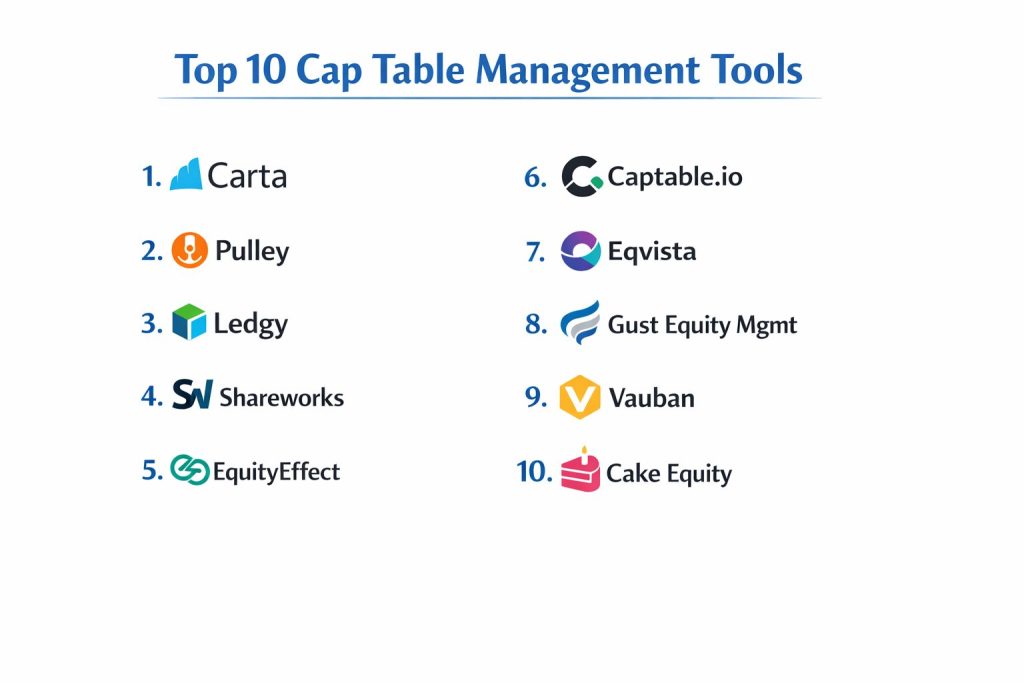
Top 10 Cap Table Management Tools
1) Carta
A widely used platform for cap table management and equity administration, often chosen by startups through growth-stage companies. Strong for equity workflows, stakeholder visibility, and reporting needs that expand over time.
Key Features
- Cap table tracking with structured equity events and ownership history
- Equity grant issuance workflows with approvals and stakeholder records
- Scenario modeling for fundraising and dilution planning (varies by setup)
- Stakeholder portals for employee and investor visibility
- Document and record organization for equity-related materials
- Reporting and exports commonly used for finance and diligence workflows
- Controls that support structured processes at scale
Pros
- Strong ecosystem and broad adoption across startup and growth segments
- Well-suited for complex, growing cap tables with many stakeholders
Cons
- Pricing can be less friendly for very early-stage teams
- Some advanced workflows may require careful setup and guidance
Platforms / Deployment
- Web
- Cloud
Security & Compliance
- SSO/SAML, MFA, encryption, audit logs, RBAC: Not publicly stated
- SOC 2, ISO 27001, GDPR, HIPAA: Not publicly stated
Integrations & Ecosystem
Carta typically fits into finance and people workflows where equity touches HR, payroll, and reporting.
- HR and payroll integrations: Varies / N/A
- Export and reporting workflows: Varies / N/A
- API and automation options: Varies / Not publicly stated
- Stakeholder portal sharing and permissions: Varies / N/A
Support & Community
Support tiers and onboarding vary by plan; documentation is generally available, and adoption is broad.
2) Pulley
A cap table and equity platform often favored by startups that want clean modeling, simple workflows, and predictable ownership reporting. Strong for fundraising planning and maintaining clarity as the company grows.
Key Features
- Cap table management with structured stakeholder records
- Fundraising and dilution scenario modeling for planning decisions
- Equity grant workflows and option pool management
- Clear reporting for founders, finance, and investors
- Stakeholder access controls and sharing patterns
- Document organization for equity-related records
- Workflows that reduce spreadsheet risk and manual errors
Pros
- Strong clarity and modeling-focused approach for fundraising planning
- Friendly workflow for teams moving beyond spreadsheets
Cons
- Some advanced or unusual equity cases may need extra support
- Integration depth can vary depending on plan and setup
Platforms / Deployment
- Web
- Cloud
Security & Compliance
- SSO/SAML, MFA, encryption, audit logs, RBAC: Not publicly stated
- SOC 2, ISO 27001, GDPR, HIPAA: Not publicly stated
Integrations & Ecosystem
Pulley typically connects into equity planning, investor reporting, and finance workflows.
- Exports for legal and finance: Varies / N/A
- HR and payroll connection patterns: Varies / N/A
- Workflow automation options: Varies / Not publicly stated
- Stakeholder portals and permission controls: Varies / N/A
Support & Community
Support is generally oriented toward founders and finance teams; exact tiers vary by plan.
3) Ledgy
An equity management platform designed to help companies manage cap tables, employee equity, and related workflows. Often chosen by teams that want structured processes and cleaner stakeholder experiences.
Key Features
- Cap table management with ownership tracking and transaction history
- Employee equity workflows including grants and vesting tracking
- Reporting for leadership, finance, and stakeholders
- Access control patterns for sharing equity information safely
- Support for common equity events and updates (varies by setup)
- Document handling for equity-related records and approvals
- Workflow features that reduce back-and-forth during updates
Pros
- Helpful for teams that want structured employee equity processes
- Good fit for organizations that need clear stakeholder access patterns
Cons
- Depth for edge cases depends on plan and support engagement
- Integration scope varies by environment and need
Platforms / Deployment
- Web
- Cloud
Security & Compliance
- SSO/SAML, MFA, encryption, audit logs, RBAC: Not publicly stated
- SOC 2, ISO 27001, GDPR, HIPAA: Not publicly stated
Integrations & Ecosystem
Ledgy fits into people and finance workflows around equity grants and stakeholder visibility.
- HR and payroll integration patterns: Varies / N/A
- Reporting exports: Varies / N/A
- API support: Varies / Not publicly stated
- Document workflows: Varies / N/A
Support & Community
Documentation and onboarding vary by plan; customer support experience depends on subscription.
4) Shareworks
A platform used for equity plan administration and cap table-related workflows, often aligned with companies that need more formal equity plan management. Common in organizations that treat equity as a structured program.
Key Features
- Equity plan administration workflows and record tracking
- Cap table and stakeholder reporting for equity programs
- Processes designed for structured governance and oversight
- Support for employee plan workflows (setup dependent)
- Reporting exports used for finance and compliance processes
- Access patterns for stakeholders and administrators
- Tools for managing equity program operations at scale
Pros
- Strong fit for organizations needing structured equity plan administration
- Designed for formal processes and governance
Cons
- Can feel heavy for very early-stage startups
- Setup and ongoing management may require more process discipline
Platforms / Deployment
- Web
- Cloud
Security & Compliance
- SSO/SAML, MFA, encryption, audit logs, RBAC: Not publicly stated
- SOC 2, ISO 27001, GDPR, HIPAA: Not publicly stated
Integrations & Ecosystem
Shareworks typically connects to enterprise equity plan operations and reporting workflows.
- HR and payroll connections: Varies / N/A
- Financial reporting exports: Varies / N/A
- Administrative automation: Varies / Not publicly stated
- Stakeholder reporting access: Varies / N/A
Support & Community
Support is typically structured around business plans and onboarding; exact tiers vary.
5) EquityEffect
An equity management platform oriented toward structured cap table and equity plan workflows. Often used where teams want organized administration and clear reporting for equity stakeholders.
Key Features
- Cap table management with ownership tracking and history
- Equity plan administration workflows (setup dependent)
- Reporting for leadership and stakeholder needs
- Controls for issuing, tracking, and managing equity records
- Document organization for equity program materials
- Support for common equity events and updates
- Administrative workflows that reduce manual reconciliation
Pros
- Practical for teams wanting structured equity plan tracking
- Focus on administration and reporting clarity
Cons
- Depth of integrations depends on plan and setup
- Some features may require guided onboarding for best outcomes
Platforms / Deployment
- Web
- Cloud
Security & Compliance
- SSO/SAML, MFA, encryption, audit logs, RBAC: Not publicly stated
- SOC 2, ISO 27001, GDPR, HIPAA: Not publicly stated
Integrations & Ecosystem
EquityEffect is typically used alongside finance, legal, and HR processes for equity programs.
- Export workflows for reporting: Varies / N/A
- HR and payroll workflows: Varies / N/A
- Automation options: Varies / Not publicly stated
- Stakeholder access patterns: Varies / N/A
Support & Community
Support and onboarding vary by subscription; documentation availability varies.
6) Captable.io
A cap table tool designed to help startups track ownership and run basic to moderate scenario planning. Often used by teams looking for a lighter toolset than enterprise-heavy platforms.
Key Features
- Cap table tracking with stakeholder records
- Basic scenario modeling for dilution and fundraising planning
- Equity issuance tracking and history management
- Export-friendly reporting for internal use
- Simple workflows for keeping cap tables current
- Stakeholder visibility patterns (varies by plan)
- Practical interface for small teams transitioning from spreadsheets
Pros
- Lighter approach that can work well for early-stage teams
- Useful for keeping ownership records cleaner than spreadsheets
Cons
- Advanced enterprise workflows may be limited
- Integration depth and automation features vary by plan
Platforms / Deployment
- Web
- Cloud
Security & Compliance
- SSO/SAML, MFA, encryption, audit logs, RBAC: Not publicly stated
- SOC 2, ISO 27001, GDPR, HIPAA: Not publicly stated
Integrations & Ecosystem
Captable.io generally focuses on core cap table management and reporting exports.
- Export workflows for legal and finance: Varies / N/A
- HR and payroll integrations: Varies / N/A
- API and automation: Varies / Not publicly stated
- Stakeholder portals: Varies / N/A
Support & Community
Support varies by plan; community presence is smaller than the biggest platforms.
7) Eqvista
A cap table and equity management tool used by startups and growing teams that want to issue shares, track equity events, and maintain organized ownership records.
Key Features
- Cap table tracking with ownership history
- Equity issuance and stakeholder record management
- Support for option and vesting tracking (setup dependent)
- Reporting features for investors and internal teams
- Scenario planning support (varies by workflow)
- Stakeholder access controls (varies by plan)
- Tools aimed at reducing manual spreadsheet reconciliation
Pros
- Often approachable for smaller teams needing structured ownership tracking
- Useful for common equity workflows and reporting
Cons
- Complex edge cases may require careful setup and support
- Integration depth and automation features can vary
Platforms / Deployment
- Web
- Cloud
Security & Compliance
- SSO/SAML, MFA, encryption, audit logs, RBAC: Not publicly stated
- SOC 2, ISO 27001, GDPR, HIPAA: Not publicly stated
Integrations & Ecosystem
Eqvista commonly supports reporting exports and equity record workflows for startups.
- Export formats for finance and legal: Varies / N/A
- HR and payroll patterns: Varies / N/A
- APIs and automation: Varies / Not publicly stated
- Stakeholder visibility and access controls: Varies / N/A
Support & Community
Support and onboarding depend on plan; documentation is available with varying depth.
8) Gust Equity Management
A cap table and equity management option often used by startups that already use related startup ecosystem workflows. Helpful for keeping ownership records organized and shareable.
Key Features
- Cap table tracking with stakeholder ownership clarity
- Basic equity record administration workflows
- Reporting for founders and stakeholders
- Data organization for equity-related records
- Permissioned sharing patterns (plan dependent)
- Useful for teams that want simple structured cap table management
- Workflows designed to reduce spreadsheet errors
Pros
- Practical for startups that want a straightforward cap table tool
- Can work well for simpler equity structures and early-stage needs
Cons
- Advanced modeling and complex equity workflows may be limited
- Integration depth varies based on broader tool usage and plan
Platforms / Deployment
- Web
- Cloud
Security & Compliance
- SSO/SAML, MFA, encryption, audit logs, RBAC: Not publicly stated
- SOC 2, ISO 27001, GDPR, HIPAA: Not publicly stated
Integrations & Ecosystem
Gust Equity Management typically fits simple cap table and stakeholder reporting needs.
- Export and reporting workflows: Varies / N/A
- Stakeholder sharing and permissions: Varies / N/A
- HR and payroll integrations: Varies / N/A
- Automation and APIs: Varies / Not publicly stated
Support & Community
Support tiers vary; documentation is generally available for common tasks.
9) Vauban
A platform designed to help teams manage ownership-related workflows, often associated with investment and deal structures. Useful when you need organized records, stakeholder reporting, and structured ownership processes.
Key Features
- Ownership and stakeholder record organization
- Workflow support for structured reporting (setup dependent)
- Tools for managing investment-related ownership events (varies)
- Document organization to support diligence and record clarity
- Permissioned access for stakeholders and administrators
- Reporting outputs designed for finance workflows
- Features aimed at reducing manual reconciliation
Pros
- Helpful for teams managing ownership workflows tied to investment processes
- Useful for producing structured stakeholder reports and records
Cons
- May not be ideal if you only need basic employee equity workflows
- Feature coverage depends on the exact product scope and plan
Platforms / Deployment
- Web
- Cloud
Security & Compliance
- SSO/SAML, MFA, encryption, audit logs, RBAC: Not publicly stated
- SOC 2, ISO 27001, GDPR, HIPAA: Not publicly stated
Integrations & Ecosystem
Vauban typically fits ownership and reporting workflows where stakeholder clarity is important.
- Reporting exports and document workflows: Varies / N/A
- Integration scope: Varies / Not publicly stated
- Stakeholder access controls: Varies / N/A
- Workflow automation: Varies / Not publicly stated
Support & Community
Support varies by plan; community visibility is smaller than mainstream equity platforms.
10) Cake Equity
An equity management tool often chosen by startups and smaller teams that want a structured approach for equity grants and ownership tracking. Useful when you want clear equity visibility without heavy enterprise overhead.
Key Features
- Cap table tracking with ownership clarity
- Equity grant workflows and vesting tracking (setup dependent)
- Employee-friendly visibility into equity holdings
- Reporting that supports founder and finance needs
- Basic to moderate scenario planning support (varies)
- Permission controls for stakeholders (plan dependent)
- Tools aimed at reducing spreadsheet errors and confusion
Pros
- Often approachable for early-stage teams implementing equity programs
- Helps improve stakeholder clarity and reduce manual tracking risk
Cons
- Complex or enterprise workflows may be limited
- Integration and automation options vary by plan
Platforms / Deployment
- Web
- Cloud
Security & Compliance
- SSO/SAML, MFA, encryption, audit logs, RBAC: Not publicly stated
- SOC 2, ISO 27001, GDPR, HIPAA: Not publicly stated
Integrations & Ecosystem
Cake Equity typically supports core equity workflows and stakeholder reporting.
- Reporting exports: Varies / N/A
- HR and payroll workflows: Varies / N/A
- APIs and automation: Varies / Not publicly stated
- Stakeholder visibility tools: Varies / N/A
Support & Community
Support quality depends on plan; onboarding and documentation vary by subscription.
Comparison Table (Top 10)
| Tool Name | Best For | Platform(s) Supported | Deployment (Cloud/Self-hosted/Hybrid) | Standout Feature | Public Rating |
|---|---|---|---|---|---|
| Carta | Growing cap tables and equity workflows | Web | Cloud | Broad adoption and equity administration | N/A |
| Pulley | Fundraising modeling and dilution planning | Web | Cloud | Scenario planning clarity | N/A |
| Ledgy | Employee equity workflows and stakeholder access | Web | Cloud | Structured equity processes | N/A |
| Shareworks | Formal equity plan administration | Web | Cloud | Governance-friendly equity plan workflows | N/A |
| EquityEffect | Structured cap table and plan administration | Web | Cloud | Administration and reporting focus | N/A |
| Captable.io | Lightweight cap table management for startups | Web | Cloud | Simple cap table and modeling approach | N/A |
| Eqvista | Startup equity issuance and ownership tracking | Web | Cloud | Practical equity tracking workflows | N/A |
| Gust Equity Management | Simple structured cap tables for startups | Web | Cloud | Straightforward cap table organization | N/A |
| Vauban | Ownership workflows tied to investment processes | Web | Cloud | Structured ownership reporting | N/A |
| Cake Equity | Early-stage equity grants and visibility | Web | Cloud | Employee-friendly equity visibility | N/A |
Evaluation & Scoring of Cap Table Management Tools
Weights: Core features 25%, Ease 15%, Integrations 15%, Security 10%, Performance 10%, Support 10%, Value 15%.
| Tool Name | Core (25%) | Ease (15%) | Integrations (15%) | Security (10%) | Performance (10%) | Support (10%) | Value (15%) | Weighted Total (0–10) |
|---|---|---|---|---|---|---|---|---|
| Carta | 9.0 | 8.0 | 8.5 | 7.0 | 8.5 | 8.0 | 6.5 | 8.05 |
| Pulley | 8.5 | 8.5 | 8.0 | 7.0 | 8.0 | 8.0 | 7.5 | 8.07 |
| Ledgy | 8.0 | 8.0 | 7.5 | 7.0 | 8.0 | 7.5 | 7.5 | 7.77 |
| Shareworks | 8.5 | 7.0 | 7.5 | 7.5 | 8.0 | 7.5 | 6.0 | 7.55 |
| EquityEffect | 7.5 | 7.5 | 7.0 | 7.0 | 7.5 | 7.0 | 7.0 | 7.25 |
| Captable.io | 7.0 | 8.0 | 6.5 | 6.5 | 7.0 | 6.5 | 8.0 | 7.20 |
| Eqvista | 7.5 | 7.5 | 6.5 | 6.5 | 7.5 | 7.0 | 7.5 | 7.17 |
| Gust Equity Management | 6.5 | 7.5 | 6.0 | 6.5 | 7.0 | 6.5 | 7.5 | 6.82 |
| Vauban | 7.0 | 7.0 | 6.5 | 6.5 | 7.5 | 6.5 | 6.5 | 6.82 |
| Cake Equity | 7.0 | 8.0 | 6.5 | 6.5 | 7.0 | 6.5 | 7.5 | 7.05 |
How to interpret the scores:
- These scores compare tools against each other within this list, not the entire market.
- A higher weighted total suggests broader strength across typical cap table workflows.
- Ease and value can matter more than depth for smaller teams starting equity programs.
- Security scoring is limited because public disclosures vary and plan tiers differ.
- Always validate with a pilot using your actual equity structures and reporting needs.
Which Cap Table Management Tool Is Right for You?
Solo / Freelancer
If you are a solo founder with a very simple cap table, start with the lightest option that keeps records clean and shareable. Captable.io, Cake Equity, or Gust Equity Management can be practical choices when you want structure without heavy overhead. The key is to avoid spreadsheet drift and keep the ownership story consistent from day one.
SMB
For small teams granting options and preparing for fundraising, Pulley and Ledgy can be strong because they focus on clarity, stakeholder workflows, and planning. Eqvista can also work when you want accessible equity issuance and tracking. The right pick depends on how many equity events you expect and how formal your reporting needs are.
Mid-Market
Mid-market companies often need stronger controls, reporting, and consistent processes. Carta is commonly chosen for growing complexity and stakeholder management. Shareworks can fit when equity plan administration needs to be handled with more formal governance. Pick the tool that matches how structured your equity program must be.
Enterprise
Enterprises prioritize governance, reporting, and controlled workflows across many stakeholders. Shareworks often aligns with formal equity plan administration needs. Carta may also fit where the company needs scalable stakeholder visibility and operational processes. The most important factor is ensuring internal finance and legal processes can be consistently enforced.
Budget vs Premium
If budget is tight, lightweight tools can cover core ownership tracking and basic workflows. Premium tools tend to justify cost when you expect frequent equity events, multiple rounds of fundraising, heavy reporting, or complex stakeholder communication needs. Choose based on the cost of errors and the time your team spends reconciling equity data.
Feature Depth vs Ease of Use
Some platforms offer deeper equity administration and reporting, but require more setup and process discipline. Others are easier to adopt quickly but may cap out when equity structures become complex. Decide whether you need advanced modeling, plan administration, and governance now—or later.
Integrations & Scalability
If you expect rapid growth, prioritize export quality, role-based permissions, and workflows that reduce manual reconciliation. Integrations with HR, payroll, and finance can matter once you scale equity grants and reporting. Where integration details are unclear, treat them as variable and test early.
Security & Compliance Needs
If you handle sensitive employee and investor data, prioritize permission controls, clear stakeholder access, and audit-friendly workflows. Where compliance claims are not publicly stated, validate through vendor documentation, procurement checks, and internal security review processes.
Frequently Asked Questions (FAQs)
1. What is a cap table, and why does it matter?
A cap table is a record of who owns what in a company, including founders, employees, and investors. It matters because it affects dilution, control, and financial outcomes during fundraising or exits.
2. When should a startup stop using spreadsheets for cap tables?
As soon as equity grants, multiple investors, or fundraising rounds start adding complexity. Spreadsheets can work early, but errors become costly when stakeholders and transactions increase.
3. Do these tools handle options, vesting, and option pools?
Most cap table tools support options and vesting, but depth varies by plan and setup. Always confirm your exact equity plan workflows during a pilot.
4. How do these tools help with fundraising planning?
Many provide scenario modeling to estimate dilution, option pool changes, and ownership outcomes. This helps founders and finance teams make better decisions before committing to term sheets.
5. Can employees and investors view their holdings in these platforms?
Many offer stakeholder portals or controlled sharing. Access models vary by plan, so confirm exactly what each stakeholder can see.
6. How hard is it to migrate from one cap table tool to another?
Migration can be manageable but requires careful data validation. The biggest risk is inconsistent historical transactions, missing documents, or mismatched instrument definitions.
7. What are common mistakes teams make with equity tracking?
Late updates after equity events, inconsistent instrument definitions, missing approvals, and poor document organization. Another major issue is not testing reports before investor or audit use.
8. Do cap table tools replace legal and accounting advice?
No. They help track and organize equity data, but legal and tax decisions still require professional guidance, especially for complex instruments and jurisdiction-specific rules.
9. How should I evaluate reporting quality?
Test exports, stakeholder summaries, and financing scenario reports. Make sure the tool can produce the exact outputs your legal, finance, and investors expect.
10. What is the safest way to choose a cap table tool?
Shortlist two or three tools, run a pilot using your real equity structure, validate exports and permissions, and involve finance and legal stakeholders before committing.
Conclusion
Cap table management tools are not just about tracking who owns shares; they are about protecting the accuracy of your company’s ownership story as it becomes more complex. The right platform reduces spreadsheet risk, improves stakeholder clarity, and supports critical moments like fundraising, option grants, and due diligence. Tools like Carta and Pulley often shine when modeling and structured workflows become essential, while options like Ledgy, Eqvista, and Cake Equity can be practical for teams building equity programs with a focus on usability. Your best next step is to shortlist two or three tools, run a small pilot with your real cap table data, test dilution scenarios and exports, confirm permissions for employees and investors, and then standardize your internal process so equity changes are always updated on time.