Introduction
Call center software has evolved from simple “voice-only” utilities into comprehensive AI-driven Customer Experience (CX) hubs. Modern call center software, often referred to as Contact Center as a Service (CCaaS), allows businesses to manage, route, and analyze customer interactions across multiple channels—including voice, SMS, social media, and video—from a single, cloud-native interface. These platforms leverage artificial intelligence to automate routine inquiries, assist human agents with real-time data, and provide predictive insights into customer behavior.
The significance of these tools in the current economy is paramount. With customer expectations for “instant” and “personalized” service at an all-time high, the call center is no longer just a support cost center; it is a primary revenue driver and brand differentiator. Companies that successfully implement advanced communication infrastructure see higher retention rates and significantly lower operational overhead through the use of “Agentic AI” and hyper-automated workflows.
Real-world use cases include:
- Proactive Outbound Sales: Using predictive dialers and AI lead scoring to reach prospects at the exact moment they are most likely to convert.
- Intelligent Self-Service: Deploying conversational AI voice bots to handle 60-70% of routine tasks like password resets or order tracking without human intervention.
- Omnichannel Healthcare Support: Ensuring a patient’s medical history and previous chat logs are instantly available to a phone agent for a seamless, secure consultation.
- Retail Crisis Management: Instantly scaling a remote workforce from 50 to 5,000 agents during a massive product recall or holiday surge using elastic cloud architecture.
- Financial Fraud Detection: Utilizing real-time sentiment analysis and voice biometrics to verify identities and flag suspicious behavior during live calls.
Buyers should evaluate these criteria:
- AI Native Capabilities: Does the platform include built-in generative AI for call summaries, sentiment analysis, and agent coaching?
- Omnichannel Orchestration: Can the software treat a WhatsApp message, a tweet, and a phone call as a single, continuous conversation thread?
- Global Reliability: Does the provider offer a 99.999% uptime SLA with geographically redundant data centers?
- CRM Deep Sync: How easily does it integrate with Salesforce, HubSpot, or Zendesk for bi-directional data flow?
- Security & Compliance: Does it meet industry standards like SOC 2, HIPAA, PCI-DSS, and GDPR natively?
- Workforce Engagement (WEM): Are there integrated tools for automated scheduling, gamification, and quality assurance?
- Ease of Deployment: Can the system be configured by business users, or does it require a team of specialized developers?
- Real-Time Analytics: Does it provide live dashboards with “intraday” forecasting and agent performance tracking?
- Scalability: How quickly can the seat count be adjusted for seasonal peaks?
- TCO (Total Cost of Ownership): Are there hidden fees for implementation, data migration, or premium support?
Best for: Global enterprises, high-volume sales teams, healthcare providers, and e-commerce companies requiring 24/7 high-fidelity customer interaction. Not ideal for: Small local businesses with extremely low call volumes or companies that only handle one-way communication without the need for historical context.
Key Trends in Call Center Software
- Agentic AI & Digital Colleagues: In 2026, AI is no longer a simple chatbot; “AI agents” now work alongside human counterparts, handling entire workflows end-to-end.
- Voice Biometrics: Traditional security questions are being replaced by “voice fingerprints,” allowing for instant, secure authentication as soon as a customer speaks.
- Hyper-Personalization at Scale: Predictive routing now matches customers with specific agents based on personality types, purchase history, and even current emotional state.
- The Death of Multi-Channel: The industry has shifted to “Omnichannel Continuity,” where an agent can see exactly what a customer did on a website or app seconds before they called.
- Low-Code Customization: Modern suites offer “drag-and-drop” workflow builders, allowing managers to change call routing or IVR logic without writing a single line of code.
- Embedded Emotional Intelligence: Real-time sentiment analysis now provides “nudges” to agents, suggesting a change in tone or offering a discount code if it detects customer frustration.
- Unified Communications Convergence: The line between internal team chat (UCaaS) and external customer support (CCaaS) has blurred into a single “Experience Cloud.”
- Sustainable Operations: Cloud providers are now providing “green routing” options, optimizing data center usage based on renewable energy availability.
How We Selected These Tools (Methodology)
Our selection process for the top 10 call center software tools involved a multi-dimensional evaluation of the current market:
- Industry Adoption: We prioritized platforms used by Fortune 500 companies and high-growth tech startups.
- Feature Innovation: We looked for tools that have successfully moved beyond “Legacy Cloud” into “AI-First” architectures.
- Third-Party Validation: We analyzed performance reports, security audits, and public user satisfaction ratings.
- Enterprise-Grade Security: A mandatory requirement was the inclusion of advanced encryption and international data compliance certifications.
- Interoperability: We selected tools that function as an “open ecosystem,” supporting a wide array of third-party API integrations.
- Scalability Benchmarks: Each tool was vetted for its ability to handle sudden volume spikes without degradation in call quality or data latency.
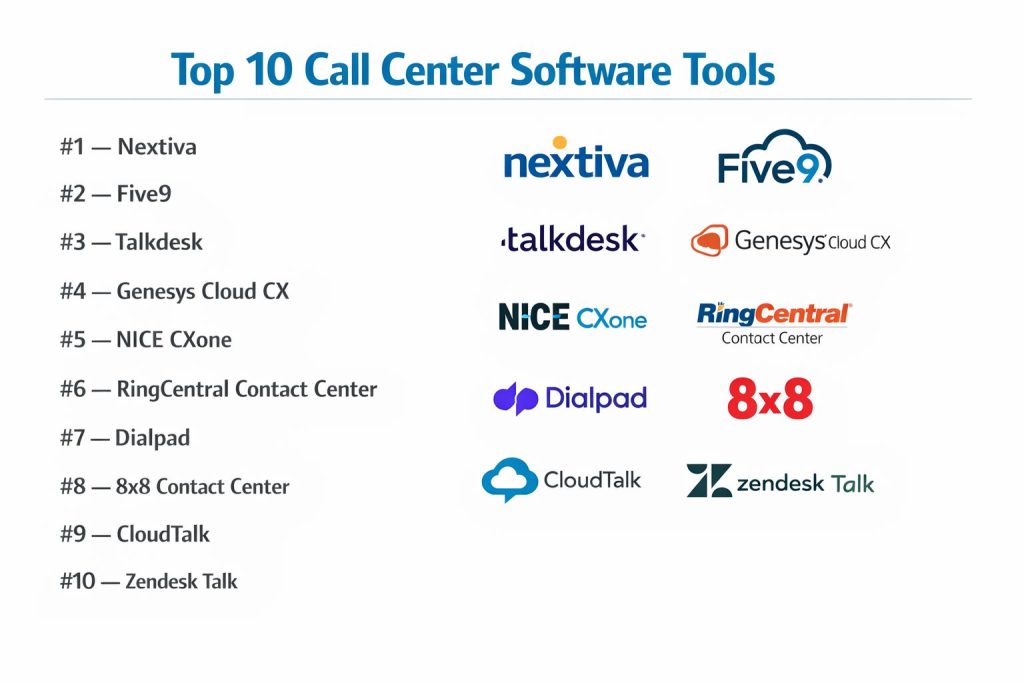
Top 10 Call Center Software Tools
#1 — Nextiva
Nextiva is a leading unified communications platform that has become the gold standard for SMBs and mid-market companies. Following its major acquisitions in late 2024, it offers a powerhouse “Intelligent Experience” suite that combines phone, video, and social media into one dashboard.
Key Features
- AI Receptionist XBert: An advanced conversational IVR that handles natural language inquiries with human-like accuracy.
- One Intelligent Display: A unified view that shows all customer interactions (voice, email, chat) in a single historical timeline.
- Proactive Notifications: Automatically sends SMS or voice updates to customers about order statuses or service interruptions.
- Dynamic Scripting: Provides agents with live-updating scripts that change based on the customer’s real-time responses.
- High Availability Architecture: Boasts a 99.999% uptime record supported by a global mesh of data centers.
Pros
- User-Friendly Interface: Known for having one of the most intuitive setups in the industry.
- Award-Winning Support: Offers 24/7 live assistance included in all tiers, not just enterprise.
Cons
- Advanced Features Cost: Some of the most powerful AI automation tools are locked behind higher-tier plans.
- Learning Curve for CRM Sync: Deeply custom CRM integrations may require initial professional services.
Platforms / Deployment
- Windows / macOS / iOS / Android / Web
- Cloud-Native
Security & Compliance
- Encryption: End-to-end TLS/SRTP encryption for all voice traffic.
- Compliance: SOC 2, HIPAA, PCI-DSS compliant.
Integrations & Ecosystem
Integrates natively with Salesforce, HubSpot, Zendesk, and Microsoft Dynamics. It also features a robust API for custom enterprise workflows.
Support & Community
Nextiva provides a massive knowledge base, live 24/7 technical support, and a structured onboarding program for new teams.
#2 — Five9
Five9 is an enterprise-focused cloud contact center known for its powerful outbound dialing capabilities and “AI-first” approach to workforce optimization. It is widely used by high-volume sales teams and large-scale support organizations.
Key Features
- Intelligent Virtual Assistant (IVA): Uses sophisticated NLU (Natural Language Understanding) to resolve complex issues without human intervention.
- Predictive & Power Dialers: Industry-leading outbound tools that maximize agent talk time and lead conversion rates.
- Agent Assist: A real-time tool that listens to calls and provides the agent with “next-best-action” suggestions and knowledge base articles.
- Visual IVR: Allows customers to interact with phone menus via a mobile web interface for a faster experience.
- Workflow Automation: Automates repetitive post-call tasks like logging summaries into the CRM.
Pros
- Massive Scalability: Capable of supporting thousands of agents across global locations seamlessly.
- Advanced Reporting: Offers incredibly deep analytics and customizable dashboards for supervisors.
Cons
- Complex Onboarding: The initial setup and configuration can be lengthy due to the sheer volume of features.
- Interface Density: The agent desktop can feel cluttered with notifications and alerts for inexperienced users.
Platforms / Deployment
- Web / Windows / macOS
- Cloud-Native
Security & Compliance
- Compliance: HITRUST, SOC 2 Type II, PCI Level 1, and GDPR compliant.
- Encryption: AES-256 for data at rest and in transit.
Integrations & Ecosystem
Deeply integrated with Salesforce (AppExchange), ServiceNow, and Oracle. It is also a key player in the NVIDIA AI ecosystem.
Support & Community
Offers Five9 University for professional certification and a 24/7 global support desk for enterprise-level troubleshooting.
#3 — Talkdesk
Talkdesk is a “cloud-native” contact center built on a global architecture. It is highly regarded for its “Experience Clouds,” which are pre-configured versions of the software tailored for specific industries like healthcare and retail.
Key Features
- Industry Experience Clouds: Tailored workflows and compliance features for highly regulated sectors.
- No-Code Studio: A visual designer for creating complex call flows and IVRs without needing a developer.
- AI Trainer: Allows non-technical staff to train and improve AI models based on actual customer interactions.
- Guardian: An AI-powered security tool that detects internal and external threats, such as unauthorized data access.
- Workforce Management: Integrated tools for forecasting, scheduling, and agent adherence tracking.
Pros
- Speed of Innovation: Maxon-fast release cycles ensure new AI features are added monthly.
- High ROI: Enterprises often report a fast “time-to-value” due to the pre-built industry templates.
Cons
- High Tier Pricing: Access to the most advanced generative AI requires the “Elite” plan subscription.
- Browser Dependent: While stable, users in low-bandwidth areas may experience latency on the web-based desktop.
Platforms / Deployment
- Web / iOS / Android / Windows
- Cloud-Native
Security & Compliance
- Compliance: ISO 27001, SOC 2, HIPAA, and PCI-DSS.
- Privacy: Advanced role-based access control (RBAC).
Integrations & Ecosystem
Features over 70 out-of-the-box integrations, including Slack, Salesforce, and Microsoft Teams.
Support & Community
Talkdesk Academy provides extensive training. The community is active, specifically among enterprise CX leads and digital transformation officers.
#4 — Genesys Cloud CX
Genesys Cloud CX is an all-in-one composable platform designed for global enterprises that need to manage highly complex, multi-touchpoint customer journeys.
Key Features
- Journey Orchestration: Maps every customer touchpoint (web visit, email, call) to provide agents with perfect context.
- Predictive Routing: Uses machine learning to match a caller with the agent most likely to resolve their specific issue based on historical data.
- Gamification: Built-in leaderboards and rewards to motivate agents and reduce burnout in high-pressure environments.
- Native Digital Channels: Supports over 30 digital channels including Instagram, WhatsApp, and Apple Business Chat.
- Lumina AI: An proprietary generative AI engine that creates automated summaries and quality scores for 100% of calls.
Pros
- Enterprise Power: The most robust platform for massive global organizations with complex logic needs.
- Customizability: Highly composable architecture allows for nearly infinite customization via APIs.
Cons
- High TCO: The total cost of ownership can be high when including implementation and expert management.
- Complexity: Requires dedicated technical staff or partners to manage the platform effectively.
Platforms / Deployment
- Windows / macOS / Web / Mobile
- Public Cloud (AWS / Azure / GCP)
Security & Compliance
- Certifications: FedRAMP (High), ISO 27001, SOC 2, HIPAA.
- Control: Global data sovereignty options for multi-national firms.
Integrations & Ecosystem
One of the most extensive marketplaces in the CCaaS industry (AppFoundry) with thousands of pre-built connectors and apps.
Support & Community
Extensive developer portal, professional services, and a dedicated customer success manager for large accounts.
#5 — NICE CXone
NICE CXone is a dominant force in the contact center market, offering the “Enlighten AI” suite which provides real-time guidance and advanced behavioral analytics.
Key Features
- Enlighten AI: Analyzes every interaction in real-time to guide agents on soft skills, such as empathy and phrasing.
- Smart Self-Service: Advanced bots that use the company’s entire knowledge base to answer questions via voice or text.
- Interaction Analytics: Automatically categorizes and trends 100% of interactions to find the “root cause” of customer issues.
- Workforce Engagement: A market-leading suite for automated scheduling and quality management.
- Proactive Outbound: Automated systems that reach out to customers across channels based on their behavior or needs.
Pros
- AI Maturity: Considered one of the most advanced AI implementations in the CX industry.
- All-in-One Suite: No need for third-party tools for QA or WFM; everything is native.
Cons
- Expensive: Generally the highest priced option, making it less accessible for small teams.
- Complex UI: The administration interface can be overwhelming for new supervisors.
Platforms / Deployment
- Windows / macOS / Web
- Cloud-Native
Security & Compliance
- Compliance: PCI Level 1, SOC 2, HIPAA, GDPR.
- Architecture: Geographically redundant with guaranteed zero-downtime updates.
Integrations & Ecosystem
Strong partnerships with Microsoft (Teams integration) and Salesforce.
Support & Community
NICE offers a comprehensive global support network and specialized “CX1 User Groups” for networking and best practices.
#6 — RingCentral Contact Center
RingCentral is a powerhouse in the UCaaS space, and its Contact Center offering provides a unified ecosystem where internal collaboration and external customer support live in one app.
Key Features
- Unified Screen: Agents can switch between an internal team chat and a customer phone call without changing apps.
- RingCX: A simple, AI-first contact center solution designed for fast deployment and lower complexity.
- Omnichannel Routing: Directs calls, emails, and social messages to the most qualified agent based on skill level.
- AI Post-Call Summaries: Automatically generates a concise summary of every interaction and syncs it to the CRM.
- Expert Assist: Allows agents to quickly “pull in” internal experts to help solve a customer’s problem via internal chat.
Pros
- Ease of Use: Famously simple to set up and manage compared to enterprise rivals.
- Single Vendor Strategy: Ideal for companies that want their phone system and contact center from the same provider.
Cons
- Feature Depth: While powerful, it may lack some of the “hyper-specialized” physics-level simulations of a tool like Houdini (not applicable here—it lacks some of the hyper-deep simulation tools found in NICE or Genesys).
- Price Per Seat: The “full” contact center can become expensive as you add more digital channels.
Platforms / Deployment
- Windows / macOS / iOS / Android / Web
- Cloud-Native
Security & Compliance
- Security: 7 layers of security with over 300 built-in integrations for compliance.
- Compliance: SOC 2, HIPAA, GDPR.
Integrations & Ecosystem
Native integration with over 300 business apps including Google Workspace, Microsoft 365, and Salesforce.
Support & Community
Offers 24/7 phone support and a massive global community of IT professionals.
#7 — Dialpad
Dialpad is a “mobile-first” and “AI-first” communication platform that focuses heavily on real-time transcription and sentiment analysis. It is highly popular among remote teams and fast-growing tech companies.
Key Features
- Dialpad Ai: Built directly into the platform to provide real-time transcription, live coaching, and automated recaps.
- AI CSAT: Automatically calculates a Customer Satisfaction (CSAT) score for every single call without needing a post-call survey.
- Real-Time Coaching Playbooks: Displays specific “battle cards” or tips on an agent’s screen when certain keywords are mentioned.
- Virtual Agents: Low-code AI bots that handle high-volume inquiries across voice and chat.
- One-Click Setup: Can deploy a new call center or add agents in minutes rather than days.
Pros
- AI Inclusion: Most AI features are included in the standard pricing, not as expensive add-ons.
- Call Quality: Known for high-definition voice quality even on mobile data connections.
Cons
- Advanced Routing: Some of the more complex “journey mapping” found in Genesys is less developed here.
- Support Tiers: The fastest support response times are reserved for Enterprise customers.
Platforms / Deployment
- Windows / macOS / iOS / Android / Web
- Cloud-Native (GCP based)
Security & Compliance
- Compliance: SOC 2 Type II, HIPAA, GDPR, PCI-DSS.
- Privacy: Enterprise-grade encryption for all stored recordings and transcripts.
Integrations & Ecosystem
Native sync with Zoho CRM, Salesforce, HubSpot, and Google Workspace.
Support & Community
Dialpad provides a highly active community forum and a “Help Center” packed with video tutorials.
#8 — 8×8 Contact Center
8×8 provides a combined CCaaS and UCaaS platform that is favored by mid-sized businesses looking for a cost-effective, global-ready solution.
Key Features
- Integrated UC & CC: A single platform for team communication and customer contact center.
- 8×8 Expert Connect: Connects agents to internal subject matter experts across the organization to resolve queries faster.
- Intelligent Dialer: Includes preview, progressive, and predictive dialing for outbound teams.
- Customer Experience Analytics: A visual dashboard that shows exactly where customers are dropping off in the IVR or queue.
- Omnichannel Support: Integrated voice, chat, SMS, and video in a single desktop.
Pros
- Global Reach: Offers local numbers in over 120 countries, ideal for international sales teams.
- All-in-One Pricing: Often more affordable than purchasing separate UC and CC platforms.
Cons
- UI Modernity: The interface is functional but can feel less “slick” than competitors like Dialpad or Nextiva.
- AI Depth: While it has AI features, they are generally less “predictive” than those found in Five9 or NICE.
Platforms / Deployment
- Windows / macOS / iOS / Android / Web
- Cloud-Native
Security & Compliance
- Compliance: FISMA, HIPAA, PCI-DSS, SOC 2.
- SLA: Guaranteed 99.999% uptime.
Integrations & Ecosystem
Strong integrations with Microsoft Teams and a wide variety of mid-market CRMs like Pipedrive and Bullhorn.
Support & Community
Global 24/7 support and a well-regarded “8×8 Academy” for user training.
#9 — CloudTalk
CloudTalk is a specialized, high-growth call center software designed specifically for sales and support teams that live inside their CRM. It is known for its “Smart Dialer” and extreme ease of use.
Key Features
- Smart Dialer: Automatically compiles a list of numbers from your CRM and dials them in sequence.
- Power Dialer: Speeds up outbound campaigns by automating the dialing process while giving agents time to prepare.
- Flow Designer: A simple drag-and-drop tool to build multi-level IVRs and routing logic.
- International Numbers: Provides local phone numbers for 160+ countries instantly.
- Real-Time Monitoring: Allows supervisors to listen in, “whisper” to agents, or “barge” into calls to take over.
Pros
- CRM Integration: Perhaps the best “sync” performance with HubSpot and Pipedrive.
- Quick Implementation: A team can be up and running in less than an hour.
Cons
- Limited Omnichannel: Primarily a voice-focused tool; its social and chat features are not as deep as Genesys.
- Basic AI: Does not yet offer the “Agentic AI” or “Journey Orchestration” of higher-end enterprise suites.
Platforms / Deployment
- Windows / macOS / iOS / Android / Web
- Cloud-Native
Security & Compliance
- Compliance: GDPR compliant, SOC 2.
- Data Privacy: Uses secure AWS infrastructure.
Integrations & Ecosystem
Deep integrations with HubSpot, Pipedrive, Salesforce, and Zendesk.
Support & Community
Responsive email and phone support with a strong library of “how-to” articles.
#10 — Zendesk Talk
Zendesk Talk is the integrated voice component of the massive Zendesk Service suite. It is the best choice for teams that are already using Zendesk for their ticketing and help desk.
Key Features
- Zendesk Agent Workspace: Places the phone call directly inside the support ticket, so the agent never has to leave the screen.
- Automatic Ticket Creation: Every call automatically generates a ticket with the recording and transcript attached.
- Omnichannel Continuity: Seamlessly switch from a phone call to a follow-up email or SMS within the same thread.
- Embedded Callback: Allows customers to request a callback from a website or app rather than waiting on hold.
- Voice AI: AI-powered IVR and routing that uses historical ticket data to triage calls.
Pros
- Unified Workflow: No “alt-tabbing” between a phone app and a support system; it’s all one platform.
- Analytics Synergy: Combines voice data with all other support metrics for a “360-degree” view of CX.
Cons
- Requires Zendesk: Not an ideal “stand-alone” phone system; it is best used as an add-on to the Zendesk CRM.
- Cost: Can become expensive when adding call minutes on top of high-tier Zendesk subscriptions.
Platforms / Deployment
- Windows / macOS / Web / Mobile (via Zendesk app)
- Cloud-Native
Security & Compliance
- Security: Inherits Zendesk’s enterprise-grade security framework.
- Compliance: SOC 2, HIPAA, GDPR, PCI-DSS.
Integrations & Ecosystem
Part of the massive Zendesk Marketplace with thousands of apps and specialized connectors.
Support & Community
Access to the global Zendesk Help Center and a massive user community of support professionals.
Comparison Table (Top 10)
| Tool Name | Best For | Platform(s) Supported | Deployment | Standout Feature | Public Rating |
| Nextiva | SMB / Mid-Market | Win, Mac, iOS, Android | Cloud-Native | One Intelligent Display | 4.7/5 |
| Five9 | High-Volume Sales | Win, Mac, Web | Cloud-Native | Predictive Dialer Power | 4.6/5 |
| Talkdesk | Industry Specifics | Win, Mac, Web, iOS | Cloud-Native | Industry Experience Clouds | 4.5/5 |
| Genesys Cloud CX | Global Enterprise | Win, Mac, Web, Mobile | Public Cloud | Journey Orchestration | 4.8/5 |
| NICE CXone | Advanced AI / WEM | Win, Mac, Web | Cloud-Native | Enlighten AI Engine | 4.7/5 |
| RingCentral | Unified UC & CC | Win, Mac, iOS, Android | Cloud-Native | RingCX AI Simplicity | 4.6/5 |
| Dialpad | Remote / AI-First | Win, Mac, iOS, Android | Cloud-Native | Real-time AI Coaching | 4.8/5 |
| 8×8 | Global Sales / UC | Win, Mac, iOS, Android | Cloud-Native | Expert Connect | 4.4/5 |
| CloudTalk | CRM-Centric Teams | Win, Mac, iOS, Android | Cloud-Native | Smart Dialer Workflow | 4.5/5 |
| Zendesk Talk | Zendesk Users | Win, Mac, Web | Cloud-Native | Ticket-Voice Integration | 4.6/5 |
Evaluation & Scoring of Call Center Software
| Tool Name | Core (25%) | Ease (15%) | Integrations (15%) | Security (10%) | Performance (10%) | Support (10%) | Value (15%) | Weighted Total |
| Nextiva | 9 | 10 | 9 | 9 | 9 | 10 | 9 | 9.25 |
| Five9 | 10 | 6 | 9 | 10 | 9 | 9 | 8 | 8.65 |
| Talkdesk | 9 | 8 | 9 | 9 | 9 | 8 | 8 | 8.55 |
| Genesys Cloud CX | 10 | 5 | 10 | 10 | 10 | 9 | 7 | 8.60 |
| NICE CXone | 10 | 5 | 9 | 10 | 10 | 9 | 6 | 8.30 |
| RingCentral | 9 | 9 | 10 | 9 | 9 | 9 | 8 | 8.95 |
| Dialpad | 9 | 9 | 9 | 9 | 9 | 8 | 10 | 9.00 |
| 8×8 | 8 | 8 | 8 | 9 | 8 | 8 | 9 | 8.15 |
| CloudTalk | 7 | 9 | 10 | 8 | 9 | 8 | 9 | 8.30 |
| Zendesk Talk | 8 | 9 | 10 | 9 | 8 | 9 | 7 | 8.40 |
Which Call Center Software Tool Is Right for You?
Solo / Freelancer
For the solo entrepreneur or freelancer, Dialpad or Nextiva are the most accessible. They offer professional-grade features without the “Enterprise” complexity or price tag, allowing you to manage business calls on your personal mobile device with full AI transcription.
SMB
Small and medium businesses should prioritize CloudTalk or RingCentral. These tools offer a balance of powerful outbound dialers and easy CRM sync, allowing small teams to maximize their output and manage customer growth without a dedicated IT staff.
Mid-Market
For companies with 50-250 agents, Talkdesk and Nextiva provide the best “growth” platform. They offer advanced AI and industry-specific workflows that can be customized as the business scales, without the extreme technical requirements of larger enterprise suites.
Enterprise
For global giants requiring multi-thousand seat deployments, Genesys Cloud CX and NICE CXone are the only logical choices. They provide the necessary security, global redundancy, and “Journey Orchestration” required to handle millions of interactions across every imaginable digital channel.
Budget vs Premium
- Budget: CloudTalk and Zendesk Talk (if you already use Zendesk) offer the best entry-level pricing for voice capabilities.
- Premium: NICE CXone and Genesys are premium investments. You are paying for the world’s most advanced AI coaching and the highest level of global reliability infrastructure.
Frequently Asked Questions (FAQs)
What is the difference between CCaaS and traditional call center software?
CCaaS (Contact Center as a Service) is cloud-native, meaning it requires no hardware, scales instantly, and handles “Omnichannel” (voice, chat, email) rather than just traditional phone calls.
Can I keep my existing phone numbers when switching?
Yes. All top 10 providers support “Number Porting,” allowing you to move your current business numbers to their cloud platform without any downtime.
How much bandwidth does call center software require?
Most platforms require approximately 100kbps per concurrent call for high-definition voice. A stable, fiber-optic connection is recommended for teams of more than 10 agents.
Does the software work for remote or hybrid teams?
Absolutely. Since these tools are cloud-based, agents can log in from any location using a computer or mobile app, while supervisors maintain full visibility through real-time dashboards.
What is “Agentic AI” ?
Agentic AI refers to advanced AI models that can take action autonomously, such as processing a refund, updating a shipping address, or scheduling a complex appointment, rather than just “chatting.”
Is call center software secure for medical data?
Yes, provided you choose a HIPAA-compliant vendor like Nextiva, Five9, or Genesys. These providers use high-level encryption and strict access controls to protect PHI (Protected Health Information).
What is an “Intelligent Virtual Assistant” (IVA)?
An IVA is an AI-powered voice or chat bot that understands natural language. Unlike traditional “Press 1” menus, an IVA allows customers to speak their problem and can often resolve it without a human agent.
Can these tools record and transcribe all calls?
Yes, most modern platforms offer automated call recording and real-time AI transcription, which can then be used for training, compliance, and automated summary generation.
How does “Predictive Routing” work?
It uses AI to analyze a caller’s history and the available agents’ performance data to “match” them. For example, a frustrated customer might be routed to an agent with high empathy scores.
Do I need to buy specialized headsets?
While any headset works, professional USB or Bluetooth headsets with “active noise cancellation” are highly recommended to ensure the AI transcription and customer experience are of the highest quality.
Conclusion
The selection of call center software is a strategic decision that bridges the gap between operational efficiency and customer loyalty. For organizations prioritizing real-time AI and ease of use, Dialpad and Nextiva are the modern frontrunners. For global enterprises managing complex, multi-national data flows, Genesys and NICE remain the industry heavyweights.
Ultimately, the best software is the one that removes friction from both the customer’s journey and the agent’s daily workflow. By shifting toward an AI-first, omnichannel approach, businesses can transform their call center from a reactive support desk into a proactive relationship hub.