Introduction
Bot management tools help websites and APIs detect, classify, and stop automated traffic that harms performance, security, and revenue. In simple terms, they separate real human visitors from scripts, scrapers, credential-stuffing attacks, fake signups, scalping bots, and automated abuse. This matters because automated traffic keeps getting smarter, more distributed, and harder to block with basic rate limits alone.
Common use cases include stopping account takeover attempts, preventing fake registrations and form spam, protecting checkout and ticketing from scalpers, reducing scraping of prices and content, safeguarding login and password reset endpoints, and keeping API usage fair for real customers. When selecting a tool, evaluate detection accuracy, false-positive control, response options (block, challenge, rate limit), coverage for web and API traffic, integration effort, performance impact, visibility and reporting, support for mobile and app flows (if needed), developer controls and automation, and total cost versus business risk.
Best for: eCommerce, fintech, media, SaaS, and any business with logins, checkout, forms, or high-value content and APIs.
Not ideal for: very small sites with low traffic and low fraud risk, or teams that only need basic rate limiting from a standard firewall.
Key Trends in Bot Management Tools
- More “human-like” bots using real browsers, rotating identities, and distributed networks
- Higher demand for API protection because abuse shifts from pages to endpoints
- Behavior-based detection becoming central, not just IP reputation
- Stronger need to reduce false positives, especially for customers on shared networks
- More layered responses: soft challenges, step-up checks, and targeted friction
- Increased focus on automation and policy tuning to reduce manual operations
- Better reporting expectations: attack types, sources, impacted endpoints, and business impact
- Wider adoption of managed edge approaches to reduce latency and complexity
How We Selected These Tools (Methodology)
- Prioritized tools with strong adoption in high-abuse industries
- Looked for clear coverage across web traffic and API endpoints
- Favoring platforms with multiple response actions, not only hard blocks
- Considered integration paths: edge, DNS, WAF, reverse proxy, or application connectors
- Weighted operational fit: policy control, visibility, and manageable tuning
- Included tools that scale for SMB through enterprise use cases
- Balanced broad platforms with focused specialists that solve tough abuse patterns
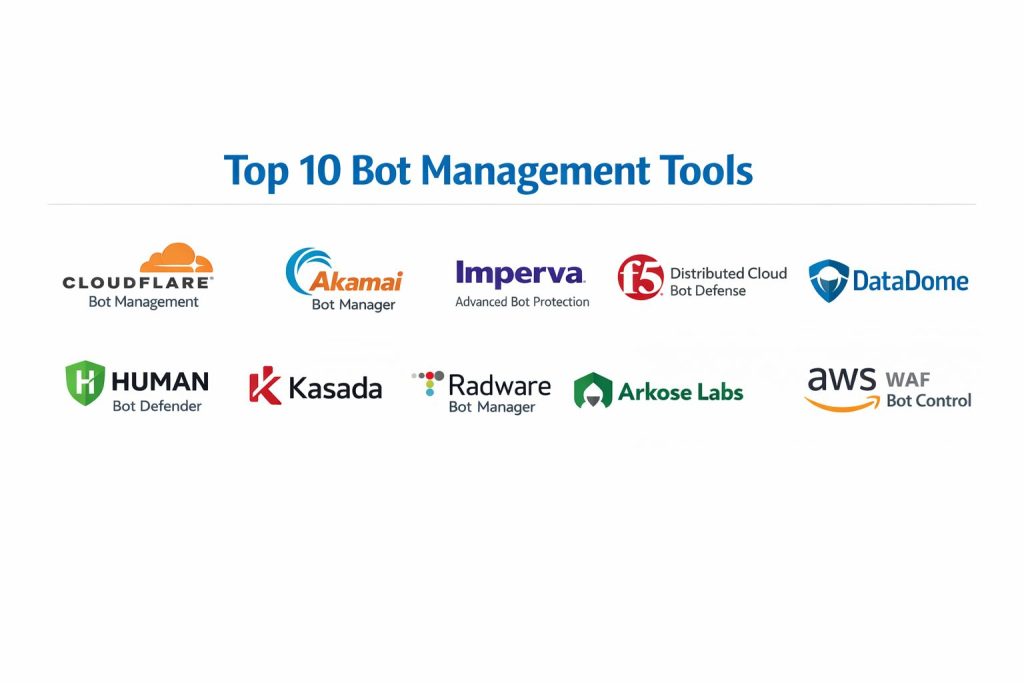
Top 10 Bot Management Tools
1 — Cloudflare Bot Management
Bot detection and mitigation integrated into an edge security platform, designed to classify traffic and apply targeted controls with low operational overhead.
Key Features
- Bot classification with configurable actions
- Behavior and fingerprint-style signals (implementation varies)
- Controls for login, forms, and high-risk paths
- Policy rules to tune by endpoint and user segment
- Reporting to support tuning and investigations
Pros
- Strong fit when you already use edge security and traffic routing
- Fast response at the edge with broad coverage
Cons
- Best results depend on clean policy design and tuning
- Some advanced workflows may require careful testing to avoid friction
Platforms / Deployment
Web and APIs, Cloud (edge-managed)
Security and Compliance
Not publicly stated
Integrations and Ecosystem
Commonly fits into edge security and application delivery patterns.
- Works with WAF-style rules and traffic routing setups
- APIs and automation options vary by plan
- Plays well with common app stacks through edge controls
Support and Community
Support tiers vary; strong documentation and broad ecosystem usage.
2 — Akamai Bot Manager
Enterprise-grade bot mitigation built for high-traffic environments, commonly used for large consumer sites with heavy scraping and account abuse pressure.
Key Features
- Advanced bot detection and classification controls
- High-scale mitigation for large traffic volumes
- Controls tuned for credential abuse and scraping patterns
- Detailed reporting for operations and security teams
- Policy controls to apply by application area
Pros
- Strong for very large sites with complex abuse patterns
- Mature enterprise posture for performance and scale
Cons
- Integration can be more involved in complex environments
- Cost and operations can be heavier than simpler options
Platforms / Deployment
Web and APIs, Cloud (edge-managed)
Security and Compliance
Not publicly stated
Integrations and Ecosystem
Often used in large edge delivery and security deployments.
- Integrates with edge routing and security controls
- Automation and reporting integrations vary by setup
- Works best with clear ownership for policy lifecycle
Support and Community
Strong enterprise support options; community depth varies by region and industry.
3 — Imperva Advanced Bot Protection
Bot protection designed to reduce scraping, account abuse, and automated fraud by combining classification, policy controls, and mitigation actions.
Key Features
- Detection and mitigation for automated abuse patterns
- Controls for scraping, credential attacks, and fake actions
- Reporting focused on attacks, endpoints, and trends
- Policy tuning by risk level and user segment
- Mitigation actions to balance security and user experience
Pros
- Strong fit for security-driven web protection programs
- Useful visibility for abuse analysis and tuning
Cons
- Some environments need careful rollout to avoid customer friction
- Integration approach may vary depending on your architecture
Platforms / Deployment
Web and APIs, Varies / N/A
Security and Compliance
Not publicly stated
Integrations and Ecosystem
Often used alongside broader application security controls.
- Can align with WAF and traffic security policies
- Reporting can feed SOC workflows depending on tooling
- Best results with endpoint-level tuning and iteration
Support and Community
Support tiers vary; documentation is typically oriented to security teams.
4 — F5 Distributed Cloud Bot Defense
Bot defense designed for protecting web and API surfaces, often selected by teams that want enterprise controls and integration into broader app security programs.
Key Features
- Bot detection and mitigation with policy controls
- Coverage for web and API abuse patterns
- Controls designed for account and transaction protection
- Visibility to support incident response and tuning
- Flexible integration options depending on environment
Pros
- Strong fit for enterprise security programs and layered defenses
- Good option when web and API protection must be aligned
Cons
- Architecture decisions can affect rollout speed
- Tuning effort can be meaningful for complex customer flows
Platforms / Deployment
Web and APIs, Varies / N/A
Security and Compliance
Not publicly stated
Integrations and Ecosystem
Often fits into enterprise application delivery and security stacks.
- Can align with traffic management and security layers
- Policy automation varies by plan and environment
- Best outcomes with shared ownership across app and security teams
Support and Community
Enterprise-grade support options; community depth varies by user base.
5 — DataDome
Bot protection focused on stopping automated abuse while minimizing false positives, often used in eCommerce and high-traffic customer platforms.
Key Features
- Bot classification and mitigation actions
- Strong tuning controls to reduce customer impact
- Coverage for scraping and account abuse patterns
- Reporting that supports security and business analysis
- Policy controls designed for operational simplicity
Pros
- Practical balance between blocking abuse and preserving user experience
- Often approachable for teams that need faster time-to-value
Cons
- Best results depend on ongoing tuning and endpoint-level policies
- Deep customization needs may require added effort in complex stacks
Platforms / Deployment
Web and APIs, Cloud
Security and Compliance
Not publicly stated
Integrations and Ecosystem
Typically integrates through common edge and application security patterns.
- Works with common traffic stacks and security layers
- Automation and alerting integration depends on environment
- Best outcomes with clear monitoring and feedback loops
Support and Community
Support options vary; generally strong onboarding guidance for common use cases.
6 — HUMAN Bot Defender
Bot mitigation aimed at stopping fraud, account abuse, and automation at scale, often used where high-risk traffic must be handled with accuracy.
Key Features
- Detection and mitigation for automated abuse
- Controls for account takeover and credential attacks
- Policy actions to apply targeted friction when needed
- Reporting for visibility and tuning decisions
- Coverage for multiple abuse patterns across endpoints
Pros
- Strong fit for high-risk login and transaction surfaces
- Useful for organizations that need mature abuse controls
Cons
- Rollout can require careful validation for sensitive customer flows
- Effectiveness depends on policy design and maintenance
Platforms / Deployment
Web and APIs, Cloud
Security and Compliance
Not publicly stated
Integrations and Ecosystem
Often used as part of a broader fraud and application security stack.
- Can align with WAF policies and SOC workflows
- Integrations depend on your monitoring and response tooling
- Works best when endpoints are clearly categorized by risk
Support and Community
Support tiers vary; typically oriented to enterprise deployments and security teams.
7 — Kasada
Bot mitigation designed to resist sophisticated automation, often selected for scenarios like scraping, credential abuse, and high-value transactional surfaces.
Key Features
- Bot detection and mitigation focused on advanced attackers
- Controls to protect login, signup, and checkout paths
- Response options to apply friction selectively
- Reporting designed to support tuning and operations
- Designed for high-abuse environments
Pros
- Strong option when automation is persistent and evasive
- Useful for protecting high-value business flows
Cons
- May require thoughtful rollout and validation
- Integration and tuning needs vary by architecture
Platforms / Deployment
Web and APIs, Cloud
Security and Compliance
Not publicly stated
Integrations and Ecosystem
Usually integrated into web traffic stacks where policies can be applied consistently.
- Fits with edge and application-layer controls
- Monitoring integrations depend on your stack
- Best results with clear endpoint risk segmentation
Support and Community
Support varies by plan; typically focused on guided deployment for high-risk use cases.
8 — Radware Bot Manager
Bot management designed to reduce automated abuse like scraping and credential attacks while providing visibility for tuning and response.
Key Features
- Detection and mitigation for automated traffic
- Controls for scraping and credential abuse patterns
- Visibility and reporting to guide policy changes
- Response actions to balance blocking and user experience
- Policy management for endpoint-level tuning
Pros
- Useful for organizations needing clear abuse reporting
- Practical for teams building structured bot defense programs
Cons
- Integration approach can differ depending on architecture
- Tuning effort may be needed to reduce customer friction
Platforms / Deployment
Web and APIs, Varies / N/A
Security and Compliance
Not publicly stated
Integrations and Ecosystem
Often used alongside application security layers and monitoring tools.
- Can integrate with security operations workflows
- Interop depends on your traffic and WAF architecture
- Best results with ongoing tuning and review loops
Support and Community
Support tiers vary; documentation typically targets security and network teams.
9 — Arkose Labs
A bot and abuse prevention tool known for using step-up challenges and risk-based friction, often applied to stop fake signups and automated account abuse.
Key Features
- Risk-based friction and step-up challenges (where applicable)
- Controls for signup, login, and recovery flows
- Policies designed to reduce automated abuse without blanket blocking
- Reporting for attack patterns and outcomes
- Useful for account lifecycle protection
Pros
- Strong for signup and account flow protection with controlled friction
- Helps reduce fake accounts and automated abuse patterns
Cons
- Challenge-based approaches must be tuned to avoid user drop-off
- Some use cases require careful design to protect accessibility
Platforms / Deployment
Web and APIs, Cloud
Security and Compliance
Not publicly stated
Integrations and Ecosystem
Often integrated at the application layer for account and identity flows.
- Works with identity and app security programs
- Integrations depend on your login and signup stack
- Best results with clear thresholds and fallback logic
Support and Community
Support varies; typically strong guidance for account-flow deployments.
10 — AWS WAF Bot Control
Bot control capabilities integrated with a managed web application firewall, designed for teams already using cloud-native security controls for web and API protection.
Key Features
- Managed detection and controls for automated traffic
- Policy rules to manage bot categories (implementation varies)
- Works alongside rate limiting and firewall protections
- Reporting aligned with WAF-style monitoring
- Useful for cloud-native deployments
Pros
- Practical for teams already standardized on cloud-native security tooling
- Good fit when WAF policies and automation are central
Cons
- Results depend on correct rule design and tuning
- Complex applications may need layered controls beyond WAF rules
Platforms / Deployment
Web and APIs, Cloud
Security and Compliance
Not publicly stated
Integrations and Ecosystem
Fits naturally into cloud security and monitoring patterns.
- Works with WAF policies and logging pipelines
- Automation through cloud tooling (varies by setup)
- Best outcomes with endpoint-aware policy design
Support and Community
Strong ecosystem familiarity for cloud teams; support depends on service plan.
Comparison Table
| Tool Name | Best For | Platform(s) Supported | Deployment | Standout Feature | Public Rating |
|---|---|---|---|---|---|
| Cloudflare Bot Management | Edge-first bot defense | Web, APIs | Cloud | Bot controls at the edge | N/A |
| Akamai Bot Manager | Large-scale enterprise sites | Web, APIs | Cloud | High-scale bot mitigation | N/A |
| Imperva Advanced Bot Protection | Security-driven bot protection | Web, APIs | Varies / N/A | Abuse visibility plus mitigation | N/A |
| F5 Distributed Cloud Bot Defense | Enterprise web and API defense | Web, APIs | Varies / N/A | Broad app security alignment | N/A |
| DataDome | eCommerce and high traffic platforms | Web, APIs | Cloud | Strong control of false positives | N/A |
| HUMAN Bot Defender | High-risk account protection | Web, APIs | Cloud | Mature abuse mitigation programs | N/A |
| Kasada | Evasive bot resistance | Web, APIs | Cloud | Strong for persistent automation | N/A |
| Radware Bot Manager | Structured bot defense programs | Web, APIs | Varies / N/A | Reporting-led tuning support | N/A |
| Arkose Labs | Signup and account flow protection | Web, APIs | Cloud | Risk-based step-up friction | N/A |
| AWS WAF Bot Control | Cloud-native WAF-centric teams | Web, APIs | Cloud | Bot controls inside WAF workflows | N/A |
Evaluation and Scoring of Bot Management Tools
Weights
Core features 25%
Ease of use 15%
Integrations and ecosystem 15%
Security and compliance 10%
Performance and reliability 10%
Support and community 10%
Price and value 15%
| Tool Name | Core | Ease | Integrations | Security | Performance | Support | Value | Weighted Total |
|---|---|---|---|---|---|---|---|---|
| Cloudflare Bot Management | 9.0 | 8.5 | 9.0 | 8.5 | 9.0 | 8.0 | 8.5 | 8.70 |
| Akamai Bot Manager | 9.5 | 7.5 | 9.5 | 8.5 | 9.5 | 8.5 | 7.5 | 8.70 |
| Imperva Advanced Bot Protection | 9.0 | 7.5 | 8.5 | 8.5 | 8.5 | 8.0 | 7.5 | 8.27 |
| F5 Distributed Cloud Bot Defense | 9.0 | 7.5 | 8.5 | 8.5 | 8.5 | 8.0 | 7.0 | 8.20 |
| DataDome | 8.5 | 8.5 | 8.0 | 8.0 | 8.5 | 8.0 | 8.0 | 8.25 |
| HUMAN Bot Defender | 9.0 | 7.5 | 8.5 | 8.5 | 8.5 | 8.0 | 7.5 | 8.27 |
| Kasada | 8.5 | 8.0 | 7.5 | 8.0 | 8.5 | 7.5 | 7.5 | 7.98 |
| Radware Bot Manager | 8.5 | 7.5 | 8.0 | 8.0 | 8.5 | 7.5 | 7.5 | 7.98 |
| Arkose Labs | 8.0 | 8.0 | 7.5 | 8.0 | 8.0 | 7.5 | 7.5 | 7.80 |
| AWS WAF Bot Control | 8.0 | 7.5 | 8.5 | 8.0 | 8.5 | 7.5 | 8.5 | 8.08 |
How to interpret the scores
These scores are comparative to support shortlisting, not a universal verdict. A slightly lower total can still be the best fit if it matches your architecture and abuse patterns. Core and integrations usually decide long-term fit, while ease decides rollout speed. Value changes based on traffic volume, licensing approach, and how much risk reduction you get in your critical endpoints. Always validate with a pilot on real traffic before standardizing.
Which Bot Management Tool Is Right for You
Solo or Freelancer
If you run a small product or site, keep it simple and focus on predictable controls. AWS WAF Bot Control can fit well if you already run on AWS and want straightforward policies. If you rely on an edge platform, Cloudflare Bot Management can reduce operational overhead.
SMB
SMBs need strong protection without heavy operational load. DataDome is often appealing when you want fast deployment and practical tuning to reduce customer friction. Cloudflare Bot Management is also a strong choice if you want edge-based controls with clear policies and reporting.
Mid-Market
Mid-market teams usually need deeper tuning, better reporting, and clearer separation of endpoint risk levels. Imperva Advanced Bot Protection and HUMAN Bot Defender fit well when account flows and transaction endpoints are central. If real-time mitigation at high volume matters, Akamai Bot Manager can be a strong option.
Enterprise
Enterprises typically need scale, coverage, and predictable operations across many apps. Akamai Bot Manager is often a strong fit for very large public sites. F5 Distributed Cloud Bot Defense can fit well when bot defense must align with broader application security programs and enterprise architecture patterns.
Budget vs Premium
Budget-oriented teams should focus on a tool that fits their existing stack to avoid extra complexity. Premium options can be justified when bot abuse directly impacts revenue, support costs, or fraud exposure. The right decision depends on measurable loss and how quickly the tool reduces it.
Feature Depth vs Ease of Use
If you need deep controls and enterprise tuning, Akamai Bot Manager, HUMAN Bot Defender, and Imperva Advanced Bot Protection can be strong. If you value faster rollout and simpler tuning, DataDome and Cloudflare Bot Management can be easier to operationalize.
Integrations and Scalability
If you already operate at the edge, Cloudflare Bot Management and Akamai Bot Manager can scale efficiently. If you want tight alignment with cloud-native controls, AWS WAF Bot Control fits naturally. For account lifecycle protection, Arkose Labs can be useful where step-up friction is acceptable.
Security and Compliance Needs
Public claims vary widely, so treat compliance details as not publicly stated unless you have vendor confirmation. For strict environments, prioritize strong logging, clear policy governance, consistent change control, and integration with your monitoring and incident workflows. Also test false positives carefully, because blocking real customers can be more costly than letting low-risk automation through.
Frequently Asked Questions
1. What does a bot management tool actually do
It detects automated traffic, classifies it, and applies actions such as blocking, challenging, or rate limiting. The goal is to stop abuse while keeping real customers flowing normally.
2. Why is basic rate limiting not enough
Modern bots distribute traffic, mimic browsers, and rotate identities. Rate limits help, but advanced bot defenses add behavior signals, classification, and targeted responses.
3. How do I avoid blocking real customers
Start with monitoring mode, tune policies by endpoint, and introduce friction only on high-risk flows. Track false positives, customer complaints, and conversion impact during rollout.
4. Should I protect APIs separately from the website
Yes, because attackers often target APIs for scraping and abuse. Ensure your solution covers API endpoints and supports endpoint-aware policies.
5. What endpoints should I protect first
Start with login, signup, password reset, checkout, search, and any high-cost or high-value API endpoints. These are often the biggest abuse magnets.
6. How long does deployment usually take
It depends on architecture and traffic routing. Many teams start small with one application, tune for stability, then expand to more endpoints.
7. Do I need step-up challenges like puzzles or extra checks
Not always, but they can be effective for certain abuse types. Use them carefully because extra friction can reduce conversions if applied too broadly.
8. How do I measure success
Look for reduced fraudulent activity, fewer account takeovers, lower scraping volume, reduced infrastructure load, and fewer support tickets tied to abuse. Also confirm that conversions and customer experience remain stable.
9. Can one tool cover both fraud and bot management
Some tools contribute strongly to fraud reduction, but bot defense is usually one layer in a broader fraud program. Pair it with good identity controls, monitoring, and secure app design.
10. What is the safest way to choose between two finalists
Run a controlled pilot on the same endpoints with clear success metrics. Compare detection accuracy, false positives, ease of tuning, reporting quality, and overall impact on customer experience.
Conclusion
Bot management is most effective when it is treated as an ongoing program, not a one-time switch. The right tool depends on your architecture, your abuse patterns, and how sensitive your customer flows are to friction. Edge-first platforms can be excellent when you want fast mitigation and broad coverage with less operational burden. Specialist tools can shine when you need stronger accuracy for account abuse, scraping, or high-value transactional paths. Before you commit, shortlist two or three options, protect a small set of high-risk endpoints, and measure impact using real traffic. Validate reporting, tuning effort, and customer experience, then expand gradually with a clear policy ownership model.