Introduction
In the modern landscape of artificial intelligence and machine learning, bias and fairness testing tools have become indispensable for ensuring the ethical integrity and regulatory compliance of automated systems. As organizations increasingly rely on algorithmic decision-making for high-stakes domains such as hiring, lending, and law enforcement, the risk of propagating systemic prejudices has grown exponentially. These tools provide a technical framework to identify, quantify, and mitigate disparities in model performance across different demographic groups. By integrating these solutions into the development lifecycle, teams can ensure that their models do not inadvertently discriminate based on protected attributes like race, gender, or age.
The implementation of fairness testing is no longer just a best practice; it is a critical component of risk management and corporate responsibility. Organizations must be able to audit their models for “disparate impact” and ensure that the mathematical foundations of their predictions are equitable. Evaluation criteria for these tools typically include the breadth of fairness metrics provided—such as equalized odds and demographic parity—as well as their ability to provide “explainability” alongside bias detection. When choosing a tool, engineers and compliance officers must look for seamless integration with existing data pipelines and the ability to handle both structured data and complex unstructured data like text or images.
Best for: Data scientists, ML engineers, compliance officers, and AI ethics boards at organizations developing automated decision-making systems that impact human livelihoods.
Not ideal for: Simple descriptive analytics projects, internal tools that do not involve predictive modeling, or organizations with no human-centric data touchpoints.
Key Trends in Bias & Fairness Testing Tools
The industry is rapidly shifting toward “continuous fairness monitoring,” where models are audited not just during training, but throughout their entire operational life in production. There is an increasing focus on intersectional fairness, moving beyond single-attribute testing to look at how combined identities—such as being both an older person and from a minority group—might be unfairly targeted by a model. Regulatory alignment has also become a major driver, with tools now mapping their technical outputs directly to emerging legal frameworks like the EU AI Act.
Explainable AI (XAI) is being merged with fairness testing to help developers understand why a model is biased, rather than just signaling that bias exists. There is also a notable rise in “adversarial debiasing,” where tools use competing neural networks to strip away discriminatory patterns during the training phase. Furthermore, as large language models (LLMs) become ubiquitous, we are seeing specialized tools designed specifically to test for toxic outputs, stereotypes, and cultural biases in generative AI systems.
How We Selected These Tools
The selection of these platforms was based on a rigorous evaluation of their technical depth and their adoption within the open-source and enterprise communities. We prioritized tools that offer a diverse set of “debiasing” algorithms, which allow teams to correct bias at the pre-processing, in-processing, and post-processing stages. Academic rigor was also a key factor, as many of the leading fairness tools originated from research institutions and tech giants with deep expertise in ethical AI.
We assessed each tool’s ability to provide clear, actionable visualizations that can be understood by both technical developers and non-technical stakeholders. Reliability and performance were scrutinized to ensure that these tools do not introduce excessive latency into the ML pipeline. Finally, we looked for evidence of robust community support and thorough documentation, ensuring that teams can successfully implement these complex frameworks in real-world production environments.
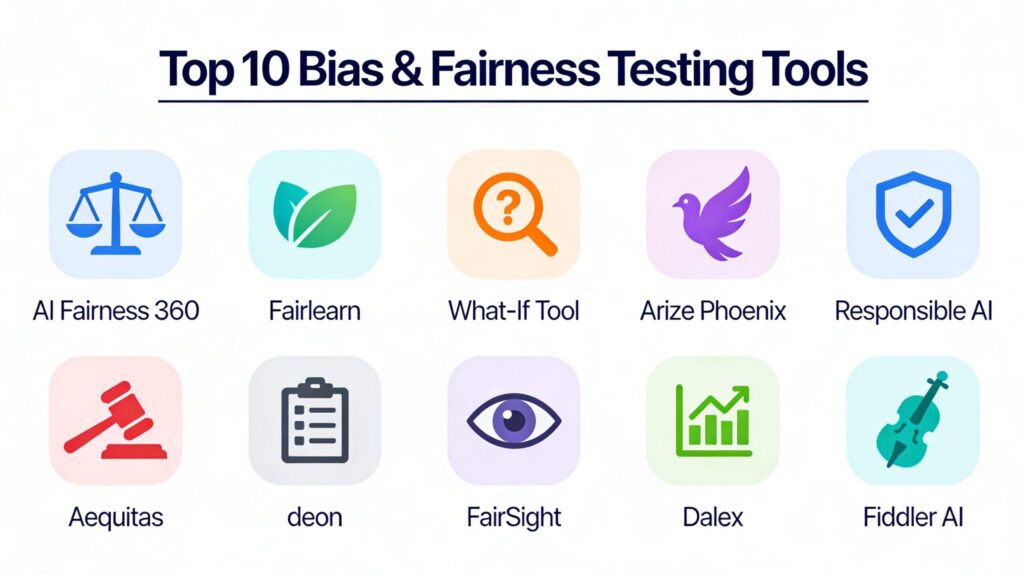
1. IBM AI Fairness 360 (AIF360)
IBM AI Fairness 360 is an expansive open-source toolkit that provides one of the most comprehensive libraries of fairness metrics and debiasing algorithms in the industry. It is designed to help researchers and developers detect and mitigate unwanted bias in machine learning models throughout the entire AI application lifecycle.
Key Features
The toolkit includes over 70 fairness metrics to test for different types of bias in datasets and models. It offers more than 10 debiasing algorithms that can be applied at various stages, including pre-processing, in-processing, and post-processing. A specialized industry-specific guidance system helps users choose the most appropriate metrics for their specific use case, such as finance or healthcare. It supports a wide range of ML frameworks and provides an interactive web demo for rapid testing. The library also includes detailed tutorials and notebooks to help users understand the underlying mathematical concepts.
Pros
It offers the most extensive collection of algorithms and metrics available in a single open-source package. The documentation is academically rigorous and provides deep educational value for teams new to AI ethics.
Cons
The sheer volume of options can be overwhelming for beginners who may struggle to choose the right metric. The learning curve is steep due to the technical nature of the implementation.
Platforms and Deployment
Python-based library; can be deployed in any environment supporting Python, including local machines and cloud clusters.
Security and Compliance
As an open-source library, security depends on the local environment; it facilitates compliance with global AI regulations through detailed audit trails.
Integrations and Ecosystem
Integrates with popular libraries like Scikit-learn, TensorFlow, and PyTorch.
Support and Community
Strong community support via GitHub and extensive documentation provided by IBM Research.
2. Fairlearn (Microsoft)
Fairlearn is a community-driven Python project initially started by Microsoft. It focuses on helping AI system developers assess and improve the fairness of their models, with a particular emphasis on the trade-offs between fairness and model performance.
Key Features
The tool provides a specialized dashboard for visualizing the disparities in model performance across different groups. It includes a variety of mitigation algorithms, such as grid search and exponentiated gradient, which seek to optimize fairness constraints during training. It allows for easy comparison between multiple models to see which one achieves the best balance of accuracy and equity. The library is built to be highly modular, allowing developers to plug in their own custom fairness definitions. It also offers a focus on “disparate impact” as a primary metric for evaluation.
Pros
The visualization dashboard makes it much easier to communicate fairness risks to non-technical business leaders. It is highly compatible with existing Scikit-learn workflows.
Cons
The set of mitigation algorithms is smaller compared to AIF360. It is primarily focused on classification and regression, with less support for other types of ML tasks.
Platforms and Deployment
Python library; works in local IDEs, Jupyter Notebooks, and cloud ML platforms.
Security and Compliance
Follows standard open-source security practices; helps meet transparency requirements under modern data laws.
Integrations and Ecosystem
Deeply integrated with Scikit-learn and the Azure Machine Learning ecosystem.
Support and Community
Very active open-source community with regular updates and clear contributing guidelines.
3. Google What-If Tool
The Google What-If Tool is an interactive visual interface designed to investigate and analyze machine learning models. It allows users to manipulate data points and observe how those changes affect model predictions, specifically to probe for bias and performance gaps.
Key Features
The tool features an intuitive “point-and-click” interface that requires no coding to analyze a model’s behavior. Users can compare two models simultaneously to see how they differ in their treatment of specific demographic groups. It includes built-in fairness optimization tools that allow users to set specific goals, such as equal opportunity or group parity. The interface allows for “counterfactual” analysis, where you can see how a prediction would change if a person’s gender or race were different. It also provides comprehensive performance charts like ROC curves and confusion matrices for each subgroup.
Pros
It is the most visual and interactive tool on the list, making it ideal for exploratory analysis. It requires minimal coding effort to get started, which is great for auditors and product managers.
Cons
It is primarily built for use within TensorBoard or Jupyter, which might limit its application in standalone production environments. Large datasets can sometimes lead to performance lag in the visual interface.
Platforms and Deployment
Web-based interface via TensorBoard, Jupyter, or Colab.
Security and Compliance
Standard Google Cloud security protocols when used in that environment; excellent for generating visual compliance reports.
Integrations and Ecosystem
Directly integrated with TensorFlow and Google Cloud AI Platform.
Support and Community
Well-maintained by Google’s PAIR (People + AI Research) team.
4. Arize Phoenix
Arize Phoenix is a modern open-source tool designed for ML observability, with a strong focus on model evaluation and fairness. It is particularly effective at identifying “performance slicing,” where a model fails specifically on a certain sub-demographic.
Key Features
It provides automated “slice discovery” to find hidden pockets of bias that developers might not have thought to look for. The tool includes specialized metrics for evaluating the fairness of large language models and unstructured data. It allows for “tracing” of data to see exactly where a biased input might be influencing the final decision. It features high-dimensional visualization to see how different data groups are clustered and treated by the model. The system is designed to handle both pre-deployment evaluation and live production monitoring.
Pros
Excellent for modern AI tasks involving LLMs and complex data structures. The automated slice discovery saves significant time during the auditing phase.
Cons
As a newer tool, it may not have the same depth of traditional “debiasing” algorithms as older toolkits. The setup can be slightly more complex for simple tabular datasets.
Platforms and Deployment
Local or self-hosted Python environment; can be integrated into CI/CD pipelines.
Security and Compliance
Self-hosted deployment allows for full data privacy; provides detailed logs for regulatory audits.
Integrations and Ecosystem
Integrates with popular orchestration tools like LlamaIndex and LangChain.
Support and Community
Rapidly growing community with excellent documentation and a modern Slack-based support channel.
5. Responsible AI Toolbox (Microsoft)
The Responsible AI Toolbox is a comprehensive suite from Microsoft that brings together several specialized tools, including Fairlearn, for a holistic approach to ethical AI. It covers not just fairness, but also interpretability and error analysis.
Key Features
The suite provides a unified dashboard that links fairness metrics directly with model explanations. It includes an “Error Analysis” component that identifies which specific data features are contributing to biased outcomes. It offers “Causal Analysis” to help developers understand if a feature is actually causing a biased result or just correlated with it. The toolbox allows for the creation of “Fairness Dashboards” that can be shared as static reports for compliance reviews. It supports a wide variety of data types, including images and text for modern deep learning tasks.
Pros
It provides the most holistic view of model health, connecting fairness with technical errors and causality. The integration between different tools in the suite is seamless.
Cons
The suite is large and can be computationally expensive to run on massive datasets. It is most effective when used within the broader Microsoft development ecosystem.
Platforms and Deployment
Python library; optimized for Azure but runs in any standard Python environment.
Security and Compliance
Enterprise-grade security features; designed specifically to help large organizations meet high compliance standards.
Integrations and Ecosystem
Strongest integration is with Azure ML and the broader Microsoft AI stack.
Support and Community
Managed by Microsoft’s research and engineering teams with significant community input.
6. Aequitas (University of Chicago)
Aequitas is an open-source bias audit toolkit developed specifically for social scientists and policymakers. It is designed to evaluate the fairness of models used in social services, criminal justice, and public policy.
Key Features
The tool provides a “Fairness Tree” to help non-experts navigate the complex world of fairness definitions and choose the right one for their project. It calculates a variety of bias metrics, including parity tests for different types of errors like false positives and false negatives. It generates a “Bias Report Card” that gives a clear visual summary of where a model passes or fails fairness tests. The library is designed to work with the outputs of any machine learning model, making it platform-agnostic. It also features a web-based tool for users who prefer not to write code.
Pros
It is the best tool for public sector and social service applications where the “cost” of different errors varies greatly. The simplified “Report Card” is excellent for transparency with the public.
Cons
It lacks the advanced “debiasing” algorithms found in AIF360. The focus is strictly on auditing rather than active mitigation during training.
Platforms and Deployment
Python library and web-based tool.
Security and Compliance
Open-source; designed specifically to meet the transparency needs of government agencies.
Integrations and Ecosystem
Works with any model output in CSV or database format.
Support and Community
Maintained by the Center for Data Science and Public Policy at the University of Chicago.
7. deon
Unlike the other technical libraries, deon is a command-line tool that focuses on the ethical process of data science. It helps teams integrate an ethics checklist into their workflow to ensure that fairness is considered from the very beginning of a project.
Key Features
It generates a customizable ethics checklist in Markdown format that can be added to a project’s repository. The checklist covers data collection, modeling, analysis, and deployment. It provides real-world examples of ethical failures for each item on the checklist to provide context to the team. The tool is designed to be integrated into the Git workflow, ensuring that an ethics review is part of the pull request process. It encourages documentation of how specific fairness risks were addressed during development.
Pros
It solves the “human” side of fairness by ensuring the team actually discusses ethics. It is incredibly lightweight and adds almost no technical overhead to a project.
Cons
It is a process tool, not a mathematical one; it does not perform any actual bias testing on the data itself. It relies entirely on the team’s honesty and diligence.
Platforms and Deployment
Command-line interface (CLI).
Security and Compliance
N/A (Process-based); excellent for internal audit documentation.
Integrations and Ecosystem
Integrates with any Git-based version control system.
Support and Community
Open-source community project with contributions from various industry ethics experts.
8. FairSight
FairSight is a visual analytics system specifically designed to help people understand the trade-offs between fairness and utility. It focuses on the “ranking” problem, which is common in hiring and university admissions.
Key Features
The tool provides a specialized visualization for ranked lists to show how different demographic groups are distributed. It allows users to “re-rank” results manually to see how much accuracy is lost when a more diverse top-ten list is required. It features a “Sensitivity Analysis” tool to show which features are having the biggest impact on a person’s rank. The interface provides a clear view of “group fairness” versus “individual fairness.” It is designed to be used by hiring committees or admissions officers who need to make final human decisions based on model scores.
Pros
The best tool for ranking-based problems, which are often neglected by other fairness toolkits. The focus on human-in-the-loop decision-making is very practical.
Cons
It is more of a specialized visualization tool than a general-purpose fairness library. It is not designed for automated production monitoring.
Platforms and Deployment
Web-based visual interface.
Security and Compliance
Depends on the hosting environment; provides excellent visual evidence for “fair hiring” compliance.
Integrations and Ecosystem
Accepts data from various model formats; best used as a final decision-support layer.
Support and Community
Academic project with community availability on GitHub.
9. Dalex
Dalex is a versatile library available for both R and Python that focuses on “Model Agnostic Language for Exploration.” It treats fairness as a core part of its model auditing suite.
Key Features
It provides a unified interface for exploring model behavior regardless of whether the model was built in Keras, H2O, or XGBoost. The “Fairness Object” in Dalex allows for quick testing of demographic parity and equalized odds. It features a unique “Four-Fifths Rule” check, which is a common legal standard for identifying hiring discrimination. The tool generates comprehensive “Model Studio” dashboards that include fairness, performance, and explainability charts. It also supports “residual analysis” to see if a model’s errors are clustered in specific demographic groups.
Pros
Excellent for teams that use both R and Python. The legal-standard checks (like the 4/5ths rule) are very useful for corporate legal departments.
Cons
The syntax can be slightly different from standard ML libraries, requiring some time to learn. The fairness component is part of a larger suite, which may feel like “overkill” for those only needing bias testing.
Platforms and Deployment
Python and R libraries.
Security and Compliance
Standard open-source security; provides robust documentation for regulatory submissions.
Integrations and Ecosystem
Works with almost all major ML frameworks across R and Python.
Support and Community
Very active community in both the R and Python data science worlds.
10. Fiddler AI
Fiddler AI is an enterprise-grade Model Monitoring and Explainability platform. It is designed for large organizations that need a centralized “control center” to monitor the fairness and performance of all their models in production.
Key Features
It provides real-time alerts when a model’s bias metrics drift outside of acceptable ranges in production. The tool includes high-end “attribution” charts that show exactly which features are driving a biased prediction. It features a centralized “Model Registry” where fairness audits for all company models are stored and tracked. It allows for “What-If” analysis on live production data to test the impact of proposed model updates. The system is built to handle massive enterprise data volumes with low latency.
Pros
The best choice for enterprise-wide governance and live production monitoring. It provides a “single source of truth” for all model fairness data across an organization.
Cons
It is a commercial platform with a significant cost, making it less accessible for small startups. The setup requires integration into the company’s data infrastructure.
Platforms and Deployment
Cloud-based (SaaS) or on-premise deployment.
Security and Compliance
SOC 2 Type II compliant; designed specifically to meet the strict auditing requirements of the financial and healthcare sectors.
Integrations and Ecosystem
Integrates with all major cloud providers (AWS, GCP, Azure) and ML platforms like Databricks and SageMaker.
Support and Community
Full enterprise support with dedicated account managers and technical success teams.
Comparison Table
| Tool Name | Best For | Platform(s) Supported | Deployment | Standout Feature | Public Rating |
| 1. AI Fairness 360 | Academic Rigor/VFX | Python | Local/Cloud | 70+ Fairness Metrics | 4.8/5 |
| 2. Fairlearn | Scikit-learn Users | Python | Local/Cloud | Performance-Fairness Trade-off | 4.7/5 |
| 3. What-If Tool | Visual/Non-coders | Web/TensorBoard | Cloud | Counterfactual Analysis | 4.6/5 |
| 4. Arize Phoenix | LLM/Unstructured | Python | Self-hosted | Automated Slice Discovery | 4.5/5 |
| 5. Responsible AI | Holistic Model Health | Python | Local/Cloud | Integrated Causal Analysis | 4.7/5 |
| 6. Aequitas | Social/Public Sector | Python/Web | Local/Web | Bias Report Card | 4.4/5 |
| 7. deon | Ethics Process | CLI | Git-integrated | Ethics Checklist | 4.3/5 |
| 8. FairSight | Human-in-the-loop | Web | Web | Interactive Re-ranking | N/A |
| 9. Dalex | R & Python Users | R, Python | Local | 4/5ths Rule Legal Check | 4.5/5 |
| 10. Fiddler AI | Enterprise Governance | Cloud/On-prem | SaaS | Live Production Monitoring | 4.8/5 |
Evaluation & Scoring of Bias & Fairness Testing Tools
The scoring below is a comparative model intended to help shortlisting. Each criterion is scored from 1–10, then a weighted total from 0–10 is calculated using the weights listed. These are analyst estimates based on typical fit and common workflow requirements, not public ratings.
Weights:
- Core features – 25%
- Ease of use – 15%
- Integrations & ecosystem – 15%
- Security & compliance – 10%
- Performance & reliability – 10%
- Support & community – 10%
- Price / value – 15%
| Tool Name | Core (25%) | Ease (15%) | Integrations (15%) | Security (10%) | Performance (10%) | Support (10%) | Value (15%) | Weighted Total |
| 1. AI Fairness 360 | 10 | 4 | 9 | 7 | 8 | 9 | 10 | 8.35 |
| 2. Fairlearn | 9 | 7 | 10 | 7 | 9 | 9 | 10 | 8.75 |
| 3. What-If Tool | 8 | 10 | 8 | 8 | 7 | 9 | 10 | 8.50 |
| 4. Arize Phoenix | 9 | 8 | 9 | 9 | 9 | 8 | 9 | 8.75 |
| 5. Responsible AI | 10 | 6 | 10 | 9 | 8 | 9 | 9 | 8.85 |
| 6. Aequitas | 7 | 9 | 6 | 7 | 8 | 8 | 10 | 7.75 |
| 7. deon | 4 | 10 | 10 | 8 | 10 | 8 | 10 | 7.80 |
| 8. FairSight | 7 | 8 | 5 | 7 | 8 | 6 | 8 | 6.95 |
| 9. Dalex | 9 | 7 | 9 | 7 | 8 | 9 | 9 | 8.45 |
| 10. Fiddler AI | 10 | 7 | 10 | 10 | 9 | 10 | 7 | 9.00 |
How to interpret the scores:
- Use the weighted total to shortlist candidates, then validate with a pilot.
- A lower score can mean specialization, not weakness.
- Security and compliance scores reflect controllability and governance fit, because certifications are often not publicly stated.
- Actual outcomes vary with assembly size, team skills, templates, and process maturity.
Which Bias & Fairness Testing Tool Is Right for You?
Solo / Freelancer
For individuals working on specialized projects, Fairlearn or Dalex provides the easiest path to integration without adding massive complexity. These tools offer a great balance of technical rigor and ease of use for a single developer.
SMB
Small businesses should focus on Arize Phoenix or the What-If Tool. These platforms offer quick insights and automated discovery features that allow a small team to perform robust audits without needing a dedicated ethics department.
Mid-Market
Organizations at this scale benefit from the Responsible AI Toolbox. It provides a holistic view of the model that goes beyond just fairness, helping teams build more reliable and explainable products as they scale.
Enterprise
For global organizations with strict regulatory oversight, Fiddler AI is the premium choice for its centralized governance and production monitoring. For enterprise research teams, AI Fairness 360 remains the gold standard for deep algorithmic testing.
Budget vs Premium
Budget: AI Fairness 360, Fairlearn, and Aequitas provide world-class testing for zero license cost.
Premium: Fiddler AI offers an end-to-end commercial platform with professional support and managed infrastructure.
Feature Depth vs Ease of Use
Depth: AI Fairness 360 and the Responsible AI Toolbox provide the most “knobs” for technical experts.
Ease: The What-If Tool and Aequitas are designed to be accessible to those who are not deep mathematics experts.
Integrations & Scalability
If your workflow is strictly Microsoft-based, the Responsible AI Toolbox is the obvious winner. For teams that need to scale monitoring across a diverse set of cloud providers and frameworks, Fiddler AI or Arize Phoenix offers the best flexibility.
Security & Compliance Needs
Organizations in finance or government should prioritize tools like Aequitas or Fiddler AI, which are built with high transparency and formal auditing in mind. deon is also a critical addition for any team needing to document their ethical process for legal reviews.
Frequently Asked Questions (FAQs)
1. What is the difference between group fairness and individual fairness?
Group fairness ensures that a model treats different demographic groups equally on average, while individual fairness ensures that two similar individuals receive similar predictions regardless of their protected attributes.
2. Can these tools automatically “fix” a biased model?
Some tools offer “mitigation” algorithms that can reduce bias during or after training, but they cannot completely “fix” a model without human oversight. Fairness often involves a trade-off with accuracy that must be managed manually.
3. Is fairness testing a one-time process during development?
No, fairness testing must be continuous. Models can “drift” over time as the data they encounter in the real world changes, which can lead to new biases appearing after the model has been deployed.
4. How do I know which fairness metric to use?
It depends on the context of your project. For example, in hiring, you might prioritize “equal opportunity,” while in criminal justice, you might focus on “predictive parity.” Tools like Aequitas offer a “Fairness Tree” to help you choose.
5. Do these tools work with images and text, or just numbers?
Modern toolkits like Arize Phoenix and the Responsible AI Toolbox have expanded to support unstructured data, helping to identify biases in computer vision and natural language processing models.
6. Is there a legal standard for what counts as “fair” in AI?
Legal standards are still evolving, but many tools include checks for the “Four-Fifths Rule,” which is a common benchmark used by the EEOC in the United States to detect disparate impact in employment.
7. Can these tools detect bias in the data collection process?
Auditing tools primarily test the resulting dataset or model. Process tools like deon are required to ensure that the collection methods themselves are reviewed for ethical flaws before the data even reaches the model.
8. What is “counterfactual analysis” in fairness testing?
Counterfactual analysis involves taking a specific data point and changing only the protected attribute (like changing “Male” to “Female”) to see if the model’s prediction changes, which is a direct test for bias.
9. How do these tools help with regulatory compliance like the EU AI Act?
They provide the technical documentation and audit logs required to prove that a model has been tested for bias and that risks have been mitigated, which is a core requirement for high-risk AI systems.
10. Do I need to be a math expert to use these tools?
While the underlying math is complex, many of these tools provide visual dashboards and “report cards” that make the results accessible to product managers, lawyers, and ethics officers.
Conclusion
The integration of bias and fairness testing tools into the modern AI stack is a fundamental shift toward mature, responsible engineering. As algorithms take on more significant roles in society, the ability to mathematically verify and visually demonstrate the equity of these systems is no longer optional. The tools selected here represent the cutting edge of both academic research and enterprise-grade monitoring, offering pathways for every type of organization to audit their impact. Success in this domain requires more than just running a script; it demands a cultural commitment to ethical oversight and a technical willingness to navigate the complex trade-offs between performance and parity. By adopting these frameworks, teams can move beyond “black-box” AI and build systems that are as equitable as they are intelligent.