Introduction
Attack Surface Management (ASM) is the practice of continuously discovering, mapping, and prioritizing everything attackers can see and reach across your organization’s digital footprint. This includes internet-facing domains, subdomains, IP ranges, cloud services, exposed apps and APIs, certificates, and misconfigurations that quietly increase risk. ASM matters because environments change daily: new cloud services appear, teams ship new web apps, vendors connect systems, and temporary exposures become permanent if nobody notices.
Typical use cases include discovering unknown internet-exposed assets, finding risky services and misconfigurations, tracking shadow IT, validating mergers and acquisition exposure, monitoring third-party and vendor exposure, and prioritizing what to fix first based on real attacker paths. When evaluating ASM, focus on discovery coverage, attribution accuracy, risk prioritization logic, context enrichment, workflow and ticketing integration, alert quality, asset ownership mapping, reporting, scalability, and operational effort.
Best for: security teams, IT ops, risk teams, and SOC teams that need continuous external visibility and prioritized remediation.
Not ideal for: teams that only need periodic vulnerability scans, or environments with very limited external presence and no web apps, cloud services, or vendor connectivity.
Key Trends in Attack Surface Management
- External discovery is becoming continuous by default, not a quarterly exercise.
- Prioritization is shifting from “most severe finding” to “most likely attacker path.”
- Asset attribution and ownership mapping are becoming as important as finding the asset.
- Exposure management is converging with vulnerability management and asset inventory practices.
- Better context enrichment is reducing noise and making tickets more actionable.
- More teams want ASM to cover subsidiaries, brands, and partner-connected systems.
- Integration depth with ticketing, SIEM, and vulnerability workflows is now a purchase driver.
- Real-time monitoring expectations are rising for ports, certificates, DNS, and service changes.
How We Selected These Tools (Methodology)
- Strong credibility and adoption signals in security teams and enterprise environments
- Clear focus on ASM or closely related external exposure management outcomes
- Continuous discovery and monitoring capabilities, not just one-time scans
- Evidence of prioritization and context enrichment beyond raw findings
- Ability to fit into operational workflows through integrations and automation patterns
- Coverage for different organization sizes and security maturity levels
- Practical reporting for leadership, risk, and remediation owners
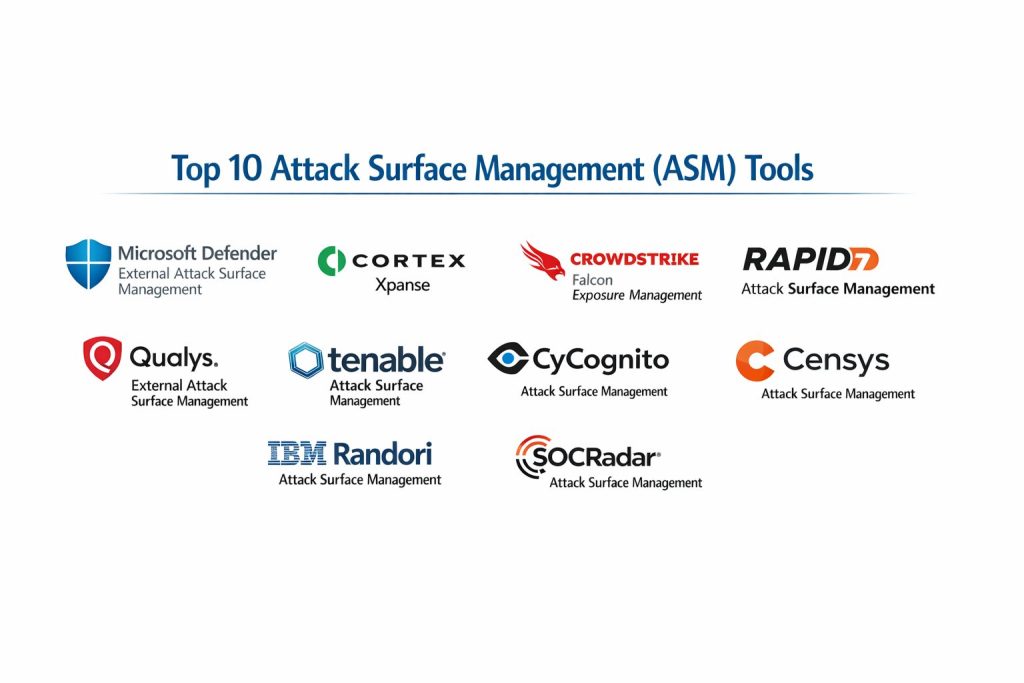
Top 10 Attack Surface Management (ASM) Tools
1 — Microsoft Defender External Attack Surface Management
A platform focused on mapping and continuously discovering internet-exposed assets, helping teams identify unknown external resources and prioritize exposures.
Key Features
- Continuous discovery of internet-exposed assets
- Asset grouping and attribution workflows
- Exposure identification with context and classification
- Monitoring for changes across the external footprint
- Risk-focused views to support prioritization
Pros
- Strong fit for teams standardizing on Microsoft security tooling
- Designed around continuous mapping and outside-in visibility
Cons
- Best value often appears when used within a broader ecosystem
- Some workflows may require process alignment to reduce noise
Platforms / Deployment
Web, Cloud
Security and Compliance
Not publicly stated
Integrations and Ecosystem
Works best when integrated into broader security operations workflows and exposure management practices.
- Security operations workflows and incident processes
- Asset and exposure management workflows
- Export and automation patterns depending on environment
Support and Community
Documentation is strong; enterprise support varies by plan and contract.
2 — Palo Alto Networks Cortex Xpanse
An active ASM solution designed to discover, learn about, and help respond to risks across internet-connected systems and exposed services.
Key Features
- Active discovery of unknown external assets
- Continuous inventory of internet-connected exposure points
- Risk identification across services and connected systems
- Prioritization support for exposure reduction
- Operational workflows aligned to discovery, learning, response
Pros
- Strong focus on active discovery at scale
- Good fit for teams that want continuous external inventory discipline
Cons
- Can require tuning to match organizational ownership structures
- Cost and packaging may be heavier for smaller teams
Platforms / Deployment
Web, Cloud
Security and Compliance
Not publicly stated
Integrations and Ecosystem
Typically used as an external visibility layer that feeds remediation and triage workflows.
- Security operations workflows
- Ticketing and remediation handoffs
- Export and automation patterns depending on environment
Support and Community
Strong vendor documentation; enterprise support and services vary.
3 — CrowdStrike Falcon Exposure Management
A unified exposure management approach that includes visibility across attack surface and risk reduction workflows, positioned to help teams reduce exposure and prioritize fixes.
Key Features
- Attack surface visibility and exposure identification
- Risk reduction workflows tied to exposure prioritization
- Consolidation approach across exposure-related capabilities
- Context to support remediation focus
- Operational reporting to track risk reduction progress
Pros
- Good fit for teams that want unified exposure workflows
- Useful for reducing fragmentation across exposure processes
Cons
- Some teams may still need separate specialist tools for niche needs
- Best outcomes require good internal asset ownership processes
Platforms / Deployment
Web, Cloud
Security and Compliance
Not publicly stated
Integrations and Ecosystem
Often deployed where teams want exposure views connected to operations and remediation.
- Security operations integrations
- Workflow automation depending on environment
- Export and reporting patterns for stakeholders
Support and Community
Documentation and support vary by plan; community is strong due to broad adoption.
4 — Rapid7 Attack Surface Management
A platform positioned around continuous visibility of the attack surface with context to help teams detect exposures and prioritize remediation across environments.
Key Features
- Continuous visibility across the attack surface
- Context enrichment to help triage exposures
- Prioritization support for remediation focus
- Consolidation patterns for asset visibility
- Reporting aligned to exposure reduction workflows
Pros
- Practical approach for teams that want visibility plus action
- Useful for aligning security and IT teams around shared exposure views
Cons
- Requires workflow discipline to translate findings into fixes
- Coverage depth can vary depending on environment and scope
Platforms / Deployment
Web, Cloud
Security and Compliance
Not publicly stated
Integrations and Ecosystem
Typically integrates into remediation workflows where ownership and ticketing are mature.
- Ticketing and remediation handoffs
- Security operations workflow alignment
- Data export patterns for reporting and review
Support and Community
Vendor support is established; community and training ecosystem are solid.
5 — Tenable Attack Surface Management
An external attack surface management capability designed to identify internet-residing assets and services attributable to your organization and provide context around posture.
Key Features
- External asset discovery and attribution
- Context enrichment for identified assets
- Monitoring for exposure changes over time
- Prioritization support for response planning
- Reporting views for external posture
Pros
- Clear focus on external discovery and visibility
- Useful for teams aligning ASM with vulnerability workflows
Cons
- Operational success depends on attribution and ownership processes
- Some teams may need additional tooling for deeper investigation paths
Platforms / Deployment
Web, Cloud
Security and Compliance
Not publicly stated
Integrations and Ecosystem
Often used as a discovery layer that supports remediation and exposure governance.
- Vulnerability and exposure workflow alignment
- Ticketing and operational handoffs
- Export patterns for governance reporting
Support and Community
Strong documentation and enterprise support options; community is broad.
6 — Qualys External Attack Surface Management
External visibility capabilities focused on monitoring internet-facing assets and supporting a broader attack surface management approach with context and reporting.
Key Features
- Discovery of internet-facing assets and services
- Monitoring of external footprint changes
- Context enrichment to reduce noise
- Risk views to guide prioritization
- Reporting for posture tracking
Pros
- Useful for teams standardizing on platform-based security operations
- Strong fit when teams want unified asset and posture views
Cons
- Requires careful rollout and scoping to avoid alert fatigue
- Some advanced workflows may need additional tuning
Platforms / Deployment
Web, Cloud
Security and Compliance
Not publicly stated
Integrations and Ecosystem
Typically fits best when integrated into broader asset and risk workflows.
- Operational workflow integrations
- Reporting and export patterns
- Remediation handoff support
Support and Community
Established enterprise vendor support; community and documentation are mature.
7 — CyCognito Attack Surface Management
A platform positioned around continuous external visibility with testing-oriented approaches and contextual risk insight to help teams focus on what matters most.
Key Features
- Continuous external discovery and mapping
- Contextual risk insight and prioritization support
- Testing-oriented approach for validating exposures
- Coverage designed for large and complex structures
- Guidance to reduce noise and focus remediation
Pros
- Strong fit for teams that want context-driven prioritization
- Useful where subsidiaries and brand structures complicate ownership
Cons
- Best value appears when teams commit to operationalizing findings
- Integration effort can vary depending on tooling stack
Platforms / Deployment
Web, Cloud
Security and Compliance
Not publicly stated
Integrations and Ecosystem
Commonly used as an outside-in visibility layer feeding remediation workflows.
- Workflow and ticketing handoffs
- Export patterns for security operations
- Ecosystem fit depends on stack maturity
Support and Community
Documentation is solid; support tiers vary; community is growing.
8 — IBM Randori Attack Surface Management
An attack surface management approach focused on discovery and prioritization from an attacker perspective, helping teams identify and reduce exposures that matter most.
Key Features
- Continuous discovery and monitoring of external assets
- Prioritization logic aligned to attacker focus
- Context to support remediation decisions
- Support for tracking changes and unexpected exposure growth
- Reporting for risk and remediation outcomes
Pros
- Useful for teams that want attacker-perspective prioritization
- Good fit where prioritization and focus are key pain points
Cons
- Requires strong collaboration with remediation owners
- Integration depth depends on the environment and processes
Platforms / Deployment
Web, Cloud
Security and Compliance
Not publicly stated
Integrations and Ecosystem
Often used as a prioritization and discovery layer that feeds security operations and remediation.
- Security workflow alignment
- Ticketing and handoff patterns
- Reporting exports for leadership and risk review
Support and Community
Enterprise support options available; community is more specialized than general tools.
9 — Censys Attack Surface Management
A solution focused on discovering and monitoring internet assets with visibility that helps teams identify unknown exposure points and track changes over time.
Key Features
- Discovery of internet-visible assets and services
- Monitoring for service and exposure changes
- Asset inventory support for external footprint tracking
- Context enrichment for investigation and triage
- Reporting views for exposure management
Pros
- Strong fit for teams that want broad internet visibility signals
- Useful for identifying unknown external services and changes
Cons
- Attribution and ownership can require extra internal work
- Some remediation workflows may need additional process design
Platforms / Deployment
Web, Cloud
Security and Compliance
Not publicly stated
Integrations and Ecosystem
Often used as a discovery and monitoring layer integrated into triage and remediation pipelines.
- Export patterns for SOC workflows
- Operational handoffs to asset owners
- Ecosystem fit depends on ticketing and governance maturity
Support and Community
Documentation is solid; community presence is growing.
10 — SOCRadar Attack Surface Management
A platform aimed at tracking digital assets and monitoring attack surface visibility with alerting and external monitoring-style capabilities.
Key Features
- External asset tracking and monitoring
- Visibility into attack surface changes over time
- Alerting designed for proactive response
- Context for understanding exposed assets
- Reporting for posture and monitoring
Pros
- Useful for continuous monitoring-focused teams
- Helpful for organizations wanting broader external visibility signals
Cons
- Some environments may require tuning for relevance and noise reduction
- Integration depth varies across different stacks
Platforms / Deployment
Web, Cloud
Security and Compliance
Not publicly stated
Integrations and Ecosystem
Typically used to feed monitoring insights into triage, ticketing, and risk reporting workflows.
- Security operations handoffs
- Reporting export patterns
- Integration depends on chosen tooling ecosystem
Support and Community
Support tiers vary; documentation is available; community is present but more niche.
Comparison Table
| Tool Name | Best For | Platform(s) Supported | Deployment | Standout Feature | Public Rating |
|---|---|---|---|---|---|
| Microsoft Defender External Attack Surface Management | Organizations wanting continuous external mapping | Web | Cloud | External asset discovery and mapping | N/A |
| Palo Alto Networks Cortex Xpanse | Active discovery at enterprise scale | Web | Cloud | Active discovery of unknown exposures | N/A |
| CrowdStrike Falcon Exposure Management | Unified exposure workflows | Web | Cloud | Consolidated exposure visibility and prioritization | N/A |
| Rapid7 Attack Surface Management | Operational visibility with context | Web | Cloud | Continuous view with remediation focus | N/A |
| Tenable Attack Surface Management | External discovery tied to exposure context | Web | Cloud | External asset attribution and context | N/A |
| Qualys External Attack Surface Management | Platform-based ASM coverage | Web | Cloud | External monitoring with posture views | N/A |
| CyCognito Attack Surface Management | Context-driven external visibility | Web | Cloud | Contextual risk insight and prioritization | N/A |
| IBM Randori Attack Surface Management | Attacker-perspective prioritization | Web | Cloud | Prioritized targets and exposure focus | N/A |
| Censys Attack Surface Management | Internet asset discovery and monitoring | Web | Cloud | Broad internet visibility and monitoring | N/A |
| SOCRadar Attack Surface Management | Monitoring-focused external visibility | Web | Cloud | Continuous monitoring and alerting | N/A |
Evaluation and Scoring of Attack Surface Management (ASM)
Scoring approach
- Scores are comparative and designed for shortlisting, not a universal verdict.
- A higher score usually indicates stronger coverage, usability, and ecosystem fit for most teams.
- Your internal tooling stack, asset ownership maturity, and workflow discipline can change outcomes.
- Use the totals to pick a shortlist, then validate with a focused pilot across real assets.
Weights used
Core features 25 percent
Ease of use 15 percent
Integrations and ecosystem 15 percent
Security and compliance 10 percent
Performance and reliability 10 percent
Support and community 10 percent
Price and value 15 percent
| Tool Name | Core (25%) | Ease (15%) | Integrations (15%) | Security (10%) | Performance (10%) | Support (10%) | Value (15%) | Weighted Total |
|---|---|---|---|---|---|---|---|---|
| Microsoft Defender External Attack Surface Management | 9 | 8 | 9 | 8 | 8 | 8 | 7 | 8.25 |
| Palo Alto Networks Cortex Xpanse | 9 | 7 | 8 | 8 | 9 | 8 | 6 | 7.90 |
| CrowdStrike Falcon Exposure Management | 8 | 8 | 8 | 8 | 8 | 8 | 6 | 7.70 |
| Rapid7 Attack Surface Management | 8 | 7 | 8 | 7 | 8 | 8 | 7 | 7.60 |
| Tenable Attack Surface Management | 8 | 7 | 8 | 7 | 8 | 7 | 7 | 7.50 |
| Qualys External Attack Surface Management | 8 | 6 | 8 | 7 | 8 | 7 | 7 | 7.35 |
| CyCognito Attack Surface Management | 8 | 7 | 7 | 7 | 8 | 7 | 6 | 7.20 |
| IBM Randori Attack Surface Management | 8 | 6 | 7 | 7 | 8 | 7 | 6 | 7.05 |
| Censys Attack Surface Management | 7 | 7 | 7 | 6 | 8 | 7 | 7 | 7.00 |
| SOCRadar Attack Surface Management | 7 | 7 | 6 | 6 | 7 | 6 | 7 | 6.65 |
Which Attack Surface Management (ASM) Tool Is Right for You
Solo or Freelancer
If you are advising smaller clients or doing lightweight external monitoring, prioritize fast setup, clear dashboards, and simple reporting. Censys Attack Surface Management and SOCRadar Attack Surface Management can fit monitoring-heavy needs, while keeping operational effort manageable.
SMB
Most small and growing teams need discovery plus practical prioritization without heavy process overhead. Rapid7 Attack Surface Management and Tenable Attack Surface Management can work well where you want clear remediation paths, ownership mapping, and steady reporting.
Mid-Market
Mid-sized organizations usually struggle with asset sprawl, subsidiaries, and inconsistent ownership. CyCognito Attack Surface Management can help where context and prioritization are needed, while Microsoft Defender External Attack Surface Management can fit well when standardizing on a cohesive security stack.
Enterprise
Large enterprises often need active discovery at scale, strong attribution, and workflow integration across many teams. Palo Alto Networks Cortex Xpanse is built for active discovery, while Microsoft Defender External Attack Surface Management can help with continuous mapping and broad visibility across a complex footprint.
Budget vs Premium
Budget-focused programs should prioritize discovery accuracy, noise reduction, and operational simplicity. Premium programs typically invest more in active discovery depth, prioritization logic, and integration into enterprise workflows where the cost of missed exposures is higher.
Feature Depth vs Ease of Use
If your team is small, ease of use and clear prioritization matter more than advanced controls. If your team is mature, deeper discovery, richer context, and stronger integration capability often provide better long-term outcomes.
Integrations and Scalability
If you already have mature vulnerability and ticketing workflows, pick a tool that cleanly feeds those processes. If you lack workflow maturity, choose a tool that helps you build ownership mapping and remediation discipline with simpler operational reporting.
Security and Compliance Needs
Treat vendor security claims carefully and validate through procurement and security review. For strict environments, focus on access controls, auditability, and secure handling of asset data, then confirm support processes and operational controls during evaluation.
Frequently Asked Questions (FAQs)
1. What is the difference between ASM and vulnerability management
ASM focuses on discovering and monitoring the full digital footprint, especially unknown and external assets. Vulnerability management typically focuses on scanning known assets for weaknesses and patching priorities.
2. What is the difference between ASM and external attack surface management
External attack surface management focuses on internet-facing assets and exposures. ASM can be broader and may include additional internal asset visibility and consolidation depending on the approach.
3. How do I know if my ASM tool is finding the right assets
Run a validation exercise using known domains, cloud accounts, and brand properties. Then confirm it finds unknowns you can verify, and measure false positives before expanding scope.
4. What are the most common mistakes when rolling out ASM
Common mistakes include unclear ownership, no ticketing process, and trying to fix everything at once. Another mistake is ignoring attribution accuracy and letting noise overwhelm the team.
5. How should I prioritize what to fix first
Prioritize exposures that are internet-reachable, high impact, and easy to exploit. Focus on assets that support critical business functions, exposed services, and repeat misconfiguration patterns.
6. Can ASM help with mergers, acquisitions, and new subsidiaries
Yes, ASM is often used to discover newly inherited exposure and unknown assets. The key is mapping ownership quickly and aligning remediation expectations across organizations.
7. How do integrations matter for ASM success
Integrations convert findings into action. Without routing issues into ticketing, vulnerability workflows, or SOC triage, ASM becomes another dashboard instead of a risk reduction engine.
8. How long does it take to see value from ASM
Teams often see early value as soon as unknown assets and high-risk exposures are confirmed. Sustained value depends on turning discoveries into repeatable remediation processes.
9. Do I still need penetration testing if I have ASM
Yes, ASM improves visibility and prioritization, while penetration testing validates real attack paths and control weaknesses. They work best together when ASM findings guide what to test next.
10. What should I ask vendors during evaluation
Ask about discovery methods, attribution accuracy, noise reduction, prioritization logic, and workflow integrations. Also ask how they handle asset ownership mapping and how they measure program outcomes.
Conclusion
Attack Surface Management works best when it is treated as a continuous operational program, not a one-time inventory project. The strongest tools help you discover unknown external assets, reduce noise through attribution and context, and convert exposures into prioritized actions that remediation owners can actually complete. Microsoft Defender External Attack Surface Management and Palo Alto Networks Cortex Xpanse are strong fits for large environments that want continuous mapping and active discovery at scale, while Rapid7 Attack Surface Management and Tenable Attack Surface Management can be practical for teams building repeatable exposure workflows. CyCognito Attack Surface Management and IBM Randori Attack Surface Management add value when prioritization and attacker perspective are key. Shortlist two or three tools, run a pilot on real domains and cloud assets, validate attribution, and confirm that workflows produce measurable risk reduction.