Introduction
Asset Tracking (RFID) Software helps organizations track physical assets using RFID tags, readers, and software dashboards. Instead of relying only on manual logs or barcode scans, RFID-based systems can identify and monitor assets faster, often with less human effort. This is especially useful for warehouses, hospitals, manufacturing plants, retail stores, schools, labs, and field operations where tools, equipment, inventory, and returnable assets move frequently.
This type of software is important because businesses want better asset visibility, fewer losses, faster audits, improved utilization, and stronger operational control. Common use cases include tracking IT equipment, medical devices, tools, pallets, containers, uniforms, and high-value inventory. Buyers should evaluate RFID hardware compatibility, real-time visibility, workflow automation, mobile support, reporting quality, integration options, scalability, deployment flexibility, user permissions, and overall implementation complexity.
Best for: operations teams, warehouse managers, IT admins, hospital administrators, manufacturing supervisors, and compliance-focused organizations that manage many movable assets.
Not ideal for: very small teams with low asset volume, low movement, or simple spreadsheet-level tracking needs where RFID setup cost and process change may not be justified.
Key Trends in Asset Tracking (RFID) Software
- More hybrid tracking models combining RFID with barcode, BLE, GPS, or IoT sensors for broader visibility
- Better mobile workflows for receiving, audits, transfers, and exception handling in the field
- Increased use of automation rules for alerts, dwell-time issues, missing assets, and maintenance triggers
- Stronger analytics dashboards focused on utilization, shrinkage, and cycle count efficiency
- Cloud-first deployments becoming common, while regulated environments still prefer controlled hosting options
- Improved RFID middleware and device management to reduce reader setup complexity
- More demand for API-first integration with ERP, CMMS, WMS, EAM, and IT asset systems
- Growing focus on role-based access and audit trails for accountability and compliance needs
- Industry-specific templates for healthcare, manufacturing, logistics, and education workflows
- Better support for large-scale deployments with multi-site visibility and standardized reporting
How We Selected These Tools (Methodology)
- Chose tools and platforms widely used or strongly recognized in RFID and enterprise asset tracking workflows
- Prioritized solutions with practical RFID support, not only generic inventory databases
- Considered fit across different environments such as healthcare, warehouse, industrial, and enterprise campuses
- Evaluated asset lifecycle coverage: check-in/check-out, location visibility, audits, transfers, and reporting
- Looked at ecosystem strength including reader compatibility, partner network, and implementation support
- Included a mix of specialized RFID solutions and broader enterprise platforms used for asset visibility
- Considered scalability for multi-site operations and high asset volume deployments
- Assessed integration readiness with ERP, CMMS, WMS, and internal systems
- Compared usability and operational fit, not just feature list size
- Scored all 10 tools comparatively using the same evaluation criteria and weights
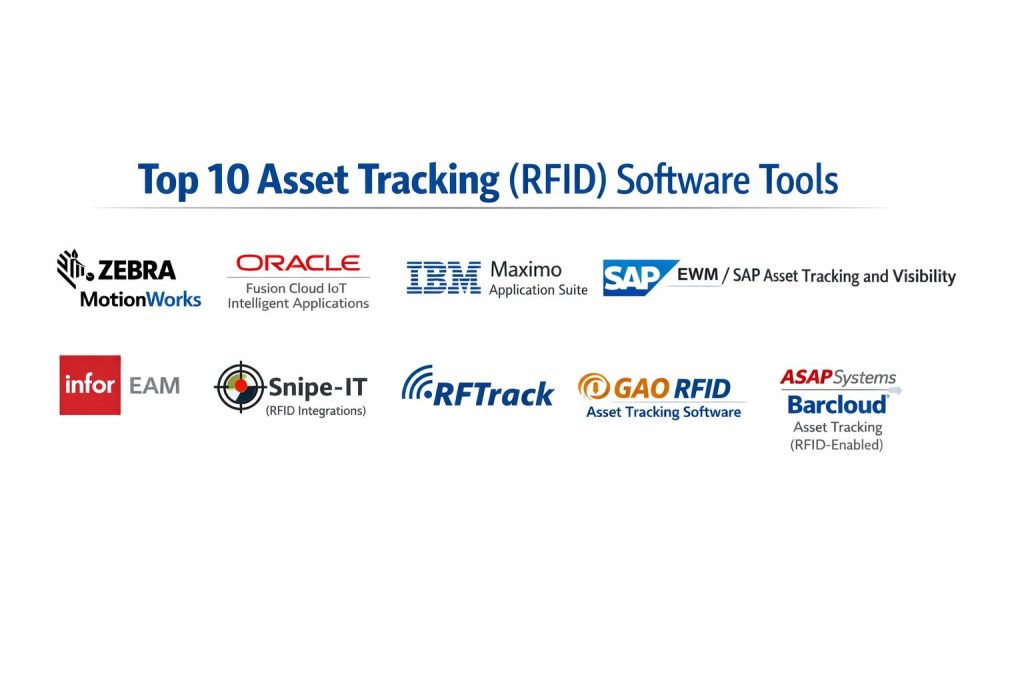
Top 10 Asset Tracking (RFID) Software Tools
1) Zebra MotionWorks
Zebra MotionWorks is an enterprise visibility platform often used for tracking assets, items, and workflows using RFID and related sensing technologies. It is a strong fit for organizations already using Zebra hardware and needing real-time operational visibility.
Key Features
- Real-time location and status visibility for tagged assets
- RFID reader and device ecosystem alignment within Zebra environments
- Event-driven alerts and workflow automation for exceptions
- Dashboards for utilization, movement, and operational analytics
- Multi-site visibility for larger operations
- Integration options through enterprise connectors and APIs (varies)
- Supports broader sensing strategies beyond RFID in some deployments
Pros
- Strong fit for enterprises using Zebra scanners, readers, and mobility devices
- Built for operational visibility and workflow action, not just static inventory records
Cons
- Implementation can require planning, site design, and partner support
- Best value often depends on broader Zebra ecosystem adoption
Platforms / Deployment
- Cloud / Hybrid (varies by implementation)
Security & Compliance
- SSO/SAML, MFA, encryption, audit logs, RBAC: Varies / Not publicly stated
- SOC 2, ISO 27001, GDPR, HIPAA: Not publicly stated
Integrations & Ecosystem
Zebra MotionWorks is commonly used with Zebra hardware and operational systems where RFID and scanning workflows are already part of the process. It is often deployed with partner-led integration projects.
- RFID readers and mobile devices compatibility within Zebra ecosystem
- API-based enterprise integration patterns (varies)
- Warehouse and operational workflow integration support (varies)
- Partner ecosystem for deployment and solution design
Support & Community
Strong enterprise and partner support model. Community discussion exists, but implementation quality often depends on the integrator and project scope.
2) Oracle Fusion Cloud IoT Intelligent Applications (Asset Monitoring)
Oracle’s IoT and enterprise application ecosystem can support asset monitoring and visibility use cases, including RFID-enabled workflows through integrated architectures. It is best suited for organizations already operating within Oracle enterprise systems.
Key Features
- Asset monitoring workflows tied to enterprise process management
- Event processing and alerts for asset state changes
- Integration with enterprise applications and analytics layers
- Scalable architecture for larger organizations
- Workflow automation tied to operational business rules
- Reporting and dashboard capabilities across sites and teams
- Strong fit for Oracle-centered digital transformation programs
Pros
- Useful for organizations wanting asset visibility tightly connected to enterprise systems
- Good enterprise scalability and process integration potential
Cons
- Can be complex for small teams or standalone RFID needs
- Implementation typically requires specialized configuration and integration effort
Platforms / Deployment
- Cloud / Hybrid (varies)
Security & Compliance
- SSO/SAML, MFA, encryption, audit logs, RBAC: Varies / Not publicly stated
- SOC 2, ISO 27001, GDPR, HIPAA: Varies / Not publicly stated
Integrations & Ecosystem
Oracle environments are often chosen for end-to-end process integration, so asset tracking workflows can be connected to ERP, analytics, and operational applications.
- Oracle enterprise application integrations
- API and middleware-based integration options
- Workflow and alerting integration with enterprise processes
- Data and analytics ecosystem alignment
Support & Community
Strong enterprise support structure and consulting ecosystem. Community support is less simple for beginners compared with smaller point solutions.
3) IBM Maximo Application Suite
IBM Maximo is a well-known enterprise asset management platform used in industrial and infrastructure-heavy environments. RFID can be part of broader asset identification and tracking workflows depending on deployment design and integrations.
Key Features
- Enterprise asset lifecycle management across maintenance and operations
- Work order, maintenance, and asset history tracking in one platform
- RFID-enabled workflows possible through integration architecture (varies)
- Strong reporting and operational visibility across asset classes
- Multi-site and enterprise-scale asset governance
- Role-based workflows and process control for complex teams
- Integration support for industrial and enterprise systems
Pros
- Strong for organizations that need asset tracking linked to maintenance and reliability
- Scales well for complex operations and regulated asset environments
Cons
- May be too heavy for simple RFID-only tracking use cases
- Implementation and customization effort can be significant
Platforms / Deployment
- Cloud / Self-hosted / Hybrid (varies)
Security & Compliance
- SSO/SAML, MFA, encryption, audit logs, RBAC: Varies / Not publicly stated
- SOC 2, ISO 27001, GDPR, HIPAA: Varies / Not publicly stated
Integrations & Ecosystem
Maximo usually operates as a core enterprise asset platform and connects to many operational systems. RFID is often one part of a wider asset data pipeline.
- Integration with enterprise asset and maintenance workflows
- APIs and middleware-based connectivity (varies)
- Support for industrial and operational data integration patterns
- Partner ecosystem for implementation and customization
Support & Community
Strong enterprise support and partner network. Community resources are available, but many deployments depend on experienced implementers.
4) SAP EWM / SAP Asset Tracking and Visibility
SAP environments support asset tracking and visibility use cases, especially in supply chain, warehouse, and enterprise operations. RFID can be included as part of broader logistics and asset movement workflows.
Key Features
- Enterprise-grade supply chain and warehouse integration options
- Asset visibility across locations and operational stages
- Event tracking and exception monitoring workflows
- Strong fit for organizations already using SAP ERP and logistics systems
- Process-driven orchestration for transfers, audits, and movement events
- Reporting and analytics across operational processes
- Scales for large multi-site environments
Pros
- Excellent fit when asset tracking must align with SAP business processes
- Strong scalability for large operational environments
Cons
- Complex for teams needing a simple standalone RFID asset tracker
- Setup and integration often require SAP expertise and project planning
Platforms / Deployment
- Cloud / Self-hosted / Hybrid (varies)
Security & Compliance
- SSO/SAML, MFA, encryption, audit logs, RBAC: Varies / Not publicly stated
- SOC 2, ISO 27001, GDPR, HIPAA: Varies / Not publicly stated
Integrations & Ecosystem
SAP-based asset visibility usually works best when connected to warehouse, procurement, and operations workflows already inside SAP.
- SAP ERP and logistics integrations
- Event and process orchestration integration patterns
- API and enterprise middleware options (varies)
- Multi-system reporting and analytics alignment
Support & Community
Strong enterprise support and consulting ecosystem. Community content exists, but successful rollouts usually require experienced SAP teams.
5) Trimble eAssets
Trimble eAssets is a fixed asset and inventory tracking platform often used by organizations managing equipment and accountable property. It supports structured asset governance and can be part of RFID-based workflows depending on deployment requirements.
Key Features
- Centralized asset records and accountability workflows
- Check-in/check-out and assignment tracking for equipment
- Audit and inventory process support
- Reporting for asset lifecycle visibility and compliance
- Multi-site asset management capabilities
- Mobile and field workflow support (varies)
- Configurable workflows for different asset programs
Pros
- Strong for accountable property and structured asset management processes
- Good fit for organizations focused on audits and asset accountability
Cons
- RFID depth depends on implementation choices and hardware integration approach
- May require process configuration to match complex environments
Platforms / Deployment
- Cloud / Self-hosted / Hybrid (varies)
Security & Compliance
- SSO/SAML, MFA, encryption, audit logs, RBAC: Varies / Not publicly stated
- SOC 2, ISO 27001, GDPR, HIPAA: Not publicly stated
Integrations & Ecosystem
Trimble eAssets is commonly used in asset accountability programs and may connect to procurement, finance, or operational systems.
- Enterprise data import/export workflows
- Integration options vary by deployment scope
- Asset lifecycle and audit reporting integration patterns
- Hardware and RFID workflow support: Varies / N/A
Support & Community
Support quality is typically vendor- and project-dependent. Community visibility is more limited than large general-purpose enterprise platforms.
6) Infor EAM
Infor EAM is an enterprise asset management platform used for maintenance, operations, and asset lifecycle processes. RFID can support identification and tracking workflows as part of a broader asset management strategy.
Key Features
- Asset lifecycle and maintenance workflow management
- Work orders, inspections, and service history tracking
- Enterprise-scale asset visibility and reporting
- Configurable workflows for operations and maintenance teams
- Multi-site and role-based operational support
- Integration options with enterprise systems and data pipelines
- Supports complex asset classes across industries
Pros
- Strong when tracking needs must connect to maintenance and service workflows
- Enterprise-grade process control for larger organizations
Cons
- More than needed for simple warehouse-only RFID tracking
- Configuration and rollout may require skilled implementation teams
Platforms / Deployment
- Cloud / Self-hosted / Hybrid (varies)
Security & Compliance
- SSO/SAML, MFA, encryption, audit logs, RBAC: Varies / Not publicly stated
- SOC 2, ISO 27001, GDPR, HIPAA: Varies / Not publicly stated
Integrations & Ecosystem
Infor EAM is often deployed as part of a broader enterprise operations stack, where tracking data supports maintenance and planning decisions.
- Enterprise application and data integration options
- API/middleware connectivity patterns (varies)
- Maintenance and operations workflow integrations
- Reporting and analytics ecosystem support
Support & Community
Strong vendor support and partner channels in enterprise contexts. Community content exists but can be less accessible for first-time buyers.
7) Snipe-IT (with RFID-enabled workflows via integrations)
Snipe-IT is a popular open-source IT asset management platform. It is not a dedicated RFID platform by itself, but many teams use it in RFID-assisted workflows through integrations, custom processes, or external hardware/software layers.
Key Features
- Asset inventory, assignment, and ownership tracking
- Check-in/check-out workflows and audit history
- User, department, and location-based asset management
- API access for integrations and automation
- Good fit for IT asset tracking and accountability
- Customizable workflows through extensions and scripts
- Strong visibility for SMB and internal IT teams
Pros
- Cost-effective and flexible for teams willing to build workflows
- Strong community and practical IT asset tracking capabilities
Cons
- Native RFID functionality is limited and depends on integrations
- Requires technical effort for enterprise-grade RFID automation workflows
Platforms / Deployment
- Self-hosted / Cloud (varies by hosting choice)
Security & Compliance
- SSO/SAML, MFA, encryption, audit logs, RBAC: Varies / Not publicly stated
- SOC 2, ISO 27001, GDPR, HIPAA: Not publicly stated
Integrations & Ecosystem
Snipe-IT is often used as a system of record while RFID capture is handled through external readers, middleware, or custom scripts.
- REST API for integration workflows
- Import/export and automation support
- Integration with identity and IT systems: Varies / N/A
- RFID workflows usually require custom integration layers
Support & Community
Strong open-source community and documentation. Formal support depends on hosting/provider arrangements and internal technical capability.
8) RFTrack
Overview
RFTrack is a specialized RFID asset tracking solution focused on physical asset visibility, inventory control, and operational tracking workflows. It is typically suited for organizations that want a more direct RFID-centric implementation.
Key Features
- RFID-based asset identification and tracking workflows
- Inventory audits and cycle count support
- Asset movement visibility across locations
- Alerts and exception management for missing or misplaced assets
- Reporting dashboards for asset status and activity
- Support for operational tagging and reader-based tracking setups
- Focused solution approach for RFID-driven asset control
Pros
- More direct fit for RFID-centric asset tracking compared with broad EAM platforms
- Can simplify deployment for organizations with clear RFID use cases
Cons
- Ecosystem breadth may be narrower than large enterprise platforms
- Advanced integrations may require vendor or partner assistance
Platforms / Deployment
- Cloud / Self-hosted / Hybrid (varies)
Security & Compliance
- SSO/SAML, MFA, encryption, audit logs, RBAC: Not publicly stated
- SOC 2, ISO 27001, GDPR, HIPAA: Not publicly stated
Integrations & Ecosystem
RFTrack is typically used for RFID-first asset workflows and may integrate with operational or enterprise systems depending on project needs.
- RFID readers and tagging workflow support
- Data export and integration options: Varies / N/A
- Operational reporting and dashboard workflows
- API/connectors: Not publicly stated
Support & Community
Vendor-led support is usually central. Community footprint is smaller than mainstream IT/EAM platforms, so support quality matters heavily.
9) GAO RFID Asset Tracking Software
GAO RFID offers RFID-focused asset tracking solutions for organizations that need equipment visibility, inventory control, and location awareness workflows. It is commonly positioned for RFID deployments with hardware and software solution pairing.
Key Features
- RFID-based asset identification and tracking
- Asset location and movement visibility workflows
- Inventory count and audit support
- Alerting for missing or out-of-zone assets (varies by setup)
- Reporting and dashboard views for asset management
- Hardware-software pairing support for RFID implementations
- Suitable for organizations adopting RFID from a vendor-led solution model
Pros
- Focused on RFID use cases with hardware-aware deployment approach
- Useful for organizations seeking guided RFID solution implementation
Cons
- Detailed platform capabilities may vary by deployment package
- Integration and customization depth may depend on project scope
Platforms / Deployment
- Cloud / Self-hosted / Hybrid (varies)
Security & Compliance
- SSO/SAML, MFA, encryption, audit logs, RBAC: Not publicly stated
- SOC 2, ISO 27001, GDPR, HIPAA: Not publicly stated
Integrations & Ecosystem
GAO RFID solutions are often implemented with hardware and software combined, which can help first-time RFID adopters.
- RFID hardware and reader integration support
- Asset reporting and monitoring workflows
- Integration with external systems: Varies / N/A
- Deployment customization through vendor services (varies)
Support & Community
Support is typically vendor-driven. Community resources are more limited, so implementation planning and vendor response quality are important.
10) ASAP Systems Barcloud Asset Tracking (RFID-enabled)
ASAP Systems Barcloud Asset Tracking is an asset tracking platform known for barcode-driven workflows and supports RFID-enabled use cases in some deployments. It is often considered by teams that want a practical asset management platform with configurable tracking methods.
Key Features
- Asset check-in/check-out and assignment tracking
- Inventory audits and location management workflows
- Configurable asset lifecycle and status management
- Mobile-friendly operational workflows (varies by setup)
- Reporting and dashboard visibility for accountability
- Barcode-first strength with RFID-enabled workflows available (varies)
- Useful for organizations transitioning from manual tracking to automated methods
Pros
- Practical asset management workflows for many business environments
- Flexible for teams using mixed barcode and RFID strategies
Cons
- RFID depth may vary depending on hardware and deployment scope
- Advanced enterprise integrations may require additional setup effort
Platforms / Deployment
- Cloud / Self-hosted / Hybrid (varies)
Security & Compliance
- SSO/SAML, MFA, encryption, audit logs, RBAC: Varies / Not publicly stated
- SOC 2, ISO 27001, GDPR, HIPAA: Not publicly stated
Integrations & Ecosystem
Barcloud is often used by organizations that need operational asset tracking and accountability without starting with a heavy EAM platform.
- Mixed tracking workflows (barcode and RFID-enabled setups)
- Import/export and operational integration support
- Mobile and field process support (varies)
- API/integration capabilities: Varies / N/A
Support & Community
Vendor support is a key factor, especially for hardware workflow alignment. Community presence exists but is not as broad as open-source or major enterprise platforms.
Comparison Table (Top 10)
| Tool Name | Best For | Platform(s) Supported | Deployment (Cloud/Self-hosted/Hybrid) | Standout Feature | Public Rating |
|---|---|---|---|---|---|
| Zebra MotionWorks | Enterprise real-time RFID visibility with Zebra ecosystem | Varies / N/A | Cloud / Hybrid (varies) | Operational visibility with RFID-centric workflows | N/A |
| Oracle Fusion Cloud IoT Intelligent Applications (Asset Monitoring) | Oracle-centric enterprise asset monitoring | Varies / N/A | Cloud / Hybrid (varies) | Tight alignment with enterprise process workflows | N/A |
| IBM Maximo Application Suite | Enterprise asset lifecycle and maintenance-linked tracking | Varies / N/A | Cloud / Self-hosted / Hybrid (varies) | Asset tracking tied to EAM and maintenance | N/A |
| SAP EWM / SAP Asset Tracking and Visibility | SAP-driven logistics and asset visibility | Varies / N/A | Cloud / Self-hosted / Hybrid (varies) | Strong enterprise supply chain integration | N/A |
| Trimble eAssets | Accountable property and structured asset governance | Varies / N/A | Cloud / Self-hosted / Hybrid (varies) | Audit and accountability-focused asset workflows | N/A |
| Infor EAM | Maintenance-connected enterprise asset tracking | Varies / N/A | Cloud / Self-hosted / Hybrid (varies) | EAM depth with operational process control | N/A |
| Snipe-IT (with RFID-enabled workflows via integrations) | Cost-conscious IT asset tracking with custom RFID workflows | Web / Varies by hosting | Self-hosted / Cloud (varies by hosting choice) | Flexible open-source asset system of record | N/A |
| RFTrack | RFID-first asset tracking deployments | Varies / N/A | Cloud / Self-hosted / Hybrid (varies) | Direct RFID-centric asset tracking focus | N/A |
| GAO RFID Asset Tracking Software | Vendor-led RFID asset tracking implementation | Varies / N/A | Cloud / Self-hosted / Hybrid (varies) | Hardware-software RFID solution approach | N/A |
| ASAP Systems Barcloud Asset Tracking (RFID-enabled) | Mixed barcode and RFID asset tracking operations | Web / Varies | Cloud / Self-hosted / Hybrid (varies) | Flexible tracking methods with practical workflows | N/A |
Evaluation & Scoring of Asset Tracking (RFID) Software
Weights: Core features 25%, Ease 15%, Integrations 15%, Security 10%, Performance 10%, Support 10%, Value 15%.
| Tool Name | Core (25%) | Ease (15%) | Integrations (15%) | Security (10%) | Performance (10%) | Support (10%) | Value (15%) | Weighted Total (0–10) |
|---|---|---|---|---|---|---|---|---|
| Zebra MotionWorks | 9.0 | 7.5 | 8.5 | 6.5 | 8.5 | 8.0 | 7.0 | 8.00 |
| Oracle Fusion Cloud IoT Intelligent Applications (Asset Monitoring) | 8.5 | 6.5 | 9.0 | 7.0 | 8.5 | 8.0 | 6.5 | 7.82 |
| IBM Maximo Application Suite | 9.0 | 6.5 | 8.5 | 7.0 | 8.5 | 8.5 | 6.5 | 7.95 |
| SAP EWM / SAP Asset Tracking and Visibility | 8.8 | 6.2 | 9.2 | 7.0 | 8.4 | 8.3 | 6.3 | 7.84 |
| Trimble eAssets | 7.8 | 7.5 | 7.2 | 6.5 | 7.8 | 7.5 | 7.5 | 7.51 |
| Infor EAM | 8.6 | 6.6 | 8.3 | 6.8 | 8.2 | 8.0 | 6.8 | 7.71 |
| Snipe-IT (with RFID-enabled workflows via integrations) | 6.8 | 8.0 | 7.8 | 6.0 | 7.2 | 8.0 | 9.2 | 7.62 |
| RFTrack | 7.9 | 7.6 | 6.8 | 5.8 | 7.8 | 7.2 | 7.6 | 7.35 |
| GAO RFID Asset Tracking Software | 7.6 | 7.2 | 6.5 | 5.8 | 7.5 | 7.0 | 7.4 | 7.13 |
| ASAP Systems Barcloud Asset Tracking (RFID-enabled) | 7.7 | 8.0 | 7.0 | 6.0 | 7.6 | 7.5 | 8.0 | 7.56 |
These scores are comparative, not absolute. A higher total usually means broader capability across different environments, but not always the best fit for your exact RFID rollout. For example, a focused RFID tool may outperform an enterprise suite in speed-to-deploy for one site, while an EAM platform may win if maintenance, compliance, and cross-department workflows matter more. Always test with your real tags, readers, asset types, and site layout before selecting a platform.
Which Asset Tracking (RFID) Software Tool Is Right for You?
Solo / Freelancer
Most solo users do not need a full RFID platform unless they manage high-value equipment with frequent movement. If you are a small internal IT team or startup ops team, Snipe-IT (with RFID-enabled workflows via integrations) can be a practical starting point because it provides strong asset accountability and can grow with custom automation.
SMB
SMBs should usually prioritize ease of deployment, audit workflows, and mixed tracking support. ASAP Systems Barcloud Asset Tracking (RFID-enabled) can be a good fit when you want practical asset tracking and may use both barcode and RFID. RFTrack may suit SMBs that want a more RFID-first approach without adopting a full enterprise asset suite.
Mid-Market
Mid-market organizations often need better process control, integrations, and reporting. Zebra MotionWorks can be a strong choice when operational visibility and Zebra hardware alignment are important. Trimble eAssets can work well for accountability-driven programs, especially where audits and property control are central.
Enterprise
Large enterprises usually need asset tracking tied to maintenance, logistics, finance, and operations. IBM Maximo Application Suite, SAP EWM / SAP Asset Tracking and Visibility, Oracle Fusion Cloud IoT Intelligent Applications (Asset Monitoring), and Infor EAM are stronger candidates when RFID data must feed enterprise-wide workflows and governance.
Budget vs Premium
If cost control is the top priority, Snipe-IT (with RFID-enabled workflows via integrations) can be attractive, but expect integration work. Premium enterprise platforms cost more yet can reduce long-term manual effort when you need cross-team workflows, auditability, and system integration at scale.
Feature Depth vs Ease of Use
Enterprise suites usually have deeper process control and broader integrations, but they can be harder to implement. Focused RFID platforms may be easier to start with, especially for single-site or limited asset classes. Choose based on rollout speed versus long-term process complexity.
Integrations & Scalability
If asset data must connect to ERP, CMMS, WMS, or service workflows, prioritize IBM Maximo Application Suite, SAP EWM / SAP Asset Tracking and Visibility, Oracle Fusion Cloud IoT Intelligent Applications (Asset Monitoring), or Infor EAM. If your first goal is just visibility and fewer lost assets, a lighter RFID-focused option may get results faster.
Security & Compliance Needs
For regulated or high-accountability environments, ask detailed questions about user roles, logging, encryption, and identity integration during evaluation. If the vendor does not clearly state security or compliance details, treat them as not confirmed and validate through procurement and internal security review.
Frequently Asked Questions
1. What is the main benefit of RFID asset tracking software over manual asset logs?
RFID can reduce manual effort, speed up audits, and improve visibility of asset movement. It is especially useful when many assets move frequently across rooms, sites, or departments.
2. Is RFID asset tracking software only for warehouses?
No. It is also useful in hospitals, schools, labs, manufacturing plants, offices, and field-service organizations. Any environment with high-value movable assets can benefit.
3. Do I need special hardware to use RFID asset tracking software?
Yes, most RFID workflows require tags, readers, and sometimes middleware. Software selection should always be matched to your hardware strategy and site conditions.
4. Can I use barcode and RFID together in one asset tracking process?
Yes, many organizations use a mixed approach. This is common when RFID is used for high-value or high-movement assets while barcodes are used for everything else.
5. Is an enterprise asset management platform better than an RFID-focused tool?
It depends on your goal. If you need maintenance, work orders, and enterprise process integration, an EAM platform may be better. If you mainly want fast RFID visibility, a focused tool may be easier.
6. What should I test in a pilot before buying?
Test read accuracy, asset movement workflows, audit speed, reporting, integration behavior, and user adoption. Also test real site conditions such as metal racks, interference, and reader placement.
7. How difficult is RFID implementation compared with regular asset software?
RFID projects usually need more planning because hardware placement and tag strategy matter. Software alone is not enough; process design and on-site testing are critical.
8. Can SMBs afford RFID asset tracking software?
Yes, but they should start with a limited scope and clear business case. A phased rollout often works better than a full-site deployment on day one.
9. What are the most common mistakes in RFID asset tracking projects?
Common mistakes include choosing software before defining workflows, skipping pilot testing, underestimating hardware setup, and ignoring user training. Poor tag strategy also causes many failures.
10. How do I choose the right tool from this list?
Start by defining asset volume, movement frequency, compliance needs, and integration requirements. Then shortlist two or three tools, run a pilot, and compare real operational outcomes before committing.
Conclusion
Choosing Asset Tracking (RFID) Software is not only about feature lists. The best choice depends on your asset types, movement patterns, site conditions, hardware strategy, and how deeply tracking must connect to maintenance, warehouse, finance, or IT workflows. Enterprise platforms like IBM Maximo Application Suite, SAP EWM / SAP Asset Tracking and Visibility, Oracle Fusion Cloud IoT Intelligent Applications (Asset Monitoring), and Infor EAM are strong when process integration matters. Focused options like RFTrack or GAO RFID Asset Tracking Software can be better for direct RFID rollout speed. Start with a pilot, validate reader performance, test real workflows, and scale only after proving operational value.