Introduction
Application Lifecycle Management suites help teams plan, build, test, release, and maintain software in a controlled, traceable way. In simple terms, an ALM suite connects requirements, development work, testing, releases, and documentation so everyone works from one trusted system. This matters because software delivery is faster, more regulated, and more distributed than ever. Without ALM discipline, teams lose traceability, quality drops, and audits become painful.
Common use cases include enterprise product development, regulated industry delivery, large program coordination, requirements-to-test traceability, and release governance across multiple teams. When selecting an ALM suite, evaluate requirements management strength, agile planning and portfolio support, test management depth, DevOps integration, reporting and traceability, security and access control, scalability, configurability, implementation effort, and total cost of ownership.
Best for: enterprises, mid-market product teams, regulated industries, and large programs that need traceability and governance.
Not ideal for: very small teams that only need a lightweight issue tracker and basic boards without formal traceability.
Key Trends in Application Lifecycle Management (ALM) Suites
- Stronger end-to-end traceability expectations from requirements through release evidence.
- More unified planning across portfolios, programs, teams, and delivery pipelines.
- AI-assisted backlog grooming, test suggestion, and risk detection in large projects.
- Increased focus on compliance-ready workflows with audit trails and approvals.
- Deeper DevOps integrations so ALM data stays connected to real delivery signals.
- Shift toward configurable templates for regulated industries and shared best practices.
- Test management moving closer to development tools while retaining governance.
- More attention to security posture, access control, and least-privilege workflows.
- Teams standardizing on fewer platforms to reduce tool sprawl and reporting gaps.
- Modern ALM adoption driven by distributed work and multi-team coordination needs.
How We Selected These Tools (Methodology)
- Selected suites with strong adoption across enterprise and mid-market teams.
- Prioritized tools with requirements, planning, and traceability capabilities.
- Considered test management depth and ability to connect tests to requirements.
- Evaluated integration breadth with DevOps workflows, repositories, and CI pipelines.
- Included platforms that support both agile delivery and governance needs.
- Balanced specialist ALM suites with widely used delivery platforms used as ALM hubs.
- Considered scalability for large programs and multi-team reporting needs.
- Considered configurability, ecosystem maturity, and support strength across segments.
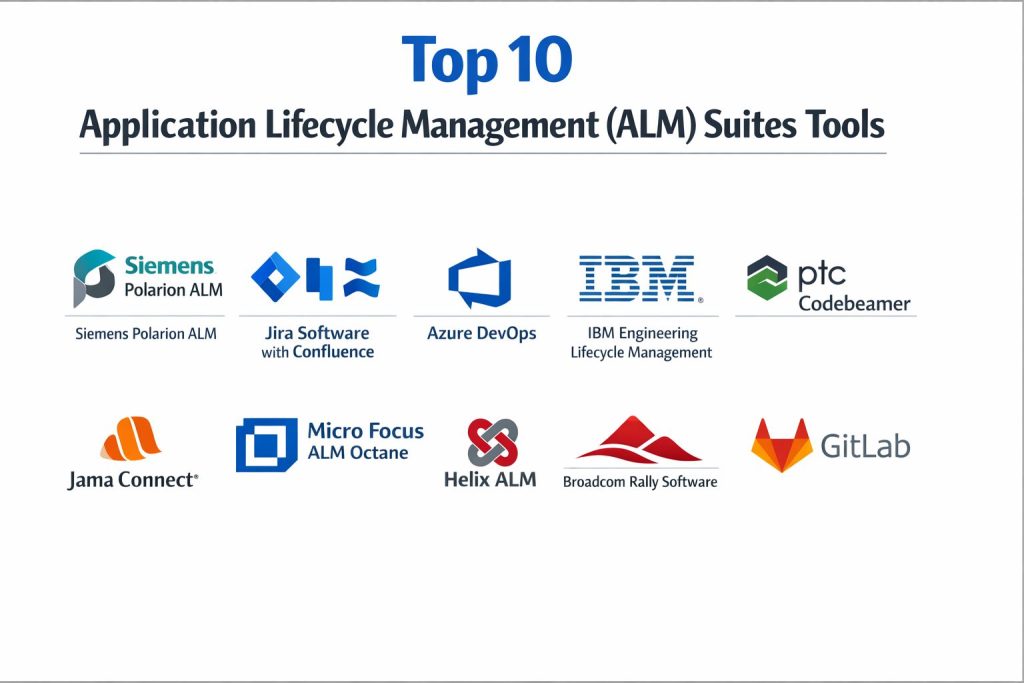
Top 10 Application Lifecycle Management (ALM) Suites
1 — Siemens Polarion ALM
A full ALM suite known for strong requirements, traceability, and governance workflows. Commonly used in regulated industries and complex engineering programs.
Key Features
- Requirements management with strong traceability
- End-to-end lifecycle workflows across teams
- Test management aligned to requirements
- Review, approvals, and audit-friendly controls
- Reporting for compliance and program governance
- Configurable templates for structured processes
Pros
- Excellent traceability and governance depth
- Strong fit for regulated and complex programs
Cons
- Implementation and configuration can take time
- Can be heavy for small teams with simple needs
Platforms / Deployment
Varies / N/A
Security and Compliance
Not publicly stated
Integrations and Ecosystem
Polarion typically fits into structured engineering ecosystems and connects with development and verification tools to maintain traceability across work products.
- Integration patterns for DevOps and engineering toolchains
- Reporting and export options for governance workflows
- Extensibility depends on deployment and configuration choices
Support and Community
Enterprise-oriented support with structured onboarding; community depth varies by region and industry.
2 — Jira Software with Confluence
A widely used combination for planning, tracking, and collaboration that many organizations extend into an ALM-style hub with add-ons and process design.
Key Features
- Agile planning with boards, backlogs, and workflows
- Cross-team coordination using projects and issue structures
- Documentation and knowledge management via Confluence
- Strong reporting and dashboarding capabilities
- Large marketplace ecosystem for ALM extensions
- Flexible workflow customization for governance needs
Pros
- Very broad adoption and strong ecosystem
- Flexible enough to fit many team styles and processes
Cons
- Full ALM traceability often needs add-ons and discipline
- Complexity can grow with customization and plugins
Platforms / Deployment
Varies / N/A
Security and Compliance
Not publicly stated
Integrations and Ecosystem
Jira and Confluence are often integrated into DevOps ecosystems and extended with marketplace apps for testing, requirements, and portfolio governance.
- Integrations across code, CI, chat, and monitoring tools
- Add-ons for requirements, test management, and reporting
- APIs and automation support for workflow standardization
Support and Community
Very large community and training resources; support tiers vary.
3 — Azure DevOps
An integrated platform covering boards, repos, pipelines, testing, and artifacts. Many teams use it as an ALM suite for planning-to-release workflows.
Key Features
- Work tracking with boards and backlogs
- Source control with repos and branching workflows
- CI and CD pipelines for automated delivery
- Test planning and manual test support
- Artifacts for package management needs
- Reporting and traceability across work items and releases
Pros
- Strong end-to-end delivery integration in one platform
- Good fit for teams standardizing on one toolset
Cons
- Requirements governance may be lighter than specialist ALM suites
- Migration and process design can require careful planning
Platforms / Deployment
Varies / N/A
Security and Compliance
Not publicly stated
Integrations and Ecosystem
Azure DevOps commonly integrates across development toolchains and supports automation that connects planning to delivery evidence.
- CI and CD integration across build and release pipelines
- Extensions for additional ALM needs
- APIs and automation for governance and reporting
Support and Community
Strong documentation and large user base; enterprise support depends on agreements.
4 — IBM Engineering Lifecycle Management
An enterprise suite designed for complex requirements, design, testing, and traceability. Common in regulated and large engineering environments.
Key Features
- Requirements, change management, and workflow governance
- Traceability across lifecycle artifacts
- Review and approval workflows for compliance
- Reporting and audit support for evidence creation
- Supports complex engineering program structures
- Strong focus on lifecycle discipline and control
Pros
- Deep traceability and governance for complex programs
- Strong fit for regulated engineering environments
Cons
- Can be complex to implement and administer
- Heavier learning curve for teams new to formal ALM
Platforms / Deployment
Varies / N/A
Security and Compliance
Not publicly stated
Integrations and Ecosystem
IBM ELM is typically used where formal lifecycle control is required and integrates into structured engineering toolchains.
- Integrations depend on enterprise setup
- Workflow configuration supports governance needs
- Reporting supports compliance evidence management
Support and Community
Enterprise-focused support; community is more specialized than general agile tools.
5 — PTC Codebeamer
An ALM suite known for requirements, risk, traceability, and compliance-driven workflows. Often used for regulated product development.
Key Features
- Requirements and risk management features
- Traceability from requirements to tests and releases
- Workflow controls with approvals and audit trails
- Test management alignment for compliance evidence
- Configurable templates for regulated delivery
- Reporting for governance and program visibility
Pros
- Strong compliance-oriented workflow support
- Good traceability depth for regulated programs
Cons
- Can feel heavy for smaller agile-only teams
- Configuration requires disciplined setup and ownership
Platforms / Deployment
Varies / N/A
Security and Compliance
Not publicly stated
Integrations and Ecosystem
Codebeamer is typically integrated into engineering ecosystems where traceability and governance must be maintained end-to-end.
- Integration patterns support development and verification flows
- Configurable workflows help standardize delivery evidence
- Extensibility depends on deployment and enterprise policies
Support and Community
Enterprise support oriented; community resources vary by region.
6 — Jama Connect
A requirements-centric ALM platform known for managing complex requirements and traceability, often used in regulated or safety-critical environments.
Key Features
- Requirements management with review workflows
- Traceability linking requirements, tests, and changes
- Collaboration features for stakeholder alignment
- Impact analysis for change management discipline
- Reporting for compliance and governance needs
- Process support for regulated product development
Pros
- Strong requirements and traceability focus
- Helps reduce risk in complex programs
Cons
- Not a complete developer platform by itself
- Often paired with other tools for full delivery workflow
Platforms / Deployment
Varies / N/A
Security and Compliance
Not publicly stated
Integrations and Ecosystem
Jama Connect typically integrates with development and test tools to keep requirements traceability connected to real delivery artifacts.
- Integrations to connect requirements and validation evidence
- Workflow support for formal reviews and approvals
- Reporting focused on traceability and risk visibility
Support and Community
Strong enterprise onboarding patterns; community is smaller than general agile platforms.
7 — Micro Focus ALM Octane
A lifecycle platform with strong test management roots and agile planning support, often used in organizations that need testing discipline and visibility.
Key Features
- Agile planning and work tracking features
- Test management and quality workflows
- Traceability across requirements, tests, and defects
- Reporting for quality, progress, and risk visibility
- Supports structured release and sprint governance
- Scales across teams needing testing discipline
Pros
- Strong quality and test management capability
- Good fit for organizations with mature QA processes
Cons
- May require integration effort for end-to-end DevOps flow
- Some teams may find it heavy compared to lightweight trackers
Platforms / Deployment
Varies / N/A
Security and Compliance
Not publicly stated
Integrations and Ecosystem
ALM Octane is often integrated into testing and delivery ecosystems to connect quality evidence with planning and release signals.
- Integrations depend on enterprise configuration
- Strong focus on quality reporting and governance
- Works best with standardized QA and release workflows
Support and Community
Enterprise support available; community depth varies.
8 — Helix ALM
A suite focused on requirements, test management, and defect tracking with traceability. Often used where structured compliance reporting is important.
Key Features
- Requirements management with traceability links
- Test management aligned to validation evidence
- Defect tracking connected to lifecycle items
- Reporting for audits and governance needs
- Process controls supporting formal delivery
- Practical for regulated product environments
Pros
- Strong traceability across requirements, tests, and defects
- Useful for compliance-oriented teams
Cons
- UI and workflows may feel structured compared to modern agile tools
- Integration strategy needs planning for DevOps alignment
Platforms / Deployment
Varies / N/A
Security and Compliance
Not publicly stated
Integrations and Ecosystem
Helix ALM is typically positioned as the governance and traceability layer that connects requirements to validation and defect evidence.
- Integrations depend on setup and toolchain choices
- Reporting supports compliance evidence needs
- Works best with disciplined lifecycle practices
Support and Community
Enterprise support is common; community is more niche than broader agile platforms.
9 — Broadcom Rally Software
A platform commonly used for agile planning at scale, portfolio visibility, and program coordination. Often adopted where multi-team alignment is the main ALM goal.
Key Features
- Agile planning across teams and programs
- Portfolio and program-level visibility
- Reporting for delivery progress and capacity
- Workflow customization for governance needs
- Supports large org structures and standardization
- Good fit for scaled agile environments
Pros
- Strong for scaled agile planning and visibility
- Works well for multi-team portfolio governance
Cons
- Requirements and test management may require additional tools
- Best value depends on organization maturity and adoption
Platforms / Deployment
Varies / N/A
Security and Compliance
Not publicly stated
Integrations and Ecosystem
Rally commonly integrates with development and CI tools to provide planning visibility that reflects actual delivery outcomes.
- Integrations depend on the enterprise toolchain
- Strong reporting for program management needs
- Works best when teams standardize work item structures
Support and Community
Enterprise support is common; community resources vary.
10 — GitLab
A unified DevOps platform that many teams use as an ALM-style system by connecting planning, code, CI, security, and delivery into one workflow.
Key Features
- Work tracking and planning workflows
- Source code management and merge workflows
- CI and CD pipelines integrated with the platform
- Security scanning and governance features vary by tier
- Reporting for delivery activity and pipeline signals
- Strong fit for developer-centric lifecycle control
Pros
- Strong end-to-end DevOps flow in one platform
- Good for teams standardizing on a single developer workflow
Cons
- Requirements and formal traceability may be lighter than specialist ALM
- Some enterprise governance needs may require process extensions
Platforms / Deployment
Varies / N/A
Security and Compliance
Not publicly stated
Integrations and Ecosystem
GitLab often serves as the center of a developer lifecycle and connects planning to delivery evidence through pipelines and governance patterns.
- Strong CI and automation ecosystem
- Integrations vary by deployment and team setup
- Works best with disciplined branching and release practices
Support and Community
Strong community and documentation; support levels vary by plan.
Comparison Table
| Tool Name | Best For | Platform(s) Supported | Deployment | Standout Feature | Public Rating |
|---|---|---|---|---|---|
| Siemens Polarion ALM | Regulated traceability and governance | Varies / N/A | Varies / N/A | Deep requirements traceability | N/A |
| Jira Software with Confluence | Flexible planning and collaboration hub | Varies / N/A | Varies / N/A | Ecosystem and extensibility | N/A |
| Azure DevOps | Plan-to-release workflows in one platform | Varies / N/A | Varies / N/A | Integrated boards, repos, pipelines | N/A |
| IBM Engineering Lifecycle Management | Complex engineering lifecycle control | Varies / N/A | Varies / N/A | Enterprise governance depth | N/A |
| PTC Codebeamer | Compliance-driven product development | Varies / N/A | Varies / N/A | Requirements and risk traceability | N/A |
| Jama Connect | Requirements-first traceability | Varies / N/A | Varies / N/A | Reviews and impact analysis | N/A |
| Micro Focus ALM Octane | Quality and test governance | Varies / N/A | Varies / N/A | Test management strength | N/A |
| Helix ALM | Requirements-test-defect traceability | Varies / N/A | Varies / N/A | Compliance evidence workflows | N/A |
| Broadcom Rally Software | Scaled agile planning visibility | Varies / N/A | Varies / N/A | Portfolio-level coordination | N/A |
| GitLab | Developer-centric lifecycle control | Varies / N/A | Varies / N/A | Unified DevOps workflow | N/A |
Evaluation and Scoring of Application Lifecycle Management (ALM) Suites
Weights
Core features 25 percent
Ease of use 15 percent
Integrations and ecosystem 15 percent
Security and compliance 10 percent
Performance and reliability 10 percent
Support and community 10 percent
Price and value 15 percent
| Tool Name | Core | Ease | Integrations | Security | Performance | Support | Value | Weighted Total |
|---|---|---|---|---|---|---|---|---|
| Siemens Polarion ALM | 9.0 | 7.0 | 8.0 | 7.0 | 8.0 | 7.5 | 6.5 | 7.83 |
| Jira Software with Confluence | 8.0 | 8.5 | 9.5 | 6.5 | 8.0 | 9.0 | 7.5 | 8.31 |
| Azure DevOps | 8.5 | 8.0 | 9.0 | 6.5 | 8.5 | 8.0 | 7.5 | 8.18 |
| IBM Engineering Lifecycle Management | 9.0 | 6.5 | 7.5 | 7.0 | 7.5 | 7.0 | 6.0 | 7.43 |
| PTC Codebeamer | 8.5 | 6.5 | 7.5 | 7.0 | 7.5 | 7.0 | 6.5 | 7.40 |
| Jama Connect | 8.0 | 7.0 | 7.5 | 7.0 | 7.5 | 7.0 | 6.5 | 7.33 |
| Micro Focus ALM Octane | 8.0 | 7.0 | 7.5 | 6.5 | 7.5 | 7.0 | 6.5 | 7.20 |
| Helix ALM | 7.5 | 6.5 | 7.0 | 6.5 | 7.0 | 6.5 | 7.0 | 6.93 |
| Broadcom Rally Software | 7.5 | 7.5 | 8.0 | 6.5 | 7.5 | 7.0 | 6.5 | 7.25 |
| GitLab | 8.0 | 7.5 | 9.0 | 6.5 | 8.5 | 8.0 | 8.0 | 8.08 |
How to interpret the scores
These scores are comparative to help you shortlist tools for a pilot. A higher total usually means broader fit across typical ALM needs, but your context matters most. Core and integrations influence long-term lifecycle traceability and automation. Ease influences adoption speed and consistency across teams. Security and compliance scores should be validated directly in your environment when details are not publicly stated.
Which Application Lifecycle Management (ALM) Suite Is Right for You
Solo or Freelancer
If you work alone or with a tiny team, a full ALM suite can be too heavy. GitLab can work well if you want planning tied directly to code and pipelines. Jira Software with Confluence can be practical if you need structured work tracking plus documentation with a flexible workflow.
SMB
Most SMBs need a balance between process and speed. Azure DevOps is strong when you want boards, repos, and pipelines in one place. Jira Software with Confluence is a good option when you need flexibility and a broad ecosystem to extend into testing or portfolio needs later.
Mid-Market
Mid-market teams often need better traceability and cross-team reporting. Azure DevOps and Jira Software with Confluence are common for scale, while Jama Connect fits well when requirements traceability becomes a formal need. If quality governance is central, Micro Focus ALM Octane can support structured testing discipline.
Enterprise
Enterprises often prioritize governance, traceability, and audit evidence. Siemens Polarion ALM, IBM Engineering Lifecycle Management, and PTC Codebeamer are strong for compliance-driven development. Broadcom Rally Software is often used for portfolio visibility in scaled agile. Many enterprises also standardize on GitLab or Azure DevOps for DevOps flow while keeping a specialist ALM for formal requirements and compliance.
Budget vs Premium
Budget-focused choices often start with Jira Software with Confluence or Azure DevOps, then add specialized capability only where needed. Premium ALM suites tend to be Polarion, IBM ELM, or Codebeamer when compliance and traceability are non-negotiable.
Feature Depth vs Ease of Use
Specialist ALM suites deliver deeper governance but often require more setup. Jira Software with Confluence is easier to adopt but needs discipline and extensions for full traceability. Azure DevOps is often a strong middle ground for teams that want lifecycle integration without maximum governance complexity.
Integrations and Scalability
GitLab and Azure DevOps often lead when you want planning tied tightly to delivery automation. Jira Software with Confluence excels in ecosystem flexibility. Specialist ALM suites can scale well for traceability, but integration work must be planned and tested early.
Security and Compliance Needs
If you operate in regulated environments, focus on traceability, audit trails, approvals, and access control. When security and compliance details are not publicly stated, treat them as validation items in your vendor review and internal security assessment before standardizing.
Frequently Asked Questions
1. What is the biggest benefit of using an ALM suite
The biggest benefit is traceability and visibility across the full lifecycle, so you can connect requirements to work, tests, and releases without losing evidence.
2. Do small teams really need ALM
Not always. Small teams may only need basic work tracking and a repository. ALM becomes valuable when coordination, quality governance, or audits become frequent.
3. How long does ALM implementation usually take
It depends on complexity. A basic rollout can be quick, while enterprise governance setups can take longer due to workflow design, integrations, and training.
4. Can ALM suites replace separate test management tools
Some can, especially those with strong quality modules. In other cases, teams keep a dedicated test tool and integrate it for traceability and reporting.
5. What are common mistakes during ALM adoption
Common mistakes include over-customizing early, skipping training, poor naming standards, and not defining ownership for workflows, fields, and governance rules.
6. How should we evaluate integrations
Test your real pipeline: repositories, CI pipelines, release evidence, and reporting. Validate whether traceability remains intact across tools and teams.
7. Is Jira with Confluence considered a real ALM
It can be used as an ALM hub when configured well and extended with add-ons. For deep regulated traceability, specialist ALM suites may still be stronger.
8. What is the difference between ALM and DevOps platforms
ALM focuses on lifecycle governance, traceability, and management across work products. DevOps platforms focus on automating build, test, security, and delivery. Many organizations use both together.
9. How do we handle compliance when details are not publicly stated
Treat compliance as a validation item. Review audit logs, access controls, evidence workflows, and security documentation directly with vendors and internal security teams.
10. What is a practical next step to choose the right ALM
Shortlist two or three tools, run a pilot on one real project, and measure adoption, traceability quality, reporting usefulness, and integration reliability before standardizing.
Conclusion
Application Lifecycle Management suites are most valuable when your teams need consistent governance, traceability, and reliable reporting across planning, delivery, and quality. Some tools lean toward deep requirements control and compliance workflows, while others excel as integrated developer delivery platforms. The right choice depends on whether your biggest pain is requirements traceability, test evidence, scaled agile visibility, or delivery automation. A smart approach is to shortlist two or three ALM candidates based on your operating model, run a focused pilot with real workflows, and validate reporting, integrations, and access control in practice. Once you prove traceability and adoption, standardize templates and training so the platform stays clean and useful over time.