Introduction
Airport Operations Management Software helps airports coordinate daily airside and landside activities such as gate planning, stand allocation, turnaround coordination, resource scheduling, and disruption response. It brings operational data into one place so teams can reduce delays, improve on-time performance, and keep stakeholders aligned across complex, fast-changing conditions.
Real-world use cases include gate and stand management, turnaround milestone tracking, de-icing coordination, allocation of ground handling resources, passenger flow monitoring, and irregular operations management during weather or capacity constraints. When evaluating options, compare: A-CDM and collaborative workflows, resource and roster planning, gate/stand optimization, real-time situational awareness, integrations with AODB/FIDS/ATC and airline systems, mobile usability for ramp teams, alerting and incident handling, reporting and performance analytics, scalability across terminals/airports, and security controls for multi-stakeholder access.
Best for: airport operators, airport operations control centers, duty managers, stand/gate planners, apron management teams, ground handling supervisors, and airport IT teams supporting operational systems.
Not ideal for: small airfields with minimal commercial traffic, or organizations that only need a single function (like staff rostering or maintenance) where a specialized point solution may be more cost-effective.
Key Trends in Airport Operations Management Software
- More real-time decision support for disruptions, with configurable playbooks and automated alerts.
- Increased collaboration workflows across airport stakeholders to improve coordination and reduce turnaround variability.
- Stronger integration expectations across operational systems, data feeds, and messaging to reduce “swivel-chair” work.
- More mobile-first execution tools for ramp and terminal teams, including task confirmations and exception reporting.
- Greater focus on performance analytics tied to KPIs like turnaround milestones, gate utilization, and delay root causes.
- Wider adoption of standard operational data models and structured event timelines to improve interoperability.
- Increased emphasis on role-based access and auditability because multiple parties share the same operational workspace.
- More automation for resource allocation and schedule adjustments under capacity constraints.
- Flexible deployment patterns to support both centralized control centers and distributed operational teams.
- Growing buyer demand for faster configuration and lower time-to-value without heavy customization.
How We Selected These Tools
- Selected tools that are widely recognized in airport operations, AODB, and operational planning contexts.
- Prioritized platforms that cover core operational workflows rather than single-function tools.
- Looked for products that can support multi-stakeholder coordination across airlines, ground handlers, and airport teams.
- Considered depth in gate/stand management, turnaround coordination, and resource planning.
- Considered integration capability as a primary selection factor due to the system-of-systems nature of airports.
- Considered scalability for multi-terminal and multi-airport environments.
- Considered operational reliability expectations for control-room usage.
- Avoided assumptions about certifications, pricing, or public ratings when not clearly known.
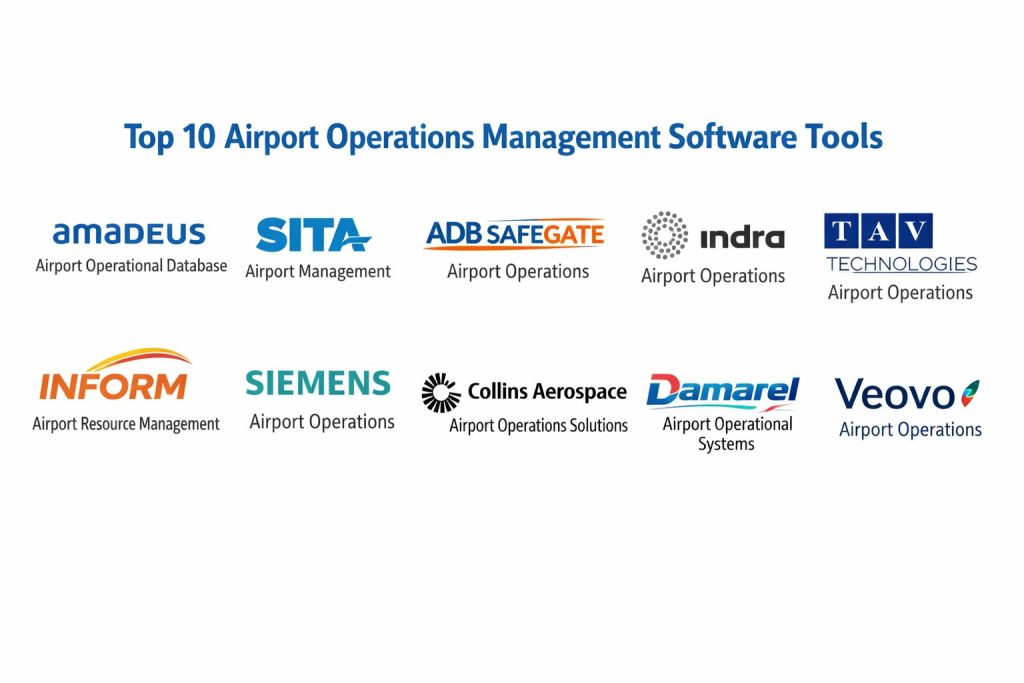
Top 10 Airport Operations Management Software Tools
1 — Amadeus Airport Operational Database
Amadeus provides airport operations systems that support coordination and visibility across flights, resources, and operational events. It is typically used by airports that want structured operational data as a foundation for planning and collaboration.
Key Features
- Operational flight data management and event tracking
- Support for coordinated airport operational workflows
- Planning and operational visibility across stakeholders
- Configurable rules and operational processes (varies)
- Reporting and operational performance views (varies)
- Integration patterns for airport systems (varies)
Pros
- Strong fit for airports needing a structured operational backbone
- Designed for multi-stakeholder airport environments
Cons
- Implementation complexity can be significant
- Some features may depend on modules and configuration
Platforms / Deployment
Varies / N/A
Security & Compliance
Not publicly stated
Integrations & Ecosystem
Typically connects with airport operational systems and stakeholder feeds to provide a shared operational picture.
- AODB-related integrations (varies)
- FIDS and operational messaging (varies)
- Airline and ground handling handoffs (varies)
- APIs and connectors (varies)
Support & Community
Commercial support; details vary by contract.
2 — SITA Airport Management
SITA offers airport management solutions designed to support airport operational workflows and stakeholder coordination. It is commonly considered by airports that need robust operational systems and integration capabilities.
Key Features
- Operational management for airport processes (varies)
- Coordination tools for airport stakeholders (varies)
- Resource planning and operational visibility (varies)
- Disruption support and operational alerts (varies)
- Reporting and operational analytics (varies)
- Integration with common airport systems (varies)
Pros
- Strong airport domain focus
- Suitable for complex operational environments
Cons
- Feature availability depends on product scope and modules
- Contracting and deployment can be enterprise-oriented
Platforms / Deployment
Varies / N/A
Security & Compliance
Not publicly stated
Integrations & Ecosystem
Typically integrates with core airport systems and communication channels to support end-to-end operations.
- FIDS/AODB ecosystem integrations (varies)
- Airline and handler coordination interfaces (varies)
- Messaging and notification channels (varies)
- APIs/connectors (varies)
Support & Community
Commercial support; onboarding varies by airport scope.
3 — ADB SAFEGATE Airport Operations
ADB SAFEGATE is known for airport operations and airside-focused solutions that help with situational awareness and operational coordination. It is commonly evaluated when airside operations, stand/gate processes, and operational control are priorities.
Key Features
- Airside operational visibility and coordination (varies)
- Stand/gate related operational workflows (varies)
- Real-time operational status views (varies)
- Alerts and exception handling (varies)
- Operational reporting (varies)
- Integration with airport operational environments (varies)
Pros
- Strong airside and operational control alignment
- Useful for operational visibility needs
Cons
- Function depth depends on configuration and modules
- Integration effort varies by existing airport stack
Platforms / Deployment
Varies / N/A
Security & Compliance
Not publicly stated
Integrations & Ecosystem
Often used alongside airside systems and operational platforms to consolidate operational awareness.
- Airside system integrations (varies)
- Operational data feeds (varies)
- Notification and escalation workflows (varies)
- APIs/connectors (varies)
Support & Community
Commercial support; details vary.
4 — Indra Airport Operations
Indra provides airport operations and management solutions used in airport modernization and operational control contexts. It is often considered for airports seeking integrated operational platforms.
Key Features
- Operational control and coordination capabilities (varies)
- Support for planning and execution workflows (varies)
- Resource-related operational tooling (varies)
- Situation monitoring and alerts (varies)
- Reporting and analytics (varies)
- Integration patterns for airport systems (varies)
Pros
- Strong enterprise delivery experience in transport contexts
- Suitable for integrated operations programs
Cons
- Customization and project scope can be significant
- Time-to-value depends on implementation approach
Platforms / Deployment
Varies / N/A
Security & Compliance
Not publicly stated
Integrations & Ecosystem
Typically positioned as part of an integrated airport technology stack with multiple system connections.
- AODB/FIDS integrations (varies)
- Airline/ground handler interfaces (varies)
- Operational data feeds (varies)
- APIs/connectors (varies)
Support & Community
Commercial support; varies by region and contract.
5 — TAV Technologies Airport Operations
TAV Technologies provides airport operations solutions focused on managing operational processes and improving coordination. It is often evaluated by airports looking for configurable operational workflows.
Key Features
- Operational process management (varies)
- Resource and operational coordination (varies)
- Stakeholder collaboration support (varies)
- Operational dashboards and reporting (varies)
- Alerts and exception workflows (varies)
- Integration capability with airport systems (varies)
Pros
- Airport-focused operational tooling
- Configuration options for local processes (varies)
Cons
- Depth and breadth depend on modules
- Integrations depend on airport system landscape
Platforms / Deployment
Varies / N/A
Security & Compliance
Not publicly stated
Integrations & Ecosystem
Commonly designed to work within an airport’s broader environment of operational systems.
- AODB/FIDS interoperability (varies)
- Stakeholder data exchange (varies)
- APIs/connectors (varies)
- Reporting exports (varies)
Support & Community
Commercial support; varies by agreement.
6 — INFORM Airport Resource Management
INFORM provides resource management solutions often used for planning and allocating airport resources. It is commonly evaluated when optimizing stands, gates, staff, and equipment is a key goal.
Key Features
- Resource planning and allocation workflows (varies)
- What-if planning and schedule adjustments (varies)
- Utilization optimization views (varies)
- Operational dashboards and reporting (varies)
- Disruption and re-planning support (varies)
- Integration into airport operations environments (varies)
Pros
- Strong focus on resource optimization
- Useful for capacity and utilization planning
Cons
- Not always a full end-to-end operations suite by itself
- Effectiveness depends on data quality and integrations
Platforms / Deployment
Varies / N/A
Security & Compliance
Not publicly stated
Integrations & Ecosystem
Typically relies on operational data feeds and connects into airport scheduling and execution processes.
- Operational data feed ingestion (varies)
- Planning and execution handoffs (varies)
- APIs/connectors (varies)
- Reporting exports (varies)
Support & Community
Commercial support; varies by plan.
7 — Siemens Airport Operations (Operations and Planning)
Siemens provides solutions used in airport operations and planning programs, often in larger modernization contexts. It is considered when airports want integrated planning, monitoring, and operational coordination.
Key Features
- Operational planning and monitoring support (varies)
- Control-center style dashboards (varies)
- Process coordination tooling (varies)
- Reporting and analytics (varies)
- Integration with airport systems (varies)
- Scalability for complex environments (varies)
Pros
- Strong enterprise integration experience
- Suitable for larger transformation programs
Cons
- Deployment may be project-heavy
- Specific capabilities depend on chosen modules
Platforms / Deployment
Varies / N/A
Security & Compliance
Not publicly stated
Integrations & Ecosystem
Typically integrates into a larger airport IT landscape with multiple systems and data feeds.
- Operational system integrations (varies)
- Data feeds and event streams (varies)
- APIs/connectors (varies)
- Reporting interfaces (varies)
Support & Community
Commercial support; varies by contract.
8 — Collins Aerospace Airport Operations Solutions
Collins Aerospace offers solutions used in aviation operations contexts, including airport-related coordination and operational support. It may be evaluated where airports align closely with aviation operational ecosystems.
Key Features
- Operational coordination tooling (varies)
- Situational awareness support (varies)
- Process and event visibility (varies)
- Reporting and analytics (varies)
- Integration patterns across aviation systems (varies)
- Scalable operational architecture (varies)
Pros
- Strong aviation domain presence
- Suitable for complex stakeholder environments
Cons
- Feature scope depends on solution configuration
- Procurement and rollout may be enterprise-oriented
Platforms / Deployment
Varies / N/A
Security & Compliance
Not publicly stated
Integrations & Ecosystem
Often positioned to connect with aviation and operational systems depending on airport context.
- Operational interfaces (varies)
- Data feed integration (varies)
- APIs/connectors (varies)
- Reporting outputs (varies)
Support & Community
Commercial support; varies by agreement.
9 — Damarel Airport Operational Systems
Damarel provides airport operational systems often focused on operational databases and operational coordination. It is commonly evaluated by airports that want improvements in operational data management and efficiency.
Key Features
- Operational data management workflows (varies)
- Coordination support for airport processes (varies)
- Dashboards for operational visibility (varies)
- Reporting and KPI tracking (varies)
- Alerting and exceptions (varies)
- Integration support for operational environments (varies)
Pros
- Strong operational domain fit
- Useful for operational visibility and data consistency
Cons
- Depth depends on configuration and airport scope
- Integrations vary by existing systems
Platforms / Deployment
Varies / N/A
Security & Compliance
Not publicly stated
Integrations & Ecosystem
Typically integrates with the airport’s operational ecosystem to share reliable flight and resource information.
- Interfaces to airport systems (varies)
- Stakeholder data exchange (varies)
- APIs/connectors (varies)
- Reporting exports (varies)
Support & Community
Commercial support; varies by plan.
10 — Veovo Airport Operations
Veovo provides airport operations and passenger flow related operational solutions. It is often considered where operational efficiency and end-to-end visibility are priorities.
Key Features
- Operational dashboards and monitoring (varies)
- Tools that support operational decision-making (varies)
- Planning and coordination workflows (varies)
- Analytics and performance monitoring (varies)
- Disruption support workflows (varies)
- Integration with airport operational data sources (varies)
Pros
- Strong focus on operational outcomes
- Useful for operational visibility and analytics
Cons
- Specific capabilities depend on product scope
- Integration effort varies by airport environment
Platforms / Deployment
Varies / N/A
Security & Compliance
Not publicly stated
Integrations & Ecosystem
Often designed to integrate with airport operational data sources to provide a unified operational view.
- Operational data integrations (varies)
- Stakeholder workflow connections (varies)
- APIs/connectors (varies)
- Reporting exports (varies)
Support & Community
Commercial support; varies by contract.
Comparison Table
| Tool Name | Best For | Platform(s) Supported | Deployment | Standout Feature | Public Rating |
|---|---|---|---|---|---|
| Amadeus Airport Operational Database | Operational backbone and shared airport data | Varies / N/A | Varies / N/A | Operational data foundation | N/A |
| SITA Airport Management | Airport operational coordination | Varies / N/A | Varies / N/A | Airport-focused operational ecosystem | N/A |
| ADB SAFEGATE Airport Operations | Airside visibility and operational coordination | Varies / N/A | Varies / N/A | Airside operations alignment | N/A |
| Indra Airport Operations | Integrated operations programs | Varies / N/A | Varies / N/A | Integrated operational delivery | N/A |
| TAV Technologies Airport Operations | Configurable airport operations workflows | Varies / N/A | Varies / N/A | Process configuration flexibility | N/A |
| INFORM Airport Resource Management | Resource planning and optimization | Varies / N/A | Varies / N/A | Resource allocation optimization | N/A |
| Siemens Airport Operations | Operations planning and monitoring | Varies / N/A | Varies / N/A | Enterprise planning and monitoring | N/A |
| Collins Aerospace Airport Operations Solutions | Aviation-aligned operational solutions | Varies / N/A | Varies / N/A | Aviation ecosystem alignment | N/A |
| Damarel Airport Operational Systems | Operational data consistency and visibility | Varies / N/A | Varies / N/A | Operational systems specialization | N/A |
| Veovo Airport Operations | Operational visibility and analytics | Varies / N/A | Varies / N/A | Operational monitoring and analytics | N/A |
Evaluation & Scoring of Airport Operations Management Software
| Tool Name | Core | Ease | Integrations | Security | Performance | Support | Value | Weighted Total |
|---|---|---|---|---|---|---|---|---|
| Amadeus Airport Operational Database | 8 | 6 | 8 | 6 | 8 | 7 | 6 | 7.05 |
| SITA Airport Management | 8 | 6 | 8 | 6 | 8 | 7 | 6 | 7.05 |
| ADB SAFEGATE Airport Operations | 7 | 6 | 7 | 6 | 8 | 7 | 6 | 6.80 |
| Indra Airport Operations | 7 | 6 | 7 | 6 | 7 | 7 | 6 | 6.70 |
| TAV Technologies Airport Operations | 7 | 6 | 7 | 6 | 7 | 7 | 6 | 6.70 |
| INFORM Airport Resource Management | 7 | 6 | 7 | 6 | 7 | 7 | 7 | 6.85 |
| Siemens Airport Operations | 7 | 5 | 7 | 6 | 7 | 7 | 6 | 6.55 |
| Collins Aerospace Airport Operations Solutions | 7 | 5 | 7 | 6 | 7 | 7 | 6 | 6.55 |
| Damarel Airport Operational Systems | 7 | 6 | 7 | 6 | 7 | 7 | 7 | 6.85 |
| Veovo Airport Operations | 7 | 6 | 7 | 6 | 7 | 7 | 7 | 6.85 |
How to interpret the scores:
- Scores are comparative and intended to support shortlisting, not to declare a universal winner.
- Core reflects breadth across airport operational workflows, while integrations reflects fit into complex airport system landscapes.
- Security is conservative due to limited publicly standardized disclosures across vendors.
- Weighted totals help compare overall balance; your priorities may shift weights based on operational maturity and stakeholder complexity.
Which Airport Operations Management Software Tool Is Right for You?
Solo / Freelancer
This category is rarely a solo purchase because airport operations tooling is designed for multi-team, multi-stakeholder environments. If you’re consulting, focus on tools with strong configuration and reporting, and validate integration readiness early.
SMB
For smaller airports, prioritize faster implementation and core workflows: operational visibility, gate/stand planning, and basic coordination. Avoid overbuying modules you can’t staff operationally.
Mid-Market
Mid-sized airports usually need stronger disruption handling, operational dashboards, and resource optimization. Prioritize tools that can integrate cleanly with existing systems and support standardized processes across shifts.
Enterprise
Large hubs benefit most from stakeholder collaboration, robust integration patterns, and governance. Prioritize operational control center usability, scalability across terminals, auditability, and clear operational KPIs.
Budget vs Premium
Budget scenarios should focus on the minimum set of capabilities that improve on-time performance and reduce manual coordination. Premium programs often justify cost through scalability, deeper integrations, and advanced planning.
Feature Depth vs Ease of Use
Airports with mature operational teams may benefit from deeper configuration and complex workflow support. Airports with limited operational IT capacity should prioritize usability, training, and a manageable rollout scope.
Integrations & Scalability
Integrations often determine success more than features. Validate how the tool connects with your flight data sources, display systems, stakeholders, and reporting stack, and confirm it can scale across your terminals and operational peaks.
Security & Compliance Needs
Treat this as a multi-system requirement: identity governance, role separation, audit trails, and secure integrations. If certifications and controls are not clearly published, treat them as not publicly stated and validate through procurement and security reviews.
Frequently Asked Questions (FAQs)
1. What does airport operations management software actually manage?
It coordinates operational workflows such as gate and stand planning, turnaround coordination, resource scheduling, and disruption response. The goal is to improve predictability and reduce operational friction across teams.
2. Is this the same as an AODB?
An AODB is often a foundational operational database of flight-related events and status. Operations management software may include an AODB component or integrate with one, depending on the product and airport architecture.
3. What are the most important features to prioritize first?
Start with operational visibility, gate/stand allocation, turnaround milestone tracking, and alerting. If those are stable, expand into resource optimization and deeper stakeholder collaboration workflows.
4. How long does implementation typically take?
It varies widely depending on airport size, integration scope, and process maturity. The biggest driver is usually integration and data quality rather than the user interface.
5. What integrations matter most for airports?
Common needs include flight data feeds, display systems, airline coordination channels, ground handling systems, and reporting/analytics. Integration readiness should be validated early because airports are highly interconnected environments.
6. Can these tools help with irregular operations?
Yes, many solutions are positioned to support disruption response through alerts, dashboards, and coordinated workflows. Effectiveness depends on real-time data availability and how well playbooks are configured.
7. How do we measure ROI for airport operations software?
Typical measures include improved on-time performance, reduced turnaround variability, better gate utilization, fewer manual coordination steps, and clearer accountability through event timelines and reporting.
8. What are common mistakes airports make when selecting a tool?
Choosing based on demos rather than real operational scenarios, underestimating integration work, and not standardizing processes across stakeholders. Another frequent issue is rolling out too many modules before the core workflows are stable.
9. What security capabilities should we expect?
Expect role-based access, secure authentication options, and auditability in mature deployments, but public disclosure varies. Validate security controls during procurement and ensure your integration layer is secured end-to-end.
10. How hard is it to switch vendors later?
Switching can be challenging because integrations, operational processes, and stakeholder training become embedded over time. Plan for data migration, process revalidation, and phased rollouts to reduce operational risk.
Conclusion
Airport operations management software is most valuable when it becomes the shared operational “source of truth” across teams that plan, execute, and monitor daily airport activity. The right choice depends on your airport’s scale, stakeholder complexity, and how much integration work you can realistically support. Focus first on operational visibility, gate and stand planning, and turnaround coordination, because those are the foundation for measurable improvements in predictability and efficiency. Then expand into resource optimization, disruption playbooks, and advanced analytics once the basics are stable. Shortlist two or three tools, run a controlled pilot with real flights and peak-time scenarios, and validate integrations, roles, and reporting before full rollout.