Introduction
AIOps platforms help IT and SRE teams detect issues faster by using analytics and automation across logs, metrics, traces, events, and alerts. In simple terms, they reduce noise, spot patterns humans miss, and guide teams to the most likely cause of incidents. This matters because modern systems create too much telemetry for manual monitoring, and downtime costs keep rising.
Common use cases include alert noise reduction, incident correlation across tools, anomaly detection, faster root-cause investigation, proactive capacity and reliability insights, and automated remediation for repeated failures. When evaluating an AIOps platform, focus on data coverage, event correlation quality, noise reduction, topology and service context, integration depth, automation options, scalability, usability for on-call teams, governance controls, and total cost to operate.
Best for: SRE teams, IT operations, platform engineering, NOC teams, and enterprises running complex hybrid or multi-cloud services.
Not ideal for: very small stacks with low alert volume, simple websites, or teams that only need basic dashboards without incident automation.
Key Trends in AIOps Platforms
- More focus on reducing alert fatigue through smarter correlation and deduplication
- Stronger root-cause hints using topology, dependency maps, and change awareness
- Wider adoption of unified observability data across logs, metrics, traces, and events
- More automation for ticketing, runbooks, and common remediation actions
- Higher expectations for integration coverage with cloud, Kubernetes, and ITSM tools
- Increased need for governance, access controls, and auditability in operations tooling
How We Selected These Tools (Methodology)
- Chose widely adopted platforms with credible enterprise use and strong mindshare
- Prioritized tools with strong event correlation, anomaly detection, and automation options
- Looked for practical integration breadth across monitoring, ITSM, incident tools, and clouds
- Considered scalability signals for high-volume telemetry and large alert streams
- Included a balanced mix of observability-first and event-correlation-first approaches
- Avoided guessing certifications and public ratings; used “Not publicly stated” or “N/A” when unclear
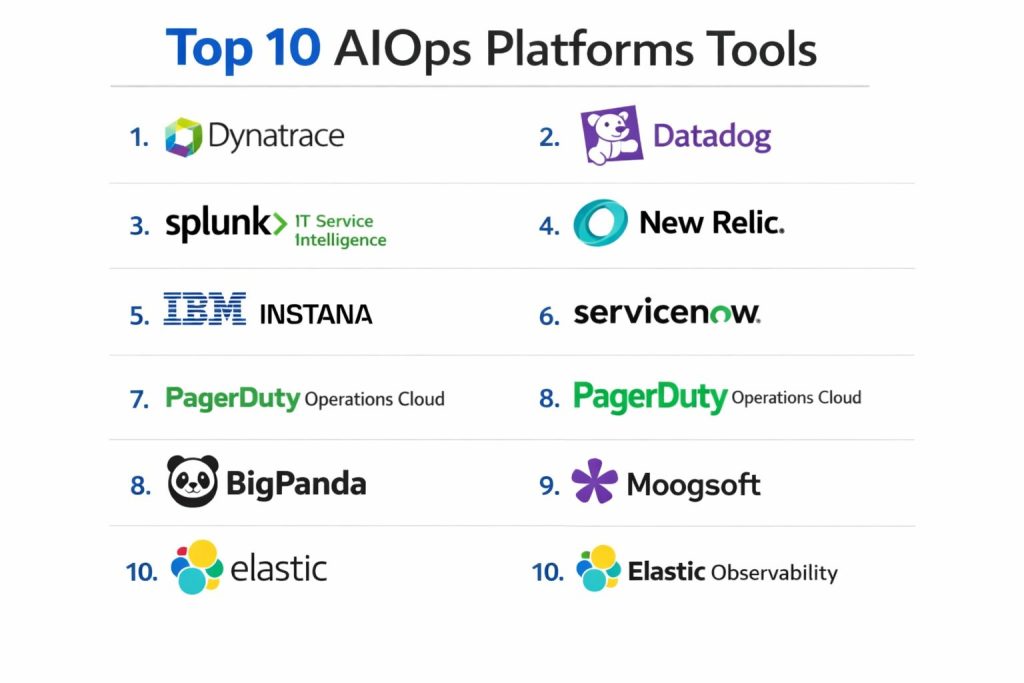
Top 10 AIOps Platforms Tools
1 — Dynatrace
Dynatrace combines observability and AIOps-style analytics to help teams detect anomalies, map dependencies, and speed up incident response across large environments.
Key Features
- Automated anomaly detection across services and infrastructure
- Dependency mapping and service context for investigations
- AI-assisted problem grouping and noise reduction
Pros
- Strong for large environments where context is hard to maintain
- Helpful for faster triage with dependency signals
Cons
- Platform breadth can increase setup time
- Cost and data volume planning can be complex
Platforms / Deployment
Windows / macOS / Linux
Cloud / Hybrid (Varies / N/A by setup)
Security & Compliance
SSO/SAML: Varies / Not publicly stated
MFA, RBAC, audit logs: Varies / Not publicly stated
Compliance: Not publicly stated
Integrations & Ecosystem
Works best when connected to core telemetry sources and incident workflows.
- Cloud and Kubernetes sources: Varies / N/A
- ITSM and alerting tools: Varies / N/A
- APIs and extensions: Varies / Not publicly stated
Support & Community
Documentation is generally strong. Support tiers vary by plan. Community strength varies.
2 — Datadog
Datadog is an observability platform that supports AIOps-like workflows through anomaly detection, alert tuning, and incident workflows across logs, metrics, and traces.
Key Features
- Anomaly detection and alert intelligence for noisy systems
- Unified views across telemetry types for faster triage
- Workflow support for incidents and on-call operations (Varies / N/A)
Pros
- Strong integration breadth for modern stacks
- Fast onboarding for common cloud and container setups
Cons
- Costs can rise with telemetry growth
- Advanced tuning may take time for high-volume orgs
Platforms / Deployment
Web / Windows / macOS / Linux
Cloud (Varies / N/A)
Security & Compliance
SSO/SAML: Varies / Not publicly stated
MFA, RBAC, audit logs: Varies / Not publicly stated
Compliance: Not publicly stated
Integrations & Ecosystem
Works well as a central hub when fed by common infrastructure and app sources.
- Cloud services and Kubernetes: Varies / N/A
- Incident and chat workflows: Varies / N/A
- APIs and app marketplace: Varies / Not publicly stated
Support & Community
Strong docs and training materials. Large user community. Support depends on plan.
3 — Splunk IT Service Intelligence
Splunk IT Service Intelligence focuses on service health, event correlation, and operational analytics built around machine data and service-level views.
Key Features
- Service health modeling and KPI-based monitoring
- Event correlation and alert noise reduction patterns
- Strong analytics across machine data sources (Varies / N/A)
Pros
- Good for service health views and operational dashboards
- Useful for organizations already invested in Splunk data
Cons
- Setup and service modeling requires planning
- Data and licensing considerations can be complex
Platforms / Deployment
Varies / N/A
Self-hosted / Cloud (Varies / N/A)
Security & Compliance
SSO/SAML: Varies / Not publicly stated
MFA, RBAC, audit logs: Varies / Not publicly stated
Compliance: Not publicly stated
Integrations & Ecosystem
Often used where Splunk data pipelines are already mature.
- Ingest from logs and events: Varies / N/A
- ITSM and alerting workflows: Varies / N/A
- Apps and add-ons: Varies / Not publicly stated
Support & Community
Strong ecosystem in Splunk-heavy organizations. Support tiers vary by plan.
4 — New Relic
New Relic provides observability with features that support anomaly detection, incident investigation, and operational workflows for engineering teams.
Key Features
- Cross-telemetry visibility for faster triage
- Alert tuning and anomaly signals (Varies / N/A)
- Dashboards and workflow automation options (Varies / N/A)
Pros
- Useful for app-focused teams that want quick visibility
- Broad support for modern monitoring patterns
Cons
- Requires discipline in instrumentation and naming
- Some AIOps-style outcomes depend on configuration quality
Platforms / Deployment
Web / Windows / macOS / Linux
Cloud (Varies / N/A)
Security & Compliance
SSO/SAML: Varies / Not publicly stated
MFA, RBAC, audit logs: Varies / Not publicly stated
Compliance: Not publicly stated
Integrations & Ecosystem
Works best when connected to app telemetry and incident processes.
- Agents and integrations: Varies / N/A
- APIs and automation hooks: Varies / Not publicly stated
- ITSM and alert routing: Varies / N/A
Support & Community
Good documentation and user community. Support tiers vary.
5 — IBM Instana
IBM Instana focuses on application performance monitoring with automation-friendly insights that help operations teams detect issues and reduce time to identify root cause.
Key Features
- Automated discovery of services and dependencies (Varies / N/A)
- Intelligent incident signals across application stacks
- Performance analytics for service reliability work
Pros
- Strong for application-centric incident triage
- Helpful for dependency-aware investigations
Cons
- Deployment and scaling decisions require planning
- Integration depth depends on environment choices
Platforms / Deployment
Windows / macOS / Linux
Cloud / Self-hosted / Hybrid (Varies / N/A)
Security & Compliance
SSO/SAML: Varies / Not publicly stated
MFA, RBAC, audit logs: Varies / Not publicly stated
Compliance: Not publicly stated
Integrations & Ecosystem
Often paired with incident workflows and enterprise monitoring setups.
- App and infrastructure integrations: Varies / N/A
- APIs and extensibility: Varies / Not publicly stated
- ITSM connectivity: Varies / N/A
Support & Community
Support varies by plan. Documentation quality is generally good. Community varies.
6 — ServiceNow IT Operations Management
ServiceNow IT Operations Management focuses on operations visibility, event management, and workflows connected to ITSM, CMDB, and service processes.
Key Features
- Event management and alert handling workflows
- Operational context through service and asset records (Varies / N/A)
- Ticketing and automation tied to ITSM processes
Pros
- Strong for organizations already using ServiceNow ITSM
- Useful for governance-heavy operations and standardized workflows
Cons
- Value depends on CMDB and process maturity
- Setup can be heavy for smaller teams
Platforms / Deployment
Web
Cloud (Varies / N/A)
Security & Compliance
SSO/SAML: Varies / Not publicly stated
MFA, RBAC, audit logs: Varies / Not publicly stated
Compliance: Not publicly stated
Integrations & Ecosystem
Best when integrated with monitoring sources and service workflows.
- Monitoring and event sources: Varies / N/A
- ITSM-native workflows: Strong fit
- APIs and connectors: Varies / Not publicly stated
Support & Community
Strong enterprise ecosystem. Implementation partners are common. Support varies by plan.
7 — PagerDuty Operations Cloud
PagerDuty Operations Cloud centers on incident response, on-call workflows, and operational automation, with intelligence features to reduce noise and speed response.
Key Features
- Alert deduplication, routing, and on-call orchestration
- Incident workflows and response automation (Varies / N/A)
- Operational analytics for response performance insights
Pros
- Strong for on-call teams and incident coordination
- Integrates well into alerting and escalation workflows
Cons
- Not a full observability platform by itself
- AIOps outcomes depend on data quality from upstream tools
Platforms / Deployment
Web / iOS / Android
Cloud
Security & Compliance
SSO/SAML: Varies / Not publicly stated
MFA, RBAC, audit logs: Varies / Not publicly stated
Compliance: Not publicly stated
Integrations & Ecosystem
Often sits between monitoring tools and responders as the workflow layer.
- Monitoring integrations: Varies / N/A
- ITSM and chatops: Varies / N/A
- APIs and automation: Varies / Not publicly stated
Support & Community
Strong documentation and common adoption in on-call teams. Support tiers vary.
8 — BigPanda
BigPanda focuses on event correlation, incident intelligence, and noise reduction by grouping alerts into higher-quality incidents for operations teams.
Key Features
- Event correlation and deduplication for alert flood reduction
- Incident grouping aligned to services and environments (Varies / N/A)
- Operational workflows for triage and handoffs
Pros
- Strong for turning noisy alerts into actionable incidents
- Useful as a layer across many monitoring tools
Cons
- Depends on good integration coverage and consistent metadata
- Not a replacement for deep observability instrumentation
Platforms / Deployment
Web
Cloud (Varies / N/A)
Security & Compliance
SSO/SAML: Varies / Not publicly stated
MFA, RBAC, audit logs: Varies / Not publicly stated
Compliance: Not publicly stated
Integrations & Ecosystem
Designed to connect multiple monitoring sources into a single incident view.
- Monitoring sources: Varies / N/A
- ITSM and paging tools: Varies / N/A
- APIs: Varies / Not publicly stated
Support & Community
Support varies by plan. Community presence varies by region and segment.
9 — Moogsoft
Moogsoft is known for AIOps event correlation and noise reduction, aiming to improve incident quality through clustering and operational intelligence.
Key Features
- Alert clustering and correlation to reduce noise
- Incident prioritization support (Varies / N/A)
- Workflow support for operations triage (Varies / N/A)
Pros
- Useful for organizations struggling with alert overload
- Helps improve signal-to-noise when well integrated
Cons
- Requires careful configuration to match operational reality
- Integration and adoption effort can be significant
Platforms / Deployment
Varies / N/A
Cloud / Self-hosted (Varies / N/A)
Security & Compliance
SSO/SAML: Varies / Not publicly stated
MFA, RBAC, audit logs: Varies / Not publicly stated
Compliance: Not publicly stated
Integrations & Ecosystem
Often positioned as the correlation layer above monitoring tools.
- Monitoring and event inputs: Varies / N/A
- ITSM and incident tools: Varies / N/A
- Extensibility: Varies / Not publicly stated
Support & Community
Support tiers vary. Community strength varies compared to larger observability suites.
10 — Elastic Observability
Elastic Observability combines logs, metrics, traces, and analytics, with features that can support anomaly detection and operational insights depending on configuration.
Key Features
- Unified search and analysis across telemetry types
- ML-style anomaly capabilities: Varies / N/A
- Flexible dashboards and investigation workflows
Pros
- Strong for teams that want flexible search and analytics
- Useful for cost-conscious architectures when well managed
Cons
- Requires tuning, data discipline, and pipeline ownership
- Outcomes depend on how well data is modeled and maintained
Platforms / Deployment
Windows / macOS / Linux
Cloud / Self-hosted / Hybrid (Varies / N/A)
Security & Compliance
SSO/SAML: Varies / Not publicly stated
MFA, RBAC, audit logs: Varies / Not publicly stated
Compliance: Not publicly stated
Integrations & Ecosystem
Fits best when you control ingestion pipelines and standardize fields.
- Data ingestion sources: Varies / N/A
- APIs and pipelines: Varies / Not publicly stated
- ITSM and alert routing: Varies / N/A
Support & Community
Strong developer community. Support depends on plan and deployment choice.
Comparison Table
| Tool Name | Best For | Platform(s) Supported | Deployment | Standout Feature | Public Rating |
|---|---|---|---|---|---|
| Dynatrace | Enterprise observability with AI insights | Windows / macOS / Linux | Cloud / Hybrid (Varies / N/A) | Dependency-aware problem grouping | N/A |
| Datadog | Cloud-first teams needing unified telemetry | Web / Windows / macOS / Linux | Cloud (Varies / N/A) | Broad integrations and fast onboarding | N/A |
| Splunk IT Service Intelligence | Service health modeling and ops analytics | Varies / N/A | Self-hosted / Cloud (Varies / N/A) | KPI and service health views | N/A |
| New Relic | App-focused observability teams | Web / Windows / macOS / Linux | Cloud (Varies / N/A) | Cross-telemetry investigations | N/A |
| IBM Instana | App dependency visibility and triage | Windows / macOS / Linux | Cloud / Self-hosted / Hybrid (Varies / N/A) | Automated discovery signals | N/A |
| ServiceNow IT Operations Management | ITSM-centered operations workflows | Web | Cloud (Varies / N/A) | ITSM-connected event workflows | N/A |
| PagerDuty Operations Cloud | Incident response and on-call operations | Web / iOS / Android | Cloud | On-call orchestration and routing | N/A |
| BigPanda | Event correlation across monitoring tools | Web | Cloud (Varies / N/A) | Noise reduction through correlation | N/A |
| Moogsoft | AIOps correlation and alert clustering | Varies / N/A | Cloud / Self-hosted (Varies / N/A) | Alert clustering into incidents | N/A |
| Elastic Observability | Flexible telemetry search and analytics | Windows / macOS / Linux | Cloud / Self-hosted / Hybrid (Varies / N/A) | Search-first investigations | N/A |
Evaluation & Scoring of AIOps Platforms
This scorecard helps you compare tools side by side. Higher weighted totals typically indicate stronger overall fit across more common scenarios, but your best choice depends on your goals. If you prioritize incident workflows, the incident layer may matter more than deep telemetry. If you prioritize root-cause analysis, topology and trace context may matter more. Use the table to shortlist, then validate with a pilot using real alerts, real services, and real escalation paths.
Weights used
Core features 25%
Ease of use 15%
Integrations and ecosystem 15%
Security and compliance 10%
Performance and reliability 10%
Support and community 10%
Price and value 15%
| Tool Name | Core (25%) | Ease (15%) | Integrations (15%) | Security (10%) | Performance (10%) | Support (10%) | Value (15%) | Weighted Total (0–10) |
|---|---|---|---|---|---|---|---|---|
| Dynatrace | 9 | 7 | 8 | 6 | 8 | 7 | 6 | 7.6 |
| Datadog | 8 | 8 | 9 | 6 | 8 | 8 | 7 | 7.9 |
| Splunk IT Service Intelligence | 8 | 6 | 8 | 6 | 7 | 7 | 5 | 6.9 |
| New Relic | 7 | 8 | 8 | 6 | 7 | 7 | 7 | 7.3 |
| IBM Instana | 8 | 7 | 7 | 6 | 7 | 6 | 6 | 6.9 |
| ServiceNow IT Operations Management | 7 | 6 | 8 | 6 | 7 | 7 | 6 | 6.8 |
| PagerDuty Operations Cloud | 7 | 8 | 8 | 6 | 7 | 8 | 7 | 7.3 |
| BigPanda | 7 | 7 | 8 | 5 | 7 | 6 | 6 | 6.8 |
| Moogsoft | 7 | 6 | 7 | 5 | 7 | 6 | 6 | 6.5 |
| Elastic Observability | 7 | 6 | 7 | 5 | 7 | 7 | 7 | 6.8 |
Which AIOps Platform Is Right for You
Solo / Freelancer
Most solo users do not need a dedicated AIOps platform. If you still want operational insights for a small stack, choose something simple that provides dashboards and basic alerting. Elastic Observability can work if you can manage ingestion and keep data tidy, but it requires ownership.
SMB
SMBs usually need fast setup, practical alerting, and predictable costs. Datadog and New Relic are often chosen for quick visibility when teams are small and time is limited. PagerDuty Operations Cloud is strong if your biggest pain is on-call coordination and noisy alert routing.
Mid-Market
Mid-market teams often need correlation across multiple tools and more reliable incident quality. BigPanda or Moogsoft can help reduce noise and group alerts into real incidents. If you want deeper dependency-aware investigations, Dynatrace or IBM Instana can be a stronger fit.
Enterprise
Enterprises often need both telemetry depth and workflow governance. Dynatrace and Splunk IT Service Intelligence are common in complex environments where service health and scale matter. ServiceNow IT Operations Management is a strong fit when ITSM workflows, approvals, and CMDB-backed processes are core requirements.
Budget vs Premium
If budget is tight, prioritize fewer tools with better coverage rather than stacking too many point products. Elastic Observability can be cost-effective when you have strong internal ownership. Premium setups often combine deep observability with an incident workflow layer.
Feature Depth vs Ease of Use
If you want quick wins and easy onboarding, Datadog and New Relic tend to feel simpler for many teams. If you want deeper correlation and topology-driven investigations, Dynatrace can provide more depth but usually needs more setup discipline.
Integrations & Scalability
If you already run many monitoring tools, an event correlation layer like BigPanda or Moogsoft can unify incident signals. If you want a single platform approach, Datadog or Dynatrace can be stronger, depending on your environment and telemetry strategy.
Security & Compliance Needs
If you require strict governance, plan for RBAC, access controls, auditability, and change management around the platform. Many compliance details are not publicly stated at tool level, so you should validate security features during a pilot and align them with your internal policies.
Frequently Asked Questions (FAQs)
1. What problem does AIOps solve first in most teams
Most teams see the biggest benefit in alert noise reduction and faster triage. The platform helps group related signals and point responders to what changed.
2. Do I need full observability to use AIOps
Not always, but better data improves results. AIOps works best when logs, metrics, traces, and events are consistent and well tagged.
3. How long does implementation usually take
It depends on integrations and data hygiene. A basic setup can be quick, but correlation quality improves over time with tuning.
4. What are the most common mistakes
Feeding inconsistent data, skipping service mapping, and expecting automation to work without clear runbooks. Another mistake is not piloting with real incidents.
5. Can AIOps replace on-call engineers
No. It reduces manual effort and noise, but humans still make decisions, validate impact, and coordinate changes during incidents.
6. How do I measure success after rollout
Track alert volume reduction, time to detect, time to acknowledge, time to resolve, and incident recurrence. Also track fewer false escalations.
7. Does AIOps work for Kubernetes and microservices
Yes, but it depends on integration quality and consistent labeling. Microservices benefit strongly from dependency context and change awareness.
8. What should I validate in a pilot
Ingest your real alerts, run through incident workflows, test correlation accuracy, check routing, and verify integrations with ITSM and paging.
9. How should I think about security and access control
Validate RBAC, audit logs, SSO options, and data retention controls. If details are not publicly stated, confirm during vendor review and testing.
10. Can I use an event correlation tool with an observability platform
Yes, many teams combine them. One handles deep telemetry and investigation, while the other improves incident quality and workflow routing.
Conclusion
AIOps platforms are most valuable when they reduce alert fatigue, improve incident quality, and help teams find the likely cause faster. The best choice depends on your operating model. If you want deep observability with AI-assisted triage, platforms like Datadog, Dynatrace, New Relic, IBM Instana, and Elastic Observability are common paths. If your biggest pain is noisy alerts from many tools, correlation-focused platforms like BigPanda or Moogsoft can help. If process governance is central, ServiceNow IT Operations Management is often a natural fit, and PagerDuty Operations Cloud is strong for on-call workflows. Shortlist two or three, run a pilot using real services and real alerts, and validate integrations, routing, and access controls before standardizing.