Introduction
Age verification tools are critical digital gatekeepers designed to ensure that users accessing restricted content or products meet specific legal age requirements. These systems utilize a variety of methods, from database cross-referencing to sophisticated biometric analysis, to confirm a user’s date of birth in real-time. In a landscape where digital safety is a primary concern, these tools provide a necessary layer of protection for minors while helping businesses avoid severe legal penalties. Organizations across industries like e-commerce, gaming, social media, and fintech rely on these solutions to maintain a safe and compliant online environment.
The necessity of robust age assurance has increased as global regulations become more stringent. Governments worldwide are introducing mandates that require platforms to move beyond simple self-declaration boxes. Modern tools now focus on reducing friction for legitimate users while maintaining high accuracy in detecting underage individuals. When selecting a tool, enterprises must evaluate the balance between user privacy, geographic coverage, and the technical complexity of the integration. A well-implemented age verification strategy not only ensures compliance but also builds long-term consumer trust by demonstrating a commitment to digital ethics and safety.
Best for: Online retailers of age-restricted goods, social media platforms, online gaming operators, and financial services requiring strict KYC and age-gating protocols.
Not ideal for: General-purpose websites with no restricted content or platforms looking for simple, non-binding user declarations without legal compliance needs.
Key Trends in Age Verification Software
The most significant trend is the shift toward AI-powered facial age estimation, which allows users to verify their age using a quick selfie without needing to upload sensitive identity documents. This “privacy-by-design” approach is gaining traction as it minimizes the collection of personally identifiable information. Additionally, there is a growing move toward reusable digital identities, where a user verifies their age once and can then use that verified status across multiple partner platforms seamlessly.
Real-time liveness detection has also become a standard feature to combat increasingly sophisticated fraud attempts, such as the use of deepfakes or high-resolution photos to bypass camera checks. We are also seeing a consolidation of age verification with broader identity platforms, allowing businesses to manage age-gating and anti-money laundering checks through a single interface. Finally, there is a push for global interoperability, ensuring that a tool can accurately verify documents and data from hundreds of different countries and jurisdictions.
How We Selected These Tools
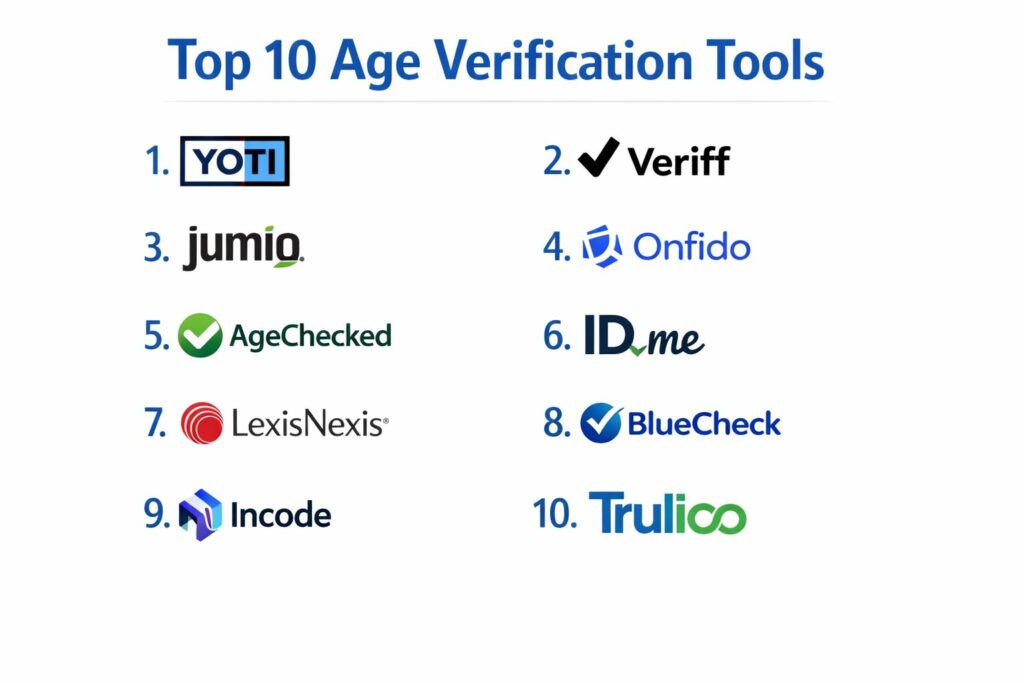
The selection of these ten tools was based on their proven reliability in high-compliance environments and their ability to scale across different global markets. We prioritized platforms that offer multiple verification methods, giving businesses the flexibility to choose the right balance of friction and security for their specific use case. Accuracy was a primary metric, particularly the software’s ability to correctly identify minors near the age threshold.
Integration flexibility was another key factor; we looked for tools that provide robust APIs and SDKs for web and mobile applications. We also considered the vendor’s reputation for data security and their adherence to international privacy standards like GDPR and CCPA. Finally, we evaluated the user experience provided by each tool, favoring those that offer clear guidance to the end-user during the verification process to minimize drop-off rates.
1. Yoti
Yoti is a leader in privacy-focused identity solutions, offering a specialized age estimation technology that is widely used in retail and social media. Their system allows for “anonymous” age checks where only the age attribute is shared, protecting the user’s full identity.
Key Features
The platform features a world-class facial age estimation engine that analyzes facial patterns without identifying the individual. It also supports government ID scanning and a reusable digital ID app. The system includes built-in liveness detection to prevent spoofing. Businesses can set custom age thresholds and receive instant pass/fail results. It also offers a web-based “no-app” flow for lower friction.
Pros
Extremely privacy-centric, often requiring no storage of personal data. It is highly regarded by regulators for its accuracy and ethical approach.
Cons
Facial estimation accuracy can vary slightly based on lighting and camera quality. The reusable app requires a critical mass of users to be most effective.
Platforms and Deployment
Web, iOS, and Android. Available via API and mobile SDKs.
Security and Compliance
GDPR compliant, ISO 27001 certified, and regularly audited by independent safety bodies.
Integrations and Ecosystem
Integrates easily with major social platforms and e-commerce engines. Offers a specialized integration for physical point-of-sale systems.
Support and Community
Provides extensive developer documentation and dedicated technical support for enterprise clients.
2. Veriff
Veriff provides a highly automated identity verification platform that uses AI to verify thousands of document types globally. Their age validation product is designed for speed and high-volume environments.
Key Features
The software utilizes a “waterfall” approach, attempting the least intrusive verification first. It extracts DOB data from IDs using advanced OCR and cross-references it with liveness checks. The system features a unique device fingerprinting technology to detect recurring fraud. It supports over 45 languages to provide a localized experience for global users. Real-time feedback guides users to take better photos of their documents.
Pros
Very high automation rates lead to near-instant results. Its global document support is among the best in the industry.
Cons
The high-end features come with a premium price tag. For very simple age-gating, the platform might offer more complexity than necessary.
Platforms and Deployment
Web, iOS, and Android. Cloud-based deployment via REST API.
Security and Compliance
SOC 2 Type II, GDPR, and CCPA compliant. Uses high-level encryption for all data in transit.
Integrations and Ecosystem
Deep integrations with gaming platforms and financial service suites. Offers no-code options for rapid deployment.
Support and Community
Offers 24/7 technical support and a comprehensive knowledge base for developers.
3. Jumio
Jumio is an enterprise-grade platform that combines AI, biometrics, and manual review to provide the highest levels of assurance. It is a preferred choice for industries with the strictest regulatory requirements.
Key Features
The platform features an “AI-first” approach backed by human experts to resolve ambiguous cases. It offers 3D liveness detection and biometric facial matching. The software can verify age through government IDs, database checks, or even bank-grade authentication. It includes a comprehensive dashboard for tracking verification trends and fraud attempts. Its “KYX” platform allows for a holistic view of user risk beyond just age.
Pros
Provides the highest level of security and accuracy for regulated industries. Its hybrid AI-human model ensures very low false-rejection rates.
Cons
Manual reviews, while accurate, can introduce slight delays in the user experience. The interface is more geared toward enterprise users than small creators.
Platforms and Deployment
Web, iOS, Android, and Windows. Flexible deployment via SDKs and APIs.
Security and Compliance
PCI DSS, SOC 2, and GDPR compliant. Adheres to global financial regulations.
Integrations and Ecosystem
Extensive ecosystem with pre-built connectors for major CRM and enterprise resource planning systems.
Support and Community
Enterprise-level support with dedicated account managers and global technical assistance.
4. Onfido
Onfido (now part of Entrust) specializes in AI-powered document and biometric verification. Its “Workflow Studio” allows businesses to build highly customized age verification journeys.
Key Features
The platform’s standout feature is its ability to orchestrate complex verification flows with no-code tools. It supports over 2,500 document types and uses AI to detect subtle signs of document forgery. The biometric engine provides fast, “fair” results across different ethnicities and lighting conditions. It also includes passive fraud signals like IP and device risk scoring. Users are guided by a smart capture SDK that ensures high-quality image uploads.
Pros
The no-code workflow builder makes it very easy to adjust verification logic without developer intervention. Excellent global document coverage.
Cons
Pricing can be complex based on the number of features and volume. Integration can take time if using the full suite of advanced features.
Platforms and Deployment
Web and mobile SDKs. Cloud-based API delivery.
Security and Compliance
ISO 27001, SOC 2, and GDPR compliant. Follows “Privacy by Design” principles.
Integrations and Ecosystem
Strong integrations with fintech and sharing economy platforms. Works seamlessly with major identity orchestration tools.
Support and Community
High-quality documentation and a professional services team for custom implementations.
5. AgeChecked
AgeChecked is a specialized provider that focuses specifically on age verification for the UK and European markets. It offers a wide array of verification methods tailored to regional laws.
Key Features
The software provides multiple “soft” and “hard” verification methods, including mobile network data, credit card checks, and electoral roll searches. It features a “tokenized” system where a user’s age is verified once and then represented by a secure token thereafter. This approach minimizes repeated data entry. The platform is designed specifically to meet the requirements of the UK’s OFCOM and similar regulators. It also offers a simple, white-labeled interface.
Pros
Very low friction for users in supported regions due to database-led checks. Highly focused on the specific legal nuances of age-restricted industries.
Cons
Geographic focus is primarily on the UK and Europe, making it less ideal for a purely North American or Asian audience.
Platforms and Deployment
Web and mobile API. Cloud-hosted solution.
Security and Compliance
Fully compliant with the UK Data Protection Act and GDPR. Approved by various industry regulatory bodies.
Integrations and Ecosystem
Pre-built plugins for popular e-commerce platforms like Shopify and WooCommerce.
Support and Community
Dedicated support for compliance officers and developers, with a focus on regulatory guidance.
6. ID.me
ID.me is a dominant player in the US market, known for its “verify once, use everywhere” model. It is widely used by government agencies and major retailers for age and identity group verification.
Key Features
The platform allows users to create a portable digital credential. It verifies age through a combination of authoritative database checks and document uploads. For high-assurance cases, it offers video chat verification with a live agent. It includes specialized modules for verifying specific groups, such as students or seniors, for age-based discounts. The system uses bank-grade encryption to secure all user data.
Pros
Huge existing user base in the US, which provides a frictionless “one-click” verification for many customers. Extremely high level of trust and security.
Cons
Primarily focused on the US market. The video chat verification, while secure, is a high-friction fallback for users.
Platforms and Deployment
Web and mobile. Integration via OAuth 2.0 and REST APIs.
Security and Compliance
NIST 800-63-3 compliant, FedRAMP authorized, and SOC 2 certified.
Integrations and Ecosystem
Integrates with thousands of major retailers and government service portals.
Support and Community
Robust support infrastructure for both businesses and the millions of end-users on the platform.
7. LexisNexis Instant Age Verify
LexisNexis utilizes its massive proprietary data repositories to provide instant age verification without requiring the user to upload any documents or take photos.
Key Features
The tool matches a user’s name, address, and DOB against billions of public and private records. This process is nearly instantaneous and happens in the background. It is ideal for “low-stakes” transactions where speed is the priority. The system provides a risk score and a clear pass/fail result. It requires minimal user input, typically only what they would already enter during a standard checkout process.
Pros
The lowest friction possible for the end-user. No need for selfies or ID photos, which significantly reduces cart abandonment.
Cons
Effectiveness depends on the user having a “data footprint,” which may exclude younger adults or recent immigrants. It does not provide biometric liveness.
Platforms and Deployment
Web-based API.
Security and Compliance
Built on enterprise-grade data security infrastructure. Adheres to strict legal and privacy guidelines.
Integrations and Ecosystem
Commonly used as a primary check, with other document-based tools used as a fallback.
Support and Community
Professional enterprise support backed by the global LexisNexis infrastructure.
8. BlueCheck
BlueCheck is a streamlined age verification tool designed specifically for e-commerce. It offers a balance of database-led checks and document verification to ensure high pass rates.
Key Features
The software provides a “first-pass” database check using name and address. If that fails, it automatically escalates to a photo ID upload. It includes a dashboard for managing age-gating rules across different product categories. The integration is designed to be lightweight, with pre-built widgets for major online stores. It also supports phone-based verification for additional security.
Pros
Very easy to set up for small to medium e-commerce businesses. The automated escalation path ensures that almost all legitimate users can get verified.
Cons
The interface is less customizable than some of the larger enterprise platforms. Document verification may involve manual review steps.
Platforms and Deployment
Web and mobile. Available as a cloud-based service.
Security and Compliance
GDPR compliant and uses secure, encrypted data pipelines.
Integrations and Ecosystem
Excellent support for Shopify, Magento, and WooCommerce.
Support and Community
Responsive email and phone support tailored for online merchants.
9. Incode
Incode offers a high-performance “Deepsight” platform that focuses on stopping sophisticated AI-generated fraud during the age verification process.
Key Features
The platform is ranked among the top globally for facial age estimation accuracy. It uses a “dynamic flow” that only asks for documents if the AI estimation is uncertain. Its liveness detection is certified to the highest industry standards, specifically designed to block deepfakes. It offers a very fast processing time, often under 300 milliseconds. The system also includes behavioral analytics to detect automated bot activity.
Pros
Exceptionally fast and resistant to advanced fraud. Its focus on the 13–17 age range makes it ideal for social media compliance.
Cons
The highly technical nature of the fraud detection features may be more than what a basic retail site requires.
Platforms and Deployment
Web, iOS, and Android SDKs.
Security and Compliance
iBeta Level 2 liveness certification and GDPR compliance.
Integrations and Ecosystem
Used by major global banks and social networks. Offers flexible API-first architecture.
Support and Community
Technical support focused on high-security implementations and fraud prevention.
10. Trulioo
Trulioo provides a “GlobalGateway” that gives businesses access to thousands of data sources worldwide for age and identity verification.
Key Features
The platform can verify users in over 190 countries using local data sources like credit bureaus and utility records. It combines this with document verification and biometric checks when needed. The system allows businesses to create different verification “packages” for different regions. It includes a robust API that can handle massive transaction volumes. The management portal provides detailed reporting on verification success rates by country.
Pros
Unmatched global reach for database-led verification. It is a true “one-stop-shop” for international age compliance.
Cons
Configuring the platform for many different regions can be complex. The pricing is scaled for larger, international organizations.
Platforms and Deployment
API-based cloud deployment.
Security and Compliance
Complies with global AML, KYC, and privacy regulations in dozens of jurisdictions.
Integrations and Ecosystem
Deeply integrated into the global financial and payments ecosystem.
Support and Community
Global support team with expertise in regional compliance requirements.
Comparison Table
| Tool Name | Best For | Platform(s) Supported | Deployment | Standout Feature | Public Rating |
| 1. Yoti | Privacy-focused apps | Web, iOS, Android | API/SDK | Facial Age Estimation | 4.7/5 |
| 2. Veriff | Global automation | Web, iOS, Android | Cloud API | Device Fingerprinting | 4.6/5 |
| 3. Jumio | High-stakes compliance | Web, iOS, Android | Hybrid | AI-Human Hybrid Model | 4.5/5 |
| 4. Onfido | Custom workflows | Web, Mobile | API/SDK | Workflow Studio | 4.6/5 |
| 5. AgeChecked | UK/EU Market focus | Web, Mobile | Cloud | Tokenized Verification | 4.4/5 |
| 6. ID.me | US User portability | Web, Mobile | OAuth/API | Portable Credentials | 4.8/5 |
| 7. LexisNexis | Frictionless retail | Web | API | Database-only Checks | 4.3/5 |
| 8. BlueCheck | E-commerce SMBs | Web, Mobile | Cloud | Automated Escalation | 4.2/5 |
| 9. Incode | Anti-Deepfake tech | Web, iOS, Android | API/SDK | Deepsight Fraud Layer | 4.7/5 |
| 10. Trulioo | Global scalability | Web | API | GlobalGateway Data | 4.5/5 |
Evaluation & Scoring of Age Verification Tools
The scoring below is a comparative model intended to help shortlisting. Each criterion is scored from 1–10, then a weighted total from 0–10 is calculated using the weights listed. These are analyst estimates based on typical fit and common workflow requirements, not public ratings.
Weights:
- Core features – 25%
- Ease of use – 15%
- Integrations & ecosystem – 15%
- Security & compliance – 10%
- Performance & reliability – 10%
- Support & community – 10%
- Price / value – 15%
| Tool Name | Core (25%) | Ease (15%) | Integrations (15%) | Security (10%) | Performance (10%) | Support (10%) | Value (15%) | Weighted Total |
| 1. Yoti | 9 | 8 | 8 | 10 | 9 | 8 | 9 | 8.75 |
| 2. Veriff | 9 | 7 | 9 | 9 | 10 | 9 | 7 | 8.55 |
| 3. Jumio | 10 | 6 | 9 | 10 | 8 | 10 | 6 | 8.45 |
| 4. Onfido | 9 | 8 | 10 | 9 | 9 | 9 | 7 | 8.75 |
| 5. AgeChecked | 8 | 9 | 8 | 8 | 8 | 8 | 8 | 8.10 |
| 6. ID.me | 9 | 9 | 9 | 10 | 8 | 9 | 8 | 8.95 |
| 7. LexisNexis | 7 | 10 | 8 | 8 | 10 | 8 | 7 | 8.15 |
| 8. BlueCheck | 8 | 9 | 9 | 7 | 8 | 8 | 9 | 8.30 |
| 9. Incode | 10 | 7 | 8 | 10 | 10 | 8 | 7 | 8.70 |
| 10. Trulioo | 9 | 6 | 10 | 9 | 9 | 9 | 7 | 8.40 |
How to interpret the scores:
- Use the weighted total to shortlist candidates, then validate with a pilot.
- A lower score can mean specialization, not weakness.
- Security and compliance scores reflect controllability and governance fit, because certifications are often not publicly stated.
- Actual outcomes vary with assembly size, team skills, templates, and process maturity.
Which Age Verification Tool Is Right for You?
Solo / Freelancer
Individuals running niche websites or small shops should look for tools that are easy to install and have low upfront costs. A tool that offers a simple widget or a pay-as-you-go model for e-commerce is often the most practical way to stay compliant without technical headaches.
SMB
Small to medium businesses need a balance between cost and conversion. Choosing a tool that starts with a database check and only asks for an ID as a fallback is a great strategy to keep customers moving through the checkout process while still meeting legal obligations.
Mid-Market
For companies growing into new regions, global data coverage is the most important factor. A platform that can handle multiple languages and document types will allow the business to expand without having to implement a new verification tool for every country.
Enterprise
Large organizations require deep integration, high availability, and the strongest security. At this level, look for tools that offer comprehensive risk dashboards, dedicated support teams, and the ability to orchestrate custom verification flows across millions of users.
Budget vs Premium
Free or very low-cost options usually rely on simple self-declaration, which may not be legally sufficient. Premium tools provide the necessary audit trails and accuracy required to protect a company from massive fines, making them a worthwhile investment for any high-risk industry.
Feature Depth vs Ease of Use
If you have a large development team, a highly technical API with deep feature depth is an asset. However, for teams that want to get up and running in a single day, a no-code or low-code solution with a simplified interface is the smarter choice.
Integrations & Scalability
A tool is only as good as its place in your stack. Ensure the software you choose integrates with your existing customer database, CRM, and payment processor. Scalability is also key; the tool must maintain performance during peak traffic periods like holiday sales.
Security & Compliance Needs
This is the non-negotiable part of the decision. Always verify that your chosen vendor holds the necessary certifications for your region. For industries like online gambling or prescription sales, only the highest level of biometric and document assurance should be considered.
Frequently Asked Questions (FAQs)
1. Is facial age estimation accurate enough for legal compliance?
Yes, modern AI models are highly accurate, but most businesses use them as a primary filter. If the AI is unsure because the user is close to the age limit, the system should automatically step up to a more definitive document check.
2. Do these tools store my customers’ private photos?
Most professional tools prioritize privacy and delete photos immediately after verification. Many are designed to return only a simple “yes” or “no” to your system, meaning your business never has to store sensitive identity data.
3. Can age verification work for users without a smartphone?
Yes, most platforms offer web-based flows that work on desktop computers with a webcam. Additionally, database-led checks can often verify a user based only on their name and address without any camera interaction at all.
4. How does age verification impact my website’s conversion rate?
If implemented poorly, it can cause drop-offs. However, using “passive” checks (like database matching) for most users and only asking for an ID when necessary keeps the experience fast and maintains high conversion rates.
5. Are these tools compliant with GDPR?
The leading tools are built with GDPR in mind, utilizing data minimization and encryption. It is essential to choose a vendor that provides clear documentation on their data handling and holds relevant security certifications.
6. Can a minor bypass these systems with a fake ID?
While no system is 100% foolproof, professional tools use advanced AI to detect altered fonts, mismatched holograms, and even the texture of the ID paper. Combined with liveness detection, this makes it very difficult for a minor to succeed with a fake.
7. Is there a way to verify age without any identity documents?
Yes, methods like mobile network carrier data, credit card verification, and public record matching can confirm age without an ID. These are often preferred for their low friction but may have lower “match rates” than document checks.
8. How long does the verification process usually take?
Database checks are instantaneous. AI-based document and selfie checks typically take between 5 and 30 seconds. Only cases requiring manual human review might take several minutes or longer.
9. Can I customize the look of the verification screen?
Most top-tier tools offer “white-label” or “embedded” options. This allows you to style the verification process with your own brand’s colors and logos so that it feels like a seamless part of your website.
10. Do these tools work for international customers?
The best tools have global databases and support thousands of different types of government IDs from almost every country in the world, ensuring you can stay compliant regardless of where your customers are located.
Conclusion
Implementing a sophisticated age verification solution is no longer a luxury but a fundamental requirement for any platform dealing with age-restricted content or products. The right tool acts as a silent partner, protecting your organization from legal liability while ensuring that the digital environment remains safe for vulnerable users. By choosing a platform that balances high-security biometrics with low-friction database checks, you can maintain a smooth user experience without compromising on compliance. As technology continues to evolve, the focus will remain on privacy-first verification methods that prove age without exposing a user’s entire identity. Investing in a robust, scalable, and secure age assurance strategy is a critical step in future-proofing your business against the growing landscape of global digital regulations.