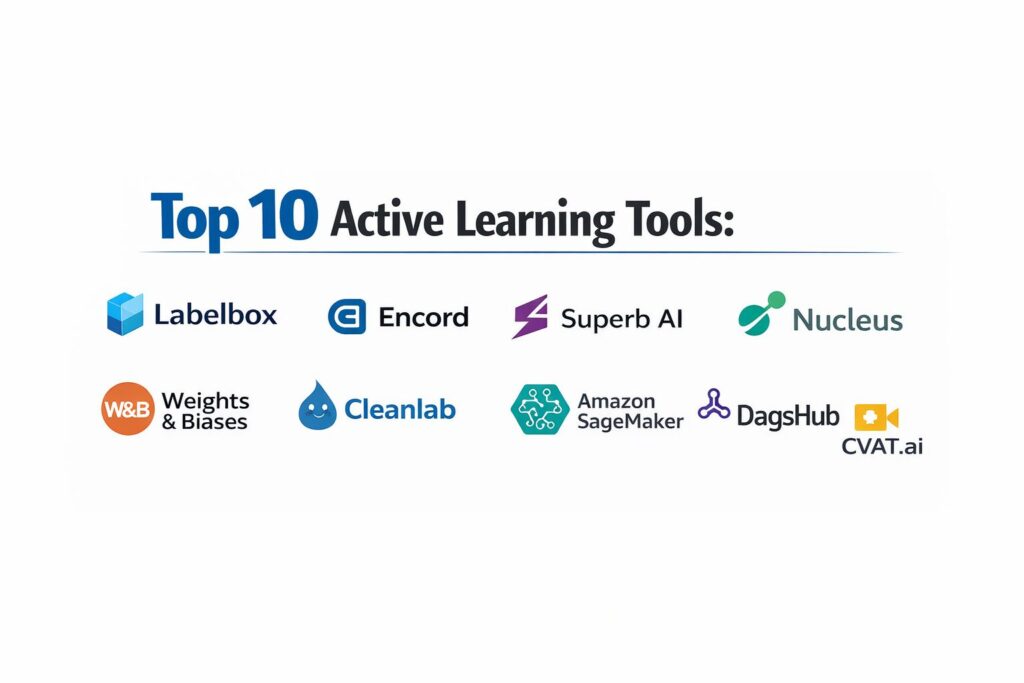
Introduction
Active learning tooling represents the strategic intersection of machine learning operations and data-centric engineering, providing a framework where models effectively choose the data they need to learn from. In a modern technological landscape characterized by an overwhelming volume of unstructured data, these platforms serve as an intelligence filter, identifying the specific samples that, if labeled, would most significantly improve model performance. Instead of traditional, exhaustive labeling processes that treat all data points as equal, active learning focuses human expert intervention on high-entropy or uncertain samples. This approach is fundamental for organizations aiming to scale their artificial intelligence initiatives while maintaining rigorous control over annotation costs and development timelines.
The necessity for sophisticated active learning tooling is driven by the sheer scale of modern foundation models and the rising cost of domain-specific expertise. Organizations can no longer rely on brute-force manual labeling to achieve competitive accuracy; they must instead adopt iterative feedback loops where the model and the human annotator collaborate. A robust active learning platform enables automated edge-case discovery, real-time quality assurance, and seamless integration between the data lake and the training environment. When evaluating these systems, enterprise buyers must assess the technical depth of the uncertainty estimation algorithms, the efficiency of the labeling interface, the strength of the security infrastructure for sensitive datasets, and the overall compatibility with the broader machine learning lifecycle.
Best for: Machine learning engineers, data scientists, and MLOps architects who need to optimize data labeling workflows and improve model accuracy through iterative, data-centric feedback loops.
Not ideal for: Simple data entry tasks without a model-in-the-loop component, or small-scale projects where the total dataset size is manageable through manual, one-time labeling efforts.
Key Trends in Active Learning Tooling
The integration of foundational models as pre-labeling engines has become a core requirement, allowing active learning tools to use zero-shot or few-shot capabilities to provide initial annotations that humans then refine. We are also seeing a significant move toward automated data curation where platforms utilize embedding-based search to identify and cluster rare edge cases that traditional random sampling would likely miss. This shift ensures that training sets are balanced and representative of real-world anomalies rather than just common occurrences. Real-time visualization of the latent space is another dominant trend, enabling data scientists to see exactly where a model is struggling in its high-dimensional understanding.
Privacy-preserving active learning is gaining traction, particularly in regulated industries like healthcare and finance, as platforms adopt federated learning and differential privacy techniques to train models without moving sensitive raw data from secure environments. There is also a heightened focus on the “model-agnostic” nature of these tools, ensuring they can interface with any architecture from transformer-based text models to complex 3D point cloud systems. Furthermore, the rise of synthetic data generation within the active learning loop allows systems to create artificial examples of identified edge cases, further augmenting the training process when real-world data is scarce or difficult to obtain.
How We Selected These Tools
Our selection process involved a comprehensive analysis of the current MLOps ecosystem and the functional depth of platforms specifically designed to handle the active learning lifecycle. We prioritized tools that have demonstrated the ability to significantly reduce labeling overhead through intelligent sample selection and high-quality automation features. A primary criterion was the technical maturity of the feedback loop, evaluating how seamlessly a platform can ingest model predictions and output high-uncertainty samples for human review. We looked for a balance between enterprise-scale infrastructure and the flexibility required for rapid research and development.
Reliability and performance signals were scrutinized by examining how these platforms handle high-velocity data streams and massive-scale datasets without latency in the labeling interface. We also considered the strength of the integration ecosystem, specifically looking at how well each tool connects with popular model training frameworks and data storage solutions. Security protocols were evaluated to ensure alignment with international standards such as SOC 2 and GDPR, which are non-negotiable for enterprise-grade AI development. Finally, we assessed the total operational value, considering the efficiency gains in human labeling time and the resulting improvements in model production timelines.
1. Labelbox
Labelbox is an enterprise-grade data-centric AI platform that provides a unified environment for data labeling, model-based assisted labeling, and active learning orchestration. It is designed to act as the “command center” for the entire data lifecycle, allowing teams to manage complex datasets and iterate on model performance through a highly structured feedback loop.
Key Features
The platform features a robust “Model Diagnostics” module that allows users to visualize model performance against ground truth to identify specific areas of uncertainty. It includes automated labeling workflows where pre-trained models can suggest annotations, significantly speeding up the human review process. The system offers advanced data curation tools that use vector embeddings to find similar images or text across massive datasets. It provides a comprehensive workflow management system to track the productivity and accuracy of labeling teams. Additionally, it supports a wide range of data types including video, geospatial data, and medical imagery.
Pros
The platform provides an exceptionally polished user interface that reduces labeler fatigue and improves overall accuracy. It offers some of the most advanced enterprise governance and quality control features in the industry.
Cons
The pricing structure is geared toward large organizations and can be prohibitive for smaller startups or individual researchers. The high level of complexity means that full implementation often requires a significant time investment.
Platforms and Deployment
Web-based SaaS with various cloud-native deployment options for enterprise environments.
Security and Compliance
Maintains high standards including SOC 2 Type II, HIPAA, and GDPR compliance with robust role-based access controls.
Integrations and Ecosystem
Integrates deeply with major cloud providers like AWS, Google Cloud, and Azure, as well as MLOps tools like Databricks and Snowflake.
Support and Community
Offers professional support tiers, a comprehensive knowledge base, and a dedicated success model for large-scale enterprise deployments.
2. Encord
Encord is a sophisticated data-centric platform with a strong focus on computer vision and medical imaging, providing powerful tools for automated labeling and active learning. It is particularly known for its “micro-model” approach, which allows users to train small, specialized models to assist in the labeling of specific classes.
Key Features
The platform features “Encord Active,” an open-source tool for data quality assessment that identifies outliers and labeling errors automatically. It includes a powerful video annotation tool that uses automated object tracking to maintain labels across frames with minimal human intervention. The system offers a “Model-in-the-Loop” workflow that prioritizes data points based on model confidence scores. It features advanced medical imaging support, including native handling of DICOM and NIfTI formats. It also provides a visual data exploration interface that helps teams understand the distribution and biases in their training sets.
Pros
The automation capabilities for video and medical data are among the best in the market, drastically reducing manual effort. It provides deep technical insights into data quality that go beyond basic labeling.
Cons
The focus on computer vision means it is not a primary choice for teams working exclusively with natural language processing. The learning curve for its advanced automation features can be steep.
Platforms and Deployment
Web-based SaaS with options for on-premise deployment in highly regulated environments.
Security and Compliance
Compliant with HIPAA and GDPR, making it a preferred choice for the healthcare and biotech sectors.
Integrations and Ecosystem
Offers a robust Python SDK for custom integrations and connects with various cloud storage and model training pipelines.
Support and Community
Known for providing highly technical support and maintaining an active open-source community around its data quality tools.
3. Superb AI
Superb AI is a highly automated data platform that leverages “Auto-Label” technology to accelerate the transition from raw data to high-quality training sets. It is designed for teams that need to scale their labeling operations rapidly through the use of sophisticated machine learning assistance.
Key Features
The platform features a proprietary “Auto-Label” engine that uses uncertainty estimation to determine which labels can be applied automatically and which need human review. It includes a “Data Management” suite that allows for the creation of custom data pipelines and automated quality assurance checks. The system offers a “Curate” module that uses embedding-based search to identify and fix biased or unrepresentative data samples. It features a collaborative interface where managers can assign tasks and monitor labeling performance in real-time. Additionally, it supports a wide variety of computer vision tasks from bounding boxes to pixel-level segmentation.
Pros
The automated labeling engine is exceptionally fast, often allowing for the processing of massive datasets in a fraction of the traditional time. The user interface is streamlined and focused on high-throughput labeling workflows.
Cons
While strong in computer vision, its features for text and audio data are less developed compared to generalist platforms. Some users may find the “Auto-Label” results require significant initial tuning.
Platforms and Deployment
Web-based SaaS.
Security and Compliance
Maintains SOC 2 compliance and follows international data protection standards to ensure the safety of proprietary datasets.
Integrations and Ecosystem
Provides native integrations with major cloud storage providers and offers a comprehensive API for custom workflow automation.
Support and Community
Provides dedicated account management and a detailed documentation library to help teams optimize their automation workflows.
4. V7 Darwin
V7 Darwin is an advanced data labeling and active learning platform that utilizes neural networks to assist annotators in real-time. It is highly favored by teams working on complex computer vision problems in fields like life sciences, manufacturing, and autonomous systems.
Key Features
The platform features an “Auto-Annotate” tool that allows users to segment complex objects with just a few clicks by predicting the boundaries in real-time. It includes a robust active learning loop that automatically selects the most difficult images for human review based on model entropy. The system offers “Workflows” that allow for complex multi-stage review processes and automated quality gates. It features specialized tools for medical imaging and high-resolution microscopy data. It also provides detailed analytics on model performance and labeler accuracy to identify bottlenecks in the production pipeline.
Pros
The real-time neural assistance in the labeling interface is remarkably smooth and significantly improves the speed of complex segmentation. It offers excellent handling of high-resolution imagery that would crash simpler tools.
Cons
The platform is premium-priced and may be outside the budget of smaller research groups. It requires a modern browser and a stable internet connection to handle its high-performance interface.
Platforms and Deployment
Web-based SaaS.
Security and Compliance
Adheres to GDPR and HIPAA standards and is frequently used by organizations with strict data privacy requirements.
Integrations and Ecosystem
Offers a powerful CLI and SDK for integrating the platform into existing CI/CD pipelines for machine learning.
Support and Community
Known for its proactive support team and its deep expertise in the technical requirements of the life sciences industry.
5. Nucleus (by Scale AI)
Nucleus, developed by Scale AI, is a sophisticated data-centric platform designed to help teams visualize, curate, and manage their datasets through an active learning lens. It focuses on identifying the “right” data to label to maximize the impact of every human annotation hour.
Key Features
The platform features a “Dataset Visualization” tool that clusters data points based on model embeddings to identify gaps in the training set. It includes an “Active Learning” module that automatically identifies edge cases and high-loss samples for prioritization. The system offers powerful “Dataset Search” capabilities, allowing users to find specific objects or scenarios across millions of images. It features automated “Model Comparison” to understand how different model versions interpret the same data. Additionally, it provides a “Unit Testing” framework for data, ensuring that edge cases are always represented in the test set.
Pros
It is one of the most powerful tools available for identifying and fixing data distribution issues. The deep integration with the broader Scale AI ecosystem provides a seamless path to professional labeling services.
Cons
The platform can be complex to set up, especially when integrating with custom, non-standard model architectures. The pricing is tailored for enterprise-scale operations.
Platforms and Deployment
Web-based SaaS.
Security and Compliance
Maintains top-tier security standards including SOC 2 and is designed to handle the rigorous requirements of the autonomous vehicle industry.
Integrations and Ecosystem
Deeply integrated with Scale AI’s labeling services and connects with major cloud storage and model orchestration tools.
Support and Community
Backed by the massive resources of Scale AI, offering professional-grade support and deep industry expertise.
6. Weights & Biases
Weights & Biases is a leading developer-first MLOps platform that provides the essential infrastructure for experiment tracking, model visualization, and active learning orchestration. It serves as a centralized hub for managing the iterative nature of machine learning development.
Key Features
The platform features “Tables” for visualizing and querying datasets alongside model predictions to identify misclassifications. It includes “Artifacts” for versioning datasets and models, ensuring full reproducibility across the active learning loop. The system offers “Sweeps” for automated hyperparameter optimization, which can be coupled with active learning strategies. It features a “Launch” module that allows for the automated triggering of labeling tasks based on model performance metrics. It also provides collaborative “Reports” for sharing insights and progress with stakeholders.
Pros
The platform is exceptionally developer-friendly and integrates into almost any existing code-based workflow with minimal effort. It provides the best experiment tracking and visualization features in the MLOps market.
Cons
It is not a dedicated labeling tool, meaning it must be paired with another platform like Labelbox or CVAT to handle the actual annotation. The complexity of its feature set can be overwhelming for beginners.
Platforms and Deployment
Web-based SaaS with options for private cloud and on-premise deployment.
Security and Compliance
Offers enterprise-grade security including SSO and SOC 2 compliance, with a focus on data privacy for proprietary models.
Integrations and Ecosystem
Native integrations with nearly every major machine learning framework, including PyTorch, TensorFlow, and Keras.
Support and Community
Maintains a massive global community and provides excellent documentation and technical support for developers.
7. Cleanlab
Cleanlab is a specialized data-centric AI platform that uses “Confident Learning” algorithms to automatically find and fix label errors in datasets. It is a critical tool for the active learning process, ensuring that the “ground truth” used for training is actually accurate.
Key Features
The platform features a “Label Error Detection” engine that identifies noisy or incorrect labels in any dataset based on model predictions. It includes “Data Valuation” tools that rank the importance of individual data points for model training. The system offers automated “Outlier Detection” to identify samples that do not belong in the dataset or are potentially corrupted. It features a “Cleanlab Studio” interface that allows non-technical users to review and correct flagged errors. Additionally, it supports a wide range of data types including text, image, and tabular data.
Pros
It is the only tool specifically focused on the “Confident Learning” methodology, providing unique insights into label noise. It can significantly improve model performance by simply cleaning the existing training data.
Cons
The studio interface is still evolving and may lack some of the advanced workflow management features of larger platforms. It is more of a data quality tool than an end-to-end active learning suite.
Platforms and Deployment
Web-based SaaS and an open-source Python library.
Security and Compliance
Follows standard cloud security practices and is designed to process data without compromising the privacy of individual records.
Integrations and Ecosystem
Integrates easily into any Python-based machine learning pipeline and connects with standard data storage formats.
Support and Community
Offers professional support for its studio product and has a strong academic and open-source following.
8. Amazon SageMaker Ground Truth
Amazon SageMaker Ground Truth is a highly scalable, cloud-native labeling service provided by AWS. it is designed to integrate seamlessly with the broader SageMaker ecosystem, providing automated labeling and human-in-the-loop workflows.
Key Features
The platform features “Automated Data Labeling,” which uses active learning to decide which data points need human intervention and which can be labeled by a model. It includes a “Built-in Workflow” system for a wide range of tasks, from object detection to text classification. The system offers access to a variety of human workforces, including Amazon Mechanical Turk and private labeling teams. It features integrated quality assurance tools that consolidate multiple human annotations into a single high-confidence label. It also provides detailed cost tracking and management within the AWS console.
Pros
It offers unparalleled scalability for organizations already deeply invested in the AWS ecosystem. The pay-as-you-go pricing model is highly flexible for fluctuating labeling needs.
Cons
The user interface is less refined and “creative-friendly” than specialized platforms like V7 or Labelbox. It can be difficult to use effectively if you are not already an AWS expert.
Platforms and Deployment
Cloud-SaaS within the AWS ecosystem.
Security and Compliance
Benefits from the full range of AWS security certifications, including SOC, HIPAA, and FedRAMP compliance.
Integrations and Ecosystem
Native integration with the entire Amazon SageMaker and AWS S3 data storage environment.
Support and Community
Backed by Amazon’s extensive professional support network and enterprise service level agreements.
9. DagsHub
DagsHub is a collaboration platform for data science teams that follows the “GitHub for Data” philosophy. It provides the infrastructure for versioning data, code, and models, making it an ideal environment for managing the active learning lifecycle in a collaborative way.
Key Features
The platform features integrated “Label Studio,” allowing teams to perform annotations directly within the project environment. It includes “DVC” (Data Version Control) integration for tracking changes to massive datasets without bloating the Git repository. The system offers “MLflow” integration for tracking experiments and model versions alongside the data. It features a collaborative interface where team members can comment on specific data points or model predictions. Additionally, it provides automated “Data Pipelines” that can be triggered to retrain models when new labels are added.
Pros
It provides the most cohesive experience for teams that want to manage their entire MLOps stack using Git-based workflows. The integration of labeling, versioning, and experiment tracking in one place is unique.
Cons
The platform is less focused on the high-end automation features like neural-assisted labeling compared to V7 or Superb AI. It may feel too technical for dedicated labeling teams.
Platforms and Deployment
Web-based SaaS with options for on-premise hosting.
Security and Compliance
Provides standard Git-based access controls and is designed to help teams maintain a clear audit trail of their data and model versions.
Integrations and Ecosystem
Strong integrations with Git, DVC, MLflow, and Label Studio.
Support and Community
Has a very active community of data scientists and provides excellent technical support for its collaborative features.
10. CVAT.ai
CVAT.ai is a professional-grade computer vision annotation tool that has evolved from an open-source project into a comprehensive enterprise platform. it is widely used for video and image annotation in high-stakes industries like robotics and security.
Key Features
The platform features “Serverless Function” integration, allowing users to plug in custom models for automated pre-labeling and active learning. It includes a powerful video annotation interface with interpolation and tracking features. The system offers “3D Point Cloud” support, making it suitable for LiDAR-based active learning tasks. It features a robust task management system with support for multiple user roles and review workflows. Additionally, it provides a highly flexible API that allows for the platform to be integrated into custom, automated data pipelines.
Pros
It is extremely flexible and can be customized to handle almost any computer vision task. The open-core nature allows for significant cost savings for teams that can self-host.
Cons
The interface can be complex and requires some time for annotators to become proficient. The self-hosted version requires significant engineering effort to maintain and scale.
Platforms and Deployment
Web-based SaaS and self-hosted via Docker.
Security and Compliance
Security depends on the deployment model, but the enterprise SaaS version offers standard data protection and access controls.
Integrations and Ecosystem
Integrates with various cloud storage providers and supports a wide range of annotation formats for export.
Support and Community
Has a massive global community and provides professional support and customization services for enterprise clients.
Comparison Table
| Tool Name | Best For | Platform(s) Supported | Deployment | Standout Feature | Public Rating |
| 1. Labelbox | Enterprise AI | Web-Based | Cloud-SaaS | Model Diagnostics | 4.7/5 |
| 2. Encord | Medical / Video | Web-Based | Cloud / On-Prem | Micro-Model Automation | 4.8/5 |
| 3. Superb AI | Rapid Scaling | Web-Based | Cloud-SaaS | Auto-Label Engine | 4.6/5 |
| 4. V7 Darwin | Life Sciences | Web-Based | Cloud-SaaS | Real-time Neural Masking | 4.8/5 |
| 5. Nucleus | Data Curation | Web-Based | Cloud-SaaS | Latent Space Search | 4.7/5 |
| 6. Weights & Biases | Dev-First MLOps | Web, Windows, Linux | Cloud / On-Prem | Experiment Tracking | 4.9/5 |
| 7. Cleanlab | Data Quality | Web, Python | Cloud-SaaS | Confident Learning | 4.6/5 |
| 8. Amazon SageMaker | AWS Ecosystem | Web-Based | Cloud-SaaS | Hyperscale Scaling | 4.3/5 |
| 9. DagsHub | Collaboration | Web-Based | Cloud / On-Prem | Git-based Versioning | 4.7/5 |
| 10. CVAT.ai | Computer Vision | Web-Based | Cloud / Self-Host | Serverless Automation | 4.5/5 |
Evaluation & Scoring of Active Learning Tooling
The scoring below is a comparative model intended to help shortlisting. Each criterion is scored from 1–10, then a weighted total from 0–10 is calculated using the weights listed. These are analyst estimates based on typical fit and common workflow requirements, not public ratings.
Weights:
- Core features – 25%
- Ease of use – 15%
- Integrations & ecosystem – 15%
- Security & compliance – 10%
- Performance & reliability – 10%
- Support & community – 10%
- Price / value – 15%
| Tool Name | Core (25%) | Ease (15%) | Integrations (15%) | Security (10%) | Performance (10%) | Support (10%) | Value (15%) | Weighted Total |
| 1. Labelbox | 10 | 8 | 9 | 10 | 9 | 9 | 7 | 8.90 |
| 2. Encord | 9 | 7 | 8 | 9 | 10 | 9 | 8 | 8.65 |
| 3. Superb AI | 9 | 9 | 8 | 8 | 9 | 8 | 9 | 8.70 |
| 4. V7 Darwin | 10 | 8 | 8 | 9 | 9 | 9 | 7 | 8.65 |
| 5. Nucleus | 9 | 7 | 9 | 9 | 9 | 8 | 8 | 8.45 |
| 6. Weights & Biases | 8 | 9 | 10 | 9 | 10 | 9 | 9 | 9.05 |
| 7. Cleanlab | 8 | 8 | 7 | 8 | 9 | 8 | 8 | 7.85 |
| 8. Amazon SageMaker | 7 | 6 | 10 | 10 | 10 | 8 | 9 | 8.20 |
| 9. DagsHub | 8 | 8 | 9 | 8 | 8 | 9 | 9 | 8.35 |
| 10. CVAT.ai | 9 | 6 | 8 | 8 | 9 | 7 | 10 | 8.20 |
How to interpret the scores:
- Use the weighted total to shortlist candidates, then validate with a pilot.
- A lower score can mean specialization, not weakness.
- Security and compliance scores reflect controllability and governance fit, because certifications are often not publicly stated.
- Actual outcomes vary with assembly size, team skills, templates, and process maturity.
Which Active Learning Tooling Tool Is Right for You?
Solo / Freelancer
For independent researchers or solo founders, the priority is often high speed and low initial overhead. You should look for tools that offer a robust “free tier” or open-source foundation that allows you to start quickly without an enterprise contract. A platform that provides integrated labeling and experiment tracking will help you keep your early-stage technical stack clean and manageable.
SMB
Organizations with limited resources should prioritize tools that maximize the value of every human hour spent on the project. Look for platforms that offer academic or nonprofit discounts and emphasize automated data cleaning. By focusing on identifying and fixing errors in existing datasets, you can often improve model performance more effectively than by simply collecting more data.
Mid-Market
Growing companies should focus on “time-to-market” and the ability to scale labeling operations without hiring a massive internal team. Platforms that offer strong automated pre-labeling and “micro-model” assistance will allow your team to punch above its weight class. It is essential to choose a tool that integrates well with your existing data storage to avoid the friction of manual data transfers.
Enterprise
For global organizations, the decision must be driven by governance, security, and the ability to manage complex, multi-stage data pipelines. You need a platform that provides a “single source of truth” for all training data and offers robust auditing features. The ability to deploy the platform within your own private cloud environment is often a critical requirement for maintaining data sovereignty.
Budget vs Premium
If budget is the primary constraint, open-core or self-hosted versions of professional tools provide deep functionality for the cost of engineering time. However, for organizations where speed is more valuable than direct software costs, premium SaaS platforms offer a “turnkey” experience that includes high-performance hardware and pre-configured automation features that can save months of development time.
Feature Depth vs Ease of Use
If your team consists of highly technical machine learning engineers, a tool with a powerful SDK and deep analytical capabilities is a major advantage. On the other hand, if you are working with non-technical subject matter experts for labeling, an intuitive, frictionless interface is much more important for maintaining high throughput and data quality.
Integrations & Scalability
Your active learning tool must be an integrated part of your broader MLOps lifecycle. It should be able to trigger model training jobs and ingest the resulting predictions automatically. As your datasets grow from thousands to millions of records, the platform’s ability to handle massive scale without performance degradation becomes the most important factor for long-term success.
Security & Compliance Needs
In regulated fields like healthcare or finance, security is the primary legal and technical barrier. You must ensure the tool provides the specific certifications required for your operational region. Features like PII redaction and secure, encrypted data tunnels are not just luxuries; they are essential for protecting both the organization and the individuals represented in the data.
Frequently Asked Questions (FAQs)
1. What is the main difference between passive and active learning?
Passive learning involves a model being trained on a random or fixed set of labeled data, where the model has no choice in what it sees. Active learning allows the model to “query” the data, selecting specific unlabelled examples that it is most uncertain about for human labeling.
2. How much can active learning reduce labeling costs?
Depending on the complexity of the task and the quality of the initial data, active learning can often reduce the amount of required labeled data by 50% to 80% while achieving the same level of model accuracy as traditional methods.
3. What is uncertainty estimation in this context?
Uncertainty estimation is the mathematical process a model uses to determine how “sure” it is about its prediction for a specific data point. Common methods include entropy calculation, least-confidence scoring, and variation ratios.
4. Can active learning tools be used for text-based NLP?
Yes, while many tools focus on computer vision, professional platforms like Labelbox and Weights & Biases support sophisticated text-based active learning for tasks like sentiment analysis, named entity recognition, and document classification.
5. What is “Confident Learning” compared to active learning?
Active learning focuses on selecting the best data to label next to improve the model. Confident Learning, as pioneered by tools like Cleanlab, focuses on finding and fixing incorrect labels that already exist in your training set to improve model performance.
6. Do active learning tools work with real-time data streams?
Some enterprise-grade platforms are designed to handle high-velocity data, allowing them to continuously identify and prioritize edge cases from live production streams for immediate human review and model retraining.
7. Is it possible to use active learning with 3D LiDAR data?
Yes, specialized professional tools like CVAT.ai and Scale AI’s Nucleus provide native support for 3D point cloud data, enabling active learning workflows for autonomous driving and robotics applications.
8. How do I measure the success of an active learning strategy?
Success is typically measured by comparing the model’s accuracy curve against the number of labeled samples. A successful strategy will show a steeper learning curve, reaching higher accuracy with significantly fewer labeled points than random sampling.
9. Can active learning help with identifying dataset bias?
By identifying which data points the model is struggling with, active learning often uncovers underrepresented demographic groups or rare environmental conditions, allowing teams to proactively collect and label data to fix these biases.
10. Do I need a high-performance GPU to run active learning tools?
The web-based interfaces themselves do not require a high-end GPU, but the “Model-in-the-Loop” backend that generates predictions and uncertainty scores often requires significant GPU resources for efficient processing at scale.
Conclusion
In the modern machine learning ecosystem, active learning tooling is the essential mechanism for transforming raw data into competitive intelligence. By moving away from transactional labeling and toward a strategic, model-informed feedback loop, organizations can significantly accelerate their AI development timelines while maintaining superior data quality. These platforms represent a critical investment in MLOps infrastructure, providing the necessary visibility and control to manage the complexities of large-scale model training. As the demand for more accurate and specialized AI grows, the ability to focus human expertise on the most informative data points will remain the primary differentiator for successful AI initiatives.