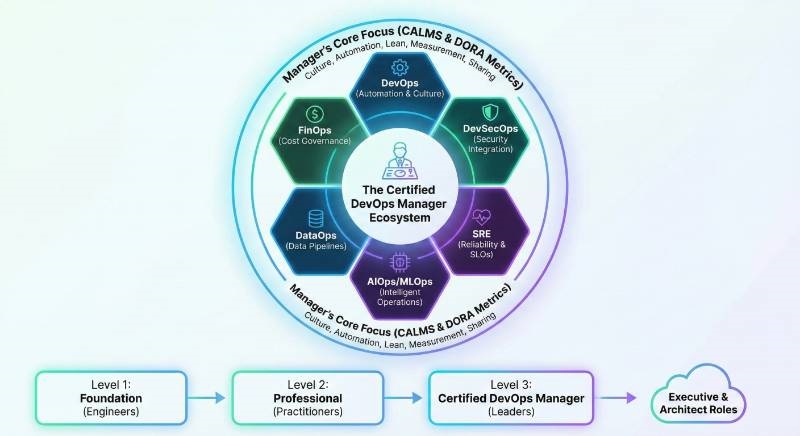
Transitioning from an individual contributor to a leadership role is one of the most significant shifts in a technical career. While engineering is about solving logic problems, management is about solving people and process problems. This guide is designed to help you navigate that transition by mastering the Certified DevOps Manager (CDM) program.
Whether you are based in India or working globally, the demand for leaders who understand the “Ops” spectrum—from SRE to FinOps—has never been higher. This master guide provides a roadmap for engineers and managers to validate their expertise and lead high-performing teams.
Choose Your Path: 6 Specialized Learning Journeys
Modern IT operations are no longer a single lane. Depending on your interest and the needs of your organization, you should align your management goals with one of these six specialized paths.
1. The DevOps Path
This is the core journey. It focuses on the CALMS framework (Culture, Automation, Lean, Measurement, and Sharing). As a manager here, you focus on breaking down silos between developers and operations to speed up delivery without sacrificing quality.
2. The DevSecOps Path
Security is now everyone’s responsibility. In this path, you learn how to “Shift Left.” You lead teams in integrating security audits, compliance checks, and vulnerability scanning directly into the automated CI/CD pipeline.
3. The SRE (Site Reliability Engineering) Path
Born from the need to manage massive scale, SRE focuses on using software engineering disciplines to solve operations problems. Your focus as a manager will be on Service Level Objectives (SLOs) and managing “error budgets” to balance innovation with stability.
4. The AIOps & MLOps Path
This path is for those leading data-driven organizations. AIOps uses artificial intelligence to automate IT operations and incident response. MLOps focuses on the specialized lifecycle of machine learning models, ensuring they move from a notebook to production reliably.
5. The DataOps Path
Data pipelines are complex. DataOps applies DevOps rigor to data management. As a manager, you ensure that data is high-quality, flows seamlessly from source to consumer, and that the infrastructure supporting it is automated and scalable.
6. The FinOps Path
Cloud costs are often the second-largest expense for a company. FinOps (Cloud Financial Management) is the practice of bringing financial accountability to the variable spend of the cloud. Managers here bridge the gap between Engineering, Finance, and Business.
Role → Recommended Certifications Mapping
To help you decide where to start, here is a quick reference guide based on your current professional role.
| Current Role | Recommended Certifications |
| DevOps Engineer | Certified DevOps Engineer (CDE), Certified DevOps Professional (CDP) |
| SRE (Site Reliability Engineer) | SRE Certified Professional (SRECP), Certified SRE Architect |
| Platform Engineer | Certified DevOps Architect (CDA), Kubernetes Master |
| Cloud Engineer | CDE Professional, Cloud-Specific Expert (AWS/Azure/GCP) |
| Security Engineer | DevSecOps Professional (DSOCP), Security Lead |
| Data Engineer | DataOps Professional (DOCP), Certified DataOps Engineer |
| FinOps Practitioner | Certified FinOps Manager, CDE Foundation |
| Engineering Manager | Certified DevOps Manager (CDM), Certified SRE Manager |
Master Table of Certifications
This table outlines the essential certifications across various tracks to help you plan your career progression.
| Track | Level | Who it’s for | Prerequisites | Skills Covered | Recommended Order |
| DevOps | Foundation | Beginners/Engineers | Basic IT knowledge | CI/CD, Git, Linux, Docker | 1 |
| DevOps | Professional | Mid-level Engineers | CDE Foundation | K8s, Terraform, Monitoring | 2 |
| DevOps | Manager | Senior/Lead/Managers | 5+ years exp | Strategy, ROI, Governance | 3 |
| DevSecOps | Professional | Security/DevOps Eng | Basic DevOps | SAST, DAST, Vault, Compliance | 1 |
| SRE | Professional | Ops/SysAdmin | Linux/Coding | SLOs, SLIs, Error Budgets | 1 |
| MLOps | Professional | Data/ML Engineers | Python, DevOps | Model Registry, Pipelines | 1 |
| AIOps | Professional | IT Ops Leads | Monitoring Exp | Predictive AI, Log Analytics | 1 |
| DataOps | Professional | Data Engineers | SQL, ETL | Data Quality, Pipeline Auto | 1 |
Deep Dive: Certified DevOps Manager (CDM)
The Certified DevOps Manager is the gold standard for those who want to lead the cultural and technical transformation of an organization. It is not just about using tools; it is about designing the systems that allow tools and people to work together.
What it is
The Certified DevOps Manager (CDM) is a management-level certification that focuses on the strategic implementation of DevOps. It covers the leadership required to manage cross-functional teams, the financial logic behind tool selection, and the governance needed to maintain security and compliance at speed.
Who should take it (Provider: DevOpsSchool)
DevOpsSchool is the leading provider for this program. It is designed for:
- Technical Leads transitioning into management.
- Project Managers who need to understand modern engineering lifecycles.
- IT Directors responsible for digital transformation.
- Senior Engineers who want to influence organizational strategy.
Skills you’ll gain
- Strategic Roadmap Design: Learn to create a multi-year DevOps transformation plan.
- Metric Management: Master DORA metrics (Lead Time, Deployment Frequency, MTTR, Change Failure Rate).
- Cultural Leadership: Techniques to reduce “silo” mentality and foster collaboration.
- Governance & Compliance: Managing risk in a world of automated deployments.
- Budget & ROI: Justifying the cost of tools and cloud infrastructure to executive leadership.
- Incident Management: Leading high-pressure teams through outages and post-mortems.
Real-world projects you should be able to do
- Toolchain Audit: Evaluate an existing stack and propose a migration plan to save costs or improve speed.
- SLA/SLO Definition: Work with business stakeholders to define reliability targets for a product.
- Pipeline Governance: Design a “Policy as Code” framework for all company deployments.
- Talent Strategy: Build a hiring and upskilling plan for a new DevOps or SRE department.
Preparation plan
- 7–14 days (Accelerated): Focus on the exam objectives, governance frameworks, and management case studies. Best for existing Leads.
- 30 days (Recommended): Spend 1 hour daily reviewing core modules. Focus on the integration of culture, process, and tools.
- 60 days (Comprehensive): Includes deep-dive labs on DORA dashboards and strategic planning workshops. Best for those new to the Ops world.
Common mistakes
- Focusing Only on Tools: Thinking that buying a tool like Kubernetes solves management problems.
- Ignoring the “Human” Factor: Forgetting that DevOps is 80% culture and 20% technology.
- Poor Metric Selection: Tracking “vanity metrics” (like number of commits) instead of business outcomes.
- Lack of Stakeholder Alignment: Failing to explain the value of DevOps to the Finance or Product teams.
Best next certification after this
- Master in DevOps Engineering (MDE): To maintain your technical edge while leading.
- Certified SRE Manager: If your organization prioritizes high-availability and reliability.
Top Training and Certification Institutions
Choosing the right partner for your certification journey is critical. These institutions are recognized for their quality of instruction and industry-aligned curriculums.
- DevOpsSchool: The premier choice for the Certified DevOps Manager program. They offer extensive instructor-led training, real-world projects, and a global community of experts to support your career growth.
- Cotocus: Highly regarded for its hands-on approach. They focus on lab-based learning where you can practice management scenarios in real-world environments.
- Scmgalaxy: A massive repository of knowledge and community support. They are excellent for those looking for deep technical insights and long-term mentorship in the SCM domain.
- BestDevOps: Known for tailored, fast-track coaching. They help senior professionals clear certifications by focusing on the most critical exam topics and leadership skills.
- DevSecopsschool: The specialist in security integration. If your management goal is to build secure-by-default pipelines, this is the institution to follow.
- Sreschool: Focuses exclusively on the Site Reliability Engineering domain. They offer specialized tracks for managers who need to handle massive scale and uptime.
- Aiopsschool: Leading the way in AI-driven operations. Their programs help you understand how to use machine learning to manage complex IT environments.
- Dataopsschool: The destination for data management professionals. They help you master the lifecycle of data pipelines and ensure high data quality across the board.
- Finopsschool: Specializes in the financial side of the cloud. They provide the training needed to manage cloud budgets and optimize spending for engineering teams.
Next Certifications to Take: 3 Options
After completing your CDM, you should look toward one of these three paths to further your executive or technical presence:
- Same Track (Leadership Depth): Master in DevOps Engineering (MDE). This provides the ultimate technical authority for a manager, ensuring you can oversee even the most complex architectures.
- Cross-Track (Functional Breadth): Certified DevSecOps Manager. As cyber threats increase, a manager who can lead security-first engineering is highly valuable.
- Leadership (Executive Path): Certified SRE Architect. This prepares you for a CTO or VP of Engineering role, focusing on the architectural stability of the entire enterprise.
FAQs: General DevOps Career & Sequence
1. How difficult is the Certified DevOps Manager exam?
It is challenging because it focuses on decision-making. You must understand how one choice (like tool selection) impacts the whole organization.
2. Is there a specific order I should follow?
Yes. Ideally, start with CDE Foundation, move to CDE Professional, and conclude with the Certified DevOps Manager (CDM).
3. What are the prerequisites for the Manager level?
We recommend at least 5 years in IT and a solid understanding of the software development lifecycle (SDLC).
4. How much time do I need to study?
Most working professionals find 30 days of consistent, daily study (1 hour) is sufficient to pass.
5. Are these certifications recognized globally?
Yes. The standards taught are universal, making these certifications valid for roles in India, the US, Europe, and beyond.
6. Do I need to be a coding expert to be a DevOps Manager?
You don’t need to write production code daily, but you must understand the logic and architecture to guide your team effectively.
7. How do these certifications impact salary?
Certified managers often command 25% to 40% higher salaries than their non-certified peers because they bring validated leadership skills.
8. Can I take the training and exam online?
Yes, all recommended institutions offer flexible online, instructor-led training and remote proctored exams.
9. What is the value of the CDM over a standard PMP?
While PMP is general project management, CDM is specific to the high-velocity, technical world of DevOps, making it more relevant for tech leaders.
10. How long is the certification valid?
The certification is typically valid for 2-3 years. You can stay current by participating in bridge programs or advanced workshops.
11. Is there a community for certified professionals?
Yes, institutions like DevOpsSchool and Scmgalaxy provide access to exclusive alumni networks and job boards.
12. Can I switch from a non-technical role to DevOps Management?
It is possible, but we highly recommend completing the CDE Foundation track first to gain the necessary technical vocabulary.
FAQs: Certified DevOps Manager (CDM) Specific
1. What is the official URL for the CDM program?
You can find all details at: Certified DevOps Manager
2. Who is the primary provider for this certification?
The official provider is DevOpsSchool.
3. Does the CDM exam cover DORA metrics?
Yes, understanding and implementing DORA metrics (Deployment Frequency, Lead Time, etc.) is a core part of the curriculum.
4. What is the exam format?
It consists of multiple-choice questions that are scenario-based, testing how you would handle real-world management challenges.
5. Is there a hands-on component?
The training includes hands-on labs focused on strategic tool selection, dashboard creation, and roadmap planning.
6. What is the cost of the CDM certification?
The fee varies by region, but it typically ranges around INR 24,999 / USD 350.
7. Can I skip the Professional level and go straight to Manager?
If you have 10+ years of experience and a strong technical background, you may skip, but the Professional level is highly recommended for context.
8. Why is DevOpsSchool considered the best for this?
They provide trainers who are industry veterans and offer a curriculum that is continuously updated to reflect the latest trends like AIOps and FinOps.
Conclusion
The role of a Certified DevOps Manager is to be the “glue” that holds an engineering organization together. It requires a unique blend of technical oversight, financial acumen, and people leadership. By following this guide and choosing the right certification path, you are not just getting a certificate—you are gaining the tools to lead the next generation of software delivery.
The industry is moving fast. Don’t just keep up; lead the way.
Would you like me to draft a custom 30-day study roadmap or a sample DevOps Roadmap project to help you get started with the CDM program?