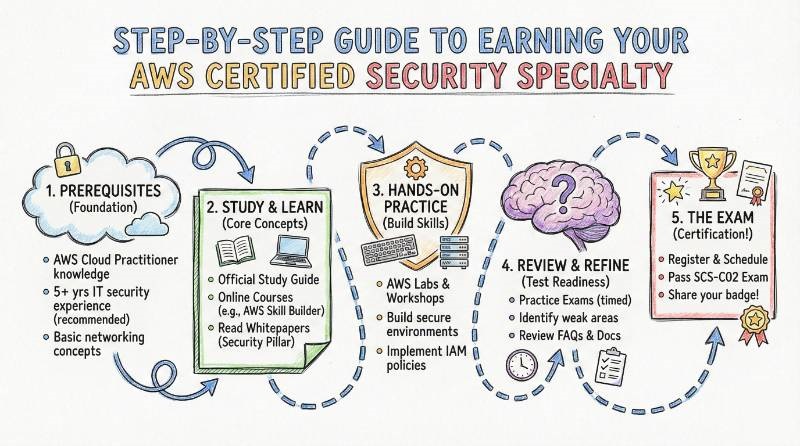
Over the years, I have watched technology change completely. We used to protect our data with physical locks and heavy doors. Today, our data lives in the cloud, and our “locks” are made of code, identity policies, and encryption keys. As an engineering lead who has managed many cloud migrations, I know that security is no longer just a side task. It is the core of everything we build.
If you are an engineer or a manager, you understand that one small mistake in a configuration can lead to a big problem. This is why specialized training is vital. The AWS Certified Security Specialty (SCS-C02) is the best way to prove you have the skills to keep a cloud environment safe and reliable.
This guide will walk you through the value of this certification and show you how to prepare for it effectively.
Why Security Training is Essential for Every Engineer
In the past, we had a separate “Security Team” that checked our work at the very end. That doesn’t work anymore. Today, if you are building infrastructure or writing software, you are responsible for security. Whether you are working in India or for a global firm, the goal is the same: protect the data.
Training for the SCS-C02 changes how you work. It teaches you to build “guardrails” into your systems so that security happens automatically. It gives you the confidence to say that your platform is not just running, but is truly defended.
The Certification Landscape
It helps to see where this security certification fits in with other AWS paths. Use this table to plan your learning journey.
AWS Certification Reference Table
| Track | Level | Who it’s for | Prerequisites | Skills Covered | Recommended Order |
| Security Specialty | Specialty | Security Engineers, SREs, Devs | AWS Associate knowledge | IAM, KMS, Logging, VPC Security | After any Associate Cert |
| Solutions Architect | Professional | Lead Architects, Tech Leads | Deep AWS experience | Multi-tier Design, Migration | After Security Specialty |
| DevOps Engineer | Professional | DevOps & Platform Engineers | CI/CD & Automation skills | Scaling, Monitoring, SDLC | After Security Specialty |
| Advanced Networking | Specialty | Network Engineers | Deep Network logic | Hybrid Cloud, BGP, Connectivity | After Security Specialty |
Deep Dive: AWS Certified Security Specialty (SCS-C02)
This certification is a serious challenge. It proves you have the technical depth to handle high-stakes security work on the AWS platform.
What it is
The AWS Certified Security Specialty (SCS-C02) is a validation of your ability to design and implement security solutions. It covers five key areas: Threat Detection, Logging, Infrastructure Security, Identity Management, and Data Protection. It is not just about knowing the tools; it is about knowing how to use them together to stop an attack.
Who should take it
This training is for those who are already working with AWS:
- Working Engineers: You need to know how to secure the resources you build every day.
- Engineering Managers: You need to understand the technical risks to guide your team.
- Software Engineers: You need to learn how to bake security into your code.
- SREs & DevOps: You need to prevent security issues from causing system downtime.
Skills you’ll gain
This training gives you a deep set of technical skills. You will move past simple setups and learn how to manage access for thousands of users using fine-grained policies. You will also learn the math and logic behind cloud encryption, ensuring data is safe even if it is stolen.
- Identity Control: Learning the deep logic of IAM, Service Control Policies (SCPs), and cross-account access.
- Data Encryption: Mastering the Key Management Service (KMS) to protect information at rest and in transit.
- Infrastructure Defense: Building secure networks using WAF, Shield, and Network Firewalls.
- Monitoring & Audit: Using CloudTrail and CloudWatch to watch every move made in your AWS account.
- Automated Defense: Learning to use Lambda to fix security gaps the moment they appear.
Real-world projects you should be able to do after it
The real value of this training is what you can build afterward. You will be ready to lead projects such as:
- Building a Secure Multi-Account Structure: Setting up a centralized “Security Hub” that monitors all company accounts from one place.
- Automated Remediation: Creating scripts that find open S3 buckets and close them automatically.
- Secure Delivery Pipelines: Adding security checks to your CI/CD process so that bad code never gets deployed.
- Incident Response: Building a system that isolates a compromised server and alerts the team in seconds.
Preparation plan (7–14 days / 30 days / 60 days)
Your study time should match your current experience level.
- 7–14 Days (The Expert Path): For those who use AWS security tools daily. Focus on the official exam guide and take several practice tests to find your weak points.
- 30 Days (The Professional Path): Best for most working engineers. Spend two weeks on a video course and two weeks doing hands-on labs in the AWS console.
- 60 Days (The Learner Path): If you are new to specialized security, take your time. Spend the first month reading whitepapers and the second month building projects.
Common mistakes
I have seen many smart people fail this exam because they underestimated it. One big mistake is only using the AWS console. The exam will test your ability to read JSON policies and understand CLI commands.
- Ignoring JSON Logic: You must be able to look at a policy and know exactly what it allows.
- Skipping Small Services: Services like Macie or Inspector are just as important as IAM on this exam.
- Not Reading Carefully: AWS questions are tricky. One word like “most cost-effective” can change the entire answer.
Best next certification after this
Once you pass the SCS-C02, you should look at these three paths for your next step:
- Same Track: AWS Certified Solutions Architect – Professional to master large-scale architecture.
- Cross-Track: AWS Certified Advanced Networking – Specialty to master complex connectivity.
- Leadership: AWS Certified DevOps Engineer – Professional to lead teams in secure automation.
Choose Your Path: 6 Specialized Learning Tracks
Security is the thread that ties all modern engineering roles together.
- DevOps Path: Focus on secure automation. Ensure your deployment tools and infrastructure-as-code are always protected.
- DevSecOps Path: This is the heart of modern security. You make safety a part of every step in the software development process.
- SRE Path: Focus on reliability. A secure system is a stable system. You use security tools to prevent outages and attacks.
- AIOps / MLOps Path: Protect the data used for AI. Ensure your machine learning models and training data are private and safe.
- DataOps Path: Focus on data privacy. Use encryption and access rules to keep your company’s most valuable data away from the wrong eyes.
- FinOps Path: Manage the cost of security. Balance the need for safety with the cloud budget so you stay protected without overspending.
Role → Recommended Certifications Mapping
| Current Role | Your Next Goal | Recommended Path |
| DevOps Engineer | Secure Automation Lead | DevOps Pro + SCS-C02 |
| SRE | Reliability Expert | SysOps Associate + SCS-C02 |
| Platform Engineer | Secure Internal Platforms | Solutions Architect Pro + SCS-C02 |
| Cloud Engineer | Infrastructure Lead | Solutions Architect Associate + SCS-C02 |
| Security Engineer | Cloud Defense Master | SCS-C02 + Networking Specialty |
| Data Engineer | Data Privacy Expert | Data Analytics Specialty + SCS-C02 |
| FinOps Practitioner | Risk and Cost Manager | Cloud Practitioner + SCS-C02 |
| Engineering Manager | Strategic Technical Lead | Solutions Architect Associate + SCS-C02 |
Top Training Institutions for AWS Security Specialty
Choosing a good training partner is the first step to success. You need a place that focuses on practical work.
- DevOpsSchool: A leader in hands-on training. They offer instructor-led sessions that focus on real industry tasks, making sure you gain actual skills, not just a certificate.
- Cotocus: They provide specialized training that is often led by working consultants. This means you learn from people who solve security problems every day.
- Scmgalaxy: A great community-focused platform. They offer a huge range of resources for those who want to learn security and configuration management together.
- BestDevOps: They offer clear and simple learning paths for professionals who want to move into senior DevOps and security roles quickly.
- Devsecopsschool: This school focuses entirely on the mix of security and development. It is the best place for a dedicated DevSecOps career.
- Sreschool: They focus on how security makes systems more reliable. This is perfect for engineers who manage large production environments.
- Aiopsschool & Dataopsschool: These are the best places to learn the specific security needs of AI, machine learning, and big data.
- Finopsschool: They provide a unique look at the financial side of security, helping you manage the costs of staying safe in the cloud.
Frequently Asked Questions (General)
Q1: How much time is needed to study for SCS-C02?
Most people spend about 80 to 120 hours. This includes watching lessons, reading, and practicing in the AWS console.
Q2: Is the exam very hard?
Yes, it is a specialty exam. It tests how well you can apply your knowledge to solve complex business problems.
Q3: Do I need to be a coder?
You don’t need to be a full developer, but you must be able to read JSON and understand basic script logic.
Q4: Is this certification helpful in India?
Very much so. The cloud market in India is growing fast, and there is a high demand for certified security experts.
Q5: What is the exam fee?
The exam costs $300 USD.
Q6: Does experience matter more than the certificate?
Experience is always important, but the certificate proves to employers that your skills meet a global standard.
Q7: How many questions are on the test?
There are 65 questions, and you have 170 minutes to answer them.
Q8: Can I take the training from home?
Yes, schools like DevOpsSchool offer excellent online sessions led by live instructors.
Q9: What score do I need to pass?
You need at least 750 out of 1000.
Q10: Are there any discounts for the exam?
If you have passed an AWS exam before, check your account for a 50% discount voucher.
Q11: Do global companies recognize this?
Yes. AWS is the world leader in cloud, and this is one of their most respected certifications.
Q12: Should a manager take this exam?
Yes. It helps managers understand the “Security Language” so they can make better decisions for their teams.
Specific AWS Security Specialty FAQs
Q1: What is the most important service for the exam?
IAM (Identity and Access Management). You must understand it perfectly to pass.
Q2: How much networking is on the test?
A lot. You need to know VPC Flow Logs, Security Groups, and how to use the AWS Network Firewall.
Q3: How much do I need to know about encryption?
You must be an expert in AWS KMS. You need to know how keys are made, rotated, and used.
Q4: What does the logging section focus on?
It focuses on auditing. You need to know how to use CloudTrail and CloudWatch to investigate what happened during a security event.
Q5: Does the exam cover tools that are not from AWS?
No. The focus is strictly on AWS services.
Q6: Is AWS Organizations covered?
Yes. You need to know how to use Service Control Policies (SCPs) to set security rules for a whole company.
Q7: What is “Incident Response” on the exam?
It is about using automation (like Lambda) to fix problems as soon as they are found by tools like GuardDuty.
Q8: Are the official whitepapers important?
Yes. You should read the “Security Pillar” of the Well-Architected Framework. It explains the logic behind many exam questions.
Conclusion
In my years of leading teams, I have learned that the best engineers are the ones who put security first. The AWS Certified Security Specialty (SCS-C02) is a tough journey, but it is one that will change your career. It shows everyone that you have the depth and the discipline to protect an organization’s most important assets. Whether you want to reach a senior role or just want to build better systems, this training is an investment that will pay off for a long time. The cloud is only getting more complex, and the need for experts who can secure it is only going up. Take the time to study, do the labs, and become a leader in cloud security.