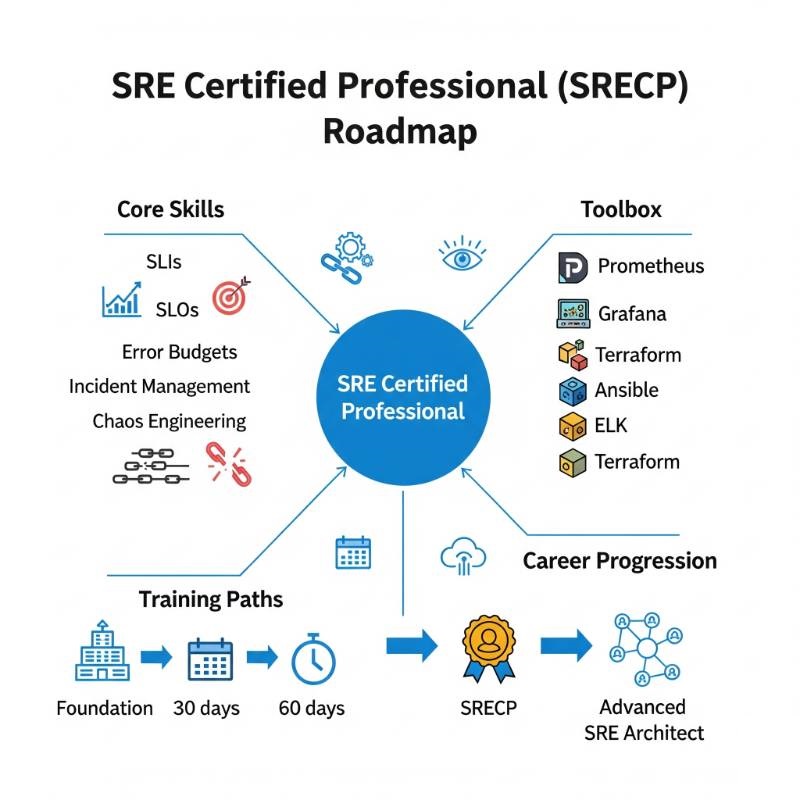
The world of software is moving faster than ever. If you are an engineer today, you know that speed is nothing without stability. That is where Site Reliability Engineering (SRE) comes in. It is the secret sauce that keeps the world’s biggest applications running smoothly while teams push new features every day. If you want to master this balance and prove your skills to the world, the SRE Certified Professional (SRECP) is the program you need to know about. This isn’t just a piece of paper; it is a roadmap to becoming the person everyone trusts when the systems are down.
Quick Snapshot: SRE Certified Professional (SRECP)
| Feature | Details |
| Certification Name | SRE Certified Professional (SRECP) |
| Track | Site Reliability Engineering (SRE) & Operations |
| Level | Professional to Expert |
| Who it’s for | DevOps Engineers, System Admins, Software Engineers, Operations Managers |
| Prerequisites | Basic knowledge of Linux, Networking, and Software Development Lifecycle (SDLC) |
| Skills Covered | SLIs/SLOs, Error Budgets, Observability, Incident Management, Chaos Engineering, Automation |
| Recommended Order | Foundation → SRECP → Advanced SRE Architect |
Deep Dive: SRE Certified Professional (SRECP)
This certification is designed to bridge the gap between “it works on my machine” and “it works for millions of users.” Here is the breakdown:
What it is
The SRECP is a comprehensive training and certification program that teaches you how to treat operations as a software problem. It moves beyond simple monitoring and teaches you how to build scalable, reliable, and self-healing systems using modern tools and cultural practices.
Who should take it
- DevOps Engineers who want to specialize in reliability and scalability.
- Software Engineers who want to understand how their code behaves in production.
- System Administrators looking to modernize their skills with automation and cloud-native tools.
- IT Managers who need to implement SRE culture in their teams.
Skills you’ll gain
- Service Level Objectives (SLOs): How to define, measure, and track reliability targets.
- Error Budgets: Using the remaining “allowable failure” to balance innovation with stability.
- Observability: Mastering Prometheus, Grafana, and ELK Stack to see inside your systems.
- Incident Management: How to handle outages calmly using PagerDuty and blameless post-mortems.
- Automation: Using Terraform and Ansible to eliminate manual “toil.”
- Resilience: Implementing Chaos Engineering to break things on purpose so they don’t break in production.
Real-world projects you should be able to do after it
- Build a fully automated monitoring dashboard that alerts you before customers complain.
- Design an “Error Budget” policy for a product team to decide when to freeze deployments.
- Set up an automated incident response workflow that pages the right person automatically.
- Create a “Chaos Monkey” script to test if your system survives a server failure.
- Refactor a legacy manual deployment process into a one-click automated pipeline.
Preparation plan
- 7–14 Days (Intensive): If you already know DevOps tools, focus entirely on SRE concepts like SLOs and Error Budgets. Spend your time on case studies.
- 30 Days (Standard): Dedicate week 1 to Linux/Networking, week 2 to Observability tools, week 3 to Automation, and week 4 to SRE cultural practices and mock exams.
- 60 Days (Relaxed): Take your time building a home lab. Install Prometheus, set up alerts, and practice “breaking” your own apps to fix them.
Common mistakes
- Ignoring the Culture: SRE is 50% tools and 50% culture. Don’t just learn the tools; learn how to talk to developers about reliability.
- Confusing Monitoring with Observability: Monitoring tells you “the system is down.” Observability tells you “why.”
- Skipping the Labs: You cannot learn SRE just by reading. You must get your hands dirty with configuration files and command lines.
Best next certification after this
- Certified Site Reliability Architect (CSRA): To move into high-level system design.
Choose Your Path: Where Do You Fit?
The tech world is vast. Here is where the SRECP fits into the bigger picture of career paths:
- DevOps Path: Focuses on the flow of code from Dev to Ops.
- DevSecOps Path: Adds security to every step of the pipeline.
- SRE Path (This Certification): Focuses on keeping the system running reliably in production.
- AIOps / MLOps Path: Using AI to manage operations or managing the operations of AI models.
- DataOps Path: Managing the flow and quality of data pipelines.
- FinOps Path: optimizing the cost of cloud infrastructure.
Role → Recommended Certifications Mapping
Not sure if this is for you? Find your current or desired role below:
| Role | Recommended Certifications |
| DevOps Engineer | SRE Certified Professional (SRECP), Certified Kubernetes Administrator (CKA) |
| Site Reliability Engineer (SRE) | SRE Certified Professional (SRECP), Certified Site Reliability Architect |
| Platform Engineer | SRECP, AWS/Azure Solution Architect |
| Cloud Engineer | Cloud Provider Associate (AWS/Azure/GCP), SRECP |
| Security Engineer | DevSecOps Certified Professional (DSOCP), SRECP |
| Data Engineer | DataOps Certified Professional (DOCP), SRECP (for pipeline reliability) |
| FinOps Practitioner | FinOps Certified Practitioner, SRECP (for resource optimization) |
| Engineering Manager | SRECP (for understanding reliability metrics), Scrum Master |
Next Certifications to Take
Once you have conquered the SRECP, here are your best options for growth (Reference: Gurukul Galaxy):
- Same Track (Deepen your SRE skills):
- Certified Site Reliability Architect. This will help you design systems from the ground up for reliability.
- Cross-Track (Broaden your skills):
- DevSecOps Certified Professional (DSOCP). Security is the partner of reliability. A secure system is a reliable system.
- Leadership Track (Move to management):
- Certified DevOps Manager. Learn to lead high-performing teams and manage organizational change.
Top Institutions for Training & Certification
If you are looking for help, training, or guidance to clear this certification, these institutions are the industry leaders.
This is a premier institution for anyone serious about a career in SRE and DevOps. They offer comprehensive, hands-on training that covers the SRECP curriculum in depth. Their trainers are industry veterans who focus on real-world scenarios, ensuring you don’t just pass the exam but actually learn the job.
2. Cotocus
Cotocus is known for its strong consulting background, which they bring into their training. Their courses are practical and often include insights from their actual client projects. They are a great choice if you want to understand how SRE is applied in large enterprises.
3. Scmgalaxy
Scmgalaxy has a massive community and a wealth of resources for configuration management and DevOps. Their training programs are well-structured and very community-focused, providing great peer support while you learn SRE concepts.
4. BestDevOps
As the name suggests, they focus purely on DevOps and SRE excellence. They offer targeted bootcamps that are intensive and designed to get you up to speed quickly. Their materials are updated frequently to match the latest industry trends.
5. devsecopsschool
While their primary focus is security, they have excellent modules on the intersection of security and reliability. If you want to approach SRE with a security-first mindset, their training provides a unique and valuable perspective.
6. sreschool
This institution is dedicated entirely to Site Reliability Engineering. They live and breathe SRE. Their curriculum is likely the most specialized, diving deep into niche SRE topics that broader courses might skim over.
7. aiopsschool
With the rise of AI in operations, aiopsschool is the place to go if you want to future-proof your SRE skills. They teach you how to use AI and machine learning to predict incidents before they happen, which is the future of SRE.
8. dataopsschool
Reliability isn’t just for apps; it’s for data too. If you are a Data Engineer looking to apply SRE principles to your data pipelines, this school offers the specialized training you need to bridge that gap.
9. finopsschool
Cost is a major factor in reliability. You can’t have infinite redundancy if you can’t afford it. FinOpsSchool teaches you the financial side of operations, making you a more strategic asset to your company.
Frequently Asked Questions (FAQs)
General FAQs about the Career & Certification
1. Is SRE difficult to learn?
It has a learning curve because it combines coding with operations. However, if you take it step-by-step—mastering one tool and concept at a time—it is very manageable.
2. How long does it take to get certified?
Typically, if you dedicate 1-2 hours a day, you can be ready in about 30 to 45 days. Intensive bootcamps can get you there in 1-2 weeks.
3. Do I need to be a coding expert?
No, but you need to be “code literate.” You should be able to read code (like Python or Go) and write scripts to automate tasks.
4. Is this certification recognized globally?
Yes, the skills taught in the SRECP program are universal standards used by companies like Google, Netflix, and Amazon worldwide.
5. What is the difference between DevOps and SRE?
Think of DevOps as the philosophy of breaking down silos, and SRE as the implementation of that philosophy. SRE prescribes specific ways (like SLOs) to achieve DevOps goals.
6. Can a fresh graduate take this course?
Yes, but it helps to have a strong foundation in Linux and basic networking first. It’s a steep climb but a very rewarding one.
7. Does this increase my salary?
Absolutely. SREs are among the highest-paid technical roles because they directly protect the company’s revenue by keeping systems online.
8. What tools will I strictly need to learn?
You will definitely need to know Linux, Git, Docker, Kubernetes, Terraform, and a monitoring tool like Prometheus.
9. Is this role stressful?
It can be, especially during outages. But good SRE practices (like Error Budgets) are actually designed to reduce stress and prevent burnout.
10. Do I need to know cloud computing?
Yes. Modern SRE is almost entirely cloud-based. You should be comfortable with at least one major provider like AWS, Azure, or Google Cloud.
11. What is the exam format?
It usually involves a mix of multiple-choice questions to test theory and scenario-based questions to test your problem-solving skills.
12. Will I get a job immediately?
Certification gets you the interview; skills get you the job. This course gives you both, but you must practice the labs to succeed in technical interviews.
Specific FAQs: SRE Certified Professional (SRECP)
1. What are the prerequisites for the SRECP?
You should have a basic understanding of the software development lifecycle and familiarity with command-line interfaces.
2. How is the SRECP different from other SRE certs?
The SRECP focuses heavily on practical implementation. It doesn’t just teach you the definition of an SLO; it teaches you how to implement one in a real tool.
3. Does the course cover “Chaos Engineering”?
Yes, it covers the principles of Chaos Engineering and how to safely introduce failure into your system to test its resilience.
4. Will I learn about “Toil Reduction”?
Yes, a major part of the curriculum is identifying manual, repetitive work (toil) and using automation to eliminate it.
5. Is there a lab component?
Yes, the best way to learn SRE is by doing. The training includes hands-on labs where you set up monitoring, pipelines, and alerts.
6. How long is the certification valid?
Most technical certifications are valid for 2-3 years, after which you are encouraged to upgrade your skills as technology changes.
7. Can I take this if I am a manager?
Yes! Managers benefit greatly by understanding how to measure their team’s reliability and how to balance feature work with stability work.
8. What happens if I fail the exam?
Check with the specific provider (DevOpsSchool), but typically there is a retake policy that allows you to try again after a short cooling-off period.
Conclusion
Becoming an SRE Certified Professional is a powerful move. It tells the industry that you are not just someone who can build software, but someone who can keep it alive, healthy, and scalable under pressure. In a world where downtime costs millions, the SRE is the hero. This certification is your cape. Don’t just watch the industry evolve—lead the change. Pick your path, start your training, and let’s build systems that never break.