Introduction
Retail merchandising tools help retailers plan, buy, allocate, price, present, and optimize products across stores and digital channels. In simple terms, these tools help you decide what to sell, where to sell it, how much to stock, how to price it, and how to present it so customers buy more and returns go down. They matter because retailers are balancing tight margins, frequent demand shifts, multi-channel fulfillment, and higher customer expectations for availability and relevance.
Real-world use cases include assortment planning for seasons and regions, automated replenishment and allocation, markdown optimization, category performance tracking, on-site merchandising for digital storefronts, and store-level execution support. When evaluating tools, buyers should check planning depth, allocation logic, inventory visibility, pricing and promotions support, performance at scale, integration with POS and eCommerce, workflow fit for merchants, reporting quality, support quality, and total cost to run.
Best for: retail merchants, category managers, planners, eCommerce teams, operations leaders, and multi-store chains that need structured planning and execution.
Not ideal for: very small shops with limited SKUs that only need basic POS reporting or simple eCommerce catalog management.
Key Trends in Retail Merchandising Tools
- AI-driven demand sensing and automated replenishment to reduce stockouts and overstock.
- Unified planning across stores and online to support consistent availability and better allocation.
- Faster markdown optimization to protect margin while clearing inventory on time.
- Stronger assortment localization by cluster, store format, and customer behavior segments.
- Shift toward real-time inventory visibility and continuous planning, not periodic spreadsheets.
- Higher expectations for personalization in digital merchandising, search, and recommendations.
- Tighter integration between merchandising, supply chain, and order management for omnichannel.
- More workflow automation for purchase orders, allocations, and exception-based management.
- Greater focus on data governance, role-based access, and auditability for enterprise usage.
How We Selected These Tools (Methodology)
- Selected tools with strong credibility in retail merchandising and planning workflows.
- Prioritized solutions that support core merchandising steps: assortment, pricing, allocation, replenishment, and execution.
- Considered fit across business sizes, from fast-growing retailers to large enterprises.
- Looked for ecosystem strength: integrations with POS, ERP, WMS, OMS, and eCommerce.
- Evaluated practical usability for merchants and planners, not only feature lists.
- Included both enterprise merchandising suites and leading digital merchandising platforms.
- Considered scalability for high SKU counts, multi-region operations, and multi-store networks.
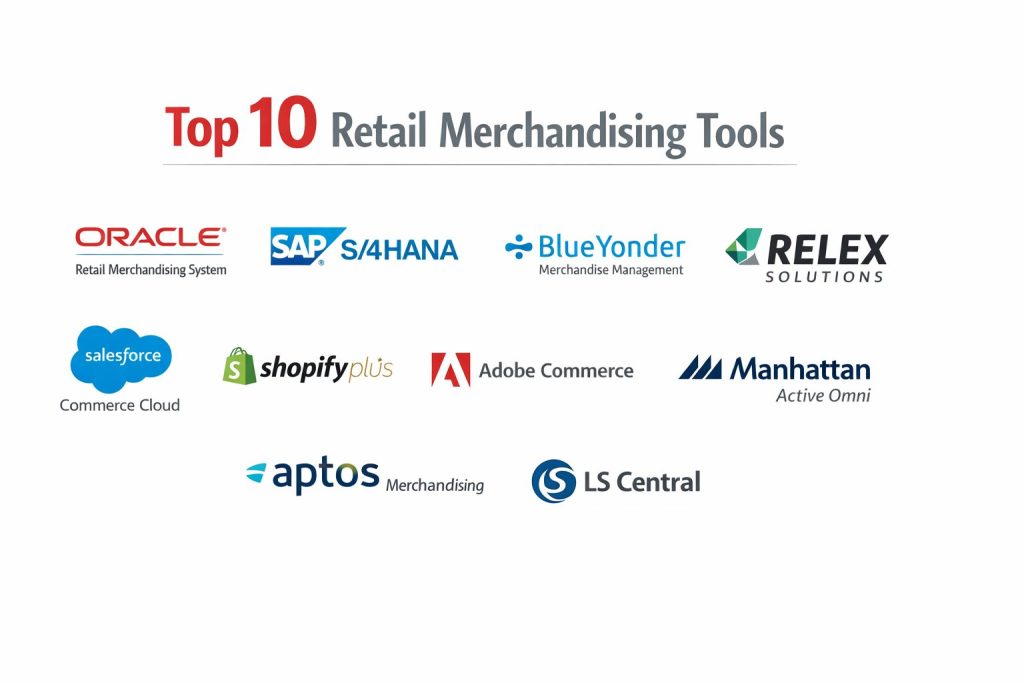
Top Retail Merchandising Tools
1 — Oracle Retail Merchandising System
A well-known enterprise merchandising backbone used to manage items, suppliers, purchasing, inventory, and merchandising operations across large retail networks.
Key Features
- Centralized item and supplier management for complex catalogs
- Purchase order, cost, and inventory controls for enterprise retail
- Merchandising workflows across stores, regions, and channels
- Strong governance for retail master data and hierarchy management
- Reporting foundations for merchandising performance tracking
Pros
- Strong fit for large, complex retail operations
- Mature merchandising data and process control
Cons
- Implementation effort can be heavy for smaller teams
- Best outcomes depend on strong process discipline and integration work
Platforms / Deployment
Varies / N/A
Security and Compliance
Not publicly stated
Integrations and Ecosystem
Often used as a core system connected to POS, finance, supply chain, and digital commerce layers.
- Common integrations with POS and inventory ecosystems
- Data exchange with supply chain and financial systems
- API and integration patterns vary by deployment and program scope
Support and Community
Enterprise support model; onboarding and success depend on partner ecosystem and internal program ownership.
2 — SAP S/4HANA for Retail
An enterprise retail platform approach that supports merchandising, finance alignment, and operations for retailers that want strong ERP-linked control.
Key Features
- Integrated retail processes aligned with finance and operations
- Retail master data management and structured governance
- Inventory and purchasing workflows tied to enterprise controls
- Reporting foundations across merchandising and operations
- Process standardization for multi-entity retail organizations
Pros
- Strong enterprise control and audit-friendly process alignment
- Works well when ERP integration is a priority
Cons
- Can be complex to implement and optimize
- Less flexible if teams need highly custom merchandising workflows
Platforms / Deployment
Varies / N/A
Security and Compliance
Not publicly stated
Integrations and Ecosystem
Commonly integrated into broader enterprise landscapes across retail operations.
- Integration with finance and operational systems
- Connectivity with POS and supply chain systems
- Extensions and customization depend on program design
Support and Community
Strong enterprise support ecosystem; success depends on implementation quality and internal adoption.
3 — Blue Yonder Merchandise Management
A merchandising and supply-chain-oriented suite known for planning, replenishment, and decision support in retailers that need scale and optimization.
Key Features
- Merchandising planning and inventory optimization capabilities
- Replenishment and allocation support for multi-location retail
- Exception-based management to focus teams on high-impact issues
- Analytics-driven decisions for assortment and inventory movement
- Scalable workflows for enterprise retail operations
Pros
- Strong optimization focus for inventory and merchandising decisions
- Good fit for complex retail networks and large SKU volumes
Cons
- Requires clean data and disciplined planning processes
- Implementation and change management can be significant
Platforms / Deployment
Varies / N/A
Security and Compliance
Not publicly stated
Integrations and Ecosystem
Typically used with POS, ERP, WMS, and order systems to unify planning with execution.
- Integration with inventory and supply chain systems
- Data pipelines for sales, stock, and forecasts
- API capabilities vary by product configuration
Support and Community
Enterprise support structure; enablement quality depends on rollout approach and training depth.
4 — RELEX Solutions
A retail planning platform commonly associated with forecasting, replenishment, and assortment optimization for retailers aiming to reduce stock issues and improve availability.
Key Features
- Demand forecasting and replenishment optimization
- Assortment planning and space-related optimization support
- Exception-based workflows to reduce manual planning load
- Store and region-level planning for localized retail demand
- Analytics for availability, waste reduction, and inventory efficiency
Pros
- Strong planning automation to improve availability and reduce waste
- Practical value for retailers focused on replenishment accuracy
Cons
- Best results require reliable sales and inventory data feeds
- Some advanced enterprise needs may require additional systems
Platforms / Deployment
Varies / N/A
Security and Compliance
Not publicly stated
Integrations and Ecosystem
Often integrated with POS and inventory systems to feed demand signals and execution results.
- Sales, stock, and promotion data integration
- Common connections to ERP and supply chain tools
- Integration details vary by retailer setup
Support and Community
Vendor-led support; training and rollout approach strongly influence adoption success.
5 — Manhattan Active Omni
An omnichannel operations platform often used where inventory, fulfillment, and execution across channels must stay aligned with merchandising outcomes.
Key Features
- Inventory visibility across nodes to support merchandising decisions
- Order and fulfillment orchestration that impacts allocation outcomes
- Exception workflows for operational alignment
- Scalability for multi-channel retail operations
- Integration patterns to connect store and digital operations
Pros
- Strong fit when omnichannel execution is central to merchandising success
- Helps align inventory reality with customer promises
Cons
- Not a pure merchandising planning tool on its own
- Merch teams may still need dedicated planning and assortment systems
Platforms / Deployment
Varies / N/A
Security and Compliance
Not publicly stated
Integrations and Ecosystem
Commonly connected to commerce platforms, POS, and warehouse systems to unify execution.
- Integrations with commerce and fulfillment systems
- Data flows for inventory and order lifecycle
- Ecosystem strength depends on retailer architecture
Support and Community
Enterprise support model; success depends on operational adoption and integration readiness.
6 — Salesforce Commerce Cloud
A digital commerce platform with strong on-site merchandising capabilities for retailers focused on personalized experiences, product discovery, and conversion optimization.
Key Features
- On-site merchandising tools for product discovery and navigation
- Personalization and customer journey support (varies by setup)
- Campaign and promotion management for digital storefronts
- Search and category presentation control for conversion impact
- Strong ecosystem for digital commerce extensions
Pros
- Strong fit for digital merchandising and customer experience teams
- Ecosystem strength for integrations and extensions
Cons
- Not a replacement for enterprise merchandising back-office suites
- Full value often requires broader Salesforce ecosystem alignment
Platforms / Deployment
Cloud
Security and Compliance
Not publicly stated
Integrations and Ecosystem
Commonly integrated with OMS, ERP, PIM, and marketing tools for complete digital merchandising.
- Integration with customer data and marketing ecosystems
- Connections to inventory and fulfillment systems
- Extensibility depends on chosen components and architecture
Support and Community
Strong partner network and enterprise support; community strength is high.
7 — Shopify Plus
A scalable commerce platform used by fast-growing retailers that need strong catalog management, storefront merchandising, and operational simplicity.
Key Features
- Flexible catalog and collection management for merchandising
- Storefront customization options for product presentation
- App ecosystem for merchandising, pricing, and personalization add-ons
- Multi-channel sales support depending on configuration
- Operational simplicity for teams that need speed
Pros
- Fast time-to-value for many retail teams
- Strong app ecosystem for merchandising extensions
Cons
- Advanced enterprise merchandising planning may require other tools
- Complex custom needs can increase dependency on partners and apps
Platforms / Deployment
Cloud
Security and Compliance
Not publicly stated
Integrations and Ecosystem
Shopify Plus commonly connects to inventory, fulfillment, marketing, and analytics stacks.
- Large app marketplace for retail workflows
- APIs for custom integration patterns
- Integration quality varies by chosen apps and implementation
Support and Community
Very strong community and ecosystem; support tier depends on plan and partners.
8 — Adobe Commerce
A flexible digital commerce platform often used by retailers that want deep storefront control, customized merchandising experiences, and integration with broader digital experience stacks.
Key Features
- Customizable product and category merchandising experiences
- Flexible promotion and storefront logic capabilities
- Extensible architecture for tailored customer experiences
- Strong support for complex catalogs and content-led merchandising
- Integrations across digital marketing and experience workflows
Pros
- Strong flexibility for customized digital merchandising
- Good fit for retailers needing advanced storefront control
Cons
- Implementation complexity can be higher than simpler platforms
- Merchandising outcomes depend heavily on implementation quality
Platforms / Deployment
Varies / N/A
Security and Compliance
Not publicly stated
Integrations and Ecosystem
Often integrated with marketing, analytics, PIM, OMS, and fulfillment systems.
- Broad ecosystem for extensions and partners
- APIs for custom workflows and integrations
- Ecosystem benefits depend on chosen stack components
Support and Community
Large community and partner ecosystem; support varies by plan and deployment.
9 — Aptos Merchandising
A retail-focused merchandising solution used by retailers that want structured merchandising operations, inventory control, and store-centric workflows.
Key Features
- Merchandising operations for item, vendor, and inventory workflows
- Purchase order and replenishment-style processes (varies by setup)
- Store and chain-level controls for retail execution
- Reporting support for merchandising performance tracking
- Retail-specific data structures for categories and hierarchies
Pros
- Retail-specialized focus for merchandising operations
- Good fit for retailers prioritizing structured processes
Cons
- Ecosystem depth may vary by region and partner availability
- Advanced planning and optimization may need complementary tools
Platforms / Deployment
Varies / N/A
Security and Compliance
Not publicly stated
Integrations and Ecosystem
Commonly connects with POS, finance, and inventory systems depending on retailer architecture.
- Integration with store systems and back-office operations
- Data exchange patterns vary by deployment
- API capabilities depend on product configuration
Support and Community
Vendor and partner-led support; rollout training is critical for merchant adoption.
10 — LS Central
A retail management platform often used by retailers seeking an integrated approach for store operations and merchandising workflows, especially in multi-store contexts.
Key Features
- Centralized retail operations support with merchandising alignment
- Item and store management workflows for retail execution
- Reporting and analytics foundations for retail performance
- Integration patterns aligned to store-centric operations
- Practical fit for retailers that want structured retail management
Pros
- Helpful for retailers wanting unified store operations and merchandising control
- Strong fit for multi-store operational consistency
Cons
- Deep merchandising planning optimization may require add-on solutions
- Capabilities can vary depending on modules and implementation scope
Platforms / Deployment
Varies / N/A
Security and Compliance
Not publicly stated
Integrations and Ecosystem
Often integrated into retail ecosystems with accounting, inventory, and commerce layers.
- Integration options vary by retailer setup
- Connections to commerce and operational systems depend on scope
- Extensibility depends on modules and implementation approach
Support and Community
Support through vendor and partners; adoption improves with clear process templates and training.
Comparison Table
| Tool Name | Best For | Platform(s) Supported | Deployment | Standout Feature | Public Rating |
|---|---|---|---|---|---|
| Oracle Retail Merchandising System | Enterprise merchandising backbone | Varies / N/A | Varies / N/A | Strong retail master data and control | N/A |
| SAP S/4HANA for Retail | ERP-linked retail control | Varies / N/A | Varies / N/A | Enterprise process alignment | N/A |
| Blue Yonder Merchandise Management | Optimization at scale | Varies / N/A | Varies / N/A | Inventory and planning optimization | N/A |
| RELEX Solutions | Forecasting and replenishment focus | Varies / N/A | Varies / N/A | Exception-based planning automation | N/A |
| Manhattan Active Omni | Omnichannel execution alignment | Varies / N/A | Varies / N/A | Strong inventory and fulfillment alignment | N/A |
| Salesforce Commerce Cloud | Digital merchandising experience | Varies / N/A | Cloud | Personalization-ready storefront control | N/A |
| Shopify Plus | Fast scaling commerce merchandising | Varies / N/A | Cloud | Speed with strong app ecosystem | N/A |
| Adobe Commerce | Custom digital merchandising | Varies / N/A | Varies / N/A | Deep storefront customization | N/A |
| Aptos Merchandising | Retail-focused merchandising operations | Varies / N/A | Varies / N/A | Retail-specific merchandising workflows | N/A |
| LS Central | Unified retail operations and merchandising | Varies / N/A | Varies / N/A | Integrated store-centric retail management | N/A |
Evaluation and Scoring of Retail Merchandising Tools
Weights
Core features 25 percent
Ease of use 15 percent
Integrations and ecosystem 15 percent
Security and compliance 10 percent
Performance and reliability 10 percent
Support and community 10 percent
Price and value 15 percent
| Tool Name | Core | Ease | Integrations | Security | Performance | Support | Value | Weighted Total |
|---|---|---|---|---|---|---|---|---|
| Oracle Retail Merchandising System | 9.0 | 6.5 | 8.5 | 6.5 | 8.5 | 7.5 | 6.0 | 7.73 |
| SAP S/4HANA for Retail | 8.5 | 6.5 | 8.0 | 7.0 | 8.0 | 7.5 | 6.0 | 7.43 |
| Blue Yonder Merchandise Management | 8.5 | 6.5 | 8.0 | 6.5 | 8.5 | 7.0 | 6.5 | 7.53 |
| RELEX Solutions | 8.0 | 7.0 | 7.5 | 6.0 | 8.0 | 7.0 | 7.0 | 7.35 |
| Manhattan Active Omni | 7.5 | 6.5 | 8.0 | 6.5 | 8.5 | 7.0 | 6.5 | 7.23 |
| Salesforce Commerce Cloud | 7.5 | 7.5 | 8.5 | 6.5 | 8.0 | 7.5 | 6.5 | 7.55 |
| Shopify Plus | 7.0 | 8.5 | 8.0 | 6.0 | 7.5 | 8.0 | 8.0 | 7.75 |
| Adobe Commerce | 7.5 | 6.5 | 8.0 | 6.0 | 7.5 | 7.0 | 6.5 | 7.05 |
| Aptos Merchandising | 7.5 | 7.0 | 7.0 | 6.0 | 7.5 | 6.5 | 6.5 | 6.98 |
| LS Central | 7.0 | 7.5 | 7.0 | 6.0 | 7.5 | 6.5 | 7.0 | 7.03 |
How to interpret the scores
These scores are comparative and help you shortlist options based on typical retail needs. A slightly lower total can still be the best choice if it matches your operating model and team skills. Core features and integrations usually predict long-term success more than surface-level UI comfort. Security is marked conservatively because public details vary and should be validated in vendor discussions. Use this table to narrow to two or three tools, then run a pilot with real product, store, and inventory data.
Which Retail Merchandising Tool Is Right for You
Solo or Freelancer
If you primarily run a small online store, Shopify Plus-style merchandising and app extensions can be easier to manage than enterprise suites. Focus on tools that improve catalog structure, collections, search, and promotions without heavy implementation work. If your scale is modest, value and ease will matter more than deep planning automation.
SMB
SMBs often need a balanced approach: fast execution plus better forecasting and replenishment. Shopify Plus or Adobe Commerce can support strong digital merchandising, while RELEX-style planning can help improve stock accuracy if your operations support it. Choose tools that integrate cleanly with POS, inventory, and fulfillment systems you already use.
Mid-Market
Mid-market retailers benefit from stronger allocation, replenishment, and exception management. RELEX Solutions and Blue Yonder Merchandise Management are typically considered when planning automation becomes urgent. If omnichannel execution is a priority, Manhattan Active Omni can strengthen inventory truth and fulfillment alignment to support merchandising decisions.
Enterprise
Large enterprises often standardize on a core merchandising backbone like Oracle Retail Merchandising System or SAP S/4HANA for Retail because governance, scale, and control matter. Blue Yonder and similar optimization suites can sit alongside core systems for planning intelligence. Digital merchandising is often handled through platforms like Salesforce Commerce Cloud or Adobe Commerce, connected to the merchandising core.
Budget vs Premium
Budget-focused buyers should prioritize a platform that reduces manual work without creating heavy implementation debt. Premium programs should focus on end-to-end governance, integration depth, and long-term scalability, even if onboarding takes longer. The best value comes from reducing stock errors and improving margin, not from feature volume alone.
Feature Depth vs Ease of Use
Enterprise suites bring depth and controls, but they demand process discipline and training. Commerce platforms often feel easier for day-to-day merchandising in digital channels, but they do not replace core retail operations planning. Decide which team owns the workflow and optimize for the reality of your organization’s skills.
Integrations and Scalability
If you have many stores, multiple regions, or large SKU volumes, integrations will decide success. Ensure your chosen tool can reliably ingest sales, inventory, promotions, and supplier data, then push decisions back into execution systems. Scalability comes from clean data flows and disciplined processes, not only from vendor claims.
Security and Compliance Needs
Most merchandising programs involve sensitive pricing, supplier, and inventory data. Even when product compliance details are not publicly stated, you should validate role-based access, audit logs, and identity integration support. Treat security as a program requirement across the whole ecosystem, not only one tool.
Frequently Asked Questions
1. What problems do retail merchandising tools solve first
They usually reduce stockouts, overstock, and margin leakage by improving forecasting, allocation, and pricing decisions. They also improve consistency across stores and digital channels when the same merchandising rules are applied.
2. Do I need an enterprise suite or a commerce platform
If your pain is planning, buying, inventory governance, and allocation, you typically need a merchandising suite. If your pain is product discovery, on-site promotions, and conversion, a commerce platform with strong merchandising tools can help more.
3. How long does implementation usually take
It varies widely based on scope and integrations. Lightweight digital merchandising changes can be quick, while core merchandising backbone programs can require significant planning, data cleanup, and change management.
4. What data do I need for a successful rollout
Clean product master data, store hierarchies, sales history, inventory snapshots, supplier lead times, and promotion calendars are common requirements. Weak data quality often causes most delays and poor outcomes.
5. What are the common mistakes teams make
Choosing a tool without testing it using real SKU, store, and promotion complexity is a frequent mistake. Another is skipping process training, which leads to teams reverting to spreadsheets even after rollout.
6. How do these tools handle omnichannel merchandising
Many tools rely on integrations to unify inventory truth across stores and warehouses. Omnichannel success depends on how well merchandising decisions connect to order management and fulfillment execution.
7. Can these tools help with markdown and promotions
Some platforms support markdown optimization and promotion planning, while others rely on integrations. You should validate how pricing workflows work end to end, including approvals and measurement.
8. What should I validate in security before signing
Validate access controls, auditability, user role design, and how identity is managed. If compliance details are not publicly stated, request formal documentation during procurement.
9. How do I measure success after go-live
Track availability, stockout rate, inventory turns, gross margin return, markdown rate, forecast accuracy, and fulfillment promise accuracy. Measure both operational efficiency and customer outcomes.
10. What is the best next step after shortlisting tools
Shortlist two or three tools and run a pilot using real assortments, store clusters, and inventory constraints. Validate integrations, workflow fit, and the quality of recommendations before committing.
Conclusion
Retail merchandising tools only deliver value when they match your real operating model and can connect planning decisions to execution. Enterprise backbones like Oracle Retail Merchandising System and SAP S/4HANA for Retail tend to suit retailers that need governance, scale, and tight control. Optimization platforms like Blue Yonder Merchandise Management and RELEX Solutions can reduce stock issues and improve replenishment when data flows are reliable. Commerce platforms like Salesforce Commerce Cloud, Shopify Plus, and Adobe Commerce strengthen digital merchandising, but they do not replace core planning for complex retail networks. A smart next step is to shortlist two or three tools, run a controlled pilot on real SKUs and stores, validate integrations and workflows, and then scale with clear ownership and training.