Introduction
In the relentless race for software velocity, the industry has fundamentally shifted from “DevOps” to “DevSecOps,” making integrated security the new non-negotiable standard for high-performing organizations. After watching this evolution for two decades, I have seen that while many engineers know the tools, few possess the structural knowledge to operationalize security without slowing down delivery. The DevSecOps Certified Professional (DSOCP) training is designed to bridge this critical gap, providing the practical, hands-on framework necessary for developers, SREs, and managers to master the art of building secure, automated pipelines that protect infrastructure as fast as it is built.
Master Certification Guide
Below is the definitive snapshot of the certification we are analyzing. This table gives you the high-level view needed to decide if this track fits your current career stage.
| Track | Level | Certification Name | Who it’s for | Prerequisites | Skills covered | Recommended order |
| DevSecOps | Professional | DevSecOps Certified Professional (DSOCP) | DevOps Engineers, SREs, Security Engineers, QA, Developers | Basic Linux, CI/CD knowledge, Fundamental Networking | SAST/DAST, Container Security, Compliance as Code, Secret Mgmt | 2nd (After DevOps Fundamentals) |
Deep Dive: DevSecOps Certified Professional Online Training
The DevSecOps Certified Professional (DSOCP) is not a theory-heavy exam you can pass by memorizing definitions. It is a practitioner’s certification designed to validate that you can actually build a secure delivery pipeline.
What it is
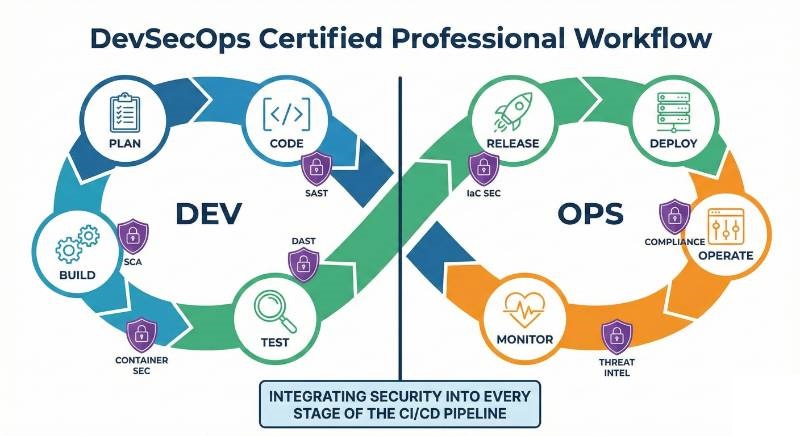
The DSOCP is a hands-on, comprehensive training program designed to teach you how to integrate security controls into every stage of the DevOps pipeline. It moves security from being a final “gatekeeper” step to being an automated, continuous process that happens every time a developer commits code.
Who should take it
- DevOps Engineers who want to increase their market value by adding “Security” to their title.
- Software Engineers who need to understand how to write secure code and fix vulnerabilities reported by automated scanners.
- Security Professionals (InfoSec) who need to adapt their traditional security audits to modern, fast-paced CI/CD workflows.
- Release Managers who need to ensure compliance without slowing down release velocity.
- QA Engineers looking to transition into security automation and testing.
Skills you’ll gain
- Pipeline Architecture: How to design a CI/CD pipeline (Jenkins/GitLab) with embedded security stages.
- Static Analysis (SAST): Implementing tools like SonarQube to catch bad code patterns early.
- Dynamic Analysis (DAST): Automating runtime attacks using tools like OWASP ZAP to find vulnerabilities in running apps.
- Container Security: Scanning Docker images and hardening Kubernetes clusters against attacks.
- Software Composition Analysis (SCA): Detecting vulnerable third-party libraries (dependencies) automatically.
- Infrastructure as Code (IaC) Security: Scanning Terraform or Ansible scripts for misconfigurations before deployment.
- Secrets Management: removing hardcoded passwords and using Vaults for dynamic secrets.
- Compliance Automation: Automating checks for standards like GDPR, PCI-DSS, or HIPAA within the pipeline.
Real-world projects you should be able to do after it
- Project 1: The “Golden Pipeline”: Build a Jenkins pipeline that automatically triggers a build, runs unit tests, performs a SAST scan, scans the Docker image, and deploys to staging only if all security gates pass.
- Project 2: Vulnerability Dashboard: create a centralized dashboard (using DefectDojo or similar) that aggregates vulnerability data from all your scanners (SAST, DAST, SCA) to give management a “Single Pane of Glass” view of risk.
- Project 3: Hardened Kubernetes Cluster: Deploy a Kubernetes cluster and implement policies that automatically reject pods running as “root” users or containing critical vulnerabilities.
- Project 4: Automated Compliance Report: Write a script that checks your cloud infrastructure against CIS Benchmarks and generates a PDF compliance report for auditors automatically every week.
Preparation plan
The time required depends on your starting point. Here are three realistic schedules:
1. The “Crash Course” (7–14 Days)
- Who: Senior DevOps Engineers with existing security knowledge.
- Plan: Focus 100% on the labs. Skip the “What is DevOps” intro modules. Spend 3 days on SAST/DAST integration, 2 days on Container Security, and 2 days on the capstone project.
- Daily Commitment: 4–6 hours.
2. The “Standard Professional” (30 Days)
- Who: Working engineers with a full-time job.
- Plan:
- Week 1: Core Concepts & Linux Security.
- Week 2: CI/CD Integration & SAST/SCA tools.
- Week 3: Dynamic Testing (DAST) & Container Security.
- Week 4: Infrastructure as Code Security & Final Project.
- Daily Commitment: 1–2 hours.
3. The “Deep Learner” (60 Days)
- Who: Beginners or those transitioning from non-technical roles.
- Plan: Dedicate the first 2 weeks entirely to Linux and basic Jenkins/GitLab concepts. Spend double time on labs, repeating them until you can do them without looking at the instructions.
- Daily Commitment: 1 hour.
Common mistakes
- Ignoring False Positives: Beginners often install a scanner and get overwhelmed by 500 “Critical” alerts. You must learn how to tune the tools to ignore noise, or developers will ignore you.
- Tool Overload: Don’t try to learn 5 tools for the same job. Master one SAST tool (like SonarQube) and one DAST tool (like ZAP) deeply first.
- Forgetting Culture: You cannot solve security with tools alone. If you don’t learn how to communicate with developers to get bugs fixed, your fancy pipeline is useless.
- Hardcoding Secrets in Labs: Even in training, never hardcode passwords. Practice using environment variables or secret managers from day one.
Best next certification after this
Once you have the DSOCP, you have options based on where you want to go:
- Same Track (Expertise): Certified DevSecOps Architect (CDSA) – Focuses on designing the strategy for an entire organization.
- Cross-Track (Broadening): Certified Kubernetes Security Specialist (CKS) – Deep dives specifically into the orchestration layer.
- Leadership (Management): Certified DevSecOps Manager (CDSM) – Focuses on governance, hiring, and calculating ROI for security initiatives.
Choose your path
The tech world is vast. To avoid getting lost, I recommend following one of these six specific “Ops” learning paths. The DSOCP is the key milestone in the second path.
1. DevOps Path
The classic route. Focuses on the flow of value from dev to ops.
- Key Focus: CI/CD, Linux, Cloud, Automation.
- Goal: Reduce time-to-market.
2. DevSecOps Path (Recommended)
The secure route. Integrates security into the DevOps path.
- Key Focus: SAST, DAST, Compliance, Vulnerability Management.
- Goal: Reduce risk while maintaining speed.
3. SRE (Site Reliability Engineering) Path
The stability route. Treats operations like a software problem.
- Key Focus: Observability, SLOs/SLIs, Incident Response, Chaos Engineering.
- Goal: Maximize system uptime and reliability.
4. AIOps / MLOps Path
The intelligence route. Focuses on managing AI/ML models in production.
- Key Focus: Model training pipelines, Model monitoring, Data drift detection.
- Goal: Reliable deployment of AI models.
5. DataOps Path
The data route. Focuses on the velocity of data analytics.
- Key Focus: ETL pipelines, Data quality, Data governance.
- Goal: Deliver accurate data to analysts faster.
6. FinOps Path
The cost route. Focuses on cloud financial management.
- Key Focus: Cloud billing analysis, Cost allocation, Resource optimization.
- Goal: Maximize business value of cloud spend.
Role → Recommended certifications mapping
Your job title dictates your learning priorities. Use this map to identify which certification you should target next.
| Current or Desired Role | Primary Focus Area | Recommended Certification Path |
| DevOps Engineer | Automation & Infrastructure | Certified DevOps Engineer (CDE) → DevSecOps Certified Professional |
| SRE | Reliability & Scalability | SRE Certified Professional → Kubernetes Administrator (CKA) |
| Platform Engineer | Internal Developer Experience | Certified DevOps Architect → Kubernetes Developer (CKAD) |
| Cloud Engineer | Cloud Infrastructure | Cloud Provider Professional (AWS/Azure) → Terraform Associate |
| Security Engineer | Application & Infra Security | DevSecOps Certified Professional → Certified Kubernetes Security Specialist (CKS) |
| Data Engineer | Data Pipelines | DataOps Certified Professional → Cloud Data Engineer |
| FinOps Practitioner | Cost Management | FinOps Certified Practitioner → Cloud Architect (for cost understanding) |
| Engineering Manager | Team Efficiency & Process | Certified DevOps Manager → Certified Agile Leadership |
Top Institutions for DevSecOps Certified Professional Training
Finding the right mentor is as important as the curriculum. Based on industry reputation and course depth, here are the top institutions.
DevOpsSchool
DevOpsSchool is widely considered the gold standard for this specific certification. They are famous for their “scenario-based” learning approach, where 70% of the class is hands-on coding. Their trainers usually have 15-20 years of experience, ensuring you learn industry reality, not just book definitions.
Cotocus
Cotocus specializes in high-end corporate training and consulting. Their courses are rigorous and often tailored for teams rather than individuals. If you are looking for training that aligns strictly with enterprise adoption patterns and consulting-grade best practices, this is a strong choice.
Scmgalaxy
One of the oldest and most respected communities in the DevOps space. Scmgalaxy offers training that is deeply rooted in community knowledge and open-source tools. They provide excellent post-training support through their massive forum and repository of tutorials and scripts.
BestDevOps
True to its name, BestDevOps focuses on curating the “best” and most current toolsets. Their curriculum is updated very frequently to reflect the latest versions of tools like Kubernetes and Jenkins. They are an excellent choice for engineers who want to be on the cutting edge of tool capabilities.
devsecopsschool
This is a highly specialized institution dedicated solely to the intersection of Development, Security, and Operations. Unlike generalist schools, every course here dives deep into security protocols. It is the perfect venue for security professionals trying to understand DevOps workflows.
sreschool
SRE School focuses on Site Reliability Engineering. While their primary focus is reliability, their DevSecOps modules are excellent because they view security as a reliability issue. They teach you how to build secure systems that are also resilient to failure.
aiopsschool
A niche provider focusing on the future of operations: Artificial Intelligence. Their DevSecOps training often includes modules on using AI to detect security threats (AIOps for Security), making them unique for forward-looking engineers.
dataopsschool
Focused on the data domain, this institution offers training that emphasizes securing data pipelines. If your role involves handling massive datasets or GDPR compliance within big data clusters, their specific flavor of DevSecOps training is invaluable.
finopsschool
Security costs money. FinOpsSchool bridges the gap between engineering and finance. Their training touches on the cost implications of security tools and how to optimize your cloud security spend without compromising on safety.
Frequently Asked Questions (FAQs)
General Certification FAQs
Q1: How much coding do I actually need to know?
You don’t need to be a developer, but you must be comfortable reading code (Python/JSON/YAML) and writing scripts (Bash). You aren’t writing apps, but you are writing the code that secures the apps.
Q2: Will this certification get me a job remotely?
DevSecOps is one of the most remote-friendly roles in IT. Because the work is cloud-native and results-oriented, companies worldwide are hiring certified professionals regardless of location.
Q3: What is the difference between this and a generic CyberSecurity cert?
Generic certs (like CEH) teach you how to hack. DSOCP teaches you how to automate the prevention of hacks inside a software delivery pipeline. It is construction vs. destruction.
Q4: Do I need a degree to take this?
No. In the DevOps world, skills and certifications outweigh university degrees. If you can pass the lab exams and demonstrate the skills, you are qualified.
DevSecOps Certified Professional (DSOCP) FAQs
Q5: What is the passing score for the DSOCP exam?
The passing score is typically around 70-75%, depending on the specific version of the exam. It is weighted heavily toward the practical/lab-based questions.
Q6: Does the DSOCP cover Cloud Security (AWS/Azure)?
Yes, but it focuses on “Cloud Agnostic” principles first. It teaches you concepts that apply to AWS, Azure, and GCP, often using Terraform to demonstrate how to secure infrastructure regardless of the provider.
Q7: Can I take the training if I don’t know Jenkins?
It is highly recommended that you learn the basics of Jenkins or a similar CI tool first. The training moves fast, and if you are struggling with basic CI concepts, you will miss the security concepts.
Q8: How long does it take to get exam results?
For the online exam, results are usually instant or available within 48 hours. For the project-based assessment, it may take 3-5 days for an instructor to grade your submission.
Q9: Is the certification recognized globally?
Yes, DevOpsSchool and its associated certifications are recognized by major multinational corporations and IT service providers across India, the US, UK, and Europe.
Q10: What tools do I need installed on my laptop?
You will generally need a decent laptop (16GB RAM recommended) with VirtualBox or Docker Desktop installed. The training usually provides cloud labs, but local tools are helpful for practice.
Q11: Does the curriculum update for new vulnerabilities (like Log4j)?
Yes, one of the benefits of the DSOCP is that the curriculum is “live.” When major industry vulnerabilities hit, the training modules are updated to show how to detect and prevent them.
Q12: What happens if I fail the lab project?
You typically get a feedback session with a mentor who explains where your pipeline failed or was insecure. You are then usually allowed a retake after a cooling-off period to fix your mistakes.
Next Certifications to Take
Learning never stops. According to the career roadmap, here are your best next steps after achieving the DSOCP:
- Same Track: Certified DevSecOps Architect – Move from implementing pipelines to designing organization-wide security strategies.
- Cross-Track: Certified SRE Professional (SRECP) – Expand your skills into reliability and observability to become a complete “Platform” expert.
- Leadership: Certified DevOps Manager (CDM) – If your goal is to lead teams, this certification bridges the gap between technical engineering and business management.
Conclusion
Ultimately, the journey to becoming a DevSecOps Certified Professional positions you at the elite intersection of development, operations, and security, solving the single biggest challenge facing modern IT: how to be fast without being reckless. By choosing this structured, project-based learning path, you are not just acquiring a certification but mastering a specialized skillset that safeguards your organization’s future and significantly elevates your own market value. The industry is no longer looking for engineers who just code; it is actively hunting for leaders who can secure the software factory, and with this training, that leader can be you.