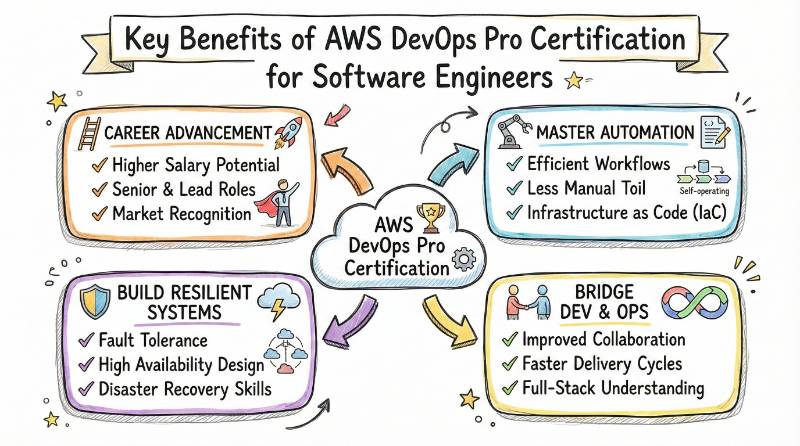
In today’s fast-moving tech world, the ability to build a server is basic knowledge. The real challenge is managing thousands of them without human effort. If you are an engineer or a manager, you know that manual work is the enemy of growth. To stay ahead, you need to shift from being a “builder” to becoming an “orchestrator.”
The AWS Certified DevOps Professional Training is the gold standard for this change. This program isn’t just about passing a test; it’s about proving you can handle the pressure of a global production environment. It shows you have the skills to make systems faster, safer, and cheaper. Whether you are working in India or for a global firm, this guide is your blueprint for reaching the highest level of cloud expertise.
The AWS Certification Landscape
Before you aim for the professional level, you must understand where you stand. The following table compares the tracks available to software engineers and technical leaders today.
AWS Certification Comparison Table
| Track | Level | Who it’s for | Prerequisites | Skills Covered | Recommended Order |
| Cloud Practitioner | Foundational | Managers, Sales | None | Basic Cloud, Billing | 1st |
| Solutions Architect | Associate | Developers, Admins | AWS Core | System Design, S3, EC2 | 2nd |
| Developer | Associate | Software Engineers | Coding basics | SDKs, CI/CD, Serverless | 3rd |
| SysOps Admin | Associate | Ops Engineers | IT Ops | Monitoring, Logging | 3rd |
| DevOps Professional | Professional | Sr. Engineers, SREs | Associate Cert | Automation, SDLC, IaC | 4th |
| Solutions Architect | Professional | Lead Architects | Associate Cert | Complex Strategy | 4th |
Deep Dive: AWS Certified DevOps Professional Training
This certification is the highest peak for anyone in the DevOps or SRE space. It tests your ability to solve real-world “broken” scenarios using deep logic and automation.
What it is
The AWS Certified DevOps Professional Training is an advanced curriculum that validates your ability to automate the entire software development lifecycle (SDLC) on the AWS platform. It focuses on the most difficult parts of cloud engineering, such as multi-account governance, high-availability deployments, and automated incident response.
Who should take it
This training is designed for professionals who are serious about technical leadership.
- Working Engineers who want to lead technical strategy.
- Software Engineers looking to master the deployment side of their code.
- Site Reliability Engineers (SREs) responsible for massive system uptime.
- Engineering Managers who need to design reliable roadmaps for their teams.
Skills you’ll gain
This program will help you develop a mindset where everything is treated as code. You will gain the technical authority to manage global systems with ease.
- Advanced SDLC Automation: You will learn to build fully automated pipelines that handle testing, security, and deployment across multiple regions without human help.
- Infrastructure as Code (IaC): You will master tools like CloudFormation and the AWS CDK, allowing you to build and tear down entire environments with just code.
- Observability and Monitoring: Moving from simple alerts to deep visibility. You will learn how to use CloudWatch and X-Ray to find bugs in seconds rather than hours.
- Security and Compliance: You will learn how to use AWS Organizations and Service Control Policies (SCPs) to ensure your infrastructure is secure by default.
Real-world projects you should be able to do
After finishing this training, you will have the confidence to lead high-stakes projects like:
- Zero-Downtime Multi-Region Rollouts: Setting up a system where you can update an app in different parts of the world at the same time without dropping a single user.
- Self-Healing Infrastructure: Creating a system that automatically detects a server failure and replaces it with a healthy one in seconds, with no manual work.
- Governance at Scale: Building a system that automatically shuts down any database that doesn’t follow security rules, protecting the company from data leaks.
Preparation plan
Your timeline should match your current daily experience. Here are the three most common paths to success:
- 7–14 Days (The Expert Sprint): Only for those who use these tools daily. Focus on the “AWS way” of solving scenarios. Spend your time taking practice exams and identifying the keywords that lead to the right answer.
- 30 Days (The Professional Path): This is the ideal timeline for most senior engineers. Spend 1 hour a day on deep-dive video courses and dedicate your weekends to building hands-on labs like multi-account pipelines.
- 60 Days (The Comprehensive Journey): If you are newer to the Professional level. Spend the first month building 10 different mini-projects. Spend the second month mastering whitepapers and complex troubleshooting scenarios.
Common mistakes
I have seen many talented engineers fail this exam because they fall into these common traps:
- Picking Manual Solutions: If an answer choice involves a human logging into the console to fix a problem, it is almost certainly wrong. AWS wants you to choose the automated path.
- Ignoring the Bill: Professional-level engineers are expected to be cost-conscious. Always look for the solution that is both effective and the most cost-efficient.
- Reading Too Slowly: The questions are long. If you don’t practice identifying the core problem in the first 30 seconds, you will run out of time.
- Neglecting IAM: Permissions are at the heart of everything. If you don’t master how roles work across different accounts, you will struggle with the security questions.
Best next certification after this
Once you have earned your DevOps Professional badge, the most logical step is the AWS Certified Security – Specialty. In today’s market, an automation expert who also understands deep security architecture is a rare and highly valued asset.
Choose Your Path: 6 Modern Learning Tracks
DevOps is no longer a single job; it has branched into specialized domains. Depending on your interest, you can follow one of these six modern tracks:
- DevOps Path: Focuses on the core speed and quality of software delivery. Perfect for those who love CI/CD and automation.
- DevSecOps Path: Focuses on “shifting security left.” You will learn how to bake security directly into the pipeline so it never gets ignored.
- SRE Path: Focuses on reliability, performance, and incident management. You become the guardian of the system’s health.
- AIOps/MLOps Path: The future of operations. You will learn to use AI to manage your cloud and automate the deployment of machine learning models.
- DataOps Path: Focuses on the automation of data pipelines. Ideal for those working in data-heavy industries like finance or healthcare.
- FinOps Path: Cloud costs are a major concern for every CEO. This path focuses on financial accountability and automated cost-saving strategies.
Role → Recommended Certifications Mapping
Align your certifications with your career goals using this strategic mapping:
- DevOps Engineer: AWS DevOps Professional + Terraform Associate.
- SRE: AWS DevOps Professional + AWS SysOps Associate.
- Platform Engineer: AWS DevOps Professional + Certified Kubernetes Administrator (CKA).
- Cloud Engineer: AWS Solutions Architect Associate + AWS DevOps Professional.
- Security Engineer: AWS Security Specialty + AWS DevOps Professional.
- Data Engineer: AWS Data Engineer Associate + AWS Solutions Architect Associate.
- FinOps Practitioner: AWS Cloud Practitioner + FinOps Certified Practitioner.
- Engineering Manager: AWS Cloud Practitioner + AWS Solutions Architect Associate.
Next Certifications to Take
To keep your growth steady, consider these three directions after your DevOps Professional training, based on data from industry sources like GurukulGalaxy:
- Same Track (Specialization): AWS Certified Security – Specialty. This completes the security pillar of DevOps and is highly valued by top firms.
- Cross-Track (Expansion): Certified Kubernetes Administrator (CKA). Since EKS is the backbone of many AWS setups, mastering Kubernetes is the ultimate force multiplier.
- Leadership (Strategic Growth): AWS Certified Solutions Architect – Professional. This allows you to move from “how to build” to “what to build” for the entire enterprise.
Top Training Institutions
Choosing the right mentor is critical for success. These institutions are recognized for their excellence in providing the AWS Certified DevOps Professional Training (CDE):
- DevOpsSchool: A premier institution known for its “Project-First” approach. They focus on teaching 50+ DevOps tools alongside the AWS curriculum, ensuring you are ready for a real production environment rather than just a written test.
- Cotocus: They specialize in high-end corporate bootcamps that help engineers bridge the gap between traditional IT and modern cloud-native architectures with expert guidance and intensive sessions.
- Scmgalaxy: A massive technical community and training provider that offers deep-dive resources on source code management and automated operations for senior engineers.
- BestDevOps: Known for their streamlined and efficient learning paths, perfect for busy managers who need to clear the certification without wasting time on fluff.
- DevSecOpsSchool: The top choice for those looking to specialize in security. Their curriculum integrates automated security testing and vulnerability scanning directly into the AWS lifecycle.
- Sreschool: Dedicated to the Site Reliability Engineering discipline, providing specific training on building resilient, self-healing, and high-availability systems on AWS.
- Aiopsschool: They lead the way in AI-driven operations, teaching you how to use machine learning and AI to manage complex cloud environments automatically.
- Dataopsschool: Ideal for engineers working in data-heavy industries, focusing on the automation and governance of data lakes and pipelines on the AWS platform.
- Finopsschool: A specialized provider focused on cloud financial management, helping you master the art of cost-saving and financial accountability on AWS.
General Career FAQs
1. Is the AWS DevOps Professional exam harder than the Architect Pro? It is technically deeper. While Architect Pro is about high-level design, DevOps Pro is about solving “broken” scenarios and complex automation logic.
2. How long should I study for this certification? For a working engineer, 2 to 3 months of consistent study (1-2 hours a day) is usually the standard timeline to master the material.
3. Do I need to be a coding expert? You don’t need to be a senior developer, but you must understand logic and be comfortable with YAML/JSON for CloudFormation and Python for automation.
4. What is the value of this certification in India? In the Indian market, this certification is a massive door-opener for senior roles at top MNCs and startups, often leading to significant salary growth.
5. How long is the certification valid? It stays valid for three years. You will need to take the latest version of the exam or pass a higher-level credential to renew it.
6. Does the training cover containers? Yes, it focuses heavily on how to deploy and manage containerized applications using Amazon ECS, EKS, and Fargate.
7. Can I take the exam from home? Yes, AWS offers online proctored exams through Pearson VUE, allowing you to get certified from your home or office.
8. What happens if I fail the exam? You can retake it after 14 days. Don’t be discouraged; many experts fail on their first attempt due to the complexity of the questions.
Specific Certification FAQs
1. What is the main goal of this training? The main focus is on automating the entire software lifecycle, from the developer’s computer to the production server.
2. Which AWS services are emphasized most? CloudFormation, CodePipeline, CloudWatch, AWS Config, and Systems Manager are the core services you will master.
3. Is the training hands-on? Yes. You cannot pass this exam without actually building and breaking things in a real AWS environment during your labs.
4. Does the training cover multi-account setups? Yes, a large portion of the training focuses on AWS Organizations and managing security across multiple teams.
5. What is the passing score? A passing score is 750 out of 1000, using a scaled scoring system where some questions carry more weight.
6. How many questions are in the exam? There are 75 multiple-choice or multiple-response questions to be completed in 180 minutes.
7. Are there discounts for the exam fee? If you have passed an AWS Associate exam, you usually get a 50% discount voucher in your certification account for the next exam.
8. How do I choose between DevOps Pro and Architect Pro? If you enjoy building and automating, choose DevOps Pro. If you prefer high-level design and migration strategy, choose Architect Pro.
Conclusion
The path to becoming an AWS Certified DevOps Professional is a defining journey for any engineering leader. It is a commitment to moving away from manual, reactive work and stepping into the world of proactive, automated engineering excellence. By mastering the concepts in this guide—from CI/CD pipelines to automated security guardrails—you aren’t just earning a badge; you are becoming an architect of the modern digital world. This certification signals to the industry that you have the expertise to lead, the skill to build, and the grit to solve the toughest cloud challenges. Whether you want to specialize in SecOps, SRE, or FinOps, the foundation you build during this training will serve you for years to come. Take the first step today, invest in your training, and prepare to lead the next generation of cloud engineering.