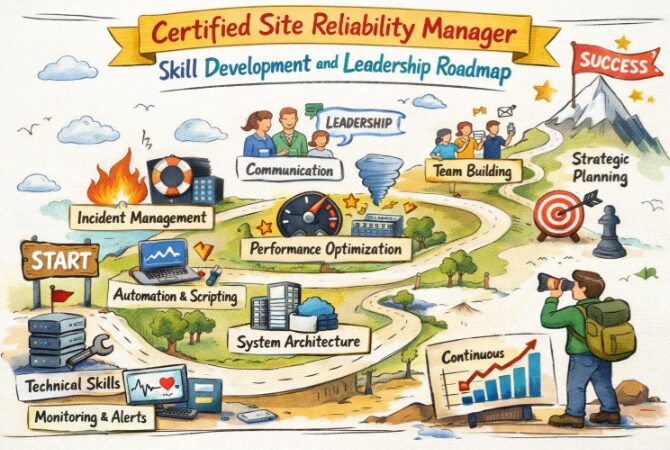
The transition from a technical individual contributor to a leadership role in the reliability domain is one of the most significant shifts an engineer can make. The Certified Site Reliability Manager is a professional designation designed for those who want to bridge the gap between deep technical SRE practices and strategic engineering management. This guide is crafted for professionals looking to master the art of managing reliability at scale, providing a roadmap to navigate the complexities of modern platform engineering. By understanding the core tenets of this certification, you can make informed decisions about your career trajectory within the DevOps and cloud-native ecosystems. This curriculum, hosted at SREschool, serves as a cornerstone for those aiming to lead high-performance teams in an increasingly automated world.
What is the Certified Site Reliability Manager?
The Certified Site Reliability Manager represents a shift from “doing” SRE to “leading” SRE. It is a credential that validates a professional’s ability to manage the operational health of complex, distributed systems while fostering a culture of accountability and continuous improvement. Unlike purely technical certifications that focus on tool-specific syntax, this program emphasizes the management of Service Level Objectives (SLOs), error budgets, and the human elements of incident response.
It exists to fill the void in the industry for leaders who understand that reliability is a product feature, not an afterthought. The focus is strictly production-oriented, moving beyond theoretical frameworks to address real-world challenges like team burnout, technical debt management, and the economics of uptime. It aligns perfectly with modern enterprise practices where platform engineering and SRE are central to the digital business strategy.
Who Should Pursue Certified Site Reliability Manager?
This certification is tailored for mid-to-senior level professionals who are either currently in leadership roles or looking to move into them. Engineering Managers who oversee DevOps or SRE teams will find the framework invaluable for setting team goals that align with business outcomes. Senior SREs and Lead Systems Engineers who are transitioning into “Staff” or “Principal” roles will benefit from the strategic oversight skills taught throughout the course.
Furthermore, Cloud Architects and Security Leads who need to integrate reliability into their broader technical roadmaps will find the structured approach highly relevant. In the context of the global market, including the rapidly evolving tech landscape in India, there is a massive demand for leaders who can handle the pressures of hyper-scale environments. It is equally beneficial for beginners in management who want a solid foundation in reliability-first leadership principles.
Why Certified Site Reliability Manager is Valuable and Beyond
The demand for reliability leadership is growing as organizations move away from traditional “ops” silos toward integrated platform teams. The Certified Site Reliability Manager helps professionals stay relevant because it focuses on principles—such as blameless culture and data-driven decision making—that persist regardless of which cloud provider or orchestration tool is currently in fashion. It provides a long-term hedge against the rapid churn of the technology sector.
Enterprises are increasingly adopting SRE not just as a set of tools, but as an organizational philosophy. Holding this certification signals to employers that you possess the maturity to manage risk, balance innovation with stability, and lead teams through high-pressure outages. The return on investment is seen in faster career progression, better alignment with business stakeholders, and the ability to command higher compensation in a competitive market.
Certified Site Reliability Manager Certification Overview
The Certified Site Reliability Manager program is a comprehensive educational track delivered via the official portal at Site Reliability Manager and hosted on the SREschool.com platform. The program is structured to provide a clear progression from foundational management concepts to advanced organizational strategy. It utilizes a combination of practical assessments, case studies, and objective examinations to ensure that candidates don’t just memorize definitions but understand how to apply them in a live production environment.
Ownership of the certification lies with an industry-led body that updates the curriculum regularly to reflect changes in how modern enterprises handle reliability. The assessment approach is designed to be rigorous, testing a candidate’s ability to make difficult trade-offs between feature velocity and system stability. The structure is practical, focusing on the day-to-day realities of managing an engineering organization that prioritizes uptime and performance.
Certified Site Reliability Manager Certification Tracks & Levels
The certification is divided into three distinct levels to cater to different stages of professional growth. The Foundation level introduces the core vocabulary and principles of SRE management, making it ideal for those new to the lead role. The Professional level dives deeper into the tactical aspects of managing teams, handling large-scale incidents, and optimizing error budgets across multiple services.
The Advanced level is reserved for those who are operating at a directorial or executive level, focusing on organizational design and multi-year reliability roadmaps. There are also specialization tracks that allow managers to align their reliability expertise with other domains like FinOps for cost-effective reliability or DevSecOps for secure operations. This tiered approach ensures that as your career progresses, your certification can evolve alongside your responsibilities.
Complete Certified Site Reliability Manager Certification Table
| Track | Level | Who it’s for | Prerequisites | Skills Covered | Recommended Order |
| Core Management | Foundation | Aspiring Leads | Basic DevOps knowledge | SLO Basics, Blameless Culture, Toil | First |
| Tactical Leadership | Professional | Engineering Managers | 2+ years SRE experience | Incident Command, Budgeting, Hiring | Second |
| Strategic Oversight | Advanced | Directors/VP Eng | Professional Level Cert | Org Design, Reliability Economics | Third |
| FinOps Integrated | Specialization | Platform Leads | Foundation Level | Cost-Reliability Trade-offs | Optional After Foundation |
| Security Operations | Specialization | DevSecOps Managers | Foundation Level | Security SLOs, Vulnerability Management | Optional After Foundation |
Detailed Guide for Each Certified Site Reliability Manager Certification
What it is
This certification validates a professional’s understanding of the fundamental building blocks of SRE management. It covers the basic terminology, the philosophy of “operations as a software problem,” and the importance of data-driven reliability.
Who should take it
This is suitable for Senior Engineers looking to move into management, new Engineering Managers, or Project Managers working within a technical DevOps environment. It is designed for those with 0-2 years of management experience.
Skills you’ll gain
- Understanding the SRE management vocabulary.
- Ability to define and differentiate between SLIs, SLOs, and SLAs.
- Knowledge of how to identify and reduce operational toil.
- Implementing a blameless post-mortem culture within a small team.
Real-world projects you should be able to do
- Draft an initial SLO document for a microservice.
- Conduct a basic blameless post-mortem after a minor outage.
- Calculate the toil percentage of a team’s weekly workload.
Preparation plan
- 7-14 days: Review the official study guide and focus on the core definitions of SRE.
- 30 days: Read “The Site Reliability Workbook” and take two practice exams to identify knowledge gaps.
- 60 days: Engage in community forums and apply the SLO principles to a mock project.
Common mistakes
- Focusing too much on specific tools (like Kubernetes) rather than management principles.
- Confusing SLAs (business contracts) with SLOs (internal reliability targets).
- Underestimating the cultural shift required for blamelessness.
Best next certification after this
- Same-track option: Certified Site Reliability Manager – Professional
- Cross-track option: Certified SRE Professional
- Leadership option: Certified Platform Manager
Choose Your Learning Path
DevOps Path
This path is for those who want to integrate reliability management into the traditional CI/CD pipeline. It focuses on how managers can ensure that speed does not compromise stability during the delivery process. Professionals here learn to build guardrails that allow developers to move fast while maintaining high reliability standards.
DevSecOps Path
The DevSecOps path emphasizes the intersection of security and reliability management. It teaches managers how to handle security incidents with the same rigor as operational outages and how to build “secure-by-default” systems. This is critical for leaders who operate in highly regulated industries like finance or healthcare.
SRE Path
The core SRE path is the most direct route for those focused solely on the health of production systems. It dives deep into the metrics, culture, and automation strategies that define the SRE role. This path is ideal for those who want to become the definitive authority on uptime within their organization.
AIOps Path
The AIOps path focuses on using artificial intelligence and machine learning to manage reliability at a scale that humans cannot handle manually. Managers in this track learn how to implement predictive analytics for incident prevention and automated anomaly detection. It is the frontier of modern reliability management.
MLOps Path
The MLOps path is specialized for those managing the reliability of machine learning models in production. It addresses unique challenges like data drift, model decay, and the infrastructure required to support large-scale AI workloads. This is essential for organizations where AI is a core part of the product offering.
DataOps Path
DataOps focuses on the reliability of data pipelines and the integrity of data at rest and in transit. Managers on this path learn how to apply SRE principles to data engineering, ensuring that data is available, accurate, and timely. This is a vital role as businesses become more data-driven.
FinOps Path
The FinOps path teaches managers how to balance the cost of cloud infrastructure with the required level of reliability. It focuses on the economics of the cloud, helping leaders make informed decisions about when to spend more for better uptime and when to optimize for cost.
Role → Recommended Certified Site Reliability Manager Certifications
| Role | Recommended Certifications |
| DevOps Engineer | CSRM Foundation, Certified DevOps Professional |
| SRE | CSRM Foundation, CSRM Professional, Certified SRE Professional |
| Platform Engineer | CSRM Professional, Certified Platform Manager |
| Cloud Engineer | CSRM Foundation, Cloud Architect Professional |
| Security Engineer | CSRM Foundation, DevSecOps Manager |
| Data Engineer | CSRM Foundation, DataOps Specialist |
| FinOps Practitioner | CSRM Foundation, Certified FinOps Professional |
| Engineering Manager | CSRM Foundation, CSRM Professional, CSRM Advanced |
Next Certifications to Take After Certified Site Reliability Manager
Same Track Progression
Deepening your specialization within the SRE management framework involves moving from Foundation to Advanced levels. This ensures a logical growth from tactical team leading to strategic organizational oversight. Professionals may also look for specific vendor-neutral certifications that focus on the architectural side of reliability to complement their management skills.
Cross-Track Expansion
Broadening your skills often means looking toward adjacent fields like FinOps or DevSecOps. A Certified Site Reliability Manager who understands the financial implications of reliability (FinOps) or the security aspects of uptime (DevSecOps) is much more valuable to a modern enterprise. This cross-pollination of skills allows you to sit at the intersection of multiple business units.
Leadership & Management Track
For those looking to transition fully into executive leadership, the next steps include certifications in General Management, CTO-level training, or specialized leadership programs. These courses move away from technical implementation entirely and focus on business strategy, human resources, and board-level communication.
Training & Certification Support Providers for Certified Site Reliability Manager
DevOpsSchool
DevOpsSchool provides a robust ecosystem for professionals looking to master the intricacies of site reliability management. They offer a blend of instructor-led training and self-paced modules that are designed to meet the needs of working engineers. Their curriculum is frequently updated to reflect the latest industry trends, ensuring that students are learning skills that are immediately applicable in the workplace. With a strong presence in the global market, they provide a community-driven approach to learning that helps candidates prepare for the rigors of the certification exam.
Cotocus
Cotocus is known for its highly practical and lab-oriented training programs that focus on the “how-to” of engineering management. They provide specialized coaching for the Certified Site Reliability Manager, emphasizing the tactical aspects of leading technical teams. Their training sessions often involve real-world simulations of incident response and SLO planning, giving students hands-on experience before they even sit for the exam. This focus on experiential learning makes them a preferred choice for professionals who want to gain deep technical competency alongside their management credentials.
Scmgalaxy
Scmgalaxy serves as a comprehensive resource hub and training provider for the broader DevOps and SRE community. They offer extensive documentation, community forums, and structured training programs that support the Certified Site Reliability Manager track. Their approach is focused on building a strong foundational understanding of software configuration management and its relationship to reliability. For candidates who prefer a resource-heavy learning environment with access to a vast library of technical content, Scmgalaxy provides the necessary tools to succeed in the certification process.
BestDevOps
BestDevOps focuses on delivering high-quality, boutique-style training for senior engineering professionals. Their courses for the Certified Site Reliability Manager are often led by industry veterans who bring decades of experience to the table. This provider is particularly effective for those looking for mentorship-style learning where they can discuss complex organizational challenges with experts. Their curriculum is streamlined to focus on the most impactful aspects of reliability leadership, making it an efficient choice for busy professionals who need to maximize their study time.
devsecopsschool.com
As the name suggests, devsecopsschool.com specializes in the intersection of security and operations. For a Site Reliability Manager, understanding security is no longer optional, and this provider ensures that reliability is taught through a security-conscious lens. They offer specific tracks that complement the CSRM, focusing on how to manage secure and resilient systems simultaneously. Their training programs are ideal for professionals working in high-security environments who need to balance the pressures of uptime with the requirements of strict compliance and vulnerability management.
sreschool.com
Sreschool.com is the primary platform and hosting site for the Certified Site Reliability Manager program. They offer the most direct and comprehensive path to certification, with a curriculum that is designed by the same experts who manage the certification standards. The platform provides a seamless learning experience, from foundational courses to advanced strategic leadership modules. By training directly with the hosting provider, candidates ensure that their learning is perfectly aligned with the exam objectives and the professional expectations of the industry.
aiopsschool.com
Aiopsschool.com is at the forefront of the next generation of reliability management, focusing on the application of AI and ML to operational tasks. For a Certified Site Reliability Manager, training through this provider offers a glimpse into the future of automated operations. Their courses cover predictive maintenance, automated incident resolution, and the management of AI-driven platform tools. This is a critical training ground for managers who want to lead their organizations toward a more automated, efficient, and intelligent future of site reliability.
dataopsschool.com
Dataopsschool.com addresses the growing need for reliability in data engineering and analytics pipelines. They provide specialized training that applies SRE principles to the world of data, ensuring that “data reliability” is managed with the same discipline as service reliability. A Certified Site Reliability Manager who understands DataOps is uniquely positioned to lead teams in data-heavy organizations. Their curriculum focuses on data quality, pipeline stability, and the management of complex data architectures in a cloud-native environment.
finopsschool.com
Finopsschool.com focuses on the financial management of cloud operations, a skill that is increasingly important for any Site Reliability Manager. They teach the art of “Cloud Financial Management,” helping leaders understand how to optimize infrastructure costs without sacrificing the reliability of their systems. For managers responsible for large cloud budgets, this provider offers the essential tools to make data-driven decisions that align engineering efforts with business profitability. Their training is indispensable for leaders who want to master the economics of reliability.
Frequently Asked Questions (General)
1. How difficult is the Certified Site Reliability Manager exam?
The difficulty depends on your experience level. For those with a strong background in SRE and management, the Foundation level is manageable, while the Professional and Advanced levels require a deep understanding of complex organizational trade-offs and tactical execution.
2. How long does it take to get certified?
Typically, a candidate spends 30 to 60 days preparing for each level. This allows for a thorough review of the materials and the application of concepts to real-world scenarios, which is crucial for passing the practical assessments.
3. Are there any mandatory prerequisites?
While the Foundation level is open to most professionals, the Professional and Advanced levels generally require that you have passed the preceding level and have a specific number of years of documented experience in a leadership or SRE role.
4. What is the return on investment for this certification?
The ROI is significant, often manifesting as a promotion to a lead or manager role, a transition into platform engineering, or a salary increase. It also provides the long-term benefit of a structured framework for managing complex systems.
5. How does this certification compare to a general DevOps certification?
A general DevOps certification focuses on the tools and culture of continuous delivery. The CSRM specifically targets the management of production reliability, focusing on SLOs, incident response, and the “run” phase of the software lifecycle.
6. Can I take the exam online?
Yes, the certification is designed to be accessible globally, with online proctoring and digital assessment tools available through the official hosting platform. This makes it convenient for working professionals to balance study with their daily responsibilities.
7. How often does the certification need to be renewed?
To ensure that certified professionals remain current with industry trends, there is typically a renewal or continuing education requirement every two to three years. This encourages lifelong learning in a fast-paced field.
8. Is this certification recognized globally?
Yes, the standards for the Certified Site Reliability Manager are designed to meet the needs of global enterprises, from Silicon Valley startups to major technology hubs in India and Europe.
9. Does the course include hands-on labs?
The training programs provided by partners like Cotocus and SREschool.com include extensive lab environments where you can practice managing mock outages and setting up monitoring and alerting frameworks.
10. What kind of support is available if I fail the exam?
Most training providers offer “exam retake” options or additional coaching sessions to help you identify the areas where you struggled and prepare for a second attempt.
11. Are there group discounts for corporate teams?
Yes, most providers offer corporate packages for engineering departments looking to certify their entire management tier. This ensures that all leaders are using a common vocabulary and framework.
12. How does this certification help with career progression?
It provides a clear signal to recruiters and senior leadership that you have the maturity and specific skill set required to lead reliability initiatives, which is a high-priority area for most modern businesses.
FAQs on Certified Site Reliability Manager
1. What specifically does a “Manager” in SRE do differently than a regular manager?
An SRE manager focuses on quantitative reliability targets and the reduction of toil. Unlike a traditional manager who might focus on feature deadlines, the SRE manager focuses on the health of the service and the sustainability of the team’s workload.
2. Is coding required for the manager certification?
While you don’t need to be a daily coder, a strong understanding of software engineering principles is essential. You must be able to speak the same language as your engineers and understand how code changes impact system reliability.
3. How do I justify the cost of this certification to my employer?
Highlight the fact that a single hour of downtime can cost thousands of dollars. By becoming a certified manager, you are learning the frameworks to prevent outages and manage them more efficiently when they do occur.
4. Can a Project Manager become a Certified Site Reliability Manager?
Yes, if they have a technical background. It is an excellent way for Project Managers to transition into more technical, operations-focused leadership roles within the DevOps ecosystem.
5. What is the most important skill covered in the CSRM?
Most professionals find that the “Error Budget” management is the most impactful skill. It provides a data-driven way to resolve the constant tension between developers (who want to move fast) and operations (who want stability).
6. Does this certification cover cloud-specific tools like AWS or Azure?
The certification is vendor-neutral, focusing on principles that apply to any cloud or on-premise environment. However, the practical examples often use industry-standard tools to illustrate the concepts.
7. How does the CSRM address team burnout?
A core part of the curriculum is dedicated to “Toil Management.” By learning how to identify and automate repetitive manual tasks, a manager can significantly improve team morale and prevent burnout.
8. Why is “Blameless Culture” a part of a management certification?
Management is responsible for the culture of the team. A blameless culture is essential for SRE because it ensures that when things go wrong, the focus remains on fixing the system rather than pointing fingers at individuals.
Final Thoughts: Is Certified Site Reliability Manager Worth It?
In my two decades of experience in this industry, I have seen many engineers struggle with the transition to leadership. They often try to manage by being the “best debugger in the room,” which doesn’t scale. The Certified Site Reliability Manager is worth the investment because it teaches you that your new “system” is the team itself. It provides the structured thinking required to move from reactive fire-fighting to proactive reliability strategy. If you want to be a leader who is respected by both the C-suite and the engineering floor, this path is one of the most practical and effective ways to get there. It is not about a piece of paper; it is about adopting a mindset that will define the next decade of your career.