Introduction
The rise of complex, distributed systems has made manual intervention nearly impossible for modern operations teams. As organizations scale, the need for intelligent automation becomes a necessity rather than a luxury. This guide explores the Certified AIOps Engineer program, a comprehensive curriculum designed to bridge the gap between traditional operations and artificial intelligence. Whether you are in DevOps, SRE, or platform engineering, understanding how to apply machine learning to operational data is the next logical step in your professional evolution.
This roadmap is provided by AIOps School to help engineers and managers navigate the complexities of algorithmic IT operations. By the end of this guide, you will understand the specific value of this certification, the difficulty level of the exams, and how it maps to high-growth roles in the global tech landscape. Our goal is to provide an unbiased perspective that helps you decide if this learning path aligns with your long-term career objectives in the cloud-native ecosystem.
What is the Certified AIOps Engineer?
The Certified AIOps Engineer designation represents a specialized standard for professionals who manage IT infrastructure using artificial intelligence and machine learning. Unlike theoretical data science courses, this program is rooted in production environments, focusing on how algorithms can solve real-world uptime and performance issues. It exists to validate an engineer’s ability to move beyond reactive troubleshooting into the realm of predictive and proactive system management.
This certification focuses heavily on the practical application of big data, streaming analytics, and automated response patterns within modern engineering workflows. It aligns with enterprise practices by emphasizing the reduction of “noise” in monitoring systems and the acceleration of Mean Time to Repair (MTTR). By completing this program, engineers demonstrate they can handle the scale of modern microservices architecture where traditional monitoring tools often fall short.
Who Should Pursue Certified AIOps Engineer?
This certification is built for professionals who sit at the intersection of development and operations, specifically DevOps engineers, Site Reliability Engineers (SREs), and Cloud Architects. Security professionals and data engineers also find significant value here, as the principles of anomaly detection and automated remediation apply directly to threat hunting and data pipeline stability. It is an ideal path for those who want to move away from repetitive manual tasks and toward high-level system orchestration.
In terms of experience levels, the program offers entry points for motivated beginners who have a baseline understanding of Linux and networking, as well as advanced tracks for senior leaders. In regions like India and across global tech hubs, there is a massive demand for engineers who can manage the operational costs of the cloud. Engineering managers and technical leaders should also consider this track to better understand how to structure their teams for an AI-driven future.
Why Certified AIOps Engineer is Valuable in the Current Market and Beyond
As enterprise adoption of cloud-native technologies continues to accelerate, the volume of telemetry data being generated has surpassed human capacity for analysis. AIOps ensures that engineers remain relevant by teaching them to build systems that think, rather than just systems that alert. The longevity of this certification lies in its focus on logic and architectural patterns rather than specific, fleeting tools, making it a stable career investment for the next decade.
The return on time invested in this certification is reflected in the increased efficiency of the teams that employ these certified professionals. Organizations are actively seeking ways to reduce operational overhead while maintaining high availability, and AIOps is the primary methodology for achieving this. By mastering these skills, you position yourself as a key contributor to business continuity and financial optimization within the enterprise.
Certified AIOps Engineer Certification Overview
The certification program is delivered via the official Certified AIOps Engineer curriculum and hosted on the AIOps School platform. The approach is deeply rooted in practical assessment, requiring candidates to demonstrate competency through labs and scenario-based testing rather than simple multiple-choice questions. This ensures that the credential carries weight in the industry as a true measure of technical capability.
The structure of the program is divided into logical modules that cover data ingestion, event correlation, and automated incident response. It is designed to be flexible, allowing professionals to balance their learning with full-time work commitments while still moving through a rigorous technical syllabus. Ownership of the certification resides with a community of practitioners who ensure the content is updated frequently to reflect current industry challenges.
Certified AIOps Engineer Certification Tracks & Levels
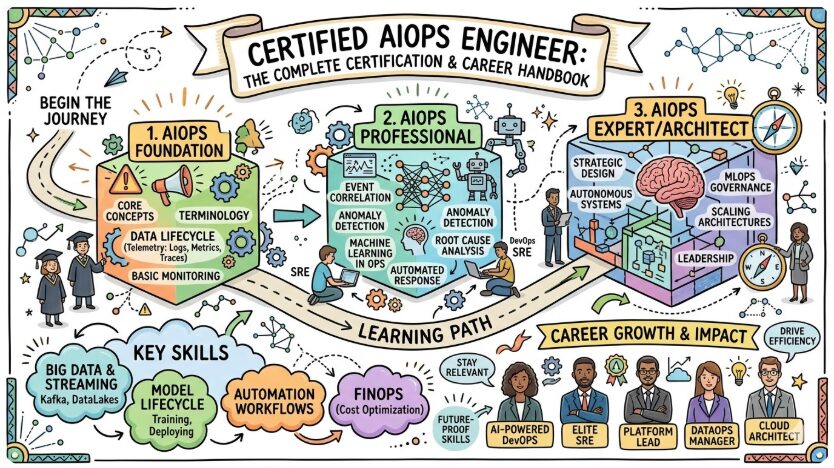
The program is structured into Foundation, Professional, and Advanced levels to cater to different stages of an engineer’s career. The Foundation level introduces the core concepts of data science for operations, while the Professional level dives into complex event processing and model deployment. The Advanced level is reserved for architects designing global-scale automated remediation frameworks that operate across multi-cloud environments.
These levels align directly with career progression, taking a practitioner from an individual contributor role to a strategic lead position. Specialization tracks are also available, allowing you to pivot toward SRE-focused AIOps, FinOps-driven cost automation, or DevSecOps security intelligence. This modularity allows you to build a personalized learning journey that supports your specific professional goals.
Complete Certified AIOps Engineer Certification Table
| Track | Level | Who it’s for | Prerequisites | Skills Covered | Recommended Order |
| Operations Foundation | Associate | Junior Admins/Grads | Basic Linux/Cloud | Data ingestion, Monitoring | 1st |
| AIOps Implementation | Professional | DevOps/SREs | 2+ Years IT Exp | Pattern Discovery, ML Ops | 2nd |
| Intelligent Automation | Specialist | Automation Engineers | Scripting/Python | Workflow Orchestration | 3rd |
| AIOps Architecture | Expert | Lead Engineers/Archs | Professional Cert | Strategy, Governance | 4th |
Detailed Guide for Each Certified AIOps Engineer Certification
Certified AIOps Engineer – Foundation Level
What it is
This certification validates a foundational understanding of how AI integrates with traditional IT operations. It ensures the candidate understands the core terminology and the data lifecycle involved in intelligent monitoring.
Who should take it
It is designed for junior engineers, recent graduates, or experienced managers who need a conceptual understanding of AIOps without getting bogged down in deep coding.
Skills you’ll gain
- Understanding the difference between traditional monitoring and AIOps.
- Basics of telemetry data collection (Logs, Metrics, Traces).
- Identification of common AI use cases in production environments.
- Familiarity with the AIOps maturity model.
Real-world projects you should be able to do
- Setting up a basic centralized logging and metrics pipeline.
- Configuring simple threshold-based alerting with noise reduction.
Preparation plan
- 7–14 days: Review official course materials and terminology.
- 30 days: Complete all fundamental labs and practice quizzes.
- 60 days: Not typically required for this level if the candidate has a background in IT.
Common mistakes
- Overcomplicating basic machine learning concepts.
- Ignoring the importance of data quality at the ingestion phase.
Best next certification after this
- Same-track option: Professional AIOps Engineer.
- Cross-track option: Certified SRE Professional.
- Leadership option: IT Operations Management (ITOM) Lead.
Certified AIOps Engineer – Professional Level
What it is
The Professional level validates the ability to implement and manage machine learning models specifically for operational tasks. It focuses on event correlation and anomaly detection in real-time.
Who should take it
DevOps engineers and SREs with at least two years of experience who are responsible for maintaining high-availability systems.
Skills you’ll gain
- Building and deploying anomaly detection algorithms.
- Implementing automated root cause analysis (RCA).
- Managing high-volume event streams using Kafka or similar tools.
- Integrating AI models with existing ITSM platforms.
Real-world projects you should be able to do
- Building a predictive alerting system that identifies failures before they occur.
- Developing an automated incident response workflow for common service disruptions.
Preparation plan
- 7–14 days: Intensive lab work focusing on data modeling.
- 30 days: Deep dive into Python for operations and ML frameworks.
- 60 days: End-to-end project implementation and exam review.
Common mistakes
- Failing to account for model drift in dynamic infrastructure.
- Creating too many automated actions without proper guardrails.
Best next certification after this
- Same-track option: Expert AIOps Architect.
- Cross-track option: Certified MLOps Specialist.
- Leadership option: Principal Platform Engineer.
Choose Your Learning Path
DevOps Path
The DevOps path focuses on integrating AIOps into the CI/CD pipeline and deployment strategies. Engineers learn how to use AI to predict deployment failures and automate rollbacks based on performance metrics. This path is ideal for those who want to enhance the “Operations” side of DevOps with intelligent feedback loops. It emphasizes the speed of delivery without sacrificing system stability.
DevSecOps Path
In this track, the focus shifts to security intelligence and automated threat response. Candidates learn how to apply anomaly detection to identify unauthorized access patterns or unusual data egress. The goal is to move security from a periodic audit to a real-time, AI-driven defense mechanism. This path is critical for engineers working in highly regulated industries or finance.
SRE Path
The SRE path is deeply rooted in reliability and the management of Error Budgets. AIOps tools are used here to manage toil and provide deep insights into service-level indicators (SLIs). Professionals learn to build self-healing systems that can resolve incidents without human intervention. This is the most technically demanding path, requiring a strong grasp of both systems engineering and data science.
AIOps Path
This dedicated path focuses on the overarching strategy of transforming a traditional NOC into an AI-driven command center. It covers the full spectrum of the AIOps lifecycle, from data strategy to organizational change management. It is designed for those who want to become specialists in the AIOps field specifically. You will master the art of noise reduction and intelligent event orchestration.
MLOps Path
The MLOps path bridges the gap between data science and production engineering. It focuses on the lifecycle of machine learning models—training, testing, deployment, and monitoring. This ensures that the AI models used in operations are themselves reliable and scalable. It is a perfect fit for data-heavy organizations that rely on sophisticated algorithms for their core business.
DataOps Path
DataOps focuses on the reliability and quality of the data pipelines that feed into AIOps engines. This path teaches engineers how to automate data testing, orchestration, and deployment. Without high-quality data, AIOps cannot function, making this a foundational career path. It is ideal for data engineers who want to apply DevOps principles to data management.
FinOps Path
The FinOps track uses AI to manage and optimize cloud spending in real-time. Engineers learn to build models that predict cost spikes and automatically identify underutilized resources. This path is increasingly valuable as cloud bills become a significant portion of corporate overhead. It combines financial accountability with technical automation to drive business value.
Role → Recommended Certified AIOps Engineer Certifications
| Role | Recommended Certifications |
| DevOps Engineer | Certified AIOps Professional, MLOps Specialist |
| SRE | Certified AIOps Expert, SRE Professional |
| Platform Engineer | AIOps Architect, Cloud Infrastructure Specialist |
| Cloud Engineer | Certified AIOps Foundation, FinOps Practitioner |
| Security Engineer | AI-Driven DevSecOps, Anomaly Detection Specialist |
| Data Engineer | DataOps Professional, Certified AIOps Foundation |
| FinOps Practitioner | Cloud Cost Optimizer, AIOps Specialist |
| Engineering Manager | AIOps for Leaders, ITOM Strategy |
Next Certifications to Take After Certified AIOps Engineer
Same Track Progression
Deepening your specialization within AIOps involves moving toward the Architect or Expert levels. These certifications focus on the strategic design of autonomous systems and the governance of AI in the enterprise. You will learn how to lead large-scale digital transformation projects and manage the cultural shifts required for AI adoption. This is the natural path for those aiming for Principal or Distinguished Engineer roles.
Cross-Track Expansion
Broadening your skills often means looking toward MLOps or DevSecOps to complement your AIOps knowledge. Understanding how to secure the AI pipeline or how to manage the models themselves makes you a much more versatile professional. This cross-pollination of skills is highly valued in the industry, as it allows you to sit at the center of multiple critical departments. It ensures you can speak the language of developers, security teams, and data scientists.
Leadership & Management Track
If you are looking to move into management, certifications in ITIL, COBIT, or specialized Engineering Leadership programs are recommended. These help you translate technical AI successes into business outcomes and ROI. Leading an AIOps team requires a different set of skills than building the models, including budget management and talent development. This track prepares you for roles like VP of Infrastructure or CTO.
Training & Certification Support Providers for Certified AIOps Engineer
DevOpsSchool
DevOpsSchool has established itself as a premier destination for technical upskilling in India and beyond. They offer a robust curriculum that focuses on the entire DevOps ecosystem, including specialized training for AIOps. Their approach combines theoretical knowledge with deep practical labs, ensuring that students can apply what they learn immediately in a professional setting. With a focus on industry-standard tools and methodologies, they provide a strong foundation for any engineer looking to modernize their skill set. Their instructors are typically working professionals who bring real-world scenarios into the virtual classroom.
Cotocus
Cotocus is known for its high-touch, hands-on training programs that cater specifically to the needs of enterprise teams. They specialize in cloud-native technologies and provide comprehensive support for certifications in the AIOps and SRE domains. Their training modules are designed to be modular and flexible, allowing companies to tailor the learning experience to their specific stack. Cotocus places a heavy emphasis on lab environments that mirror production systems, which is essential for mastering the complexities of algorithmic operations. Their mentorship programs help bridge the gap between passing an exam and performing on the job.
Scmgalaxy
Scmgalaxy is a community-driven platform that has been a staple in the software configuration management and DevOps world for years. They provide an extensive repository of resources, tutorials, and certification guides that are invaluable for self-paced learners. Their focus on the community means that their content is often updated based on the latest industry trends and candidate feedback. For those looking for a mix of formal training and community support, Scmgalaxy offers a unique ecosystem. They are particularly strong in providing deep dives into specific tools and automation frameworks that support AIOps implementations.
BestDevOps
BestDevOps focuses on delivering high-quality, curated training experiences for individual professionals seeking to advance their careers. They offer a range of certification prep courses that are specifically designed to be concise and impactful. Their curriculum for AIOps focuses on the most critical skills needed to succeed in the modern market, avoiding unnecessary filler. By prioritizing mentor-led sessions, they ensure that students get their questions answered by experts. This provider is an excellent choice for those who value time efficiency and a direct path to certification and career growth.
devsecopsschool.com
DevSecOpsSchool is the leading authority for engineers who want to integrate security into every phase of the development lifecycle. Their training programs are essential for AIOps professionals who need to understand how AI can be used to detect threats and automate security compliance. They offer specialized tracks that combine machine learning with security orchestration, automation, and response (SOAR). Their curriculum is designed to help professionals stay ahead of evolving cyber threats by using intelligent systems. If your career goal is to work in high-security environments, this is a critical support provider for your journey.
sreschool.com
SRESchool focuses exclusively on the principles of Site Reliability Engineering, which is the natural home for AIOps. Their training covers essential topics like Error Budgets, SLIs/SLOs, and incident management, all through the lens of automated operations. They provide the technical depth required to build and maintain high-scale, reliable systems using algorithmic approaches. By focusing on the “SRE way” of doing things, they help students develop the mindset needed to manage complex production environments. Their courses are a perfect complement to the Certified AIOps Engineer program, providing the operational context needed for AI.
aiopsschool.com
AIOpsSchool is the primary authority and hosting site for the Certified AIOps Engineer program itself. They provide the most direct and comprehensive training for this specific certification, including the official syllabus and practice exams. Their focus is entirely on the intersection of AI and operations, making them the most specialized provider in this list. By training through the official source, candidates ensure they are learning exactly what is required for the certification. They offer a range of levels from foundation to expert, providing a complete career path for aspiring AIOps engineers.
dataopsschool.com
DataOpsSchool addresses the critical need for data reliability in the AIOps lifecycle. They teach the principles of managing data as a product, ensuring that the information feeding your AI models is accurate, timely, and secure. Their curriculum covers data pipeline automation, quality control, and orchestration, which are all vital skills for an AIOps professional. As data becomes more complex, the role of DataOps becomes more central to the success of any AI initiative. This provider helps engineers master the underlying data architecture that makes intelligent operations possible.
finopsschool.com
FinOpsSchool is dedicated to the growing field of cloud financial management and cost optimization. They provide training on how to use AI and machine learning to predict cloud spend and automate cost-saving measures. This is a vital skill set for AIOps engineers who are tasked with maintaining not just system reliability, but also financial efficiency. Their courses help bridge the gap between engineering, finance, and business leadership. By mastering FinOps through this school, professionals can demonstrate their value in terms of direct bottom-line impact for their organizations.
Frequently Asked Questions (General)
- How difficult is it to get certified?
The difficulty depends on the level, but professional certifications are designed to be challenging and require significant hands-on experience with operations and data analysis. - Is there a prerequisite for the foundation level?
No formal prerequisites are required, but a basic understanding of IT infrastructure and monitoring concepts is highly recommended for success. - How long does the certification remain valid?
Most certifications in this field are valid for two to three years, after which you may need to recertify or move to a higher level. - Do I need to be a programmer to succeed in AIOps?
While you don’t need to be a software developer, a working knowledge of scripting languages like Python is essential for the professional and expert levels. - Is the exam proctored or open-book?
Most professional-grade exams are proctored and conducted in a controlled environment to maintain the integrity of the credential. - What is the typical timeframe for preparation?
A dedicated professional can usually prepare for the professional-level exam in 30 to 60 days of consistent study and lab work. - Does this certification help with salary increases?
Certified professionals in niche fields like AIOps often command higher salaries due to the scarcity of these specialized skills in the market. - Can I take the exam online?
Yes, most providers offer remote proctoring options that allow you to take the exam from your home or office. - Are there lab-based questions in the exam?
Yes, the higher-level certifications often include lab environments where you must solve real-world operational problems. - Is there a community for certified individuals?
Yes, most schools maintain a community or alumni network where professionals can share insights and job opportunities. - Do companies recognize this certification?
Major enterprises and cloud service providers increasingly recognize these credentials as they seek to build more automated operations teams. - How much do the exams cost?
Costs vary by provider and level, but they typically range from $200 to $500 per attempt.
FAQs on Certified AIOps Engineer
- What exactly does a Certified AIOps Engineer do daily?
They build and maintain the systems that monitor IT health, using AI to filter out false alerts and automatically resolve common infrastructure issues. - How does this certification differ from a standard Data Science degree?
This program focuses specifically on the “Operations” use cases, such as log analysis and incident response, rather than general-purpose machine learning. - Which tools will I learn during the certification?
You will be exposed to a variety of tools for data streaming, log management, and ML modeling, but the focus is on the underlying architectural principles. - Is AIOps only for large enterprises?
While large companies benefit most from the scale, any organization with complex cloud infrastructure can use AIOps to reduce the burden on their engineers. - Can an SRE benefit from becoming a Certified AIOps Engineer?
Absolutely. It is the natural evolution of SRE work, allowing for the management of thousands of services without a linear increase in headcount. - What is the focus of the AIOps School curriculum?
The curriculum is designed to be vendor-neutral, focusing on the core logic of data ingestion, correlation, and automated remediation. - Is there a focus on India’s tech market in this training?
The program is global, but the providers mentioned have a strong presence in India, catering to the massive demand for DevOps and SRE talent there. - How do I start my journey if I’m currently a System Administrator?
Start with the Foundation level to understand the landscape, then gradually build your Python and cloud skills to move toward the Professional track.
Final Thoughts: Is Certified AIOps Engineer Worth It?
The decision to pursue a certification should always be based on your long-term career goals and the needs of the industry. From my perspective, the shift toward algorithmic operations is not a trend; it is a fundamental change in how technology is managed. As systems grow more complex, the humans responsible for them must leverage better tools and smarter logic. The Certified AIOps Engineer program provides a structured, high-quality path to mastering these necessary skills.
If you are looking for a way to differentiate yourself in a crowded market of DevOps and Cloud engineers, this is a strategic move. It shows that you are prepared for the next wave of IT management and that you have the practical skills to implement it. While it requires a significant investment of time and effort, the potential for career growth and the ability to work on cutting-edge systems makes it a highly worthwhile endeavor for any serious IT professional.