Introduction
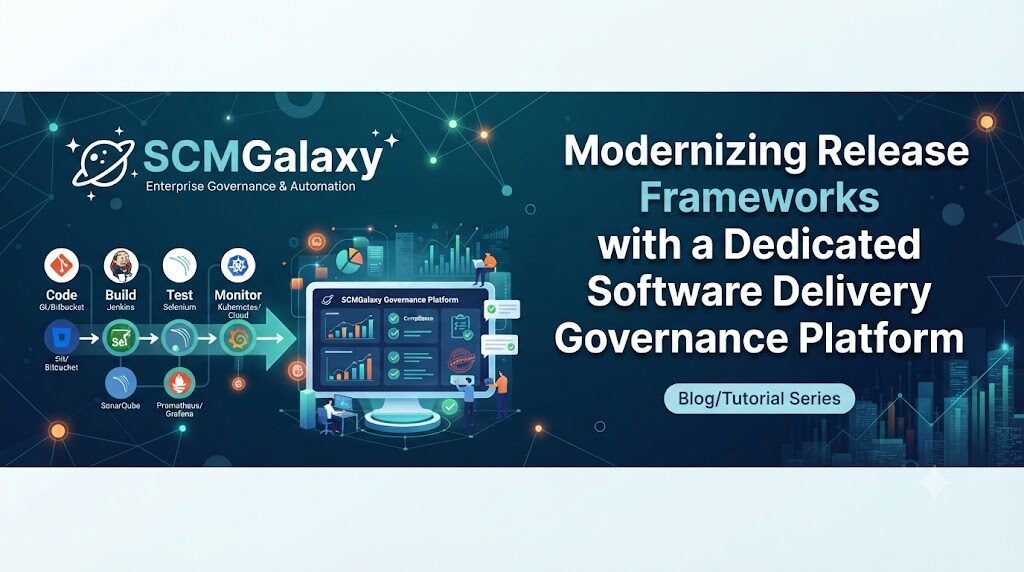
Modern enterprise software development has evolved into a hyper-complex ecosystem where relying on a fragmented array of decoupled tools—like GitHub, Jenkins, Terraform, and Kubernetes—frequently leaves engineering executives blind to actual delivery maturity, systemic security vulnerabilities, and deployment bottlenecks. To bridge this gap, forward-thinking organizations are adopting a dedicated Software Delivery Governance Platform like SCMGalaxy OS, which acts as an overarching orchestration layer that moves beyond simple tool execution to continuously assess engineering processes, enforce automated compliance guardrails, and provide structured, metrics-driven pathways toward true operational excellence.
Featured Snippet
What Is a Software Delivery Governance Platform?
A Software Delivery Governance Platform is an enterprise management solution that unifies visibility, compliance, and performance tracking across the entire software development lifecycle. It continuously evaluates engineering teams against maturity frameworks, enforces process compliance, balances velocity with security metrics, and provides automated, actionable roadmaps to optimize delivery efficiency and reduce systemic risk.
Understanding Software Delivery Governance
What Is Software Delivery Governance?
Software delivery governance is the structured framework of rules, metrics, operational standards, and compliance mechanisms that oversee how software is built, secured, verified, and deployed. It transforms software delivery from an ad-hoc engineering activity into a predictable, auditable business process.
Why Modern Enterprises Need Governance
As software architectures shift toward microservices and decentralized engineering teams, standardizing practices across an organization becomes incredibly difficult. Without explicit governance, teams create bespoke deployment methods, bypass security checks to meet deadlines, and introduce fragmented configurations that complicate maintenance. Governance ensures alignment without micromanagement by embedding automated guardrails into the software delivery pipeline.
Tool Usage vs. Process Maturity
Many IT leaders mistake an extensive toolchain for a mature DevOps practice. An engineering team might use advanced continuous integration pipelines, yet lack automated quality gates, clear rollback strategies, or standard vulnerability scanning. True delivery governance evaluates how effectively these tools are integrated into a cohesive, repeatable process.
| Tool Adoption | Delivery Governance |
| Focuses on installing and configuring specific software platforms. | Focuses on measuring process compliance, efficiency, and quality outcomes. |
| Measures success by tool uptime and user adoption rates. | Measures success by lead time, deployment frequency, MTTR, and change failure rates. |
| Creates fragmented workflows tailored to individual team preferences. | Standardizes architectural and delivery patterns across the enterprise. |
| Delivers localized automation without systemic visibility. | Provides comprehensive executive dashboards to analyze organizational health. |
Special Enterprise Education Framework
In Simple Terms
Think of tool adoption as buying a fleet of high-performance sports cars. Software delivery governance is building the highway system, setting the traffic laws, installing speed cameras, and training the drivers to ensure everyone reaches their destination safely without crashing.
Enterprise Example
A global retail bank utilized Jenkins across fifty separate application development teams. However, because there was no centralized governance, every team wrote their own deployment scripts. Three teams accidentally exposed internal API credentials in their production build files, triggering a severe security audit. By implementing a unified governance platform, the bank enforced standardized, immutable pipeline templates that completely eliminated manual, non-compliant configurations.
Why It Matters
Unregulated software delivery leads directly to production downtime, compliance violations, and inflated operational costs. Proper governance protects brand reputation while eliminating friction for developers, turning delivery speed into a reliable competitive advantage.
Key Takeaways
- Tools provide execution capability, but governance guarantees process reliability.
- Centralized frameworks prevent fragmented configurations across disparate engineering groups.
- Automated guardrails enable faster delivery by removing manual validation bottlenecks.
Understanding Engineering Maturity
What Is a Maturity Assessment?
An engineering maturity assessment is an objective evaluation of an organization’s software development capabilities, culture, and technical execution. It compares current engineering behaviors against recognized industry benchmarks—such as DORA (DevOps Research and Assessment) metrics—to pinpoint systemic gaps.
Why Maturity Measurement Matters
You cannot optimize what you do not measure. Without a structured assessment framework, engineering leaders prioritize initiatives based on anecdotal feedback or the latest industry trends rather than addressing actual architectural constraints. Continuous maturity tracking provides clear, data-driven justification for platform engineering investments.
Characteristics of High-Maturity Engineering Teams
High-maturity teams consistently demonstrate predictable delivery cycles. They rely on trunk-based development, boast fully automated testing suites that run within their pipelines, utilize blue-green or canary deployment patterns, and actively manage their systems using real-time observability dashboards.
Common Signs of Low Engineering Maturity
Conversely, low-maturity organizations exhibit clear anti-patterns. These include long lead times stretching over weeks, frequent manual intervention during production rollouts, critical vulnerabilities discovered late in the development lifecycle, and a high change failure rate requiring emergency rollbacks.
[Low Maturity: Manual Steps / Siloed Teams]
       │
       ▼ (Implement Automated Guardrails & Tracing)
[Medium Maturity: Standardized CI/CD / Scheduled Releases]
       │
       ▼ (Introduce Predictive Analytics & AI Governance)
[High Maturity: Continuous Delivery / Autonomous Governance]
Code language: CSS (css)
Special Enterprise Education Framework
In Simple Terms
An engineering maturity assessment is a comprehensive health checkup for your software delivery organization. It uncovers underlying operational problems before they manifest as critical system failures or delayed product launches.
Enterprise Example
An insurance firm struggled with consistent delays in its quarterly software releases. An engineering maturity assessment revealed that while their writing of code was fast, their testing phase relied heavily on manual verification, creating a massive logjam. This objective data allowed the VP of Engineering to pivot resources toward building automated regression testing frameworks.
Why It Matters
Understanding maturity prevents organizations from wasting capital on unnecessary infrastructure. It ensures that transformation budgets are precisely directed toward fixing the exact processes hampering delivery velocity.
Key Takeaways
- Objective assessments replace subjective opinions with verifiable data.
- High maturity directly correlates with lower production incident rates and faster feature delivery.
- Tracking maturity helps align engineering goals with broader business strategies.
Software Delivery Maturity Assessment
What Is a Software Delivery Maturity Assessment?
This specialized evaluation analyzes the entire lifecycle of an application—from the initial code commit down to production monitoring—ensuring that every phase meets strict corporate standards for quality, security, and velocity.
Key Assessment Areas
Source Code Management
Evaluates code branching strategies, commit frequencies, pull request review cycles, and secret detection mechanisms within repositories.
Build Automation
Measures the speed, repeatability, and isolation of the compilation process, ensuring builds are immutable and clear of external environmental dependencies.
Deployment Automation
Analyzes how code transitions across staging, testing, and production environments without relying on manual steps or ad-hoc scripts.
Security Controls
Tracks the integration of static and dynamic security analysis tools directly within active development workflows.
Observability
Assesses the system’s ability to provide deep context into application health via structured logs, distributed traces, and granular metrics.
Reliability Engineering
Examines disaster recovery runbooks, automated scaling capabilities, chaos engineering experiments, and system resilience under heavy loads.
Governance Practices
Verifies auditability, compliance logging, and alignment with regulatory frameworks like SOC 2, ISO 27001, or HIPAA.
Special Enterprise Education Framework
In Simple Terms
This assessment verifies that every step an application takes on its way to your customers is completely secure, automated, documentable, and repeatable.
Enterprise Example
An e-commerce business implemented a delivery assessment framework across its core checkout services. The assessment discovered that although their build automation was highly mature, their deployment automation was flawed because staging environments did not accurately replicate production configurations. This mismatch caused frequent runtime errors during deployment windows.
Why It Matters
Evaluating the entire lifecycle prevents siloed optimization. It does little good to speed up code compilation if your deployment phase remains stuck in a complex web of manual approvals and environmental mismatches.
Key Takeaways
- Governance platforms evaluate multiple interlinked engineering disciplines simultaneously.
- Continuous compliance checking ensures the delivery pipeline remains audit-ready at all times.
- Eliminating environment drifts reduces post-deployment production errors.
DevOps Maturity Assessment
What Is DevOps Maturity?
DevOps maturity measures how deeply an enterprise has broken down traditional silos between software development and IT operations, replacing them with shared tooling, automated feedback loops, and collaborative workflows.
Collaboration and Culture
True DevOps maturity is rooted in organizational culture. It requires shared accountability for system stability, blameless post-mortems following production outdates, and a pervasive commitment to continuous experimentation.
Automation Adoption
Mature DevOps organizations minimize manual intervention across the operational spectrum. This includes treating infrastructure as code (IaC), automating patch management, and embedding self-healing scripts into the runtime environment.
Delivery Performance
Performance is tracked using core DORA metrics: deployment frequency, lead time for changes, time to restore service (MTTR), and change failure rate. High-maturity organizations consistently achieve elite performance levels across these indicators.
Continuous Improvement Practices
A mature DevOps practice leverages feedback from production environments to refine upstream development. Performance logs, user errors, and system bottlenecks are automatically funneled back into the product backlog for engineering review.
Special Enterprise Education Framework
In Simple Terms
DevOps maturity is about how well your development team (the people building features) and your operations team (the people keeping the systems running) operate as a single, coordinated unit using automation.
Enterprise Example
A logistics provider transitioned from a legacy architecture to a mature DevOps model. Previously, developers handed off code to an isolated operations team, resulting in multi-day deployment cycles. By introducing shared performance metrics and automated deployment pipelines, the combined team reduced their production release time from two weeks down to less than one hour.
Why It Matters
High DevOps maturity cuts down organizational friction, prevents finger-pointing during major system outages, and dramatically speeds up the delivery of customer-facing features.
Key Takeaways
- DevOps maturity balances rapid code deployment with high system stability.
- Tracking core DORA metrics provides a transparent view of engineering velocity.
- Cultural alignment is just as critical as automated tooling for long-term success.
CI/CD Maturity Assessment
Understanding CI/CD Maturity
Continuous Integration and Continuous Delivery (CI/CD) maturity examines the depth, speed, and safety of an organization’s automated pipelines. It tracks how efficiently code updates move from a developer’s local machine into active production.
Pipeline Standardization
Low-maturity organizations suffer from unique, snowflake pipelines maintained by individual teams. High maturity requires standardized, reusable pipeline blueprints managed by central platform engineering teams, ensuring uniform compliance policies.
Deployment Automation
This tracks the elimination of manual handoffs. Highly mature pipelines utilize advanced automated deployment strategies—such as progressive delivery or canary rollouts—to limit the blast radius of any faulty code updates.
Quality Gates
Mature pipelines enforce strict quality gates. Code commits must pass static analysis linting, unit test coverage minimums, and architectural compliance checks automatically before moving down the pipeline.
Release Frequency
While low-maturity groups cluster updates into high-risk, monthly releases, high-maturity teams push small, incremental changes multiple times per day, minimizing operational risk.
| Low Maturity | Medium Maturity | High Maturity |
| Manual builds triggered via developer workstations. | Scheduled nightly builds running on a shared server. | Automated builds triggered instantly on code commit. |
| Code testing performed manually by QA silos. | Basic automated unit tests run inside the pipeline. | Comprehensive unit, integration, and security tests. |
| Production rollouts require manual server configuration. | Automated scripts deploy code to static targets. | Progressive delivery using automated canary gates. |
| Zero automated rollbacks during deployment failures. | Manual execution of rollback scripts required. | Automated rollbacks triggered by metric deviations. |
Special Enterprise Education Framework
In Simple Terms
CI/CD maturity measures how clean, secure, and automated your software assembly line is. A mature line automatically tests and packages every part the moment it arrives, rejecting any defective components instantly.
Enterprise Example
A fintech enterprise updated its core transaction engine using a high-maturity CI/CD model. When a developer committed code containing a minor memory leak, the automated pipeline detected an anomaly during integrated performance testing, halted the staging rollout, and alerted the developer within ten minutes—preventing a catastrophic production outage.
Why It Matters
A mature CI/CD pipeline stops bad code from ever reaching production. It removes human error from the deployment equation, ensuring that applications are shipped uniformly every single time.
Key Takeaways
- Reusable pipeline templates prevent configuration drift across diverse codebases.
- Automated quality gates enforce organizational standards without slowing down developers.
- Small, frequent updates drastically lower the blast radius of software bugs.
Release Management Maturity Assessment
Release Governance
Release governance defines the policies, risk assessments, and compliance approvals required to authorize production deployments. It ensures clear alignment between engineering speed and enterprise risk tolerance.
Change Management
Legacy change management relies on long, manual review meetings (CABs). Mature release management replaces these meetings with automated change tracking, leveraging pipeline data to populate audit trails in real time.
Risk Reduction
This focuses on decoupled releases using feature flags and progressive rollouts. By separating code deployment from feature activation, organizations minimize systemic risk during major product updates.
Deployment Coordination
Large enterprises often need to orchestrate complex rollouts across multiple interdependent legacy platforms and modern cloud systems simultaneously. Mature release management automates this cross-team choreography.
Release Reliability Metrics
Tracking metrics like change failure rate, release slippage, and rollback duration helps organizations understand the operational predictability of their delivery processes.
Special Enterprise Education Framework
In Simple Terms
Release management governance is the digital traffic controller for your production environment. It verifies that every code update has passed its inspections, carries the right documentation, and enters production without disrupting existing traffic.
Enterprise Example
A healthcare applications provider used a governance platform to automate their change management process. Instead of convening a weekly 3-hour review board to manually approve release logs, the platform verified that all pipeline tests passed, compiled the compliance records, and automatically opened and approved the production change ticket.
Why It Matters
Automating release governance removes massive bureaucratic delays from the software lifecycle, transforming deployment windows from high-stress weekend marathons into non-events.
Key Takeaways
- Separating code deployment from feature activation reduces operational risk.
- Automated change logs save hundreds of hours during enterprise compliance audits.
- Real-time risk scoring highlights problematic releases before they hit production.
DevSecOps Maturity Assessment
Security Integration Across the SDLC
DevSecOps maturity evaluates how naturally security practices are woven throughout the entire software development lifecycle, ensuring that security is never treated as a final, superficial check.
Shift-Left Security
This practice moves security analysis directly into the developer’s early workspace. It includes scanning code for open-source vulnerabilities (SCA) and code quality issues (SAST) during local development and initial pull requests.
[Plan] ──> [Code + Local SAST] ──> [Build + SCA] ──> [Test + DAST] ──> [Govern & Deploy]
                ▲                      ▲                  ▲
                └──────────────────────┴──────────────────┴─ (Automated Security Gates)
Code language: CSS (css)
Compliance Automation
Enterprises must continuously adhere to stringent regulatory standards. Mature DevSecOps replaces periodic manual audits with automated, continuous compliance scanning across all active configurations.
Secure Software Delivery
Ensures the absolute integrity of the software build pipeline itself. This involves validating container images, generating cryptographic Software Bills of Materials (SBOMs), and securing secrets within the environment.
Risk Governance
Tracks exposure levels across the company, prioritizing vulnerabilities based on real-world reachability and business impact rather than relying on generic severity scores.
Special Enterprise Education Framework
In Simple Terms
DevSecOps maturity means installing security inspection checkpoints at every station of your software assembly line, catching and correcting flaws the exact moment they appear.
Enterprise Example
An aviation software company embedded automated container scanning into their build pipelines. When an open-source library used in a service developed a critical exploit, the platform immediately flagged the vulnerability, blocked the build from moving forward, and provided the engineering team with the exact secure patch version required.
Why It Matters
Fixing a security vulnerability in production is incredibly expensive and highly risky. Shifting security checks left into early development cycles saves millions in remediation costs while protecting critical corporate data.
Key Takeaways
- Continuous software supply chain validation protects against advanced third-party vulnerabilities.
- Automated compliance controls keep engineering practices aligned with evolving regulations.
- Reachability analysis helps developers focus on fixing high-priority, exposed security risks.
Observability and SRE Maturity Assessment
What Is Observability Maturity?
Observability maturity evaluates an enterprise’s capability to understand the true internal state of its production applications based entirely on their external outputs, shifting operational models from reactive alerting to proactive system optimization.
Metrics, Logs, and Traces
Low-maturity teams look at basic infrastructure metrics like CPU usage in isolation. High-maturity groups correlate system metrics, structured application logs, and distributed traces to map user journeys across distributed environments.
Reliability Engineering Practices
Site Reliability Engineering (SRE) maturity measures how effectively an organization manages operational risk, automates incident response, runs chaos experiments, and architecturally designs for system resilience.
Incident Management
Tracks the lifecycle of operational incidents. Mature teams rely on automated alerting, dynamic runbooks, automated anomaly detection, and systematic post-mortems to continuously lower their Mean Time to Repair (MTTR).
Service Level Objectives (SLOs)
High-maturity teams align engineering priorities with user satisfaction by establishing strict Service Level Indicators (SLIs) and Service Level Objectives (SLOs), managing features against a predefined error budget.
Special Enterprise Education Framework
In Simple Terms
Observability and SRE maturity is like driving an advanced aircraft with a smart digital cockpit. Instead of waiting for an engine to fail completely, your instruments monitor deep internal performance trends, warning you of minor anomalies so you can adjust course early.
Enterprise Example
A streaming media service implemented advanced SRE telemetry. During a high-traffic live event, an automated observability system noticed an unusual latency spike in a microservice. Instead of waiting for an engineer to log in, the system dynamically scaled up the container cluster and rerouted traffic, maintaining a seamless experience for users.
Why It Matters
High observability and SRE maturity ensures that production systems scale predictably, minimize costly downtime, and provide deep data insights to optimize system performance.
Key Takeaways
- Correlated telemetry speeds up root-cause analysis during major incidents.
- Error budgets provide an objective mechanism to balance feature speed with system stability.
- Blameless post-mortems convert operational failures into structural system improvements.
Software Configuration Management Platform
Importance of Configuration Governance
Configuration governance ensures that all environment properties, application parameters, and systemic policies are managed uniformly through auditable code, preventing human error from destabilizing setups.
Managing Infrastructure Consistency
Using Tools like Terraform or Ansible requires rigorous governance. A Software Configuration Management platform ensures that no manual modifications occur directly within production infrastructure, enforcing a strict GitOps methodology.
Version Control Governance
Enforces administrative policies across code repositories, requiring multi-party pull request sign-offs, mandatory linear histories, and automated commit tracing back to authorized project tickets.
Auditability and Traceability
Maintains an immutable record of exactly who changed what, when, and why across both application source code and global infrastructure environments, simplifying regulatory audits.
Configuration Compliance
Continuously scans runtime configurations against security baselines, automatically alerting teams or remediating drifted parameters back to their authorized states.
Special Enterprise Education Framework
In Simple Terms
Configuration governance ensures that the underlying blueprints for your digital infrastructure are version-controlled, securely locked down, and completely protected against ad-hoc, manual modifications.
Enterprise Example
A global telecommunications provider suffered periodic outages caused by engineers making manual configuration tweaks directly on live staging servers. By adopting a strict configuration management framework, they locked down direct server access and mandated that every single environment update go through an approved Git repository, entirely eliminating undocumented system drift.
Why It Matters
Uncontrolled configuration drift is a major cause of mysterious production outages. Treating infrastructure strictly as versioned code guarantees complete system reproducibility across environments.
Key Takeaways
- Enforcing GitOps principles removes manual human mistakes from infrastructure management.
- Granular change tracing ensures total transparency for internal and external auditors.
- Continuous configuration scanning prevents silent security degradations over time.
AI Code Governance Platform
Rise of AI-Assisted Software Development
The integration of generative AI coding assistants has drastically accelerated code creation. However, this massive spike in raw code volume introduces a pressing need for automated governance frameworks to oversee AI-generated contributions.
Risks of Uncontrolled AI Code Generation
Without explicit governance, AI assistants can inadvertently introduce insecure design patterns, use outdated open-source packages, violate intellectual property licensing, and swell the technical debt profile of an application.
Governance Requirements for AI Usage
Enterprises must establish automated guardrails to verify that all AI-assisted code contributions are cleanly documented, pass rigorous static analysis, and comply with strict copyright standards.
Code Quality and Compliance Controls
An AI code governance platform automatically monitors the percentage of code generated via AI, tracks its subsequent refactoring rate, and applies stricter linting and testing requirements to AI-originated pull requests.
Future of AI Governance
As AI agents move from simple code completion to autonomous agentic software development, governance platforms will serve as the essential orchestrator—verifying agent access levels, validating code logic, and auditing all autonomous adjustments.
| Traditional Development | AI-Assisted Development Governance |
| Code written solely by human engineers at a predictable, manageable speed. | Code generated rapidly by AI agents, drastically increasing overall review volume. |
| Code reviews focus primarily on human design and internal logic paths. | Code reviews must strictly check for licensing defects and hidden security design flaws. |
| Security risks are well-understood and tied directly to developer experience. | Security risks can be weirdly unpredictable due to hallucinated dependencies. |
| Compliance relies on manual peer reviews and traditional code checkups. | Compliance requires fully automated validation engines to scale with generation volume. |
Special Enterprise Education Framework
In Simple Terms
AI code governance is like adding an automated quality inspector to check the work of an ultra-fast robotic worker on an assembly line, ensuring its high speed doesn’t compromise structural integrity or safety standards.
Enterprise Example
A software enterprise noticed a 40% jump in code commits after equipping developers with AI assistants. However, their security teams discovered that these assistants frequently suggested deprecated library methods. By deploying an AI code governance platform, the firm automatically blocked any AI pull requests that failed to meet their updated security architecture baselines.
Why It Matters
AI tools offer incredible software development velocity, but without clear governance, that speed can easily result in unsafe, non-compliant code reaching production environments.
Key Takeaways
- High code generation speed requires highly automated validation systems.
- Licensing compliance checks prevent intellectual property liabilities from AI suggestions.
- Advanced analytics help track code churn and quality across AI-assisted repositories.
How SCMGalaxy OS Works
SCMGalaxy OS serves as an enterprise Software Delivery Governance Platform, providing engineering leaders with a structured environment to assess, govern, and systematically optimize their engineering maturity.
[SCMGalaxy OS Core Engine]
   ├── 1. Data Ingestion (GitHub, Jira, Jenkins, Telemetry)
   ├── 2. Assessment Framework (DevOps, DevSecOps, SRE, AI)
   ├── 3. Scoring & Risk Identification Engine
   └── 4. Dynamic Dashboards ──> Generates 30/90/180-Day Roadmaps
Assessment Framework
The platform connects with an organization’s existing software toolchain, pulling clean metadata across repositories, pipelines, issue trackers, and cloud environments to assess capabilities without disrupting daily workflows.
Maturity Scoring Engine
SCMGalaxy OS normalizes this data against proprietary maturity scoring algorithms, outputting clear, cross-discipline maturity scores across SCM, CI/CD, security, and site reliability engineering.
Risk Identification
The engine automatically surfaces hidden process risks—such as long code review times, missing security gates, undocumented environment variations, and high pipeline failure rates.
Recommendations and Insights
Beyond displaying raw graphs, the platform delivers contextual, actionable recommendations, highlighting the exact structural changes needed to remove delivery friction.
Governance Dashboards
Provides real-time dashboards customized for specific roles—giving CTOs high-level maturity roadmaps while providing engineering managers with granular pipeline health analytics.
Transformation Roadmaps
SCMGalaxy OS converts assessment data into clear, phased improvement pathways:
30-Day Roadmap
Focuses on fixing immediate, high-severity operational issues—such as securing exposed access parameters, establishing basic unit test gates, and patching critical security flaws.
90-Day Roadmap
Expands toward process standardization—including rolling out uniform pipeline templates, automating change tracking, and setting up initial SLO metrics.
180-Day Roadmap
Drives advanced optimization initiatives—such as launching progressive canary delivery models, running chaos engineering experiments, and deploying automated AI code governance frameworks.
Benefits of SCMGalaxy OS
Visibility Into Engineering Health
Eliminates operational blind spots by unifying engineering data into a single, reliable source of truth, allowing executives to objectively evaluate performance across all engineering departments.
Standardized Assessments
Replaces manual, inconsistent assessment methods with fully automated evaluations, ensuring all engineering groups are tracked against the exact same high standards.
Better Governance
Enforces compliance requirements directly within development workflows, completely stopping non-compliant code changes from reaching live production environments.
Reduced Delivery Risk
Highlights delivery bottlenecks and architectural issues early, helping organizations lower their change failure rates and prevent production regressions.
Improved Reliability
Guides engineering teams to build deeply resilient systems by helping them systematically implement advanced SRE principles and robust observability telemetry.
Stronger Security Posture
Shifts security compliance directly into active pipelines, allowing organizations to maintain an audit-ready security profile without slowing down daily features.
Executive Decision Support
Provides tech executives with the objective data required to prioritize engineering investments, optimize resource allocation, and validate digital transformation outcomes.
Real-World Enterprise Scenarios
Enterprise DevOps Transformation
- Challenge: A retail giant had highly siloed development and operations teams, resulting in high change failure rates and slow feature rollouts.
- Assessment Findings: Deep pipeline variances across teams, a complete lack of automated testing, and zero standard DORA metrics tracking.
- Recommendations: Centralize pipeline blueprints and enforce automated integration test gates within SCMGalaxy OS.
- Expected Outcomes: Cut deployment lead times by 50% while lowering the change failure rate below 10%.
Platform Engineering Assessment
- Challenge: An enterprise platform group lacked any clear metrics to judge the internal adoption and effectiveness of their cloud infrastructure templates.
- Assessment Findings: Massive configuration drift across cloud environments due to teams making manual, undocumented changes.
- Recommendations: Implement a strict GitOps deployment model and set up automated configuration scanning.
- Expected Outcomes: Eliminate infrastructure drift across staging and production, saving thousands in operational cleanup.
Multi-Team Governance Initiative
- Challenge: A software company struggled with inconsistent code quality and varying delivery metrics across ten newly acquired engineering groups.
- Assessment Findings: Drastically different branching methodologies and wildly inconsistent code verification standards.
- Recommendations: Deploy SCMGalaxy OS governance dashboards to establish baseline metrics and enforce uniform code review gates.
- Expected Outcomes: Achieve uniform compliance and release predictability across all business units within 90 days.
Security Modernization Program
- Challenge: A healthcare technology provider needed to modernize its security verification processes to comply with strict update regulations.
- Assessment Findings: Security scans were only run right before major releases, creating huge remediation delays.
- Recommendations: Shift security scans directly into the early CI build phase via SCMGalaxy OS quality gates.
- Expected Outcomes: Reduce vulnerability remediation times by 70% while maintaining an audit-ready regulatory posture.
AI Development Governance Rollout
- Challenge: An insurance provider wanted to accelerate development with AI tools but faced major concerns regarding intellectual property leaks and unstable code patterns.
- Assessment Findings: AI code was entering repositories without distinct tracking, leading to high code churn rates.
- Recommendations: Set up automated AI code attribution tracking and apply stricter automated verification gates on AI commits.
- Expected Outcomes: Safely harness AI generation speed while guaranteeing full licensing and quality compliance.
Common Software Delivery Governance Challenges
Tool Sprawl
The uncontrolled addition of independent software tools leads directly to fragmented data silos, making it incredibly difficult to form a cohesive view of delivery performance.
- Solution: Use a governance platform to pull data from all existing systems into a centralized analytics engine.
Lack of Standardization
When individual development groups build unique delivery processes, maintaining organizational compliance and predictable software quality becomes nearly impossible.
- Solution: Mandate centralized, reusable pipeline templates managed by a core platform engineering team.
Poor Visibility
Without clean, unified metrics dashboards, technology leaders are forced to make strategic decisions based on guesswork rather than objective operational data.
- Solution: Deploy real-time governance scorecards that continuously aggregate engineering health data.
Inconsistent Processes
Teams utilizing variable branching methodologies and subjective code review standards introduce unpredictable risks during release windows.
- Solution: Enforce automated branching and review policies directly within your source control platforms.
Weak Security Controls
Treating security checks as an afterthought at the end of a long release cycle inevitably delays code rollouts and increases vulnerability exposure.
- Solution: Integrate automated security scans directly into early continuous integration workflows.
Absence of Measurement Frameworks
Without an established framework to evaluate maturity, engineering organizations struggle to track progress or identify exactly where optimizations are required.
- Solution: Adopt an industry-standard maturity model to measure and guide engineering initiatives.
Common Mistakes Organizations Make
- Measuring Tools Instead of Outcomes: Tracking tool license usage or simple commit volumes rather than business-impacting metrics like lead time, stability, and customer satisfaction.
- Ignoring Engineering Culture: Expecting automation to solve underlying cultural issues, such as a lack of shared accountability or fear of reporting system flaws.
- Assessing Once and Never Reassessing: Treating maturity evaluation as a single, annual check box rather than an ongoing, continuous operational measurement process.
- Treating Governance as Compliance Only: Viewing governance purely as bureaucratic oversight rather than a mechanism to empower developers to ship code safely.
- Lack of Executive Sponsorship: Attempting to transform deep engineering practices without the explicit backing and strategic alignment of executive leadership.
Governance Improvement Checklist
- Do all engineering teams track their core DORA metrics automatically in real time?
- Are deployment pipelines built from centralized, standardized templates?
- Are security checks run automatically on every code commit?
- Is change management documentation populated automatically via pipeline data?
- Do engineering teams operate with defined, measurable SLOs and error budgets?
Building a Software Delivery Transformation Roadmap
[1. Assessment Phase] ──> [2. Prioritization] ──> [3. Execution] ──> [4. Optimization] ──> [5. Continuous Evaluation]
Code language: CSS (css)
1. Assessment Phase
Begin by connecting your delivery applications to baseline current practices across all engineering groups, uncovering immediate bottlenecks and hidden structural risks.
2. Prioritization Phase
Analyze your baseline metrics to identify high-impact, achievable improvements—focusing first on critical security gaps and manual deployment bottlenecks.
3. Execution Phase
Roll out targeted technical improvements, such as introducing standardized pipeline blueprints, automating test gates, and removing manual approval steps.
4. Optimization Phase
Introduce advanced operational practices once foundations are stable—including progressive delivery rollouts, deeper telemetry correlation, and initial AI governance layers.
5. Continuous Improvement Phase
Establish a culture of ongoing engineering evaluation, continuously analyzing live delivery data to refine your architectural standards and governance guardrails.
Future of Software Delivery Governance
AI-Powered Governance
Governance platforms will soon leverage advanced predictive analytics to analyze code changes and historical pipeline metrics to forecast release risks before execution.
Platform Engineering Governance
As platform engineering matures, governance tools will serve as the essential control layer, ensuring internal developer platforms deliver speed without compromising compliance.
Autonomous Delivery Pipelines
Future pipelines will autonomously adapt their deployment pathways based on real-time risk scores—skipping manual gates for low-risk changes while stepping up testing for highly complex updates.
Engineering Intelligence Platforms
Software governance is shifting toward comprehensive intelligence systems, combining operational metrics with business outcomes to map the true ROI of engineering initiatives.
Continuous Maturity Measurement
Static annual maturity audits are being phased out by continuous, real-time tracking engines that reflect the true state of an organization’s engineering maturity at any moment.
Governance-Driven Transformation
Enterprise transformations will increasingly rely on data-driven governance models, utilizing automated platforms to guide, measure, and scale organizational changes safely.
Why Organizations Choose SCMGalaxy OS
SCMGalaxy OS provides the comprehensive architecture modern enterprises need to move beyond simple tool tracking and establish true software delivery governance. By seamlessly combining cross-discipline assessments, automated risk identification, and actionable roadmaps, the platform empowers technology leaders to optimize delivery speed, enforce rigorous security, and drive measurable engineering maturity at scale.
FAQ Section
1. What is a Software Delivery Governance Platform?
It is a centralized enterprise system that tracks performance, ensures compliance, and measures engineering maturity across the entire software development lifecycle, transforming delivery into a predictable business process.
2. Why do organizations need maturity assessments?
Maturity assessments replace subjective guesswork with clear, objective data, allowing engineering leaders to locate operational bottlenecks and ensure transformation investments match true system constraints.
3. What is DevOps Maturity Assessment?
It evaluates how effectively an enterprise has eliminated traditional silos between its development and operations teams, tracking cultural collaboration, automation adoption, and core DORA metrics.
4. How does CI/CD Maturity Assessment work?
It analyzes the speed, automation depth, and safety of deployment pipelines, checking for standardized templates, automated quality gates, and progressive rollout capabilities.
5. What is DevSecOps Maturity Assessment?
It tracks the natural integration of security practices throughout the entire development cycle, ensuring code analysis, container checks, and compliance scanning happen automatically and early.
6. Why is observability maturity important?
Observability maturity shifts operations from reactive alerts to proactive optimization, allowing teams to correlate metrics, logs, and traces to solve production problems before they disrupt users.
7. What is AI Code Governance?
It is an automated framework designed to manage the quality, security, and licensing compliance of code written by generative AI assistants, preventing technical debt and copyright issues.
8. How does SCMGalaxy OS generate maturity scores?
The platform integrates directly with your existing developer toolchain, analyzing lifecycle metadata against standardized algorithms to produce objective maturity metrics across engineering fields.
9. What are 30/90/180-day transformation roadmaps?
They are phased, data-driven improvement pathways generated by SCMGalaxy OS that prioritize fixing critical technical flaws first before scaling up to advanced automation and continuous optimization.
10. Who should use SCMGalaxy OS?
It is designed for technology executives—including CTOs, CIOs, VPs of Engineering, Platform Architects, and Security Leaders—looking to govern, analyze, and scale engineering performance across an enterprise.
Final Summary
Achieving software delivery excellence requires moving past simple tool adoption and embracing objective, automated governance. A modern software delivery lifecycle demands deep, data-driven coordination across multiple disciplines—including DevOps collaboration, standardized CI/CD pipelines, automated DevSecOps gates, robust SRE observability, and comprehensive AI code governance frameworks. SCMGalaxy OS gives technology leaders the exact architectural visibility and framework engine needed to transform chaotic development processes into structured, high-performing delivery ecosystems. By continuously tracking engineering maturity metrics and converting those insights into actionable roadmaps, the platform ensures your enterprise scales its delivery speed safely, securely, and predictably. Take control of your software delivery lifecycle today. Explore SCMGalaxy OS to baseline your engineering maturity, implement automated guardrails, and build a reliable, high-performance software transformation roadmap for your enterprise.