Introduction
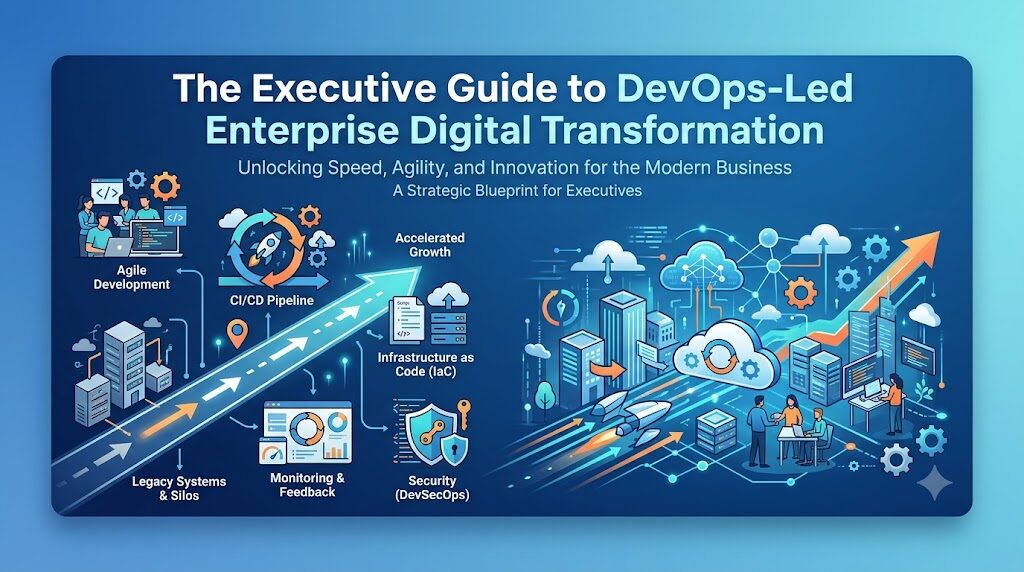
In the modern business landscape, digital transformation has evolved from a strategic advantage into an existential necessity, forcing enterprises to abandon siloed, legacy IT models in favor of agile, cloud-native frameworks. As organizations strive to balance increasing market demands with the need for operational resilience, DevOps has emerged as the critical bridge between business strategy and technical execution, effectively transforming IT departments from mere cost centers into engines of sustainable innovation. By prioritizing speed, automation, and a culture of shared responsibility, DevOps provides the architectural foundation for success in a digital-first economy; however, mastering this transition requires guided expertise and a commitment to continuous improvement, which is why forward-thinking leaders leverage specialized ecosystems like DevOpsSchool to equip their teams with the requisite skills. This guide explores how integrating these practices enables a more responsive, scalable, and automated enterprise, ensuring that technology serves as a true catalyst for long-term growth.
What Is Digital Transformation in Enterprises?
Digital transformation is the profound transformation of business activities, processes, competencies, and models to fully leverage the changes and opportunities of digital technologies and their accelerating impact across society.
At its core, this process involves:
- Business Model Evolution: Moving from legacy, product-centric models to service-oriented, customer-centric digital ecosystems.
- Technology Modernization: Replacing fragmented, on-premise legacy systems with cloud-native, scalable, and modular architectures.
- Customer Experience Focus: Using real-time data to personalize interactions and reduce friction in the user journey.
- Data-Driven Decision-Making: Shifting from intuition-based planning to real-time analytics, allowing for rapid pivots based on market feedback.
Digital transformation is not a project with a start and end date; it is an organizational evolution toward continuous innovation.
Why DevOps Is Central to Digital Transformation
DevOps is not just a set of tools; it is a philosophy that mandates a fundamental shift in how an organization works. Without a DevOps mindset, digital transformation initiatives often stall because the underlying delivery processes remain slow and siloed.
- Speed of Delivery: DevOps removes the bottlenecks that prevent code from moving from development to production.
- Automation-First Mindset: By automating repetitive tasks, DevOps frees up high-value engineering resources to focus on business innovation rather than “keeping the lights on.”
- Collaboration: DevOps destroys the wall between “Dev” (who want change) and “Ops” (who want stability), creating a shared responsibility for business outcomes.
- Continuous Improvement: The feedback loop inherent in DevOps allows for constant refinement, which is essential for any transformation effort.
How DevOps Accelerates Digital Transformation
The correlation between DevOps maturity and digital transformation success is direct. Enterprises that adopt these practices see measurable improvements in key performance indicators (KPIs).
| Business Benefit | DevOps Contribution |
| Faster Software Delivery | CI/CD pipelines automate testing and deployment, slashing lead times. |
| Reduced Time to Market | Shortened feedback cycles allow features to reach customers weeks faster. |
| Improved Reliability | Automated testing and infrastructure management reduce human error in production. |
| Enhanced Scalability | Infrastructure as Code (IaC) ensures environments can scale automatically with demand. |
DevOps as a Cultural Transformation Driver
The greatest hurdle in any digital transformation is not technology—it is culture. Transitioning to DevOps requires a shift from hierarchical, siloed thinking to a model of autonomy and accountability.
Breaking Silos:
When development teams own their code in production, they gain empathy for operations. When operations teams are involved in the design phase, they anticipate deployment challenges earlier.
Shared Responsibility:
In a DevOps culture, “it works on my machine” is no longer an acceptable excuse. The goal is a shared commitment to the stability, performance, and security of the application.
Agile Collaboration:
DevOps complements Agile methodologies by ensuring that the agility requested by product owners is actually executable by engineering. It creates a continuous feedback loop where developers are informed by user behavior in real-time.
Role of CI/CD in Digital Transformation
Continuous Integration and Continuous Deployment (CI/CD) are the mechanical heart of DevOps. They enable the “continuous” aspect of digital transformation.
- Automated Pipelines: By automating the build, test, and deploy stages, organizations can deploy updates multiple times a day instead of once a quarter.
- Continuous Integration: Developers merge code changes frequently, allowing for early detection of integration issues and preventing “merge hell.”
- Continuous Deployment: Once code passes automated quality gates, it is automatically deployed to production, ensuring that business value is realized as soon as the feature is ready.
- Reduced Manual Intervention: Automating deployment eliminates the risk associated with human error and manual configuration drifts.
Cloud Adoption and DevOps Transformation
Cloud computing provides the elasticity required for digital transformation, but DevOps provides the management discipline to utilize that elasticity effectively.
- Infrastructure as Code (IaC): This allows IT teams to manage infrastructure with the same rigor as application code. You can version, test, and deploy infrastructure changes automatically.
- Scalable Environments: Cloud-native DevOps allows for the creation of on-demand environments, enabling rapid experimentation without the risk of breaking production.
- Cost Optimization: Through automated monitoring and resource management, DevOps practices help enterprises avoid “cloud sprawl” and unnecessary expenditure.
DevSecOps in Digital Transformation
Security cannot be an afterthought in a digital-first enterprise. DevSecOps integrates security controls directly into the CI/CD pipeline.
- Security Automation: Instead of waiting for a manual security audit at the end of a cycle, automated scanning tools detect vulnerabilities in code or dependencies in real-time.
- Compliance as Code: Regulatory requirements (like GDPR or HIPAA) are baked into the infrastructure configuration, ensuring the organization is always audit-ready.
- Risk Reduction: By shifting security “left” (earlier in the development process), organizations can patch vulnerabilities before they reach production, drastically reducing the attack surface.
Real-World Example: Traditional Enterprise Before vs. After DevOps
Consider a mid-sized retail organization transitioning to an e-commerce model.
Before DevOps (The Legacy State):
- Deployment Frequency: Monthly, accompanied by high anxiety and long downtime.
- Collaboration: Development and Operations are in separate buildings, communicating only through tickets.
- Customer Impact: If a bug reaches production, it takes 48 hours to fix, resulting in lost revenue and customer churn.
After DevOps-Driven Transformation:
- Deployment Frequency: Daily, with zero-downtime deployments.
- Collaboration: Integrated product teams work together to solve customer issues.
- Customer Impact: A bug is identified and patched in hours, and the release cycle aligns with seasonal shopping trends, significantly increasing revenue.
Challenges in DevOps-Driven Transformation
Adoption is rarely without friction. Leadership must anticipate these common obstacles:
- Legacy System Integration: Older mainframe or monolithic applications are difficult to automate.
- Cultural Resistance: Mid-level management may feel threatened by the shift toward engineer autonomy.
- Skill Gaps: Existing staff may require significant upskilling in modern tools like Kubernetes, Terraform, and CI/CD platforms.
- Toolchain Complexity: Managing a massive stack of open-source tools requires strong governance and platform engineering.
- Governance Issues: Balancing the need for speed with the necessity of corporate compliance and oversight.
Best Practices for DevOps-Led Transformation
- Start with Pilot Projects: Do not attempt a “big bang” transformation. Pick a non-critical application to pilot your new DevOps workflows.
- Automate Incrementally: You do not need to automate everything on day one. Start with the most painful, manual bottleneck in your deployment process.
- Focus on Culture First: Ensure buy-in from leadership and incentivize cross-team collaboration over individual performance metrics.
- Measure Outcomes: Focus on DORA metrics (Deployment Frequency, Lead Time for Changes, Mean Time to Recovery, Change Failure Rate).
- Align IT with Business Goals: Ensure the IT roadmap directly supports revenue-generating business initiatives.
Role of DevOpsSchool in Transformation Learning
Successful transformation relies on the competency of the team. As organizations pivot toward DevOps, the demand for trained professionals who understand both the theory and the practical application of these technologies is immense.
Enterprises often utilize structured learning paths provided by organizations like DevOpsSchool to help their teams bridge the gap between legacy operations and modern engineering. Whether it is understanding complex CI/CD workflows, mastering cloud-native architecture, or implementing security-first development practices, access to expert-led curriculum is essential. Providing teams with clear, standardized training ensures that the organization moves in the same direction, reducing the “tool sprawl” that often occurs when teams adopt disparate technologies without a unified strategy.
Industries Benefiting from DevOps Transformation
- Banking & Finance: Improving security and compliance while accelerating fintech innovation.
- Healthcare: Ensuring 99.999% system availability while protecting patient data.
- Retail & E-Commerce: Scaling infrastructure rapidly to handle seasonal traffic spikes.
- Telecom: Automating network management and speeding up the rollout of new digital services.
- SaaS Companies: Enabling the rapid iteration and deployment cycles that are the lifeblood of software-as-a-service businesses.
- Government Systems: Modernizing citizen-facing portals to be more responsive and accessible.
Future of DevOps in Digital Transformation
The future of DevOps lies in the move toward autonomous operations.
- AI-Driven Automation (AIOps): Using machine learning to predict system failures and automatically remediate them before they impact the user.
- Platform Engineering: Building internal developer platforms (IDP) that provide developers with a self-service experience, reducing cognitive load.
- Autonomous Infrastructure: Environments that can self-heal, scale, and optimize costs without manual intervention.
- Fully Cloud-Native Enterprises: Organizations will stop viewing “cloud” as a location and start viewing it as an operating model.
FAQs
- How does DevOps support digital transformation?It acts as the delivery engine, enabling the speed, scalability, and agility required to execute digital business models.
- What is the role of CI/CD in transformation?CI/CD automates the delivery pipeline, allowing for faster, more reliable code releases that directly impact customer satisfaction.
- Why is DevOps important for enterprises?It bridges the gap between IT operations and business goals, reducing waste and increasing innovation speed.
- How does DevOps improve business speed?By removing manual bottlenecks and fostering a culture of continuous delivery.
- What is DevSecOps in transformation?It is the practice of embedding security directly into the development pipeline, ensuring safety at speed.
- Is cloud required for DevOps transformation?While possible on-premise, cloud provides the infrastructure flexibility that maximizes the benefits of DevOps.
- What are the biggest challenges in DevOps adoption?Cultural inertia, legacy technical debt, and skill gaps within existing IT teams.
- How do companies measure transformation success?By tracking DORA metrics such as deployment frequency and mean time to recovery.
- Can DevOps be implemented in legacy environments?Yes, but it requires wrapping legacy apps in modern interfaces or incrementally refactoring them into microservices.
- What is the difference between DevOps and Agile?Agile is a methodology for project management and software development; DevOps is a culture and set of practices that extends this to operations and delivery.
- Who should lead a DevOps transformation?It requires a coalition of leaders from Development, Operations, and Security, supported by top-level executive sponsorship.
- How long does a DevOps transformation take?It is a continuous journey, though teams often see efficiency gains within 6–12 months of focused effort.
- Is DevOps expensive to implement?It requires initial investment in training and tooling, but it pays for itself by reducing operational costs and accelerating time-to-revenue.
- How do I start a DevOps transformation?Start with a single pilot team, identify a common bottleneck, and solve it with automation.
- Does DevOps eliminate the need for IT operations?No, it evolves the role of IT operations from manual server maintenance to platform engineering and reliability management.
Final Thoughts
DevOps is not a silver bullet, nor is it merely a suite of tools. It is the foundational pillar upon which successful digital transformation is built. In a world where customer expectations are fluid and competitive landscapes shift overnight, the ability to deliver value continuously, reliably, and securely is your most significant competitive advantage.
Technology alone will not save an enterprise. The real change happens when leaders empower their teams to automate the mundane, collaborate across boundaries, and take shared responsibility for the success of their digital initiatives. Success is defined not by the technology you adopt, but by how well that technology enables your people to innovate.