Introduction
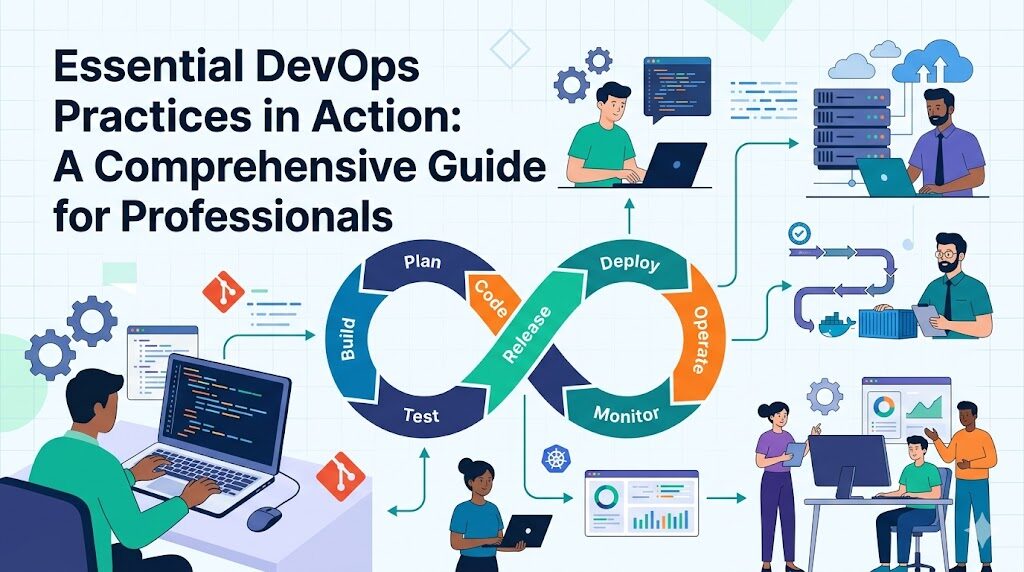
In the rapidly evolving landscape of software engineering, DevOps has transitioned from a buzzword to a critical operational necessity. Many engineers and managers enter the field with a solid grasp of tools like Docker or Jenkins, yet they struggle to visualize how these pieces fit into the complex, messy reality of an organization. DevOps is not merely a collection of software; it is a cultural and technical methodology centered on breaking down silos to improve speed, reliability, and security.
Studying real-world implementation examples is the most effective way to bridge the gap between textbook theory and professional application. By observing how companies handle deployment failures, scale infrastructure, or integrate security, learners can gain a clearer perspective on why specific architectural decisions are made. Whether you are a student or a seasoned IT professional, understanding these workflows is essential. For those seeking structured guidance and industry-relevant curriculum, DevOpsSchool provides deep insights into the methodologies that drive these successful engineering environments. By examining how different organizations solve problems, we can stop viewing DevOps as a rigid set of rules and start seeing it as a flexible framework for continuous improvement.
Why Real-World DevOps Examples Matter
Learning DevOps without context is like studying music theory without ever picking up an instrument. You might understand the notes on a page, but you will not understand how to create a melody.
- Practical Understanding: Examples show you how tools interact in a live environment, not just in a sanitized local development setup.
- Faster Learning: Seeing a problem—such as a deployment bottleneck—followed by a DevOps solution provides an immediate “aha!” moment that theory alone cannot provide.
- Better Decision-Making: When you understand how other teams have failed or succeeded with specific patterns (like GitOps or blue-green deployments), you are better equipped to make informed architectural choices for your own projects.
- Avoiding Misconceptions: A common error is believing DevOps is just “hiring someone to manage servers.” Real-world examples demonstrate that it is fundamentally about shifting organizational behavior and process.
Think of it this way: DevOps is a journey. When you look at how a company moves from a legacy monolithic deployment to a microservices-based CI/CD pipeline, you are not just learning a technical skill; you are learning how to manage the change inherent in modern business.
Common Goals Organizations Pursue Through DevOps
Most organizations do not start their journey because they want “more tools.” They start because they have specific pain points. The following table outlines the typical objectives behind a DevOps transformation.
| Goal | Expected Benefit |
| Faster Releases | Reduced time-to-market for new features and bug fixes. |
| Improved Reliability | Fewer production outages and faster recovery times. |
| Better Collaboration | Breaking down barriers between developers and operations teams. |
| Reduced Downtime | Minimizing the impact of deployments on end-users. |
| Enhanced Customer Satisfaction | Stable, feature-rich, and high-performance applications. |
Example 1: Startup Adopting CI/CD
A small SaaS startup was struggling with a “Friday deployment” culture. Every time developers pushed code, the operation team had to manually update servers, often leading to broken features over the weekend.
- Initial Challenges: Manual deployment steps, no automated testing, and long release cycles.
- Workflow: The team implemented a Git-based workflow where every merge to the main branch triggered an automated pipeline. This pipeline ran unit tests, built a container image, and deployed to a staging environment.
- Outcomes: The release cycle dropped from two weeks to daily. Developers gained confidence because tests caught bugs before they reached production.
- Lesson Learned: Automated testing is the backbone of CI/CD. Without a safety net, you are just moving broken code faster.
Example 2: E-Commerce Company Improving Deployment Reliability
An e-commerce platform experienced massive traffic spikes during holiday sales. Their manual rollback process was slow, leading to hours of revenue loss when a deployment failed.
- The Shift: They transitioned to a Blue-Green deployment strategy. They maintained two identical production environments. The “Blue” environment ran the current version, while “Green” ran the new version.
- Mechanisms: If the “Green” environment showed high error rates in logs, traffic was instantly routed back to “Blue.”
- Outcome: Recovery time improved from two hours to seconds.
- Lesson Learned: Reliability is not about preventing all failures; it is about minimizing the impact of the inevitable failure.
Example 3: Enterprise Infrastructure Automation Initiative
A large enterprise had hundreds of virtual machines managed via spreadsheets. Provisioning a new server took three weeks of manual approvals and manual configuration.
- Implementation: They adopted Infrastructure as Code (IaC) using tools that allowed them to define server configurations in code files.
- Process: Developers could now request an environment via a ticket that automatically executed an IaC script.
- Outcome: Provisioning time dropped from three weeks to 15 minutes.
- Lesson Learned: Consistency is the greatest benefit of automation. Eliminating manual configuration prevents “configuration drift,” where servers become unique, unmanageable snowflakes.
Example 4: DevSecOps Integration in Financial Services
A banking application needed to release features fast but had strict security compliance requirements. Security was previously a final, manual gate that slowed development to a crawl.
- Implementation: They shifted security “left.” They integrated automated vulnerability scanning directly into the CI pipeline. If a container image had high-risk vulnerabilities, the build would automatically fail.
- Outcome: Security teams transitioned from being “blockers” to being “enablers” who helped define the security policies that the pipeline enforced.
- Lesson Learned: Security is not a phase; it is an integrated part of the development lifecycle.
Example 5: Monitoring and Observability Transformation
A logistics company often didn’t know a service was down until customers called support. They had basic server monitoring but no insight into application performance.
- Transformation: They moved from simple server metrics to full-stack observability. They implemented distributed tracing to see how requests moved through their microservices.
- Outcome: When a slowdown occurred, engineers could pinpoint the exact database query or service causing the latency in minutes.
- Lesson Learned: Monitoring tells you something is wrong; observability tells you why it is wrong.
Example 6: Platform Engineering Approach
A large tech firm found that their developers were spending 30% of their time configuring cloud infrastructure rather than writing features.
- The Approach: A dedicated platform team built an Internal Developer Platform (IDP). This was a self-service portal where developers could click a button to provision an authenticated, secured, and monitored microservice environment.
- Outcome: Developer velocity increased significantly because they no longer needed deep infrastructure expertise to deploy.
- Lesson Learned: Providing paved roads for developers reduces cognitive load and accelerates delivery.
Key DevOps Practices Seen Across Successful Implementations
Successful teams do not just adopt tools; they adopt habits. These core practices are consistent across successful organizations:
- Automation: If a task happens more than once, it should be automated.
- CI/CD: Continuous Integration and Continuous Deployment ensure small, frequent changes.
- Infrastructure as Code (IaC): Treating infrastructure like software, version-controlled and testable.
- Monitoring & Observability: Real-time visibility into system health.
- Feedback Loops: Using data from production to drive development priorities.
- Collaboration: Shared responsibility where everyone owns the service quality.
Common Challenges Organizations Encounter
DevOps transformation is difficult. Here is why:
- Legacy Systems: Old architectures that weren’t designed for automation often require a partial rewrite before they can be integrated into modern pipelines.
- Skill Gaps: DevOps requires a broader skillset than traditional silos, necessitating significant training.
- Tool Sprawl: Buying every tool on the market creates complexity rather than solving it.
- Cultural Resistance: Moving from a “not my job” mentality to shared responsibility is a major leadership challenge.
- Inconsistent Processes: Attempting to automate a broken process only results in a faster, more automated broken process.
Lessons Learned From Real DevOps Transformations
- Incremental Adoption: Never attempt a “big bang” migration. Start with one service, prove the value, and expand.
- Metrics-Driven Decisions: Use DORA metrics (Deployment Frequency, Lead Time for Changes, Change Failure Rate, Time to Restore Service) to track success.
- Leadership Support: DevOps requires budget and authority to change cross-departmental processes.
- Continuous Learning: The landscape changes yearly; teams must prioritize time for learning and experimentation.
Real-World Example: Failed DevOps Initiative
A retail firm decided to implement a full DevOps stack. They spent millions on software but did not change their hierarchical structure. Developers were still not allowed to access production logs, and “Operations” remained a separate, distant team. The result was a set of expensive tools that nobody used effectively.
- Key Insight: DevOps is 20% tools and 80% culture. If the organization does not change how people interact and share responsibility, the tools will fail to deliver value.
Best Practices for Applying DevOps Principles
- Start with Pain Points: Do not try to fix everything at once. Pick the most painful bottleneck and solve that.
- Measure Progress: Establish a baseline before you start so you can prove the improvement.
- Automate Gradually: Don’t automate a bad process. Refine the process, then automate.
- Encourage Collaboration: Host cross-functional meetings. Developers should understand the pain of production issues, and operators should understand the pressure of feature deadlines.
- Continuously Refine: DevOps is not a destination. Review your workflows regularly to remove waste and improve efficiency.
Role of DevOpsSchool in Understanding Practical DevOps
Understanding the why is just as important as the how. Organizations often get stuck because they focus on mastering a tool rather than understanding the architectural pattern. DevOpsSchool provides a platform where engineers can learn not just the commands, but the workflows and best practices used in enterprise environments. By focusing on practical, hands-on learning, it helps bridge the gap between classroom knowledge and professional execution, exposing learners to the real-world engineering concepts that distinguish high-performing teams from the rest.
Career Benefits of Understanding Real DevOps Implementations
Mastering these concepts positions professionals for high-demand roles, including:
- DevOps Engineer: Bridging development and operations to streamline pipelines.
- SRE (Site Reliability Engineer): Focusing on long-term system reliability and scalability.
- Cloud Engineer: Managing complex, multi-cloud architectures.
- Platform Engineer: Building the tools and platforms that enable other developers.
- DevOps Consultant: Helping organizations navigate the cultural and technical hurdles of transformation.
Industries Where DevOps Is Commonly Applied
- SaaS: Rapid iteration is the core of the business model.
- Banking: Heavy emphasis on compliance, security, and stability.
- Healthcare: Focus on data privacy and reliable, audit-friendly infrastructure.
- Telecom: Managing massive scale and high-availability networks.
- E-Commerce: Scaling for traffic surges and maintaining uptime.
- Enterprise IT: Modernizing legacy architectures for competitive advantage.
Future Trends in DevOps Implementations
- AI-Assisted Operations: Using machine learning to detect anomalies and suggest or execute auto-remediation.
- Platform Engineering: A shift toward treating the internal platform as a product with its own customers (the developers).
- GitOps: Managing infrastructure and applications entirely through Git repositories as the single source of truth.
- Autonomous Remediation: Systems that can automatically roll back or self-heal based on defined policies.
- Unified Observability: Integrating logs, metrics, and traces into a single pane of glass for faster troubleshooting.
FAQs
- What are some examples of DevOps in practice?Examples include automated CI/CD pipelines, using Terraform for Infrastructure as Code, and implementing automated security scanning in the deployment process.
- Do startups really benefit from DevOps?Yes. Startups benefit from the speed and agility that DevOps provides, allowing them to iterate and find product-market fit faster.
- Is DevOps only for cloud-native companies?No. While cloud-native companies often adopt DevOps faster, traditional enterprises can gain significant value by modernizing their legacy workflows through DevOps principles.
- What is the biggest challenge in DevOps adoption?Cultural resistance. Changing the mindset from silos to shared responsibility is often harder than learning the new tools.
- How long does a DevOps transformation take?It is a continuous process. Initial benefits can be seen in weeks, but a full cultural transformation can take years.
- Why do some DevOps initiatives fail?They often fail because they focus on tools rather than culture and do not address the underlying organizational silos.
- Is automation always required?Automation is necessary for consistency and speed, but it should be applied strategically to processes that have already been optimized.
- How can beginners learn practical DevOps?Begin by setting up a local CI/CD pipeline, learning a cloud provider, and exploring resources at platforms like DevOpsSchool.
- Can DevOps be applied to non-software teams?While the term originated in software, the principles of collaboration, continuous improvement, and feedback loops are applicable across many operational fields.
- What is the difference between DevOps and SRE?DevOps is the methodology, while SRE is a specific implementation of those principles with a strong focus on reliability and engineering solutions to operational problems.
- Do I need to be a developer to do DevOps?While coding skills are helpful, many successful DevOps professionals start with strong systems administration or cloud operations backgrounds.
- Is DevOps a specific software tool?No, DevOps is a philosophy and set of practices. There is no single “DevOps tool,” but rather an ecosystem of tools that support it.
- How do I measure DevOps success?Use DORA metrics: deployment frequency, lead time for changes, change failure rate, and time to restore service.
- Does DevOps eliminate the need for QA?No, it integrates QA into the process earlier (shifting left), making quality everyone’s responsibility rather than an afterthought.
- What is the most important skill in DevOps?The ability to learn constantly and the mindset to collaborate across teams.
Final Thoughts
DevOps is best understood through the lens of experience. There is no single “perfect” architecture, and tools alone will never solve fundamental engineering or cultural problems. Successful organizations evolve gradually, learning from every deployment failure and every infrastructure success. By focusing on continuous improvement, collaboration, and a metrics-driven approach, any team can move toward more stable, faster, and more reliable delivery. Keep learning, keep experimenting, and remain focused on the value you deliver to your users.