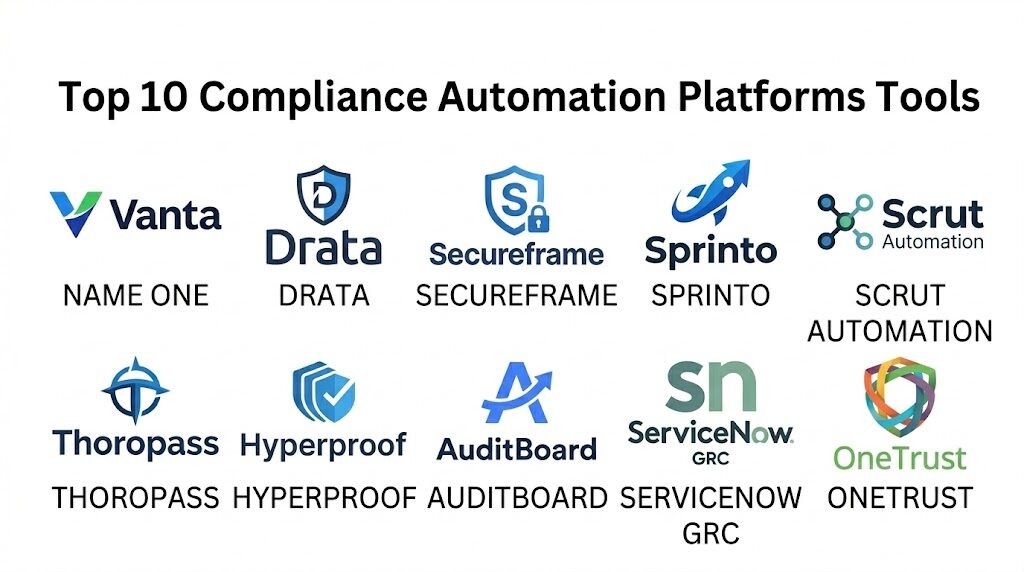
Introduction
Compliance automation platforms represent the modernization of regulatory governance, moving organizations away from static spreadsheets toward dynamic, real-time security postures. In the current digital landscape, compliance is no longer a “point-in-time” exercise performed annually; it is a continuous operational requirement. These platforms leverage API-driven integrations to automatically collect evidence from an organization’s cloud infrastructure, identity providers, and development workflows. By mapping a single security control to multiple regulatory frameworks—such as SOC 2, ISO 27001, HIPAA, and GDPR—compliance automation tools drastically reduce the redundant manual effort typically associated with audit preparation.
For the modern enterprise, these tools serve as a “single source of truth” for security and risk management. They provide a centralized dashboard where stakeholders can monitor control health, manage policy lifecycles, and track employee training completion. By automating the grunt work of evidence gathering, these platforms allow security and DevOps teams to focus on mitigating actual risks rather than administrative documentation. As global regulations like the EU AI Act and DORA introduce more stringent requirements, the ability to maintain an “always-audit-ready” state becomes a significant competitive advantage, building trust with customers and accelerating the sales cycle by simplifying security reviews.
Best for: Rapidly growing SaaS startups, fintech and health-tech firms, and global enterprises that need to manage multiple security certifications simultaneously while maintaining high operational velocity.
Not ideal for: Organizations with entirely air-gapped or legacy on-premise environments that cannot leverage API-based automated evidence collection, or very small businesses with no immediate regulatory or contractual requirements.
Key Trends in Compliance Automation Platforms
The defining trend in 2026 is the rise of “Agentic AI” within GRC (Governance, Risk, and Compliance) workflows. Platforms are transitioning from simple data connectors to intelligent agents capable of performing automated remediation—such as identifying a misconfigured S3 bucket and suggesting or executing the specific fix to maintain compliance. This shift toward “Autonomous Governance” allows systems to handle the “Check” and “Act” phases of the traditional Plan-Do-Check-Act cycle without constant human intervention.
Another major trend is the expansion into AI Governance itself. With the proliferation of LLMs in the enterprise, platforms are now integrating frameworks like ISO 42001 and the NIST AI Risk Management Framework. This allows companies to monitor their AI systems for bias, transparency, and data privacy in the same dashboard used for their cybersecurity controls. Furthermore, we are seeing a convergence of Cybersecurity, ESG (Environmental, Social, and Governance), and Privacy into unified “Trust Management” platforms, reflecting a holistic approach to corporate responsibility and risk.
How We Selected These Tools
Our selection process focused on platforms that demonstrate technical maturity in three specific areas: integration depth, automated control testing, and auditor ecosystem. We prioritized tools that offer 100+ native integrations across the modern tech stack—including major cloud providers (AWS, Azure, GCP), HRIS systems (Rippling, Gusto), and developer tools (GitHub, Jira). The ability to perform hourly or real-time automated tests, rather than daily or weekly scans, was a critical factor in determining the “Continuous Compliance” capability of a platform.
Security and data integrity were non-negotiable criteria; we evaluated each platform’s own compliance certifications and their handling of sensitive metadata. We also considered the “user-to-auditor” experience, favoring platforms that provide dedicated auditor portals to streamline the final certification process. Finally, we assessed the scalability of the platforms, ensuring they can support a company’s journey from its first SOC 2 Type I audit to complex, multi-entity international certifications like ISO 27001 and beyond.
1. Vanta
Vanta is widely recognized as the pioneer of the automated compliance space and remains a market leader due to its massive integration catalog and mature auditor network. It is designed to act as a “security hire in a box,” helping companies get audit-ready in weeks by automating up to 90% of evidence collection.
Key Features
The platform features over 400 integrations, the largest in the industry, allowing for deep connectivity across cloud, identity, and task management tools. It offers a “Trust Center” that lets companies share their real-time security posture with prospects to accelerate deals. Vanta’s AI automates the creation of security policies and even helps autofill complex security questionnaires. It performs hourly automated tests on controls, ensuring that any compliance drift is caught and alerted instantly. Additionally, it provides a centralized portal for managing employee security training and background check tracking.
Pros
Extensive integration depth reduces manual work more than most competitors. The largest network of partner auditors often leads to faster and cheaper certification cycles.
Cons
The pricing can be high for very early-stage startups. Some users find the initial configuration of custom frameworks to be more complex than the pre-built options.
Platforms and Deployment
Cloud-based SaaS platform with high-frequency automated testing.
Security and Compliance
SOC 2 Type II, ISO 27001 certified; utilizes zero-knowledge principles for sensitive data handling.
Integrations and Ecosystem
Seamlessly connects with AWS, GCP, Azure, Okta, GitHub, Slack, and 400+ other SaaS tools.
Support and Community
Offers a dedicated customer success manager and access to a broad community of GRC professionals.
2. Drata
Drata is a top-tier competitor known for its exceptionally clean user interface and a “security-first” approach to automation. It focuses on providing a frictionless experience for teams managing complex, multi-framework environments.
Key Features
The platform provides a unified view of compliance status across 16+ frameworks simultaneously. It includes a built-in risk management module that helps organizations identify, assess, and treat risks directly within the compliance workflow. Drata’s “Autopilot” feature uses AI to collect evidence and validate controls with minimal human touch. It features a robust policy builder with pre-vetted templates and automated version control. The platform also offers a dedicated “Auditor Portal” that provides third-party auditors with a structured, read-only view of all evidence and control history.
Pros
The UI/UX is frequently cited as the most intuitive in the category. Strong focus on continuous monitoring rather than just “getting the badge.”
Cons
While growing rapidly, the integration list is slightly smaller than Vanta’s. Pricing is competitive but can scale quickly as frameworks are added.
Platforms and Deployment
Web-based SaaS with real-time continuous monitoring agents.
Security and Compliance
Maintains SOC 2, HIPAA, and ISO 27001 standards; high-level encryption for all data at rest and in transit.
Integrations and Ecosystem
Strong native integrations with 75+ major cloud and security tools, plus a flexible API for custom connectors.
Support and Community
Provides 24/7 technical support and regular live training webinars for new compliance leads.
3. Secureframe
Secureframe differentiates itself by combining its automation platform with a high degree of personalized “white-glove” support. It is an ideal choice for teams that want a tool but also need expert guidance through the nuances of the audit process.
Key Features
The platform guides users through a step-by-step readiness roadmap, from initial gap analysis to final audit. It features an automated vendor risk management module that streamlines security reviews of third-party SaaS providers. Secureframe’s AI-powered “Questionnaire Automation” tool significantly reduces the time spent responding to customer security inquiries. It provides real-time alerts for compliance failures and offers detailed remediation steps to fix issues. The platform also includes an integrated employee training suite that covers privacy and security basics.
Pros
The hands-on customer success model is excellent for teams without dedicated in-house compliance experts. The platform’s automated tasks are very well-structured and easy to follow.
Cons
Can be more expensive than “self-service” automation tools due to the high level of support. The level of customization for unique enterprise workflows is somewhat limited.
Platforms and Deployment
Cloud-native platform with guided implementation workflows.
Security and Compliance
Adheres to rigorous global security standards and provides transparent reporting on its own controls.
Integrations and Ecosystem
Integrates with 200+ popular services including cloud providers, identity managers, and HRIS systems.
Support and Community
Known for highly responsive “compliance assistants” and dedicated success managers.
4. Sprinto
Sprinto is an agile compliance automation platform that is particularly popular with global startups and mid-market companies. It is known for its speed of implementation and its “adaptive” framework that scales as the business grows.
Key Features
The platform utilizes a “Common Control Framework” approach, allowing users to map a single activity to multiple standards like SOC 2, ISO 27001, and PCI DSS. It features a health dashboard that gives a granular look at every control’s status across different business units. Sprinto automates the evidence collection for over 80% of typical security controls. It includes built-in modules for vulnerability management and incident response tracking. The platform also provides a “Bridge” feature to help international companies navigate regional compliance variations.
Pros
Very fast implementation—some companies achieve audit readiness in as little as 15 days. Highly affordable for early-stage companies compared to enterprise-grade tools.
Cons
The integration depth for niche or specialized enterprise software is not as extensive as the market leaders. The reporting interface is functional but lacks some advanced visualization features.
Platforms and Deployment
Online web platform with automated data synchronization.
Security and Compliance
Fully compliant with the standards it helps automate, featuring strong data isolation protocols.
Integrations and Ecosystem
Connects with all major cloud providers and standard startup tech stacks (Slack, GitHub, Jira).
Support and Community
Offers proactive 24/5 support and specialized assistance for specific framework audits.
5. Scrut Automation
Scrut Automation takes a risk-centric approach to compliance, making it a strong choice for organizations that want to formalize their overall security operations while getting certified. It is highly valued in the fintech and health-tech sectors.
Key Features
The platform consolidates over 50 compliance frameworks into a single management console. It performs daily cloud compliance checks against 230+ CIS benchmarks, ensuring that infrastructure is always hardened. Scrut features a unique “Risk Register” that quantifies security risks and maps them directly to compliance controls. It provides automated evidence collection through 70+ native integrations. The platform also includes a collaboration suite for teams and auditors to communicate directly on specific evidence items.
Pros
The combination of GRC and cloud security posture management (CSPM) provides a more holistic security view. Excellent pricing model with no hidden charges for user scaling.
Cons
The feature set can be slightly overwhelming for absolute beginners. Documentation for custom API integrations could be more detailed.
Platforms and Deployment
Cloud-based dashboard with continuous infrastructure scanning.
Security and Compliance
Meets international data security standards and maintains a rigorous internal audit schedule.
Integrations and Ecosystem
Robust connectivity with development tools like Azure DevOps and cloud services like AWS and GCP.
Support and Community
Provides access to in-house VAPT experts and specialized compliance consultants.
6. Thoropass (formerly Laika)
Thoropass offers a unique “integrated” model where the platform, the expert guidance, and the actual audit are all managed through one provider. This “all-in-one” approach is designed to eliminate the friction between the tool and the auditor.
Key Features
The platform provides a centralized hub for all audit activities, including a secure evidence locker and a real-time progress tracker. It features AI-powered evidence validation to ensure that uploaded documents meet auditor requirements before the audit begins. Thoropass includes a “Trust Center” for sharing security certifications and real-time status with customers. It offers integrated penetration testing and security questionnaire automation. The platform’s workflow is specifically optimized for a collaborative experience between the company and the Thoropass-integrated audit firm.
Pros
Eliminates the “middleman” friction between the software platform and the external auditor. High-quality expert support is built into the subscription.
Cons
The UI has been noted by some users as being less intuitive than competitors like Drata. Users are somewhat locked into the Thoropass auditor ecosystem for the best experience.
Platforms and Deployment
Web-based platform with integrated audit management.
Security and Compliance
Strong emphasis on data privacy and secure evidence storage with granular access controls.
Integrations and Ecosystem
Solid integrations with core cloud and identity services required for automated evidence collection.
Support and Community
Exceptional support from former auditors and dedicated customer success teams.
7. Hyperproof
Hyperproof is a highly flexible GRC platform that focuses on “operationalizing” compliance. It is best suited for organizations that have outgrown simple automation and need to manage complex, overlapping compliance programs.
Key Features
The platform excels at “Cross-Framework Mapping,” identifying where one piece of evidence can satisfy controls across dozens of different standards. It provides a “Compliance Program Dashboard” that visualizes the maturity and health of various programs. Hyperproof features a robust task management system that allows compliance leads to assign work to stakeholders across the organization. It supports “Freshness” monitoring, alerting users when a periodic control (like a quarterly access review) is due. The platform also offers a dedicated module for managing internal audits and external certifications.
Pros
Incredible flexibility for organizations managing 10+ frameworks. Excellent for cross-functional collaboration in larger companies.
Cons
The platform is less “prescriptive” than Vanta or Drata, requiring more internal compliance knowledge to set up effectively. The interface is more “technical” and less “startup-friendly.”
Platforms and Deployment
Cloud-based enterprise GRC platform.
Security and Compliance
Enterprise-grade security with support for complex RBAC and data localization needs.
Integrations and Ecosystem
Integrates with a wide range of ticketing, cloud, and document repository tools.
Support and Community
Offers professional services for setup and a highly technical support team.
8. AuditBoard
AuditBoard is a powerhouse in the enterprise audit and risk space. It is the platform of choice for large corporations and publicly traded companies that need to manage SOX compliance alongside their cybersecurity frameworks.
Key Features
The platform is composed of several specialized modules: “CrossComply” for IT compliance, “SOXHUB” for financial controls, and “OpsAudit” for internal audit management. It features advanced risk quantification and heat-mapping tools. AuditBoard provides automated evidence requests and follow-ups with internal stakeholders. It includes a robust reporting engine that can generate executive-level presentations on risk and compliance posture. The platform also supports complex organizational structures with multiple entities and business units.
Pros
The gold standard for internal audit and SOX compliance. Highly scalable for the largest global enterprises.
Cons
Can be prohibitively expensive for startups and mid-market companies. The complexity of the platform requires a dedicated team or administrator to manage.
Platforms and Deployment
Enterprise cloud-based GRC suite.
Security and Compliance
Meets the highest standards of financial and data security required by publicly traded companies.
Integrations and Ecosystem
Deep integrations with enterprise ERP systems like SAP and Oracle, as well as modern IT tools.
Support and Community
Extensive training through “AuditBoard University” and a large global user community.
9. ServiceNow GRC (Integrated Risk Management)
ServiceNow GRC is the ultimate choice for organizations that already run their IT operations on the ServiceNow platform. It embeds risk and compliance directly into the existing IT Service Management (ITSM) workflows.
Key Features
The platform leverages the ServiceNow “Common Service Data Model” to provide real-time compliance visibility across the entire IT landscape. It automates control testing by pulling data directly from the ServiceNow CMDB (Configuration Management Database). It includes sophisticated policy lifecycle management and automated exception handling workflows. The “Risk Management” module allows for advanced scenario modeling and risk scoring. It also features a “Vendor Risk Management” portal that is fully integrated with the procurement and IT workflows.
Pros
Unmatched integration with IT operations; compliance becomes a byproduct of daily work. High degree of customization for complex global workflows.
Cons
Only makes sense for organizations already invested in the ServiceNow ecosystem. Setup is a major undertaking that usually requires specialized consultants.
Platforms and Deployment
Enterprise SaaS integrated into the ServiceNow platform.
Security and Compliance
Highly secure, meeting the compliance needs of government and highly regulated sectors.
Integrations and Ecosystem
Native integration with all ServiceNow modules (ITSM, SecOps, HRSD) and external connectors.
Support and Community
Massive global network of partners and a robust official support structure.
10. OneTrust
OneTrust is the market leader for privacy and data governance. While it handles security frameworks like SOC 2, its real strength lies in helping multinational organizations navigate the complex web of global privacy laws.
Key Features
The platform features a world-class “Data Discovery” engine that automatically scans and classifies sensitive data across cloud and on-premise environments. It provides a comprehensive module for “Consent and Preference Management,” essential for GDPR and CCPA compliance. OneTrust includes a sophisticated “Third-Party Risk Management” system that automates vendor assessments and questionnaires. It offers a “Regulatory Research” tool that provides real-time updates on changing laws in over 100 countries. The platform is highly modular, allowing companies to start with what they need and grow.
Pros
The most comprehensive solution for global privacy and data governance. Excellent at managing third-party and supply chain risks.
Cons
The modularity can make pricing and configuration confusing. The interface can feel fragmented due to the sheer number of different products within the suite.
Platforms and Deployment
Multi-module cloud-based governance platform.
Security and Compliance
Industry-leading focus on privacy and security; holds nearly every major global certification.
Integrations and Ecosystem
Broad integrations across marketing, legal, IT, and security software.
Support and Community
Massive resource library and a large global team of privacy and compliance experts.
Comparison Table
| Tool Name | Best For | Platform(s) Supported | Deployment | Standout Feature | Public Rating |
| 1. Vanta | SMB/Mid-Market SaaS | Web | Cloud | 400+ Integrations | 4.7/5 |
| 2. Drata | Continuous Monitoring | Web | Cloud | Clean UI/UX & Autopilot | 4.9/5 |
| 3. Secureframe | Hands-on Support | Web | Cloud | Personalized Guidance | 4.8/5 |
| 4. Sprinto | Fast Implementation | Web | Cloud | 15-day Audit Readiness | 4.8/5 |
| 5. Scrut Automation | Risk-centric Security | Web | Cloud | Integrated CSPM & GRC | 4.6/5 |
| 6. Thoropass | All-in-One Audits | Web | Cloud | Integrated Audit Services | 4.5/5 |
| 7. Hyperproof | Multi-Framework Ops | Web | Cloud | Cross-Framework Mapping | 4.4/5 |
| 8. AuditBoard | Enterprise/SOX | Web | Cloud | Enterprise Audit Suite | 4.7/5 |
| 9. ServiceNow GRC | ITSM Integration | Web | Cloud | Native ITSM Alignment | 4.3/5 |
| 10. OneTrust | Privacy & Governance | Web | Cloud | Global Privacy Engine | 4.2/5 |
Evaluation & Scoring of Compliance Automation Platforms
The scoring below is a comparative model intended to help shortlisting. Each criterion is scored from 1–10, then a weighted total from 0–10 is calculated using the weights listed. These are analyst estimates based on typical fit and common workflow requirements, not public ratings.
Weights:
- Core features – 25%
- Ease of use – 15%
- Integrations & ecosystem – 15%
- Security & compliance – 10%
- Performance & reliability – 10%
- Support & community – 10%
- Price / value – 15%
| Tool Name | Core (25%) | Ease (15%) | Integrations (15%) | Security (10%) | Performance (10%) | Support (10%) | Value (15%) | Weighted Total |
| 1. Vanta | 10 | 9 | 10 | 9 | 9 | 8 | 8 | 9.15 |
| 2. Drata | 9 | 10 | 9 | 9 | 9 | 9 | 8 | 8.95 |
| 3. Secureframe | 9 | 8 | 8 | 9 | 8 | 10 | 7 | 8.45 |
| 4. Sprinto | 8 | 9 | 7 | 8 | 9 | 9 | 10 | 8.45 |
| 5. Scrut Automation | 9 | 7 | 8 | 9 | 9 | 9 | 9 | 8.50 |
| 6. Thoropass | 8 | 7 | 7 | 9 | 8 | 10 | 8 | 8.05 |
| 7. Hyperproof | 10 | 6 | 9 | 9 | 9 | 8 | 8 | 8.55 |
| 8. AuditBoard | 10 | 5 | 8 | 10 | 10 | 9 | 7 | 8.40 |
| 9. ServiceNow GRC | 9 | 4 | 10 | 10 | 10 | 8 | 6 | 7.85 |
| 10. OneTrust | 10 | 5 | 9 | 10 | 9 | 8 | 7 | 8.30 |
How to interpret the scores:
- Use the weighted total to shortlist candidates, then validate with a pilot.
- A lower score can mean specialization, not weakness.
- Security and compliance scores reflect controllability and governance fit, because certifications are often not publicly stated.
- Actual outcomes vary with assembly size, team skills, templates, and process maturity.
Which Compliance Automation Platform Is Right for You?
Solo / Freelancer
For a small team needing their first SOC 2 Type I or Type II quickly and affordably, Sprinto or Vanta are the prime candidates. They offer the most “prescriptive” path, meaning they tell you exactly what to do, which is invaluable when you don’t have a dedicated compliance officer.
SMB
Growing companies that value an intuitive interface and continuous monitoring should look toward Drata. If your team needs more personalized hand-holding through the audit process, Secureframe’s model of dedicated success managers provides the best balance of tool and service.
Mid-Market
For industries where risk management is as important as the certificate itself, Scrut Automation provides a high degree of infrastructure visibility alongside compliance. Its daily CIS benchmark checks ensure your technical security actually matches your policy.
Budget vs Premium
Enterprises with complex internal audit needs and multi-country operations will find the most value in Hyperproof or AuditBoard. These tools provide the necessary project management and cross-mapping capabilities to manage 10+ frameworks without redundant effort.
Feature Depth vs Ease of Use
Organizations with a heavy focus on privacy and data governance across multiple jurisdictions should prioritize OneTrust. Its ability to map data flows and manage consent is unmatched, even if its cybersecurity automation is slightly less “automated” than the pure-play SOC 2 tools.
Integrations & Scalability
If your organization is already standardized on ServiceNow for ITSM and Security Operations, the ServiceNow GRC module is the logical choice. It provides a level of native data integration that no third-party API-based tool can truly replicate.
Security & Compliance Needs
If you find the process of hiring a third-party auditor separately to be a hassle, Thoropass provides the most seamless experience by bundling the software and the audit into a single professional services engagement.
Frequently Asked Questions (FAQs)
1. Does using an automation platform guarantee an audit pass?
No tool can guarantee a pass, as the final decision rests with the independent auditor. However, these platforms ensure that you have all the necessary evidence organized and that your controls meet the framework requirements, which significantly reduces the risk of a “qualified” report or an audit failure.
2. How long does it take to get SOC 2 ready with automation?
With an automation platform, companies can often become “ready” for a Type I audit in 2–4 weeks. A Type II audit requires a “monitoring period” (usually 3–12 months), but the platform automates the evidence collection during that entire window.
3. Do these platforms replace the need for an external auditor?
No. To receive a certified SOC 2 or ISO 27001 report, you must still engage an independent CPA firm or accredited registrar. The platform simply prepares you for the audit and makes the auditor’s job much faster and easier.
4. Can I map one control to multiple frameworks?
Yes, this is one of the primary benefits. For example, a policy requiring “Multi-Factor Authentication” can be mapped to SOC 2, ISO 27001, HIPAA, and PCI DSS simultaneously, so you only have to prove it once.
5. How do these platforms collect evidence?
Most platforms use read-only API connections to your cloud providers, identity managers, and HR systems. They pull metadata (like a list of users or a configuration setting) to verify that a control is active, without ever accessing your sensitive customer data.
6. What is the difference between a Type I and Type II audit?
A Type I audit checks if your controls are designed correctly at a single point in time. A Type II audit verifies that those controls were consistently operated over a period of time (usually 6 months). Automation is particularly helpful for Type II because it monitors the entire period.
7. Are these tools helpful for GDPR?
Yes. While GDPR is a legal framework, these tools help by automating the technical security requirements (like encryption and access control) and managing the administrative side (like data processing agreements and privacy policies).
8. Can I build custom frameworks in these tools?
Most mid-market and enterprise platforms like Hyperproof and Drata allow you to import custom controls and frameworks, allowing you to manage internal corporate standards alongside public regulations.
9. How does the pricing usually work?
Pricing is typically an annual subscription based on the number of frameworks you need and the size of your company (often measured by employee count). Some platforms also offer a “startup” tier for very small teams.
10. What is “Continuous Compliance”?
Continuous compliance means your controls are tested every hour or every day by the platform. If a developer accidentally turns off MFA or leaves a database open, the platform alerts you immediately so you can fix it before it becomes an audit issue or a security breach.
Conclusion
The transition to automated compliance is a fundamental shift in how modern businesses manage risk and establish trust. As we progress through 2026, the complexity of the regulatory environment—driven by new AI and data privacy laws—makes manual compliance management nearly impossible for high-growth organizations. Selecting the right platform requires a deep understanding of your current technical stack, your future growth plans, and the specific frameworks your customers demand. While automation significantly lowers the barrier to entry, it does not remove the need for a strong security culture. The most successful organizations are those that use these platforms not just to “get the badge,” but to build a resilient, transparent, and proactive security operation. By choosing a partner that scales with your complexity, you ensure that compliance remains a business enabler rather than an operational bottleneck.
I find that this comprehensive guide on Compliance Automation Platforms perfectly highlights the critical shift from “point-in-time” audits to the continuous monitoring required in our modern regulatory landscape. I learned from this blog that the real value of platforms like Vanta and Drata isn’t just in gathering evidence, but in providing a single source of truth that maps one control to multiple global frameworks like SOC 2 and GDPR. In the real world, this transition helps me eliminate the “fire drill” mentality of audit season, allowing me to focus on actual security posture rather than administrative documentation. For others, adopting these AI-driven GRC tools means accelerating sales cycles by sharing a real-time Trust Center with customers, proving security maturity instantly. My advice for anyone looking to master this space is to prioritize understanding API-driven evidence collection; once you see how automated connectors pull data directly from your cloud and identity providers, you’ll never want to go back to manual spreadsheets again.