Introduction
Patient portal platforms are secure online applications that provide patients with 24/7 access to their personal health information from any device with an internet connection. By bridging the communication gap between healthcare providers and patients, these platforms allow individuals to view lab results, schedule appointments, and message their care teams without the need for traditional phone calls or physical visits. In the 2026 healthcare landscape, these portals have moved beyond simple “record viewing” to become comprehensive engagement hubs that support telehealth, remote patient monitoring, and automated financial management.
The shift toward value-based care has made patient portals a critical component of medical practice operations. Modern systems prioritize interoperability, allowing data to flow seamlessly between specialized clinics and large hospital networks using standardized frameworks. For healthcare providers, the primary goal is to increase patient autonomy while reducing the administrative burden on front-desk staff. Successful implementation leads to higher patient satisfaction scores, better clinical outcomes through improved medication adherence, and a more streamlined revenue cycle.
Real-world use cases include:
- Chronic Disease Management: Patients tracking vitals like glucose levels and sharing them with specialists in real-time.
- Virtual Care Delivery: Launching secure, HIPAA-compliant video consultations directly from the portal interface.
- Preventive Care Alerts: Automated notifications for upcoming vaccinations, screenings, or annual physicals.
- Family Care Coordination: Proxy access allowing adult children to manage the healthcare records and appointments for elderly parents.
- Financial Transparency: Patients viewing itemized billing statements and setting up digital payment plans.
What buyers should evaluate:
- Mobile Accessibility: Native app performance on both iOS and Android.
- EHR Integration: How deeply the portal syncs with the existing Electronic Health Record system.
- User Interface (UX): Simplicity of navigation for elderly or non-technical patients.
- Self-Service Capabilities: Depth of scheduling, prescription refill, and intake form features.
- Security Architecture: Implementation of multi-factor authentication and role-based access.
- Regulatory Compliance: Adherence to HIPAA, GDPR, and the 21st Century Cures Act.
- Interoperability Standards: Support for HL7, FHIR, and OpenUSD-like data exchange protocols.
Best for: Large hospital systems, multi-specialty clinics, and private practices looking to automate patient engagement and provide transparent access to clinical data.
Not ideal for: Emergency medical services, low-volume cash-only practices with no digital records, or healthcare environments that rely exclusively on verbal communication and manual charting.
Key Trends in Patient Portal Platforms
- AI-Powered Symptom Checkers: Integration of intelligent triage bots that guide patients to the appropriate level of care based on reported symptoms.
- Unified Health Records: A shift toward “Universal Portals” where patients can see data from multiple different healthcare providers in a single longitudinal view.
- Wearable Data Integration: Portals now automatically ingest data from consumer health devices to provide clinicians with continuous monitoring capabilities.
- Ambient Intake Forms: Using natural language processing to allow patients to record their medical history via voice rather than typing into long digital forms.
- Real-Time Financial Estimates: Platforms provide “out-of-pocket” cost transparency for procedures before the patient even books the appointment.
- Hyper-Personalized Content: AI-driven educational materials tailored to a patient’s specific diagnosis, language, and literacy level.
- Biometric Authentication: Increasing use of facial recognition and fingerprint scanning for quick, secure access to sensitive medical data.
How We Selected These Tools (Methodology)
Our selection of the top patient portal platforms is based on a structured evaluation of market leadership and technical innovation within the current year. We focused on “enterprise-ready” solutions that demonstrate the highest levels of security while maintaining a consumer-grade user experience. High priority was given to platforms that offer “full-stack” engagement, meaning they handle everything from the initial appointment request to the final payment and post-visit survey.
We also analyzed interoperability signals, specifically how well these tools participate in national health information exchanges. Reliability and performance were measured through reported uptime and the responsiveness of their mobile applications. Finally, we considered the “vendor ecosystem”—the availability of third-party integrations and the quality of support provided to both the medical practice and the end patient.
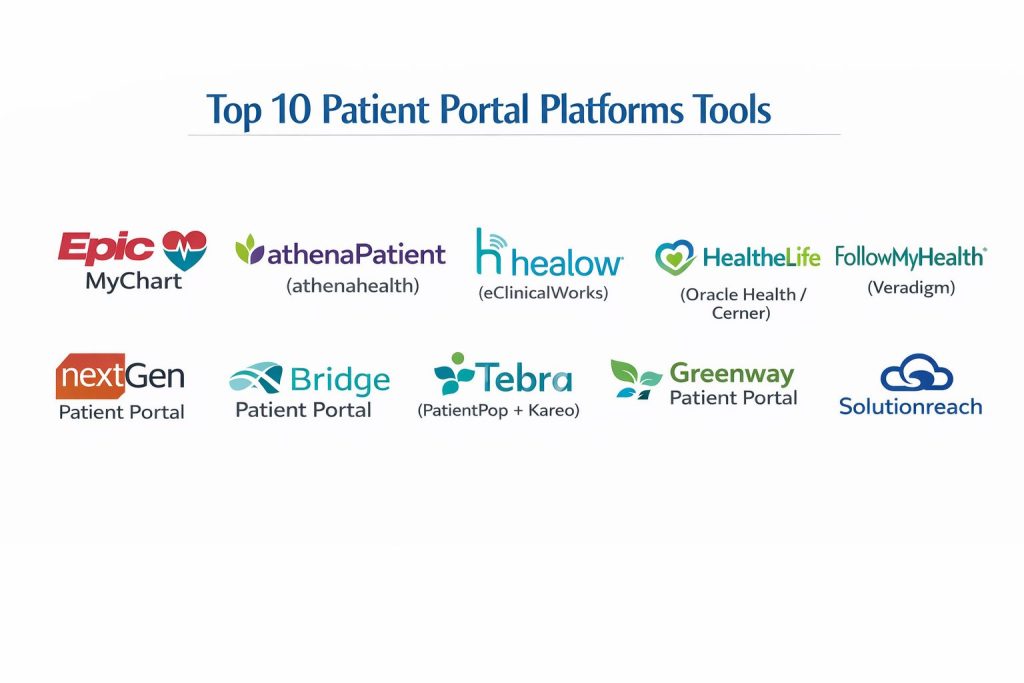
Top 10 Patient Portal Platforms
1 — Epic MyChart
Epic MyChart is the most widely adopted patient portal in the United States, used by the majority of top-tier academic medical centers and health systems. It provides a massive range of features designed for complex, multi-site healthcare environments.
Key Features
- Bedside Features: Specialized interfaces for hospitalized patients to see their daily schedule and care team.
- Proxy Access: Robust tools for parents and caregivers to manage multiple accounts securely under one login.
- Interoperability: Seamless data sharing with any other Epic-using facility via the “Care Everywhere” network.
- Self-Scheduling: Logic-based appointment booking that respects complex provider rules and availability.
- Apple Health Integration: Native synchronization with iOS Health app data and various medical wearables.
- E-Visits: Structured messaging workflows that allow for asynchronous clinical consultations.
Pros
- Unmatched feature depth and scalability for large national health networks.
- Highly rated mobile applications with frequent updates and a very high patient adoption rate.
Cons
- Extremely high implementation cost and technical complexity for the healthcare provider.
- The interface can feel cluttered and overwhelming due to the sheer volume of available features.
Platforms / Deployment
- Web / iOS / Android
- Cloud (SaaS)
Security & Compliance
- Features: Multi-factor authentication (MFA), biometric login, role-based access controls, and comprehensive audit logging.
- Compliance: HIPAA, SOC 2, ISO 27001, and 21st Century Cures Act compliant.
Integrations & Ecosystem
MyChart is part of the broader Epic ecosystem, integrating natively with all Epic clinical and financial modules. It features a robust “Connection Hub” for third-party health app integrations.
Support & Community
Autodesk-level professional support for health systems. The community includes thousands of health IT professionals who share best practices via user group meetings.
2 — athenaPatient (athenahealth)
athenaPatient is a cloud-native platform focused on reducing administrative friction for both the patient and the provider. It is highly regarded for its automated communication tools and clean, modern interface.
Key Features
- Automated Outreach: Uses AI to send appointment reminders, lab result notifications, and preventive care alerts.
- Digital Check-In: Allows patients to complete intake forms and pay co-pays on their mobile device before entering the clinic.
- Streamlined Messaging: A simplified, chat-like interface for HIPAA-compliant communication with the care team.
- Billing Transparency: Clear, easy-to-read financial statements with one-click payment options via Apple Pay or Google Pay.
- Cloud-First Architecture: No on-premise servers required; updates are pushed automatically to all users.
- Lab Results Visualization: Interactive charts that help patients track their health trends over time.
Pros
- Minimal IT footprint for the practice since it is a 100% managed cloud solution.
- Excellent at reducing “no-show” rates through highly optimized, automated patient communication.
Cons
- Customization options are limited compared to traditional on-premise enterprise systems.
- Heavily reliant on the athenahealth EHR ecosystem for its full suite of capabilities.
Platforms / Deployment
- Web / iOS / Android
- Cloud (SaaS)
Security & Compliance
- Features: Standard MFA, encrypted data at rest and in transit, and secure session management.
- Compliance: HIPAA, GDPR, and SOC 2.
Integrations & Ecosystem
Deeply integrated with the athenahealth network. It also supports various third-party integrations through the athenahealth Marketplace.
Support & Community
Offers dedicated account management for providers. The “athenaNation” community provides a platform for users to share feedback and request features.
3 — Healow (eClinicalWorks)
Healow (Health and Online Wellness) is the patient-facing arm of eClinicalWorks, designed to provide a “lifestyle” approach to health management. It emphasizes wellness tracking and easy access to a patient’s entire medical circle.
Key Features
- Healow Kids: Specialized tools for pediatric care, including growth charts and immunization trackers.
- Smart Vitals: Connects to blood pressure cuffs, scales, and glucose monitors for remote patient monitoring.
- One-Click Telehealth: Integrated “Healow TeleVisit” feature allows for seamless video calls within the app.
- Family Portal: Manage records for children and elderly relatives from a single, unified dashboard.
- Find a Doc: Integrated search functionality that allows patients to find and book new providers within the network.
- Price Transparency: Provides estimated costs for common procedures based on the patient’s insurance.
Pros
- Highly user-friendly mobile app with some of the highest download numbers in the category.
- Comprehensive features for chronic disease management and proactive wellness tracking.
Cons
- Users occasionally report syncing delays between the portal and the clinician’s EHR view.
- The desktop version feels less modern compared to the highly polished mobile application.
Platforms / Deployment
- Web / iOS / Android
- Cloud / Hybrid
Security & Compliance
- Features: PIN-based mobile access, biometric security, and secure messaging encryption.
- Compliance: HIPAA and SOC 2.
Integrations & Ecosystem
Integrates natively with eClinicalWorks EHR. It also features a “Healow Hub” for connecting to thousands of wearable devices and fitness trackers.
Support & Community
Provides a 24/7 technical support line for medical practices. Extensive online training documentation is available for both staff and patients.
4 — HealtheLife (Oracle Health / Cerner)
HealtheLife is the flagship patient engagement solution for Oracle Health (formerly Cerner). It focuses on providing a holistic view of a patient’s health across various care settings, from the hospital to the doctor’s office.
Key Features
- Millennium Integration: Deep synchronization with the Millennium EHR for real-time updates of clinical data.
- Customizable Dashboards: Allows healthcare organizations to brand the portal and prioritize specific features for their patient population.
- Health Education: Provides a massive library of peer-reviewed articles and videos tailored to the patient’s condition.
- Dynamic Scheduling: Allows for both in-person and virtual appointment management with automated calendar invites.
- Secure Document Exchange: Safe uploading and downloading of medical images, insurance cards, and legal documents.
- Task Automation: Patients can complete “Pre-Visit Tasks” that flow directly into the clinician’s workflow.
Pros
- Extremely stable and reliable, making it ideal for large-scale academic and regional health systems.
- Strong data analytics capabilities for providers to track portal engagement and patient outcomes.
Cons
- The implementation process is resource-intensive and requires a dedicated IT team.
- Some users find the navigation less intuitive than the newer, cloud-only competitors.
Platforms / Deployment
- Web / iOS / Android
- Cloud / Self-hosted
Security & Compliance
- Features: Role-based access, data encryption, and regular third-party security audits.
- Compliance: HIPAA, ISO 27001, and GDPR.
Integrations & Ecosystem
Part of the Oracle Health ecosystem. It utilizes the “CommonWell Health Alliance” for broader interoperability with non-Oracle systems.
Support & Community
Enterprise-grade support through Oracle Health. A dedicated user community focuses on large-scale health system optimization.
5 — FollowMyHealth (Veradigm)
FollowMyHealth is an “EHR-agnostic” patient portal, meaning it can aggregate health data from multiple different doctors even if they use different backend systems. It is best for patients who see many specialists across various organizations.
Key Features
- Universal Health Record: Creates a single, unified record by pulling data from multiple different healthcare systems.
- Native Biometric Login: Quick access via FaceID or TouchID for mobile users.
- Real-Time Result Flagging: Automatically highlights abnormal lab results and provides simple layman explanations.
- Clinical Forms: Digital versions of standard medical forms that can be filled out and signed electronically.
- Secure Texting: Enables real-time, two-way texting between the patient and the clinic’s front office.
- Wellness Dashboard: Tracks patient-entered data alongside clinical data for a complete health overview.
Pros
- Excellent for “fragmented” care where the patient needs to bridge data between different doctors.
- Simple, high-contrast user interface that is very accessible for elderly populations.
Cons
- Data syncing from older EHR systems can occasionally be slow or incomplete.
- Advanced features like telehealth are often sold as separate modules.
Platforms / Deployment
- Web / iOS / Android
- Cloud (SaaS)
Security & Compliance
- Features: Two-factor authentication, secure session timeouts, and encrypted messaging.
- Compliance: HIPAA and SOC 2 Type II.
Integrations & Ecosystem
Integrates with hundreds of EHR systems including Allscripts, NextGen, and Greenway. It is one of the most widely connected portals in the industry.
Support & Community
Known for its robust patient-facing help desk, which reduces the support burden on the medical practice’s own staff.
6 — NextGen Patient Portal
The NextGen Patient Portal is designed for ambulatory practices that want to prioritize regulatory compliance and high-performance financial workflows. It is particularly strong in the area of automated patient billing.
Key Features
- MIPS/MACRA Reporting: Built-in tools that help practices meet federal requirements for patient engagement.
- Integrated Online Payments: A seamless checkout experience that supports all major credit cards and health savings accounts.
- Custom Branding: Allows practices to change colors, logos, and the overall “look and feel” to match their brand.
- Automated Prescription Refills: Patients can request refills which are then automatically routed to the provider for approval.
- Telehealth Launchpad: A dedicated area for patients to join virtual visits without needing to download external software.
- Advanced Intake Workflows: Supports complex logic in intake forms, where subsequent questions change based on previous answers.
Pros
- Best-in-class tools for ensuring the practice stays compliant with evolving healthcare regulations.
- Highly flexible branding and configuration options for specialized medical groups.
Cons
- Can be more expensive than basic portals due to its extensive feature set.
- The mobile experience, while functional, is occasionally reported as less “snappy” than its competitors.
Platforms / Deployment
- Web / iOS / Android
- Cloud / Hybrid
Security & Compliance
- Features: Robust MFA, database encryption, and secure audit trails for every data interaction.
- Compliance: HIPAA and SOC 2.
Integrations & Ecosystem
Deeply integrated with the NextGen Enterprise EHR. Also supports API-based integrations for third-party billing and analytics tools.
Support & Community
NextGen provides a comprehensive “Success Community” portal with training videos, forums, and direct support tickets.
7 — Tebra (PatientPop + Kareo)
Tebra is a modern “growth-oriented” platform that combines the marketing power of PatientPop with the clinical depth of Kareo. It is best for small to mid-sized practices looking to attract new patients while managing existing ones.
Key Features
- Reputation Management: Automatically sends surveys to patients after their visit and encourages positive online reviews.
- SEO-Optimized Booking: Patients can find and book appointments directly from Google Search or the practice’s website.
- Modern Messaging: A unified inbox for SMS, email, and portal messages that feels like a modern consumer app.
- Waitlist Management: Automatically notifies patients when a sooner appointment slot becomes available.
- Digital Intake: Beautifully designed forms that patients can complete on their phone while in the waiting room.
- Practice Growth Analytics: Dashboard showing where new patients are coming from and how they engage with the portal.
Pros
- The best tool for practices that are actively trying to grow their patient base and online reputation.
- Extremely easy to set up and use, requiring minimal training for both staff and patients.
Cons
- Lacks the deep “inpatient” or surgical clinical features found in systems like Epic.
- Marketing-heavy focus may be overkill for well-established practices with full schedules.
Platforms / Deployment
- Web / iOS / Android
- Cloud (SaaS)
Security & Compliance
- Features: Standard encryption, secure messaging, and HIPAA-compliant data storage.
- Compliance: HIPAA and SOC 2.
Integrations & Ecosystem
Integrates natively with the Tebra clinical suite. It also offers a “Marketplace” for connecting to third-party billing and insurance verification services.
Support & Community
Highly responsive customer success teams and a modern online knowledge base tailored to small business owners.
8 — Bridge Patient Portal
Bridge is an enterprise-grade, “API-first” platform designed for organizations that want to build a completely custom patient experience. It is the most flexible tool for large groups with unique workflows.
Key Features
- White-Labeling: Organizations can fully rebrand the portal so that it appears as their own proprietary technology.
- API-First Design: Almost every feature is accessible via API, allowing for custom integrations with external systems.
- Multi-Language Support: Best-in-class translation capabilities for diverse patient populations.
- Unified Appointment Feed: Aggregates appointments from multiple different scheduling systems into one view.
- Custom Forms Engine: A drag-and-drop builder for creating highly specialized clinical or administrative forms.
- Mobile SDK: Allows organizations to embed portal features into their own existing mobile apps.
Pros
- Unmatched flexibility for organizations that have a specific vision for their patient user experience.
- Strong focus on the “consumer” side of healthcare, with a very modern and clean aesthetic.
Cons
- Requires more technical expertise to implement and customize compared to “out-of-the-box” solutions.
- Pricing is generally geared toward larger organizations rather than solo practitioners.
Platforms / Deployment
- Web / iOS / Android / Mobile SDK
- Cloud (SaaS)
Security & Compliance
- Features: Enterprise SSO (Single Sign-On), advanced MFA, and highly granular role-based permissions.
- Compliance: HIPAA, GDPR, and SOC 2.
Integrations & Ecosystem
Bridge is built to be the “middle layer” between various systems. It integrates with most major EHRs via HL7 and FHIR standards.
Support & Community
Provides high-touch project management during the implementation phase and dedicated technical support for developers.
9 — Greenway Patient Portal
The Greenway Patient Portal (associated with Intergy and Prime Suite) is a reliable, straightforward tool that focuses on the core needs of primary and specialty care practices. It emphasizes clinical transparency and ease of access.
Key Features
- 24/7 Record Access: Provides instant access to VDT (View, Download, Transmit) compliant records for patients.
- Greenway Patient Connect: An integrated suite for intake, scheduling, and automated reminders.
- MIPS/MACRA Support: Specifically designed to help practices meet the “Promoting Interoperability” requirements of federal programs.
- Secure Messaging: A unified platform for provider-patient interaction that reduces the need for phone tag.
- Lab Integration: Automatically pushes new lab results to the portal as soon as they are signed off by the clinician.
- Multi-Account Management: Allows a single user to manage records for multiple family members across different practices.
Pros
- A very “safe” choice for existing Greenway customers, offering deep and reliable integration.
- Strong focus on clinical quality and meeting the standards of the 21st Century Cures Act.
Cons
- The user interface is functional but lacks the high-end “consumer” feel of platforms like Tebra or Bridge.
- New features are sometimes slower to roll out compared to the cloud-only competitors.
Platforms / Deployment
- Web / Mobile Web
- Cloud / Hybrid
Security & Compliance
- Features: Standard encryption, secure login protocols, and HIPAA-compliant messaging.
- Compliance: HIPAA and 21st Century Cures Act compliant.
Integrations & Ecosystem
Part of the broader Greenway Health ecosystem. It works natively with Intergy and Prime Suite EHR platforms.
Support & Community
Extensive training through the Greenway “Knowledge Center” and a dedicated support team for practice administrators.
10 — Solutionreach
Solutionreach is an all-in-one patient engagement platform that started in the dental market but has since expanded to serve all medical specialties. It is a leader in automated patient communications and revenue cycle messaging.
Key Features
- SR Conversations: A powerful two-way texting platform that allows the front office to communicate with patients in real-time.
- Batch Messaging: Send personalized messages to your entire patient database or specific segments (e.g., all diabetic patients).
- SR Intake: Digital intake forms that can be sent via text and completed on any mobile device.
- Automated Recalls: Uses AI to identify patients who are overdue for a visit and automatically reaches out to book them.
- Text-to-Pay: Allows patients to pay their bills via a secure link sent directly to their phone.
- Post-Visit Feedback: Automatically collects patient reviews and internal feedback immediately following an appointment.
Pros
- The strongest platform for automated “lifecycle” messaging—from first contact to final payment.
- Proven ability to significantly reduce no-show rates and increase practice revenue through automated recalls.
Cons
- Not a “full” EHR-integrated portal; it often functions as a powerful add-on to an existing system.
- Some patients may find the frequency of automated messages intrusive if not properly configured.
Platforms / Deployment
- Web / iOS / Android
- Cloud (SaaS)
Security & Compliance
- Features: Secure, HIPAA-compliant messaging and encrypted data handling.
- Compliance: HIPAA and SOC 2.
Integrations & Ecosystem
Integrates with over 400 different PM/EHR systems, making it one of the most versatile “bolt-on” engagement tools available.
Support & Community
Known for having a very high level of customer service and a well-structured onboarding process that takes less than 7 weeks.
Comparison Table (Top 10)
| Tool Name | Best For | Platform(s) Supported | Deployment | Standout Feature | Public Rating |
| Epic MyChart | Enterprise Systems | Web, iOS, Android | Cloud | Bedside Features | 4.8/5 |
| athenaPatient | Cloud Automation | Web, iOS, Android | Cloud | Automated Outreach | 4.6/5 |
| Healow | Wellness Tracking | Web, iOS, Android | Cloud/Hybrid | Smart Vitals Sync | 4.7/5 |
| HealtheLife | Holistic Records | Web, iOS, Android | Cloud/Hybrid | Millennium Sync | 4.4/5 |
| FollowMyHealth | Fragmented Care | Web, iOS, Android | Cloud | Universal Record | 4.5/5 |
| NextGen Portal | Regulatory Compliance | Web, iOS, Android | Cloud/Hybrid | MIPS/MACRA Tools | 4.3/5 |
| Tebra | Practice Growth | Web, iOS, Android | Cloud | Review Management | 4.6/5 |
| Bridge Portal | Custom UX/API | Web, iOS, Android | Cloud | White-Labeling | N/A |
| Greenway Portal | Clinical Transparency | Web, Mobile Web | Cloud/Hybrid | Cures Act Compliance | 4.2/5 |
| Solutionreach | Patient Messaging | Web, iOS, Android | Cloud | Two-Way Texting | 4.5/5 |
Evaluation & Scoring of Patient Portal Platforms
The scoring below is a comparative model intended to help shortlisting. Each criterion is scored from 1–10, then a weighted total from 0–10 is calculated using the weights listed. These are analyst estimates based on typical fit and common workflow requirements, not public ratings.
Weights:
Price / value – 15%
Core features – 25%
Ease of use – 15%
Integrations & ecosystem – 15%
Security & compliance – 10%
Performance & reliability – 10%
Support & community – 10%
| Tool Name | Core (25%) | Ease (15%) | Integrations (15%) | Security (10%) | Performance (10%) | Support (10%) | Value (15%) | Weighted Total |
| Epic MyChart | 10 | 6 | 10 | 10 | 10 | 9 | 5 | 8.60 |
| athenaPatient | 8 | 10 | 8 | 9 | 9 | 8 | 8 | 8.45 |
| Healow | 9 | 9 | 9 | 8 | 9 | 8 | 8 | 8.65 |
| FollowMyHealth | 8 | 8 | 10 | 8 | 8 | 9 | 7 | 8.20 |
| Tebra | 7 | 10 | 8 | 8 | 9 | 8 | 8 | 8.15 |
| Bridge Portal | 8 | 5 | 10 | 10 | 9 | 7 | 6 | 7.55 |
How to interpret the scores:
- Use the weighted total to shortlist candidates, then validate with a pilot.
- A lower score can mean specialization, not weakness.
- Security and compliance scores reflect controllability and governance fit, because certifications are often not publicly stated.
- Actual outcomes vary with assembly size, team skills, templates, and process maturity.
Which Patient Portal Platform Tool Is Right for You?
Solo / Freelancer
For a solo practitioner, Tebra is often the best choice. It provides the necessary clinical portal features while simultaneously acting as a marketing engine to help the practice grow through automated SEO and review management.
SMB
Small to medium-sized practices should look at athenaPatient. Its cloud-native model means the practice doesn’t need to manage servers, and the automated outreach features significantly reduce the need for administrative staff.
Mid-Market
Multi-specialty groups should consider Solutionreach paired with their existing EHR. The ability to manage complex, automated messaging across multiple locations while handling text-to-pay functionality provides the best return on investment.
Enterprise
For large hospital systems, Epic MyChart remains the definitive choice. Its ability to handle the “continuum of care” (from the ER to long-term follow-up) and its high patient adoption rate make it the industry gold standard.
Budget vs Premium
- Budget: Blender (for health IT projects) or athenahealth‘s transparent cloud model.
- Premium: Epic MyChart and Oracle Health represent the top-tier, high-investment solutions.
Feature Depth vs Ease of Use
If you need absolute clinical depth (inpatient schedules, complex lab trends), choose Epic MyChart. If you need ease of use for a non-technical patient population, athenaPatient or Tebra are superior.
Integrations & Scalability
If your organization needs to connect disparate systems across a whole region, Bridge Patient Portal or FollowMyHealth offer the best API-first and EHR-agnostic frameworks.
Security & Compliance Needs
Any practice handling sensitive specialized data (mental health, oncology) should prioritize Epic or Oracle Health, as they offer the most granular role-based access controls and the most battle-tested security frameworks.
Frequently Asked Questions (FAQs)
What is the primary difference between a patient portal and an EHR?
An Electronic Health Record (EHR) is the tool used by clinicians to document care, while a patient portal is the secure “window” that allows patients to see specific parts of that record.
Are patient portals required by law?
While not strictly required, the 21st Century Cures Act mandates that patients must have “immediate, digital access” to their health information without a fee, making a portal the most practical way to comply.
Can patients see their lab results immediately?
Yes, under current regulations, most lab results must be released to the patient portal as soon as they are finalized, often before the doctor has a chance to call the patient with an explanation.
How do portals improve practice revenue?
By automating appointment reminders, portals reduce “no-show” rates. Additionally, “Text-to-Pay” features and online billing portals significantly speed up the collection of patient co-pays and balances.
Are portals secure enough for sensitive health data?
Yes, modern portals use the same level of encryption as online banking and require multi-factor authentication (MFA) to ensure that only the authorized patient or their proxy can access the data.
Can I manage my child’s records through my own account?
Most enterprise portals like MyChart offer “Proxy Access,” where a parent can toggle between their own medical record and their child’s record using a single login.
What happens if a patient forgets their password?
All major platforms include self-service password reset tools via email or SMS. To maintain security, these resets often require a secondary verification step to prove the patient’s identity.
Do portals work on smartphones?
Yes, the top 10 platforms listed all have native iOS and Android applications, as the majority of patient portal engagement now happens via mobile devices rather than desktop computers.
Can patients schedule their own appointments?
Most modern portals allow for direct self-scheduling, where the patient sees open time slots and books them instantly, though some practices may choose to use “appointment requests” instead.
What is the biggest mistake practices make when launching a portal?
The most common mistake is failing to “market” the portal to patients. Without staff actively encouraging patients to sign up during check-in, adoption rates often remain too low to see an ROI.
Conclusion
The selection of a patient portal platform in 2026 is a strategic decision that impacts every aspect of a medical practice, from clinical outcomes to financial stability. While Epic MyChart leads the way for large-scale systems, the rise of cloud-native and growth-focused tools like athenaPatient and Tebra has leveled the playing field for smaller practices. The goal is no longer just to “show records,” but to create a digital front door that makes healthcare as easy to navigate as any other modern service.