Introduction
Patient engagement platforms have become the essential interface between modern healthcare providers and their patients, moving beyond simple portals to integrated ecosystems. These platforms leverage digital communication tools to empower patients to take an active role in their health journey, facilitating everything from scheduling and education to remote monitoring. By centralizing the patient experience, these systems reduce the administrative burden on clinical staff while simultaneously improving health outcomes through better adherence and consistent communication.
In the current healthcare landscape, patient engagement is the primary driver of operational efficiency and value-based care. As healthcare systems transition toward more personalized, proactive models, the ability to maintain a continuous digital connection with patients is vital for preventing readmissions and managing chronic conditions. These platforms provide the infrastructure for a “digital front door,” ensuring that the patient experience is seamless, transparent, and accessible, which is now a fundamental requirement for patient retention and clinical success.
Real-World Use Cases
- Chronic Disease Management: Providers use these platforms to send automated reminders for medication, blood sugar checks, and exercise, while patients upload vitals for real-time clinical review.
- Post-Surgical Recovery: Automated workflows deliver wound care instructions and physical therapy videos to patients at home, flagging any reported symptoms that require immediate clinical intervention.
- Preventive Care Outreach: Health systems run automated campaigns to identify and contact patients due for screenings, such as mammograms or colonoscopies, allowing them to book appointments instantly.
- Telehealth and Virtual Visits: Platforms integrate secure video conferencing and asynchronous messaging, allowing patients to receive care without traveling to a physical office, increasing access for rural populations.
- Patient Education and Literacy: Digital libraries deliver personalized, condition-specific educational content to patients’ devices, ensuring they understand their diagnosis and treatment plans.
Buyer Evaluation Criteria
- EHR Integration Depth: The platform must offer bi-directional integration with major electronic health records to ensure that data flows seamlessly and does not create additional manual work for staff.
- User Experience (UX) for Patients: If the interface is difficult to navigate, adoption rates will plummet; look for platforms with high mobile accessibility and intuitive, consumer-grade designs.
- Multi-Channel Communication: Evaluate whether the tool supports SMS, secure messaging, email, and voice calls to meet patients where they are most comfortable.
- Automated Clinical Workflows: The ability to trigger specific actions based on patient input, such as scheduling a follow-up if a patient reports high pain levels, is critical for efficiency.
- Security and HIPAA Compliance: Strong encryption, multi-factor authentication, and strict adherence to healthcare privacy regulations are non-negotiable requirements for protecting patient data.
- Customization and Scalability: Determine if the platform can be tailored to the specific needs of different specialties (e.g., oncology vs. pediatrics) and scale as the organization grows.
- Accessibility and Inclusion: The platform should support multiple languages and meet WCAG accessibility standards to ensure all patient populations can use the service effectively.
- Patient Self-Service Capabilities: Features like online scheduling, digital registration, and bill pay are essential for reducing the administrative load on front-office staff.
- Analytics and Reporting: Look for robust dashboards that track patient enrollment, engagement rates, and clinical outcomes to measure the platform’s return on investment.
- Technical Support and Implementation: Assess the vendor’s reputation for onboarding success and their ability to provide ongoing technical assistance to both staff and patients.
Key Trends in Patient Engagement Platforms
- Generative AI for Patient Communication: Platforms are integrating AI-driven chatbots that can handle complex queries, draft personalized responses for clinicians, and summarize medical jargon for patients.
- Hyper-Personalization of Care Paths: Using machine learning, platforms now deliver content and reminders tailored to a patient’s specific behavior, cultural background, and health literacy level.
- Integration of Social Determinants of Health (SDoH): Tools are now screening for factors like transportation and housing instability, automatically connecting at-risk patients with community resources.
- Voice-Activated Interfaces: The rise of voice assistants in the home has led to platforms developing skills that allow patients to check appointments or report symptoms hands-free.
- Wearable Data Orchestration: Patient engagement tools are increasingly acting as hubs for data from consumer wearables, integrating heart rate and sleep patterns directly into the clinical view.
- Ambient Documentation Support: Some platforms are utilizing ambient listening during virtual visits to automatically update the patient portal with the doctor’s instructions and next steps.
- Gamification of Wellness: To improve adherence to physical therapy or chronic care plans, platforms are incorporating points, badges, and progress tracking to motivate patients.
- Zero-Trust Patient Identity: Advanced identity verification methods, including biometrics, are being used to ensure that only authorized users can access sensitive health information.
How We Selected These Tools (Methodology)
Our selection process for the top 10 patient engagement platforms involved a comprehensive analysis of market presence, feature set, and clinical impact. We prioritized vendors who have demonstrated a commitment to interoperability and have a proven track record of increasing patient satisfaction scores (HCAHPS).
- Interoperability Benchmarks: We evaluated each platform’s ability to sync data with industry-leading EHRs like Epic, Cerner, and Meditech without significant data loss or latency.
- Clinical Outcome Data: Priority was given to platforms that have published case studies showing reductions in no-show rates, emergency room visits, or hospital readmissions.
- Patient Adoption Rates: We reviewed user feedback and app store ratings to identify platforms that patients actually enjoy using and find valuable.
- Breadth of Functionality: We focused on “all-in-one” platforms that handle the entire patient journey—from pre-visit marketing to post-visit follow-up—over niche, point solutions.
- Security Posture: Each platform was screened for SOC 2 Type II compliance and robust data encryption standards to ensure the highest level of patient privacy.
- Vendor Stability and Innovation: We analyzed company growth and investment in R&D to ensure the tools listed are leaders who will continue to evolve with the industry.
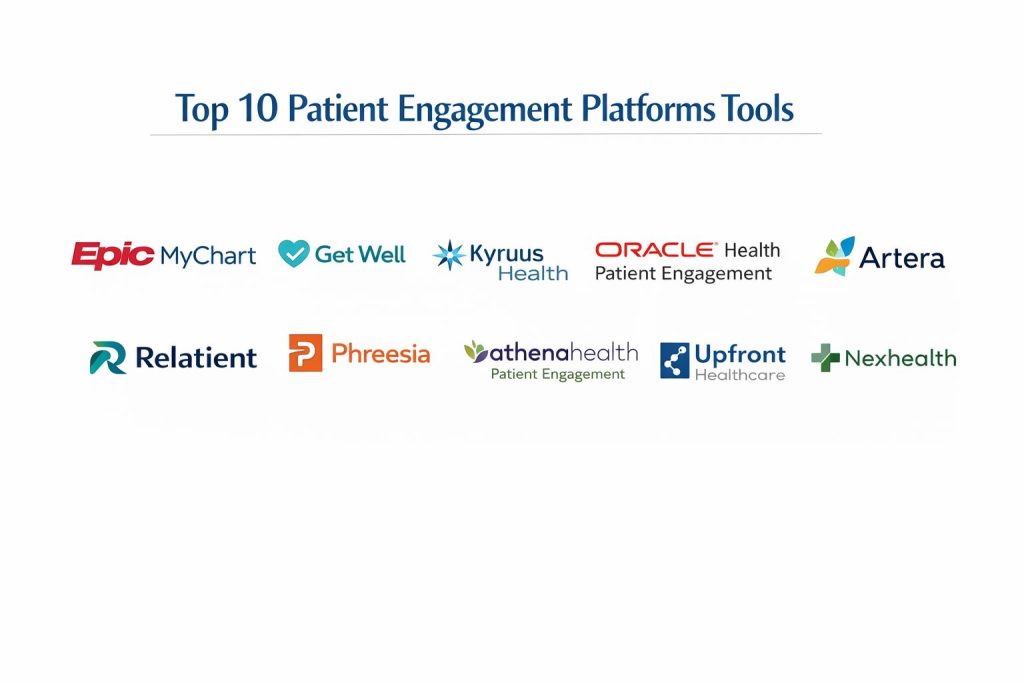
Top 10 Patient Engagement Platforms
1. Epic MyChart
Epic MyChart is the most widely utilized patient portal in the world, serving as the digital interface for millions of patients whose providers use the Epic EHR. It offers an incredibly deep range of features that are natively integrated into the clinical workflow, providing a truly unified experience for both patients and doctors.
Key Features
- Full Medical Record Access: Patients can view test results, clinical notes, immunization records, and medical history in real-time.
- Direct Scheduling: Allows patients to book, cancel, or reschedule appointments directly within the portal based on live provider availability.
- Secure Messaging: Facilitates HIPAA-compliant communication between patients and their care teams for non-urgent medical inquiries.
- Bedside Experience: Provides hospitalized patients with real-time access to their daily schedule, care team photos, and educational materials.
- Family Access (Proxy): Enables caregivers or parents to manage the health records and appointments of family members within a single account.
- Integrated Bill Pay: Provides a streamlined way for patients to view statements, set up payment plans, and pay their medical bills online.
- Telehealth Integration: Supports seamless virtual visits with built-in video capabilities and pre-visit digital check-in.
Pros
- Unmatched integration with the provider’s clinical records, ensuring data is always accurate and up-to-date.
- Extremely high brand recognition among patients, which leads to higher adoption rates and trust.
- Robust mobile application that supports biometrics and push notifications for a modern user experience.
Cons
- Only available to healthcare organizations that utilize the Epic EHR system, limiting its accessibility.
- The interface can be overwhelming for some users due to the sheer volume of data and features available.
- Customization options for the provider are often restricted compared to standalone, third-party engagement tools.
Platforms / Deployment
- Web / iOS / Android
- Natively hosted within Epic’s infrastructure.
Security & Compliance
- Gold standard HIPAA compliance.
- Multi-factor authentication and biometric login support.
Integrations & Ecosystem
MyChart is the centerpiece of the Epic ecosystem and connects with a vast array of health data sources.
- Native integration with Apple Health and Google Fit for wearable data.
- Direct connection to pharmacy networks for prescription management.
- Support for third-party medical devices through Epic’s device integration layer.
- Interoperability with other MyChart accounts via the “Happy Together” feature.
Support & Community
Epic provides extensive technical support to health systems, who in turn manage patient support. The user community is the largest in the industry, with frequent knowledge sharing among member organizations.
2. Get Well
Get Well is a comprehensive patient engagement platform that focuses on the “digital patient journey” across all care settings. It is designed to guide patients through their care episodes with personalized digital prompts, education, and navigation tools that work inside and outside the hospital walls.
Key Features
- Digital Care Navigation: Guides patients through specific care episodes, such as a joint replacement, with timed reminders and checklists.
- Patient Education: Delivers high-quality, multimedia educational content tailored to the patient’s diagnosis and health literacy level.
- Interactive In-Patient TV: Transforms hospital room televisions into engagement hubs for education, meal ordering, and entertainment.
- GetWell Anywhere: A mobile-first experience that extends engagement to the patient’s own device before and after hospital visits.
- Real-time Patient Feedback: Captures patient satisfaction data during the stay, allowing staff to address concerns immediately.
- Automated Discharge Workflows: Streamlines the transition from hospital to home with digital discharge instructions and follow-up check-ins.
- Virtual Care Rounds: Facilitates digital communication between the care team and the patient’s family during a hospital stay.
Pros
- Highly effective at improving patient satisfaction and HCAHPS scores through consistent communication.
- Agnostic platform that can integrate with multiple different EHR systems (Epic, Cerner, etc.).
- Strong focus on the entire continuum of care, not just the clinical visit.
Cons
- Implementation can be complex, particularly when deploying hardware in hospital rooms.
- Some organizations may find the cost high if they are not utilizing the full suite of in-patient features.
- Requires significant staff buy-in to effectively manage the alerts and feedback generated by the platform.
Platforms / Deployment
- Web / iOS / Android / Hospital TV
- Cloud-based SaaS
Security & Compliance
- SOC 2 Type II certified.
- HIPAA compliant with robust data encryption and privacy controls.
Integrations & Ecosystem
Get Well is built for interoperability, acting as a bridge between the EHR and the patient.
- Bi-directional integration with major EHRs like Epic, Oracle Health (Cerner), and Meditech.
- Integration with hospital hospitality systems for meal ordering and environment control.
- Connects with third-party education providers for specialized medical content.
Support & Community
Get Well provides dedicated project management for implementation and ongoing support. They have a strong clinical team that helps providers design effective digital care pathways.
3. Kyruus Health
Kyruus Health focuses on the “Digital Front Door,” specializing in provider search, scheduling, and patient access. The platform ensures that patients are matched with the right provider for their specific needs, significantly improving the initial engagement and conversion process for health systems.
Key Features
- Provider Search and Match: A sophisticated search engine that helps patients find providers based on specialty, location, and clinical expertise.
- Online Scheduling: Allows patients to book appointments directly on a health system’s website without making a phone call.
- Provider Data Management: Serves as a single source of truth for provider profiles, ensuring accuracy across all digital channels.
- Analytics Dashboard: Provides insights into patient search behavior, appointment conversion rates, and supply-demand gaps.
- Multi-Channel Booking: Supports scheduling through websites, call centers, and third-party search engines.
- Clinical Keywords: Uses a deep clinical taxonomy to match patient symptoms with the most appropriate providers.
- Insurance Verification: Helps patients confirm that their insurance is accepted by a provider before they book an appointment.
Pros
- Exceptionally strong at reducing “leakage” by keeping patients within the health system’s network.
- Improves patient satisfaction by making the search and booking process simple and transparent.
- Data-driven approach helps health systems optimize their provider network and marketing spend.
Cons
- Focuses primarily on the pre-visit and scheduling phase rather than post-visit care management.
- Requires a high level of data accuracy from the health system’s provider directory to be effective.
- May require integration with multiple different scheduling systems if the health system is fragmented.
Platforms / Deployment
- Web-based / API
- Cloud-based SaaS
Security & Compliance
- HIPAA compliant.
- SOC 2 Type II and standard enterprise security protocols.
Integrations & Ecosystem
Kyruus acts as the gateway to the health system, requiring deep integration with administrative systems.
- Integrates with major EHR scheduling modules (Epic, Cerner).
- Connects with digital marketing platforms to track patient acquisition.
- Supports integration with call center software for unified patient access.
Support & Community
Kyruus provides robust implementation support and strategic consulting to help health systems improve patient access. They host an annual “Atlas” conference for healthcare leaders.
4. Oracle Health Patient Engagement
Formerly part of Cerner, the Oracle Health patient engagement suite provides a seamless digital experience for patients whose providers use the Oracle Health EHR. It emphasizes clinical connectivity and streamlined administrative tasks to reduce barriers to care.
Key Features
- HealtheLife Portal: A comprehensive portal where patients can view records, message doctors, and manage their health data.
- Digital Registration: Allows patients to complete intake forms and sign documents digitally before arriving at the clinic.
- Secure Messaging: Facilitates two-way communication between patients and providers within a secure, audited environment.
- Health Education: Delivers personalized medical content directly to the patient’s portal based on their health needs.
- Self-Service Scheduling: Enables patients to find and book appointments through the portal or the provider’s website.
- Consolidated Health Record: Displays a patient’s health history across different facilities that use the Oracle Health network.
- Patient Financials: Provides a clear view of balances and allows for secure online bill payment.
Pros
- Native integration with the Oracle Health EHR ensures a consistent experience for clinicians and patients.
- Strong focus on reducing administrative friction through digital intake and scheduling.
- Scalable for large health systems and community hospitals alike.
Cons
- Like Epic MyChart, its primary value is tied to the use of the parent EHR system.
- The portal’s user interface has historically been considered less modern than some standalone competitors.
- Customizing the patient experience can be a complex process within the broader EHR framework.
Platforms / Deployment
- Web / iOS / Android
- Hosted within the Oracle Health cloud environment.
Security & Compliance
- Full HIPAA compliance.
- Enterprise-level security backed by Oracle’s cloud infrastructure.
Integrations & Ecosystem
Oracle Health focuses on creating a unified health ecosystem for the patient.
- Integration with consumer health apps for data sharing.
- Direct connection with pharmacy and lab partners.
- Interoperability with other health systems through industry-standard protocols.
Support & Community
Oracle Health provides global support and a massive network of user groups and professional services partners to assist with deployment.
5. Artera
Artera is a leader in patient communication, providing a “Unified Communications” platform that sits on top of existing healthcare systems. It excels at centralizing SMS, email, and voice communications to ensure patients receive consistent and timely information.
Key Features
- Multi-Channel Messaging: Consolidates all patient communications into a single, secure thread across text, email, and phone.
- Intelligent Routing: Automatically directs patient messages to the correct department or staff member for resolution.
- Appointment Reminders: Sends automated, bi-directional reminders that allow patients to confirm or cancel via text.
- Digital Forms and Intake: Delivers links to intake forms and surveys directly through SMS for higher completion rates.
- Staff Collaboration: Allows internal teams to chat about patient needs within the same platform where they message patients.
- Broadcast Messaging: Enables health systems to send mass alerts for office closures, flu clinics, or health news.
- Chatbot Automation: Uses AI-driven bots to handle common requests like address changes or basic scheduling.
Pros
- Exceptionally high patient engagement rates due to its heavy reliance on SMS/text messaging.
- Very easy to implement on top of existing EHRs without needing to switch portals.
- Drastically reduces phone tag and administrative time for clinical staff.
Cons
- Does not serve as a full clinical record portal; it is a communication layer, not a health record hub.
- Over-reliance on SMS can be a drawback for patients without reliable cellular data or smartphones.
- Pricing can be complex as it is often based on the volume of messages sent.
Platforms / Deployment
- Web (Staff Dashboard) / Mobile (Patient SMS/Email)
- Cloud-based SaaS
Security & Compliance
- HITRUST CSF Certified.
- SOC 2 Type II and full HIPAA compliance.
Integrations & Ecosystem
Artera is designed to be the communication engine for the entire health system.
- Deep integration with Epic, Oracle Health, and Athenahealth.
- Connects with telehealth platforms and billing software.
- Open API for custom integrations with third-party healthcare tools.
Support & Community
Artera offers 24/7 technical support and a dedicated implementation team. They have a very active user community focused on improving the “patient communication” experience.
6. Relatient
Relatient is an “all-in-one” patient engagement and scheduling platform designed to streamline the administrative aspects of the patient journey. It is particularly strong in medical group settings where scheduling complexity and no-show rates are primary concerns.
Key Features
- Dash Scheduling: A sophisticated scheduling engine that handles complex physician rules and multi-site bookings.
- Automated Reminders: Customizable outreach via text, email, and voice to reduce no-show rates.
- Digital Check-In: Allows patients to complete their registration and pay co-pays on their own device before the visit.
- Patient Surveys: Automatically sends satisfaction surveys (NPS) following a visit to track patient sentiment.
- Health Campaigns: Enables providers to target specific patient groups for wellness checks or marketing outreach.
- Two-Way Chat: Facilitates real-time, HIPAA-compliant messaging between patients and front-office staff.
- Waitlist Management: Automatically notifies patients when earlier appointment slots become available.
Pros
- Excellent at managing complex scheduling needs that standard EHR portals often struggle with.
- High ROI proven through significant reductions in no-show rates and staff phone time.
- User-friendly interface for both administrative staff and patients.
Cons
- May have some overlap with features already present in larger EHR systems.
- Implementation of the Dash scheduling engine can require significant time to map complex provider rules.
- Not a substitute for a full clinical portal for viewing complex medical history.
Platforms / Deployment
- Web / Mobile
- Cloud-based SaaS
Security & Compliance
- HITRUST certified.
- SOC 2 Type II and HIPAA compliant.
Integrations & Ecosystem
Relatient is built for broad compatibility with the medical office tech stack.
- Integration with over 85 different EHR and Practice Management systems.
- Connects with major payment processors for digital co-pay collection.
- Supports integration with third-party marketing and analytics tools.
Support & Community
Relatient provides dedicated implementation specialists and ongoing account management. They offer extensive training materials for both staff and providers.
7. Phreesia
Phreesia is a powerhouse in patient intake and financial engagement. It is often the first digital interaction a patient has with a provider, managing everything from registration and clinical screening to payments and point-of-care marketing.
Key Features
- Mobile Check-In: Patients complete the entire intake process on their own mobile device before or upon arrival.
- Patient Payments: Offers flexible payment options, including Apple Pay, Google Pay, and card-on-file for co-pays and balances.
- Clinical Screenings: Automatically delivers relevant screenings (e.g., PHQ-9 for depression) during the intake process.
- Appointment Accelerator: Uses AI to identify and fill gaps in the schedule by reaching out to patients on waitlists.
- Patient Activation: Delivers targeted health messages and educational content based on the patient’s specific health profile.
- Insurance Verification: Real-time benefits verification to ensure providers get paid and patients know their costs upfront.
- Post-Visit Outreach: Follows up with patients for satisfaction surveys or to schedule necessary future care.
Pros
- Significantly speeds up the check-in process and reduces waiting room congestion.
- Very effective at increasing “time-of-service” collections and overall practice revenue.
- Seamlessly integrates with the clinical workflow to deliver screenings directly into the EHR.
Cons
- Patients may find the frequent prompts for payments or marketing content annoying.
- The focus is primarily on the administrative/financial side of engagement rather than clinical management.
- Can be more expensive than basic intake tools due to its broad feature set.
Platforms / Deployment
- Web / Mobile / In-office Tablets
- Cloud-based SaaS
Security & Compliance
- PCI DSS Level 1 for payment security.
- SOC 2 Type II and HIPAA compliant.
Integrations & Ecosystem
Phreesia is one of the most well-connected intake platforms in the industry.
- Deep bi-directional integration with major EHRs like Epic, Cerner, and Athenahealth.
- Integration with nearly all major merchant aggregators for payment processing.
- Connects with pharmaceutical partners for point-of-care education programs.
Support & Community
Phreesia offers 24/7 technical support and a robust onboarding process. They provide extensive analytics to help practices track their financial and operational performance.
8. Athenahealth Patient Engagement
As part of its cloud-based healthcare suite, Athenahealth provides a native patient engagement platform that focuses on making the patient-provider relationship as frictionless as possible. It is highly optimized for ambulatory and specialty medical groups.
Key Features
- athenahealth Patient Portal: A mobile-optimized portal for viewing results, managing medications, and messaging the care team.
- Self-Service Scheduling: Patients can find open slots and book appointments via the portal or practice website.
- Automated Messaging: Sends reminders for appointments, lab results, and overdue preventive care.
- Digital Check-In: Streamlines the arrival process with mobile forms and digital signature capture.
- Online Bill Pay: Integrated financial tools that allow patients to view statements and pay bills easily.
- Telehealth: A built-in, one-click virtual visit experience that requires no patient app downloads.
- Population Health Outreach: Tools for managing large groups of patients and identifying gaps in care for specific populations.
Pros
- Being a “cloud-native” platform, updates and new features are rolled out seamlessly without provider downtime.
- The user interface for patients is clean, modern, and very easy to navigate.
- Data from the engagement portal flows perfectly into the clinical and billing modules of Athenahealth.
Cons
- Only available to practices that use the Athenahealth EHR and Practice Management system.
- Some users find the customization options for automated messaging to be more limited than standalone tools.
- While strong in ambulatory care, it may not be as robust for complex in-patient hospital systems.
Platforms / Deployment
- Web / iOS / Android
- Cloud-native SaaS
Security & Compliance
- Full HIPAA compliance.
- Enterprise-grade cloud security with regular audits.
Integrations & Ecosystem
Athenahealth utilizes an “open” approach to its ecosystem through the Athenahealth Marketplace.
- Direct integration with hundreds of third-party healthcare apps.
- Connects with national lab and pharmacy networks.
- Supports data sharing with other health systems via the CommonWell Health Alliance.
Support & Community
Athenahealth provides 24/7 support and a massive online knowledge base. The “athenahealth Marketplace” allows users to easily find and add supplemental tools to their platform.
9. Upfront Healthcare
Upfront Healthcare is a specialized platform that uses behavioral science and data analytics to drive “Patient Activation.” It focuses on moving patients toward specific health actions, such as returning for a follow-up or completing a screening, through highly personalized digital outreach.
Key Features
- Personalized Outreach: Uses AI to determine the best channel and message to motivate an individual patient to take action.
- Care Gap Closure: Identifies patients missing necessary screenings and delivers targeted prompts to book them.
- Behavioral Science Integration: Messages are designed using behavioral triggers to improve response rates.
- Digital Navigation: Guides patients through pre- and post-visit requirements via mobile links without requiring a portal login.
- Referral Management: Tracks and nudges patients to complete their specialist referrals.
- Patient Satisfaction Tracking: Monitors patient sentiment in real-time to identify areas for improvement.
- Enterprise Analytics: Detailed reporting on which outreach strategies are most effective at driving patient behavior.
Pros
- Highly effective at improving clinical outcomes by ensuring patients follow through on their care plans.
- Does not require patients to remember a portal password, leading to much higher engagement rates.
- Very strong for population health management and value-based care initiatives.
Cons
- Focuses on “activation” rather than being a full repository for medical records.
- May require significant initial data setup to correctly segment patient populations.
- Success is heavily dependent on the quality of the contact data (phone/email) provided by the health system.
Platforms / Deployment
- Web / Mobile (SMS/Email)
- Cloud-based SaaS
Security & Compliance
- SOC 2 Type II certified.
- HIPAA compliant and secure data handling.
Integrations & Ecosystem
Upfront acts as the proactive engagement layer that sits on top of existing clinical systems.
- Integrates with major EHRs to pull patient data and push scheduling requests.
- Connects with population health tools for advanced patient segmentation.
- Open API for custom data integrations.
Support & Community
Upfront provides a high level of strategic support, helping organizations design their outreach “playbooks” based on behavioral science principles.
10. Nexhealth
Nexhealth is a modern patient engagement platform specifically designed for dental and medical practices that prioritize growth and a high-end patient experience. It is famous for its “Synchronized Scheduling” and its ability to modernize legacy practice management systems.
Key Features
- Real-time Synchronized Scheduling: A bi-directional scheduling engine that syncs instantly with the provider’s calendar.
- Automated Recall: Automatically reaches out to patients who are due for their next cleaning or wellness check.
- Digital Forms: Customizable intake forms that patients can complete on their phones, with data flowing back into the practice system.
- Patient Messaging: Centralizes SMS and email communication into a clean, modern dashboard for the staff.
- Online Payments: Provides a simple “text-to-pay” feature that allows patients to settle balances in seconds.
- Marketing Tools: Includes features for managing online reviews and sending email newsletters to the patient base.
- Waitlist Automation: Automatically texts the next person in line when a last-minute cancellation occurs.
Pros
- The most “consumer-like” experience for patients, making it very popular with younger, tech-savvy demographics.
- Incredibly fast to set up, often working on top of older “on-premise” systems that other platforms can’t touch.
- Very strong at driving new patient growth and increasing practice revenue.
Cons
- Primarily focused on the “boutique” medical and dental market rather than massive enterprise hospital systems.
- May lack some of the deeper clinical care management features found in platforms like Get Well.
- Pricing is generally higher than basic communication tools due to its focus on practice growth.
Platforms / Deployment
- Web (Staff) / Mobile (Patient)
- Cloud-based SaaS
Security & Compliance
- HIPAA compliant.
- SOC 2 Type II certified and secure data encryption.
Integrations & Ecosystem
Nexhealth specializes in “unlocking” data from legacy healthcare software.
- Native integration with over 40 practice management systems (Dentrix, Eaglesoft, etc.).
- Connects with major EHRs like Athenahealth and Modernizing Medicine.
- API for developers to build custom patient experiences on top of Nexhealth data.
Support & Community
Nexhealth offers 24/7 technical support and a dedicated onboarding manager. They are very active in the dental and specialized medical practice communities.
Comparison Table (Top 10)
| Platform Name | Best For | Platform(s) | Deployment | Standout Feature |
| 1. Epic MyChart | Epic EHR Users | Web, iOS, Android | On-Prem/Cloud | Unified Health Record |
| 2. Get Well | All-Continuum Care | Web, Mobile, TV | Cloud (SaaS) | In-Patient TV Hub |
| 3. Kyruus Health | Patient Access/Search | Web, API | Cloud (SaaS) | Clinical Search Engine |
| 4. Oracle Health | Oracle EHR Users | Web, iOS, Android | Cloud (SaaS) | Digital Registration |
| 5. Artera | Unified Communication | Web, SMS, Email | Cloud (SaaS) | Intelligent SMS Routing |
| 6. Relatient | Complex Scheduling | Web, Mobile | Cloud (SaaS) | Dash Scheduling Engine |
| 7. Phreesia | Intake & Payments | Web, Mobile, Tablet | Cloud (SaaS) | Financial Engagement |
| 8. Athenahealth | Ambulatory Practices | Web, iOS, Android | Cloud-Native | One-Click Telehealth |
| 9. Upfront Healthcare | Behavioral Activation | Web, SMS, Email | Cloud (SaaS) | Behavioral Science Hub |
| 10. Nexhealth | Practice Growth | Web, Mobile | Cloud (SaaS) | Real-time Sync-Scheduling |
Evaluation & Scoring of Patient Engagement Platforms
The scoring below is a comparative model intended to help shortlisting. Each criterion is scored from 1–10, then a weighted total from 0–10 is calculated using the weights listed. These are analyst estimates based on typical fit and common workflow requirements, not public ratings.
Weights:
Price / value – 15%
Core features – 25%
Ease of use – 15%
Integrations & ecosystem – 15%
Security & compliance – 10%
Performance & reliability – 10%
Support & community – 10%
| Platform Name | Integration (25%) | Patient UX (20%) | Feature Depth (15%) | Scalability (15%) | Security (10%) | Clinical ROI (15%) | Weighted Total |
| Epic MyChart | 10 | 8 | 10 | 10 | 10 | 9 | 9.5 |
| Get Well | 9 | 9 | 9 | 9 | 9 | 10 | 9.2 |
| Kyruus Health | 8 | 10 | 7 | 10 | 9 | 8 | 8.6 |
| Oracle Health | 10 | 7 | 9 | 10 | 10 | 8 | 9.0 |
| Artera | 9 | 10 | 7 | 9 | 9 | 8 | 8.8 |
| Relatient | 8 | 9 | 8 | 8 | 9 | 9 | 8.4 |
| Phreesia | 9 | 9 | 8 | 9 | 10 | 8 | 8.9 |
| Athenahealth | 10 | 9 | 9 | 8 | 10 | 8 | 9.1 |
| Upfront Healthcare | 8 | 10 | 7 | 9 | 9 | 10 | 8.8 |
| Nexhealth | 7 | 10 | 7 | 8 | 9 | 8 | 8.1 |
How to interpret the scores:
- Use the weighted total to shortlist candidates, then validate with a pilot.
- A lower score can mean specialization, not weakness.
- Security and compliance scores reflect controllability and governance fit, because certifications are often not publicly stated.
- Actual outcomes vary with assembly size, team skills, templates, and process maturity.
Which Patient Engagement Platform Is Right for You?
Small to Mid-Sized Medical Practice
For smaller practices focusing on growth and modern patient experience, 10. Nexhealth or 8. Athenahealth are the strongest contenders. They provide high-end scheduling and communication tools that are easy for small teams to manage while delivering a “big-system” feel to patients.
Large Health System (EHR-Driven)
If your health system is standardized on a single EHR, utilizing the native tools like 1. Epic MyChart or 4. Oracle Health is often the most efficient path. These platforms offer the deepest clinical integration and a “single source of truth” for the patient, which is vital for complex care coordination.
Specialty Practices with High Administrative Load
Practices that struggle with complex scheduling and high no-show rates should prioritize 6. Relatient or 7. Phreesia. These tools are hyper-focused on solving the administrative “bottleneck,” ensuring that the schedule stays full and the registration process is completely digital.
Organizations Focused on Value-Based Care
For health systems where clinical outcomes and chronic care management are the primary goals, 2. Get Well or 9. Upfront Healthcare are the best choices. Their focus on digital care pathways and behavioral activation ensures that patients are not just tracked, but are actively guided toward better health behaviors.
Improving Patient Access and Acquisition
If the primary goal is to grow the patient base and make it easier for new patients to find and book with the right doctors, 3. Kyruus Health is the clear winner. Its sophisticated search and matching capabilities are designed specifically to solve the “access” problem for large networks.
Communication-First Strategy
For systems that have a portal but find patients aren’t using it, adding a communication layer like 5. Artera can bridge the gap. By using SMS as the primary channel, you can ensure that information actually reaches the patient without them needing to remember a login and password.
Frequently Asked Questions (FAQs)
1. What is the difference between a patient portal and a patient engagement platform?
A patient portal is typically a static repository for medical records, while a patient engagement platform is a proactive tool that uses communication, education, and automation to drive patient action and clinical involvement.
2. Do these platforms work for patients without smartphones?
Most modern platforms like 5. Artera and 6. Relatient include multi-channel support, meaning they can send automated voice calls or standard emails to patients who do not use SMS or smartphones.
3. How do these tools integrate with my current EHR?
Platforms typically integrate via HL7 or FHIR API standards, allowing for the real-time exchange of scheduling, demographic, and clinical data between the engagement tool and the medical record.
4. Can patients pay their medical bills through these platforms?
Yes, the majority of the top platforms, especially 7. Phreesia and 10. Nexhealth, include integrated payment processing that allows patients to settle balances via text, email, or portal.
5. Will a patient engagement platform reduce my staff workload?
Yes, by automating appointment reminders, check-in forms, and common inquiries, these platforms can reduce front-desk phone calls and administrative tasks by up to 50% in some clinical settings.
6. Are these platforms secure enough for sensitive medical data?
The platforms listed here are HIPAA compliant and most hold advanced certifications like SOC 2 Type II or HITRUST, ensuring that all data is encrypted and access is strictly audited.
7. How do these tools improve “no-show” rates?
By providing automated, bi-directional reminders and easy “one-click” rescheduling options, these tools make it simpler for patients to manage their appointments, typically reducing no-shows by 20% or more.
8. Can I use these platforms for telehealth visits?
Most of the listed platforms, such as 8. Athenahealth and 1. Epic MyChart, have native telehealth capabilities, while others like 5. Artera can integrate and launch third-party virtual visit tools.
9. Do these platforms support multiple languages?
Yes, top-tier vendors recognize the need for health equity and provide patient-facing interfaces and automated messages in multiple languages, including Spanish, Mandarin, and French.
10. How long does it typically take to implement a new platform?
Implementation timelines vary based on the complexity of the integration, but most cloud-based platforms can be fully deployed within 30 to 90 days, including staff training and testing.
Conclusion
Patient engagement platforms are the critical infrastructure for the modern healthcare experience, transforming the patient from a passive recipient of care into an active partner. Whether through the massive, EHR-integrated power of 1. Epic MyChart or the agile, growth-focused tools of 10. Nexhealth, these platforms are essential for driving efficiency and improving health outcomes. As we move further into a digital-first world, the organizations that prioritize a seamless, transparent, and proactive patient experience will be the ones that thrive in the evolving value-based care landscape.