Introduction
Workplace Safety or Environmental, Health, and Safety (EHS) software has transitioned from a back-office compliance necessity into a mission-critical strategic asset for modern enterprises. These platforms leverage Artificial Intelligence (AI), the Internet of Things (IoT), and predictive analytics to move organizations from a reactive “incident management” posture to a proactive “risk prevention” culture. This software centralizes safety data, automates regulatory reporting (like OSHA 300 logs), and empowers frontline workers with mobile-first tools to report hazards in real-time.
As global regulations intensify and ESG (Environmental, Social, and Governance) transparency becomes a mandate for investors, EHS software serves as the single source of truth for corporate accountability. Beyond simple recordkeeping, today’s leading tools provide the visibility needed to prevent fatalities, reduce insurance premiums, and foster a “safety-first” workforce. Whether you are managing a single construction site or a global manufacturing fleet, the right EHS tool is the bedrock of operational excellence.
Best for: High-risk industries such as manufacturing, oil and gas, construction, and healthcare where regulatory compliance and worker safety are paramount.
Not ideal for: Small service-based businesses with no physical operational hazards or companies seeking only basic document storage without safety workflows.
Key Trends in Workplace Safety (EHS) Software
- Computer Vision Safety Monitoring: Advanced EHS platforms now integrate with existing CCTV to automatically detect PPE non-compliance or restricted zone incursions using AI.
- Predictive PSIF Insights: Algorithms now analyze “near-miss” data to predict Potential Serious Injuries and Fatalities (PSIF) before they occur, allowing for preemptive intervention.
- Psychosocial Risk Management: 2026 sees a major shift toward tracking mental health, stress, and burnout as formal safety metrics within EHS dashboards.
- IoT & Wearable Integration: Real-time data from smart helmets, exoskeletons, and environmental sensors is fed directly into safety software to monitor heat stress and fatigue.
- Hyper-Automated ESG Reporting: EHS tools now automatically calculate Scope 1, 2, and 3 emissions alongside safety metrics to meet rigorous global sustainability standards.
- Voice-to-Action Reporting: Frontline workers can now report hazards using voice-activated mobile apps, drastically increasing data capture rates from the field.
- Digital Twin Safety Simulations: Safety managers use virtual replicas of job sites to run “what-if” scenarios for emergency responses without putting workers at risk.
How We Selected These Tools (Methodology)
Our selection process for the top 10 EHS tools involved a rigorous evaluation of technical capabilities and real-world deployment success. We prioritized “Mobile-First” platforms, recognizing that the most critical safety data comes from the field, not the office. We analyzed each software’s ability to scale, specifically looking for multi-language support and the capacity to handle complex global regulatory frameworks like OSHA, REACH, and ISO 45001.
Security was a non-negotiable criterion; we evaluated platforms based on their SOC 2 Type II compliance and data residency options for highly regulated sectors. We also weighed the “Speed to Value”—how quickly a company can move from purchase to a fully functional, adopted system. Finally, we considered the robustness of the AI engine, rewarding platforms that offer genuine predictive insights rather than just static reporting.
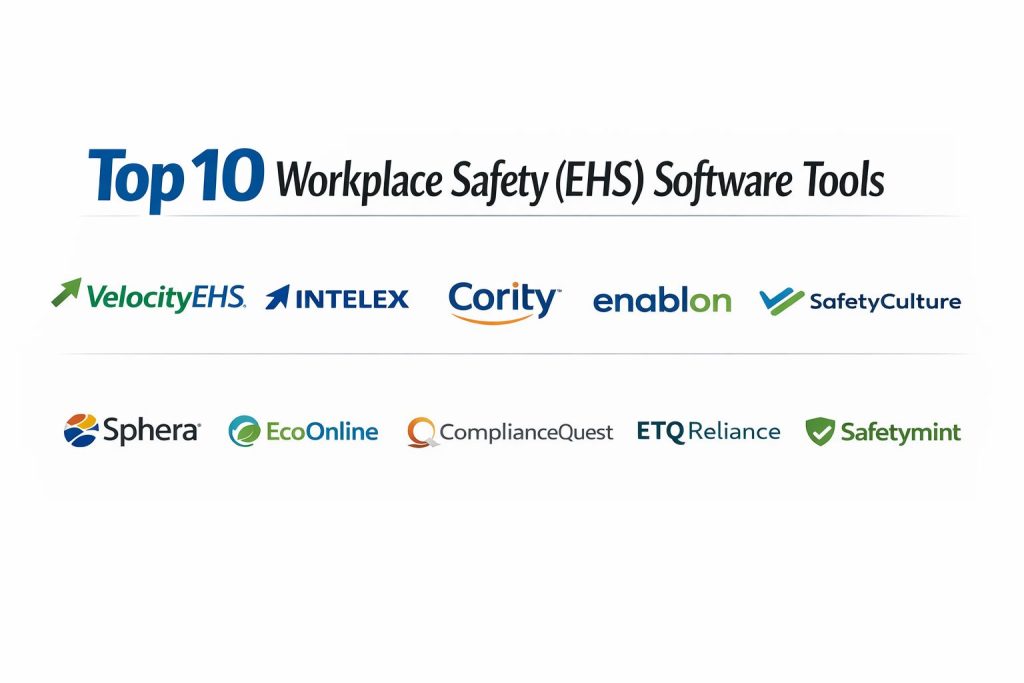
Top 10 Workplace Safety (EHS) Software Tools
1 VelocityEHS
VelocityEHS is a market leader known for its intuitive “Accelerate” platform, which simplifies complex safety tasks like chemical management and ergonomics. It is designed to be accessible for safety professionals who need expert-level tools without the typical enterprise complexity.
Key Features
- Chemical Management: Features an industry-leading SDS (Safety Data Sheet) library with automated indexing and cross-referencing.
- VelocityAI: A proprietary engine that analyzes hazard descriptions to suggest root causes and corrective actions automatically.
- ActiveEHS Ergonomics: Uses sensor-less motion capture technology to assess musculoskeletal risks via a smartphone camera.
- Environmental Compliance: Integrated modules for air emissions, water quality, and hazardous waste tracking.
- Risk Management: Tools for Bowtie Analysis and Job Hazard Analysis (JHA) that link directly to worker training records.
- Operational Risk: Connects frontline safety observations with high-level corporate risk registers in real-time.
Pros
- Exceptionally user-friendly interface that drives high adoption rates among frontline workers.
- The most comprehensive chemical and SDS management solution currently available on the market.
Cons
- Advanced enterprise-wide customization can sometimes be more limited than “pure-play” EHS platforms.
- High-tier AI features often require significant data volume to provide accurate predictive insights.
Platforms / Deployment
- Windows / macOS / Web
- Mobile (iOS & Android) / Cloud (SaaS)
Security & Compliance
- Features: SOC 2 Type II, ISO 27001, end-to-end data encryption.
- Compliance: OSHA, EPA, REACH, GHS, ISO 45001.
2 Intelex
Intelex is an enterprise-grade platform that offers one of the most extensive “app” ecosystems in the EHS space. It allows large organizations to build a highly customized safety management system by selecting specific modules tailored to their industry.
Key Features
- App Builder: A no-code environment that allows administrators to create custom safety modules and workflows from scratch.
- Business Intelligence (BI): Advanced data visualization tools that allow for deep-dive analysis of safety performance trends.
- Supplier Management: Comprehensive tools for pre-qualifying contractors and tracking their safety performance on-site.
- Audit & Inspection: Offline-capable mobile inspections with automated task generation for found non-conformances.
- Learning Management (LMS): Integrated training portal that automatically assigns courses based on worker roles or incident history.
- Sustainability Performance: Tracks energy, waste, and carbon footprint data for integrated ESG reporting.
Pros
- Highly scalable and flexible, making it ideal for large, multinational corporations with diverse needs.
- Powerful reporting capabilities that can handle massive datasets across thousands of global sites.
Cons
- The vast array of options can lead to a longer and more complex implementation period.
- The mobile experience, while robust, can feel “heavier” than native-first mobile safety apps.
Platforms / Deployment
- Windows / macOS / Web
- Mobile (iOS & Android) / Cloud (SaaS)
Security & Compliance
- Features: Multi-factor authentication, RBAC, encrypted backups.
- Compliance: ISO 14001, ISO 45001, ASSE, VPP.
3 Cority
Cority is widely recognized for its “CorityOne” platform, which uniquely integrates Occupational Health and Industrial Hygiene into the core EHS workflow. It is the preferred choice for organizations where worker health and medical surveillance are as critical as incident reporting.
Key Features
- Occupational Health: Manages medical records, surveillance programs, and clinical visits within a HIPAA-compliant environment.
- Industrial Hygiene: Advanced tools for tracking exposure data, noise levels, and respiratory fit testing.
- Cortex AI: Uses machine learning to detect patterns in medical and safety data to predict potential health outbreaks or injury clusters.
- Environmental Management: Comprehensive EMIS (Environmental Management Information System) for complex regulatory reporting.
- Quality Management: Links safety incidents with quality non-conformances for a holistic view of operational risk.
- Enterprise Dashboards: Role-based views that provide executives with real-time safety KPIs across the whole organization.
Pros
- Unmatched depth in health and hygiene modules, providing a truly holistic view of employee well-being.
- Strong “Quality” integration makes it a favorite for manufacturing and pharmaceutical sectors.
Cons
- Can be significantly more expensive than competitors due to the depth of its medical and hygiene modules.
- Often requires a more technical internal team to manage and configure the complex health workflows.
Platforms / Deployment
- Web / Windows
- Mobile (iOS & Android) / Cloud (SaaS) / Private Cloud
Security & Compliance
- Features: HIPAA/HITECH compliant, SOC 2, FedRAMP (for government).
- Compliance: OSHA, ISO 45001, GDPR.
4 Enablon
Enablon (a Wolters Kluwer company) is a powerhouse in the EHS and ESG space, focusing on large-scale enterprise risk and operational resilience. It is built for the “Fortune 500” and provides heavy-duty tools for global compliance.
Key Features
- Operational Risk Management (ORM): Connects safety data with maintenance and production schedules to prevent process-related disasters.
- Enablon Insights: An advanced analytics engine that benchmarks your safety performance against global industry standards.
- Unified ESG Reporting: One of the most robust tools for gathering and auditing environmental and social data for investors.
- Barrier Management: Visualizes safety barriers and their current health to prevent catastrophic events in high-hazard industries.
- Mobile Field App: Native mobile functionality for work permits, audits, and real-time hazard notifications.
- Management of Change (MOC): Sophisticated workflows to ensure safety is maintained during organizational or technical changes.
Pros
- The “gold standard” for global enterprises requiring extreme scalability and complex risk modeling.
- Exceptional integration with broader GRC (Governance, Risk, and Compliance) systems.
Cons
- High cost of ownership and steep learning curve for administrators.
- Implementation often requires specialized third-party consultants.
Platforms / Deployment
- Web / Windows
- Mobile / Cloud (SaaS) / On-Premise
Security & Compliance
- Features: Enterprise-grade security with advanced identity management.
- Compliance: ISO 45001, CSRD (EU), SEC Climate Disclosures.
5 SafetyCulture (formerly iAuditor)
SafetyCulture is the definitive “frontline-first” safety tool. It started as a simple checklist app and has evolved into a comprehensive platform that empowers every worker to be a safety inspector.
Key Features
- Smart Checklists: Drag-and-drop template builder for creating digital inspections in minutes.
- Heads Up: A communication tool for broadcasting safety alerts and videos to the entire workforce instantly.
- Sensors & Telematics: Integrates with hardware to monitor temperature, humidity, and equipment health in real-time.
- Issues & Actions: Allows workers to snap a photo of a hazard and assign it to a manager for resolution on the spot.
- Asset Management: Tracks the safety and maintenance history of vehicles, machinery, and tools.
- Training (EdApp Integration): Delivers micro-learning safety training directly to workers’ mobile devices.
Pros
- Fastest implementation in the industry; teams can be up and running in a single day.
- Extremely high user engagement due to its modern, “social-media-like” interface.
Cons
- Lacks the deep environmental and industrial hygiene modules found in Cority or Enablon.
- Not designed for complex chemical management or advanced occupational health tracking.
Platforms / Deployment
- Web
- Mobile (Native iOS & Android) / Cloud (SaaS)
Security & Compliance
- Features: SOC 2, SSO, advanced data encryption.
- Compliance: OSHA, ISO 9001/45001/14001 templates.
6 Sphera
Sphera specializes in “Integrated Risk Management” with a heavy focus on high-hazard industries like chemicals and mining. It is particularly strong in product stewardship and environmental performance.
Key Features
- Product Stewardship: Manages the safety and compliance of chemical products throughout their entire lifecycle.
- Advanced Risk Modeling: Uses “Bowtie” and “LOPA” (Layer of Protection Analysis) to visualize and mitigate major risks.
- Emissions Management: Sophisticated carbon accounting tools that track Scope 1, 2, and 3 emissions for global reporting.
- Maintenance Safety: Integrates with ERP systems like SAP to manage “Permit to Work” and LOTO (Lockout Tagout) processes.
- SpheraCloud Platform: A unified cloud environment that breaks down silos between safety, risk, and sustainability data.
- Regulatory Content: Built-in access to global regulatory databases to ensure products are compliant in every market.
Pros
- Best-in-class for chemical manufacturing and high-hazard industrial risk management.
- Deeply integrated regulatory intelligence that updates automatically as laws change.
Cons
- Interface can feel technical and “industrial,” which may be intimidating for less technical users.
- High license costs reflecting its specialized, high-value industrial focus.
Platforms / Deployment
- Web / Windows
- Cloud (SaaS) / Hybrid
Security & Compliance
- Features: ISO 27001, SOC 2, advanced RBAC.
- Compliance: REACH, TSCA, GHS, OSHA.
7 EcoOnline
EcoOnline has grown rapidly through acquisitions to become a top European and global contender. It is highly valued for its ability to combine EHS with specialized “Crisis Management” and “Contractor Safety” modules.
Key Features
- Chemical Safety: A powerful tool for creating and managing chemical inventories and exposure assessments.
- Crisis Management: Dedicated tools for managing emergency response teams and communication during major incidents.
- Contractor Portal: Self-service portal for contractors to upload safety documents and complete inductions.
- Business Intelligence: Pre-built dashboards that track safety maturity and cultural indicators over time.
- Mobile App: Centralized access for reporting incidents, conducting audits, and viewing safety procedures.
- Training Management: Tracks employee certifications and sends automated alerts before they expire.
Pros
- Excellent balance between deep technical functionality and ease of use.
- Strong focus on “Safety Culture” with tools designed to engage employees at all levels.
Cons
- The platform can feel slightly fragmented due to being built from multiple acquired products.
- Some modules may have inconsistent user interfaces as they are integrated into the core platform.
Platforms / Deployment
- Web
- Mobile (iOS & Android) / Cloud (SaaS)
Security & Compliance
- Features: GDPR compliant, SOC 2, standard data encryption.
- Compliance: ISO 45001, ISO 14001, COSHH.
8 ComplianceQuest
ComplianceQuest is a cloud-native platform built on the Salesforce ecosystem. It is the go-to choice for companies that want to unify Quality (QMS) and Safety (EHS) on a single, highly secure, and familiar platform.
Key Features
- Salesforce Integration: Leverages the world’s leading CRM platform for unmatched security, uptime, and reporting.
- AI-Powered CAPA: Uses AI to identify common threads between quality defects and safety incidents for unified root cause analysis.
- Change Management: Robust workflows to assess the safety impact of any process or equipment changes.
- Incident Management: Streamlined reporting for injuries, near-misses, and environmental spills with automated workflows.
- Audit & Inspection: Highly configurable mobile checklists with “Chatter” integration for real-time collaboration.
- Worker Training: Assigns and tracks safety training within the same system used for quality and HR records.
Pros
- Benefit from Salesforce’s multi-billion dollar R&D in security, mobile, and AI.
- Ideal for organizations that are already using Salesforce and want a seamless user experience.
Cons
- Requires a Salesforce license/ecosystem, which may not be suitable for companies using other CRM/ERP systems.
- Customization often requires Salesforce admin knowledge.
Platforms / Deployment
- Web / Windows / macOS
- Mobile / Cloud (Salesforce AppExchange)
Security & Compliance
- Features: Salesforce Shield (encryption, event monitoring, audit trail).
- Compliance: FDA (GxP), ISO 45001, OSHA.
9 ETQ Reliance
ETQ Reliance (part of Hexagon) is a premium EHS and Quality platform that prioritizes “Workflow Automation.” It is designed for manufacturers who need to manage extremely complex processes across global locations.
Key Features
- Modular Architecture: Over 40 pre-configured applications that can be “snapped” together to build a custom system.
- Dynamic Workflows: Drag-and-drop workflow designer to automate any safety approval or escalation process.
- Centralized Action Tracking: A single dashboard to monitor all corrective actions from every safety and quality audit.
- Risk Register: A sophisticated tool for identifying and prioritizing operational risks across the enterprise.
- Document Control: Enterprise-grade management for safety policies, SOPs, and regulatory filings.
- Etq Anywhere: A high-performance mobile app designed for field-level data entry and disconnected use.
Pros
- Exceptional at handling complex, multi-stage workflows that require many levels of approval.
- Strong integration with Hexagon’s industrial sensor and measurement hardware.
Cons
- Can be overly complex for organizations with simple safety needs.
- Implementation typically takes longer than more specialized, “out-of-the-box” EHS tools.
Platforms / Deployment
- Web / Windows
- Cloud (SaaS) / Private Cloud
Security & Compliance
- Features: SOC 2 Type II, advanced encryption, enterprise-level SSO.
- Compliance: ISO 45001, ISO 9001, OSHA.
10 Safetymint
Safetymint is a rapidly growing EHS platform that focuses on “Speed to Value” and radical simplicity. It is an excellent choice for mid-market companies that need professional safety tools without the “enterprise bloat.”
Key Features
- Permit to Work: A digital system for managing high-risk work permits (Hot Work, Confined Space) with real-time status.
- Incident Reporting: A simplified, 3-step reporting process designed to encourage maximum participation from the field.
- Risk Assessment: Integrated HIRA (Hazard Identification and Risk Assessment) tools that are easy to use.
- Audit Management: Pre-built audit templates for various industries that can be deployed instantly.
- Corrective Actions (CAPA): Simple tracking system to ensure that every safety gap found is closed and verified.
- Real-time Analytics: Visual heatmaps and trend charts that provide an instant view of “hotspots” in the organization.
Pros
- One of the most affordable professional-grade EHS tools on the market.
- Extremely clean and modern user interface that requires zero training for end-users.
Cons
- Lacks the deep sustainability (ESG) and industrial hygiene modules of the larger enterprise suites.
- Not as many built-in integrations with legacy ERP systems like SAP or Oracle.
Platforms / Deployment
- Web
- Mobile (iOS & Android) / Cloud (SaaS)
Security & Compliance
- Features: Standard cloud security, data encryption, RBAC.
- Compliance: OSHA, ISO 45001 templates.
Comparison Table (Top 10)
| Tool Name | Best For | Platform(s) Supported | Deployment | Standout Feature | Public Rating |
| VelocityEHS | Chemical/Ergonomics | Web, Mobile | Cloud (SaaS) | Machine Learning MSD | 4.7/5 |
| Intelex | Enterprise Scaling | Web, Mobile | Cloud (SaaS) | No-Code App Builder | 4.6/5 |
| Cority | Occupational Health | Web, Mobile | Cloud / Private | Medical Surveillance | 4.6/5 |
| Enablon | Global Fortune 500 | Web, Mobile | Cloud / On-Prem | Barrier Management | 4.5/5 |
| SafetyCulture | Frontline Teams | Web, Mobile | Cloud (SaaS) | Smart Checklists | 4.8/5 |
| Sphera | High-Hazard Risk | Web, Mobile | Cloud (SaaS) | Product Stewardship | 4.4/5 |
| EcoOnline | Safety Culture | Web, Mobile | Cloud (SaaS) | Crisis Management | 4.5/5 |
| ComplianceQuest | Salesforce Users | Web, Mobile | Salesforce Cloud | Unified QMS + EHS | 4.7/5 |
| ETQ Reliance | Complex Workflows | Web, Mobile | Cloud / Private | Dynamic Workflow Eng | 4.6/5 |
| Safetymint | Mid-Market Simplicity | Web, Mobile | Cloud (SaaS) | Permit to Work | 4.8/5 |
Evaluation & Scoring of Workplace Safety (EHS) Software
Weights
Core features 25 percent
Ease of use 15 percent
Integrations and ecosystem 15 percent
Security and compliance 10 percent
Performance and reliability 10 percent
Support and community 10 percent
Price and value 15 percent
| Tool Name | Core (25%) | Ease (15%) | Integrations (15%) | Security (10%) | Performance (10%) | Support (10%) | Value (15%) | Weighted Total |
| VelocityEHS | 9 | 10 | 8 | 9 | 9 | 9 | 8 | 8.85 |
| Intelex | 10 | 6 | 9 | 9 | 8 | 8 | 7 | 8.20 |
| Cority | 10 | 6 | 9 | 10 | 9 | 9 | 6 | 8.30 |
| Enablon | 10 | 4 | 10 | 10 | 9 | 8 | 5 | 7.85 |
| SafetyCulture | 7 | 10 | 8 | 8 | 10 | 9 | 9 | 8.35 |
| Sphera | 9 | 5 | 9 | 9 | 8 | 7 | 6 | 7.45 |
| EcoOnline | 8 | 8 | 8 | 8 | 8 | 8 | 8 | 8.00 |
| ComplianceQuest | 9 | 7 | 10 | 10 | 9 | 8 | 7 | 8.40 |
| ETQ Reliance | 9 | 5 | 9 | 9 | 8 | 8 | 6 | 7.60 |
| Safetymint | 7 | 10 | 7 | 8 | 9 | 9 | 10 | 8.25 |
Which Workplace Safety (EHS) Software Tool Is Right for You?
Small to Mid-Sized Business (SMB)
For companies looking for rapid deployment and ease of use, SafetyCulture or Safetymint are the best options. They offer lower entry costs and a focus on daily tasks that drive immediate safety improvements without overwhelming a small team with “enterprise” features.
Large Global Enterprise
Large organizations with thousands of employees and complex international regulations should look at Enablon or Intelex. These tools are built to scale and can be configured to manage everything from a localized permit to a global ESG report in one system.
Health-Focused Organizations
If your primary concern is employee health, medical surveillance, and exposure monitoring, Cority is the clear choice. Its medical and hygiene modules are significantly deeper than the safety-only competitors.
High-Hazard Manufacturing
For industries like chemical production or energy, Sphera and VelocityEHS (especially for chemical management) provide the specialized risk modeling and product stewardship needed to manage life-critical hazards.
IT Ecosystem Alignment
If your company is already invested in Salesforce, ComplianceQuest is the logical choice to keep your data in one cloud. Similarly, if your organization relies on Hexagon hardware or deep Quality (QMS) workflows, ETQ Reliance offers the best synergy.
Frequently Asked Questions (FAQs)
Is EHS software required by law?
While the software itself is not usually a legal requirement, the reporting it facilitates (like OSHA 300 logs) is mandatory. Using software ensures you don’t miss deadlines or report inaccurate data, which can lead to significant fines.
Can EHS software work offline?
Yes, most top-tier tools like SafetyCulture and Intelex allow workers to complete inspections and report incidents while offline. The data is stored on the device and automatically syncs once an internet connection is restored.
How long does it take to implement EHS software?
Implementation varies by complexity. A simple tool like Safetymint can be active in a few weeks, while an enterprise platform like Enablon can take 6–12 months due to data migration and custom configuration.
Does EHS software replace the safety manager?
No, it is a “force multiplier” for the safety manager. It handles the manual data entry, reminders, and report generation, allowing the safety professional to focus on high-value tasks like behavioral coaching and site visits.
Can EHS software integrate with my HR system?
Yes, leading platforms integrate with HRIS (like Workday or SAP SuccessFactors) to automatically pull worker names, roles, and location data, ensuring that safety records always match the current workforce.
Is mobile access really that important?
Mobile access is critical because 90% of safety data occurs on the shop floor or in the field. If a worker has to walk back to an office to report a hazard, they are 50% less likely to do it compared to a mobile app.
How does AI improve workplace safety?
AI can read through thousands of “near-miss” reports to find hidden patterns that a human might miss. It can also analyze photos to detect if a worker is wearing their safety gear correctly.
What is the cost of EHS software?
Pricing is typically subscription-based (SaaS). It can range from $25 per user/month for basic tools to several hundred thousand dollars per year for enterprise-wide deployments with specialized modules.
How secure is safety data in the cloud?
Modern EHS software uses enterprise-grade security, including end-to-end encryption and SOC 2 compliance. For high-security needs, vendors like Cority and Enablon offer private cloud or on-premise options.
Can EHS software help with ESG reporting?
Yes, most modern platforms now include “Environmental” modules that track carbon, water, and waste. This data can be automatically exported into formats required for ESG disclosures and investor reports.
Conclusion
The EHS software market has evolved to meet the demands of a high-tech, socially conscious world. Selecting the right tool is no longer just about checking a “compliance” box; it is about choosing a partner that can turn your safety data into a strategic advantage. Whether you choose the rapid engagement of SafetyCulture, the medical depth of Cority, or the enterprise power of Enablon, the goal remains the same: ensuring that every worker returns home safely every day.
By centralizing your safety processes, you not only protect your workforce but also build a more resilient and transparent organization. Start by identifying your highest-risk areas—whether it’s chemical exposure, falls from height, or regulatory audits—and select the tool that demonstrates the most strength in those specific domains.
I love how this breakdown simplifies everything, making it way easier to choose an EHS platform.