Introduction
Requirements management tools help teams capture, refine, approve, trace, and change requirements across the full product or project lifecycle. They reduce confusion by turning scattered notes, emails, and spreadsheets into structured requirements that can be reviewed, linked to tests, and tracked through delivery. These tools matter because teams now build complex systems with faster release cycles, more stakeholders, and tighter governance expectations. Common use cases include regulated product development, large enterprise software programs, hardware and embedded projects, safety-critical systems, and multi-team platform initiatives. When evaluating a tool, focus on requirement versioning, change control, traceability to tests and risks, review and approval workflows, collaboration, reporting, integrations with engineering tools, scalability, role-based access, audit readiness, and ease of adoption for non-technical stakeholders.
Best for: product managers, business analysts, system engineers, QA leads, compliance teams, and enterprise delivery leaders who need clear requirement ownership, traceability, and change control.
Not ideal for: very small teams with lightweight scope and minimal governance needs where a simple backlog tool and a shared document workflow are enough.
Key Trends in Requirements Management Tools
- Stronger end-to-end traceability across requirements, tests, risks, and releases
- More configurable approval workflows to support audit-ready governance
- Better collaboration features for distributed teams and external stakeholders
- Increased alignment between agile backlogs and formal requirement baselines
- More structured requirement quality checks to reduce ambiguity and rework
- Wider integration with test management, defect tracking, and DevOps toolchains
- Growing demand for impact analysis when requirements change mid-delivery
- Greater emphasis on role-based access and permissions for large programs
- Improved reporting for compliance audits and executive visibility
- Increasing support for model-based and systems engineering style workflows
How We Selected These Tools (Methodology)
- Selected tools with strong adoption across enterprise delivery and regulated environments
- Prioritized capabilities for traceability, baselining, and change control
- Considered how well tools support collaboration and structured reviews
- Evaluated integration breadth with common engineering and QA ecosystems
- Included options that fit both agile and plan-driven delivery styles
- Looked at how tools scale across large programs with many stakeholders
- Considered reporting strength for audits, governance, and portfolio visibility
- Included a mix of enterprise-grade suites and modern, flexible platforms
- Ranked tools comparatively based on real-world requirement lifecycle needs
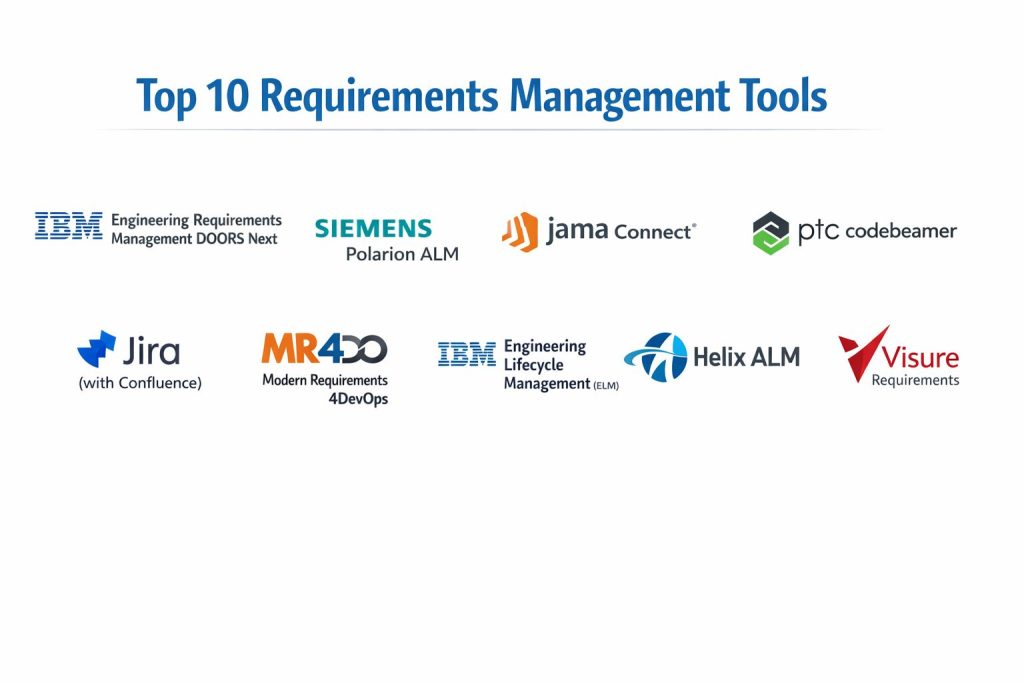
Top 10 Requirements Management Tools
1) IBM Engineering Requirements Management DOORS Next
A requirements tool built for complex engineering programs that need deep traceability, baselines, and audit-ready governance. Often chosen for large enterprises and regulated, safety-critical environments.
Key Features
- Strong requirement baselining and controlled change management
- End-to-end traceability across requirements and related lifecycle artifacts
- Review and approval workflows for multi-stakeholder governance
- Impact analysis to understand downstream effects of changes
- Structured requirement organization for large-scale programs
- Reporting designed for compliance and executive oversight
- Works well in formal systems engineering style environments
Pros
- Excellent for deep traceability and governance-heavy programs
- Scales well for large teams with strict process needs
Cons
- Setup and administration can be complex for smaller teams
- Adoption can feel heavy if the project is lightweight or fast-moving
Platforms / Deployment
- Web
- Cloud / Self-hosted (Varies / N/A)
Security & Compliance
- SSO/SAML, MFA, encryption, audit logs, RBAC: Not publicly stated
- SOC 2, ISO 27001, GDPR, HIPAA: Not publicly stated
Integrations & Ecosystem
This tool commonly sits inside enterprise engineering lifecycle ecosystems and supports traceability across related work items and tests.
- Integrations with engineering lifecycle suites: Varies / N/A
- Connections to test and defect workflows: Varies / N/A
- Reporting and export for audits: Varies / N/A
- APIs and automation hooks: Varies / Not publicly stated
Support & Community
Enterprise-grade support options are commonly available through contracts, with documentation suited to large programs. Community guidance varies by industry.
2) Siemens Polarion ALM
A unified lifecycle platform that supports requirements, quality, and traceability in one system. Strong for organizations that want connected requirements-to-test coverage and consistent governance.
Key Features
- Centralized requirements with approvals, discussions, and history tracking
- Traceability across requirements, tests, and changes for audit readiness
- Configurable workflows and roles for governance at scale
- Reporting dashboards for compliance and program status
- Supports both agile planning and formal baseline approaches
- Collaboration for internal and external stakeholders
- Scales well for multi-team and multi-product programs
Pros
- Strong end-to-end traceability and lifecycle linkage
- Flexible workflows for regulated and enterprise environments
Cons
- Implementation can require planning and administration effort
- Can be more than needed for small teams with simple requirements
Platforms / Deployment
- Web
- Cloud / Self-hosted (Varies / N/A)
Security & Compliance
- SSO/SAML, MFA, encryption, audit logs, RBAC: Not publicly stated
- SOC 2, ISO 27001, GDPR, HIPAA: Not publicly stated
Integrations & Ecosystem
Polarion is typically used as a connected ALM hub linking requirements, tests, and releases.
- Integration with engineering and QA ecosystems: Varies / N/A
- Export and reporting for audits: Varies / N/A
- APIs and automation: Varies / Not publicly stated
- Connectors to DevOps toolchains: Varies / N/A
Support & Community
Enterprise support is common, and documentation is structured for program teams. Community strength varies by industry and region.
3) Jama Connect
A requirements and traceability platform often used in regulated industries where collaboration, review workflows, and audit trails are critical. Strong fit for teams that need structured approval and traceability.
Key Features
- Structured requirements with versioning, reviews, and approvals
- Traceability linking requirements to tests, risks, and changes
- Impact analysis to assess downstream effects before approving changes
- Collaborative review cycles for cross-functional stakeholders
- Reporting for compliance audits and delivery visibility
- Flexible templates for different product and regulatory contexts
- Helps reduce ambiguity through consistent requirement formatting
Pros
- Strong collaboration and review workflows for real-world governance
- Traceability and audit trail features align with regulated needs
Cons
- Teams may need process alignment to get full value
- Scaling and customization can require skilled administration
Platforms / Deployment
- Web
- Cloud / Self-hosted (Varies / N/A)
Security & Compliance
- SSO/SAML, MFA, encryption, audit logs, RBAC: Not publicly stated
- SOC 2, ISO 27001, GDPR, HIPAA: Not publicly stated
Integrations & Ecosystem
Jama Connect commonly integrates with test management, defect tracking, and delivery tooling to maintain traceability.
- Test and QA tooling integrations: Varies / N/A
- Defect and delivery integrations: Varies / N/A
- Import/export for document-heavy workflows: Varies / N/A
- APIs and automation support: Varies / Not publicly stated
Support & Community
Support tiers vary by contract; onboarding is typically guided for enterprise teams. Community knowledge exists but is more professional than hobbyist.
4) PTC Codebeamer
A lifecycle platform designed for complex product development where requirements, quality, and traceability need to stay connected. Common in regulated product engineering and multi-team programs.
Key Features
- Requirements management with baselines and change control
- Traceability across development artifacts and quality processes
- Configurable workflows for approvals and governance
- Supports risk, test linkage, and compliance reporting patterns
- Scales across large product lines and multiple teams
- Customizable templates and item types for different domains
- Strong audit readiness through history and reporting
Pros
- Strong for connected lifecycle governance and compliance workflows
- Flexible configurations to match complex enterprise processes
Cons
- Setup and customization can be time-intensive
- Can feel heavy for lightweight agile-only teams
Platforms / Deployment
- Web
- Cloud / Self-hosted (Varies / N/A)
Security & Compliance
- SSO/SAML, MFA, encryption, audit logs, RBAC: Not publicly stated
- SOC 2, ISO 27001, GDPR, HIPAA: Not publicly stated
Integrations & Ecosystem
Codebeamer often functions as a lifecycle backbone connecting requirements with delivery and quality.
- Integration with DevOps and QA tools: Varies / N/A
- Reporting exports for audits: Varies / N/A
- APIs for automation and integration: Varies / Not publicly stated
- Links to version control and build systems: Varies / N/A
Support & Community
Enterprise support is typical, and documentation is designed for program rollouts. Community is smaller than mainstream backlog tools.
5) Azure DevOps (Boards + Wikis)
A widely used DevOps suite where teams can manage requirements as backlog items, user stories, and epics, supported by documentation workflows. Best for teams that want requirements tightly connected to delivery work.
Key Features
- Requirements captured as epics, features, and user stories with hierarchy
- Strong linkage from requirements to tasks, builds, and releases
- Dashboards and reporting for progress and scope visibility
- Configurable workflows and custom fields for requirement attributes
- Collaboration through discussions, history, and notifications
- Works well for agile delivery and continuous planning
- Permission models for enterprise organizations (setup dependent)
Pros
- Excellent alignment between requirements and delivery execution
- Familiar workflow for engineering teams already using DevOps pipelines
Cons
- Formal baselining and strict compliance workflows may be limited
- Requirements quality depends on team discipline and templates
Platforms / Deployment
- Web
- Cloud / Self-hosted (Varies / N/A)
Security & Compliance
- SSO/SAML, MFA, encryption, audit logs, RBAC: Not publicly stated
- SOC 2, ISO 27001, GDPR, HIPAA: Not publicly stated
Integrations & Ecosystem
Azure DevOps integrates tightly with engineering workflows and can connect to testing and release automation.
- Native links to repos, pipelines, and test workflows: Varies / N/A
- Integrations with third-party tools: Varies / N/A
- APIs for automation and reporting: Varies / N/A
- Extension ecosystem for customization: Varies / N/A
Support & Community
Strong documentation and a large user community. Support depends on the plan and enterprise agreement.
6) Jira (with Confluence)
A common setup where teams manage requirements in Jira issues (epics/stories) and maintain structured documentation and decision logs in Confluence. Works well for agile organizations and cross-functional collaboration.
Key Features
- Requirement capture as epics, stories, and custom issue types
- Workflow customization and approvals (workflow dependent)
- Strong collaboration and cross-team visibility with comments and history
- Documentation and structured specs in Confluence pages
- Linking between requirements, tasks, bugs, and releases
- Dashboards and reporting for stakeholders
- Large ecosystem for extensions and requirement-style templates
Pros
- Very flexible and widely adopted across many teams
- Strong ecosystem and collaboration patterns with documentation support
Cons
- Formal baselining and compliance-grade traceability may need add-ons
- Inconsistent requirement quality if teams do not standardize templates
Platforms / Deployment
- Web
- Cloud / Self-hosted (Varies / N/A)
Security & Compliance
- SSO/SAML, MFA, encryption, audit logs, RBAC: Not publicly stated
- SOC 2, ISO 27001, GDPR, HIPAA: Not publicly stated
Integrations & Ecosystem
Jira and Confluence are known for broad integrations and extensibility across product and engineering ecosystems.
- Integrations with CI/CD, repos, and test tools: Varies / N/A
- Marketplace add-ons for requirement governance and reporting: Varies / N/A
- APIs and automation rules: Varies / N/A
- Cross-tool linking patterns: Varies / N/A
Support & Community
Very large community, strong documentation, and many implementation partners. Support tiers vary by plan.
7) Modern Requirements4DevOps
A requirements management solution that works with Azure DevOps to add stronger requirement documentation, traceability, and review patterns. Useful for organizations standardizing requirement governance inside DevOps work management.
Key Features
- Structured requirement documents connected to DevOps work items
- Traceability views linking requirements to tests and implementation work
- Review and approval workflows aligned with governance needs
- Templates for consistent requirement writing across teams
- Impact analysis style views for changes (workflow dependent)
- Reporting for audit and stakeholder visibility
- Helps bridge formal requirement docs with agile backlogs
Pros
- Good fit for teams standardizing requirements in Azure DevOps
- Improves traceability and governance without replacing DevOps workflows
Cons
- Most valuable when Azure DevOps is already the core system
- Advanced needs may require careful configuration and rollout
Platforms / Deployment
- Web
- Cloud / Self-hosted (Varies / N/A)
Security & Compliance
- SSO/SAML, MFA, encryption, audit logs, RBAC: Not publicly stated
- SOC 2, ISO 27001, GDPR, HIPAA: Not publicly stated
Integrations & Ecosystem
This tool is commonly used as an extension to strengthen requirement governance within DevOps ecosystems.
- Tight linkage with Azure DevOps work items: Varies / N/A
- Reporting and document outputs: Varies / N/A
- Traceability views for QA and delivery: Varies / N/A
- Automation options: Varies / Not publicly stated
Support & Community
Support and onboarding typically focus on enterprise DevOps teams. Community size is smaller than general backlog tools.
8) IBM Engineering Lifecycle Management (ELM)
A broader lifecycle suite that supports connected engineering processes, including requirements and traceability across related disciplines. Best for large engineering organizations with complex governance needs.
Key Features
- Connected lifecycle approach linking requirements to engineering artifacts
- Governance workflows for reviews, approvals, and controlled changes
- Traceability across programs, teams, and product lines
- Reporting for audits and executive oversight
- Works well in systems engineering and regulated environments
- Supports scaling across multi-team portfolios
- Strong emphasis on lifecycle consistency and process control
Pros
- Strong suite approach for end-to-end lifecycle governance
- Suitable for complex organizations needing connected traceability
Cons
- Can be complex to implement across departments
- May be more than needed for smaller teams or single products
Platforms / Deployment
- Web
- Cloud / Self-hosted (Varies / N/A)
Security & Compliance
- SSO/SAML, MFA, encryption, audit logs, RBAC: Not publicly stated
- SOC 2, ISO 27001, GDPR, HIPAA: Not publicly stated
Integrations & Ecosystem
ELM is designed to connect engineering lifecycle tools and maintain traceability across them.
- Lifecycle integrations within suite: Varies / N/A
- Connectors to external tools: Varies / N/A
- APIs and reporting exports: Varies / Not publicly stated
- Integration with quality and delivery processes: Varies / N/A
Support & Community
Enterprise support is typical, with structured documentation for large rollouts. Community content exists but is often enterprise-focused.
9) Helix ALM
A lifecycle platform that supports requirements, test management, and defect tracking in a connected workflow. Useful for teams that want stronger governance and linkage without stitching too many tools together.
Key Features
- Requirements management with version history and approvals
- Linkage between requirements, tests, and defects
- Reporting for coverage, progress, and audit readiness
- Workflow controls that support governance patterns
- Useful for regulated teams needing consistent traceability
- Supports teams that prefer a suite approach for QA alignment
- Helps reduce gaps between requirements and test coverage
Pros
- Strong linkage between requirements and QA workflows
- Practical for teams that want structured governance without extreme complexity
Cons
- Ecosystem may be smaller than mainstream backlog tools
- Customization and scaling require planning and admin effort
Platforms / Deployment
- Web / Windows (Varies / N/A)
- Cloud / Self-hosted (Varies / N/A)
Security & Compliance
- SSO/SAML, MFA, encryption, audit logs, RBAC: Not publicly stated
- SOC 2, ISO 27001, GDPR, HIPAA: Not publicly stated
Integrations & Ecosystem
Helix ALM is commonly adopted where requirement-to-test-to-defect linkage is a priority.
- Integrated suite workflows for QA coverage: Varies / N/A
- Reporting and exports for audits: Varies / N/A
- APIs and connectors: Varies / Not publicly stated
- Integration with delivery tooling: Varies / N/A
Support & Community
Support options are typically contract-based, with documentation focused on ALM workflows. Community size varies by industry.
10) Visure Requirements
A requirements platform focused on traceability, governance, and structured requirement management for regulated and engineering-driven teams. Often used where audits and controlled change are important.
Key Features
- Requirements baselining and controlled change management
- Strong traceability and relationship modeling across artifacts
- Review, approval, and audit trail workflows
- Templates and structured requirement formats to reduce ambiguity
- Impact analysis style reporting for change decisions
- Reporting aimed at compliance and program visibility
- Useful for teams needing strong requirement governance discipline
Pros
- Strong governance and traceability for audit-focused environments
- Structured approach helps improve requirement quality and consistency
Cons
- Adoption may be heavy for lightweight agile-only teams
- Customization and rollout require process alignment
Platforms / Deployment
- Web / Windows (Varies / N/A)
- Cloud / Self-hosted (Varies / N/A)
Security & Compliance
- SSO/SAML, MFA, encryption, audit logs, RBAC: Not publicly stated
- SOC 2, ISO 27001, GDPR, HIPAA: Not publicly stated
Integrations & Ecosystem
Visure often integrates into engineering ecosystems where traceability and exports matter.
- Integrations with test and defect tools: Varies / N/A
- Import/export for document workflows: Varies / N/A
- APIs and automation: Varies / Not publicly stated
- Traceability reporting for audits: Varies / N/A
Support & Community
Support is typically structured for enterprise use, with onboarding guidance. Community visibility is smaller than mainstream agile tools.
Comparison Table (Top 10)
| Tool Name | Best For | Platform(s) Supported | Deployment (Cloud/Self-hosted/Hybrid) | Standout Feature | Public Rating |
|---|---|---|---|---|---|
| IBM Engineering Requirements Management DOORS Next | Large regulated engineering programs | Web | Cloud / Self-hosted (Varies / N/A) | Baselining and deep traceability | N/A |
| Siemens Polarion ALM | Unified requirements-to-test governance | Web | Cloud / Self-hosted (Varies / N/A) | End-to-end traceability hub | N/A |
| Jama Connect | Collaborative reviews and compliance workflows | Web | Cloud / Self-hosted (Varies / N/A) | Review and impact analysis | N/A |
| PTC Codebeamer | Connected lifecycle governance and compliance | Web | Cloud / Self-hosted (Varies / N/A) | Flexible workflow and traceability | N/A |
| Azure DevOps (Boards + Wikis) | Requirements linked to delivery work | Web | Cloud / Self-hosted (Varies / N/A) | Requirements-to-release linkage | N/A |
| Jira (with Confluence) | Agile requirements plus structured documentation | Web | Cloud / Self-hosted (Varies / N/A) | Ecosystem and collaboration | N/A |
| Modern Requirements4DevOps | Formal requirements inside DevOps workflows | Web | Cloud / Self-hosted (Varies / N/A) | Docs and traceability for DevOps | N/A |
| IBM Engineering Lifecycle Management (ELM) | Large-scale connected engineering lifecycle | Web | Cloud / Self-hosted (Varies / N/A) | Suite-level lifecycle linkage | N/A |
| Helix ALM | Requirements linked with tests and defects | Web / Windows (Varies / N/A) | Cloud / Self-hosted (Varies / N/A) | Requirements-to-QA coverage | N/A |
| Visure Requirements | Audit-ready requirement governance | Web / Windows (Varies / N/A) | Cloud / Self-hosted (Varies / N/A) | Traceability and baselines | N/A |
Evaluation & Scoring of Requirements Management Tools
Weights: Core features 25%, Ease 15%, Integrations 15%, Security 10%, Performance 10%, Support 10%, Value 15%.
| Tool Name | Core (25%) | Ease (15%) | Integrations (15%) | Security (10%) | Performance (10%) | Support (10%) | Value (15%) | Weighted Total (0–10) |
|---|---|---|---|---|---|---|---|---|
| IBM Engineering Requirements Management DOORS Next | 9.5 | 6.5 | 8.5 | 6.5 | 8.5 | 8.0 | 6.0 | 7.87 |
| Siemens Polarion ALM | 9.0 | 7.0 | 8.5 | 6.5 | 8.5 | 8.0 | 6.5 | 7.87 |
| Jama Connect | 8.5 | 7.5 | 8.0 | 6.0 | 8.0 | 7.5 | 6.5 | 7.60 |
| PTC Codebeamer | 8.5 | 6.5 | 8.0 | 6.0 | 8.0 | 7.5 | 6.5 | 7.42 |
| Azure DevOps (Boards + Wikis) | 7.5 | 8.0 | 8.0 | 6.0 | 8.5 | 8.0 | 8.0 | 7.85 |
| Jira (with Confluence) | 7.5 | 8.0 | 8.5 | 6.0 | 8.0 | 8.5 | 8.0 | 7.93 |
| Modern Requirements4DevOps | 7.5 | 7.5 | 7.5 | 6.0 | 7.5 | 7.0 | 7.0 | 7.25 |
| IBM Engineering Lifecycle Management (ELM) | 8.5 | 6.5 | 8.0 | 6.5 | 8.0 | 7.5 | 6.0 | 7.35 |
| Helix ALM | 8.0 | 7.0 | 7.5 | 6.0 | 7.5 | 7.5 | 7.0 | 7.33 |
| Visure Requirements | 8.0 | 6.5 | 7.0 | 6.0 | 7.5 | 7.0 | 6.5 | 7.05 |
How to interpret the scores:
- These scores are comparative within this list, not absolute rankings of the entire market.
- A higher total suggests broader strength across more selection criteria, not a universal best choice.
- Ease and value can matter more than depth if adoption speed is the biggest risk.
- Security scoring is limited because public compliance details are often not clearly stated.
- Always validate with a pilot using your real requirement templates, review flow, and reporting needs.
Which Requirements Management Tool Is Right for You?
Solo / Freelancer
If you are a consultant or solo BA working with multiple clients, Jira (with Confluence) can be a practical option because it is familiar to many organizations and supports collaboration and documentation. If you work inside a DevOps-heavy client environment, Azure DevOps (Boards + Wikis) may be easier to align with delivery work and reporting.
SMB
For smaller companies, the biggest risk is adoption friction. Jira (with Confluence) and Azure DevOps (Boards + Wikis) are often easier to roll out quickly. If you have compliance needs but want to stay close to DevOps workflows, Modern Requirements4DevOps can add structure to requirement documentation and traceability.
Mid-Market
Mid-market teams often need stronger governance while keeping agile speed. Jama Connect can be a strong fit when reviews, approvals, and traceability are important. Siemens Polarion ALM and PTC Codebeamer are good choices if you want requirements tightly linked to QA and lifecycle control across multiple teams.
Enterprise
Enterprises typically care most about traceability depth, baselines, and audit readiness. IBM Engineering Requirements Management DOORS Next and Siemens Polarion ALM are strong options for large regulated programs. IBM Engineering Lifecycle Management (ELM) can work well if you want a connected lifecycle suite across teams and disciplines.
Budget vs Premium
Budget-focused teams usually choose Jira (with Confluence) or Azure DevOps (Boards + Wikis) because they fit delivery work management and stakeholder collaboration. Premium solutions like DOORS Next, Polarion ALM, and Codebeamer often justify cost when the price of a requirement mistake is high and governance must be strict.
Feature Depth vs Ease of Use
If you need baseline control, formal change management, and deep traceability, DOORS Next, Polarion ALM, and Codebeamer are typically stronger choices. If you need fast adoption and wide user participation, Jira (with Confluence) and Azure DevOps (Boards + Wikis) are easier for many teams.
Integrations & Scalability
If requirements must connect to tests and defects, Helix ALM and Polarion ALM can help create continuous traceability. If you are already standardized on Azure DevOps, Modern Requirements4DevOps can add structured requirement governance without splitting tools.
Security & Compliance Needs
When compliance requirements are strict, prioritize tools that support controlled change, audit trails, and consistent approval workflows. Where compliance certifications are not publicly stated, treat them as unknown and validate through procurement and internal security review.
Frequently Asked Questions (FAQs)
1. What is the difference between requirement tracking and requirements management?
Tracking focuses on listing and updating items, while management includes baselines, approvals, change control, and traceability to tests and releases. Management becomes critical when scope changes frequently or compliance demands audit trails.
2. Do agile teams really need a requirements management tool?
Many agile teams still need structured requirements when there are many stakeholders, multiple teams, or strict quality expectations. A tool can keep stories, acceptance criteria, and decisions consistent and reviewable.
3. How do I know if I need baselining?
If you must “freeze” a set of requirements for a release, contract, or regulatory checkpoint, baselining is important. It protects you from uncontrolled change and supports repeatable audits.
4. What is traceability and why does it matter?
Traceability links requirements to design, implementation, tests, and defects so you can prove coverage. It reduces missed testing, improves impact analysis, and supports compliance reporting.
5. What are common mistakes teams make with requirements tools?
They skip templates, allow inconsistent writing, ignore review workflows, and do not link requirements to tests. Teams also fail to define ownership, making the tool a storage place instead of a control system.
6. How difficult is onboarding for stakeholders who are not technical?
It depends on the UI and how well you design workflows. Tools with clear review cycles and simple commenting often succeed, while overly complex schemas can reduce participation.
7. Can Jira and Azure DevOps replace enterprise requirements suites?
For many teams, yes, especially when requirements are handled as stories and epics with strong templates. However, very regulated programs may need deeper baselines, traceability, and audit patterns.
8. How do requirements tools connect to testing?
Some suites link requirements directly to test cases and results to prove coverage. In lighter setups, teams link requirements items to test work items or use a test management system and maintain traceability through relationships.
9. What should I validate in a pilot before buying?
Test requirement templates, review and approval flow, traceability to tests, reporting outputs, and change impact analysis. Also test how easy it is to onboard business stakeholders and maintain discipline over time.
10. How should I measure success after implementation?
Track reduction in requirement-related rework, improved test coverage visibility, fewer late changes without impact analysis, and faster stakeholder approvals. Also measure adoption rates and consistency of requirement quality.
Conclusion
Requirements management tools are most valuable when your team needs clarity, accountability, and traceability from idea to delivery. If the cost of misunderstanding is high, tools that support baselines, approvals, and deep traceability can prevent expensive rework and audit pain. Enterprise platforms like IBM Engineering Requirements Management DOORS Next, Siemens Polarion ALM, Jama Connect, and PTC Codebeamer can provide strong governance, especially for regulated programs. If your priority is fast adoption and tight alignment with delivery work, Jira (with Confluence) and Azure DevOps (Boards + Wikis) are often practical choices. A smart next step is to shortlist two or three tools, run a pilot using real templates and review workflows, validate traceability and reporting, and then standardize your requirement writing rules across teams.
Finding the right requirements tool is tough, but this list makes the choice much clearer.
This list is so helpful for figuring out which management tool actually fits our team.
This guide makes comparing requirements management tools so simple, and I truly appreciate the clear pros and cons.