Introduction
Investor Relations Platforms help public companies and fast-growing private firms manage investor communications, reporting, events, compliance workflows, and market intelligence in one structured system. In simple terms, they reduce the chaos of spreadsheets, email threads, scattered press releases, and disconnected stakeholder lists by giving IR teams a single place to plan, publish, track, and improve investor-facing work. These platforms matter because stakeholders expect faster, clearer, and more consistent updates, while internal teams need stronger governance and repeatable processes.
Common use cases include preparing earnings communication packs, managing investor contacts and targeting lists, running webcasts and events, publishing filings and press releases, monitoring investor sentiment and analyst coverage, and tracking engagement across channels. When choosing a platform, evaluate contact database depth, workflow and approvals, content publishing control, event and webcast support, analytics and reporting, integrations with CRM and finance systems, security controls, scalability for multi-entity teams, support quality, and total cost.
Best for: public company IR teams, finance leaders, communications teams, and high-growth firms building strong investor communication discipline.
Not ideal for: very early-stage startups with a small investor group and low reporting needs, where a lightweight CRM and simple communication process may be enough.
Key Trends in Investor Relations Platforms
- Stronger focus on investor targeting and segmentation using data-driven insights and engagement signals.
- More integrated event workflows combining webcasts, registrations, reminders, and post-event analytics.
- Higher demand for consistent governance: approvals, version control, and audit-friendly publishing processes.
- Deeper analytics expectations, including engagement tracking on IR sites, filings, and communications.
- More collaboration between IR, finance, legal, and comms teams through shared workflow and calendars.
- Increased need for secure access controls as more stakeholders contribute to investor-facing content.
- Growing use of AI-assisted research and summarization for earnings prep and market monitoring.
- More interest in platform consolidation to reduce vendor sprawl across events, websites, and intelligence tools.
How We Selected These Tools (Methodology)
- Selected tools with strong adoption across IR teams and recognized presence in the market.
- Prioritized end-to-end coverage: communications, website, events, targeting, and analytics workflows.
- Considered reliability and operational fit for recurring reporting cycles and time-sensitive publishing.
- Evaluated how well tools support collaboration across IR, finance, legal, and communications.
- Looked for ecosystem strength and the ability to fit into broader company systems and processes.
- Included platforms serving multiple segments, from IR operational platforms to intelligence-focused tools.
- Focused on practical value in real IR work, not just feature lists.
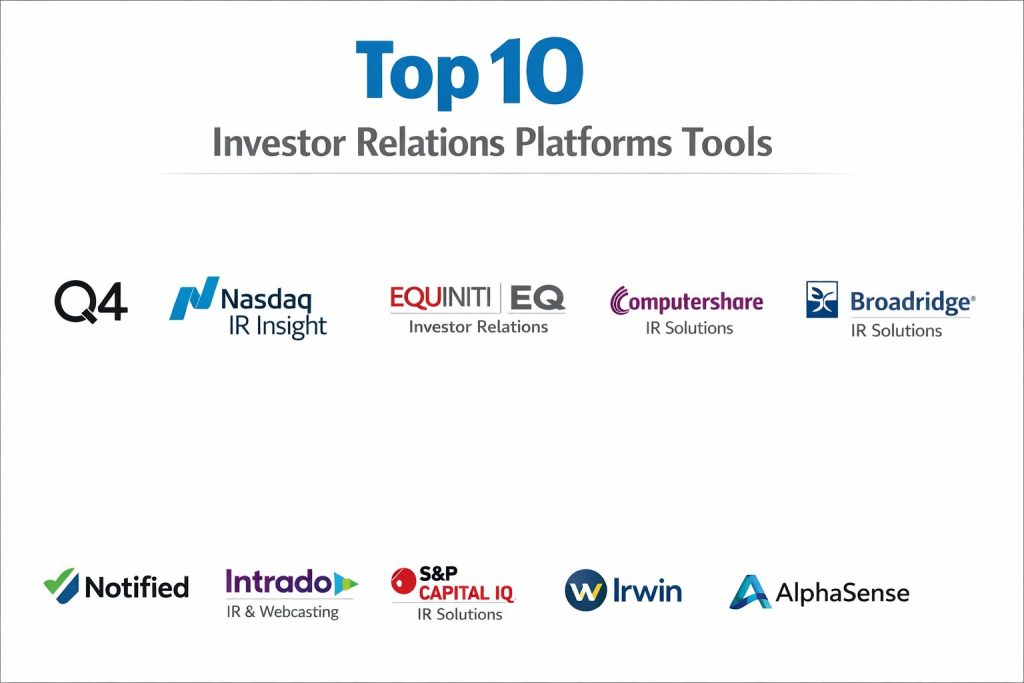
Top 10 Investor Relations Platforms Tools
1 — Q4
An investor relations platform focused on helping IR teams manage communications, events, and analytics with structured workflows and measurable engagement tracking.
Key Features
- Investor engagement analytics and behavior insights
- Workflow support for IR content planning and publishing
- Tools to support investor targeting and outreach
- Event support and communications coordination
- Reporting views for IR activity and outcomes
Pros
- Strong IR-focused workflow orientation
- Useful analytics that support decision-making
Cons
- Fit depends on how mature your IR processes are
- Advanced use may require strong internal discipline
Platforms / Deployment
Web, Cloud
Security and Compliance
Not publicly stated
Integrations and Ecosystem
Designed to fit into common IR operating models, often connecting to internal contact systems and reporting workflows.
- Data export and reporting workflows
- Common integrations vary by organization needs
- Ecosystem typically includes events, content, and analytics practices
Support and Community
Support is typically structured and guided; adoption improves with onboarding involvement.
2 — Nasdaq IR Insight
A platform that supports investor relations teams with targeting, intelligence, and engagement tools designed to improve shareholder communication and outreach planning.
Key Features
- Investor targeting and segmentation capabilities
- Shareholder data views and tracking workflows
- Research and intelligence features for IR planning
- Outreach planning and activity tracking
- Reporting and dashboards for decision support
Pros
- Strong targeting and market intelligence orientation
- Useful for structured IR planning cycles
Cons
- Value depends on data quality and internal usage discipline
- May require process maturity to maximize benefit
Platforms / Deployment
Web, Cloud
Security and Compliance
Not publicly stated
Integrations and Ecosystem
Commonly used alongside other IR tools such as websites and event solutions, with exportable data supporting internal workflows.
- Data exports for planning and reporting
- Workflow alignment with common IR practices
- Integration approach depends on company systems
Support and Community
Typically vendor-supported with onboarding; community is more professional than open.
3 — Equiniti (EQ) Investor Relations
An investor relations and share registry ecosystem option for teams needing structured shareholder services, communications support, and governance-oriented workflows.
Key Features
- Shareholder services alignment and communications support
- Event and communication workflow coordination
- Structured governance and stakeholder handling
- Reporting and operational support for recurring cycles
- Services-oriented support model for IR functions
Pros
- Strong fit for structured IR operations
- Helpful for organizations needing services and support layers
Cons
- Platform depth may vary by package and region
- Some needs may require combining multiple modules
Platforms / Deployment
Web, Cloud
Security and Compliance
Not publicly stated
Integrations and Ecosystem
Often used as part of broader shareholder and communications processes, with workflows shaped by service models.
- Operational alignment with shareholder services
- Common reporting and communications workflows
- Integration depends on chosen modules
Support and Community
Support tends to be services-led; suitable for teams wanting guided delivery.
4 — Computershare IR Solutions
IR solutions often paired with shareholder services, supporting regulated communications and investor-facing workflows for recurring reporting cycles.
Key Features
- Support for investor communications and stakeholder workflows
- Website and content publishing capabilities
- Event coordination support and reporting workflows
- Shareholder-related operational alignment
- Structured process support for compliance-oriented teams
Pros
- Strong for teams needing operational consistency
- Good alignment with shareholder service needs
Cons
- Feature scope may vary across packages
- Some intelligence functions may require additional tools
Platforms / Deployment
Web, Cloud
Security and Compliance
Not publicly stated
Integrations and Ecosystem
Commonly used within broader corporate governance processes, integrating through structured workflows and exports.
- Publishing and content governance workflows
- Stakeholder list management patterns
- Integrations depend on organizational systems
Support and Community
Typically vendor-supported with professional onboarding and service options.
5 — Broadridge IR Solutions
A platform and services ecosystem that supports investor communications, governance workflows, and stakeholder engagement across recurring IR cycles.
Key Features
- Investor communications support and distribution workflows
- Event-related operational support and coordination
- Reporting and analytics depending on package
- Governance-friendly approval and publishing patterns
- Stakeholder engagement support features
Pros
- Strong fit for structured, repeatable IR operations
- Helpful for teams seeking services plus tooling
Cons
- Feature set may vary by plan and configuration
- Some organizations may need additional intelligence tools
Platforms / Deployment
Web, Cloud
Security and Compliance
Not publicly stated
Integrations and Ecosystem
Often sits within a broader governance and communications stack, supporting repeatable reporting cycles.
- Aligns well with internal approvals and publishing governance
- Data sharing via exports and structured reporting
- Integration patterns vary by organization
Support and Community
Professional support model; onboarding and services are commonly included.
6 — Notified
A communications and events-focused platform commonly used for webcasting, press distribution, and investor communication workflows.
Key Features
- Webcasting and virtual event support
- Communication distribution workflows
- Registration, reminders, and audience tracking
- Post-event reporting and engagement analytics
- Operational tools for recurring communication cycles
Pros
- Strong event and webcast execution capability
- Useful for teams that run frequent public communications
Cons
- Intelligence and targeting needs may require other tools
- Best results require consistent content operations
Platforms / Deployment
Web, Cloud
Security and Compliance
Not publicly stated
Integrations and Ecosystem
Notified commonly fits into IR communications operations where events and distribution are central.
- Works with common stakeholder lists and outreach workflows
- Reporting exports for internal analysis
- Integration depends on internal systems used
Support and Community
Support tends to be operational and event-focused; onboarding improves outcomes.
7 — Intrado (IR and Webcasting)
A platform known for webcasting and event services that support investor communications, live events, and structured execution.
Key Features
- Webcasting services and event execution workflows
- Registration, streaming, and attendance tracking
- Tools for live communication operations
- Post-event reporting and engagement data
- Support model aligned to event delivery needs
Pros
- Strong operational reliability for event execution
- Useful for teams that prioritize webcast performance
Cons
- Primarily event-centered for many deployments
- May need other tools for targeting and intelligence depth
Platforms / Deployment
Web, Cloud
Security and Compliance
Not publicly stated
Integrations and Ecosystem
Often used alongside IR websites and targeting tools, supporting event operations and reporting exports.
- Stakeholder list workflows for event invites
- Reporting outputs for internal dashboards
- Integration depends on adjacent systems
Support and Community
Services and delivery support is a key strength; community is mainly professional.
8 — S&P Capital IQ IR Solutions
An intelligence and data-driven solution that supports IR teams with market context, investor analysis, and reporting-oriented workflows.
Key Features
- Market data and investor analysis features
- Tools to support shareholder monitoring and context
- Research support for earnings preparation
- Reporting workflows for IR planning and reviews
- Insights that support targeting decisions
Pros
- Strong for research and market context
- Useful for building data-backed IR narratives
Cons
- Not always a complete communications platform on its own
- Outcomes depend on internal interpretation and usage
Platforms / Deployment
Web, Cloud
Security and Compliance
Not publicly stated
Integrations and Ecosystem
Often used as an intelligence layer alongside IR websites and communications tools.
- Research workflows feeding IR planning
- Data exports into internal reporting
- Works best with a clear IR planning cadence
Support and Community
Vendor-supported; onboarding helps teams use features consistently.
9 — Irwin
An investor relations platform focused on investor targeting, relationship tracking, and IR workflow execution, often used to systematize investor engagement.
Key Features
- Investor targeting and outreach planning tools
- Relationship tracking and engagement history views
- Workflow support for meeting and follow-up discipline
- Analytics for targeting effectiveness
- Reporting for IR performance and activity
Pros
- Strong for building repeatable outreach processes
- Useful for IR teams focused on targeting discipline
Cons
- Requires consistent data hygiene for best results
- Some communications needs may sit outside the platform
Platforms / Deployment
Web, Cloud
Security and Compliance
Not publicly stated
Integrations and Ecosystem
Irwin commonly fits into an IR operations stack where engagement tracking and targeting are core.
- Exports for reporting and planning reviews
- Alignment with investor meeting workflows
- Integration depends on company systems
Support and Community
Professional vendor support; adoption is strongest with clear process ownership.
10 — AlphaSense
A market intelligence platform used by IR and finance teams to research topics, track sentiment, and prepare for investor conversations using structured discovery workflows.
Key Features
- Research discovery and content analysis workflows
- Monitoring of market narratives and company context
- Tools for earnings preparation support
- Search and alerting patterns for fast insight retrieval
- Collaboration workflows for sharing findings internally
Pros
- Strong for research speed and coverage
- Useful for building investor-ready context quickly
Cons
- Not a full IR communications and event platform
- Best used as an intelligence layer, not the only system
Platforms / Deployment
Web, Cloud
Security and Compliance
Not publicly stated
Integrations and Ecosystem
AlphaSense often complements IR platforms by feeding research into planning, messaging, and Q&A preparation workflows.
- Research outputs used in internal planning documents
- Collaboration workflows for sharing summaries
- Integration approach varies by organization
Support and Community
Vendor-supported with onboarding resources; community is professional and use-case driven.
Comparison Table
| Tool Name | Best For | Platform(s) Supported | Deployment | Standout Feature | Public Rating |
|---|---|---|---|---|---|
| Q4 | IR workflows and engagement analytics | Web | Cloud | Investor engagement analytics | N/A |
| Nasdaq IR Insight | Investor targeting and intelligence | Web | Cloud | Targeting and shareholder insights | N/A |
| Equiniti (EQ) Investor Relations | Shareholder services aligned IR operations | Web | Cloud | Services-led IR operations support | N/A |
| Computershare IR Solutions | Governance-oriented IR communications | Web | Cloud | Shareholder services alignment | N/A |
| Broadridge IR Solutions | Structured IR communications and governance | Web | Cloud | Enterprise-grade IR operations | N/A |
| Notified | Webcasting and investor communications | Web | Cloud | Event and webcast execution | N/A |
| Intrado (IR and Webcasting) | Reliable webcast delivery and event ops | Web | Cloud | Webcasting operations focus | N/A |
| S&P Capital IQ IR Solutions | Market intelligence for IR planning | Web | Cloud | Data-driven investor analysis | N/A |
| Irwin | Investor targeting and relationship tracking | Web | Cloud | Engagement workflow discipline | N/A |
| AlphaSense | Research and market narrative monitoring | Web | Cloud | Fast research discovery | N/A |
Evaluation and Scoring of Investor Relations Platforms
Weights
Core features 25 percent
Ease of use 15 percent
Integrations and ecosystem 15 percent
Security and compliance 10 percent
Performance and reliability 10 percent
Support and community 10 percent
Price and value 15 percent
| Tool Name | Core | Ease | Integrations | Security | Performance | Support | Value | Weighted Total |
|---|---|---|---|---|---|---|---|---|
| Q4 | 8.5 | 8.0 | 8.0 | 6.5 | 8.0 | 8.0 | 7.0 | 7.83 |
| Nasdaq IR Insight | 8.0 | 7.5 | 7.5 | 6.5 | 7.5 | 7.5 | 7.0 | 7.45 |
| Equiniti (EQ) Investor Relations | 7.5 | 7.0 | 7.0 | 6.5 | 7.5 | 8.0 | 6.5 | 7.12 |
| Computershare IR Solutions | 7.5 | 7.0 | 7.0 | 6.5 | 7.5 | 8.0 | 6.5 | 7.12 |
| Broadridge IR Solutions | 8.0 | 7.0 | 7.5 | 6.5 | 7.5 | 8.0 | 6.5 | 7.35 |
| Notified | 7.5 | 8.0 | 7.0 | 6.0 | 8.0 | 7.5 | 7.0 | 7.33 |
| Intrado (IR and Webcasting) | 7.0 | 7.5 | 6.5 | 6.0 | 8.0 | 7.5 | 7.0 | 7.10 |
| S&P Capital IQ IR Solutions | 7.5 | 7.0 | 7.5 | 6.5 | 7.5 | 7.5 | 6.5 | 7.23 |
| Irwin | 8.0 | 7.5 | 7.5 | 6.5 | 7.5 | 7.5 | 7.0 | 7.48 |
| AlphaSense | 7.5 | 8.0 | 7.5 | 6.5 | 8.0 | 7.5 | 6.5 | 7.48 |
How to interpret the scores
These scores are comparative and help you shortlist tools based on your priorities. A slightly lower total can still be the best fit if it matches your workflow, team size, and reporting cadence. Core and integrations affect long-term operational fit, while ease affects onboarding speed and adoption. Security is often not publicly detailed, so treat these as baseline assumptions and validate with vendor documentation during evaluation. Use the scoring table to narrow choices, then confirm through a pilot.
Which Investor Relations Platform Tool Is Right for You
Solo or Freelancer
Investor relations work is usually company-driven, but small advisory teams may still need structured research and reporting support. AlphaSense can help with rapid research and monitoring, while a lighter operational setup may be sufficient for limited stakeholder communication.
SMB
Smaller public companies or lean IR teams often need a platform that reduces manual coordination without adding complexity. Q4 and Irwin can help systematize targeting and engagement workflows. If events and webcasts are frequent, Notified can support consistent execution.
Mid-Market
Mid-market teams usually want stronger governance and repeatable reporting workflows. Broadridge IR Solutions, Computershare IR Solutions, and Equiniti (EQ) Investor Relations can fit where consistency and operational discipline are priorities. Combine with intelligence tooling when deeper market context is needed.
Enterprise
Large enterprises often require a mature support model, strong governance workflows, and structured stakeholder engagement at scale. Broadridge IR Solutions and Nasdaq IR Insight can align with enterprise needs, while S&P Capital IQ IR Solutions and AlphaSense can strengthen research and investor narrative preparation.
Budget vs Premium
If budget is tight, prioritize the workflow you must improve first: targeting discipline or event execution or research speed. Premium stacks often combine an IR operations platform with an intelligence tool, because they solve different parts of the IR cycle.
Feature Depth vs Ease of Use
Teams that want a guided system and repeatable processes may prefer platforms designed specifically for IR workflows. Teams that want quick research and fast answers may prioritize an intelligence platform and add operational tooling later.
Integrations and Scalability
If you already use internal finance systems, CRM tools, or structured communication workflows, choose a platform that can align with those processes without forcing a rebuild. Scalability depends on consistent contact hygiene, role-based access control, and repeatable publishing and approvals.
Security and Compliance Needs
When IR communications are sensitive, focus on access controls, role permissions, audit-friendly workflows, and secure handling of drafts and approvals. If public details are unclear, treat them as not publicly stated and validate in your vendor review process.
Frequently Asked Questions
1. What does an Investor Relations Platform actually replace
It typically replaces scattered spreadsheets, manual contact lists, ad-hoc event processes, and inconsistent publishing workflows. The goal is fewer errors, faster reporting cycles, and better engagement tracking.
2. Do I need a platform if my investor base is small
If reporting and communication needs are light, you may not need a full platform. However, if you run regular events, manage many stakeholders, or need consistent governance, a platform can still be valuable.
3. How long does implementation usually take
It depends on contact migration, website and content setup, event workflows, and internal approvals. A phased rollout often works best so teams can adopt without disruption.
4. What is the biggest mistake teams make during selection
Choosing based on brand name without mapping the platform to their real workflow. Another common mistake is ignoring adoption planning, which leads to underuse and poor data hygiene.
5. How important is investor targeting functionality
It is important when you actively plan outreach, meetings, and engagement strategies. Without targeting discipline, teams often rely on intuition and miss measurable improvement opportunities.
6. Can these platforms help with earnings preparation
Yes, many support planning calendars, publishing workflows, and analytics. Intelligence-focused tools also help by improving research speed and narrative preparation.
7. Are security and compliance features clearly published
Often not in a fully detailed way. Treat security and compliance as not publicly stated unless a vendor provides clear documentation and validated details.
8. Should I buy one platform or combine multiple tools
Many teams combine an operational IR platform with a research and intelligence tool. This works well because communication workflows and intelligence workflows are different problems.
9. How do I measure success after adopting a platform
Track fewer publishing errors, faster cycle times, consistent approvals, better event attendance, improved engagement metrics, and stronger internal confidence during reporting cycles.
10. What is the best way to run a pilot
Shortlist two or three tools and test with real tasks: importing contacts, planning an event, publishing content, and producing a reporting dashboard. Evaluate speed, clarity, support response, and workflow fit.
Conclusion
Investor Relations Platforms are most valuable when they reduce manual work, improve governance, and help IR teams communicate with consistency and confidence. The right choice depends on whether your biggest pain is investor targeting, event execution, website and publishing operations, or research and narrative preparation. Tools like Q4 and Irwin can help strengthen engagement discipline, while services-oriented stacks can support structured operational consistency for larger reporting cycles. Event-focused tools help when webcasts are frequent and deadlines are tight, and intelligence platforms help when research and monitoring are constant needs. A simple next step is to shortlist two or three tools, run a small pilot using real IR workflows, validate access controls, and confirm that reporting outputs match your internal expectations.
This guide on investor relations platforms is super helpful and makes finding the right software for us much easier.