Introduction
Contract Lifecycle Management tools help organizations create, negotiate, approve, sign, store, and renew contracts in a controlled, trackable way. Instead of scattered files, email threads, and manual follow-ups, CLM brings structure to every contract step and makes ownership clear. This matters because businesses are under pressure to move faster, reduce legal and financial risk, and maintain stronger audit trails across vendors, customers, and partners. Common use cases include procurement contracts, sales agreements, NDAs, MSAs, employment contracts, and partner deals. When evaluating a CLM tool, focus on authoring and clause libraries, approval workflows, redlining and negotiation support, e-sign support, repository search, obligation tracking, renewals, integrations with CRM and ERP, reporting, access controls, and admin governance.
Best for: legal teams, procurement, sales operations, finance, compliance, and business owners who manage many contracts and need speed, consistency, and lower risk.
Not ideal for: very small teams with a handful of simple agreements and no compliance needs, where a basic template folder and a simple signing tool may be enough.
Key Trends in Contract Lifecycle Management (CLM)
- Stronger intake workflows to reduce contract requests coming through email and chat
- More focus on clause standardization and fallback language to reduce negotiation cycles
- AI-assisted review and risk flagging becoming more common, but requires careful governance
- Better obligation and milestone tracking to reduce missed renewals and missed deliverables
- Increased integration depth with CRM, ERP, procurement suites, and ticketing tools
- More configurable approval workflows for multi-department sign-off and audit readiness
- Faster search and contract analytics for portfolio insight and executive reporting
- Role-based controls and tighter permissioning for sensitive clauses and deal terms
- Improved vendor management alignment by linking contracts to suppliers and spend
- More attention to implementation speed and admin usability, not just feature depth
How We Selected These Tools (Methodology)
- Prioritized tools with strong adoption across legal, procurement, and sales workflows
- Looked for end-to-end coverage: intake, authoring, negotiation, approvals, signing, repository, renewals
- Considered workflow flexibility for different org sizes and contract types
- Evaluated integration patterns with common business systems and document tools
- Included tools that cover enterprise complexity as well as mid-market needs
- Favored products with clear governance controls and reporting capability
- Considered ecosystem maturity such as implementation partners and admin tooling
- Scored comparatively based on practical fit, not marketing claims
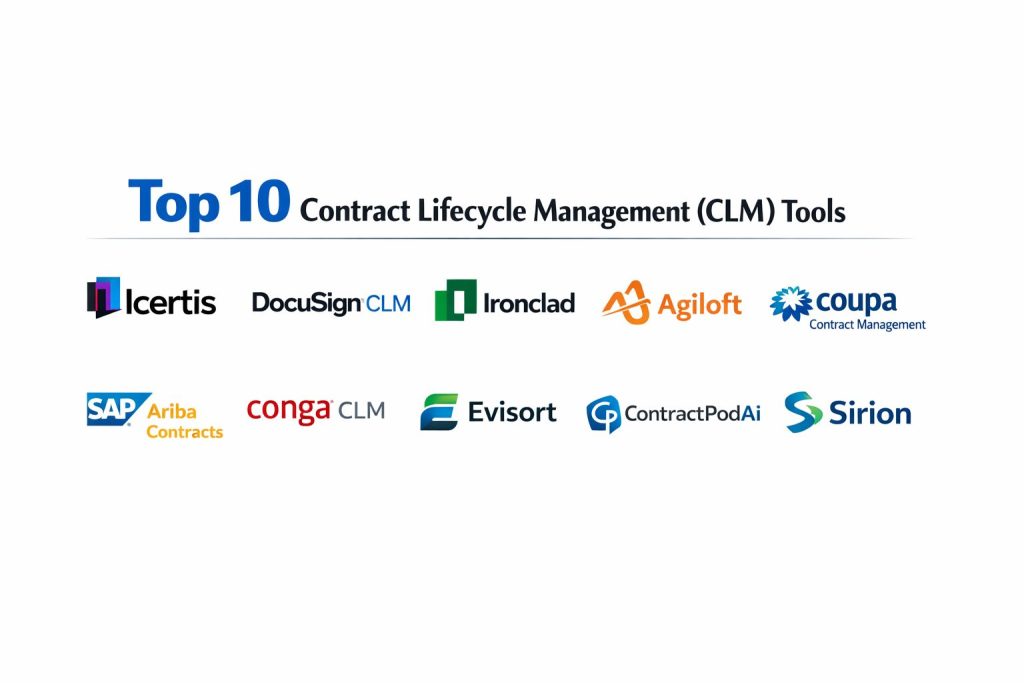
Top 10 Contract Lifecycle Management (CLM) Tools
1) Icertis
Enterprise-grade CLM focused on managing complex contract portfolios with strong governance and reporting. Common in large organizations that need scalable workflows and rigorous controls.
Key Features
- Central repository with structured metadata and advanced search
- Configurable workflows for drafting, review, and approvals
- Obligation tracking and milestone reminders for renewals and deliverables
- Clause and template management to support standardization
- Contract analytics and reporting for portfolio visibility
- Role-based controls for sensitive terms and document access
- Support for complex enterprise contract processes and governance
Pros
- Strong fit for enterprise-scale contract governance and reporting
- Flexible workflows for complex approval paths
Cons
- Implementation can require significant time and process alignment
- May be heavy for small teams with simple contract needs
Platforms / Deployment
- Web
- Cloud
Security & Compliance
- SSO/SAML, MFA, encryption, audit logs, RBAC: Not publicly stated
- SOC 2, ISO 27001, GDPR, HIPAA: Not publicly stated
Integrations & Ecosystem
Often used as a contract backbone connected to sales, procurement, and finance systems.
- CRM integrations: Varies / N/A
- ERP and procurement integrations: Varies / N/A
- Document system integrations: Varies / N/A
- APIs and automation: Varies / Not publicly stated
Support & Community
Enterprise support and onboarding are commonly available, but exact tiers vary by contract.
2) DocuSign CLM
A widely recognized CLM option that pairs well with signing workflows and document routing. Suitable for teams that want structured contract processes with familiar agreement operations.
Key Features
- Contract authoring and template workflows
- Approval routing and audit-friendly tracking
- Repository for executed agreements and drafts
- Negotiation support with tracked edits (workflow dependent)
- Renewal reminders and key date tracking
- Integration patterns with signing workflows
- Reporting to track cycle time and process bottlenecks
Pros
- Strong fit when signing workflows are central to operations
- Familiar user experience for many business teams
Cons
- Complex configurations may require careful admin planning
- Some advanced needs may require add-ons or deeper setup
Platforms / Deployment
- Web
- Cloud
Security & Compliance
- SSO/SAML, MFA, encryption, audit logs, RBAC: Not publicly stated
- SOC 2, ISO 27001, GDPR, HIPAA: Not publicly stated
Integrations & Ecosystem
Commonly connects contract workflows to business systems and signing processes.
- CRM and ERP integrations: Varies / N/A
- Document management integrations: Varies / N/A
- APIs and workflow automation: Varies / Not publicly stated
- Partner ecosystem: Varies / N/A
Support & Community
Documentation is generally strong; support tiers vary by plan and contract size.
3) Ironclad
A modern CLM focused on improving collaboration between legal and business teams with configurable workflows. Often chosen by fast-moving organizations that want speed without losing control.
Key Features
- Intake forms and request routing for contract creation
- Workflow-driven approvals and collaboration
- Template and clause management for standard terms
- Central repository with searchable metadata
- Negotiation support and redline workflows (tool dependent)
- Dashboard reporting on workload and cycle times
- Admin tools for refining processes over time
Pros
- Strong collaboration model for legal and business teams
- Good balance of usability and workflow control
Cons
- Advanced enterprise use can require careful configuration
- Some complex contracting models may need deeper customization
Platforms / Deployment
- Web
- Cloud
Security & Compliance
- SSO/SAML, MFA, encryption, audit logs, RBAC: Not publicly stated
- SOC 2, ISO 27001, GDPR, HIPAA: Not publicly stated
Integrations & Ecosystem
Designed to connect contract intake and approval to business tools.
- CRM integrations: Varies / N/A
- Collaboration tool integrations: Varies / N/A
- APIs and automation: Varies / Not publicly stated
- Document ecosystem: Varies / N/A
Support & Community
Typically offers structured onboarding and support; details vary by agreement.
4) Agiloft
A highly configurable CLM platform often used when teams need custom workflows, fields, and lifecycle rules. Works well for organizations that want to tailor CLM to unique processes.
Key Features
- Highly configurable contract workflows and business rules
- Clause libraries and template standardization
- Repository search with customizable metadata fields
- Approval routing with role-based control
- Alerts for renewals, obligations, and milestones
- Reporting dashboards for contract operations
- Customizable integrations via APIs (setup dependent)
Pros
- Strong flexibility for custom processes and unique contract models
- Good fit for teams that need CLM to match internal policy
Cons
- Configuration power can add admin complexity
- Best results require clear process mapping and governance
Platforms / Deployment
- Web
- Cloud (others: Varies / N/A)
Security & Compliance
- SSO/SAML, MFA, encryption, audit logs, RBAC: Not publicly stated
- SOC 2, ISO 27001, GDPR, HIPAA: Not publicly stated
Integrations & Ecosystem
Often integrates with business systems through configurable connectors and APIs.
- CRM and ERP integrations: Varies / N/A
- Document storage integrations: Varies / N/A
- APIs for workflow automation: Varies / Not publicly stated
Support & Community
Support and onboarding are typically available; exact tiers vary by plan.
5) Coupa Contract Management
A CLM option commonly aligned with procurement and spend management workflows. Best for organizations that want contracts tightly connected to supplier and purchasing operations.
Key Features
- Central contract repository tied to procurement processes
- Standard templates and clause controls for vendor agreements
- Approval workflows for legal and procurement alignment
- Renewal and obligation tracking for supplier contracts
- Reporting for contract coverage and compliance
- Integration alignment with procurement workflows (suite dependent)
- Controls to reduce maverick contracting and inconsistent terms
Pros
- Strong for procurement-led contract operations and vendor governance
- Helps connect contracts to purchasing and compliance processes
Cons
- Best value often depends on broader suite usage
- Less ideal for sales-heavy contracting without procurement focus
Platforms / Deployment
- Web
- Cloud
Security & Compliance
- SSO/SAML, MFA, encryption, audit logs, RBAC: Not publicly stated
- SOC 2, ISO 27001, GDPR, HIPAA: Not publicly stated
Integrations & Ecosystem
Typically integrates strongly within procurement and financial workflows.
- ERP and finance integrations: Varies / N/A
- Supplier management alignment: Varies / N/A
- APIs and connectors: Varies / Not publicly stated
Support & Community
Support usually aligns to enterprise plans; details vary by contract.
6) SAP Ariba Contracts
Contract management capabilities aligned to procurement and supplier lifecycle workflows. Common in large organizations with SAP-centered operations and supplier governance requirements.
Key Features
- Contract repository tied to supplier and procurement workflows
- Approval routing aligned with procurement policy and controls
- Templates and clause controls for consistency
- Compliance and obligation tracking for supplier agreements
- Reporting for procurement contract coverage
- Alignment with broader purchasing processes (suite dependent)
- Scalable workflow support for complex enterprise procurement
Pros
- Strong fit for SAP-centered procurement environments
- Useful governance and reporting alignment for supplier contracts
Cons
- Implementation can be complex depending on environment
- Less ideal for organizations without strong SAP procurement focus
Platforms / Deployment
- Web
- Cloud
Security & Compliance
- SSO/SAML, MFA, encryption, audit logs, RBAC: Not publicly stated
- SOC 2, ISO 27001, GDPR, HIPAA: Not publicly stated
Integrations & Ecosystem
Often integrates within SAP procurement and finance ecosystems.
- ERP and procurement integration patterns: Varies / N/A
- Supplier lifecycle alignment: Varies / N/A
- APIs and extensions: Varies / Not publicly stated
Support & Community
Enterprise support is typical; details vary by agreement and environment.
7) Conga CLM
A CLM product often chosen by revenue teams that want contract generation and lifecycle control closely connected to sales operations. Frequently used where CRM-driven workflows are important.
Key Features
- Template-driven contract generation and standardization
- Workflow approvals for legal, sales, and finance review
- Repository with searchable contract metadata
- Renewal and obligation tracking for ongoing agreements
- Reporting on turnaround time and bottlenecks
- Integrations aligned to sales operations (setup dependent)
- Controls to reduce inconsistent terms and manual drafting
Pros
- Strong fit for sales-led contracting and standard document generation
- Helps improve speed while keeping approval controls
Cons
- Best results require disciplined template and clause governance
- Complex contract types can require more customization
Platforms / Deployment
- Web
- Cloud
Security & Compliance
- SSO/SAML, MFA, encryption, audit logs, RBAC: Not publicly stated
- SOC 2, ISO 27001, GDPR, HIPAA: Not publicly stated
Integrations & Ecosystem
Often used with CRM-driven contracting operations and document workflows.
- CRM integrations: Varies / N/A
- Document tooling integrations: Varies / N/A
- APIs and automation: Varies / Not publicly stated
Support & Community
Support tiers vary by plan; onboarding often depends on implementation scope.
8) Evisort
A CLM platform known for contract repository intelligence and faster extraction of key terms from large contract sets. Useful for teams modernizing legacy contract storage.
Key Features
- Central repository with strong search and metadata extraction workflows
- Bulk contract ingestion patterns for legacy contract sets
- Key term identification to support reporting and risk review
- Renewal and obligation tracking support (workflow dependent)
- Templates and workflows for new contracts (setup dependent)
- Portfolio reporting for legal and operations teams
- Useful for contract discovery and visibility improvements
Pros
- Helpful for organizations with scattered legacy contracts
- Strong fit when rapid contract visibility is a top goal
Cons
- Value depends on how well extraction workflows fit your contracts
- Advanced lifecycle workflows may require deeper configuration
Platforms / Deployment
- Web
- Cloud
Security & Compliance
- SSO/SAML, MFA, encryption, audit logs, RBAC: Not publicly stated
- SOC 2, ISO 27001, GDPR, HIPAA: Not publicly stated
Integrations & Ecosystem
Typically integrates into document storage and business workflows for contract visibility.
- Document storage integrations: Varies / N/A
- CRM and procurement integrations: Varies / N/A
- APIs and automation: Varies / Not publicly stated
Support & Community
Support and onboarding vary by plan; documentation quality is generally solid.
9) ContractPodAi
A CLM platform designed to help legal teams manage contract workflows with structure and visibility. Often chosen by teams that want lifecycle control with legal operations focus.
Key Features
- Contract request intake and workflow management
- Clause and template libraries for standardization
- Approval routing with audit-friendly tracking
- Repository with structured search and metadata
- Obligation and renewal reminders
- Reporting for contract cycle time and workload visibility
- Configurable workflows to match legal operations needs
Pros
- Strong legal operations focus with structured lifecycle workflows
- Useful visibility for contract workload and bottlenecks
Cons
- Implementation success depends on process clarity and governance
- Some integrations may require additional setup and validation
Platforms / Deployment
- Web
- Cloud
Security & Compliance
- SSO/SAML, MFA, encryption, audit logs, RBAC: Not publicly stated
- SOC 2, ISO 27001, GDPR, HIPAA: Not publicly stated
Integrations & Ecosystem
Commonly connects legal workflows to business systems and storage tools.
- Document and storage integrations: Varies / N/A
- CRM and ERP integrations: Varies / N/A
- APIs and automation: Varies / Not publicly stated
Support & Community
Support tiers vary by plan; onboarding often includes implementation guidance.
10) Sirion
A CLM platform often used in supplier and service contract contexts, with emphasis on managing obligations and performance post-signature. Useful when contract value depends heavily on delivery and compliance.
Key Features
- Contract repository with strong post-signature management patterns
- Obligation tracking to reduce missed deliverables and renewals
- Workflow controls for approvals and contract changes
- Reporting for performance and contract coverage insights
- Controls for managing complex service agreements (workflow dependent)
- Integration patterns for procurement and vendor workflows (setup dependent)
- Helps connect contract terms to execution follow-through
Pros
- Strong focus on post-signature value and obligation tracking
- Useful for complex vendor and service contract governance
Cons
- May be more than needed for simple sales agreements
- Implementation requires alignment between legal, procurement, and owners
Platforms / Deployment
- Web
- Cloud
Security & Compliance
- SSO/SAML, MFA, encryption, audit logs, RBAC: Not publicly stated
- SOC 2, ISO 27001, GDPR, HIPAA: Not publicly stated
Integrations & Ecosystem
Often integrates with procurement and vendor management workflows to connect contracts to execution.
- ERP and procurement integrations: Varies / N/A
- Document storage integrations: Varies / N/A
- APIs and workflow automation: Varies / Not publicly stated
Support & Community
Support options are typically enterprise-oriented; details vary by contract.
Comparison Table (Top 10)
| Tool Name | Best For | Platform(s) Supported | Deployment | Standout Feature | Public Rating |
|---|---|---|---|---|---|
| Icertis | Enterprise contract governance | Web | Cloud | Portfolio-scale workflows and reporting | N/A |
| DocuSign CLM | Agreement operations plus lifecycle control | Web | Cloud | Strong agreement workflow alignment | N/A |
| Ironclad | Business and legal collaboration workflows | Web | Cloud | Intake and workflow-driven contracting | N/A |
| Agiloft | Highly configurable contract processes | Web | Cloud | Custom workflows and rules | N/A |
| Coupa Contract Management | Procurement-led contract operations | Web | Cloud | Supplier contract governance alignment | N/A |
| SAP Ariba Contracts | SAP-centered procurement contracts | Web | Cloud | Procurement governance at scale | N/A |
| Conga CLM | CRM-driven sales contracting | Web | Cloud | Template-driven contract generation | N/A |
| Evisort | Contract visibility and portfolio search | Web | Cloud | Faster term discovery and search | N/A |
| ContractPodAi | Legal operations lifecycle workflows | Web | Cloud | Structured legal workflow management | N/A |
| Sirion | Post-signature obligation management | Web | Cloud | Obligation tracking and follow-through | N/A |
Evaluation and Scoring of Contract Lifecycle Management Tools
Weights: Core features 25%, Ease 15%, Integrations 15%, Security 10%, Performance 10%, Support 10%, Value 15%.
| Tool Name | Core (25%) | Ease (15%) | Integrations (15%) | Security (10%) | Performance (10%) | Support (10%) | Value (15%) | Weighted Total (0–10) |
|---|---|---|---|---|---|---|---|---|
| Icertis | 9.5 | 7.5 | 8.5 | 6.5 | 8.5 | 8.0 | 6.5 | 8.03 |
| DocuSign CLM | 8.5 | 8.0 | 8.0 | 6.5 | 8.0 | 8.0 | 7.0 | 7.86 |
| Ironclad | 8.5 | 8.5 | 7.5 | 6.0 | 8.0 | 7.5 | 7.5 | 7.86 |
| Agiloft | 8.5 | 7.5 | 8.0 | 6.0 | 8.0 | 7.5 | 7.0 | 7.71 |
| Coupa Contract Management | 8.0 | 7.5 | 8.0 | 6.0 | 8.0 | 7.5 | 6.5 | 7.53 |
| SAP Ariba Contracts | 8.0 | 7.0 | 8.0 | 6.0 | 8.0 | 7.5 | 6.5 | 7.45 |
| Conga CLM | 8.0 | 7.5 | 8.0 | 6.0 | 7.5 | 7.5 | 7.0 | 7.56 |
| Evisort | 7.5 | 8.0 | 7.0 | 6.0 | 7.5 | 7.0 | 7.0 | 7.28 |
| ContractPodAi | 7.5 | 7.5 | 7.0 | 6.0 | 7.5 | 7.0 | 7.0 | 7.20 |
| Sirion | 8.0 | 7.0 | 7.5 | 6.0 | 7.5 | 7.0 | 6.5 | 7.31 |
How to interpret the scores:
- Scores compare these tools against each other within this list, not the entire market.
- A higher total indicates broader strength across many use cases, not an automatic best choice.
- Ease and value can be the deciding factor for small teams that need speed.
- Security scoring is limited because public disclosures vary and details may not be publicly stated.
- Always validate with a short pilot using your real templates, approval steps, and integrations.
Which Contract Lifecycle Management Tool Is Right for You?
Solo / Freelancer
Most solo users do not need full CLM. If you manage a moderate number of contracts and want structure, a lightweight workflow approach may be enough. If you do need CLM, focus on ease, quick setup, and a clean repository to avoid admin overhead.
SMB
For SMBs, the best choice is often a tool that improves speed, standardization, and basic reporting without heavy implementation. Ironclad can be strong for collaboration and intake workflows, while DocuSign CLM can be strong when agreement operations and process consistency matter most.
Mid-Market
Mid-market teams typically need stronger integrations, repeatable workflows, and better reporting. Agiloft can work well when processes are unique and need configuration. Conga CLM can fit well when contracting is tied closely to revenue operations and standardized generation.
Enterprise
Enterprises usually prioritize governance, deep workflows, and portfolio-scale reporting. Icertis is often positioned for large-scale lifecycle needs, while SAP Ariba Contracts and Coupa Contract Management can be strong where procurement and supplier contracts drive the CLM strategy.
Budget vs Premium
Budget-focused teams should prioritize ease and value, and avoid platforms that require heavy customization to be usable. Premium choices make sense when complexity, auditability, and cross-department approvals are unavoidable, and the cost of contract risk is high.
Feature Depth vs Ease of Use
If your team needs complex workflows, strict controls, and deep reporting, focus on core depth even if training is required. If your goal is faster turnaround with fewer bottlenecks, choose a tool that business teams can use without constant legal support.
Integrations and Scalability
If contracts start in CRM or procurement systems, integrations matter more than extra features. Ensure your CLM connects cleanly to your document storage, CRM, ERP, and identity systems. Scalability depends on workflow configuration, permissions, and reporting performance at portfolio size.
Security and Compliance Needs
If you handle sensitive commercial terms, access control and audit trails should be non-negotiable. Where vendor compliance details are not publicly stated, treat them as unknown and validate through formal security review and procurement due diligence.
Frequently Asked Questions (FAQs)
1. What does CLM actually manage end-to-end?
CLM typically covers request intake, drafting, negotiation, approvals, signing, storage, renewals, and obligation tracking. The value is in repeatability, visibility, and reduced risk across all steps.
2. How do CLM tools reduce contract cycle time?
They standardize templates and clauses, automate approvals, centralize negotiation versions, and reduce waiting time through reminders and structured ownership. This removes many manual follow-ups and rework loops.
3. What is the biggest mistake when implementing CLM?
Trying to automate a broken process. First align stakeholders on a clean contract workflow, clause standards, and approval rules, then configure the tool around that.
4. Do CLM tools replace legal review?
No. CLM helps legal teams work faster and more consistently, but legal review is still needed for non-standard terms, high-risk deals, and complex negotiations.
5. How should we structure templates and clause libraries?
Start with your highest-volume contracts and build standard clauses with approved fallback options. Keep ownership clear and limit who can change approved language to protect consistency.
6. How hard is it to migrate old contracts into a CLM repository?
It can be time-consuming if contracts are scattered and inconsistent. A phased migration works best: start with active contracts and renewals, then import older agreements in batches.
7. What integrations matter most for CLM success?
Common priorities are CRM for sales contracts, ERP or procurement suites for vendor agreements, document storage for files, and identity systems for access control. Choose based on where contracts originate and where data must flow.
8. Can CLM help with renewals and avoiding missed obligations?
Yes. Many tools track dates, obligations, and milestones and can alert owners before renewal windows or deliverables are missed. This is often one of the fastest ways to show ROI.
9. How do we evaluate security for CLM if details are not publicly stated?
Run a vendor security review. Ask for documentation on encryption, access control, audit logs, SSO options, data residency, and incident response. Confirm how permissions work for sensitive clauses and attachments.
10. What is a practical pilot plan before buying?
Choose one contract type, load your template, configure approvals, run a few real contract cycles, and measure turnaround time. Validate integrations, reporting usefulness, and how easy it is for business users to follow the process.
Conclusion
Contract Lifecycle Management tools create a disciplined system for handling contracts from request to renewal, reducing risk and improving speed across legal, sales, procurement, and finance. The right choice depends on how complex your agreements are, how many stakeholders approve them, and how strongly you need integrations with CRM, ERP, and procurement workflows. Enterprise teams often prioritize governance and portfolio visibility, while smaller teams may prioritize usability and faster setup. A practical next step is to shortlist two or three tools, run a pilot using a high-volume contract type, validate template and clause governance, confirm approval routing, and test the integrations you cannot live without. Once those basics work reliably, you can expand to more contract types and deeper reporting.
This breakdown of contract management tools is awesome and helps me see which platform would actually work for us.
I really love how this guide breaks down contract lifecycle tools, making it so much easier to choose a winner.
This breakdown of contract lifecycle management tools is awesome and helps me see which platform would actually work for us.