Introduction
A Treasury Management System helps organizations control cash, liquidity, bank accounts, payments, and financial risk from one central place. Instead of juggling spreadsheets, emails, and multiple banking portals, treasury teams use one system to track cash positions, forecast cash flow, manage debt and investments, automate payments, and reduce fraud risk. This category matters because businesses are handling faster payment cycles, higher interest-rate sensitivity, more global banking complexity, and stronger internal controls expectations. Common use cases include daily cash positioning, short and long-range cash forecasting, bank fee analysis, payments approvals, intercompany funding, and FX exposure tracking. When evaluating a TMS, focus on cash visibility, forecasting accuracy, bank connectivity, payment controls, workflow approvals, ERP integration depth, reporting, scalability, audit readiness, implementation effort, and total cost of ownership.
Best for: treasury teams, finance leaders, controllers, shared services, and CFO organizations in SMB, mid-market, and enterprise businesses that manage multiple bank accounts, currencies, payment types, and liquidity needs.
Not ideal for: very small businesses with a single bank account, low transaction volume, and simple cash needs where a banking portal plus accounting software is enough.
Key Trends in Treasury Management Systems
- More demand for real-time cash visibility with faster bank data refresh cycles
- Stronger focus on fraud prevention, approvals, and payment security controls
- Increased adoption of bank connectivity hubs and standardized bank messaging
- More automation for cash forecasting using pattern-based and rule-based models
- Expansion of embedded workflows for intercompany funding and in-house banking
- Tighter integration expectations with ERP, AP automation, and procurement suites
- Increased emphasis on audit trails, role-based access, and segregation of duties
- Growth of multi-entity and multi-currency support for global operations
- Better self-service dashboards for CFO-ready reporting and scenario planning
- Vendor consolidation where companies prefer a treasury platform over point tools
How We Selected These Tools (Methodology)
- Selected tools with strong market adoption in treasury and corporate finance
- Prioritized cash visibility, forecasting strength, and payment workflow depth
- Considered global bank connectivity options and multi-entity scalability
- Evaluated practical integration patterns with ERP and finance ecosystems
- Looked for strong controls: approvals, audit logs, and access governance
- Included a balanced mix for enterprise, mid-market, and fast-growing companies
- Considered implementation practicality, configurability, and ongoing usability
- Weighed ecosystem maturity, customer support signals, and product stability
- Scored tools comparatively based on typical treasury outcomes and fit
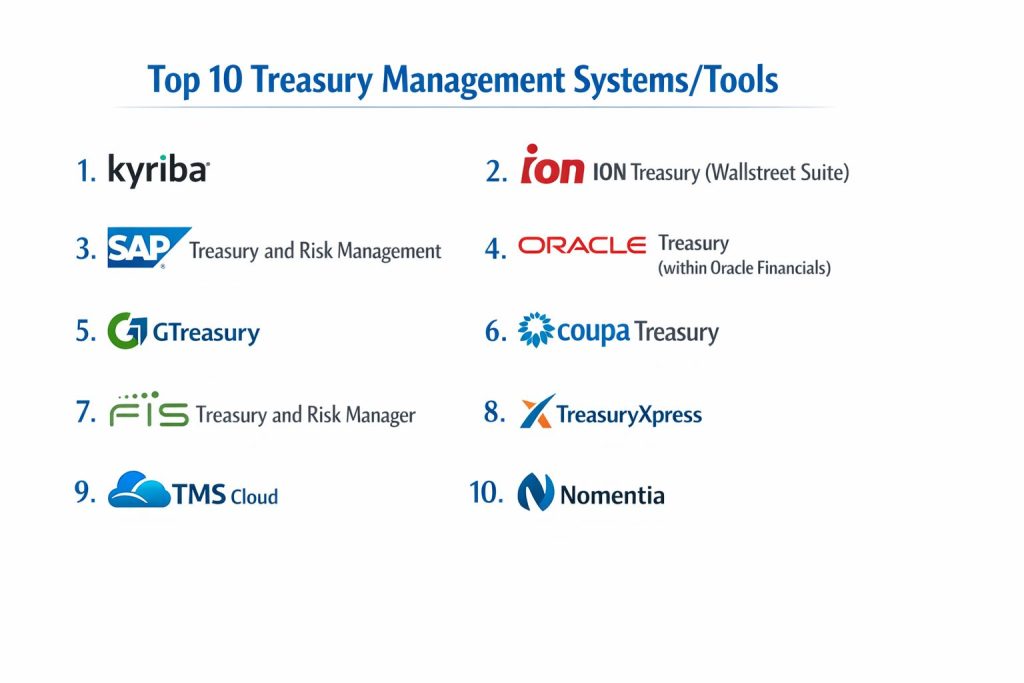
Top 10 Treasury Management Systems Tools
1) Kyriba
A widely recognized treasury platform used for cash visibility, liquidity management, payments, and financial risk workflows. Best for mid-market and enterprise teams needing breadth across treasury processes.
Key Features
- Cash positioning and multi-bank cash visibility
- Short and long-range cash forecasting workflows
- Payment workflows with approvals and controls (varies by setup)
- Bank connectivity options and statement handling (varies by region)
- FX exposure management and hedging support (varies by modules)
- Reporting dashboards for treasury leadership visibility
- Multi-entity and multi-currency treasury operations support
Pros
- Broad treasury coverage suitable for complex organizations
- Strong fit for teams standardizing treasury processes across entities
Cons
- Implementation can require structured planning and treasury expertise
- Some advanced capabilities may depend on modules and configuration
Platforms / Deployment
- Web
- Cloud
Security & Compliance
- SSO/SAML, MFA, encryption, audit logs, RBAC: Not publicly stated
- SOC 2, ISO 27001, GDPR, HIPAA: Not publicly stated
Integrations & Ecosystem
Kyriba commonly connects with ERPs and banks and supports treasury workflows across multiple financial systems.
- ERP integrations: Varies / N/A
- Bank connectivity: Varies / N/A
- Payment file formats and messaging: Varies / N/A
- APIs and automation options: Varies / Not publicly stated
- Ecosystem partners: Varies / N/A
Support & Community
Enterprise-style onboarding and support is common; documentation and customer success depth varies by contract.
2) ION Treasury (Wallstreet Suite)
An enterprise treasury solution focused on cash, risk, debt, and investment workflows. Often chosen by larger organizations with sophisticated treasury operations and risk requirements.
Key Features
- Enterprise-grade cash and liquidity management
- Risk management workflows for FX and rates (module dependent)
- Debt and investment management capabilities (module dependent)
- Scenario analysis for exposure and funding decisions
- Multi-entity treasury operations and policy enforcement
- Advanced reporting and controls for governance and audit
- Configurable workflows for approvals and segregation of duties
Pros
- Strong depth for complex enterprise treasury requirements
- Suitable for organizations with risk and capital structure complexity
Cons
- Complexity can increase implementation and admin effort
- Best value often requires mature treasury processes and ownership
Platforms / Deployment
- Web
- Cloud / Hybrid (Varies / N/A)
Security & Compliance
- SSO/SAML, MFA, encryption, audit logs, RBAC: Not publicly stated
- SOC 2, ISO 27001, GDPR, HIPAA: Not publicly stated
Integrations & Ecosystem
ION Treasury typically integrates with banks, ERPs, and risk data sources in enterprise environments.
- ERP and GL integrations: Varies / N/A
- Market and risk data feeds: Varies / N/A
- Bank connectivity and payments: Varies / N/A
- APIs and automation: Varies / Not publicly stated
- Integration partners: Varies / N/A
Support & Community
Enterprise support with implementation partners is common; support experience varies by region and contract.
3) SAP Treasury and Risk Management
A treasury solution commonly selected by organizations standardizing on SAP for finance operations. Best for teams wanting treasury embedded into a broader SAP ecosystem.
Key Features
- Cash management and liquidity reporting within SAP-aligned workflows
- Treasury and risk processes connected to finance and accounting
- Exposure management for FX and interest risk (configuration dependent)
- Bank communication and payment control patterns (setup dependent)
- Policy-driven workflows and approvals aligned to enterprise controls
- Reporting tied to finance data models and governance structures
- Strong fit for multi-entity operations using SAP finance foundations
Pros
- Strong alignment for organizations already invested in SAP finance
- Helps reduce system sprawl by consolidating treasury into ERP ecosystem
Cons
- Best results require experienced SAP treasury configuration skills
- Can be less flexible for non-SAP-centric environments
Platforms / Deployment
- Web
- Cloud / Self-hosted / Hybrid (Varies / N/A)
Security & Compliance
- SSO/SAML, MFA, encryption, audit logs, RBAC: Not publicly stated
- SOC 2, ISO 27001, GDPR, HIPAA: Not publicly stated
Integrations & Ecosystem
SAP Treasury typically benefits most when finance operations already run through SAP, enabling smoother data alignment.
- SAP ecosystem integrations: Varies / N/A
- Bank messaging and payments: Varies / N/A
- Data and reporting integrations: Varies / N/A
- APIs and extensions: Varies / Not publicly stated
- Partner ecosystem: Varies / N/A
Support & Community
Large enterprise support ecosystem with partners; implementation outcomes depend on project governance and expertise.
4) Oracle Treasury (within Oracle Financials)
A treasury capability commonly adopted by organizations running Oracle finance suites. Best for teams that want treasury workflows aligned to Oracle financial operations and governance.
Key Features
- Cash visibility and liquidity tracking aligned with finance operations
- Payment workflow governance and approval patterns (setup dependent)
- Forecasting and scenario planning features (module dependent)
- Integration patterns with Oracle finance and accounting workflows
- Controls for roles, approvals, and audit trails (configuration dependent)
- Reporting aligned with enterprise finance requirements
- Multi-entity support for larger organizations (depends on setup)
Pros
- Strong fit for Oracle-centric finance environments
- Treasury workflows can align closely with broader finance governance
Cons
- Complexity can rise for mixed-system environments
- Depth depends on modules and configuration choices
Platforms / Deployment
- Web
- Cloud / Hybrid (Varies / N/A)
Security & Compliance
- SSO/SAML, MFA, encryption, audit logs, RBAC: Not publicly stated
- SOC 2, ISO 27001, GDPR, HIPAA: Not publicly stated
Integrations & Ecosystem
Oracle Treasury typically integrates best with Oracle ERP and finance modules, with additional integrations depending on project design.
- Oracle suite integrations: Varies / N/A
- Bank connectivity and payments: Varies / N/A
- APIs and automation: Varies / Not publicly stated
- Partner ecosystem: Varies / N/A
- Reporting integrations: Varies / N/A
Support & Community
Strong enterprise support ecosystem; success often depends on implementation governance and solution architecture.
5) GTreasury
A treasury management platform designed to support cash management, forecasting, payments, and risk workflows. Often chosen by mid-market and enterprise teams looking for treasury-focused usability.
Key Features
- Daily cash positioning and multi-bank visibility workflows
- Cash forecasting with scenario and variance analysis
- Payments and approval workflows (module dependent)
- Bank connectivity options (varies by region and bank coverage)
- Risk and exposure tracking features (module dependent)
- Reporting and dashboards for treasury and finance leadership
- Configurable workflows aligned to internal controls
Pros
- Treasury-first focus with practical workflows for daily operations
- Flexible configuration for different treasury operating models
Cons
- Some advanced areas may require additional modules
- Integration effort depends on bank and ERP complexity
Platforms / Deployment
- Web
- Cloud
Security & Compliance
- SSO/SAML, MFA, encryption, audit logs, RBAC: Not publicly stated
- SOC 2, ISO 27001, GDPR, HIPAA: Not publicly stated
Integrations & Ecosystem
GTreasury typically integrates with ERPs, banks, and payment formats based on treasury requirements.
- ERP integrations: Varies / N/A
- Bank statement and payment connectivity: Varies / N/A
- APIs and file-based integrations: Varies / N/A
- Ecosystem partners: Varies / N/A
- Data exports for BI: Varies / N/A
Support & Community
Implementation and support are usually structured; quality depends on contract and complexity of rollout.
6) Coupa Treasury
A treasury solution commonly evaluated by organizations looking to connect treasury with broader spend and finance workflows. Best for teams that want treasury visibility alongside connected finance operations.
Key Features
- Cash visibility and forecasting workflows (module dependent)
- Bank account and payment governance patterns (setup dependent)
- Workflow controls for approvals and segregation of duties
- Reporting to support liquidity and planning decisions
- Integration patterns across finance operations (varies by environment)
- Centralized treasury process standardization
- Support for multi-entity treasury workflows (depends on setup)
Pros
- Can fit organizations seeking connected finance and spend visibility
- Useful for standardizing approval workflows and controls
Cons
- Depth and fit depend on module scope and environment
- Bank connectivity and global coverage depends on setup and region
Platforms / Deployment
- Web
- Cloud
Security & Compliance
- SSO/SAML, MFA, encryption, audit logs, RBAC: Not publicly stated
- SOC 2, ISO 27001, GDPR, HIPAA: Not publicly stated
Integrations & Ecosystem
Coupa Treasury typically integrates within broader finance ecosystems, often depending on existing finance architecture.
- ERP integrations: Varies / N/A
- Bank connectivity options: Varies / N/A
- Payment workflows: Varies / N/A
- APIs and integration tooling: Varies / Not publicly stated
- Partner ecosystem: Varies / N/A
Support & Community
Support tiers vary; implementation success depends on process design and integration planning.
7) FIS Treasury and Risk Manager
A treasury and risk platform often used by larger organizations with complex cash and risk requirements. Best for teams that need strong controls and enterprise-scale treasury processes.
Key Features
- Cash and liquidity management workflows for complex organizations
- Risk and exposure tracking for FX and rates (module dependent)
- Payment controls and governance patterns (setup dependent)
- Multi-entity and multi-bank support for global operations
- Reporting and analytics for treasury leadership and audit
- Configurable workflows and policy-driven approvals
- Support for structured treasury operations and controls
Pros
- Strong enterprise orientation and risk workflow depth
- Suitable for organizations with complex global banking needs
Cons
- Implementation can be heavy depending on scope and integrations
- Best fit usually requires mature treasury process ownership
Platforms / Deployment
- Web
- Cloud / Hybrid (Varies / N/A)
Security & Compliance
- SSO/SAML, MFA, encryption, audit logs, RBAC: Not publicly stated
- SOC 2, ISO 27001, GDPR, HIPAA: Not publicly stated
Integrations & Ecosystem
FIS treasury solutions often integrate with ERPs, banks, and risk data sources, depending on operating model.
- ERP and GL integrations: Varies / N/A
- Bank connectivity and payment formats: Varies / N/A
- Risk data integrations: Varies / N/A
- APIs and automation: Varies / Not publicly stated
- Ecosystem partners: Varies / N/A
Support & Community
Enterprise support models are common; user community visibility varies by region and industry.
8) TreasuryXpress
A treasury solution often considered by mid-market companies looking for straightforward cash management, forecasting, and payment governance features without heavy complexity.
Key Features
- Cash positioning and bank balance visibility
- Forecasting workflows for planning and liquidity awareness
- Payment approvals and workflow controls (setup dependent)
- Bank connectivity and statement ingestion (varies by coverage)
- Standard reporting for treasury operations and leadership updates
- Multi-bank support for growing organizations
- Configurable controls for daily treasury operations
Pros
- Practical for mid-market treasury teams needing core coverage
- Often simpler to operate than heavy enterprise stacks
Cons
- Advanced risk and complex structures may require other tools
- Global coverage and integrations depend on setup and banking footprint
Platforms / Deployment
- Web
- Cloud
Security & Compliance
- SSO/SAML, MFA, encryption, audit logs, RBAC: Not publicly stated
- SOC 2, ISO 27001, GDPR, HIPAA: Not publicly stated
Integrations & Ecosystem
TreasuryXpress commonly integrates through bank connectivity and finance handoffs depending on customer environment.
- Bank statement formats and connections: Varies / N/A
- ERP handoffs: Varies / N/A
- File-based integrations: Varies / N/A
- APIs: Varies / Not publicly stated
- BI exports: Varies / N/A
Support & Community
Support and onboarding are typically guided; community size is smaller than large enterprise vendors.
9) TIS (Treasury Intelligence Solutions)
A treasury platform often used for cash management, payments, and bank connectivity, especially where centralized bank integration and payment governance are priorities.
Key Features
- Cash visibility across multiple banks and entities
- Payment workflows with centralized controls (setup dependent)
- Bank connectivity and messaging hub capabilities (coverage varies)
- Cash forecasting and liquidity planning tools (module dependent)
- Bank account management workflows (setup dependent)
- Reporting for treasury leadership and audit readiness
- Multi-entity support for shared services treasury models
Pros
- Strong fit for centralized treasury teams managing many banks
- Useful for standardizing payment governance and controls
Cons
- Depth and coverage depend on bank network and configuration
- Treasury outcomes rely on clean master data and disciplined processes
Platforms / Deployment
- Web
- Cloud
Security & Compliance
- SSO/SAML, MFA, encryption, audit logs, RBAC: Not publicly stated
- SOC 2, ISO 27001, GDPR, HIPAA: Not publicly stated
Integrations & Ecosystem
TIS typically integrates through bank connectivity layers and ERP handoffs to unify cash and payment processes.
- Bank connectivity: Varies / N/A
- ERP integrations: Varies / N/A
- Payment file formats: Varies / N/A
- APIs and automation: Varies / Not publicly stated
- Partner network: Varies / N/A
Support & Community
Support is generally enterprise-oriented; implementation experience depends on bank complexity and project design.
10) Nomentia
A treasury solution often selected for cash management and forecasting workflows with a focus on practical treasury operations. Suitable for teams looking for core treasury outcomes without extreme complexity.
Key Features
- Cash positioning and liquidity visibility across bank accounts
- Cash forecasting with planning and variance analysis
- Payment workflows and approval controls (setup dependent)
- Bank connectivity patterns and statement ingestion (varies)
- Multi-entity handling for group treasury operations
- Reporting dashboards for treasury decision-making
- Practical configuration for day-to-day treasury work
Pros
- Solid fit for teams focused on core cash and forecasting discipline
- Useful for standardizing treasury visibility across entities
Cons
- Advanced risk and complex derivatives workflows may be limited
- Integration effort depends on banking and ERP landscape
Platforms / Deployment
- Web
- Cloud
Security & Compliance
- SSO/SAML, MFA, encryption, audit logs, RBAC: Not publicly stated
- SOC 2, ISO 27001, GDPR, HIPAA: Not publicly stated
Integrations & Ecosystem
Nomentia typically integrates through bank connectivity and ERP interfaces to support cash visibility and reporting.
- Bank connectivity and formats: Varies / N/A
- ERP integration patterns: Varies / N/A
- File-based and workflow integrations: Varies / N/A
- APIs: Varies / Not publicly stated
- BI exports: Varies / N/A
Support & Community
Support models vary by plan; teams often benefit from guided onboarding and clear treasury process ownership.
Comparison Table (Top 10)
| Tool Name | Best For | Platform(s) Supported | Deployment | Standout Feature | Public Rating |
|---|---|---|---|---|---|
| Kyriba | Broad treasury coverage for mid-market and enterprise | Web | Cloud | Cash visibility plus treasury breadth | N/A |
| ION Treasury (Wallstreet Suite) | Enterprise treasury with risk depth | Web | Cloud / Hybrid (Varies / N/A) | Advanced enterprise treasury workflows | N/A |
| SAP Treasury and Risk Management | SAP-aligned treasury operations | Web | Cloud / Self-hosted / Hybrid (Varies / N/A) | Embedded treasury in SAP ecosystem | N/A |
| Oracle Treasury (within Oracle Financials) | Oracle-centric finance and treasury | Web | Cloud / Hybrid (Varies / N/A) | Alignment with Oracle finance governance | N/A |
| GTreasury | Treasury-first usability for daily operations | Web | Cloud | Practical cash and forecasting workflows | N/A |
| Coupa Treasury | Connected finance visibility and controls | Web | Cloud | Standardized approvals and governance | N/A |
| FIS Treasury and Risk Manager | Enterprise treasury and risk operations | Web | Cloud / Hybrid (Varies / N/A) | Risk plus global treasury scale | N/A |
| TreasuryXpress | Mid-market core treasury needs | Web | Cloud | Straightforward cash and forecasting | N/A |
| TIS (Treasury Intelligence Solutions) | Centralized bank connectivity and payments | Web | Cloud | Bank connectivity and payment governance | N/A |
| Nomentia | Core cash management and forecasting | Web | Cloud | Practical treasury operations focus | N/A |
Evaluation & Scoring of Treasury Management Systems
Weights: Core features 25%, Ease 15%, Integrations 15%, Security 10%, Performance 10%, Support 10%, Value 15%.
| Tool Name | Core (25%) | Ease (15%) | Integrations (15%) | Security (10%) | Performance (10%) | Support (10%) | Value (15%) | Weighted Total |
|---|---|---|---|---|---|---|---|---|
| Kyriba | 9.0 | 8.0 | 8.5 | 7.0 | 8.5 | 8.0 | 7.5 | 8.25 |
| ION Treasury (Wallstreet Suite) | 9.2 | 7.2 | 8.2 | 7.2 | 8.6 | 7.8 | 7.0 | 8.05 |
| SAP Treasury and Risk Management | 8.8 | 7.0 | 8.8 | 7.4 | 8.2 | 7.8 | 6.8 | 7.89 |
| Oracle Treasury (within Oracle Financials) | 8.6 | 7.2 | 8.6 | 7.3 | 8.2 | 7.7 | 6.9 | 7.85 |
| GTreasury | 8.4 | 8.0 | 7.9 | 7.0 | 8.0 | 7.8 | 7.6 | 7.97 |
| Coupa Treasury | 7.8 | 8.1 | 7.8 | 7.2 | 7.8 | 7.6 | 7.4 | 7.71 |
| FIS Treasury and Risk Manager | 8.9 | 7.0 | 8.0 | 7.2 | 8.4 | 7.7 | 6.8 | 7.90 |
| TreasuryXpress | 7.6 | 8.2 | 7.2 | 6.8 | 7.8 | 7.2 | 8.0 | 7.63 |
| TIS (Treasury Intelligence Solutions) | 8.2 | 7.7 | 8.4 | 7.1 | 8.1 | 7.5 | 7.2 | 7.86 |
| Nomentia | 7.9 | 7.9 | 7.4 | 6.9 | 7.9 | 7.3 | 7.8 | 7.68 |
How to interpret the scores:
- These totals compare tools within this list, not across every vendor in the market.
- Higher scores generally reflect broader treasury coverage and stronger integration fit.
- Ease and value often matter most for teams with limited treasury IT support.
- Security scoring is conservative because public disclosures vary by vendor and contract.
- Always validate with a pilot using your bank landscape, ERP flows, and approval policies.
Which Treasury Management Systems Tool Is Right for You?
Solo / Freelancer
Most solo operators do not need a full TMS. If you manage a small business with basic banking, start with disciplined cash forecasting, strong payment approvals in banking portals, and clean accounting processes. If you still need treasury-grade cash visibility for multiple accounts, lighter mid-market options like TreasuryXpress or Nomentia may be more practical than large enterprise stacks.
SMB
If you are growing into multiple banks and need consistent cash forecasting, TreasuryXpress, Nomentia, or GTreasury can be good starting points. The key is to prioritize bank connectivity, daily cash positioning, and approvals first, then expand to risk and investment modules only if you truly need them.
Mid-Market
Mid-market teams often benefit most from tools that balance control with usability. Kyriba and GTreasury are strong candidates when you need standardized cash visibility, forecasting discipline, and payment workflows across entities. If bank connectivity and centralized payment governance are the main drivers, TIS can be a strong fit depending on your banking footprint.
Enterprise
Enterprises typically need multi-entity scale, advanced controls, and strong integration governance. ION Treasury (Wallstreet Suite) and FIS Treasury and Risk Manager fit complex environments, especially where risk and policy controls matter. SAP Treasury and Risk Management or Oracle Treasury (within Oracle Financials) can be the best fit when your finance backbone is already SAP or Oracle and you want aligned governance.
Budget vs Premium
Budget-sensitive teams should prioritize faster implementation, core cash visibility, and forecasting accuracy. Premium stacks make sense when the organization has complex global banking, high payment volumes, and risk exposure requiring strong controls and reporting.
Feature Depth vs Ease of Use
If you need advanced risk, debt, and policy controls, enterprise tools often win on depth. If your main goal is clean cash visibility and forecasting without heavy admin overhead, mid-market tools can deliver faster outcomes.
Integrations & Scalability
If your ERP and banking landscape is complex, integration capabilities can matter more than feature checklists. Validate bank statement coverage, payment file formats, ERP postings, and how easily you can scale to new entities, banks, and currencies.
Security & Compliance Needs
Treasury systems touch sensitive payment and bank data, so controls matter. Focus on role-based access, approval workflows, audit logs, segregation of duties, and strong authentication practices. Where certifications are not publicly stated, treat them as unknown and confirm during vendor security review.
Frequently Asked Questions (FAQs)
1. What does a Treasury Management System actually do day to day?
It helps teams see cash across banks, forecast cash needs, control payments, and reduce risk. It replaces manual spreadsheets with workflows, approvals, and reporting.
2. How long does implementation usually take?
It depends on bank count, ERP complexity, and scope. A narrow cash-visibility scope is faster, while full payments and risk modules typically take longer.
3. What is the biggest reason TMS projects fail?
Trying to do everything at once. Start with cash visibility and forecasting, then expand to payments and risk after processes and data are stable.
4. Do these systems replace my ERP?
No. Most connect to an ERP for accounting, AP, and reporting. A TMS focuses on treasury workflows like liquidity, bank connectivity, and payment control.
5. How do these tools connect to banks?
Typically through bank statement imports, connectivity hubs, or messaging formats. Coverage varies by region and bank network, so testing is essential.
6. Are TMS tools mainly for large enterprises?
Not anymore. Mid-market tools exist, and many growing companies adopt a TMS once they have multiple banks, multiple entities, or higher payment risk.
7. What security controls should I insist on?
Role-based access, approvals, segregation of duties, audit logs, and strong authentication. Also validate how payment release is controlled end to end.
8. Can a TMS help reduce fraud?
Yes, especially through approvals, dual controls, and centralized payment governance. However, outcomes depend on how strictly workflows are configured and enforced.
9. What should I measure to prove value after rollout?
Forecast accuracy improvement, fewer manual hours, fewer payment errors, better cash utilization, reduced idle cash, and stronger audit readiness.
10. Should I shortlist based on features or integrations first?
Start with integrations. If bank connectivity and ERP posting are weak, even a feature-rich tool will struggle. Validate connectivity before final selection.
Conclusion
Treasury Management Systems are most valuable when they replace uncertainty with daily clarity. The right platform should help you answer simple questions quickly: how much cash do we have, where is it, what do we need next, and what risks could impact liquidity. Kyriba and GTreasury often suit teams looking for broad treasury workflows with practical usability, while enterprise environments may lean toward ION Treasury (Wallstreet Suite) or FIS Treasury and Risk Manager for deeper controls and complex structures. SAP Treasury and Risk Management and Oracle Treasury (within Oracle Financials) can be strong choices when your finance ecosystem already runs on those foundations. A smart next step is to shortlist two or three tools, test bank connectivity and ERP handoffs, validate approval workflows, and run a controlled pilot before scaling organization-wide.