Introduction
Spend management platforms help companies control, track, and optimize how money is requested, approved, paid, and reported across the business. In simple terms, they bring purchasing, employee expenses, invoices, vendor payments, and budget controls into one governed system. This matters because growing teams often leak money through scattered card usage, manual approvals, duplicate vendors, and slow invoice cycles. Common real-world use cases include controlling employee card spending, automating expense claims, managing vendor onboarding and invoices, enforcing policy approvals, and producing finance-ready reports for audits and forecasting. When evaluating a platform, focus on spend visibility, approval workflows, corporate card controls, invoice automation, ERP/accounting integrations, multi-entity support, policy enforcement, audit trails, reporting depth, scalability, and total cost of ownership.
Best for: finance teams, procurement teams, controllers, and founders who want stronger spend control, faster close cycles, and clean audit-ready data across cards, expenses, and invoices.
Not ideal for: very small teams with limited vendors and low transaction volume that can manage spending with basic accounting software and a simple card program.
Key Trends in Spend Management Platforms
- Real-time spend visibility across cards, invoices, and reimbursements in one dashboard
- Tighter policy controls at the moment of purchase, not after the month closes
- AI-assisted receipt capture, categorization, and anomaly detection to reduce manual work
- Vendor risk checks and smarter onboarding workflows to reduce fraud exposure
- Deeper budgeting and departmental controls with enforced limits and approvals
- Multi-entity and multi-currency features becoming standard for global teams
- Stronger integration patterns with ERPs, payroll, and finance ops automation tools
- More demand for audit-ready trails, role-based controls, and standardized approvals
- Consolidation into all-in-one platforms rather than separate expense and AP tools
- Increased focus on speed: faster reimbursements, faster invoice processing, faster close
How We Selected These Tools (Methodology)
- Picked platforms with strong adoption across SMB, mid-market, and enterprise segments
- Prioritized end-to-end coverage for expenses, cards, approvals, and invoice workflows
- Evaluated spend control depth: policy rules, merchant controls, approval routing, and audit trails
- Considered finance team usability: coding, reconciliation speed, and reporting
- Looked for mature integration ecosystems with accounting and ERP systems
- Considered multi-entity capabilities for companies operating across locations and teams
- Weighed reliability signals like workflow stability and operational scalability
- Included a balanced mix of enterprise suites and modern finance-first platforms
- Scored tools comparatively using practical buyer criteria instead of marketing claims
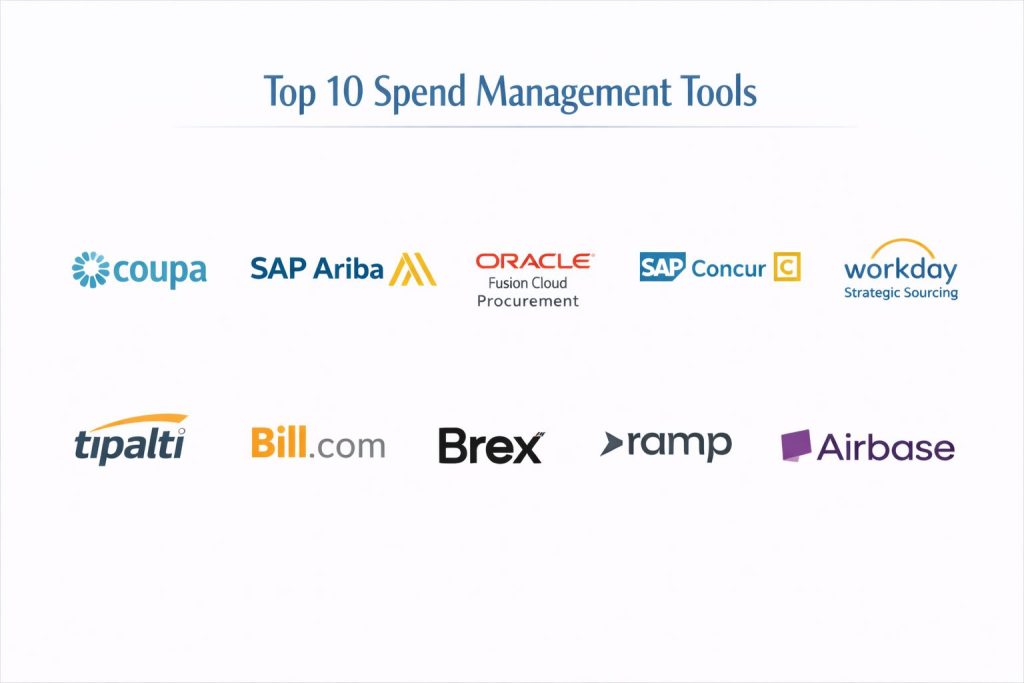
Top 10 Spend Management Platforms Tools
1) Coupa
An enterprise-grade spend management platform covering procurement, invoicing, supplier management, and spend analytics. Strong fit for large organizations that need deep control, governance, and global spend visibility.
Key Features
- Broad suite for procurement, invoicing, and supplier workflows
- Strong approval routing and policy enforcement for governed spend
- Supplier and contract-style management workflows (varies by setup)
- Spend analytics and reporting for enterprise visibility
- Integration patterns for ERP and finance systems (varies by deployment)
- Controls for multi-entity operations and shared governance
- Configurable workflows for complex org structures
Pros
- Strong enterprise governance and reporting depth
- Designed for complex global procurement and finance operations
Cons
- Implementation can be heavy for smaller teams
- Cost and configuration effort may be high depending on scope
Platforms / Deployment
- Web
- Cloud
Security & Compliance
- SSO/SAML, MFA, encryption, audit logs, RBAC: Not publicly stated
- SOC 2, ISO 27001, GDPR, HIPAA: Not publicly stated
Integrations & Ecosystem
Built for enterprise finance ecosystems with configurable integrations and data flows.
- ERP integrations: Varies / N/A
- Procurement and supplier ecosystem tools: Varies / N/A
- APIs and extensibility: Varies / Not publicly stated
- Data export and analytics tooling: Varies / N/A
Support & Community
Enterprise-grade support options, structured onboarding, and consulting ecosystem; specifics vary by contract.
2) SAP Ariba
A widely used enterprise procurement and spend platform focused on sourcing, procurement, supplier networks, and invoicing workflows. Best for organizations needing strong supplier processes and large-scale procurement governance.
Key Features
- Sourcing and procurement workflow management for enterprises
- Supplier network-style collaboration patterns (setup dependent)
- Invoice processing and approval controls
- Contract and supplier management patterns (varies by configuration)
- Reporting and spend visibility across departments
- Integration with SAP ecosystem and other systems (varies)
- Policy enforcement with configurable approval routing
Pros
- Strong fit for enterprise procurement and supplier processes
- Mature ecosystem for large-scale sourcing workflows
Cons
- Can feel complex for smaller organizations
- Configuration and change management can take time
Platforms / Deployment
- Web
- Cloud
Security & Compliance
- SSO/SAML, MFA, encryption, audit logs, RBAC: Not publicly stated
- SOC 2, ISO 27001, GDPR, HIPAA: Not publicly stated
Integrations & Ecosystem
Often selected by organizations using SAP-aligned finance operations and procurement governance.
- ERP integration patterns: Varies / N/A
- Supplier onboarding and network workflows: Varies / N/A
- APIs and customization: Varies / Not publicly stated
- Spend analytics extensions: Varies / N/A
Support & Community
Enterprise support and partner ecosystem; community and training availability is broad, but specifics vary.
3) Oracle Fusion Cloud Procurement
A procurement-focused platform within a broader enterprise suite, designed for sourcing, purchasing, supplier management, and spend controls. Strong for enterprises standardizing procurement and finance operations.
Key Features
- Purchasing, sourcing, and supplier workflows in an integrated suite
- Configurable approvals and purchasing policy enforcement
- Supplier and item management patterns (workflow dependent)
- Reporting and spend tracking for procurement teams
- Integration with enterprise finance systems (suite dependent)
- Controls for multi-entity governance and permissions
- Process automation support across purchasing flows
Pros
- Strong suite alignment for organizations standardizing enterprise finance tooling
- Good fit for procurement-led governance needs
Cons
- Can require significant implementation effort
- Best value often comes when used as part of a wider suite
Platforms / Deployment
- Web
- Cloud
Security & Compliance
- SSO/SAML, MFA, encryption, audit logs, RBAC: Not publicly stated
- SOC 2, ISO 27001, GDPR, HIPAA: Not publicly stated
Integrations & Ecosystem
Designed to integrate with enterprise finance and data environments through suite patterns.
- ERP and financial suite integrations: Varies / N/A
- APIs and data integrations: Varies / Not publicly stated
- Supplier ecosystem tooling: Varies / N/A
- Reporting extensions: Varies / N/A
Support & Community
Enterprise support and partner services exist; onboarding and support depth varies by agreement.
4) SAP Concur
A widely adopted platform for travel and expense management, often used by mid-market and enterprise teams to enforce expense policies and streamline reimbursements.
Key Features
- Expense capture workflows with policy enforcement
- Approval routing and audit trails for compliance workflows
- Travel and expense integration patterns (setup dependent)
- Reporting for finance teams and managers
- Receipt capture and expense categorization support (varies)
- Corporate card reconciliation workflows (setup dependent)
- Multi-entity support patterns for larger organizations
Pros
- Strong for expense governance at scale
- Mature workflows for travel and expense processes
Cons
- User experience can feel heavy depending on configuration
- Some automation may require additional setup and admin effort
Platforms / Deployment
- Web / iOS / Android
- Cloud
Security & Compliance
- SSO/SAML, MFA, encryption, audit logs, RBAC: Not publicly stated
- SOC 2, ISO 27001, GDPR, HIPAA: Not publicly stated
Integrations & Ecosystem
Commonly used as part of a finance stack with travel, card, and accounting systems.
- Accounting/ERP integrations: Varies / N/A
- Corporate card integrations: Varies / N/A
- Travel ecosystem integrations: Varies / N/A
- APIs and export workflows: Varies / Not publicly stated
Support & Community
Strong enterprise presence and training ecosystem; support tiers vary by plan and contract.
5) Workday Strategic Sourcing
A sourcing and procurement-focused platform designed to support supplier workflows, sourcing events, and spend oversight, typically used by larger organizations with structured procurement operations.
Key Features
- Sourcing workflows and supplier collaboration patterns
- Approval routing for sourcing and purchasing governance
- Supplier onboarding-style workflows (setup dependent)
- Reporting to track sourcing performance and spend trends
- Integration patterns for HR/finance ecosystems (varies)
- Centralization of supplier data for governance
- Configurable workflows for procurement teams
Pros
- Strong sourcing focus for structured procurement organizations
- Useful when aligned with broader enterprise operations
Cons
- Less focused on modern corporate card controls than some newer platforms
- Best results depend on integration and implementation depth
Platforms / Deployment
- Web
- Cloud
Security & Compliance
- SSO/SAML, MFA, encryption, audit logs, RBAC: Not publicly stated
- SOC 2, ISO 27001, GDPR, HIPAA: Not publicly stated
Integrations & Ecosystem
Often used in enterprise environments where sourcing, supplier data, and approvals matter.
- Suite integrations: Varies / N/A
- Supplier and finance system connections: Varies / N/A
- APIs: Varies / Not publicly stated
- Reporting and data export: Varies / N/A
Support & Community
Enterprise support and partner ecosystem; onboarding depth varies by contract and services.
6) Tipalti
A payables-focused spend platform designed to help finance teams manage vendor onboarding, payment workflows, and payables controls. Strong for organizations with many suppliers or complex payout needs.
Key Features
- Vendor onboarding workflows to reduce manual setup
- Payables automation for approvals and payment execution
- Multi-entity and multi-currency payout support (setup dependent)
- Tax and compliance workflows: Not publicly stated
- Payment method support patterns (varies by region)
- Reporting for payables tracking and reconciliation
- Integrations with accounting and finance systems (varies)
Pros
- Strong for supplier payments and scaling payables operations
- Helps reduce manual work in vendor payment processes
Cons
- Not a full procurement suite for sourcing and contracting needs
- Best fit depends on your payables complexity and regions
Platforms / Deployment
- Web
- Cloud
Security & Compliance
- SSO/SAML, MFA, encryption, audit logs, RBAC: Not publicly stated
- SOC 2, ISO 27001, GDPR, HIPAA: Not publicly stated
Integrations & Ecosystem
Often used alongside accounting systems to automate supplier payments and approvals.
- Accounting integrations: Varies / N/A
- Payment partner ecosystem: Varies / N/A
- APIs and automation: Varies / Not publicly stated
- Data export workflows: Varies / N/A
Support & Community
Generally strong onboarding for finance teams; support tiers vary by plan and contract.
7) Bill.com
A finance operations platform focused on accounts payable and receivable workflows, with approvals, invoice processing, and payment execution. Common among SMB and mid-market finance teams.
Key Features
- Invoice intake and approval workflows for AP processes
- Payment execution workflows to streamline vendor payments
- Role-based approvals and audit trails for controlled spend
- Vendor management basics for AP operations (varies)
- Accounting system integration patterns (setup dependent)
- Reporting for cash flow visibility and AP tracking
- Workflow automation to reduce manual AP tasks
Pros
- Practical AP automation for finance teams with limited resources
- Helps shorten invoice-to-payment cycles
Cons
- Procurement sourcing features are limited compared to enterprise suites
- Complex multi-entity needs may require careful evaluation
Platforms / Deployment
- Web / iOS / Android
- Cloud
Security & Compliance
- SSO/SAML, MFA, encryption, audit logs, RBAC: Not publicly stated
- SOC 2, ISO 27001, GDPR, HIPAA: Not publicly stated
Integrations & Ecosystem
Typically integrates with accounting systems and banking/payment workflows.
- Accounting integrations: Varies / N/A
- Payment workflows and approvals: Varies / N/A
- APIs and automation: Varies / Not publicly stated
- Export and reporting: Varies / N/A
Support & Community
Strong SMB user base and onboarding resources; support tiers vary by plan.
8) Brex
A spend platform combining corporate cards, expense management, and controls built for fast-moving companies. Useful for teams that want real-time card controls and streamlined expense workflows.
Key Features
- Corporate cards with configurable spend controls and limits
- Real-time policy enforcement at the point of purchase
- Automated receipt capture and expense coding support (varies)
- Approval workflows for controlled spend and reimbursements
- Budget tracking for teams and departments (workflow dependent)
- Reporting for finance visibility and close support
- Integrations with accounting and finance tooling (varies)
Pros
- Strong real-time controls and modern user experience
- Useful for reducing expense cleanup and speeding reconciliation
Cons
- Fit depends on availability, regions, and program eligibility
- Procurement-style sourcing features are limited compared to enterprise suites
Platforms / Deployment
- Web / iOS / Android
- Cloud
Security & Compliance
- SSO/SAML, MFA, encryption, audit logs, RBAC: Not publicly stated
- SOC 2, ISO 27001, GDPR, HIPAA: Not publicly stated
Integrations & Ecosystem
Often used with accounting platforms and finance ops tooling for automated reconciliation.
- Accounting integrations: Varies / N/A
- Expense workflows and exports: Varies / N/A
- APIs and automation: Varies / Not publicly stated
- Partner integrations: Varies / N/A
Support & Community
Good onboarding for modern finance teams; support levels vary by plan and eligibility.
9) Ramp
A spend platform focused on expense management, corporate card controls, and spend analytics. Strong for finance teams that want visibility, automated categorization, and tighter policy controls.
Key Features
- Corporate cards with advanced controls and category limits
- Expense automation for receipts, coding, and approvals (varies)
- Spend visibility dashboards and analytics for finance oversight
- Policy enforcement and approval routing to reduce leakage
- Vendor and subscription visibility patterns (workflow dependent)
- Integrations with accounting systems for reconciliation
- Audit trail support for controlled spend workflows
Pros
- Strong for spend visibility and finance-friendly automation
- Helps reduce manual expense cleanup and improve policy compliance
Cons
- Fit depends on availability, regions, and program requirements
- Deep procurement sourcing features are limited compared to suites
Platforms / Deployment
- Web / iOS / Android
- Cloud
Security & Compliance
- SSO/SAML, MFA, encryption, audit logs, RBAC: Not publicly stated
- SOC 2, ISO 27001, GDPR, HIPAA: Not publicly stated
Integrations & Ecosystem
Typically integrates with accounting tools and supports exports for finance processes.
- Accounting integrations: Varies / N/A
- Approval workflows and rules: Varies / N/A
- APIs and automation: Varies / Not publicly stated
- Partner integrations: Varies / N/A
Support & Community
Strong modern product onboarding; support tiers vary by plan and eligibility.
10) Airbase
A spend management platform designed to unify corporate cards, reimbursements, approvals, and vendor payments with strong policy controls. Often chosen by teams aiming to centralize spend operations.
Key Features
- Unified workflows for cards, reimbursements, and payables
- Strong approval routing and policy rules for governed spend
- Budget controls and spend visibility for departments
- Receipt capture and automated coding support (varies)
- Audit trails and role-based permissions for finance governance
- Integration patterns for accounting systems (setup dependent)
- Vendor payment workflows depending on configuration
Pros
- Strong centralized spend controls and approval consistency
- Useful for standardizing spend operations across teams
Cons
- Best value depends on integration depth and process maturity
- Some workflows may require careful configuration for complex orgs
Platforms / Deployment
- Web
- Cloud
Security & Compliance
- SSO/SAML, MFA, encryption, audit logs, RBAC: Not publicly stated
- SOC 2, ISO 27001, GDPR, HIPAA: Not publicly stated
Integrations & Ecosystem
Often used as a central layer between employees, finance teams, and accounting tools.
- Accounting integrations: Varies / N/A
- Workflow automation: Varies / N/A
- APIs and extensibility: Varies / Not publicly stated
- Export and reporting: Varies / N/A
Support & Community
Support and onboarding are oriented toward finance teams; community visibility varies by region.
Comparison Table (Top 10)
| Tool Name | Best For | Platform(s) Supported | Deployment (Cloud/Self-hosted/Hybrid) | Standout Feature | Public Rating |
|---|---|---|---|---|---|
| Coupa | Enterprise spend governance and analytics | Web | Cloud | Enterprise-wide spend control | N/A |
| SAP Ariba | Enterprise procurement and supplier workflows | Web | Cloud | Sourcing and supplier network patterns | N/A |
| Oracle Fusion Cloud Procurement | Enterprise procurement standardization | Web | Cloud | Suite-aligned procurement governance | N/A |
| SAP Concur | Travel and expense control at scale | Web, iOS, Android | Cloud | Expense governance and approvals | N/A |
| Workday Strategic Sourcing | Structured sourcing and supplier processes | Web | Cloud | Sourcing workflows and supplier oversight | N/A |
| Tipalti | Payables automation and vendor payouts | Web | Cloud | Vendor onboarding and payables automation | N/A |
| Bill.com | AP automation for SMB and mid-market | Web, iOS, Android | Cloud | Invoice-to-payment workflow automation | N/A |
| Brex | Modern card controls and spend workflows | Web, iOS, Android | Cloud | Real-time card policy controls | N/A |
| Ramp | Spend visibility and expense automation | Web, iOS, Android | Cloud | Analytics-driven spend management | N/A |
| Airbase | Unified approvals, cards, and payables | Web | Cloud | Centralized spend control workflows | N/A |
Evaluation & Scoring of Spend Management Platforms
Weights: Core features 25%, Ease 15%, Integrations 15%, Security 10%, Performance 10%, Support 10%, Value 15%.
| Tool Name | Core (25%) | Ease (15%) | Integrations (15%) | Security (10%) | Performance (10%) | Support (10%) | Value (15%) | Weighted Total (0–10) |
|---|---|---|---|---|---|---|---|---|
| Coupa | 9.5 | 7.0 | 9.0 | 7.0 | 8.5 | 8.0 | 6.5 | 8.03 |
| SAP Ariba | 9.0 | 6.5 | 8.5 | 7.0 | 8.0 | 7.5 | 6.0 | 7.63 |
| Oracle Fusion Cloud Procurement | 8.5 | 6.5 | 8.0 | 7.0 | 8.0 | 7.5 | 6.0 | 7.38 |
| SAP Concur | 8.0 | 7.0 | 8.0 | 7.0 | 8.0 | 7.5 | 6.5 | 7.40 |
| Workday Strategic Sourcing | 8.0 | 6.5 | 7.5 | 7.0 | 7.5 | 7.5 | 6.0 | 7.13 |
| Tipalti | 8.0 | 7.5 | 7.5 | 7.0 | 8.0 | 7.5 | 7.0 | 7.55 |
| Bill.com | 7.5 | 8.0 | 7.5 | 6.5 | 7.5 | 7.5 | 7.5 | 7.53 |
| Brex | 7.5 | 8.5 | 7.0 | 6.5 | 8.0 | 7.0 | 7.0 | 7.50 |
| Ramp | 8.0 | 8.5 | 7.5 | 6.5 | 8.0 | 7.5 | 7.5 | 7.85 |
| Airbase | 8.0 | 8.0 | 7.5 | 6.5 | 7.5 | 7.0 | 7.0 | 7.55 |
How to interpret the scores:
- Scores are comparative within this list, not a universal benchmark.
- A higher total usually means broader strength across more spend scenarios.
- Ease and value matter more for smaller teams with lean finance operations.
- Enterprise suites may score higher on governance but require heavier implementation.
- Validate with a pilot using your approval flows, chart of accounts, and real vendor/invoice volume.
Which Spend Management Platforms Tool Is Right for You?
Solo / Freelancer
Most solo operators do not need a full spend platform unless they manage many contractors and invoices. If you want a simple AP and payment workflow, Bill.com can be a practical starting point in some setups. If you need controlled card spending and clean expense capture for a small team, Ramp or Brex may be more suitable, depending on availability.
SMB
SMBs should prioritize fast setup, expense automation, and clean accounting exports. Ramp, Brex, and Airbase are commonly aligned to SMB finance needs because they focus on controls and simplified workflows. Bill.com works well when invoice approvals and vendor payments are your primary pain points.
Mid-Market
Mid-market teams should look for strong multi-entity support, deeper approvals, and better reporting. Airbase can work well as a central control layer for approvals and spend. Tipalti becomes important when payables operations scale and vendor payouts become complex. SAP Concur is often chosen when travel and expense governance is a major requirement.
Enterprise
Enterprises typically need governance, supplier workflows, and global standardization. Coupa and SAP Ariba are strong enterprise choices for procurement-led controls and spend analytics. Oracle Fusion Cloud Procurement and Workday Strategic Sourcing are often considered when organizations standardize around suite-aligned enterprise operations.
Budget vs Premium
Budget-focused teams often choose tools that reduce manual work without heavy implementation. Premium enterprise suites may deliver strong governance and analytics but require configuration, change management, and higher ongoing cost. Choose based on how much process control you truly need versus how fast you need results.
Feature Depth vs Ease of Use
If you need deep procurement governance and structured sourcing, enterprise suites often win. If you need fast adoption and daily finance productivity, modern platforms like Ramp, Brex, and Airbase can reduce friction. Always evaluate which workflows matter most: cards and expenses, invoices and payables, or sourcing and procurement.
Integrations & Scalability
Integrations decide whether the tool saves time or creates rework. Validate how the platform maps to your chart of accounts, approval routing, vendor sync, and month-end close steps. Also test scale: number of users, number of cards, invoice volume, and multi-entity needs.
Security & Compliance Needs
Most platforms support role-based access and audit logs, but formal certifications are not always clearly stated. Treat any unclear claims as not publicly stated and validate through vendor documentation shared during procurement. For strict environments, prioritize access controls, approval auditability, and strong permission design.
Frequently Asked Questions (FAQs)
1. What is the difference between spend management and expense management?
Expense management usually focuses on reimbursements and receipts, while spend management covers broader controls like cards, approvals, invoices, and vendor payments across the company.
2. Do spend platforms replace accounting software?
Usually no. They typically sit in front of accounting systems to control spending and automate coding, approvals, and reconciliation.
3. How long does implementation usually take?
It varies by tool and scope. Simple setups can be faster, while enterprise procurement suites often require longer configuration and change management.
4. What should I test in a pilot before buying?
Test approval routing, card controls, invoice workflows, accounting exports, user roles, audit trails, and how quickly finance can reconcile transactions.
5. Are corporate cards required to use these platforms?
Not always. Some platforms focus on AP workflows, while others are card-first. Choose based on whether your main pain is card spend, invoices, or both.
6. How do these tools help reduce fraud or policy violations?
Many enforce controls before spending happens, using approval rules, merchant restrictions, and required documentation. The effectiveness depends on how well policies are configured.
7. Can these platforms handle multi-entity and multi-currency companies?
Some can, but depth varies. If you operate across locations or entities, validate entity separation, currency handling, and reporting structure early.
8. What are the common mistakes teams make after purchase?
Weak policy setup, unclear approvals, poor chart-of-accounts mapping, and skipping training. Also, not assigning ownership for ongoing governance is a frequent issue.
9. How hard is it to switch platforms later?
Switching can be painful due to policy rules, integrations, and historical reporting needs. Keep your accounting mapping clean and export data regularly to reduce lock-in.
10. Which platform is best for enterprise procurement governance?
Tools like Coupa and SAP Ariba are often aligned with enterprise procurement governance needs, but the best fit depends on your processes and integration requirements.
Conclusion
Spend management platforms deliver value when they reduce messy manual work, prevent policy violations before they happen, and give finance teams clean, audit-ready data without chasing people for receipts. Enterprise suites like Coupa and SAP Ariba can provide strong procurement governance and analytics, but they often need more implementation effort and structured change management. Modern platforms like Ramp, Brex, and Airbase focus on speed, usability, and real-time controls that help smaller and mid-sized teams move faster with fewer surprises at month-end. Tipalti and Bill.com can be especially helpful when invoice approvals and vendor payments are your biggest bottlenecks. A practical next step is to shortlist two or three tools, run a pilot using real approvals, real vendors, and your chart of accounts, then choose the platform that fits your daily workflows best.