Introduction
An Order Management System (OMS) is the control center that captures orders, validates inventory, routes fulfillment, manages payments status, and keeps customers informed from checkout to delivery (and returns). When your sales happen across multiple channels, warehouses, stores, and marketplaces, an OMS helps you avoid overselling, late shipments, split-order chaos, and poor customer updates.
Real use cases include unified commerce for retail, marketplace order routing, B2B order processing with approvals, ship-from-store and curbside pickup coordination, subscription renewals with order changes, and returns/refunds automation. When evaluating an OMS, focus on inventory visibility, order orchestration rules, split shipments, returns management, integrations with ERP/WMS/ecommerce, workflow configurability, scalability, exception handling, reporting, automation capability, and total ownership cost.
Best for: retailers, brands, manufacturers, distributors, and marketplaces that handle multi-channel orders and need reliable fulfillment routing and customer transparency.
Not ideal for: very small sellers with a single channel and simple shipping flows, or teams that only need basic invoicing without orchestration and routing.
Key Trends in Order Management Systems (OMS)
- Orchestration-first designs that route orders dynamically across warehouses, stores, and partners
- Real-time inventory visibility with stronger reservation logic to reduce oversell and cancellations
- Returns becoming a first-class workflow with smarter refund rules and exchange flows
- Event-driven integrations for faster updates across ERP, WMS, carrier, and storefront systems
- More automation for exception handling (backorders, partial shipments, fraud holds, address fixes)
- Configurable rules engines replacing hard-coded fulfillment routing
- Growing need for marketplace and dropship support with partner onboarding workflows
- Better customer communication triggers from order events, not manual status updates
- Stronger focus on data quality: SKU normalization, address validation, and payment state sync
- Increased demand for enterprise governance: role controls, auditability, and approval workflows
How We Selected These Tools (Methodology)
- Picked widely recognized OMS options used across retail, B2B, and multi-channel commerce
- Prioritized strong orchestration, inventory visibility, and fulfillment routing capabilities
- Included a mix of enterprise suites and modern cloud-first platforms for flexibility
- Considered integration breadth with ERP, WMS, commerce platforms, and carrier tools
- Looked for proven scalability patterns and reliability signals for peak order volumes
- Weighted practical usability: configurability, admin experience, and rule management
- Evaluated ecosystem maturity: partner networks, implementation availability, and support models
- Ensured the final list covers different org sizes and operating models
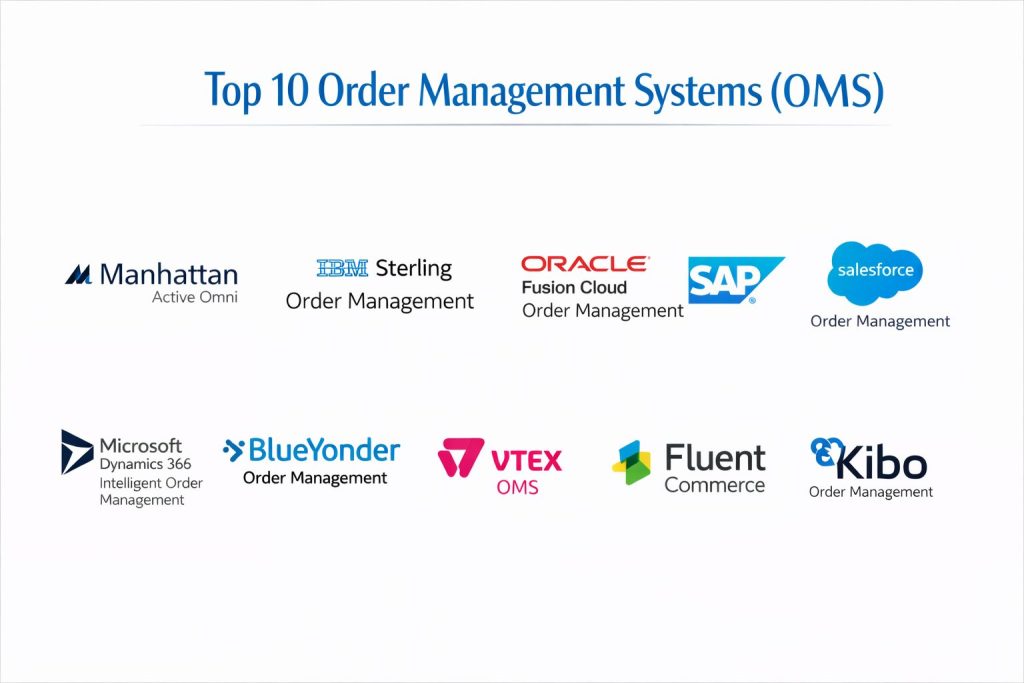
Top 10 Order Management Systems (OMS) Tools
1) Manhattan Active Omni
An enterprise-grade OMS focused on unified commerce and complex fulfillment routing. Strong fit for retailers needing advanced orchestration across DCs, stores, and delivery options.
Key Features
- Advanced order orchestration and routing logic across multiple nodes
- Inventory visibility and reservation patterns for high-volume commerce
- Support for ship-from-store, pickup, and mixed fulfillment scenarios
- Exception handling workflows for partials, backorders, and substitutions
- Promising and sourcing logic to improve delivery outcomes
- Strong support for enterprise retail operations and process controls
Pros
- Very strong orchestration depth for complex retail fulfillment networks
- Designed for large-scale operations and peak demand patterns
Cons
- Implementation complexity can be high without clear process ownership
- Cost and change management can be heavy for smaller teams
Platforms / Deployment
- Web
- Cloud (details vary by agreement)
Security & Compliance
- Not publicly stated
- Buyers should validate: SSO/SAML, MFA, RBAC, audit logs, encryption
Integrations & Ecosystem
Manhattan deployments typically connect deeply with WMS, ERP, POS, ecommerce platforms, and carrier services, with integrations shaped by the customer architecture.
- ERP and finance systems: Varies / N/A
- WMS and inventory sources: Varies / N/A
- Commerce and POS connectors: Varies / N/A
- Carrier and last-mile services: Varies / N/A
- APIs and event patterns: Varies / N/A
Support & Community
Enterprise support models are common, with documentation and partner ecosystems that vary by region and contract.
2) IBM Sterling Order Management
A well-known OMS used for multi-channel orchestration and complex order flows. Often selected by large enterprises that need robust integration and governance.
Key Features
- Order capture and orchestration across channels and fulfillment nodes
- Inventory visibility and allocation logic across multiple systems
- Configurable workflows for holds, approvals, and exceptions
- Returns and exchange flows (capabilities vary by setup)
- Strong integration patterns with enterprise back-office systems
- Controls for complex enterprise operations and compliance needs
Pros
- Strong fit for complex enterprises with many systems to coordinate
- Mature approach to orchestration and integration-heavy environments
Cons
- Admin experience and configuration can feel heavy without specialists
- Time-to-value depends strongly on implementation quality
Platforms / Deployment
- Web
- Cloud / Hybrid (varies by customer setup)
Security & Compliance
- Not publicly stated
- Buyers should validate: SSO/SAML, MFA, RBAC, audit logs, encryption
Integrations & Ecosystem
Sterling commonly sits between commerce channels and fulfillment systems, coordinating updates and status events.
- ERP, WMS, TMS integrations: Varies / N/A
- Commerce platform connectivity: Varies / N/A
- Partner and EDI-style integrations: Varies / N/A
- APIs and workflow extensibility: Varies / N/A
- Monitoring and operational tooling: Varies / N/A
Support & Community
Strong enterprise support availability; partner ecosystem is significant, but experiences vary by region and contract.
3) Oracle Fusion Cloud Order Management
A cloud OMS option aligned to Oracle’s broader enterprise suite. Common for organizations that want tight linkage between order processing, finance, and supply workflows.
Key Features
- End-to-end order processing tied to enterprise workflows
- Orchestration steps for fulfillment and billing states (varies by setup)
- Change management for order edits, cancellations, and holds
- Configurable rules for approvals and exception handling
- Reporting and operational visibility across order lifecycle
- Integration patterns for enterprise applications and services
Pros
- Strong alignment with enterprise finance and operational processes
- Suitable for organizations already standardizing on Oracle cloud systems
Cons
- Best-fit can depend on how much of the Oracle suite you adopt
- Integration design requires careful ownership to avoid brittle flows
Platforms / Deployment
- Web
- Cloud
Security & Compliance
- Not publicly stated
- Buyers should validate: SSO/SAML, MFA, RBAC, audit logs, encryption
Integrations & Ecosystem
Typically integrates with ERP, inventory sources, fulfillment systems, and commerce channels based on the chosen architecture.
- ERP and finance alignment: Varies / N/A
- Fulfillment and warehouse connectivity: Varies / N/A
- Commerce channel integrations: Varies / N/A
- APIs and integration tooling: Varies / N/A
- Event and status synchronization: Varies / N/A
Support & Community
Enterprise support is common; implementation partners are available, with experience varying across regions.
4) SAP Commerce Cloud
A commerce platform that can support OMS-style orchestration as part of broader commerce operations. Often used by enterprises building unified commerce with SAP-aligned processes.
Key Features
- Commerce-centric order processing and lifecycle management
- Workflow configuration for order states and exceptions (varies by setup)
- Integration patterns with SAP back-office and inventory systems
- Support for multi-channel commerce operations (capabilities vary by design)
- Extensibility through platform customization and services
- Reporting and operational visibility across commerce activity
Pros
- Strong for organizations aligning commerce and enterprise operations
- Fits teams already invested in SAP ecosystems and integration patterns
Cons
- OMS depth can depend on modules and architecture choices
- Customization can increase maintenance effort over time
Platforms / Deployment
- Web
- Cloud
Security & Compliance
- Not publicly stated
- Buyers should validate: SSO/SAML, MFA, RBAC, audit logs, encryption
Integrations & Ecosystem
Most value comes from how well it connects to ERP, inventory, fulfillment, and customer data systems.
- SAP back-office integrations: Varies / N/A
- External WMS and carriers: Varies / N/A
- Marketplace and partner flows: Varies / N/A
- APIs and extension tooling: Varies / N/A
- Operational monitoring: Varies / N/A
Support & Community
Large enterprise ecosystem and partner network; support structure varies by agreement.
5) Salesforce Order Management
A cloud OMS designed to connect order flows with customer service and CRM-driven operations. Useful when service teams need strong visibility into order status and exceptions.
Key Features
- Order capture and lifecycle tracking aligned to customer engagement
- Service-friendly views for cancellations, refunds, and exceptions
- Workflow automation patterns across order states (varies by setup)
- Integrations with commerce channels and fulfillment systems
- Reporting and dashboards across customer and order activity
- Extensibility via platform services and automation tools
Pros
- Strong for connecting order operations with service workflows
- Helpful for organizations standardizing on Salesforce platform capabilities
Cons
- Fulfillment depth depends on integrations with WMS, ERP, and logistics tools
- Costs can rise as platform usage and add-ons expand
Platforms / Deployment
- Web
- Cloud
Security & Compliance
- Not publicly stated
- Buyers should validate: SSO/SAML, MFA, RBAC, audit logs, encryption
Integrations & Ecosystem
Works best when tightly integrated with commerce, payments, inventory, and fulfillment partners.
- Commerce channel integrations: Varies / N/A
- ERP and finance synchronization: Varies / N/A
- WMS and carrier integrations: Varies / N/A
- APIs and automation tooling: Varies / N/A
- App ecosystem extensions: Varies / N/A
Support & Community
Large community and implementation ecosystem; enterprise support options vary by plan.
6) Microsoft Dynamics 365 Intelligent Order Management
A cloud OMS-oriented solution that helps coordinate orders across systems and streamline orchestration workflows. Often considered by organizations using Microsoft business apps.
Key Features
- Order orchestration across multiple sources and destinations
- Workflow rules for routing, exceptions, and fulfillment decisions
- Integration patterns aligned with Microsoft ecosystem tooling
- Operational visibility and reporting for order status events
- Automation support for routine updates and escalations
- Designed to connect commerce, inventory, and fulfillment systems
Pros
- Good fit for organizations already building on Microsoft business platforms
- Useful for connecting multiple order and fulfillment systems into one view
Cons
- Effectiveness depends on integration maturity and data consistency
- Advanced routing needs careful rule design and operational ownership
Platforms / Deployment
- Web
- Cloud
Security & Compliance
- Not publicly stated
- Buyers should validate: SSO/SAML, MFA, RBAC, audit logs, encryption
Integrations & Ecosystem
Commonly integrates with ERP, commerce platforms, WMS, and logistics tools, shaped by the customer stack.
- Microsoft ecosystem integrations: Varies / N/A
- ERP and inventory sources: Varies / N/A
- Fulfillment and logistics services: Varies / N/A
- APIs and connectors: Varies / N/A
- Event-driven patterns: Varies / N/A
Support & Community
Strong availability of implementation resources in many regions; support depends on plan and partner model.
7) Blue Yonder Order Management
An OMS option often associated with supply chain-focused orchestration. Useful when fulfillment decisions must align tightly with inventory, allocation, and network constraints.
Key Features
- Orchestration designed around supply chain realities and constraints
- Inventory visibility patterns to reduce cancellations and late shipments
- Routing logic across multiple fulfillment nodes
- Exception workflows for backorders, partials, and substitutions
- Analytics and operational views for fulfillment performance
- Supports complex retail and distribution operating models
Pros
- Strong for organizations that want supply chain-aware routing decisions
- Good fit for complex fulfillment networks and high variability demand
Cons
- Implementation can be complex, especially with many legacy systems
- Admin and rule tuning can require specialized operational expertise
Platforms / Deployment
- Web
- Cloud (details vary by agreement)
Security & Compliance
- Not publicly stated
- Buyers should validate: SSO/SAML, MFA, RBAC, audit logs, encryption
Integrations & Ecosystem
Integrations typically span inventory sources, WMS, ERP, commerce channels, and logistics services.
- Supply chain system connectivity: Varies / N/A
- Commerce and POS integrations: Varies / N/A
- WMS and carrier integrations: Varies / N/A
- APIs and integration tooling: Varies / N/A
- Monitoring and reporting ecosystems: Varies / N/A
Support & Community
Enterprise support and partner ecosystems exist; experience varies by region and contract.
8) VTEX OMS
Summary: A cloud-based OMS capability often used by brands and retailers running VTEX commerce. Useful when you want an integrated commerce-plus-OMS experience.
Key Features
- Centralized order visibility across channels in the VTEX ecosystem
- Routing and fulfillment options aligned to commerce storefront needs
- Support for split shipments and multi-node fulfillment (varies by setup)
- Order status events designed for customer communication workflows
- Admin tools for managing exceptions and operational tasks
- API-driven patterns for integrations (capabilities vary by plan)
Pros
- Strong fit when VTEX is the primary commerce platform
- Faster alignment between storefront behavior and order operations
Cons
- Best-fit depends on how much of your stack is VTEX-based
- Deep enterprise routing needs may require careful architecture planning
Platforms / Deployment
- Web
- Cloud
Security & Compliance
- Not publicly stated
- Buyers should validate: SSO/SAML, MFA, RBAC, audit logs, encryption
Integrations & Ecosystem
Works best when connected cleanly to inventory, logistics, payments, and partner services.
- Commerce-native integrations: Varies / N/A
- ERP and finance integrations: Varies / N/A
- WMS and logistics connections: Varies / N/A
- APIs and extensions: Varies / N/A
- Marketplace partner workflows: Varies / N/A
Support & Community
Growing community and partner availability; support structure varies by plan and region.
9) Fluent Commerce
A cloud-first OMS focused on distributed order management and orchestration. Often chosen by retailers that need flexible routing rules and quick iteration on fulfillment models.
Key Features
- Distributed order orchestration across stores, DCs, and partners
- Configurable routing rules to adapt to changing network conditions
- Inventory visibility patterns to reduce cancellations and delays
- Support for ship-from-store and pickup workflows (setup dependent)
- Exception handling and operational tooling for daily order ops
- API-forward approach for integration-heavy environments
Pros
- Strong flexibility for evolving fulfillment strategies
- Good fit for teams that want configurable routing without heavy custom builds
Cons
- Integration success depends on data quality across connected systems
- Advanced operations require strong monitoring and ownership processes
Platforms / Deployment
- Web
- Cloud
Security & Compliance
- Not publicly stated
- Buyers should validate: SSO/SAML, MFA, RBAC, audit logs, encryption
Integrations & Ecosystem
Designed to integrate with commerce platforms, ERP, WMS, carriers, and partner services using API-centric patterns.
- Commerce and marketplace integrations: Varies / N/A
- ERP and inventory sources: Varies / N/A
- WMS and logistics services: Varies / N/A
- APIs and event patterns: Varies / N/A
- Operational analytics integrations: Varies / N/A
Support & Community
Vendor-led support is common; partner ecosystem exists, with experience varying by region.
10) Kibo Order Management
An OMS option aligned with commerce operations and multi-channel fulfillment needs. Often considered by teams seeking orchestration and visibility tied closely to commerce workflows.
Key Features
- Order visibility and lifecycle management across channels
- Fulfillment routing and split shipment handling (setup dependent)
- Returns and exchange support patterns (capabilities vary)
- Configurable workflows for exceptions and operational tasks
- Integrations with commerce, inventory, and fulfillment systems
- Reporting views for operational monitoring and service support
Pros
- Good fit for commerce-driven order operations requiring orchestration
- Useful for teams that want a unified view across order states
Cons
- Depth depends on integration scope and chosen architecture
- Some advanced enterprise needs may require additional tooling
Platforms / Deployment
- Web
- Cloud
Security & Compliance
- Not publicly stated
- Buyers should validate: SSO/SAML, MFA, RBAC, audit logs, encryption
Integrations & Ecosystem
Most deployments rely on strong connections to inventory, fulfillment, payments, and service tooling.
- Commerce platform connectivity: Varies / N/A
- ERP and finance synchronization: Varies / N/A
- WMS and carrier integrations: Varies / N/A
- APIs and extensions: Varies / N/A
- Monitoring and analytics tooling: Varies / N/A
Support & Community
Support is typically vendor-led with partner options; documentation quality and partner availability vary.
Comparison Table (Top 10)
| Tool Name | Best For | Platform(s) Supported | Deployment | Standout Feature | Public Rating |
|---|---|---|---|---|---|
| Manhattan Active Omni | Complex unified commerce orchestration | Web | Cloud | Enterprise-grade routing depth | N/A |
| IBM Sterling Order Management | Enterprise orchestration with heavy integrations | Web | Cloud / Hybrid | Governance and integration patterns | N/A |
| Oracle Fusion Cloud Order Management | Enterprise order processing alignment | Web | Cloud | Suite alignment for order workflows | N/A |
| SAP Commerce Cloud | Commerce-led order operations in SAP ecosystems | Web | Cloud | Enterprise commerce ecosystem fit | N/A |
| Salesforce Order Management | Order ops tied to service and customer workflows | Web | Cloud | CRM-aligned order visibility | N/A |
| Microsoft Dynamics 365 Intelligent Order Management | Orchestration across connected business systems | Web | Cloud | Connector-friendly orchestration approach | N/A |
| Blue Yonder Order Management | Supply chain-aware fulfillment decisions | Web | Cloud | Network-aware routing logic | N/A |
| VTEX OMS | OMS needs inside VTEX commerce stacks | Web | Cloud | Commerce-plus-OMS alignment | N/A |
| Fluent Commerce | Cloud-first distributed order management | Web | Cloud | Configurable routing flexibility | N/A |
| Kibo Order Management | Commerce-driven OMS operations | Web | Cloud | Unified order lifecycle visibility | N/A |
Evaluation & Scoring of Order Management Systems (OMS)
Weights: Core features 25%, Ease 15%, Integrations 15%, Security 10%, Performance 10%, Support 10%, Value 15%.
| Tool Name | Core (25%) | Ease (15%) | Integrations (15%) | Security (10%) | Performance (10%) | Support (10%) | Value (15%) | Weighted Total |
|---|---|---|---|---|---|---|---|---|
| Manhattan Active Omni | 9 | 7 | 9 | 7 | 9 | 8 | 6 | 7.95 |
| IBM Sterling Order Management | 9 | 6 | 8 | 7 | 8 | 7 | 6 | 7.45 |
| Oracle Fusion Cloud Order Management | 8 | 7 | 8 | 7 | 8 | 7 | 6 | 7.35 |
| SAP Commerce Cloud | 8 | 6 | 8 | 7 | 8 | 7 | 6 | 7.20 |
| Salesforce Order Management | 8 | 8 | 8 | 7 | 7 | 7 | 6 | 7.40 |
| Microsoft Dynamics 365 Intelligent Order Management | 7 | 7 | 7 | 7 | 7 | 7 | 7 | 7.00 |
| Blue Yonder Order Management | 8 | 6 | 7 | 7 | 8 | 7 | 6 | 7.05 |
| VTEX OMS | 7 | 8 | 7 | 6 | 7 | 7 | 7 | 7.05 |
| Fluent Commerce | 8 | 7 | 8 | 7 | 8 | 7 | 6 | 7.35 |
| Kibo Order Management | 7 | 7 | 7 | 6 | 7 | 7 | 6 | 6.75 |
How to read the scores:
- These totals compare tools within this list, not the entire market.
- A higher total suggests broader fit across more OMS scenarios, not a universal winner.
- Ease and Value can be more important than depth for teams moving fast with smaller ops.
- Validate assumptions with a pilot using your own channels, inventory sources, and fulfillment flows.
Which OMS Tool Is Right for You?
Solo / Small Seller
If you run a simpler operation, prioritize quick setup, clean integrations, and basic routing. Many sellers do better with an OMS that aligns tightly to their commerce platform and shipping setup, rather than an enterprise suite. Look for easy admin controls, clear order status flows, and low operational overhead.
SMB
SMBs should focus on practical orchestration: split shipments, backorders, returns, and reliable inventory sync. Tools like Fluent Commerce or VTEX OMS can fit well when you need flexible routing without a massive program. If customer service is central, Salesforce Order Management can help connect exceptions to service workflows.
Mid-Market
Mid-market teams often benefit from a configurable orchestration layer plus strong integrations. Microsoft Dynamics 365 Intelligent Order Management can be attractive when your business apps already sit in that ecosystem. If your fulfillment network is complex and you need stronger routing decisions, Blue Yonder Order Management can be a solid direction.
Enterprise
Enterprises usually need deep orchestration, governance, and high reliability under peak demand. Manhattan Active Omni and IBM Sterling Order Management are common anchors for complex networks and heavy integration environments. If you are standardizing on a large suite, Oracle Fusion Cloud Order Management or SAP Commerce Cloud can align well, but success depends on architecture and process ownership.
Budget vs Premium
Budget-focused teams should prioritize integration simplicity and operational clarity. Premium platforms often justify cost when you need complex routing, store fulfillment, high availability expectations, and tighter governance across many teams.
Feature Depth vs Ease of Use
If your ops are mature and complex, depth matters more than simplicity. If your team is lean, ease of admin and rule clarity often wins. The best OMS is the one your team can operate confidently every day without constant firefighting.
Integrations & Scalability
Integrations often decide success more than feature lists. Ensure the OMS can sync inventory reliably, handle status events cleanly, and recover gracefully from failures. Run a pilot that includes cancellations, partial shipments, returns, and carrier exceptions, not just happy-path orders.
Security & Compliance Needs
If you have strict governance needs, focus on access controls, auditability, approval workflows, and how data moves between systems. When vendor details are not publicly stated, confirm security controls during procurement and validate with internal reviews.
Frequently Asked Questions (FAQs)
1. What does an OMS actually do that an ecommerce platform cannot?
An OMS focuses on orchestration across systems and fulfillment nodes. It routes orders intelligently, manages exceptions, keeps inventory consistent, and coordinates returns in a structured way.
2. Do I need an OMS if I sell on only one channel?
Not always. If your fulfillment is simple and inventory is easy to track, a lighter setup may be enough. OMS value rises quickly when channels and fulfillment locations increase.
3. What integrations matter most for an OMS rollout?
Inventory sources, ERP, WMS, shipping carriers, payments status, and customer service tools. Weak integration design can cause overselling, wrong statuses, and refund delays.
4. How long does implementation typically take?
It varies widely based on complexity, data quality, and integration scope. A focused pilot and phased rollout usually reduces risk and improves adoption.
5. What are common mistakes teams make with OMS projects?
Trying to automate everything at once, skipping exception flows, underestimating data cleanup, and not defining ownership for routing rules and operational monitoring.
6. How should I evaluate order routing quality?
Test with real constraints: limited inventory, split shipments, store fulfillment, carrier delays, and cancellations. Routing should be explainable, adjustable, and measurable.
7. How do returns and refunds fit into OMS decisions?
Returns can overwhelm operations if not structured. Ensure the OMS supports clear return states, refund triggers, exchange flows, and service visibility.
8. Can an OMS improve delivery speed and customer experience?
Yes, when it routes orders to the best node, reduces exceptions, and keeps status updates accurate. Improvements depend on inventory accuracy and fulfillment execution.
9. What should I include in an OMS pilot?
Happy-path orders plus exceptions: partial fulfillment, backorders, address issues, payment holds, cancellations, returns, and customer service interventions.
10. When should I choose an enterprise OMS instead of a cloud-first OMS?
Choose enterprise OMS when you need advanced governance, complex networks, high peak volumes, and deep integration patterns. Choose cloud-first OMS when you need speed, flexibility, and faster iteration.
Conclusion
An OMS is the operational glue that keeps multi-channel commerce stable when orders, inventory, and fulfillment are spread across many systems and locations. The best choice depends on your network complexity, integration maturity, and how often you face exceptions like backorders, partial shipments, and returns. Enterprise platforms such as Manhattan Active Omni and IBM Sterling Order Management can be a strong fit for complex networks and governance-heavy environments, while cloud-first platforms such as Fluent Commerce and VTEX OMS can help teams move faster with configurable routing. A smart next step is to shortlist two or three tools, map your critical flows end to end, run a pilot that includes exception scenarios, and confirm integration reliability before scaling.