Introduction
Nonconformance Management Tools help organizations capture, investigate, and resolve quality issues when something does not meet requirements. A nonconformance can come from manufacturing defects, audit findings, supplier issues, customer complaints, or process failures. These tools matter because teams need faster containment, clearer root-cause analysis, stronger preventive actions, and reliable proof of control across sites and suppliers. Common use cases include tracking shop-floor defects, managing audit nonconformities, handling supplier corrective actions, standardizing CAPA workflows, and improving product quality over time. When evaluating a tool, look at workflow flexibility, CAPA depth, audit readiness, reporting and analytics, role-based approvals, traceability, integrations with ERP/MES/PLM, ease of use for frontline teams, multi-site support, and scalability for enterprise governance.
Best for: quality managers, QA/QC engineers, compliance teams, manufacturing leaders, supplier quality teams, and regulated industries needing consistent CAPA and audit-ready traceability.
Not ideal for: very small teams with occasional issues who only need a simple checklist or spreadsheet approach, or teams without formal quality processes where adoption will fail without change management.
Key Trends in Nonconformance Management Tools
- Faster containment workflows with guided decision steps and approvals
- Mobile-first issue capture on the shop floor with photos and structured fields
- Stronger supplier collaboration portals for SCAR and shared evidence
- More connected quality ecosystems linking NCR, CAPA, audits, training, and change control
- Increased focus on traceability across sites, lines, and product variants
- Better analytics dashboards for recurring defects and cost-of-poor-quality insights
- More workflow configurability without heavy custom development
- Deeper integration expectations with ERP, MES, PLM, and document control
- More standardized templates for regulated processes and audit readiness
- Higher expectations for security controls, access governance, and audit logs
How We Selected These Tools (Methodology)
- Prioritized recognized quality platforms with proven nonconformance and CAPA workflows
- Included tools used across regulated and manufacturing-heavy industries
- Evaluated workflow flexibility, traceability depth, and evidence management
- Considered reporting strength and the ability to spot recurring issues quickly
- Looked at multi-site scalability and enterprise governance capabilities
- Weighed integration readiness with common operations systems and data flows
- Assessed usability for both frontline reporting and quality team investigation
- Included a mix of enterprise platforms and practical mid-market options
- Scored tools comparatively based on real-world fit, not marketing claims
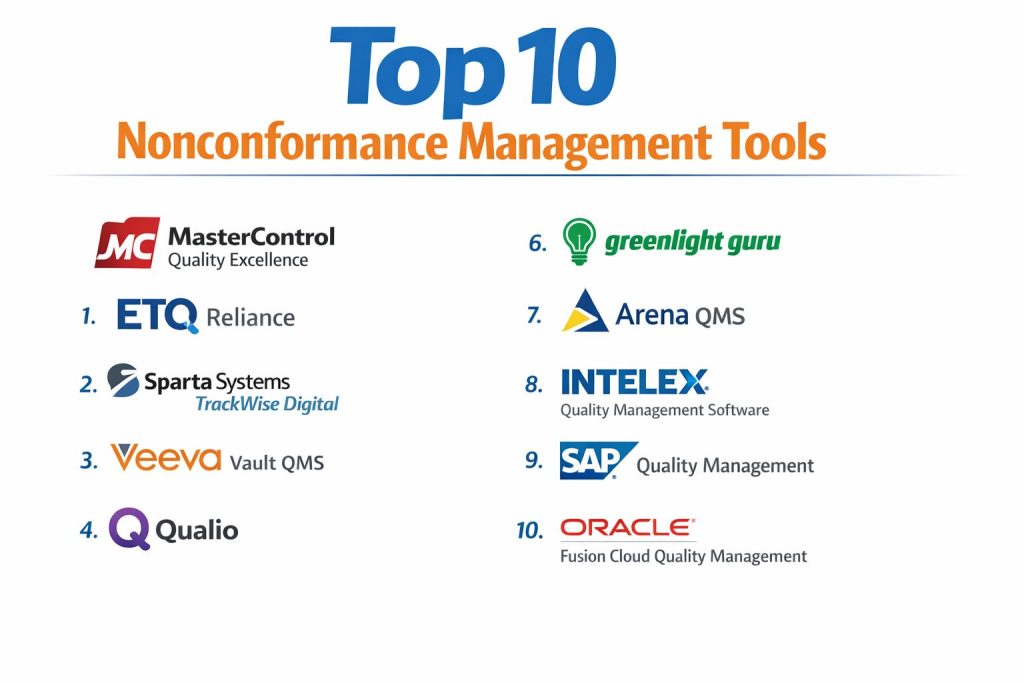
Top 10 Nonconformance Management Tools
1) MasterControl Quality Excellence
An enterprise quality platform built for structured quality processes and strong traceability. Common fit for regulated industries and organizations needing consistent governance across sites.
Key Features
- Nonconformance workflows with approvals, escalation, and evidence capture
- CAPA linkage for root-cause, actions, verification, and effectiveness checks
- Audit-ready traceability with structured records and change history
- Role-based routing and configurable forms for different issue types
- Reporting dashboards for trends, repeat issues, and closure performance
- Document and training connections in broader quality workflows (platform dependent)
- Multi-site governance patterns and standardized templates
Pros
- Strong process control and traceability for audit readiness
- Scales well when multiple departments and sites must follow one system
Cons
- Implementation and configuration can be complex
- Cost may be high for small teams
Platforms / Deployment
- Web
- Cloud
Security & Compliance
- SSO/SAML, MFA, encryption, audit logs, RBAC: Not publicly stated
- SOC 2, ISO 27001, GDPR, HIPAA: Not publicly stated
Integrations & Ecosystem
Often connects to ERP/MES/PLM and document ecosystems to reduce duplicate entry and improve traceability.
- ERP and production data connections: Varies / N/A
- APIs and integration methods: Varies / Not publicly stated
- Reporting and data export options: Varies / N/A
- Partner ecosystem for implementation: Varies / N/A
Support & Community
Enterprise support typically available with structured onboarding; community resources vary by customer base and partner networks.
2) ETQ Reliance
A flexible quality management platform commonly used for nonconformance and CAPA workflows. Strong fit for organizations wanting configurable processes and reporting.
Key Features
- Configurable nonconformance capture, review, and investigation workflows
- CAPA connection for root-cause analysis and preventive action management
- Audit and compliance support through traceable records and approvals
- Dashboards and analytics for trend identification and recurring issue control
- Supplier quality workflows for external issue collaboration (setup dependent)
- Centralized evidence capture and attachment management
- Scalable deployment patterns for multi-site quality governance
Pros
- Strong configurability for different industries and process styles
- Good reporting focus for identifying repeat problems
Cons
- Configuration choices can increase setup time if requirements are unclear
- Training is needed to ensure consistent data entry across teams
Platforms / Deployment
- Web
- Cloud
Security & Compliance
- SSO/SAML, MFA, encryption, audit logs, RBAC: Not publicly stated
- SOC 2, ISO 27001, GDPR, HIPAA: Not publicly stated
Integrations & Ecosystem
Commonly integrates with operational systems to improve traceability and reduce manual entry.
- ERP/MES/PLM connections: Varies / N/A
- APIs and connectors: Varies / Not publicly stated
- Export and reporting integrations: Varies / N/A
- Implementation ecosystem: Varies / N/A
Support & Community
Typically offers structured enterprise support and onboarding; community strength varies by industry.
3) Sparta Systems TrackWise Digital
An enterprise-grade platform designed for structured quality and compliance workflows, often used in regulated environments. Strong focus on traceability, audit readiness, and controlled processes.
Key Features
- Nonconformance workflows with controlled routing and approvals
- CAPA management with verification and effectiveness checks
- Strong audit trail and change history across records
- Standardized process templates and structured quality governance
- Reporting for trend tracking, closure time, and issue recurrence
- Cross-functional collaboration workflows for investigations
- Scales for multi-site environments with consistent controls
Pros
- Strong governance and audit trail for compliance-heavy operations
- Works well for standardized, repeatable quality processes
Cons
- Can feel heavy for teams wanting lightweight reporting only
- Implementation can require careful process design
Platforms / Deployment
- Web
- Cloud
Security & Compliance
- SSO/SAML, MFA, encryption, audit logs, RBAC: Not publicly stated
- SOC 2, ISO 27001, GDPR, HIPAA: Not publicly stated
Integrations & Ecosystem
Often integrated into enterprise environments as a central quality system with downstream data flows.
- ERP/MES/PLM links: Varies / N/A
- Data exchange options: Varies / Not publicly stated
- Reporting exports and BI connections: Varies / N/A
- Partner-led integrations: Varies / N/A
Support & Community
Enterprise support and onboarding commonly available; community resources depend on industry adoption.
4) Veeva Vault QMS
A quality system widely used in regulated industries where document control, training, and compliance workflows must connect to nonconformance and CAPA processes.
Key Features
- Nonconformance workflows linked to controlled quality records
- CAPA processes with structured approvals and effectiveness checks
- Document and training connections to support controlled quality operations
- Strong traceability and audit-ready record management
- Configurable workflows to match regulated process requirements
- Reporting for compliance monitoring and trend analysis
- Multi-site and global governance patterns (setup dependent)
Pros
- Strong fit when quality records must connect to documentation and training
- Designed for controlled, compliance-focused processes
Cons
- May be more than needed for non-regulated teams
- Configuration and governance require planning and ownership
Platforms / Deployment
- Web
- Cloud
Security & Compliance
- SSO/SAML, MFA, encryption, audit logs, RBAC: Not publicly stated
- SOC 2, ISO 27001, GDPR, HIPAA: Not publicly stated
Integrations & Ecosystem
Often used alongside broader enterprise systems to connect quality events with documentation and related data.
- ERP and operational data: Varies / N/A
- APIs and integration methods: Varies / Not publicly stated
- Reporting and data exports: Varies / N/A
- Implementation ecosystem: Varies / N/A
Support & Community
Typically structured support and onboarding; community knowledge is strong in regulated industry circles.
5) Qualio
A quality platform often chosen for teams that want structured nonconformance and CAPA workflows without excessive complexity. Common fit for growing organizations building stronger quality discipline.
Key Features
- Nonconformance capture with structured fields, evidence, and routing
- CAPA workflows for root-cause, actions, and closure verification
- Controlled recordkeeping with traceability and approvals
- Reporting dashboards for issue tracking and performance visibility
- Role-based workflows for cross-functional ownership
- Templates that help standardize quality processes
- Collaboration features suited for growing teams
Pros
- Easier adoption for teams building quality maturity
- Practical workflow structure without excessive overhead
Cons
- Very large enterprises may need deeper customization and governance controls
- Integration depth may vary depending on environment
Platforms / Deployment
- Web
- Cloud
Security & Compliance
- SSO/SAML, MFA, encryption, audit logs, RBAC: Not publicly stated
- SOC 2, ISO 27001, GDPR, HIPAA: Not publicly stated
Integrations & Ecosystem
Typically integrates through export, APIs, or connectors depending on plan and setup.
- ERP/MES/PLM integrations: Varies / N/A
- APIs and automation: Varies / Not publicly stated
- Reporting exports: Varies / N/A
- Partner ecosystem: Varies / N/A
Support & Community
Often provides onboarding and practical support for smaller teams; community strength varies by industry.
6) Greenlight Guru
A quality system commonly used in regulated product environments where CAPA and traceability are essential. Strong fit for teams that need controlled workflows and structured evidence.
Key Features
- Nonconformance management linked to CAPA workflows
- Root-cause tools and action tracking with verification steps
- Traceability practices that support audit and compliance needs
- Role-based routing and approvals for quality records
- Reporting for trending, recurrence, and closure performance
- Evidence capture and attachment handling for investigations
- Standardized templates for consistent execution
Pros
- Strong structure for compliance-heavy quality workflows
- Useful traceability patterns for quality investigations
Cons
- Might be more process-heavy than needed for basic NCR tracking
- Integration needs may require planning and setup
Platforms / Deployment
- Web
- Cloud
Security & Compliance
- SSO/SAML, MFA, encryption, audit logs, RBAC: Not publicly stated
- SOC 2, ISO 27001, GDPR, HIPAA: Not publicly stated
Integrations & Ecosystem
Typically connects to surrounding tools through exports and integration methods that vary by setup.
- ERP and operations data links: Varies / N/A
- APIs and integration options: Varies / Not publicly stated
- Reporting and BI exports: Varies / N/A
- Partner setup support: Varies / N/A
Support & Community
Support tends to be structured and process-focused; community resources vary by customer segment.
7) Arena QMS
A quality platform used by teams that want connected quality processes and good visibility into issues, actions, and records. Often selected by product-focused organizations that value structured workflows.
Key Features
- Nonconformance capture and investigation workflows with approvals
- CAPA linkage for structured corrective and preventive action management
- Evidence attachment management and controlled record history
- Dashboards for issue status, aging, and recurrence patterns
- Cross-functional routing for engineering, operations, and quality teams
- Standardized templates for consistent issue classification
- Scalable setup for multi-team collaboration
Pros
- Strong visibility into issue lifecycle and ownership
- Practical workflows that support cross-functional quality execution
Cons
- Customization depth may vary depending on plan
- Integration requirements need validation during pilot
Platforms / Deployment
- Web
- Cloud
Security & Compliance
- SSO/SAML, MFA, encryption, audit logs, RBAC: Not publicly stated
- SOC 2, ISO 27001, GDPR, HIPAA: Not publicly stated
Integrations & Ecosystem
Often integrates with product and operations systems depending on environment.
- ERP/PLM/MES connections: Varies / N/A
- APIs and integration: Varies / Not publicly stated
- Reporting exports: Varies / N/A
- Partner ecosystem: Varies / N/A
Support & Community
Typically offers onboarding and support; community size varies by industry focus.
8) Intelex Quality Management Software
A broad enterprise platform supporting quality and compliance workflows, including nonconformance, CAPA, and audit readiness. Strong fit for organizations that want configurable processes and reporting.
Key Features
- Configurable nonconformance workflows with approvals and escalations
- CAPA management with structured root-cause and effectiveness checks
- Evidence tracking and controlled record history for audits
- Analytics dashboards for trends, recurrence, and performance monitoring
- Role-based access and workflow routing for distributed teams
- Multi-site governance and standard process templates
- Integration patterns for connecting with operational systems (setup dependent)
Pros
- Flexible configuration for varied process needs across business units
- Strong reporting and analytics focus
Cons
- Setup complexity can rise with heavy customization
- Governance is required to keep workflows consistent across sites
Platforms / Deployment
- Web
- Cloud
Security & Compliance
- SSO/SAML, MFA, encryption, audit logs, RBAC: Not publicly stated
- SOC 2, ISO 27001, GDPR, HIPAA: Not publicly stated
Integrations & Ecosystem
Often used as a central quality layer with integrations to operations data sources.
- ERP/MES/PLM connections: Varies / N/A
- APIs and automation: Varies / Not publicly stated
- Reporting and BI exports: Varies / N/A
- Partner ecosystem for deployment: Varies / N/A
Support & Community
Enterprise-focused support and onboarding are common; community and peer resources vary by region and industry.
9) SAP Quality Management
A quality management capability that fits well in SAP-centric environments, supporting nonconformance tracking, inspections, and quality processes linked to operations and supply chain workflows.
Key Features
- Nonconformance handling connected to enterprise operations workflows
- Quality inspection and defect tracking aligned to production processes
- CAPA-like workflows through connected quality process patterns (implementation dependent)
- Strong data consistency when integrated across SAP operations modules
- Reporting and traceability across production and supply chain workflows
- Role-based processes aligned to enterprise governance models
- Scales well for large, multi-site operations within the same ecosystem
Pros
- Strong fit for organizations already standardized on SAP operations
- Good end-to-end traceability when quality is linked to production data
Cons
- Can be complex to implement and tune for user-friendly workflows
- Less ideal for teams outside SAP ecosystems seeking a lightweight tool
Platforms / Deployment
- Web
- Cloud / Self-hosted / Hybrid (Varies / N/A)
Security & Compliance
- SSO/SAML, MFA, encryption, audit logs, RBAC: Varies / Not publicly stated
- SOC 2, ISO 27001, GDPR, HIPAA: Not publicly stated
Integrations & Ecosystem
Integration is strongest inside SAP ecosystems and connected enterprise operations workflows.
- ERP and operations modules: Varies / N/A
- APIs and integration methods: Varies / Not publicly stated
- Reporting and BI ecosystems: Varies / N/A
- Partner implementation ecosystem: Varies / N/A
Support & Community
Large enterprise user base and partner ecosystem; support strength depends on contract and implementation partner.
10) Oracle Fusion Cloud Quality Management
A quality management capability suited for organizations operating in Oracle ecosystems. Often used to connect quality processes with supply chain and manufacturing workflows.
Key Features
- Nonconformance tracking aligned with broader operational workflows
- Quality processes connected to manufacturing and supply chain data
- Structured approvals, routing, and record history (setup dependent)
- Reporting for quality performance and recurring issue patterns
- Role-based workflows designed for distributed enterprise teams
- Scales for multi-site operations within an enterprise ecosystem
- Integration patterns for connected applications (implementation dependent)
Pros
- Strong fit for organizations standardized on Oracle enterprise applications
- Good potential for linking quality events to operational data flows
Cons
- Implementation complexity can be high
- Less attractive for teams outside Oracle ecosystems
Platforms / Deployment
- Web
- Cloud
Security & Compliance
- SSO/SAML, MFA, encryption, audit logs, RBAC: Not publicly stated
- SOC 2, ISO 27001, GDPR, HIPAA: Not publicly stated
Integrations & Ecosystem
Strongest inside Oracle application ecosystems with connected workflows.
- Enterprise application integrations: Varies / N/A
- APIs and integration methods: Varies / Not publicly stated
- Reporting and data export: Varies / N/A
- Partner implementation ecosystem: Varies / N/A
Support & Community
Enterprise support and partner ecosystem commonly available; community resources vary by industry.
Comparison Table (Top 10)
| Tool Name | Best For | Platform(s) Supported | Deployment | Standout Feature | Public Rating |
|---|---|---|---|---|---|
| MasterControl Quality Excellence | Enterprise quality governance and audit-ready traceability | Web | Cloud | Strong controlled workflows and traceability | N/A |
| ETQ Reliance | Configurable NCR and CAPA workflows across sites | Web | Cloud | Flexible configuration and reporting | N/A |
| Sparta Systems TrackWise Digital | Compliance-heavy quality processes at scale | Web | Cloud | Strong governance and audit trail | N/A |
| Veeva Vault QMS | Regulated quality with connected records and workflows | Web | Cloud | Connected quality records and approvals | N/A |
| Qualio | Growing teams building structured NCR and CAPA | Web | Cloud | Practical adoption-focused workflows | N/A |
| Greenlight Guru | Structured quality workflows with strong traceability patterns | Web | Cloud | CAPA linkage and investigation structure | N/A |
| Arena QMS | Cross-functional quality execution with visibility | Web | Cloud | Strong ownership and lifecycle visibility | N/A |
| Intelex Quality Management Software | Enterprise configurable quality with analytics | Web | Cloud | Reporting and configurable workflows | N/A |
| SAP Quality Management | SAP-centric enterprises linking quality to operations | Web | Cloud / Self-hosted / Hybrid (Varies / N/A) | Strong operational data linkage | N/A |
| Oracle Fusion Cloud Quality Management | Oracle-centric enterprises connecting quality to supply chain | Web | Cloud | Enterprise ecosystem integration potential | N/A |
Evaluation & Scoring of Nonconformance Management Tools
Weights: Core features 25%, Ease 15%, Integrations 15%, Security 10%, Performance 10%, Support 10%, Value 15%.
| Tool Name | Core (25%) | Ease (15%) | Integrations (15%) | Security (10%) | Performance (10%) | Support (10%) | Value (15%) | Weighted Total (0–10) |
|---|---|---|---|---|---|---|---|---|
| MasterControl Quality Excellence | 9.0 | 7.0 | 8.5 | 6.5 | 8.5 | 8.0 | 6.5 | 7.86 |
| ETQ Reliance | 8.5 | 7.5 | 8.5 | 6.5 | 8.0 | 8.0 | 7.0 | 7.91 |
| Sparta Systems TrackWise Digital | 8.5 | 6.5 | 8.0 | 6.5 | 8.0 | 8.0 | 6.5 | 7.54 |
| Veeva Vault QMS | 8.0 | 7.0 | 7.5 | 6.5 | 8.0 | 8.0 | 6.5 | 7.41 |
| Qualio | 7.5 | 8.0 | 7.0 | 6.0 | 7.5 | 7.5 | 8.0 | 7.53 |
| Greenlight Guru | 7.5 | 7.5 | 7.0 | 6.0 | 7.5 | 7.5 | 7.5 | 7.34 |
| Arena QMS | 7.5 | 7.5 | 7.5 | 6.0 | 7.5 | 7.5 | 7.0 | 7.29 |
| Intelex Quality Management Software | 8.0 | 7.0 | 8.0 | 6.5 | 8.0 | 7.5 | 6.5 | 7.45 |
| SAP Quality Management | 8.0 | 6.5 | 9.0 | 6.5 | 8.5 | 7.5 | 6.5 | 7.63 |
| Oracle Fusion Cloud Quality Management | 7.5 | 6.5 | 8.5 | 6.5 | 8.0 | 7.5 | 6.5 | 7.34 |
How to interpret the scores:
- Scores compare tools inside this list and reflect typical fit, not a universal truth.
- A higher total indicates broader strength across most criteria, not automatic best for you.
- Ease and value matter more for smaller teams trying to drive adoption quickly.
- Integration scores assume ecosystem alignment; validate in your own environment.
- Use a pilot to confirm workflow fit, reporting needs, and data quality expectations.
Which Nonconformance Management Tool Is Right for You?
Solo / Small Team
If you are a small quality team trying to replace spreadsheets, prioritize ease of adoption, guided workflows, and simple reporting. Qualio can be a practical choice where you want structured NCR and CAPA without heavy complexity. If your organization expects strong evidence capture and repeatable processes, Arena QMS can also work well depending on how you set up ownership and routing.
SMB
SMBs often need configurable workflows, reliable reporting, and supplier collaboration without a long rollout. ETQ Reliance and Intelex Quality Management Software are strong candidates when you want flexibility and dashboards for trends. If your processes are regulated and need tighter control, MasterControl Quality Excellence can be a better fit if you can support implementation effort.
Mid-Market
Mid-market teams often operate across multiple lines or sites and need standardized classification, containment rules, and cross-functional accountability. ETQ Reliance and Intelex Quality Management Software fit well when you want consistent processes and analytics. If you are compliance-heavy and want strict governance, Sparta Systems TrackWise Digital can be a strong anchor.
Enterprise
Enterprises usually prioritize multi-site governance, formal approvals, audit trail consistency, and ecosystem integration. MasterControl Quality Excellence, Sparta Systems TrackWise Digital, and Veeva Vault QMS are strong options when controlled records and traceability are central. If you are deeply invested in ERP ecosystems, SAP Quality Management or Oracle Fusion Cloud Quality Management can offer strong operational linkages when implemented well.
Budget vs Premium
Budget-focused teams should optimize for adoption and workflow clarity first, even if features are slightly lighter. Premium platforms are worth it when audit readiness, multi-site governance, and compliance proof are non-negotiable and the organization can support rollout and training.
Feature Depth vs Ease of Use
If your team is mature and needs strict controls, enterprise platforms typically win on governance. If frontline reporting and fast closure are your biggest pain points, prioritize simpler interfaces, mobile-friendly capture, and clear routing.
Integrations & Scalability
If you must connect NCR to production, lots, suppliers, and shipments, integration becomes a deciding factor. Ecosystem-aligned choices often reduce friction. Always test data handoffs and reporting accuracy during pilot.
Security & Compliance Needs
For compliance-heavy environments, focus on access control, audit trails, record retention, and governance. If formal compliance statements are not publicly stated, treat them as unknown and validate through procurement and internal security review.
Frequently Asked Questions (FAQs)
1. What is the difference between nonconformance and CAPA?
Nonconformance captures the issue and containment, while CAPA manages root-cause and long-term corrective and preventive actions. Good tools link both so investigations lead to verified improvements.
2. How do these tools help during audits?
They provide traceable records showing what happened, who approved actions, what evidence was collected, and whether effectiveness was verified. This reduces scramble and improves consistency.
3. What is the most common reason NCR programs fail?
Poor adoption and inconsistent data entry. If frontline teams find reporting hard, records stay incomplete and trends become unreliable.
4. Do small teams really need a dedicated tool?
If issues are rare and simple, spreadsheets may be enough. But if problems repeat, customers complain, or audits are frequent, a tool quickly pays for itself by improving control.
5. How should we structure classifications for NCRs?
Keep it simple at first: issue type, severity, location, product, and root-cause category. Expand only when reporting and trend analysis consistently require more detail.
6. What should be included in an NCR record?
Clear description, containment action, evidence, ownership, due dates, root-cause summary, corrective actions, verification steps, and effectiveness check results.
7. How long does implementation usually take?
It varies widely based on process complexity, integrations, and number of sites. A minimal rollout can start quickly, but enterprise standardization takes longer.
8. Can these tools manage supplier corrective actions?
Many can, especially when supplier workflows and portals are configured. Always pilot supplier scenarios to confirm how evidence sharing and deadlines work.
9. What metrics should we track first?
Aging of open NCRs, recurrence rates, time to containment, time to closure, top defect categories, and cost-of-poor-quality signals if available.
10. How do we pick the right tool quickly?
Shortlist two or three, run a pilot with real NCR cases, validate reporting and approvals, test at least one supplier scenario, and confirm integration feasibility before committing.
Conclusion
Nonconformance management is not just about logging defects; it is about proving control, reducing repeat issues, and building a quality culture that scales. The right tool depends on how regulated you are, how many sites and suppliers you manage, and how deeply you must connect quality records to operations data. Enterprise platforms like MasterControl Quality Excellence, Sparta Systems TrackWise Digital, and Veeva Vault QMS often shine where audit readiness and governance are strict. ETQ Reliance and Intelex Quality Management Software are strong when you need configurable workflows and analytics. Ecosystem-aligned choices like SAP Quality Management and Oracle Fusion Cloud Quality Management can work well when integration is the priority. Next step: shortlist two or three tools, pilot real NCR workflows, validate reporting accuracy, and confirm approvals and integrations before rollout.